售 价:¥
 9.8
9.8
温馨提示:数字商品不支持退换货,不提供源文件,不支持导出打印
为你推荐

Title Page
Copyright and Credits
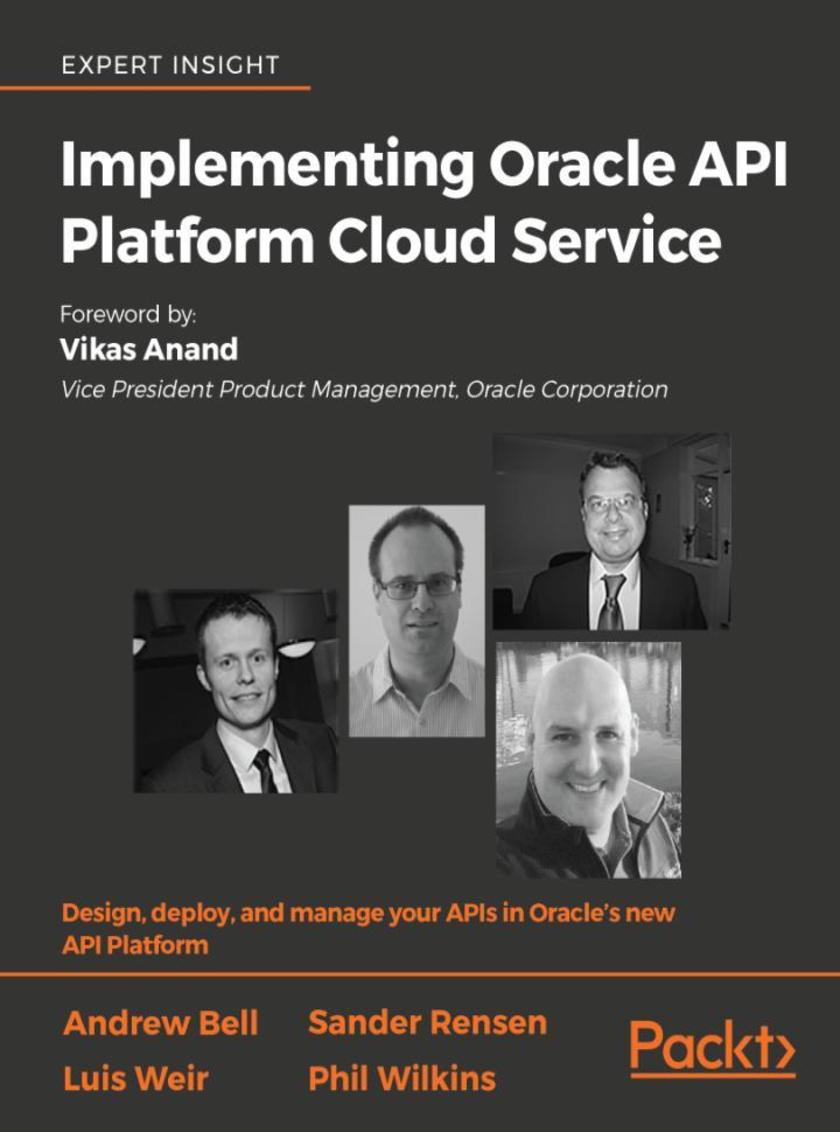
Implementing Oracle API Platform Cloud Service
Packt Upsell
Why subscribe?
PacktPub.com
Foreword
Contributors
About the authors
About the reviewers
Packt is searching for authors like you
Acknowledgments by All Authors
Preface
What is an API?
3rd generation APIs
What this book covers
How we have approached this book
What you need for this book
Who is the book for?
Conventions
Reader feedback
Customer support
Downloading the example code
Download the color images
Errata
Piracy
Questions
Platform Overview
What is the Oracle API platform?
Evolution of Oracle's API offering
Platform architecture
Components description
Management portal
APIs page
The API implementation page
The implementation section
The deployment section
The publication section
The grants section
Registration section
The analytics section
Applications page
The settings section
Grants section
The gateways page
Settings section
Properties section
Nodes section
Deployments section
Grants section
The analytics section
The services page
The settings section
The grants section
Service accounts page
The settings section
The grants section
The roles page
Users and groups
Platform settings page
General settings section
Developer portal settings section
Development portal
The API page
The API documentation section
API subscription
My applications page
The overview section
Subscribed APIs section
The grants section
The analytics section
Management service REST APIs
API plans
Apiary
The Apiary account
Apiary views
Apiary personal view
Apiary editor
Inspector
Documentation
Testing with Apiary
Apiary settings
People
Apiary team view
APIs
Styles
People
Settings
Billing
Account settings
Summary
Use Case
Scenario
Use case opportunities
IT landscape
Financial processes
Recorded material and related assets
Contracts
Identities
Audit trail
Logical data view
API requirements in detail
Product
Product for partners
Product for composers and artists
Product availability
Structuring the design approach
Exploring OMESA
Single purpose versus multipurpose APIs
Semi-decoupled and fully decoupled
Bounded context
Next steps
Summary
Designing the API
Scenario
The API design-first process
Step 1 – defining the API type
Single-purpose APIs
Multi-purpose APIs
MRA's Media Catalogue API – public and multi-purpose
Step 2 – defining the API's domain semantics
Step 3 – creating the API definition with its main resources
Step 4 – trying the API mock
Step 5 – defining MSON data structures
Step 6 – pushing the API blueprint to GitHub
Step 7 – publishing the API mock in Oracle API platform CS
Step 8 – setting up Dredd for continuous testing of API endpoints against the API blueprint
Summary
Building and Running the Microservice
What is a microservice?
Understanding the technical requirements
Building the Microservice
Step 1 – install Node.js and MongoDB
Step 2 – create the skeleton of the Media Catalogue Microservice
Step 3 – define the structure of the Media Catalogue Microservice
Step 4 – configure the Media Catalogue Microservice
Step 5 – define the data entity
Step 6 – code the interaction with the database
Step 7 – define the controller function
Step 8 – route the incoming request to the new controller function
Step 9 – test the microservice
Step 10 – package and deploy the microservice
Step 11 – updating the API endpoint and re-test using Dredd
Summary
Platform Setup and Gateway Configuration
Platform architecture
The concept of logical and physical gateways
Avoiding network latency for global deployments
Deployment for the use case
How many nodes
How many logical gateways
How much storage?
Gateway design decisions in our use case
One cloud management or several?
Single management instance
Multiple management instances
MRA's approach number of cloud management instances
Firewall or no firewall
Load balancing
Web proxies
Content Delivery Networks (CDNs)
Prerequisites to allow the API platform to be built
Background to the account types
Building the cloud
Default roles and users
Creating users inside API platform
Configuring Oracle traffic director
Network-based access controls
Setting up Apiary
Configure developer portal look and feel
Gateway life cycle and deployment
Gateway configuration
Where to get the logical gateway ID
Configuration JSON properties
Gateway prerequisites
Retrieving the gateway deployment package
Actioning the gateway deployment
Unpacking
Install
Configure
Start
Create
Join
Making the gateway production ready
Linux security
Log analytics
Dealing with certificates
Gateway lockdown
Summary
Defining Policies for APIs
Background
Common security threats
Denial-of-service attacks (DoS)
Payload attacks
Role of the gateway
HTTP and HTTPS
Throttling
Implementing APIs for MRA
Understanding policies
General guidelines for designing policies
Request and response pipeline policies
Defining polices
Inbound policies
Outbound policies
Defining rate limiting policies
API rate limiting policies
Steps to create a rate limiting policy
Application rate limiting policies
Creating an application rate policy
Testing the policy
Lightweight authorization checks
Creating an API key policy
Testing the API key
Logging
Enabling logging
Interface filtering
Creating an interface filter
Testing the policy
Cross origin resource sharing (CORS)
Creating a CORS policy
Testing the CORS policy
Gateway-based routing
Creating a gateway-based routing policy
Resource-based routing
Groovy policies
Response policies
API policy iterations
Monitoring APIs
Summary
Testing APIs with API Fortress
What is API Fortress?
Test management
Monitoring
Continuous deployment
Tools
Test the MRA Media Catalogue API
Create Media Catalogue test case
The GetArtistById test case
Test using the Jenkins plugin
Summary
Implementing OAuth 2.0
OAuth 2.0 overview
Client credentials
Resource owner password
Implicit
Authorization code
MRA use case
Implementation steps
Step 1 – obtaining an Oracle identity cloud account
Step 2 – configuring an Oracle identity cloud resource server
Step 3 – configuring an Oracle identity cloud client application
Step 4 – adding users and groups to client application
Step 5 – configuring the API platform gateway
Step 6 – applying OAuth 2.0 policies to APIs
Summary
Implementing Custom Policies
What is Groovy?
Why provide Groovy for logging?
How Groovy custom policies work?
APIs to access call data
How to reject an API call in a Groovy policy?
Recognizing Groovy errors
Groovy policy illustration
Addressing a problem with a simple Groovy policy
Building our API
Run the test
Implementing a Groovy policy for an API response
A closer look at Groovy language limitations
Custom Java policies
Composition of a custom Java policy
Creating a custom policy for MRA
Getting geolocation information
Simplifying the development process
Using an IDE
Build properties
Build process
Presentation definition
Supporting JavaScript
Localization of the UI
UI Backend for validating configuration
Backend implementation
API runtime
Metadata
Additional libraries
Deployment
Current constraints
Custom policies – which policy type to use?
Summary
Moving from API Management 12c to APIP CS
Oracle API management suite 12c
Oracle API manager 12c overview
Oracle API gateway 11g
Oracle API Platform Cloud Service
Mapping of personas and roles
Architectural differences
Strategy for transitioning APIs from OAPIM 12c to APIP CS
API re-implementation design
Service implementation
API definition and API-first design
API creation/policy implementation
API testing
API switch-over strategy
Defining API policies
Adding API documentation
Deploying endpoints
Testing the API
Publication of the API
Analytics
Summary
Another book You May Enjoy
Leave a review - let other readers know what you think

买过这本书的人还买过
读了这本书的人还在读
同类图书排行榜




 购物车
购物车 个人中心
个人中心