


 购物车
购物车 个人中心
个人中心
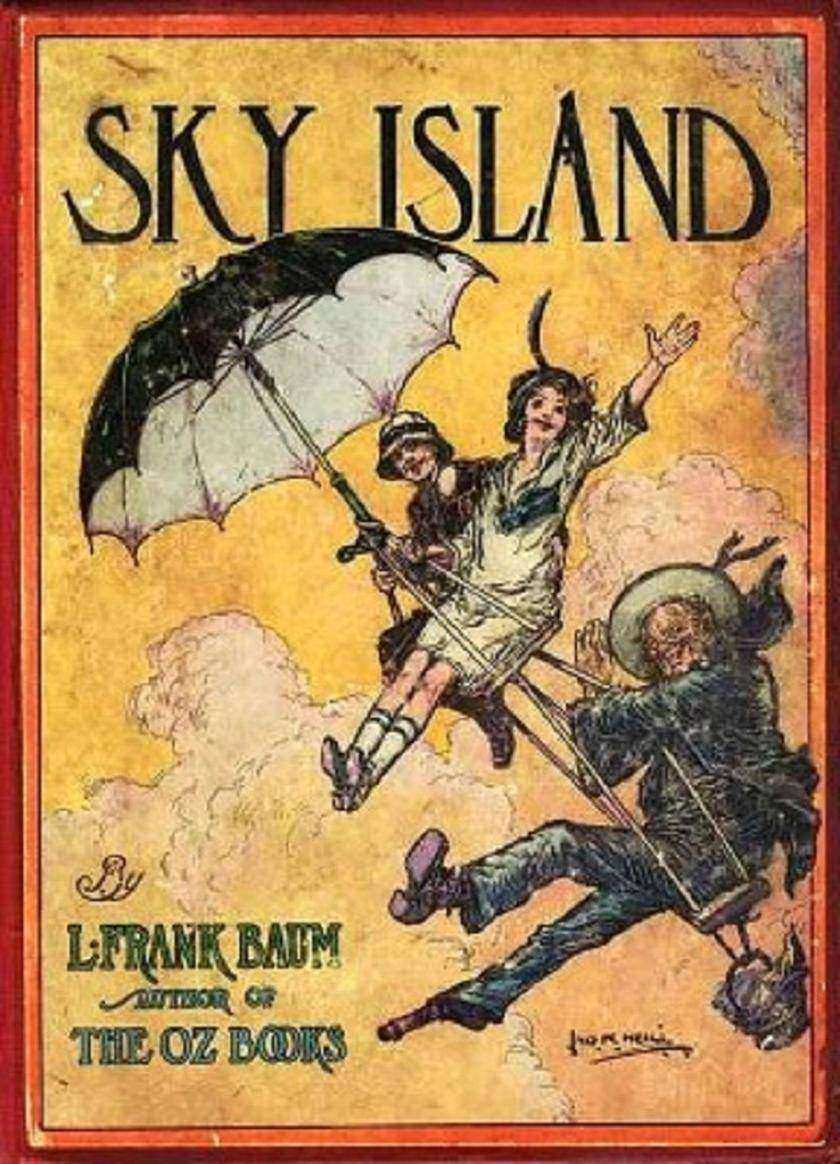
Sky Island
¥8.09
According to Wikipedia: "Sky Island: Being the Further Adventures of Trot and Cap'n Bill after Their Visit to the Sea Fairies is a children's fantasy novel written by L. Frank Baum, illustrated by John R. Neill, and published in 1912 by the Reilly & Britton Company — the same constellation of forces that produced the Oz books in the first decades of the twentieth century. As the full title indicates, Sky Island is a sequel to Baum's The Sea Fairies of 1911. Both books were intended as parts of a projected long-running fantasy series to replace the Oz books. Given the relatively tepid reception of the first book in the series, however, Baum tried to attract young readers by including two characters from his Oz mythos in Sky Island — Button Bright and Polychrome, originally introduced in The Road to Oz (1909)."
Surprising Adventures of the Magical Monarch of Mo
¥8.09
With 94 illustrations, by the author of the Wizard of Oz. According to Wikipedia: "The Surprising Adventures of the Magical Monarch of Mo and His People (copyright registered 17 June 1896) is the first full-length children's fantasy book by L. Frank Baum. Originally published in 1899 as A New Wonderland, Being the First Account Ever Printed of the Beautiful Valley, and the Wonderful Adventures of Its Inhabitants, the book was reissued in 1903 with a new title in order to capitalize upon the alliterative title of Baum's successful The Wonderful Wizard of Oz. The book is only slightly altered--Mo is called Phunniland or Phunnyland, but aside from the last paragraph of the first chapter, they are essentially the same book... Lyman Frank Baum (1856 – 1919) was an American author, poet, playwright, actor and independent filmmaker, best known today as the creator, along with illustrator W. W. Denslow, of one of the most popular books in American children's literature, The Wonderful Wizard of Oz, better known now as simply The Wizard of Oz."

Lin McLean
¥8.09
Classic western. According to Wikipedia: "Owen Wister (July 14, 1860 – July 21, 1938) was an American writer of western fiction... Wister had spent several summers out in the American West, making his first trip to Wyoming in 1885. Like his friend Teddy Roosevelt, Wister was fascinated with the culture, lore and terrain of the region. On an 1893 visit to Yellowstone, Wister met the western artist Frederic Remington; they remained lifelong friends. When he started writing, he naturally inclined towards fiction set on the western frontier. Wister's most famous work remains the 1902 novel The Virginian, the loosely constructed story of a cowboy who is a natural aristocrat, set against a highly mythologized version of the Johnson County War and taking the side of the large land owners. This is widely regarded as being the first cowboy novel and was reprinted fourteen times in eight months. The book is dedicated to Theodore Roosevelt."
Madame Bovary
¥8.09
According to Wikipedia: "Madame Bovary is a novel by Gustave Flaubert that was attacked for obscenity by public prosecutors when it was first serialised in La Revue de Paris between 1 October 1856 and 15 December 1856, resulting in a trial in January 1857 that made it notorious. After the acquittal on 7 February, it became a bestseller in book form in April 1857, and now stands virtually unchallenged not only as a seminal work of Realism, but as one of the most influential novels ever written. The novel focuses on a doctor's wife, Emma Bovary, who has adulterous affairs and lives beyond her means in order to escape the banalities and emptiness of provincial life. Though the basic plot is rather simple, even archetypal, the novel's true art lies in its details and hidden patterns. Flaubert was notoriously perfectionistic about his writing and claimed to always be searching for le mot juste (the right word). A 2007 poll of contemporary authors...cited Madame Bovary as one of the 2 greatest novels ever written."
The Heptameron, Volume 5
¥8.09
With 58 illustrations. According to Wikipedia: "The Heptameron is a collection of 72 short stories written in French by Marguerite of Navarre (1492-1549), published posthumously in 1558. It has the form of a frame narrative and was inspired by The Decameron of Giovanni Boccaccio. It was originally intended to contain one hundred stories covering ten days just as The Decameron does, but at Marguerite’s death it was only completed as far as the second story of the eighth day. Many of the stories deal with love, lust, infidelity and other romantic and sexual matters. One was based on the life of Marguerite de La Rocque, a French noblewoman abandoned, as punishment, with her lover on an island off Quebec... Marguerite de Navarre (French: Marguerite d'Angoulême) (April 11, 1492 – December 21, 1549), also known as Marguerite of Angouleme and Margaret of Navarre, was the queen consort of King Henry II of Navarre. As patron of humanists and reformers, and as an author in her own right, she was an outstanding figure of the French Renaissance. Samuel Putnam called her "The First Modern Woman"."
The Killer
¥8.09
Classic western. According to Wikipedia: "Stewart Edward White (12 March 1873 – September 18, 1946) was an American author. Born in Grand Rapids, Michigan he earned degrees from University of Michigan (Ph.D., 1895; M.A., 1903). From about 1900 until about 1922, he wrote adventure travel books."
Tales and Novels
¥8.09
The novels and stories of Maria Edgeworth, in ten volumes According to Wikipedia: "Maria Edgeworth (1 January 1768 – 22 May 1849) was a prolific Irish writer of adults' and children's literature. She was one of the first realist writers in children's literature and was a significant figure in the evolution of the novel in Europe. She held advanced views, for a woman of her time, on estate management, politics and education, and corresponded with some of the leading literary and economic writers, including Sir Walter Scott and David Ricardo."
Science and Health, with Key to the Scriptures
¥8.09
According to Wikipedia: "Mary Baker Eddy (born Mary Morse Baker July 16, 1821 – December 3, 1910) was the founder of the Christian Science movement. Deeply religious, she advocated Christian Science as a spiritual practical solution to health and moral issues. She wrote Science and Health with Key to the Scriptures, founded The First Church of Christ, Scientist of Boston in 1879, and several periodicals including The Christian Science Monitor. She took the name Mary Baker Glover from her first marriage and was also known as Mary Baker Glover Eddy or Mary Baker G. Eddy from her third marriage. She did much spiritual teaching, lecturing, and instantaneous healing. Her influence continues to grow through her writings."
The Circular Staircase
¥8.09
According to Wikipedia: "Mary Roberts Rinehart (August 12, 1876-September 22, 1958) was a prolific author often called the American Agatha Christie.[1] She is considered the source of the phrase "The butler did it", although she did not actually use the phrase herself, and also considered to have invented the "Had-I-But-Known" school of mystery writing.... Rinehart wrote hundreds of short stories, poems, travelogues and special articles. Many of her books and plays, such as The Bat (1920) were adapted for movies, such as The Bat (1926), The Bat Whispers (1930), and The Bat (1959). While many of her books were best-sellers, critics were most appreciative of her murder mysteries. Rinehart, in The Circular Staircase (1908), is credited with inventing the "Had-I-But-Known" school of mystery writing. The Circular Staircase is a novel in which "a middle-aged spinster is persuaded by her niece and nephew to rent a country house for the summer. The house they choose belonged to a bank defaulter who had hidden stolen securities in the walls. The gentle, peace-loving trio is plunged into a series of crimes solved with the help of the aunt. This novel is credited with being the first in the "Had-I-But-Known" school."[3] The Had-I-But-Known mystery novel is one where the principal character (frequently female) does less than sensible things in connection with a crime which have the effect of prolonging the action of the novel. Ogden Nash parodied the school in his poem Don't Guess Let Me Tell You: "Sometimes the Had I But Known then what I know now I could have saved at least three lives by revealing to the Inspector the conversation I heard through that fortuitous hole in the floor." The phrase "The butler did it", which has become a cliché, came from Rinehart's novel The Door, in which the butler actually did do it, although that exact phrase does not actually appear in the work."
Tangled Trails, A Western Detective Story
¥8.09
Classic western novel, first published in 1921. According to Wikipedia: "William MacLeod Raine (1871—1954), was a British-born American novelist who wrote fictional adventure stories about the American Old West.."
A Texas Ranger
¥8.09
Classic western novel, first published in 1910. "How a member of the border police saved the life of an innocent man, followed a fugitive to Wyoming, and then passed through deadly peril to ultimate happiness." William MacLeod Raine (1871—1954), was a British-born American novelist who wrote fictional adventure stories about the American Old West.
Love Stories
¥8.09
According to Wikipedia: "Mary Roberts Rinehart (August 12, 1876-September 22, 1958) was a prolific author often called the American Agatha Christie.[1] She is considered the source of the phrase "The butler did it", although she did not actually use the phrase herself, and also considered to have invented the "Had-I-But-Known" school of mystery writing.... Rinehart wrote hundreds of short stories, poems, travelogues and special articles. Many of her books and plays, such as The Bat (1920) were adapted for movies, such as The Bat (1926), The Bat Whispers (1930), and The Bat (1959). While many of her books were best-sellers, critics were most appreciative of her murder mysteries. Rinehart, in The Circular Staircase (1908), is credited with inventing the "Had-I-But-Known" school of mystery writing. The Circular Staircase is a novel in which "a middle-aged spinster is persuaded by her niece and nephew to rent a country house for the summer. The house they choose belonged to a bank defaulter who had hidden stolen securities in the walls. The gentle, peace-loving trio is plunged into a series of crimes solved with the help of the aunt. This novel is credited with being the first in the "Had-I-But-Known" school."[3] The Had-I-But-Known mystery novel is one where the principal character (frequently female) does less than sensible things in connection with a crime which have the effect of prolonging the action of the novel. Ogden Nash parodied the school in his poem Don't Guess Let Me Tell You: "Sometimes the Had I But Known then what I know now I could have saved at least three lives by revealing to the Inspector the conversation I heard through that fortuitous hole in the floor." The phrase "The butler did it", which has become a cliché, came from Rinehart's novel The Door, in which the butler actually did do it, although that exact phrase does not actually appear in the work."
Sense and Sensibility
¥8.09
The classic novel. According to Wikipedia: "Jane Austen (1775 – 1817) was an English novelist whose realism, biting social commentary and masterful use of free indirect speech, burlesque and irony have earned her a place as one of the most widely read and most beloved writers in English literature. Austen lived her entire life as part of a small and close-knit family located on the lower fringes of English gentry. She was educated primarily by her father and older brothers as well as through her own reading. The steadfast support of her family was critical to Austen's development as a professional writer. Austen's artistic apprenticeship lasted from her teenage years until she was about thirty-five years old. During this period, she experimented with various literary forms, including the epistolary novel which she tried and then abandoned, and wrote and extensively revised three major novels and began a fourth. From 1811 until 1815, with the release of Sense and Sensibility (1811), Pride and Prejudice (1813), Mansfield Park (1814) and Emma (1815), she achieved success as a published writer. She wrote two additional novels, Northanger Abbey and Persuasion, both published after her death in 1817, and began a third, which was eventually titled Sanditon, but died before completing it."
Adam Bede
¥8.09
The classic novel. According to Wikipedia: "Mary Ann (Marian) Evans (1819 – 1880), better known by her pen name, George Eliot, was an English novelist. She was one of the leading writers of the Victorian era. Her novels, largely set in provincial England, are well known for their realism and psychological perspicacity. She used a male pen name, she said, to ensure that her works were taken seriously. Female authors published freely under their own names, but Eliot wanted to ensure that she was not seen as merely a writer of romances. An additional factor may have been a desire to shield her private life from public scrutiny and to prevent scandals attending her relationship with the married George Henry Lewes."
Barry Lyndon
¥8.09
The classic novel. According to Wikipedia: "Thackeray is most often compared to one other great novelist of Victorian literature, Charles Dickens. During the Victorian era, he was ranked second only to Dickens, but he is now much less read and is known almost exclusively for Vanity Fair. In that novel he was able to satirize whole swaths of humanity while retaining a light touch. It also features his most memorable character, the engagingly roguish Becky Sharp. As a result, unlike Thackeray's other novels, it remains popular with the general reading public; it is a standard fixture in university courses and has been repeatedly adapted for movies and television. In Thackeray's own day, some commentators, such as Anthony Trollope, ranked his History of Henry Esmond as his greatest work, perhaps because it expressed Victorian values of duty and earnestness, as did some of his other later novels. It is perhaps for this reason that they have not survived as well as Vanity Fair, which satirizes those values."
Le Corricolo
¥8.09
Roman classique dans le fran?ais original. Selon Wikipédia: "Alexandre Dumas, père (fran?ais pour" père ", apparenté à" Senior "en anglais), né Dumas Davy de la Pailleterie (24 juillet 1802 - 5 décembre 1870) était un écrivain fran?ais, mieux connu pour ses nombreux romans historiques de grande aventure qui ont fait de lui l'un des auteurs fran?ais les plus lus au monde, dont plusieurs de ses romans, dont Le Comte de Monte-Cristo, Les Trois Mousquetaires et Le Vicomte de Bragelonne, écrit des pièces de thé?tre et des articles de magazines et était un correspondant prolifique. "
La Dame de Monsoreau
¥8.09
Roman classique dans le fran?ais original. Selon Wikipédia: "Alexandre Dumas, père (fran?ais pour" père ", apparenté à" Senior "en anglais), né Dumas Davy de la Pailleterie (24 juillet 1802 - 5 décembre 1870) était un écrivain fran?ais, mieux connu pour ses nombreux romans historiques de grande aventure qui ont fait de lui l'un des auteurs fran?ais les plus lus au monde, dont plusieurs de ses romans, dont Le Comte de Monte-Cristo, Les Trois Mousquetaires et Le Vicomte de Bragelonne, écrit des pièces de thé?tre et des articles de magazines et était un correspondant prolifique. "
Jane Eyre
¥8.09
The classic romantic novel. According to Wikipedia: "Jane Eyre is a novel by English writer Charlotte Bront?. It was published in London, England, in 1847 by Smith, Elder & Co. with the title Jane Eyre. An Autobiography under the pen name "Currer Bell." The first American edition was released the following year by Harper & Brothers of New York. Writing for the Penguin edition, Stevie Davies describes it as an "influential feminist text" because of its in-depth exploration of a strong female character's feelings. Primarily of the bildungsroman genre, Jane Eyre follows the emotions and experiences of eponymous Jane Eyre, her growth to adulthood, and her love for Mr. Rochester, the byronic master of Thornfield Hall. The novel contains elements of social criticism, with a strong sense of morality at its core, but is nonetheless a novel many consider ahead of its time given the individualistic character of Jane and the novel's exploration of sexuality, religion, and proto-feminism."
Dead Souls
¥8.09
The classic satiric novel. According to Wikipedia: "Nikolai Vasilievich Gogol ( 1809 - 1852) was a Russian writer of Ukrainian ethnicity. Although his early works were heavily influenced by his Ukrainian upbringing and identity, he wrote in Russian and his works belong to the tradition of Russian literature; often called the "father of modern Russian realism," he was one of the first Russian authors to criticize his country's way of life. The novels Taras Bul'ba (1835; 1842 [revised edition]), Dead Souls (1842), the play The Inspector-General (1836, 1842), and the short story The Overcoat (1842) are among his masterpieces."
King Richard II, with line numbers
¥8.09
The classic Shakespearean history play. According to Wikipedia: "King Richard the Second is a history play by William Shakespeare believed to be written in approximately 1595. It is based on the life of King Richard II of England and is the first part of a tetralogy, referred to by scholars as the Henriad, followed by three plays concerning Richard's successors: Henry IV, part 1, Henry IV, part 2, and Henry V. It may not have been written as a stand-alone work."
The Count of Monte Cristo
¥8.09
The classic tale of Edmond Dantes -- his imprisonment, escape, enrichment, and revenge. According to Wikipedia: "Alexandre Dumas, père (French for "father", akin to 'Senior' in English), born Dumas Davy de la Pailleterie (1802 — 1870) was a French writer, best known for his numerous historical novels of high adventure which have made him one of the most widely read French authors in the world. Many of his novels, including The Count of Monte Cristo, The Three Musketeers, Twenty Years After, and The Vicomte de Bragelonne were serialized. He also wrote plays and magazine articles and was a prolific correspondent."


