


 购物车
购物车 个人中心
个人中心
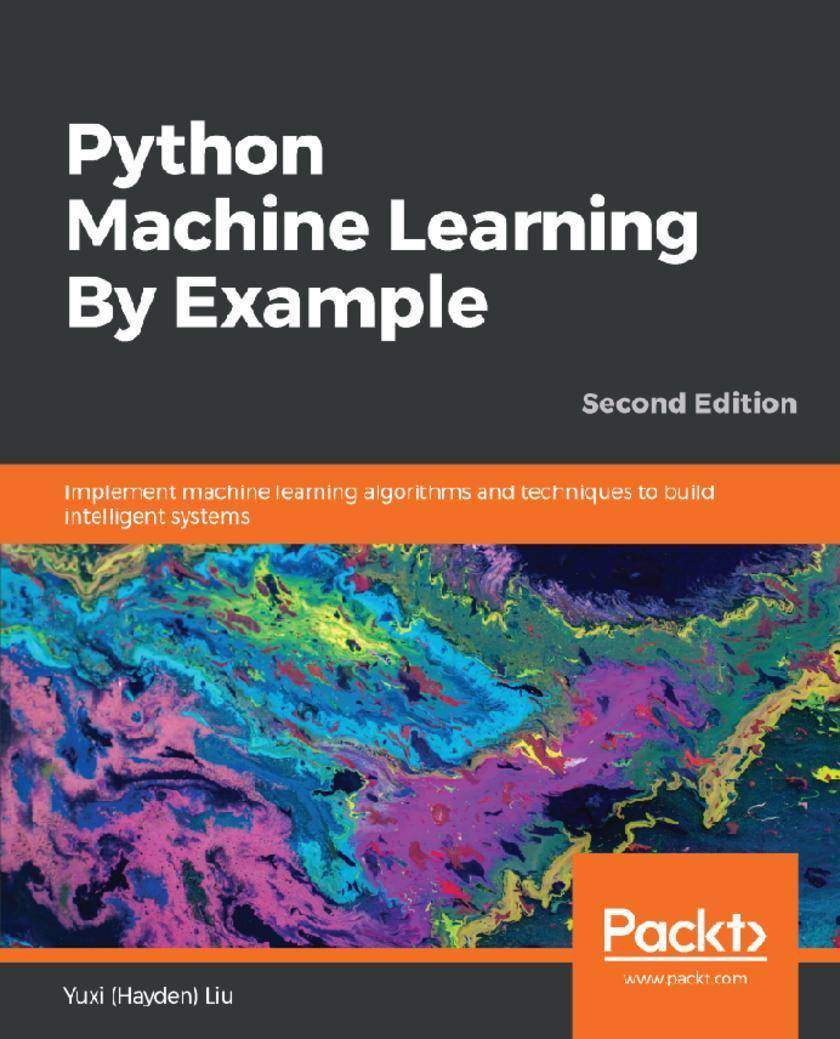
Python Machine Learning By Example
¥63.21
Grasp machine learning concepts, techniques, and algorithms with the help of real-world examples using Python libraries such as TensorFlow and scikit-learn Key Features * Exploit the power of Python to explore the world of data mining and data analytics * Discover machine learning algorithms to solve complex challenges faced by data scientists today * Use Python libraries such as TensorFlow and Keras to create smart cognitive actions for your projects Book Description The surge in interest in machine learning (ML) is due to the fact that it revolutionizes automation by learning patterns in data and using them to make predictions and decisions. If you’re interested in ML, this book will serve as your entry point to ML. Python Machine Learning By Example begins with an introduction to important ML concepts and implementations using Python libraries. Each chapter of the book walks you through an industry adopted application. You’ll implement ML techniques in areas such as exploratory data analysis, feature engineering, and natural language processing (NLP) in a clear and easy-to-follow way. With the help of this extended and updated edition, you’ll understand how to tackle data-driven problems and implement your solutions with the powerful yet simple Python language and popular Python packages and tools such as TensorFlow, scikit-learn, gensim, and Keras. To aid your understanding of popular ML algorithms, the book covers interesting and easy-to-follow examples such as news topic modeling and classification, spam email detection, stock price forecasting, and more. By the end of the book, you’ll have put together a broad picture of the ML ecosystem and will be well-versed with the best practices of applying ML techniques to make the most out of new opportunities. What you will learn * Understand the important concepts in machine learning and data science * Use Python to explore the world of data mining and analytics * Scale up model training using varied data complexities with Apache Spark * Delve deep into text and NLP using Python libraries such NLTK and gensim * Select and build an ML model and evaluate and optimize its performance * Implement ML algorithms from scratch in Python, TensorFlow, and scikit-learn Who this book is for If you’re a machine learning aspirant, data analyst, or data engineer highly passionate about machine learning and want to begin working on ML assignments, this book is for you. Prior knowledge of Python coding is assumed and basic familiarity with statistical concepts will be beneficial although not necessary.
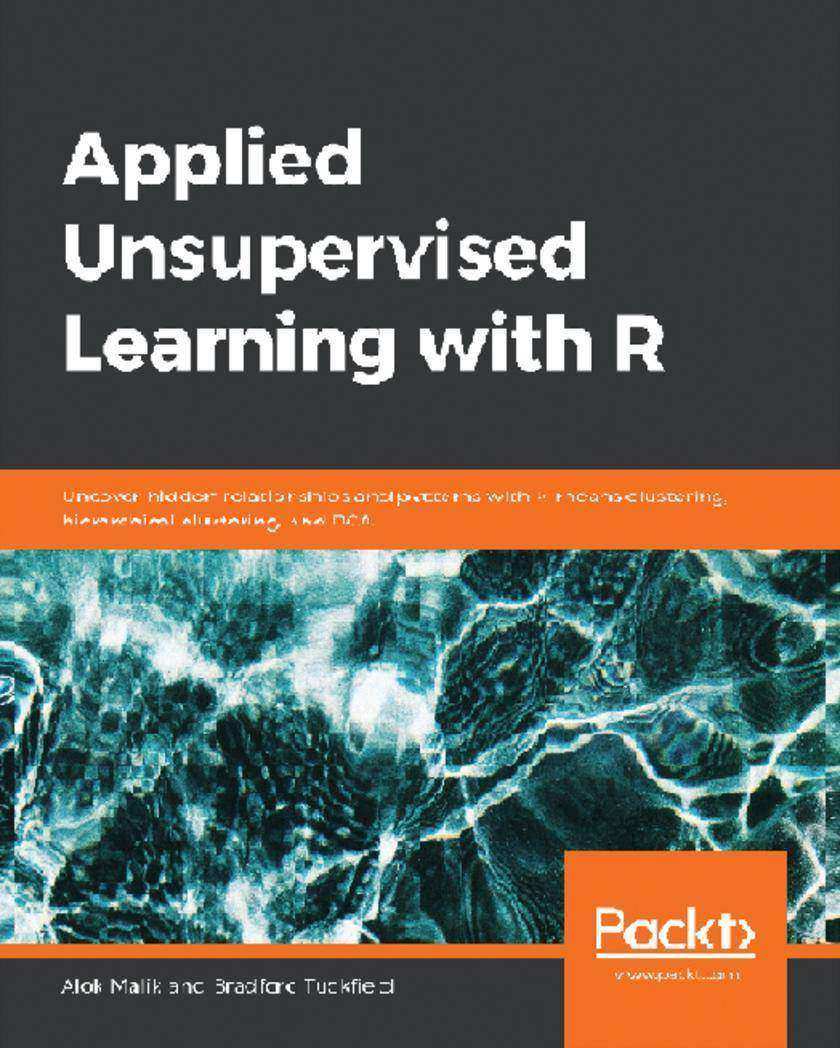
Applied Unsupervised Learning with R
¥63.21
Design clever algorithms that discover hidden patterns and draw responses from unstructured, unlabeled data. Key Features * Build state-of-the-art algorithms that can solve your business' problems * Learn how to find hidden patterns in your data * Revise key concepts with hands-on exercises using real-world datasets Book Description Starting with the basics, Applied Unsupervised Learning with R explains clustering methods, distribution analysis, data encoders, and features of R that enable you to understand your data better and get answers to your most pressing business questions. This book begins with the most important and commonly used method for unsupervised learning - clustering - and explains the three main clustering algorithms - k-means, divisive, and agglomerative. Following this, you'll study market basket analysis, kernel density estimation, principal component analysis, and anomaly detection. You'll be introduced to these methods using code written in R, with further instructions on how to work with, edit, and improve R code. To help you gain a practical understanding, the book also features useful tips on applying these methods to real business problems, including market segmentation and fraud detection. By working through interesting activities, you'll explore data encoders and latent variable models. By the end of this book, you will have a better understanding of different anomaly detection methods, such as outlier detection, Mahalanobis distances, and contextual and collective anomaly detection. What you will learn * Implement clustering methods such as k-means, agglomerative, and divisive * Write code in R to analyze market segmentation and consumer behavior * Estimate distribution and probabilities of different outcomes * Implement dimension reduction using principal component analysis * Apply anomaly detection methods to identify fraud * Design algorithms with R and learn how to edit or improve code Who this book is for Applied Unsupervised Learning with R is designed for business professionals who want to learn about methods to understand their data better, and developers who have an interest in unsupervised learning. Although the book is for beginners, it will be beneficial to have some basic, beginner-level familiarity with R. This includes an understanding of how to open the R console, how to read data, and how to create a loop. To easily understand the concepts of this book, you should also know basic mathematical concepts, including exponents, square roots, means, and medians.
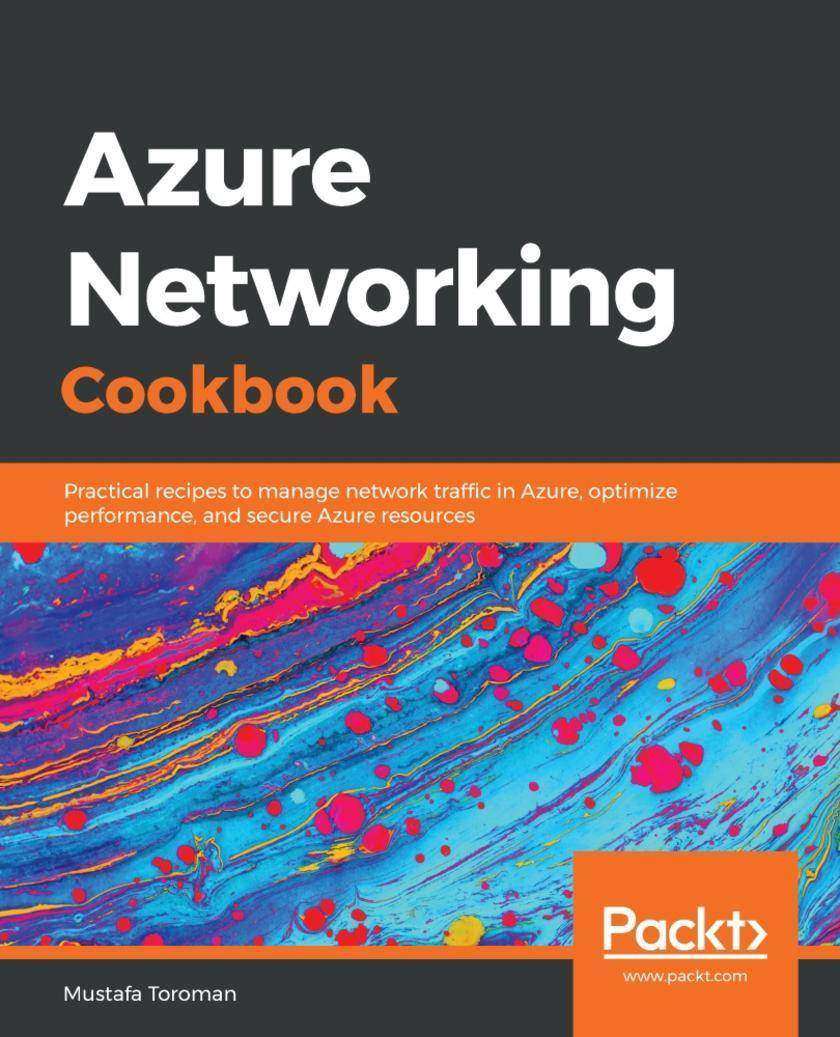
Azure Networking Cookbook
¥63.21
Learn to distribute network traffic, optimize application delivery, and defend network-level threats. Key Features * Quickly get up and running with Azure networking solutions * Level-up your cloud networking skills by planning, implementing, configuring, and securing your infrastructure network with Azure * Leverage Azure networking services to provide applications highly available and fault tolerant environment Book Description Microsoft provides organizations with an effective way of managing their network with Azure's networking services. No matter the size of your organization, Azure provides a way to highly reliable performance and secure connectivity with its networking services. The book starts with an introduction to the Azure networking like creating Azure virtual networks, designing address spaces and subnets. Then you will learn to create and manage network security groups, application security groups, and IP addresses in Azure. Gradually, we move on to various aspects like S2S, P2S, and Vnet2Vnet connections, DNS and routing, load balancers and traffic manager. This book will cover every aspect and function required to deliver practical recipes to help readers learn from basic cloud networking practices to planning, implementing, and securing their infrastructure network with Azure. Readers will not only be able to upscale their current environment but will also learn to monitor, diagnose, and ensure secure connectivity. After learning to deliver a robust environment readers will also gain meaningful insights from recipes on best practices. By the end of this book, readers will gain hands-on experience in providing cost-effective solutions that benefit organizations. What you will learn * Learn to create Azure networking services * Understand how to create and work on hybrid connections * Configure and manage Azure network services * Learn ways to design high availability network solutions in Azure * Discover how to monitor and troubleshoot Azure network resources * Learn different methods of connecting local networks to Azure virtual networks Who this book is for This book is targeted towards cloud architects, cloud solution providers, or any stakeholders dealing with networking on the Azure cloud. Some prior understanding of Microsoft Azure will be a plus point.
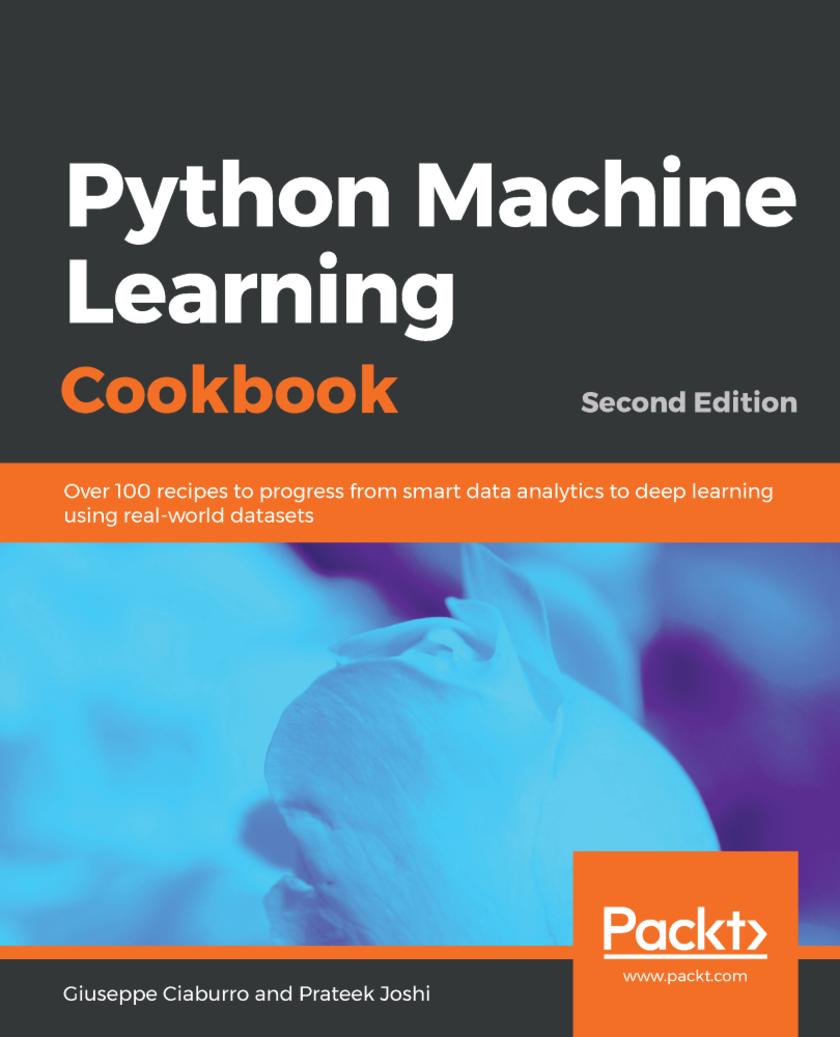
Python Machine Learning Cookbook
¥63.21
Discover powerful ways to effectively solve real-world machine learning problems using key libraries including scikit-learn, TensorFlow, and PyTorch Key Features * Learn and implement machine learning algorithms in a variety of real-life scenarios * Cover a range of tasks catering to supervised, unsupervised and reinforcement learning techniques * Find easy-to-follow code solutions for tackling common and not-so-common challenges Book Description This eagerly anticipated second edition of the popular Python Machine Learning Cookbook will enable you to adopt a fresh approach to dealing with real-world machine learning and deep learning tasks. With the help of over 100 recipes, you will learn to build powerful machine learning applications using modern libraries from the Python ecosystem. The book will also guide you on how to implement various machine learning algorithms for classification, clustering, and recommendation engines, using a recipe-based approach. With emphasis on practical solutions, dedicated sections in the book will help you to apply supervised and unsupervised learning techniques to real-world problems. Toward the concluding chapters, you will get to grips with recipes that teach you advanced techniques including reinforcement learning, deep neural networks, and automated machine learning. By the end of this book, you will be equipped with the skills you need to apply machine learning techniques and leverage the full capabilities of the Python ecosystem through real-world examples. What you will learn * Use predictive modeling and apply it to real-world problems * Explore data visualization techniques to interact with your data * Learn how to build a recommendation engine * Understand how to interact with text data and build models to analyze it * Work with speech data and recognize spoken words using Hidden Markov Models * Get well versed with reinforcement learning, automated ML, and transfer learning * Work with image data and build systems for image recognition and biometric face recognition * Use deep neural networks to build an optical character recognition system Who this book is for This book is for data scientists, machine learning developers, deep learning enthusiasts and Python programmers who want to solve real-world challenges using machine-learning techniques and algorithms. If you are facing challenges at work and want ready-to-use code solutions to cover key tasks in machine learning and the deep learning domain, then this book is what you need. Familiarity with Python programming and machine learning concepts will be useful.
Learn Type-Driven Development
¥63.21
A fast paced guide for JavaScript developers for writing safe, fast, and reusable code by leveraging ResaonML's strong static type system Key Features *Reduce code errors with the power of type systems *Employ static typechecking and genericity to promote code reuse and consistency *Understand functional programming which is the foundation of type-driven development Book Description Type-driven development is an approach that uses a static type system to achieve results including safety and efficiency. Types are used to express relationships and other assumptions directly in the code, and these assumptions are enforced by the compiler before the code is run. Learn Type-Driven Development covers how to use these type systems to check the logical consistency of your code. This book begins with the basic idea behind type-driven development. You’ll learn about values (or terms) and how they contrast with types. As you progress through the chapters, you’ll cover how to combine types and values inside modules and build structured types out of simpler ones. You’ll then understand how to express choices or alternatives directly in the type system using variants, polymorphic variants, and generalized algebraic data types. You’ll also get to grips with sum types, build sophisticated data types from generics, and explore functions that express change in the types of values. In the concluding chapters, you’ll cover advanced techniques for code reuse, such as parametric polymorphism and subtyping. By end of this book, you will have learned how to iterate through a type-driven process of solving coding problems using static types, together with dynamic behavior, to obtain more safety and speed. What you will learn *Use static types to capture information, making programs safer and faster *Learn ReasonML from experienced type-driven developers *Enhance safety by simply using basic types *Understand the most important type-driven concepts with simple examples *Explore a design space using static typing and find the best way to express your system rules *Use static types and dynamic runtime in harmony to write even safer and faster code Who this book is for If you’re a programmer working with dynamically typed languages and are looking for ways to mitigate production runtime errors, Learn Type-Driven Development is for you. You’ll also find this book helpful if you’re a programmer working with statically typed languages looking for increased safety and improved performance.
Learning Adobe Connect 9
¥63.21
Written in an engaging, easy-to-follow style, Learning Adobe Connect 9 is a practical guide that will help you master the use of this web conferencing platform and its most important features. This book is ideal for users who would like to start utilizing Adobe Connect for web meetings, e-learning, and webinars. Those who are looking to learn Connect and get up to speed with using all of its features would find this book extremely useful.
Hands-On Reinforcement Learning with Python
¥63.21
A hands-on guide enriched with examples to master deep reinforcement learning algorithms with Python About This Book ? Your entry point into the world of artificial intelligence using the power of Python ? An example-rich guide to master various RL and DRL algorithms ? Explore various state-of-the-art architectures along with math Who This Book Is For If you’re a machine learning developer or deep learning enthusiast interested in artificial intelligence and want to learn about reinforcement learning from scratch, this book is for you. Some knowledge of linear algebra, calculus, and the Python programming language will help you understand the concepts covered in this book. What You Will Learn ? Understand the basics of reinforcement learning methods, algorithms, and elements ? Train an agent to walk using OpenAI Gym and Tensorflow ? Understand the Markov Decision Process, Bellman’s optimality, and TD learning ? Solve multi-armed-bandit problems using various algorithms ? Master deep learning algorithms, such as RNN, LSTM, and CNN with applications ? Build intelligent agents using the DRQN algorithm to play the Doom game ? Teach agents to play the Lunar Lander game using DDPG ? Train an agent to win a car racing game using dueling DQN In Detail Reinforcement Learning (RL) is the trending and most promising branch of artificial intelligence. Hands-On Reinforcement learning with Python will help you master not only the basic reinforcement learning algorithms but also the advanced deep reinforcement learning algorithms. The book starts with an introduction to Reinforcement Learning followed by OpenAI Gym, and TensorFlow. You will then explore various RL algorithms and concepts, such as Markov Decision Process, Monte Carlo methods, and dynamic programming, including value and policy iteration. This example-rich guide will introduce you to deep reinforcement learning algorithms, such as Dueling DQN, DRQN, A3C, PPO, and TRPO. You will also learn about imagination-augmented agents, learning from human preference, DQfD, HER, and many more of the recent advancements in reinforcement learning. By the end of the book, you will have all the knowledge and experience needed to implement reinforcement learning and deep reinforcement learning in your projects, and you will be all set to enter the world of artificial intelligence. Style and approach This is a hands-on book designed to further expand your machine learning skills by understanding reinforcement to deep reinforcement learning algorithms with applications in Python.
Mastering Numerical Computing with NumPy
¥63.21
Enhance the power of NumPy and start boosting your scientific computing capabilities About This Book ? Grasp all aspects of numerical computing and understand NumPy ? Explore examples to learn exploratory data analysis (EDA), regression, and clustering ? Access NumPy libraries and use performance benchmarking to select the right tool Who This Book Is For Mastering Numerical Computing with NumPy is for you if you are a Python programmer, data analyst, data engineer, or a data science enthusiast, who wants to master the intricacies of NumPy and build solutions for your numeric and scientific computational problems. You are expected to have familiarity with mathematics to get the most out of this book. What You Will Learn ? Perform vector and matrix operations using NumPy ? Perform exploratory data analysis (EDA) on US housing data ? Develop a predictive model using simple and multiple linear regression ? Understand unsupervised learning and clustering algorithms with practical use cases ? Write better NumPy code and implement the algorithms from scratch ? Perform benchmark tests to choose the best configuration for your system In Detail NumPy is one of the most important scientific computing libraries available for Python. Mastering Numerical Computing with NumPy teaches you how to achieve expert level competency to perform complex operations, with in-depth coverage of advanced concepts. Beginning with NumPy's arrays and functions, you will familiarize yourself with linear algebra concepts to perform vector and matrix math operations. You will thoroughly understand and practice data processing, exploratory data analysis (EDA), and predictive modeling. You will then move on to working on practical examples which will teach you how to use NumPy statistics in order to explore US housing data and develop a predictive model using simple and multiple linear regression techniques. Once you have got to grips with the basics, you will explore unsupervised learning and clustering algorithms, followed by understanding how to write better NumPy code while keeping advanced considerations in mind. The book also demonstrates the use of different high-performance numerical computing libraries and their relationship with NumPy. You will study how to benchmark the performance of different configurations and choose the best for your system. By the end of this book, you will have become an expert in handling and performing complex data manipulations. Style and approach This mastering guide will help you master your skills required to perform a complex numerical computation. The book contains the right mixture of theory and practical examples that will help you in dealing with the advanced NumPy and build solutions for your numeric and scientific computational problems
The Modern C++ Challenge
¥63.21
Test your C++ programming skills by solving real-world programming problems covered in the book About This Book ? Solve a variety of real-world programming and logic problems by leveraging the power of C++17 ? Test your skills in using language features, algorithms, data structures, design patterns, and more ? Explore areas such as cryptography, communication, and image handling in C++ Who This Book Is For This book will appeal to C++ developers of all levels. There's a challenge inside for everyone. What You Will Learn ? Serialize and deserialize JSON and XML data ? Perform encryption and signing to facilitate secure communication between parties ? Embed and use SQLite databases in your applications ? Use threads and asynchronous functions to implement generic purpose parallel algorithms ? Compress and decompress files to/from a ZIP archive ? Implement data structures such as circular buffer and priority queue ? Implement general purpose algorithms as well as algorithms that solve specific problems ? Create client-server applications that communicate over TCP/IP ? Consume HTTP REST services ? Use design patterns to solve real-world problems In Detail C++ is one of the most widely-used programming languages and has applications in a variety of fields, such as gaming, GUI programming, and operating systems, to name a few. Through the years, C++ has evolved into (and remains) one of the top choices for software developers worldwide. This book will show you some notable C++ features and how to implement them to meet your application needs. Each problem is unique and doesn't just test your knowledge of the language; it tests your ability to think out of the box and come up with the best solutions. With varying levels of difficulty, you'll be faced with a wide variety of challenges. And in case you're stumped, you don't have to worry: we've got the best solutions to the problems in the book. So are you up for the challenge? Style and approach A recipe-based approach where each problem is solved with the help of step by step instructions.
ASP.NET Web API Security Essentials
¥63.21
Take the security of your ASP.NET Web API to the next level using some of the most amazing security techniques around About This Book This book has been completely updated for ASP.NET Web API 2.0 including the new features of ASP.NET Web API such as Cross-Origin Resource Sharing (CORS) and OWIN self-hosting Learn various techniques to secure ASP.NET Web API, including basic authentication using authentication filters, forms, Windows Authentication, external authentication services, and integrating ASP.NET’s Identity system An easy-to-follow guide to enable SSL, prevent Cross-Site Request Forgery (CSRF) attacks, and enable CORS in ASP.NET Web API Who This Book Is For This book is intended for anyone who has previous knowledge of developing ASP.NET Web API applications. Good working knowledge and experience with C# and.NET Framework are prerequisites for this book. What You Will Learn Secure your web API by enabling Secured Socket Layer (SSL) Manage your application’s user accounts by integrating ASP.NET’s Identity system Ensure the security of your web API by implementing basic authentication Implement forms and Windows authentication to secure your web API Use external authentication such as Facebook and Twitter to authenticate a request to a web API Protect your web API from CSRF attacks Enable CORS in your web API to explicitly allow some cross-origin requests while rejecting others Fortify your web API using OAuth2 In Detail This book incorporates the new features of ASP.NET Web API 2 that will help you to secure an ASP.NET Web API and make a well-informed decision when choosing the right security mechanism for your security requirements. We start by showing you how to set up a browser client to utilize ASP.NET Web API services. We then cover ASP.NET Web API’s security architecture, authentication, and authorization to help you secure a web API from unauthorized users. Next, you will learn how to use SSL with ASP.NET Web API, including using SSL client certificates, and integrate the ASP.NET Identity system with ASP.NET Web API. We’ll show you how to secure a web API using OAuth2 to authenticate against a membership database using OWIN middleware. You will be able to use local logins to send authenticated requests using OAuth2. We also explain how to secure a web API using forms authentication and how users can log in with their Windows credentials using integrated Windows authentication. You will come to understand the need for external authentication services to enable OAuth/OpenID and social media authentication. We’ll then help you implement anti-Cross-Site Request Forgery (CSRF) measures in ASP.NET Web API. Finally, you will discover how to enable Cross-Origin Resource Sharing (CORS) in your web API application. Style and approach Each chapter is dedicated to a specific security technique, in a task-based and easy-to-follow way. Most of the chapters are accompanied with source code that demonstrates the step-by-step guidelines of implementing the technique, and includes an explanation of how each technique works.
Amazon EC2 Cookbook
¥63.21
Over 40 hands-on recipes to develop and deploy real-world applications using Amazon EC2 About This Book Design and build applications using Amazon EC2 and a range of supporting AWS tools Find highly effective solutions to your AWS Cloud-based application development, deployment, and infrastructural issues A comprehensive set of recipes to implement your product’s functional and non-functional requirements Who This Book Is For This book is targeted at Cloud-based developers who have prior exposure to AWS concepts and features. Some experience in building small applications and creating some proof-of-concept applications is required. What You Will Learn Select and configure the right EC2 instances Create, configure, and secure a Virtual Private Cloud Create an AWS CloudFormation template Use AWS Identity and Access Management to secure access to EC2 instances Configure auto-scaling groups using CloudWatch Choose and use the right data service such as SimpleDB and DynamoDB for your cloud applications Access key AWS services using client tools and AWS SDKs Deploy AWS applications using Docker containers In Detail Amazon Elastic Compute Cloud (Amazon EC2) is a web service that provides flexible and resizable compute capacity in the cloud. The main purpose of Amazon EC2 is to make web-scale cloud computing easier for the developers. It offers developers and companies the raw building blocks like load balancers, object stores and virtual machines running on general hardware (that is, Amazon runs a multitude of hardware components but presents them as a generic utility to its users) with accessible APIs in order to create scalable software products This book covers designing, developing, and deploying scalable, highly available, and secure applications on the AWS platform. By following the steps in the recipes, you will be able to effectively and systematically resolve issues related to development, deployment, and infrastructure for enterprise-grade cloud applications or products. This book starts with helping you choose and configure the right EC2 instances to meet your application-specific requirements. The book then moves on to creating a CloudFormation template and will teach you how to work with stacks. You will then be introduced to using IAM services to configure users, groups, roles, and multi-factor authentication. You will also learn how to connect AD to AWS IAM. Next, you will be using AWS data services and accessing other AWS services including Route 53, Amazon S3, and AWS SES (Amazon Simple Email Service). Finally, you will be deploying AWS applications using Docker containers. Style and approach This book contains a rich set of recipes that cover not only the full spectrum of real-world cloud application development using Amazon EC2, but also the services and security of the applications. The book contains easy-to-follow recipes with step-by-step instructions to leverage EC2 within your applications.
SciPy Recipes
¥63.21
Tackle the most sophisticated problems associated with scientific computing and data manipulation using SciPy About This Book ? Covers a wide range of data science tasks using SciPy, NumPy, pandas, and matplotlib ? Effective recipes on advanced scientific computations, statistics, data wrangling, data visualization, and more ? A must-have book if you're looking to solve your data-related problems using SciPy, on-the-go Who This Book Is For Python developers, aspiring data scientists, and analysts who want to get started with scientific computing using Python will find this book an indispensable resource. If you want to learn how to manipulate and visualize your data using the SciPy Stack, this book will also help you. A basic understanding of Python programming is all you need to get started. What You Will Learn ? Get a solid foundation in scientific computing using Python ? Master common tasks related to SciPy and associated libraries such as NumPy, pandas, and matplotlib ? Perform mathematical operations such as linear algebra and work with the statistical and probability functions in SciPy ? Master advanced computing such as Discrete Fourier Transform and K-means with the SciPy Stack ? Implement data wrangling tasks efficiently using pandas ? Visualize your data through various graphs and charts using matplotlib In Detail With the SciPy Stack, you get the power to effectively process, manipulate, and visualize your data using the popular Python language. Utilizing SciPy correctly can sometimes be a very tricky proposition. This book provides the right techniques so you can use SciPy to perform different data science tasks with ease. This book includes hands-on recipes for using the different components of the SciPy Stack such as NumPy, SciPy, matplotlib, and pandas, among others. You will use these libraries to solve real-world problems in linear algebra, numerical analysis, data visualization, and much more. The recipes included in the book will ensure you get a practical understanding not only of how a particular feature in SciPy Stack works, but also of its application to real-world problems. The independent nature of the recipes also ensure that you can pick up any one and learn about a particular feature of SciPy without reading through the other recipes, thus making the book a very handy and useful guide. Style and approach This book consists of hands-on recipes where you’ll deal with real-world problems. You’ll execute a series of tasks as you walk through scientific computing challenges using SciPy. Your one-stop solution for common and not-so-common pain points, this is a book that you must have on the shelf.
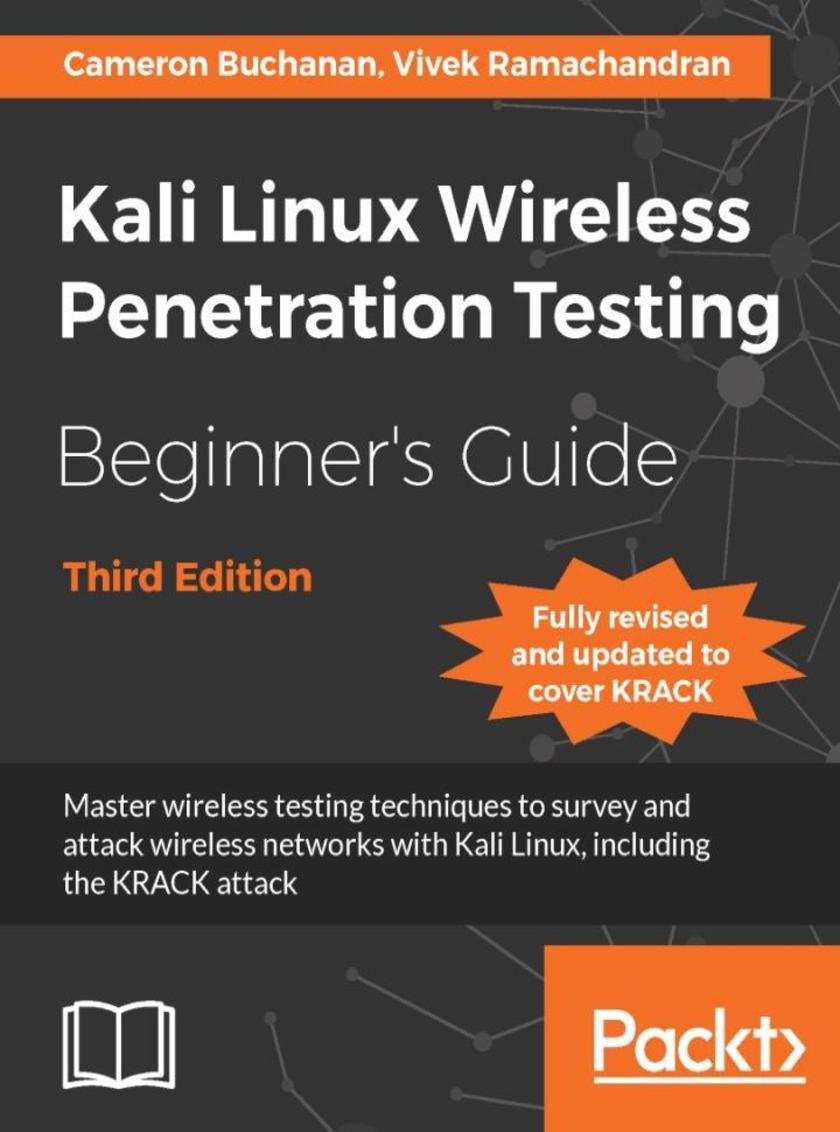
Kali Linux Wireless Penetration Testing Beginner's Guide - Third Edition
¥63.21
Kali Linux Wireless Penetration Testing Beginner's Guide, Third Edition presents wireless pentesting from the ground up, and has been updated with the latest methodologies, including full coverage of the KRACK attack. About This Book ? Learn wireless penetration testing with Kali Linux ? Detect hidden wireless networks and discover their names ? Explore advanced Wi-Fi hacking techniques including rogue access point hosting and probe sniffing ? Develop your encryption cracking skills and gain an insight into the methods used by attackers and the underlying technologies that facilitate these attacks Who This Book Is For Kali Linux Wireless Penetration Testing Beginner's Guide, Third Edition is suitable for anyone who wants to learn more about pentesting and how to understand and defend against the latest wireless network attacks. What You Will Learn ? Understand the KRACK attack in full detail ? Create a wireless lab for your experiments ? Sniff out wireless packets, hidden networks, and SSIDs ? Capture and crack WPA-2 keys ? Sniff probe requests and track users through their SSID history ? Attack radius authentication systems ? Sniff wireless traffic and collect interesting data ? Decrypt encrypted traffic with stolen keys In Detail As wireless networks become ubiquitous in our lives, wireless penetration testing has become a key skill in the repertoire of the professional penetration tester. This has been highlighted again recently with the discovery of the KRACK attack which enables attackers to potentially break into Wi-Fi networks encrypted with WPA2. The Kali Linux security distribution comes with a myriad of tools used for networking attacks and detecting security loopholes. Kali Linux Wireless Penetration Testing Beginner's Guide, Third Edition has been updated to Kali Linux 2017.3 with the latest methodologies, including full coverage of the KRACK attack and how to defend against it. The book presents wireless pentesting from the ground up, introducing all elements of penetration testing with each new technology. You'll learn various wireless testing methodologies by example, from the basics of wireless routing and encryption through to detailed coverage of hacking methods and attacks such as the Hirte and Caffe Latte. Style and approach Kali Linux Wireless Penetration Testing Beginner's Guide, Third Edition is a practical, hands-on guide to modern wi-fi network hacking. It covers both the theory and practice of wireless pentesting, offering detailed, real-world coverage of the latest vulnerabilities and attacks.
Intel Edison Projects
¥63.21
Build powerful Robots and IoT solutions using Intel Edison About This Book ? Learn to build advanced level robots with Intel Edison and Arduino ? Efficiently build and program home automation and IoT projects with Intel Edison ? Master the skills of creating enticing projects with Intel Edison. Who This Book Is For If you are a hobbyist, robot engineer, IoT enthusiast, programmer, or developer who wants to create autonomous projects with Intel Edison, then this book is for you. Prior programming knowledge would be beneficial. What You Will Learn ? Program your device using the Arduino processor language, Python, and Node.js ? Interface different sensors with the Intel Edison ? Build a home automation system using MQTT, Android, and WPF ? Perform face detection using Intel Edison ? Develop a high-speed line follower robot ? Control a robot using a PC application and an custom controller In Detail Change the way you look at embedded electronics with Intel Edison. It is a small computing platform packed with a set of robust features to deliver hands-on performance, durability, and software support. This book is a perfect place to kickstart development and rapid prototyping using Intel Edison. It will start by introducing readers to the Intel Edison board and explaining how to get started with it. You will learn how to build a mini weather station, which will help you to acquire temperature and smoke level and push it to the IoT platform. Then you will see how to build a home automation device and control your appliances using an Android app. Furthermore, we will build a security system using a webcam to detect faces and perform voice recognition. Toward the end, the book will demonstrate how you can build two robots, which will be based on different line sensing sensors and can be controlled by a PC. The book will guide the readers through each and every step of execution of a project, using Intel Edison. Style and approach A project-based guide that will take the readers through various domains of projects like robotics, IoT and so on.
IoT Projects with Bluetooth Low Energy
¥63.21
Use the power of BLE to create exciting IoT applications About This Book ? Build hands-on IoT projects using Bluetooth Low Energy and learn about Bluetooth 5 and its features. ? Build a health tracking system, and indoor navigation and warehouse weather monitoring projects using smart devices. ? Build on a theoretical foundation and create a practice-based understanding of Bluetooth Low Energy. Who This Book Is For If you're an application developer, a hardware enthusiast, or just curious about the Internet of Things and how to convert it into hands-on projects, then this book is for you. Having some knowledge of writing mobile applications will be advantageous. What You Will Learn ? Learn about the architecture and IoT uses of BLE, and in which domains it is being used the most ? Set up and learn about various development platforms (Android, iOS, Firebase, Raspberry Pi, Beacons, and GitHub) ? Create an Explorer App (Android/iOS) to diagnose a Fitness Tracker ? Design a Beacon with the Raspberry Pi and write an app to detect the Beacon ? Write a mobile app to periodically poll the BLE tracking sensor ? Compose an app to read data periodically from temperature and humidity sensors ? Explore more applications of BLE with IoT ? Design projects for both Android and iOS mobile platforms In Detail Bluetooth Low Energy, or Bluetooth Smart, is Wireless Personal Area networking aimed at smart devices and IoT applications. BLE has been increasingly adopted by application developers and IoT enthusiasts to establish connections between smart devices. This book initially covers all the required aspects of BLE, before you start working on IoT projects. In the initial stages of the book, you will learn about the basic aspects of Bluetooth Low Energy—such as discovering devices, services, and characteristics—that will be helpful for advanced-level projects. This book will guide you through building hands-on projects using BLE and IoT. These projects include tracking health data, using a mobile App, and making this data available for health practitioners; Indoor navigation; creating beacons using the Raspberry Pi; and warehouse weather Monitoring. This book also covers aspects of Bluetooth 5 (the latest release) and its effect on each of these projects. By the end of this book, you will have hands-on experience of using Bluetooth Low Energy to integrate with smart devices and IoT projects. Style and approach A practical guide that will help you promote yourself into an expert by building and exploring practical applications of Bluetooth Low Energy.
Jira Software Essentials - Second Edition
¥63.21
Explore Jira Software to manage your projects proficiently About This Book ? Plan and manage projects effortlessly with Jira Software by integrating it with other applications ? Improve your team's performance with Scrum and Kanban, together with agile methodology ? Easy-to-follow learning guide to install Jira Software and understand how it fits in with Atlassian Jira Who This Book Is For If you want to get started with Jira Software and learn how to run your Jira projects the agile way, then this is the perfect book for you. You will need to be familiar with the basics of Jira, both from an end user's and an administrator's perspective. Experience with workflows, custom fields, and other administrative functions of Jira will be useful. What You Will Learn ? Understand the basics and agile methodologies of Jira software ? Use Jira Software in a Scrum environment ? Manage and run Jira Software projects beyond the out of box Scrum and Kanban way ? Combine Scrum and Kanban and use other project management options beyond just agile ? Customize Jira Software’s various features and options as per your requirements ? Work with Jira Agile offline, and plan and forecast projects with agile portfolio ? Integrate Jira Agile with Confluence and Bitbucket In Detail Jira Software is an agile project management tool that supports any agile methodology, be it scrum, Kanban, or your own unique flavour. From agile boards to reports, you can plan, track, and manage all your agile software development projects from a single tool. Jira Software brings the power of agile methodology to Atlassian Jira. This second edition of JIRA Agile Essentials, will help you dive straight into the action, exploring critical agile terminologies and concepts in the context of Jira Software. You will learn how to plan, track, and release great software. This book will teach you how to install and run Jira Software and set it up to run with Scrum and Kanban. It will also teach you to use Jira Software your way and run projects beyond the out-of-box Scrum and Kanban way, including a hybrid approach of both the methodologies and other options that come with Jira Software. Later, you will learn how to integrate it with the tools you are already using and enhance Jira with add-ons such as Confluence. You will learn to stay connected with your team from anywhere to ensure great development. Jira Software has numerous deployment options in the cloud, on your own infrastructure, or at a massive scale. You will be introduced to Bitbucket, Atlassian’s distributed version control system, which integrates seamlessly with Jira, allowing your team to work within the two applications as one harmonious environment. With this practical guide, you will develop a great working knowledge of Jira Software and your project management will become much more efficient. Style and approach This practical book explains Jira Software with the help of detailed examples in a step-by- step manner.
IPython Interactive Computing and Visualization Cookbook - Second Edition
¥63.21
Learn to use IPython and Jupyter Notebook for your data analysis and visualization work. About This Book ? Leverage the Jupyter Notebook for interactive data science and visualization ? Become an expert in high-performance computing and visualization for data analysis and scientific modeling ? A comprehensive coverage of scientific computing through many hands-on, example-driven recipes with detailed, step-by-step explanations Who This Book Is For This book is intended for anyone interested in numerical computing and data science: students, researchers, teachers, engineers, analysts, and hobbyists. A basic knowledge of Python/NumPy is recommended. Some skills in mathematics will help you understand the theory behind the computational methods. What You Will Learn ? Master all features of the Jupyter Notebook ? Code better: write high-quality, readable, and well-tested programs; profile and optimize your code; and conduct reproducible interactive computing experiments ? Visualize data and create interactive plots in the Jupyter Notebook ? Write blazingly fast Python programs with NumPy, ctypes, Numba, Cython, OpenMP, GPU programming (CUDA), parallel IPython, Dask, and more ? Analyze data with Bayesian or frequentist statistics (Pandas, PyMC, and R), and learn from actual data through machine learning (scikit-learn) ? Gain valuable insights into signals, images, and sounds with SciPy, scikit-image, and OpenCV ? Simulate deterministic and stochastic dynamical systems in Python ? Familiarize yourself with math in Python using SymPy and Sage: algebra, analysis, logic, graphs, geometry, and probability theory In Detail Python is one of the leading open source platforms for data science and numerical computing. IPython and the associated Jupyter Notebook offer efficient interfaces to Python for data analysis and interactive visualization, and they constitute an ideal gateway to the platform. IPython Interactive Computing and Visualization Cookbook, Second Edition contains many ready-to-use, focused recipes for high-performance scientific computing and data analysis, from the latest IPython/Jupyter features to the most advanced tricks, to help you write better and faster code. You will apply these state-of-the-art methods to various real-world examples, illustrating topics in applied mathematics, scientific modeling, and machine learning. The first part of the book covers programming techniques: code quality and reproducibility, code optimization, high-performance computing through just-in-time compilation, parallel computing, and graphics card programming. The second part tackles data science, statistics, machine learning, signal and image processing, dynamical systems, and pure and applied mathematics. Style and approach IPython Interactive Computing and Visualization Cookbook, Second Edition is a practical, hands-on book that will teach you how to analyze and visualize all kinds of data in the Jupyter Notebook.
Ansible 2 Cloud Automation Cookbook
¥63.21
Orchestrate your cloud infrastructure About This Book ? Recipe-based approach to install and configure cloud resources using Ansible ? Covers various cloud-related modules and their functionalities ? Includes deployment of a sample application to the cloud resources that we create ? Learn the best possible way to manage and automate your cloud infrastructure Who This Book Is For If you are a system administrator, infrastructure engineer, or a DevOps engineer who wants to obtain practical knowledge about Ansible and its cloud deliverables, then this book is for you. Recipes in this book are designed for people who would like to manage their cloud infrastructures efficiently using Ansible, which is regarded as one of the best tools for cloud management and automation. What You Will Learn ? Use Ansible Vault to protect secrets ? Understand how Ansible modules interact with cloud providers to manage resources ? Build cloud-based resources for your application ? Create resources beyond simple virtual machines ? Write tasks that can be reused to create resources multiple times ? Work with self-hosted clouds such as OpenStack and Docker ? Deploy a multi-tier application on various cloud providers In Detail Ansible has a large collection of inbuilt modules to manage various cloud resources. The book begins with the concepts needed to safeguard your credentials and explain how you interact with cloud providers to manage resources. Each chapter begins with an introduction and prerequisites to use the right modules to manage a given cloud provider. Learn about Amazon Web Services, Google Cloud, Microsoft Azure, and other providers. Each chapter shows you how to create basic computing resources, which you can then use to deploy an application. Finally, you will be able to deploy a sample application to demonstrate various usage patterns and utilities of resources. Style and approach This book will help readers get started with Ansible cloud modules. It has code snippets and diagrams along with real world examples that will help you move ahead easily. Using real world scenarios, you will learn to deploy an application to cloud resources.
Internet of Things with Arduino Cookbook
¥63.21
Over 60 recipes will help you build smart IoT solutions and surprise yourself with captivating IoT projects you thought only existed in Bond movies About This Book This book offers key solutions and advice to address the hiccups faced when working on Arduino-based IoT projects in the real world Take your existing skills and capabilities to the next level by building challenging IoT applications with ease. Be the tech disruptor you always wanted to be with key recipes that help you solve Arduino IoT related problems smarter and faster. Put IoT to work through recipes on building Arduino-based devices that take control of your home, health, and life! Who This Book Is For This book is primarily for tech enthusiasts and early IoT adopters who would like to make the most of IoT and address the challenges encountered while developing IoT-based applications with Arduino. This book is also good for developers with basic electronics knowledge who need help to successfully build Arduino projects. What You Will Learn Monitor several Arduino boards simultaneously Tweet sensor data directly from your Arduino board Post updates on your Facebook wall directly from your Arduino board Create an automated access control with a fingerprint sensor Control your entire home from a single dashboard Make a GPS tracker that you can track in Google Maps Build a live camera that streams directly from your robot In Detail Arduino is a powerful and very versatile platform used by millions of people around the world to create DIY electronics projects. It can be connected to a wide variety of sensors and other components, making it the ideal platform to build amazing Internet of Things (IoT) projects on—the next wave in the era of computing. This book takes a recipe-based approach, giving you precise examples on how to build IoT projects of all types using the Arduino platform. You will come across projects from several fields, including the popular robotics and home automation domains. Along with being introduced to several forms of interactions within IoT, including projects that directly interact with well-known web services such as Twitter, Facebook, and Dropbox we will also focus on Machine-to-Machine (M2M) interactions, where Arduino projects interact without any human intervention. You will learn to build a few quick and easy-to-make fun projects that will really expand your horizons in the world of IoT and Arduino. Each chapter ends with a troubleshooting recipe that will help you overcome any problems faced while building these projects. By the end of this book, you will not only know how to build these projects, but also have the skills necessary to build your own IoT projects in the future. Style and approach This book takes a recipe-based approach, giving you precise examples on how to build IoT projects using the Arduino platform. You will learn to build fun and easy projects through a task-oriented approach.
Android Studio 2 Essentials - Second Edition
¥63.21
A fast-paced guide to get you up and running with Android application development using Android Studio 2 About This Book Configure, build, and run Android projects with Android Studio 2 Test your apps using the Android emulator and learn how to manage virtual devices Explore how Android Studio 2 can be made a part of your workflow to reduce the overall development time Who This Book Is For If you are an Android developer looking to quickly take advantage of Android Studio 2 and add it to your workflow, then this book is for you. It is assumed that you are familiar with the OOP paradigm and Java. You are recommended to have prior knowledge of the main characteristics of the Android mobile system to get the most out of this book. What You Will Learn Install Android Studio on your system and configure the Android Software Development Kit Create your first project and explore its structure Manage a project in Android Studio 2 with Gradle Improve your productivity while programming by getting the best of the code editor Design the user interface using layouts and see how to handle various user events Integrate Google Play services into your project efficiently Monitor your app while it's running and constantly improve its performance In Detail Android Studio 2, the official IDE for Android application development, dramatically improves your workflow by letting you quickly see changes running on your device or emulator. It gives developers a unique platform by making app builds and deployment faster. This book will get you up and running with all the essential features of Android Studio 2 to optimize your development workflow. Starting off with the basic installation and configuration of Android Studio 2, this book will help you build a new project by showing you how to create a custom launcher icon and guiding you to choose your project. You will then gain an insight into the additional tools provided in Android Studio, namely the Software Development Kit (SDK) Manager, Android Virtual Device (AVD) Manager, and Javadoc. You’ll also see how to integrate Google Play Services in an Android project. Finally, you’ll become familiar with the Help section in Android Studio, which will enable you to search for support you might require in different scenarios. Style and approach A comprehensive and practical guide that will give you the essential skills required to develop Android applications quickly using Android Studio. With the help of a real-world project, this book will show how to make Android Studio a part of your development process and optimize it.
Linux Networking Cookbook
¥63.21
Over 40 recipes to help you set up and configure Linux networks About This Book Move beyond the basics of how a Linux machine works and gain a better understanding of Linux networks and their configuration Impress your peers by setting up and configuring a Linux server and its various network elements like a pro This is a hands-on solution guide to building, maintaining, and securing a network using Linux Who This Book Is For This book is targeted at Linux systems administrators who have a good basic understanding and some prior experience of how a Linux machine operates, but want to better understand how various network services function, how to set them up, and how to secure them. You should be familiar with how to set up a Linux server and how to install additional software on them. What You Will Learn Route an IPv6 netblock to your local network Modify your named instance to support setting hostnames for your IPv6 addresses Use SSH for remote console access Configure NGINX with TLS Secure XMPP with TLS Leverage iptables6 to firewall your IPv6 traffic Configure Samba as an Active Directory compatible directory service In Detail Linux can be configured as a networked workstation, a DNS server, a mail server, a firewall, a gateway router, and many other things. These are all part of administration tasks, hence network administration is one of the main tasks of Linux system administration. By knowing how to configure system network interfaces in a reliable and optimal manner, Linux administrators can deploy and configure several network services including file, web, mail, and servers while working in large enterprise environments. Starting with a simple Linux router that passes traffic between two private networks, you will see how to enable NAT on the router in order to allow Internet access from the network, and will also enable DHCP on the network to ease configuration of client systems. You will then move on to configuring your own DNS server on your local network using bind9 and tying it into your DHCP server to allow automatic configuration of local hostnames. You will then future enable your network by setting up IPv6 via tunnel providers. Moving on, we’ll configure Samba to centralize authentication for your network services; we will also configure Linux client to leverage it for authentication, and set up a RADIUS server that uses the directory server for authentication. Toward the end, you will have a network with a number of services running on it, and will implement monitoring in order to detect problems as they occur. Style and approach This book is packed with practical recipes and a task-based approach that will walk you through building, maintaining, and securing a computer network using Linux.


