


 购物车
购物车 个人中心
个人中心
Mastering Application Development with Force.com
¥63.21
Design and develop state-of-the-art applications using Force.com's powerful development platformAbout This BookFlaunt your skillsets by developing complex applications that include demanding concepts such as triggers, Visualforce controllers, batch jobs, and Lightning componentsEarn the gratitude of your colleagues by structuring a project so that multiple developers can work independently of each otherKevin Poorman, the author of the book and a Force.com MVP, shares his years of Force.com knowledge and experience with you through the medium of telling examplesWho This Book Is ForIf you're a Force.com developer with a fundamental understanding of Apex and JavaScript but now want to enhance your skills with tips, tricks, and guidance on the best architectural and engineering practices, then this book is for you.What You Will LearnCreating triggers, and the best practices for writing themDeveloping a number of Visualforce controllers and extensionsIntegrating third-party web APIs into your Apex codeWriting unit tests that cover testing bulk safety, user and profile settings, and negative testsCreating a Lightning component for use in Salesforce1Getting acquainted with various methods for deploying metadata between orgsUsing the Rest sObject API for access to Salesforce objects and data using the REST methodologyLearning about overarching architectural considerations such as naming conventions, testing practices, and data modeling practicesIn DetailForce.com is an extremely powerful, scalable, and secure cloud platform, delivering a complete technology stack, ranging from databases and security to workflow and the user interface. With salesforce.com's Force.com cloud platform, you can build any business application and run it on your servers.The book will help you enhance your skillset and develop complex applications using Force.com. It gets you started with a quick refresher of Force.com's development tools and methodologies, and moves to an in-depth discussion of triggers, bulkification, DML order of operations, and trigger frameworks. Next, you will learn to use batchable and schedulable interfaces to process massive amounts of information asynchronously. You will also be introduced to Salesforce Lightning and cover components—including backend (apex) controllers, frontend (JavaScript) controllers, events, and attributes—in detail.Moving on, the book will focus on testing various apex components: what to test, when to write the tests, and—most importantly—how to test. Next, you will develop a changeset and use it to migrate your code from one org to another, and learn what other tools are out there for deploying metadata. You will also use command-line tools to authenticate and access the Force.com Rest sObject API and the Bulk sObject API; additionally, you will write a custom Rest endpoint, and learn how to structure a project so that multiple developers can work independently of each other without causing metadata conflicts.Finally, you will take an in-depth look at the overarching best practices for architecture (structure) and engineering (code) applications on the Force.com platform.Style and approach A step-by-step tutorial, with plenty of tips and tricks that will help you develop complex Force.com applications.
OpenStack Administration with Ansible
¥63.21
Design, build, and automate 10 real-world OpenStack administrative tasks with AnsibleAbout This BookAutomate real-world OpenStack cloud operator administrative tasksConstruct a collection of automation code to save time on managing your OpenStack cloudUse this step-by-step tutorial to automate such tasks with AnsibleWho This Book Is ForIf you are an OpenStack-based cloud operator and/or infrastructure administrator and are interested in automating administrative functions, then this book is exactly what you are looking for. Having a functioning OpenStack environment is helpful, but most certainly not necessary.What You Will LearnEfficiently execute OpenStack administrative tasksFamiliarize yourself with how Ansible works and assess the defined best practicesCreate Ansible playbooks and rolesAutomate tasks to customize your OpenStack cloudReview OpenStack automation considerations when automating administrative tasksExamine and automate advanced OpenStack tasks and designated use casesGet a high-level overview of OpenStack and the current production-ready projectsDeep dive into OpenStack CLI tools and find out how to use themIn DetailMost organizations are seeking methods to improve business agility because they have realized just having a cloud is not enough. Being able to improve application deployments, reduce infrastructure downtime, and eliminate daily manual tasks can only be accomplished through some sort of automation.Packed with real-world OpenStack administrative tasks, this book will walk you through working examples and explain how these tasks can be automated using one of the most popular open source automation tools—Ansible.We will start with a brief overview of OpenStack and Ansible and highlight some best practices. Each chapter will provide an introduction to handling various Cloud Operator administration tasks such as creating multiple users/tenants, setting up Multi-Tenant Isolation, customizing your clouds quotas, taking instance snapshots, evacuating compute hosts for maintenance, and running cloud health checks, and a step-by-step tutorial on how to automate these tasks with Ansible.Style and approachThis easy-to-follow reference guide is packed with examples of real-world OpenStack administration tasks; each task is explained in detail and then subsequently turned into automation code.
D Web Development
¥63.21
Leverage the power of D and the vibe.d framework to develop web applications that are incredibly fastAbout This BookUtilize the elegant vibe.d framework to build web applications easily and REST backends with the D programming languageLearn about all components of vibe.d to enhance your web development with DA hands-on guide to the vibe.d framework; from static web pages to template-based, interactive and localized web applications with database access and REST backendsWho This Book Is ForWhether you are new to the world of D, or already have developed applications in D, or if you want to leverage the power of D for web development, then this book is ideal for you. Basic knowledge of core web technologies like HTML 5 is helpful but not required. This book explains the difficult details to speed your web development.What You Will LearnCreate amazingly fast web applications with DUse Diet templates to easily create a web user interfaceUtilize the web framework for interactive applications with input validation and internationalizationAccess a database to provide persistent storage for your applicationExtend your application with a REST interface and access other applications via RESTUnderstand vibe.d’s fiber-based approach to asynchronous I/O and use it for integration of existing componentsCreate GUI applications with vibe.dIn DetailD is a programming language with C-like syntax and static typing. The vibe.d framework builds on powerful D concepts like template meta-programming and compile-time function execution to provide an easy-to-use environment for web applications. The combination of a feature-rich web programming framework with a language compiling to native code solves two common issues in web development today: it accelerates your development and it results in fast, native web applications. Learning the vibe.d framework before you start your application will help you to choose the right features to reach your goal.This book guides you through all aspects of web development with D and the vibe.d framework.Covering the popular operating systems today, this guide starts with the setup of your development system. From the first Hello World-style application you will move on to building static web pages with templates. The concise treatment of web forms will give you all the details about form handling and web security. Using the abstractions of the web framework you will learn how to easily validate user input. Next, you will add database access to your application, providing persistent storage for your data. Building on this foundation, you will expose your component and integrate other components via REST. Learning about the internals of vibe.d you will be able to use low-level techniques such as raw TCP access. The vibe.d concepts can also be used for GUI clients, which is the next topic that you will learn. vibe.d is supported by an active community, which adds new functionality. This comprehensive guide concludes with an overview of the most useful vibe.d extensions and where to find them. It also shows you how to integrate these extensions in your application.The concepts are always illustrated with source code, giving you an insight into how to apply them in your application.Style and approachA tutorial-style guide to develop web applications with D and the vibe.d framework. Each topic is explained in detail and illustrated with source code, providing you with hands-on assistance for your application.
Building Bluetooth Low Energy Systems
¥63.21
Bluetooth Low Energy (BLE) is a Wireless Personal Area network technology aimed at novel applications for smart devices. High-tech BLE profiles and services are being increasingly used by application developers and hardware enthusiasts to allow devices to interact with the surrounding world. This book will focus on a technical introduction to BLE and how it is reshaping small-distance communication. We will start with IoT, where many technologies such as BLE, Zigbee, and IEEE 802.15.4 Mesh will be introduced. The book will present BLE from an engineering perspective, from which the protocol stack, architecture, and layers are discussed. You will learn to implement customized projects for Peripheral/Central communication, BLE Beacons, indoor navigation using triangulation, and the Internet gateway for Bluetooth Low Energy Personal Network, all using various code samples and APIs on Android, iOS, and the Web. Finally, the book will conclude with a glimpse into future technologies destined to be prominent in years to come. What you will learn ?Bluetooth Low Energy in theory. ?Bluetooth Low Energy Hardware and Software Development Kits. ?Implement Bluetooth low energy communication (central and peripheral) using Android. ?Master BLE Beacons with examples implemented over Eddystone and iBeacons.
Python Programming with Raspberry Pi
¥63.21
Become a master of Python programming using the small yet powerful Raspberry Pi Zero About This Book ?This is the first book on the market that teaches Python programming with Raspberry Pi Zero ?Develop exciting applications such as a mobile robot and home automation controller using Python ?This step-by-step guide helps you make the most out of Raspberry Pi Zero using Python programming Who This Book Is For This book is aimed at hobbyists and programmers who want to learn Python programming and develop applications using the Pi Zero. They should have basic familiarity with electronics. What You Will Learn ?Configure Raspberry Pi using Python ?Control loops to blink an LED using simple arithmetic operations ?Understand how interface sensors, actuators, and LED displays work ?Get to grips with every aspect of Python programming using practical examples ?Explore machine vision, data visualization, and scientific computations ?Build a mobile robot using the Raspberry Pi as the controller ?Build a voice-activated home automation controller In Detail Raspberry Pi Zero is a super-small and super-affordable product from Raspberry Pi that is packed with a plethora of features and has grabbed the notice of programmers, especially those who use Python. This step-by-step guide will get you developing practical applications in Python using a Raspberry Pi Zero. It will become a valuable resource as you learn the essential details of interfacing sensors and actuators to a Raspberry Pi, as well as acquiring and displaying data. You will get started by writing a Python program that blinks an LED at 1-second intervals. Then you will learn to write simple logic to execute tasks based upon sensor data (for example, to control a motor) and retrieve data from the web (such as to check e-mails to provide a visual alert). Finally, you will learn to build a home automation system with Python where different appliances are controlled using the Raspberry Pi. The examples discussed in each chapter of this book culminate in a project that help improve the quality of people's lives. Style and approach This will be a learning, step-by-step guide to teach Python programming using the famous Raspberry Pi Zero. The book is packed with practical examples at every step along with tips and tricks for the Raspberry Pi fans
Practical Convolutional Neural Networks
¥63.21
One stop guide to implementing award-winning, and cutting-edge CNN architectures About This Book ? Fast-paced guide with use cases and real-world examples to get well versed with CNN techniques ? Implement CNN models on image classification, transfer learning, Object Detection, Instance Segmentation, GANs and more ? Implement powerful use-cases like image captioning, reinforcement learning for hard attention, and recurrent attention models Who This Book Is For This book is for data scientists, machine learning and deep learning practitioners, Cognitive and Artificial Intelligence enthusiasts who want to move one step further in building Convolutional Neural Networks. Get hands-on experience with extreme datasets and different CNN architectures to build efficient and smart ConvNet models. Basic knowledge of deep learning concepts and Python programming language is expected. What You Will Learn ? From CNN basic building blocks to advanced concepts understand practical areas they can be applied to ? Build an image classifier CNN model to understand how different components interact with each other, and then learn how to optimize it ? Learn different algorithms that can be applied to Object Detection, and Instance Segmentation ? Learn advanced concepts like attention mechanisms for CNN to improve prediction accuracy ? Understand transfer learning and implement award-winning CNN architectures like AlexNet, VGG, GoogLeNet, ResNet and more ? Understand the working of generative adversarial networks and how it can create new, unseen images In Detail Convolutional Neural Network (CNN) is revolutionizing several application domains such as visual recognition systems, self-driving cars, medical discoveries, innovative eCommerce and more.You will learn to create innovative solutions around image and video analytics to solve complex machine learning and computer vision related problems and implement real-life CNN models. This book starts with an overview of deep neural networkswith the example of image classification and walks you through building your first CNN for human face detector. We will learn to use concepts like transfer learning with CNN, and Auto-Encoders to build very powerful models, even when not much of supervised training data of labeled images is available. Later we build upon the learning achieved to build advanced vision related algorithms for object detection, instance segmentation, generative adversarial networks, image captioning, attention mechanisms for vision, and recurrent models for vision. By the end of this book, you should be ready to implement advanced, effective and efficient CNN models at your professional project or personal initiatives by working on complex image and video datasets. Style and approach An easy to follow concise and illustrative guide explaining the core concepts of ConvNets to help you understand, implement and deploy your CNN models quickly.
Mastering TensorFlow 1.x
¥63.21
Build, scale, and deploy deep neural network models using the star libraries in Python About This Book ? Delve into advanced machine learning and deep learning use cases using Tensorflow and Keras ? Build, deploy, and scale end-to-end deep neural network models in a production environment ? Learn to deploy TensorFlow on mobile, and distributed TensorFlow on GPU, Clusters, and Kubernetes Who This Book Is For This book is for data scientists, machine learning engineers, artificial intelligence engineers, and for all TensorFlow users who wish to upgrade their TensorFlow knowledge and work on various machine learning and deep learning problems. If you are looking for an easy-to-follow guide that underlines the intricacies and complex use cases of machine learning, you will find this book extremely useful. Some basic understanding of TensorFlow is required to get the most out of the book. What You Will Learn ? Master advanced concepts of deep learning such as transfer learning, reinforcement learning, generative models and more, using TensorFlow and Keras ? Perform supervised (classification and regression) and unsupervised (clustering) learning to solve machine learning tasks ? Build end-to-end deep learning (CNN, RNN, and Autoencoders) models with TensorFlow ? Scale and deploy production models with distributed and high-performance computing on GPU and clusters ? Build TensorFlow models to work with multilayer perceptrons using Keras, TFLearn, and R ? Learn the functionalities of smart apps by building and deploying TensorFlow models on iOS and Android devices ? Supercharge TensorFlow with distributed training and deployment on Kubernetes and TensorFlow Clusters In Detail TensorFlow is the most popular numerical computation library built from the ground up for distributed, cloud, and mobile environments. TensorFlow represents the data as tensors and the computation as graphs. This book is a comprehensive guide that lets you explore the advanced features of TensorFlow 1.x. Gain insight into TensorFlow Core, Keras, TF Estimators, TFLearn, TF Slim, Pretty Tensor, and Sonnet. Leverage the power of TensorFlow and Keras to build deep learning models, using concepts such as transfer learning, generative adversarial networks, and deep reinforcement learning. Throughout the book, you will obtain hands-on experience with varied datasets, such as MNIST, CIFAR-10, PTB, text8, and COCO-Images. You will learn the advanced features of TensorFlow1.x, such as distributed TensorFlow with TF Clusters, deploy production models with TensorFlow Serving, and build and deploy TensorFlow models for mobile and embedded devices on Android and iOS platforms. You will see how to call TensorFlow and Keras API within the R statistical software, and learn the required techniques for debugging when the TensorFlow API-based code does not work as expected. The book helps you obtain in-depth knowledge of TensorFlow, making you the go-to person for solving artificial intelligence problems. By the end of this guide, you will have mastered the offerings of TensorFlow and Keras, and gained the skills you need to build smarter, faster, and efficient machine learning and deep learning systems. Style and approach Step-by-step comprehensive guide filled with advanced, real-world examples to help you master Tensorflow 1.x
Seven NoSQL Databases in a Week
¥63.21
A beginner's guide to get you up and running with Cassandra, DynamoDB, HBase, InfluxDB, MongoDB, Neo4j, and Redis About This Book ? Covers the basics of 7 NoSQL databases and how they are used in the enterprises ? Quick introduction to MongoDB, DynamoDB, Redis, Cassandra, Neo4j, InfluxDB, and Hbase ? Includes effective techniques for database querying and management Who This Book Is For If you are a budding DBA or a developer who wants to get started with the fundamentals of NoSQL databases, this book is for you. Relational DBAs who want to get insights into the various offerings of popular NoSQL databases will also find this book to be very useful. What You Will Learn ? Understand how MongoDB provides high-performance, high-availability, and automatic scaling ? Interact with your Neo4j instances via database queries, Python scripts, and Java application code ? Get familiar with common querying and programming methods to interact with Redis ? Study the different types of problems Cassandra can solve ? Work with HBase components to support common operations such as creating tables and reading/writing data ? Discover data models and work with CRUD operations using DynamoDB ? Discover what makes InfluxDB a great choice for working with time-series data In Detail This is the golden age of open source NoSQL databases. With enterprises having to work with large amounts of unstructured data and moving away from expensive monolithic architecture, the adoption of NoSQL databases is rapidly increasing. Being familiar with the popular NoSQL databases and knowing how to use them is a must for budding DBAs and developers. This book introduces you to the different types of NoSQL databases and gets you started with seven of the most popular NoSQL databases used by enterprises today. We start off with a brief overview of what NoSQL databases are, followed by an explanation of why and when to use them. The book then covers the seven most popular databases in each of these categories: MongoDB, Amazon DynamoDB, Redis, HBase, Cassandra, InfluxDB, and Neo4j. The book doesn't go into too much detail about each database but teaches you enough to get started with them. By the end of this book, you will have a thorough understanding of the different NoSQL databases and their functionalities, empowering you to select and use the right database according to your needs. Style and approach This book is a quick-start guide with short and simple introductory content on the seven popular databases.
Java 9 Regular Expressions
¥63.21
Solve real world problems using Regex in Java. About This Book ? Discover regular expressions and how they work ? Implement regular expressions with Java to your code base ? Learn to use regular expressions in emails, URLs, paths, and IP addresses Who This Book Is For This book is for Java developers who would like to understand and use regular expressions. A basic knowledge of Java is assumed. What You Will Learn ? Understand the semantics, rules, and core concepts of writing Java code involving regular expressions ? Learn about the java.util.Regex package using the Pattern class, Matcher class, code snippets, and more ? Match and capture text in regex and use back-references to the captured groups ? Explore Regex using Java String methods and regex capabilities in the Java Scanner API ? Use zero-width assertions and lookarounds in regex ? Test and optimize a poorly performing regex and various other performance tips In Detail Regular expressions are a powerful tool in the programmer's toolbox and allow pattern matching. They are also used for manipulating text and data. This book will provide you with the know-how (and practical examples) to solve real-world problems using regex in Java. You will begin by discovering what regular expressions are and how they work with Java. This easy-to-follow guide is a great place from which to familiarize yourself with the core concepts of regular expressions and to master its implementation with the features of Java 9. You will learn how to match, extract, and transform text by matching specific words, characters, and patterns. You will learn when and where to apply the methods for finding patterns in digits, letters, Unicode characters, and string literals. Going forward, you will learn to use zero-length assertions and lookarounds, parsing the source code, and processing the log files. Finally, you will master tips, tricks, and best practices in regex with Java. Style and approach This book will take readers through this learning journey using simple, easy-to-understand, step-by-step instructions and hands-on examples at every stage.
Learn Arduino Prototyping in 10 days
¥63.21
The ultimate power-packed crash course in building Arduino-based projects in just 10 days! About This Book ? A carefully designed 10-day crash course, covering major project/device types, with 20+ unique hands-on examples ? Get easy-to-understand explanations of basic electronics fundamentals and commonly used C sketch functions ? This step-by-step guide with 90+ diagrams and 50+ important tips will help you become completely self-reliant and confident Who This Book Is For This book is a beginner’s crash course for professionals, hobbyists, and students who are tech savvy, have a basic level of C programming knowledge, and basic familiarity with electronics, be it for embedded systems or the Internet of Things. What You Will Learn ? Write Arduino sketches and understand the fundamentals of building prototype circuits using basic electronic components, such as resistors, transistors, and diodes ? Build simple, compound, and standalone devices with auxiliary storage (SD card), a DC battery, and AC power supplies ? Deal with basic sensors and interface sensor modules by using sensor datasheets ? Discover the fundamental techniques of prototyping with actuators ? Build remote-controlled devices with infrared (IR), radio frequency (RF), and telephony with GSM ? Learn IoT edge device prototyping (using ESP8266) and IoT cloud configuration In Detail This book is a quick, 10-day crash course that will help you become well acquainted with the Arduino platform. The primary focus is to empower you to use the Arduino platform by applying basic fundamental principles. You will be able to apply these principles to build almost any type of physical device. The projects you will work through in this book are self-contained micro-controller projects, interfacing with single peripheral devices (such as sensors), building compound devices (multiple devices in a single setup), prototyping standalone devices (powered from independent power sources), working with actuators (such as DC motors), interfacing with an AC-powered device, wireless devices (with Infrared, Radio Frequency and GSM techniques), and finally implementing the Internet of Things (using the ESP8266 series Wi-Fi chip with an IoT cloud platform). The first half of the book focuses on fundamental techniques and building basic types of device, and the final few chapters will show you how to prototype wireless devices. By the end of this book, you will have become acquainted with the fundamental principles in a pragmatic and scientific manner. You will also be confident enough to take up new device prototyping challenges. Style and approach This step-by- step guide will serve as a quick, 10-day crash course to help you become well acquainted with the Arduino platform.
Learning Android Game Development
¥63.21
Learn the art of making Android games and turn your game development dreams into reality About This Book ? Leverage the latest features of Android N to create real-world 2D games ? Architect a 2D game from scratch and level up your Android game development skill ? Transition from developing simple 2D games to 3D games using basic Java code Who This Book Is For If you are a mobile developer who has basic Java programming knowledge, then this book is ideal for you. Previous Android development experience is not needed; however, basic mobile development knowledge is essential. What You Will Learn ? Understand the nuts and bolts of developing highly interactive and interesting games for Android N ? Link the interface to the code used in games through simple methods ? Interact with the images on the screen and also learn to animate them ? Set and save the game state and save high scores, hit points, and so on for your games ? Get a grasp of various collision techniques and implement the bounding box technique ? Convert your 2D games to 3D games using Android N ? Get an understanding of the process of UI creation using Android Studio In Detail In this book, we’ll start with installing Android studio and its components, and setting it up ready for Android N. We teach you how to take inputs from users, create images and interact with them, and work with sprites to create animations. You’ll then explore the various collision detection methods and use sprites to create an explosion. Moving on, you’ll go through the process of UI creation and see how to create buttons as well as display the score and other parameters on screen. By the end of the book, you will have a working example and an understanding of a 2D platform game like Super Mario and know how to convert your 2D games to 3D games. Style and approach This easy-to-understand guide follows a step-by-step approach to building games, and contains plenty of graphical examples for you to follow and grasp quickly, giving you the chance to implement the concepts practically.
Python Web Scraping - Second Edition
¥63.21
Successfully scrape data from any website with the power of Python 3.x About This Book ? A hands-on guide to web scraping using Python with solutions to real-world problems ? Create a number of different web scrapers in Python to extract information ? This book includes practical examples on using the popular and well-maintained libraries in Python for your web scraping needs Who This Book Is For This book is aimed at developers who want to use web scraping for legitimate purposes. Prior programming experience with Python would be useful but not essential. Anyone with general knowledge of programming languages should be able to pick up the book and understand the principals involved. What You Will Learn ? Extract data from web pages with simple Python programming ? Build a concurrent crawler to process web pages in parallel ? Follow links to crawl a website ? Extract features from the HTML ? Cache downloaded HTML for reuse ? Compare concurrent models to determine the fastest crawler ? Find out how to parse JavaScript-dependent websites ? Interact with forms and sessions In Detail The Internet contains the most useful set of data ever assembled, most of which is publicly accessible for free. However, this data is not easily usable. It is embedded within the structure and style of websites and needs to be carefully extracted. Web scraping is becoming increasingly useful as a means to gather and make sense of the wealth of information available online. This book is the ultimate guide to using the latest features of Python 3.x to scrape data from websites. In the early chapters, you’ll see how to extract data from static web pages. You’ll learn to use caching with databases and files to save time and manage the load on servers. After covering the basics, you’ll get hands-on practice building a more sophisticated crawler using browsers, crawlers, and concurrent scrapers. You’ll determine when and how to scrape data from a JavaScript-dependent website using PyQt and Selenium. You’ll get a better understanding of how to submit forms on complex websites protected by CAPTCHA. You’ll find out how to automate these actions with Python packages such as mechanize. You’ll also learn how to create class-based scrapers with Scrapy libraries and implement your learning on real websites. By the end of the book, you will have explored testing websites with scrapers, remote scraping, best practices, working with images, and many other relevant topics. Style and approach This hands-on guide is full of real-life examples and solutions starting simple and then progressively becoming more complex. Each chapter in this book introduces a problem and then provides one or more possible solutions.
Learning Elastic Stack 6.0
¥63.21
Deliver end-to-end real-time distributed data processing solutions by leveraging the power of Elastic Stack 6.0 About This Book ? Get to grips with the new features introduced in Elastic Stack 6.0 ? Get valuable insights from your data by working with the different components of the Elastic stack such as Elasticsearch, Logstash, Kibana, X-Pack, and Beats ? Includes handy tips and techniques to build, deploy and manage your Elastic applications efficiently on-premise or on the cloud Who This Book Is For This book is for data professionals who want to get amazing insights and business metrics from their data sources. If you want to get a fundamental understanding of the Elastic Stack for distributed, real-time processing of data, this book will help you. A fundamental knowledge of JSON would be useful, but is not mandatory. No previous experience with the Elastic Stack is required. What You Will Learn ? Familiarize yourself with the different components of the Elastic Stack ? Get to know the new functionalities introduced in Elastic Stack 6.0 ? Effectively build your data pipeline to get data from terabytes or petabytes of data into Elasticsearch and Logstash for searching and logging ? Use Kibana to visualize data and tell data stories in real-time ? Secure, monitor, and use the alerting and reporting capabilities of Elastic Stack ? Take your Elastic application to an on-premise or cloud-based production environment In Detail The Elastic Stack is a powerful combination of tools for distributed search, analytics, logging, and visualization of data from medium to massive data sets. The newly released Elastic Stack 6.0 brings new features and capabilities that empower users to find unique, actionable insights through these techniques. This book will give you a fundamental understanding of what the stack is all about, and how to use it efficiently to build powerful real-time data processing applications. After a quick overview of the newly introduced features in Elastic Stack 6.0, you’ll learn how to set up the stack by installing the tools, and see their basic configurations. Then it shows you how to use Elasticsearch for distributed searching and analytics, along with Logstash for logging, and Kibana for data visualization. It also demonstrates the creation of custom plugins using Kibana and Beats. You’ll find out about Elastic X-Pack, a useful extension for effective security and monitoring. We also provide useful tips on how to use the Elastic Cloud and deploy the Elastic Stack in production environments. On completing this book, you’ll have a solid foundational knowledge of the basic Elastic Stack functionalities. You’ll also have a good understanding of the role of each component in the stack to solve different data processing problems. Style and approach This step-by-step guide will show you the Elastic Stack, covering all the components through interactive and easy-to-follow examples. It also includes handy tips.
Apache Kafka 1.0 Cookbook
¥63.21
Simplify real-time data processing by leveraging the power of Apache Kafka 1.0 About This Book ? Use Kafka 1.0 features such as Confluent platforms and Kafka streams to build efficient streaming data applications to handle and process your data ? Integrate Kafka with other Big Data tools such as Apache Hadoop, Apache Spark, and more ? Hands-on recipes to help you design, operate, maintain, and secure your Apache Kafka cluster with ease Who This Book Is For This book is for developers and Kafka administrators who are looking for quick, practical solutions to problems encountered while operating, managing or monitoring Apache Kafka. If you are a developer, some knowledge of Scala or Java will help, while for administrators, some working knowledge of Kafka will be useful. What You Will Learn ? Install and configure Apache Kafka 1.0 to get optimal performance ? Create and configure Kafka Producers and Consumers ? Operate your Kafka clusters efficiently by implementing the mirroring technique ? Work with the new Confluent platform and Kafka streams, and achieve high availability with Kafka ? Monitor Kafka using tools such as Graphite and Ganglia ? Integrate Kafka with third-party tools such as Elasticsearch, Logstash, Apache Hadoop, Apache Spark, and more In Detail Apache Kafka provides a unified, high-throughput, low-latency platform to handle real-time data feeds. This book will show you how to use Kafka efficiently, and contains practical solutions to the common problems that developers and administrators usually face while working with it. This practical guide contains easy-to-follow recipes to help you set up, configure, and use Apache Kafka in the best possible manner. You will use Apache Kafka Consumers and Producers to build effective real-time streaming applications. The book covers the recently released Kafka version 1.0, the Confluent Platform and Kafka Streams. The programming aspect covered in the book will teach you how to perform important tasks such as message validation, enrichment and composition.Recipes focusing on optimizing the performance of your Kafka cluster, and integrate Kafka with a variety of third-party tools such as Apache Hadoop, Apache Spark, and Elasticsearch will help ease your day to day collaboration with Kafka greatly. Finally, we cover tasks related to monitoring and securing your Apache Kafka cluster using tools such as Ganglia and Graphite. If you're looking to become the go-to person in your organization when it comes to working with Apache Kafka, this book is the only resource you need to have. Style and approach Following a cookbook recipe-based approach, we’ll teach you how to solve everyday difficulties and struggles you encounter using Kafka through hands-on examples.
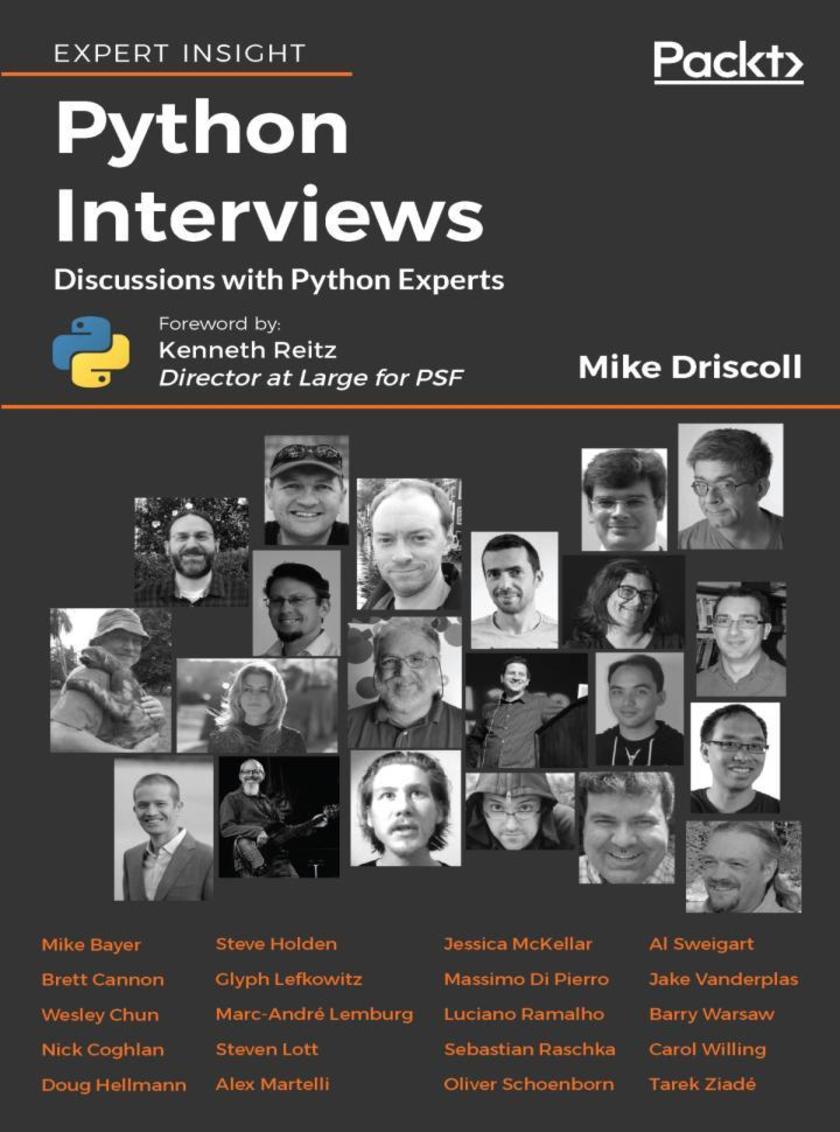
Python Interviews
¥63.21
Mike Driscoll takes you on a journey talking to a hall-of-fame list of truly remarkable Python experts. You’ll be inspired every time by their passion for the Python language, as they share with you their experiences, contributions, and careers in Python. About This Book ? Hear from these key Python thinkers about the current status of Python, and where it's heading in the future ? Listen to their close thoughts on significant Python topics, such as Python's role in scientific computing, and machine learning ? Understand the direction of Python, and what needs to change for Python 4 Who This Book Is For Python programmers and students interested in the way that Python is used – past and present – with useful anecdotes. It will also be of interest to those looking to gain insights from top programmers. What You Will Learn ? How successful programmers think ? The history of Python ? Insights into the minds of the Python core team ? Trends in Python programming In Detail Each of these twenty Python Interviews can inspire and refresh your relationship with Python and the people who make Python what it is today. Let these interviews spark your own creativity, and discover how you also have the ability to make your mark on a thriving tech community. This book invites you to immerse in the Python landscape, and let these remarkable programmers show you how you too can connect and share with Python programmers around the world. Learn from their opinions, enjoy their stories, and use their tech tips. ? Brett Cannon - former director of the PSF, Python core developer, led the migration to Python 3. ? Steve Holden - tireless Python promoter and former chairman and director of the PSF. ? Carol Willing - former director of the PSF and Python core developer, Project Jupyter Steering Council member. ? Nick Coghlan - founding member of the PSF and Python core developer. ? Jessica McKellar - former director of the PSF and Python activist. ? Marc-André Lemburg - Python core developer and founding member of the PSF. ? Glyph Lefkowitz - founder of Twisted and fellow of the PSF. ? Doug Hellmann - fellow of the PSF, creator of the Python Module of the Week blog, Python community member since 1998. ? Massimo Di Pierro - fellow of the PSF, data scientist and the inventor of web2py. ? Alex Martelli - fellow of the PSF and co-author of Python in a Nutshell. ? Barry Warsaw - fellow of the PSF, Python core developer since 1995, and original member of PythonLabs. ? Tarek Ziadé - founder of Afpy and author of Expert Python Programming. ? Sebastian Raschka - data scientist and author of Python Machine Learning. ? Wesley Chun - fellow of the PSF and author of the Core Python Programming books. ? Steven Lott - Python blogger and author of Python for Secret Agents. ? Oliver Schoenborn - author of Pypubsub and wxPython mailing list contributor. ? Al Sweigart - bestselling author and creator of the Python modules Pyperclip and PyAutoGUI. ? Luciano Ramalho - fellow of the PSF and the author of Fluent Python. ? Mike Bayer - fellow of the PSF, creator of open source libraries including SQLAlchemy. ? Jake Vanderplas - data scientist and author of Python Data Science Handbook. Style and approach This is a book of one-to-one interviews with leading Python programmers and luminaries in the field.
Modular Programming in Java 9
¥63.21
Kick-start your modular programming journey and gear up for the future of Java development About This Book ? Master design patterns and best practices to build truly modular applications in Java 9 ? Upgrade your old Java code to Java 9 with ease ? Build and run a smooth functioning multi-module application. Who This Book Is For This book is written for Java developers who are interested in learning and understanding the techniques and best practices to build modular applications in Java. The book assumes some previous programming experience in Java 8 or earlier, familiarity with the basic Java types such as classes and interfaces, as well as experience in compiling and executing Java programs. What You Will Learn ? Get introduced to the concept of modules and modular programming by working on a fully modular Java application ? Build and configure your own Java 9 modules ? Work with multiple modules and establish inter-module dependencies ? Understand and use the principles of encapsulation, readability, and accessibility ? Use jlink to generate fully loaded custom runtime images like a pro ? Discover the best practices to help you write awesome modules that are a joy to use and maintain ? Upgrade your old Java code to use the new Java 9 module system In Detail The Java 9 module system is an important addition to the language that affects the way we design, write, and organize code and libraries in Java. It provides a new way to achieve maintainable code by the encapsulation of Java types, as well as a way to write better libraries that have clear interfaces. Effectively using the module system requires an understanding of how modules work and what the best practices of creating modules are. This book will give you step-by-step instructions to create new modules as well as migrate code from earlier versions of Java to the Java 9 module system. You'll be working on a fully modular sample application and add features to it as you learn about Java modules. You'll learn how to create module definitions, setup inter-module dependencies, and use the built-in modules from the modular JDK. You will also learn about module resolution and how to use jlink to generate custom runtime images. We will end our journey by taking a look at the road ahead. You will learn some powerful best practices that will help you as you start building modular applications. You will also learn how to upgrade an existing Java 8 codebase to Java 9, handle issues with libraries, and how to test Java 9 applications. Style and Approach The book is a step-by-step guide to understanding Modularity and building a complete application using a modular design.
Metasploit for Beginners
¥63.21
An easy to digest practical guide to Metasploit covering all aspects of the framework from installation, configuration, and vulnerability hunting to advanced client side attacks and anti-forensics. About This Book ? Carry out penetration testing in highly-secured environments with Metasploit ? Learn to bypass different defenses to gain access into different systems. ? A step-by-step guide that will quickly enhance your penetration testing skills. Who This Book Is For If you are a penetration tester, ethical hacker, or security consultant who wants to quickly learn the Metasploit framework to carry out elementary penetration testing in highly secured environments then, this book is for you. What You Will Learn ? Get to know the absolute basics of the Metasploit framework so you have a strong foundation for advanced attacks ? Integrate and use various supporting tools to make Metasploit even more powerful and precise ? Set up the Metasploit environment along with your own virtual testing lab ? Use Metasploit for information gathering and enumeration before planning the blueprint for the attack on the target system ? Get your hands dirty by firing up Metasploit in your own virtual lab and hunt down real vulnerabilities ? Discover the clever features of the Metasploit framework for launching sophisticated and deceptive client-side attacks that bypass the perimeter security ? Leverage Metasploit capabilities to perform Web application security scanning In Detail This book will begin by introducing you to Metasploit and its functionality. Next, you will learn how to set up and configure Metasploit on various platforms to create a virtual test environment. You will also get your hands on various tools and components used by Metasploit. Further on in the book, you will learn how to find weaknesses in the target system and hunt for vulnerabilities using Metasploit and its supporting tools. Next, you'll get hands-on experience carrying out client-side attacks. Moving on, you'll learn about web application security scanning and bypassing anti-virus and clearing traces on the target system post compromise. This book will also keep you updated with the latest security techniques and methods that can be directly applied to scan, test, hack, and secure networks and systems with Metasploit. By the end of this book, you'll get the hang of bypassing different defenses, after which you'll learn how hackers use the network to gain access into different systems. Style and approach This tutorial is packed with step-by-step instructions that are useful for those getting started with Metasploit. This is an easy-to-read guide to learning Metasploit from scratch that explains simply and clearly all you need to know to use this essential IT power tool.
Mastering Linux Shell Scripting
¥63.21
Master the complexities of Bash shell scripting and unlock the power of shell for your enterprise About This Book ? Identify high-level steps such as verifying user input ? Using the command line and conditional statements in creating/executing simple shell scripts ? Create and edit dynamic shell scripts to manage complex and repetitive tasks ? Leverage the command-line to bypass GUI and automate common tasks Who This Book Is For If you are a Linux administrator or a system administrator and are interested in automating tasks in your daily lives, saving time and effort, this book is for you. Basic shell scripting and command-line experience will be required. Familiarity with the tasks you need to automate will be helpful. What You Will Learn ? Make, execute, and debug your first Bash script ? Create interactive scripts that prompt for user input ? Foster menu structures for operators with little command-line experience ? Develop scripts that dynamically edit web configuration files to produce a new virtual host ? Write scripts that use AWK to search and reports on log files ? Draft effective scripts using functions as building blocks, reducing maintenance and build time ? Make informed choices by comparing different script languages such as Python with BASH In Detail In this book, you’ll discover everything you need to know to master shell scripting and make informed choices about the elements you employ. Grab your favorite editor and start writing your best Bash scripts step by step. Get to grips with the fundamentals of creating and running a script in normal mode, and in debug mode. Learn about various conditional statements' code snippets, and realize the power of repetition and loops in your shell script. You will also learn to write complex shell scripts. This book will also deep dive into file system administration, directories, and system administration like networking, process management, user authentications, and package installation and regular expressions. Towards the end of the book, you will learn how to use Python as a BASH Scripting alternative. By the end of this book, you will know shell scripts at the snap of your fingers and will be able to automate and communicate with your system with keyboard expressions. Style and approach The book will capture your attention and keep you engaged with the simplicity and clarity of each explanation. Every step is accompanied by screenshots so you can cross-check the results before moving on.
Enterprise Internet of Things Handbook
¥63.21
Get familiar with the building blocks of IoT solutions using off–the-shelf IoT platforms. About This Book ? Work with various trending IoT platforms such as AWS IoT, Azure IoT, Google IoT, IBM Watson IoT, and Kaa IoT ? Gain hands-on knowledge working with Cloud-based IoT platforms, IoT Analytics, and so on. ? A practical guide that will help you build IoT strategies for your organization Who This Book Is For This book is targeted at IoT architects and engineers, or any stakeholders working with IoT solutions in an organization. This book will also help decision makers and professionals from small- and medium-sized enterprises build an IoT strategy for their venture. What You Will Learn ? Connect a Temperature and Humidity sensor and see how these two can be managed from various platforms ? Explore the core components of AWS IoT such as AWS Kinesis and AWS IoTRules Engine ? Build a simple analysis dashboard using Azure IoT and Power BI ? Understand the fundamentals of Google IoT and use Google core APIs to build your own dashboard ? Get started and work with the IBM Watson IoT platform ? Integrate Cassandra and Zeppelin with Kaa IoT dashboard ? Review some Machine Learning and AI and get to know more about their implementation in the IoT domain. In Detail There is a lot of work that is being done in the IoT domain and according to Forbes the global IoT market will grow from $157B in 2016 to $457B by 2020. This is an amazing market both in terms technology advancement as well as money. In this book, we will be covering five popular IoT platforms, namely, AWS IoT, Microsoft Azure IoT, Google IoT Core, IBM Watson IoT, and Kaa IoT middleware. You are going to build solutions that will use a Raspberry Pi 3, a DHT11 Temperature and humidity sensor, and a dashboard to visualize the sensor data in real-time. Furthermore, you will also explore various components of each of the platforms that are needed to achieve the desired solution. Besides building solutions, you will look at how Machine Learning and IoT go hand in hand and later design a simple predictive web service based on this concept. By the end of this book, you will be in a position to implement an IoT strategy best-fit for your organization Style and approach An informative guide that will help you design and implement an IoT Strategy best-fit for your organization
Raspberry Pi 3 Cookbook for Python Programmers
¥63.21
A recipe-based guide to programming your Raspberry Pi 3 using Python About This Book : ? Leverage the power of Raspberry Pi 3 using Python programming ? Create 3D games, build neural network modules, and interface with your own circuits ? Packed with clear, step-by-step recipes to walk you through the capabilities of Raspberry Pi Who This Book Is For : This book is for anyone who wants to master the skills of Python programming using Raspberry Pi 3. Prior knowledge of Python will be an added advantage. What You Will Learn : ? Learn to set up and run Raspberry Pi 3 ? Build text classifiers and perform automation using Python ? Predict sentiments in words and create games and graphics ? Detect edges and contours in images ? Build human face detection and recognition system ? Use Python to drive hardware ? Sense and display real-world data ? Build a neural network module for optical character recognition ? Build movie recommendations system In Detail : Raspberry Pi 3 Cookbook for Python Programmers – Third Edition begins by guiding you through setting up Raspberry Pi 3, performing tasks using Python 3.6, and introducing the first steps to interface with electronics. As you work through each chapter, you will build your skills and apply them as you progress. You will learn how to build text classifiers, predict sentiments in words, develop applications using the popular Tkinter library, and create games by controlling graphics on your screen. You will harness the power of a built in graphics processor using Pi3D to generate your own high-quality 3D graphics and environments. You will understand how to connect Raspberry Pi’s hardware pins directly to control electronics, from switching on LEDs and responding to push buttons to driving motors and servos. Get to grips with monitoring sensors to gather real-life data, using it to control other devices, and viewing the results over the internet. You will apply what you have learned by creating your own Pi-Rover or Pi-Hexipod robots. You will also learn about sentiment analysis, face recognition techniques, and building neural network modules for optical character recognition. Finally, you will learn to build movie recommendations system on Raspberry Pi 3. Style and approach : Written in a cookbook style, this book contains a series of recipes on various topics. It is an easy-to-follow step-by-step guide with examples of feature integration suitable for any search application.
Java 9: Building Robust Modular Applications
¥63.21
Mastering advanced features of Java and implement them to build amazing projects About This Book ? Take advantage of Java's new modularity features to write real-world applications that solve a variety of problems ? Explore the major concepts introduced with Java 9, including modular programming, HTTP 2.0, API changes, and more ? Get to grips with tools, techniques and best practices to enhance application development Who This Book Is For This learning path is for Java developers who are looking to move a level up and learn how to build robust applications in the latest version of Java. What You Will Learn ? Package Java applications as modules using the Java Platform Module System ? Implement process management in Java using the all-new process handling API ? Integrate your applications with third-party services in the cloud ? Interact with mail servers, using JavaMail to build an application that filters spam messages ? Use JavaFX to build rich GUI-based applications, which are an essential element of application development ? Leverage the possibilities provided by the newly introduced Java shell ? Test your application's effectiveness with the JVM harness ? See how Java 9 provides support for the HTTP 2.0 standard In Detail Java 9 and its new features add to the richness of the language; Java is one of the languages most used by developers to build robust software applications. Java 9 comes with a special emphasis on modularity with its integration with Jigsaw. This course is your one-stop guide to mastering the language. You'll be provided with an overview and explanation of the new features introduced in Java 9 and the importance of the new APIs and enhancements. Some new features of Java 9 are ground-breaking; if you are an experienced programmer, you will be able to make your enterprise applications leaner by learning these new features. You'll be provided with practical guidance in applying your newly acquired knowledge of Java 9 and further information on future developments of the Java platform. This course will improve your productivity, making your applications faster. Next, you'll go on to implement everything you've learned by building 10 cool projects. You will learn to build an email filter that separates spam messages from all your inboxes, a social media aggregator app that will help you efficiently track various feeds, and a microservice for a client/server note application, to name just a few. By the end of this course, you will be well acquainted with Java 9 features and able to build your own applications and projects. This Learning Path contains the best content from the following two recently published Packt products: ? Mastering Java 9 ? Java 9 Programming Blueprints Style and approach This practical guide is filled with real-world examples. Its projects will help you get acquainted with concepts in depth.


