


 购物车
购物车 个人中心
个人中心
Unreal Engine 4.X By Example
¥90.46
An example-based practical guide to get you up and running with Unreal Engine 4.X About This Book A unique resource on Unreal with an interactive example based approach that is sure to get you up and running immediately Will feature four unique game projects that increase in complexity which will enable readers to build their game development skills using Unreal Engine 4 and the C++ programming language Will be the most up to date book in the market on Unreal with full coverage of the new features of UE4 Who This Book Is For Unreal Engine 4.X by Example was written for keen developers who wish to learn how to fully utilise Unreal Engine 4 to make awesome and engrossing game titles. Whether you are brand new to game development or a seasoned expert, you will be able to make use of the engine with C++. Experience with both C++ and other game engines is preferred before embarking on the Unreal by Example journey, but with a little external research into the basics of C++ programming, this book can take a complete game development novice to an Unreal Engine Developer! What You Will Learn Use C++ with Unreal Engine to boost the development potential of any Unreal Engine project Vastly improve workflow and content creation with the visual *ing system blueprint Design, test, and implement interesting game worlds using Unreal Engines built-in editor Build a networked, feature-rich first person shooter that you can play with others over LAN Build design-centric game worlds that play to needs of your game ideas Paint your game worlds via the creation and modification of visual shaders called materials Gain knowledge of other game development disciplines through the use of the Animation and Material tool sets Create feature-rich game projects with a sophisticated visual quality and feature set In Detail With Unreal Engine 4 being made free to use, for any keen game developer it is quickly becoming the most popular game engine in today’s development industry. The engine offers a rich feature set that can be customized and built upon through the use of C++. This book will cover how to work with Unreal Engine’s tool set all the way from the basics of the editor and the visual *ing system blueprint to the in-depth low-level creation of content using C++. This book will provide you with the skills you need to create feature-rich, captivating, and refined game titles with Unreal Engine 4. This book will take you through the creation of four unique game projects, designed so that you will be ready to apply the engine’s rich development capabilities. You will learn not only to take advantage of the visual tools of the engine, but also the vast and powerful programming feature set of Unreal Engine 4. Style and approach The best resource that any beginner level game developer can dream of with examples on leveraging the amazing graphics engine, beautiful character animation and game world generations etc. by means of exciting real world game generation.This book would be a very unique resource for any game developer who wants to get up and running with Unreal. The unique example-driven approach will take you through the most basic games towards the more complex ones and will gradually build your skill level.
Node.js 6.x Blueprints
¥90.46
Create stunning web applications and Restful APIs from start to finish with Express, Loopback, MongoDB, and MySQL using this definitive guide About This Book Create stunning applications with Node.js from scratch, no matter the goal Discover a wide variety of applications you can effectively integrate third-party libraries and other front-end frameworks with Node.js Leverage all the new features introduced in Node.js 6.X Who This Book Is For This book caters to developers who are looking to build projects right from a simple website to more complex one such as a blog, chat application, a photography site, and a lot more. A Basic knowledge of JavaScript and Node.js would be extremely beneficial. What You Will Learn Explore MVC design pattern in Node.js Build solid architectures by following test-driven development Look beyond web applications and create your own desktop app with Node.js Develop single page applications using Node.js with the RESTful APIs, MongoDB, and ORM Master the Express framework and build a complete application with a real database Create a real-time and fully functional online chat application with Socket.IO In Detail Node.js is the most popular framework to create server-side applications today. Be it web, desktop, or mobile, Node.js comes to your rescue to create stunning real-time applications. Node.js 6.x Blueprints will teach you to build these types of projects in an easy-to-understand manner. The key to any Node.js project is a strong foundation on the concepts that will be a part of every project. The book will first teach you the MVC design pattern while developing a Twitter-like application using Express.js. In the next chapters, you will learn to create a website and applications such as streaming, photography, and a store locator using MongoDB, MySQL, and Firebase. Once you’re warmed up, we’ll move on to more complex projects such as a consumer feedback app, a real-time chat app, and a blog using Node.js with frameworks such as loopback.io and socket.io. Finally, we’ll explore front-end build processes, Docker, and continuous delivery. By the end of book, you will be comfortable working with Node.js applications and will know the best tools and frameworks to build highly scalable desktop and cloud applications. Style and approach This is an easy-to-follow guide full of practical examples. This book takes a project-based approach and each chapter contains step-by-step instructions to create stunning applications across different application domains from scratch.
Mastering Tableau
¥90.46
Master the intricacies of Tableau to create effective data visualizations About This Book Arm yourself with an arsenal of advanced chart types and geocoding to efficiently and engagingly present information Map a grid over a network node diagram and use that grid to demonstrate loads, processing time, and more in Tableau Integrate R with Tableau by utilizing R functions, libraries, and saved models Who This Book Is For If you are a business analyst without developer-level programming skills, then this book is for you. You are expected to have at least a fundamental understanding of Tableau and basic knowledge of joins, however SQL knowledge is not assumed. You should have basic computer skills, including at least moderate Excel proficiency. What You Will Learn Create a worksheet that can display the current balance for any given period in time Recreate a star schema from in a data warehouse in Tableau Combine level of detail calculations with table calculations, sets, and parameters Create custom polygons to build filled maps for area codes in the USA Visualize data using a set of analytical and advanced charting techniques Know when to use Tableau instead of PowerPoint Build a dashboard and export it to PowerPoint In Detail Tableau has emerged as one of the most popular Business Intelligence solutions in recent times, thanks to its powerful and interactive data visualization capabilities. This book will empower you to become a master in Tableau by exploiting the many new features introduced in Tableau 10.0. You will embark on this exciting journey by getting to know the valuable methods of utilizing advanced calculations to solve complex problems. These techniques include creative use of different types of calculations such as row-level, aggregate-level, and more. You will discover how almost any data visualization challenge can be met in Tableau by getting a proper understanding of the tool’s inner workings and creatively exploring possibilities. You’ll be armed with an arsenal of advanced chart types and techniques to enable you to efficiently and engagingly present information to a variety of audiences through the use of clear, efficient, and engaging dashboards. Explanations and examples of efficient and inefficient visualization techniques, well-designed and poorly designed dashboards, and compromise options when Tableau consumers will not embrace data visualization will build on your understanding of Tableau and how to use it efficiently. By the end of the book, you will be equipped with all the information you need to create effective dashboards and data visualization solutions using Tableau. Style and approach This book takes a direct approach, to systematically evolve to more involved functionalities such as advanced calculation, parameters & sets, data blending and R integration. This book will help you gain skill in building visualizations previously beyond your capacity.
PHP 7 Programming Cookbook
¥90.46
Over 80 recipes that will take your PHP 7 web development skills to the next level! About This Book This is the most up-to-date book in the market on PHP It covers the new features of version 7.x, best practices for server-side programming, and MVC frameworks The recipe-based approach will allow you to explore the unique capabilities that PHP offers to web programmers Who This Book Is For If you are an aspiring web developer, mobile developer, or backend programmer, then this book is for you as it will take your PHP programming skills to next level. Basic knowledge of PHP programming is assumed. What You Will Learn Use advanced PHP 7 features, such as the Abstract Syntax Tree, Uniform Variable Syntax, Scalar Type Hints, Generator Delegation, Anonymous Classes, and the Context Sensitive Lexer Discover where and when PHP 5 code needs to be re-written to avoid backwards-compatibility breaks Improve the overall application security and error handling by taking advantage of classes that implement the new throwable interface Solve practical real-world programming problems using PHP 7 Develop middle-wareclasses that allow PHP developers to gluedifferent open source libraries together seamlessly Define and Implement PSR-7 classes Create custom middleware using PSR-7 compliant classes Test and debug your code, and get to know the best practices In Detail PHP 7 comes with a myriad of new features and great tools to optimize your code and make your code perform faster than in previous versions. Most importantly, it allows you to maintain high traffic on your websites with low-cost hardware and servers through a multithreading web server. This book demonstrates intermediate to advanced PHP techniques with a focus on PHP 7. Each recipe is designed to solve practical, real-world problems faced by PHP developers like yourself every day. We also cover new ways of writing PHP code made possible only in version 7. In addition, we discuss backward-compatibility breaks and give you plenty of guidance on when and where PHP 5 code needs to be changed to produce the correct results when running under PHP 7. This book also incorporates the latest PHP 7.x features. By the end of the book, you will be equipped with the tools and skills required to deliver efficient applications for your websites and enterprises. Style and approach This book takes a recipe-based approach, with real-world examples that can serve as building blocks for a larger application. Each recipe is self-contained with no external dependencies. This book follows a problem-solution strategy so you understand how to deal with various scenarios you may encounter while using PHP 7 in your daily activities.
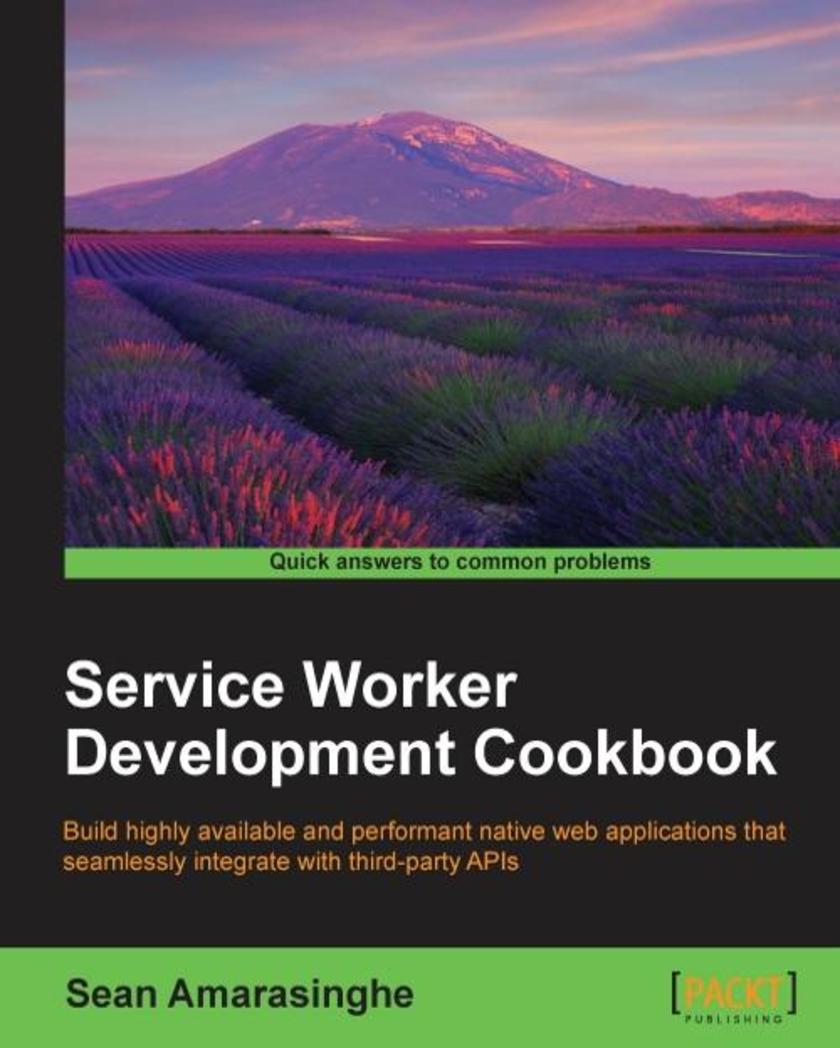
Service Worker Development Cookbook
¥90.46
Build highly available and performant native web applications that seamlessly integrate with third-party APIs About This Book Get straight into the action with step-by-step recipes that show you how to put Service Workers to work Find out what Service Workers can do for your app, then do it! Get the first in-depth look at this important new feature for web developers Who This Book Is For Web developers, mobile application developers, and software engineers with any level of knowledge can use this book. You should be familiar with JavaScript and HTML. What You Will Learn Display a custom offline page Cache critical resources for offline use Implement offline Google Analytics Get network responses offline Implement push notifications Improve performance of your app In Detail It would be nice to have web apps that work offline and send push notifications. This is now possible with Service Workers, which can add native-like functionality to your web apps without requiring a download. This book will get your mobile and web apps functioning without Internet connectivity, improve performance and network interaction in order to increase the level of availability, and show you how to build performant applications that seamlessly integrate with third-party APIs. We’ll show you how to add Service Worker functionality to web apps and sites, access offline content through basic and advanced techniques, and build powerful interactive system notifications. We’ll also teach you about cache functionality and assets to provide immediate load even over narrow connections. We conclude by giving you various tips to improve app performance, including the background sync technique. By the end of this book, you’ll know build high performing and faster web and mobile applications with Service Workers. Style and approach This book provides lots of task-oriented, practical, and inspiring ways to put Service Workers to work. Step-by-step instructions will guide you through every task.
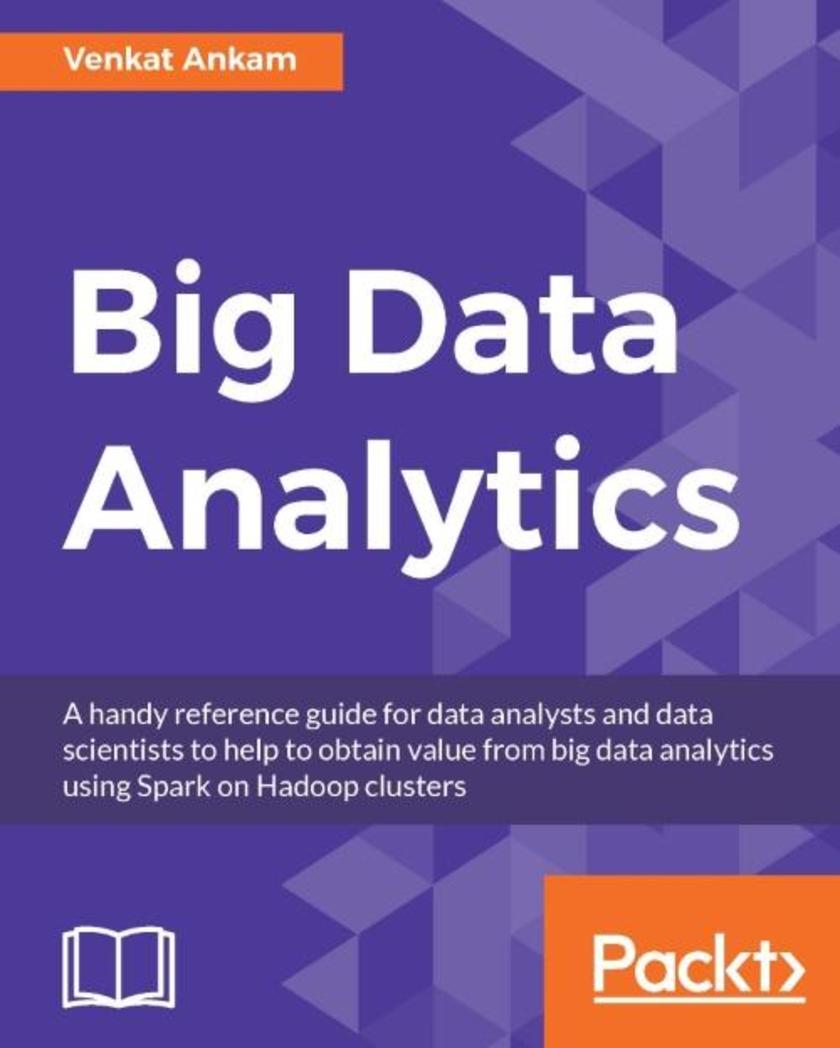
Big Data Analytics
¥90.46
A handy reference guide for data analysts and data scientists to help to obtain value from big data analytics using Spark on Hadoop clusters About This Book This book is based on the latest 2.0 version of Apache Spark and 2.7 version of Hadoop integrated with most commonly used tools. Learn all Spark stack components including latest topics such as DataFrames, DataSets, GraphFrames, Structured Streaming, DataFrame based ML Pipelines and SparkR. Integrations with frameworks such as HDFS, YARN and tools such as Jupyter, Zeppelin, NiFi, Mahout, HBase Spark Connector, GraphFrames, H2O and Hivemall. Who This Book Is For Though this book is primarily aimed at data analysts and data scientists, it will also help architects, programmers, and practitioners. Knowledge of either Spark or Hadoop would be beneficial. It is assumed that you have basic programming background in Scala, Python, SQL, or R programming with basic Linux experience. Working experience within big data environments is not mandatory. What You Will Learn Find out and implement the tools and techniques of big data analytics using Spark on Hadoop clusters with wide variety of tools used with Spark and Hadoop Understand all the Hadoop and Spark ecosystem components Get to know all the Spark components: Spark Core, Spark SQL, DataFrames, DataSets, Conventional and Structured Streaming, MLLib, ML Pipelines and Graphx See batch and real-time data analytics using Spark Core, Spark SQL, and Conventional and Structured Streaming Get to grips with data science and machine learning using MLLib, ML Pipelines, H2O, Hivemall, Graphx, SparkR and Hivemall. In Detail Big Data Analytics book aims at providing the fundamentals of Apache Spark and Hadoop. All Spark components – Spark Core, Spark SQL, DataFrames, Data sets, Conventional Streaming, Structured Streaming, MLlib, Graphx and Hadoop core components – HDFS, MapReduce and Yarn are explored in greater depth with implementation examples on Spark + Hadoop clusters. It is moving away from MapReduce to Spark. So, advantages of Spark over MapReduce are explained at great depth to reap benefits of in-memory speeds. DataFrames API, Data Sources API and new Data set API are explained for building Big Data analytical applications. Real-time data analytics using Spark Streaming with Apache Kafka and HBase is covered to help building streaming applications. New Structured streaming concept is explained with an IOT (Internet of Things) use case. Machine learning techniques are covered using MLLib, ML Pipelines and SparkR and Graph Analytics are covered with GraphX and GraphFrames components of Spark. Readers will also get an opportunity to get started with web based notebooks such as Jupyter, Apache Zeppelin and data flow tool Apache NiFi to analyze and visualize data. Style and approach This step-by-step pragmatic guide will make life easy no matter what your level of experience. You will deep dive into Apache Spark on Hadoop clusters through ample exciting real-life examples. Practical tutorial explains data science in simple terms to help programmers and data analysts get started with Data Science
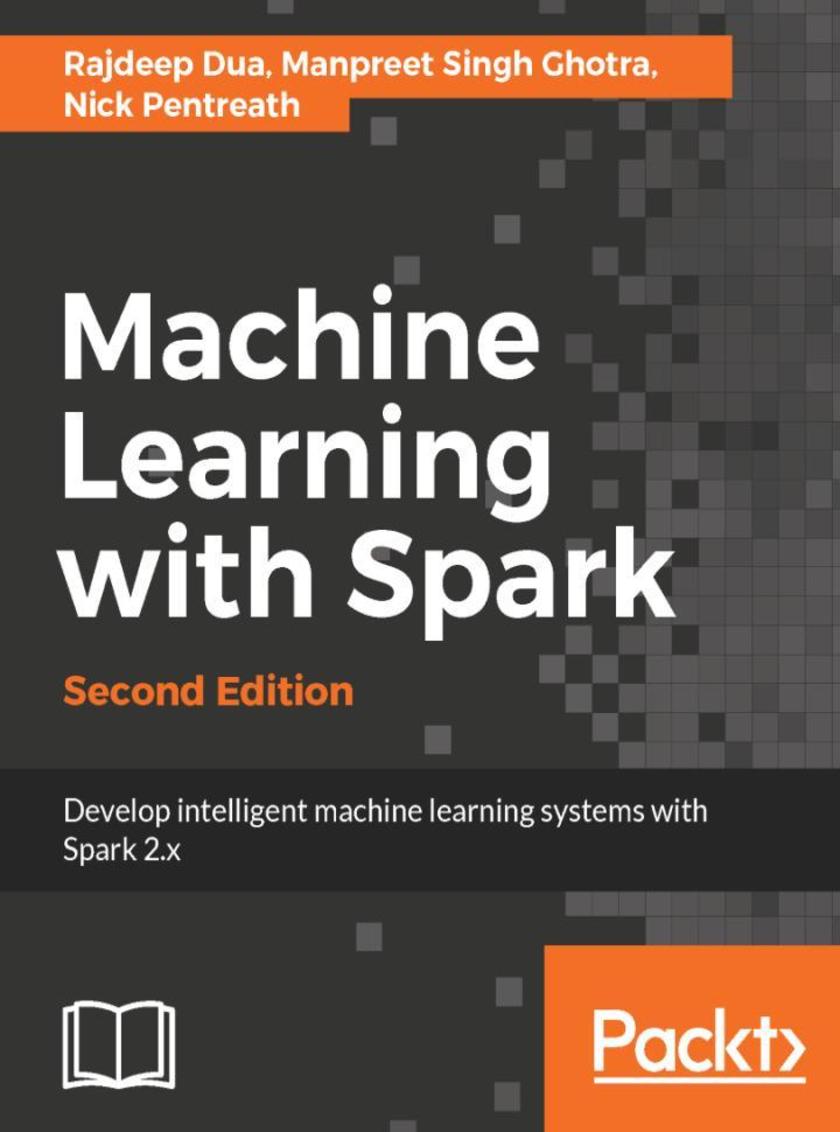
Machine Learning with Spark - Second Edition
¥90.46
"Key Features ?Get to the grips with the latest version of Apache Spark ?Utilize Spark's machine learning library to implement predictive analytics ?Leverage Spark's powerful tools to load, analyze, clean, and transform your data Book De*ion Spark ML is the machine learning module of Spark. It uses in-memory RDDs to process machine learning models faster for clustering, classification, and regression. This book will teach you about popular machine learning algorithms and their implementation. You will learn how various machine learning concepts are implemented in the context of Spark ML. You will start by installing Spark in a single and multinode cluster. Next you'll see how to execute Scala and Python based programs for Spark ML. Then we will take a few datasets and go deeper into clustering, classification, and regression. Toward the end, we will also cover text processing using Spark ML. Once you have learned the concepts, they can be applied to implement algorithms in either green-field implementations or to migrate existing systems to this new platform. You can migrate from Mahout or Scikit to use Spark ML. What you will learn ?Get hands-on with the latest version of Spark ML ?Create your first Spark program with Scala and Python ?Set up and configure a development environment for Spark on your own computer, as well as on Amazon EC2 ?Access public machine learning datasets and use Spark to load, process, clean, and transform data ?Use Spark's machine learning library to implement programs by utilizing well-known machine learning models ?Deal with large-scale text data, including feature extraction and using text data as input to your machine learning models ?Write Spark functions to evaluate the performance of your machine learning models "
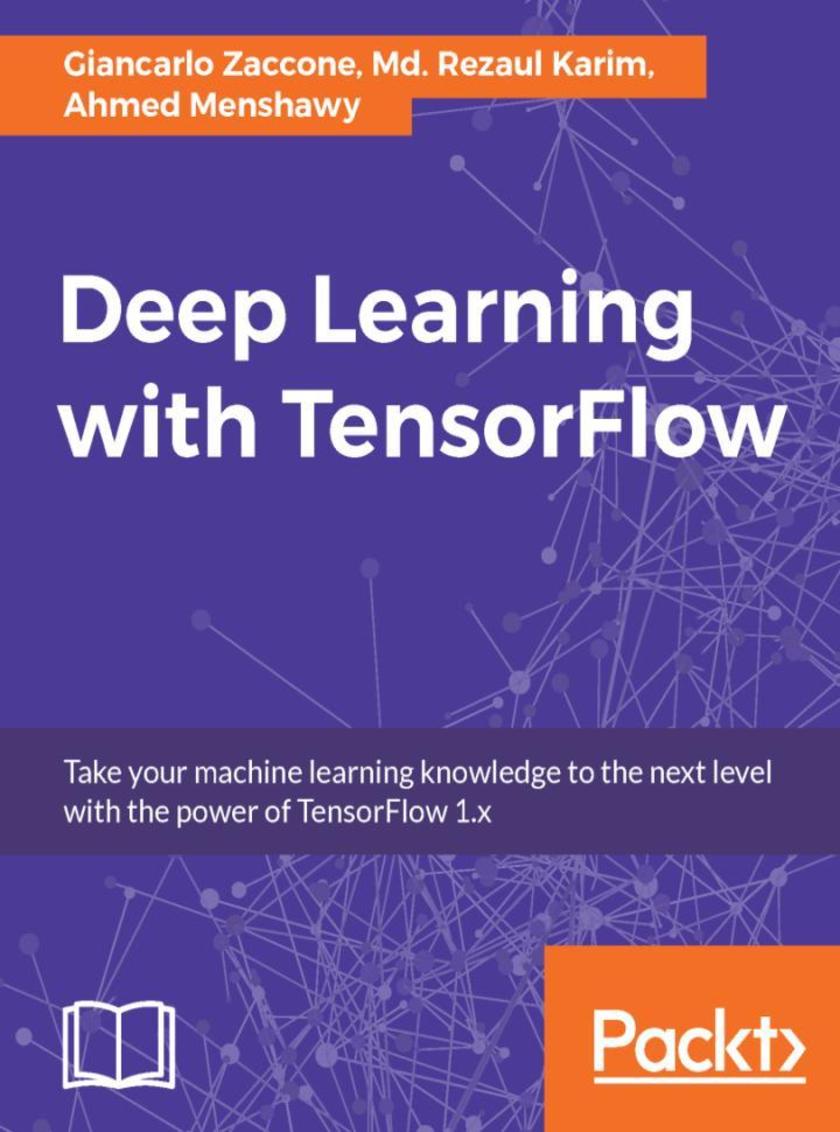
Deep Learning with TensorFlow
¥90.46
Delve into neural networks, implement deep learning algorithms, and explore layers of data abstraction with the help of this comprehensive TensorFlow guide About This Book ?Learn how to implement advanced techniques in deep learning with Google's brainchild, TensorFlow ?Explore deep neural networks and layers of data abstraction with the help of this comprehensive guide ?Real-world contextualization through some deep learning problems concerning research and application Who This Book Is For The book is intended for a general audience of people interested in machine learning and machine intelligence. A rudimentary level of programming in one language is assumed, as is a basic familiarity with computer science techniques and technologies, including a basic awareness of computer hardware and algorithms. Some competence in mathematics is needed to the level of elementary linear algebra and calculus. What You Will Learn ?Learn about machine learning landscapes along with the historical development and progress of deep learning ?Learn about deep machine intelligence and GPU computing with the latest TensorFlow 1.x ?Access public datasets and utilize them using TensorFlow to load, process, and transform data ?Use TensorFlow on real-world datasets, including images, text, and more ?Learn how to evaluate the performance of your deep learning models ?Using deep learning for scalable object detection and mobile computing ?Train machines quickly to learn from data by exploring reinforcement learning techniques ?Explore active areas of deep learning research and applications
Expert Data Visualization
¥90.46
Do you want to make sense of your data? Do you want to create interactive charts, data trees, info-graphics, geospatial charts, and maps efficiently? This book is your ideal choice to master interactive data visualization with D3.js V4. The book includes a number of extensive examples that to help you hone your skills with data visualization. Throughout nine chapters these examples will help you acquire a clear practical understanding of the various techniques, tools and functionality provided by D3.js. You will first setup your D3.JS development environment and learn the basic patterns needed to visualize your data. After that you will learn techniques to optimize different processes such as working with selections; animating data transitions; creating graps and charts, integrating external resources (static as well as streaming); visualizing information on maps; working with colors and scales; utilizing the different D3.js APIs; and much more. The book will also guide you through creating custom graphs and visualizations, and show you how to go from the raw data to beautiful visualizations. The extensive examples will include working with complex and realtime data streams, such as seismic data, geospatial data, scientific data, and more. Towards the end of the book, you will learn to add more functionality on top of D3.js by using it with other external libraries and integrating it with Ecma* 6 and Type*
Java 9 Concurrency Cookbook - Second Edition
¥90.46
Writing concurrent and parallel programming applications is an integral skill for any Java programmer. Java 9 comes with a host of fantastic features, including significant performance improvements and new APIs. This book will take you through all the new APIs, showing you how to build parallel and multi-threaded applications. The book covers all the elements of the Java Concurrency API, with essential recipes that will help you take advantage of the exciting new capabilities. You will learn how to use parallel and reactive streams to process massive data sets. Next, you will move on to create streams and use all their intermediate and terminal operations to process big collections of data in a parallel and functional way. Further, you ll discover a whole range of recipes for almost everything, such as thread management, synchronization, executors, parallel and reactive streams, and many more. At the end of the book, you will learn how to obtain information about the status of some of the most useful components of the Java Concurrency API and how to test concurrent applications using different tools. What you will learn ?Find out to manage the basic components of the Java Concurrency API ?Use synchronization mechanisms to avoid data race conditions and other problems of concurrent applications ?Separate the thread management from the rest of the application with the Executor framework ?Solve problems using a parallelized version of the divide and conquer paradigm with the Fork / Join framework ?Process massive data sets in an optimized way using streams and reactive streams ?See which data structures we can use in concurrent applications and how to use them ?Practice efficient techniques to test concurrent applications ?Get to know tips and tricks to design concurrent applications
Deep Learning with Keras
¥90.46
This book starts by introducing you to supervised learning algorithms such as simple linear regression, the classical multilayer perceptron and more sophisticated deep convolutional networks. You will also explore image processing with recognition of hand written digit images, classification of images into different categories, and advanced objects recognition with related image annotations. An example of identification of salient points for face detection is also provided. Next you will be introduced to Recurrent Networks, which are optimized for processing sequence data such as text, audio or time series. Following that, you will learn about unsupervised learning algorithms such as Autoencoders and the very popular Generative Adversarial Networks (GAN). You will also explore non-traditional uses of neural networks as Style Transfer. Finally, you will look at Reinforcement Learning and its application to AI game playing, another popular direction of research and application of neural networks. What you will learn ?Optimize step-by-step functions on a large neural network using the Backpropagation Algorithm ?Fine-tune a neural network to improve the quality of results ?Use deep learning for image and audio processing ?Use Recursive Neural Tensor Networks (RNTNs) to outperform standard word embedding in special cases ?Identify problems
Spatial Analytics with ArcGIS
¥90.46
Spatial statistics has the potential to provide insight that is not otherwise available through traditional GIS tools. This book is designed to introduce you to the use of spatial statistics so you can solve complex geographic analysis. The book begins by introducing you to the many spatial statistics tools available in ArcGIS. You will learn how to analyze patterns, map clusters, and model spatial relationships with these tools. Further on, you will explore how to extend the spatial statistics tools currently available in ArcGIS, and use the R programming language to create custom tools in ArcGIS through the ArcGIS Bridge using real-world examples. At the end of the book, you will be presented with two exciting case studies where you will be able to practically apply all your learning to analyze and gain insights into real estate data. What you will learn ?Get to know how to measure geographic distributions ?Perform clustering analysis including hot spot and outlier analysis ?Conduct data conversion tasks using the Utilities toolset ?Understand how to use the tools provided by the Mapping Clusters toolset in the Spatial Statistics Toolbox ?Get to grips with the basics of R for performing spatial statistical programming ?Create custom ArcGIS tools with R and ArcGIS Bridge ?Understand the application of Spatial Statistics tools
Mastering Java for Data Science
¥90.46
Java is the most popular programming language, according to the TIOBE index, and it is a typical choice for running production systems in many companies, both in the startup world and among large enterprises. Not surprisingly, it is also a common choice for creating data science applications: it is fast and has a great set of data processing tools, both built-in and external. What is more, choosing Java for data science allows you to easily integrate solutions with existing software, and bring data science into production with less effort. This book will teach you how to create data science applications with Java. First, we will revise the most important things when starting a data science application, and then brush up the basics of Java and machine learning before diving into more advanced topics. We start by going over the existing libraries for data processing and libraries with machine learning algorithms. After that, we cover topics such as classification and regression, dimensionality reduction and clustering, information retrieval and natural language processing, and deep learning and big data. Finally, we finish the book by talking about the ways to deploy the model and evaluate it in production settings. What you will learn ?Get a solid understanding of the data processing toolbox available in Java ?Explore the data science ecosystem available in Java
Vulkan Cookbook
¥90.46
Work through recipes to unlock the full potential of the next generation graphics API―Vulkan About This Book ?This book explores a wide range of modern graphics programming techniques and GPU compute methods to make the best use of the Vulkan API ?Learn techniques that can be applied to a wide range of platforms desktop, smartphones, and embedded devices Who This Book Is For This book is ideal for developers who know C/C++ languages, have some basic familiarity with graphics programming, and now want to take advantage of the new Vulkan API in the process of building next generation computer graphics. Some basic familiarity of Vulkan would be useful to follow the recipes. OpenGL developers who want to take advantage of the Vulkan API will also find this book useful. What You Will Learn?Work with Swapchain to present images on screen ?Create, submit, and synchronize operations processed by the hardware ?Create buffers and images, manage their memory, and upload data to them from CPU ?Explore de*or sets and set up an interface between application and shaders ?Organize drawing operations into a set of render passes and subpasses ?Prepare graphics pipelines to draw 3D scenes and compute pipelines to perform mathematical calculations ?Implement geometry projection and tessellation, texturing, lighting, and post-processing techniques ?Write shaders in GLSL and convert them into SPIR-V assemblies ?Find out about and
Mastering PhoneGap Mobile Application Development
¥90.46
Take your PhoneGap experience to the next level and create engaging real-world applicationsAbout This BookCreate a useful PhoneGap workflow for larger projects in order to simplify and manage the development processUse third-party plugins, IndexedDB, and SQLite for PhoneGap to develop large-scale, data-driven, and highly accessible applicationsA pragmatic guide to construct top-notch large-scale applications using PhoneGapWho This Book Is ForIf you have created simple applications using PhoneGap in the past and now want to take your workflow and apps to the next level, this book will help you reach your goals. You should have a good working knowledge of HTML, CSS, and JavaScript, and prior experience with PhoneGap.What You Will LearnConstruct build workflows that simplify complex application developmentIntegrate the next version of JavaScript to simplify your codeCreate accessible hybrid applicationsPersist and query data using third-party database pluginsCreate your own PhoneGap plugins for your unique use casesCreate icons and splash screens suitable for submission to app storesPublish your app to the Google Play and Apple iTunes storesIn DetailPhoneGap is a useful and flexible tool that enables you to create complex hybrid applications for mobile platforms. In addition to the core technology, there is a large and vibrant community that creates third-party plugins that can take your app to the next level.This book will guide you through the process of creating a complex data-driven hybrid mobile application using PhoneGap, web technologies, and third-party plugins.A good foundation is critical, so you will learn how to create a useful workflow to make development easier. From there, the next version of JavaScript (ES6) and the CSS pre-processor SASS are introduced as a way to simplify creating the look of the mobile application. Responsive design techniques are also covered, including the flexbox layout module. As many apps are data-driven, you'll build an application throughout the course of the book that relies upon IndexedDB and SQLite. You'll also download additional content and address how to handle in-app purchases. Furthermore, you’ll build your own customized plugins for your particular use case. When the app is complete, the book will guide you through the steps necessary to submit your app to the Google Play and Apple iTunes stores.Style and approachThis book is a step-by-step guide, in which the concepts covered are explained with the help of hands-on examples
Ember.js Cookbook
¥90.46
Arm yourself with over 65 hands-on recipes to master the skills of building scalable web applications with Ember.jsAbout This BookThis book is your one-stop solution to the key features of Ember.js. Become skilled in the art of building web-apps in a fraction of the code you'd write in other frameworks.Build JavaScript apps that don't break the web! Our 100 recipes will make this a cakewalk for you!This books makes learning Ember.js easy by breaking down each topic into simple-to-understand recipesWho This Book Is ForAnyone who wants to explore Ember.js and wishes to get hands on making sophisticated web apps with less coding will find this book handy. Prior experience in Coding and familiarity with JavaScript is recommended. If you’ve heard of Ember.js or are just curious on how a single-page application framework works, then this book is for you.What You Will LearnSkip the boilerplate code with Ember CLI generatorsCreate a component with actions and eventsSet up a model with Ember Data using fixture dataCreate several different types of test cases and run themManage and set up user authentication using Ember Simple AuthAdd animated transitions to your app with Liquid FireSet up a service and initializer with dependency injectionCreate a working chat applicationSet up an Ember Service and initializer with dependency injectionCreate a working chat applicationIn DetailEmber.js is an open source JavaScript framework that will make you more productive. It uses common idioms and practices, making it simple to create amazing single-page applications. It also lets you create code in a modular way using the latest JavaScript features. Not only that, it has a great set of APIs to get any task done. The Ember.js community is welcoming newcomers and is ready to help you when needed.This book provides in-depth explanations on how to use the Ember.js framework to take you from beginner to expert. You’ll start with some basic topics and by the end of the book, you’ll know everything you need to know to build a fully operational Ember application.We’ll begin by explaining key points on how to use the Ember.js framework and the associated tools. You’ll learn how to effectively use Ember CLI and how to create and deploy your application. We’ll take a close look at the Ember object model and templates by examining bindings and observers. We’ll then move onto Ember components, models, and Ember Data. We’ll show you examples on how to connect to RESTful databases. Next we’ll get to grips with testing with integration and acceptance tests using QUnit. We will conclude by covering authentication, services, and Ember add-ons. We’ll explore advanced topics such as services and initializers, and how to use them together to build real-time applications.Style and approachEach recipe in this book will make it that much easier to understand Ember.js. Recipe after recipe, you will learn the concepts of Ember.js by following the simple step-by-step processes
Learning Network Forensics
¥90.46
Identify and safeguard your network against both internal and external threats, hackers, and malware attacksAbout This BookLay your hands on physical and virtual evidence to understand the sort of crime committed by capturing and analyzing network trafficConnect the dots by understanding web proxies, firewalls, and routers to close in on your suspectA hands-on guide to help you solve your case with malware forensic methods and network behaviorsWho This Book Is ForIf you are a network administrator, system administrator, information security, or forensics professional and wish to learn network forensic to track the intrusions through network-based evidence, then this book is for you. Basic knowledge of Linux and networking concepts is expected.What You Will LearnUnderstand Internetworking, sources of network-based evidence and other basic technical fundamentals, including the tools that will be used throughout the bookAcquire evidence using traffic acquisition software and know how to manage and handle the evidencePerform packet analysis by capturing and collecting data, along with content analysisLocate wireless devices, as well as capturing and analyzing wireless traffic data packetsImplement protocol analysis and content matching; acquire evidence from NIDS/NIPSAct upon the data and evidence gathered by being able to connect the dots and draw links between various eventsApply logging and interfaces, along with analyzing web proxies and understanding encrypted web trafficUse IOCs (Indicators of Compromise) and build real-world forensic solutions, dealing with malwareIn DetailWe live in a highly networked world. Every digital device—phone, tablet, or computer is connected to each other, in one way or another. In this new age of connected networks, there is network crime. Network forensics is the brave new frontier of digital investigation and information security professionals to extend their abilities to catch miscreants on the network.The book starts with an introduction to the world of network forensics and investigations. You will begin by getting an understanding of how to gather both physical and virtual evidence, intercepting and analyzing network data, wireless data packets, investigating intrusions, and so on. You will further explore the technology, tools, and investigating methods using malware forensics, network tunneling, and behaviors. By the end of the book, you will gain a complete understanding of how to successfully close a case.Style and approachAn easy-to-follow book filled with real-world case studies and applications. Each topic is explained along with all the practical tools and software needed, allowing the reader to use a completely hands-on approach.
Learning Informatica PowerCenter 10.x - Second Edition
¥90.46
Harness the power and simplicity of Informatica PowerCenter 10.x to build and manage efficient data management solutions About This Book ? Master PowerCenter 10.x components to create, execute, monitor, and schedule ETL processes with a practical approach. ? An ideal guide to building the necessary skills and competencies to become an expert Informatica PowerCenter developer. ? A comprehensive guide to fetching/transforming and loading huge volumes of data in a very effective way, with reduced resource consumption Who This Book Is For If you wish to deploy Informatica in enterprise environments and build a career in data warehousing, then this book is for you. Whether you are a software developer/analytic professional and are new to Informatica or an experienced user, you will learn all the features of Informatica 10.x. A basic knowledge of programming and data warehouse concepts is essential. What You Will Learn ? Install or upgrade the components of the Informatica PowerCenter tool ? Work on various aspects of administrative skills and on the various developer Informatica PowerCenter screens such as Designer, Workflow Manager, Workflow Monitor, and Repository Manager. ? Get practical hands-on experience of various sections of Informatica PowerCenter, such as navigator, toolbar, workspace, control panel, and so on ? Leverage basic and advanced utilities, such as the debugger, target load plan, and incremental aggregation to process data ? Implement data warehousing concepts such as schemas and SCDs using Informatica ? Migrate various components, such as sources and targets, to another region using the Designer and Repository Manager screens ? Enhance code performance using tips such as pushdown optimization and partitioning In Detail Informatica PowerCenter is an industry-leading ETL tool, known for its accelerated data extraction, transformation, and data management strategies. This book will be your quick guide to exploring Informatica PowerCenter’s powerful features such as working on sources, targets, transformations, performance optimization, scheduling, deploying for processing, and managing your data at speed. First, you’ll learn how to install and configure tools. You will learn to implement various data warehouse and ETL concepts, and use PowerCenter 10.x components to build mappings, tasks, workflows, and so on. You will come across features such as transformations, SCD, XML processing, partitioning, constraint-based loading, Incremental aggregation, and many more. Moreover, you’ll also learn to deliver powerful visualizations for data profiling using the advanced monitoring dashboard functionality offered by the new version. Using data transformation technique, performance tuning, and the many new advanced features, this book will help you understand and process data for training or production purposes. The step-by-step approach and adoption of real-time scenarios will guide you through effectively accessing all core functionalities offered by Informatica PowerCenter version 10.x. Style and approach You'll get hand-on with sources, targets, transformations, performance optimization, scheduling, deploying for processing, and managing your data, and learn everything you need to become a proficient Informatica PowerCenter developer.
Building Web Apps with Spring 5 and Angular
¥90.46
A complete guide to build robust and scalable web applications with Spring and Angular. About This Book ? This hands on guide will teach you how to build an end-to-end modern web application using Spring and Angular. ? It is easy to read and will benefit Java developers who have been used to develop the back-end part of web application while front-end (UI) has been left for UI developers. ? Learn the core aspects involved in developing the backend and the UI, right from designing to integrating and deploying. Who This Book Is For This book is targeted towards Java Web Developers with a basic knowledge of Spring who want to build complete web applications in a fast and effective way. They will want to gain a stronghold on both frontend and backend development to advance in their careers. What You Will Learn ? Set up development environment for Spring Web App and Angular app. ? Process web request and response and build REST API endpoints. ? Create data access components using Spring Web MVC framework and Hibernate ? Use Junit 5 to test your application ? Learn the fundamental concepts around building Angular ? Configure and use Routes and Components. ? Protect Angular app content from common web vulnerabilities and attacks. ? Integrate Angular apps with Spring Boot Web API endpoints ? Deploy the web application based on CI and CD using Jenkins and Docker containers In Detail Spring is the most popular application development framework being adopted by millions of developers around the world to create high performing, easily testable, reusable code. Its lightweight nature and extensibility helps you write robust and highly-scalable server-side web applications. Coupled with the power and efficiency of Angular, creating web applications has never been easier. If you want build end-to-end modern web application using Spring and Angular, then this book is for you. The book directly heads to show you how to create the backend with Spring, showing you how to configure the Spring MVC and handle Web requests. It will take you through the key aspects such as building REST API endpoints, using Hibernate, working with Junit 5 etc. Once you have secured and tested the backend, we will go ahead and start working on the front end with Angular. You will learn about fundamentals of Angular and Type* and create an SPA using components, routing etc. Finally, you will see how to integrate both the applications with REST protocol and deploy the application using tools such as Jenkins and Docker. Style and approach This is a straightforward guide that shows how to build a complete web application in Angular and Spring.
Boost C++ Application Development Cookbook - Second Edition
¥90.46
Learn to build applications faster and better by leveraging the real power of Boost and C++ About This Book ? Learn to use the Boost libraries to simplify your application development ? Learn to develop high quality, fast and portable applications ? Learn the relations between Boost and C++11/C++4/C++17 Who This Book Is For This book is for developers looking to improve their knowledge of Boost and who would like to simplify their application development processes. Prior C++ knowledge and basic knowledge of the standard library is assumed. What You Will Learn ? Get familiar with new data types for everyday use ? Use smart pointers to manage resources ? Get to grips with compile-time computations and assertions ? Use Boost libraries for multithreading ? Learn about parallel execution of different task ? Perform common string-related tasks using Boost libraries ? Split all the processes, computations, and interactions to tasks and process them independently ? Learn the basics of working with graphs, stacktracing, testing and interprocess communications ? Explore different helper macros used to detect compiler, platform and Boost features In Detail If you want to take advantage of the real power of Boost and C++ and avoid the confusion about which library to use in which situation, then this book is for you. Beginning with the basics of Boost C++, you will move on to learn how the Boost libraries simplify application development. You will learn to convert data such as string to numbers, numbers to string, numbers to numbers and more. Managing resources will become a piece of cake. You’ll see what kind of work can be done at compile time and what Boost containers can do. You will learn everything for the development of high quality fast and portable applications. Write a program once and then you can use it on Linux, Windows, MacOS, Android operating systems. From manipulating images to graphs, directories, timers, files, networking – everyone will find an interesting topic. Be sure that knowledge from this book won’t get outdated, as more and more Boost libraries become part of the C++ Standard. Style and approach Clear step-by-step recipes that will help you take advantage of the real power of Boost.
Mastering C++ Programming
¥90.46
Take your C++ coding to the next level by leveraging the latest features and advanced techniques to building high performing, reliable applications. About This Book ? Get acquainted with the latest features in C++ 17 ? Take advantage of the myriad of features and possibilities that C++ offers to build real-world applications ? Write clear and expressive code in C++, and get insights into how to keep your code error-free Who This Book Is For This book is for experienced C++ developers. If you are a novice C++ developer, then it’s highly recommended that you get a solid understanding of the C++ language before reading this book What You Will Learn ? Write modular C++ applications in terms of the existing and newly introduced features ? Identify code-smells, clean up, and refactor legacy C++ applications ? Leverage the possibilities provided by Cucumber and Google Test/Mock to automate test cases ? Test frameworks with C++ ? Get acquainted with the new C++17 features ? Develop GUI applications in C++ ? Build portable cross-platform applications using standard C++ features In Detail C++ has come a long way and has now been adopted in several contexts. Its key strengths are its software infrastructure and resource-constrained applications. The C++ 17 release will change the way developers write code, and this book will help you master your developing skills with C++. With real-world, practical examples explaining each concept, the book will begin by introducing you to the latest features in C++ 17. It encourages clean code practices in C++ in general, and demonstrates the GUI app-development options in C++. You’ll get tips on avoiding memory leaks using smart-pointers. Next, you’ll see how multi-threaded programming can help you achieve concurrency in your applications. Moving on, you’ll get an in-depth understanding of the C++ Standard Template Library. We show you the concepts of implementing TDD and BDD in your C++ programs, and explore template-based generic programming, giving you the expertise to build powerful applications. Finally, we’ll round up with debugging techniques and best practices.By the end of the book, you’ll have an in-depth understanding of the language and its various facets. Style and approach This straightforward guide will help you level up your skills in C++ programming, be it for enterprise software or for low-latency applications like games. Filled with real-world, practical examples, this book will take you gradually up the steep learning curve that is C++.


