


 购物车
购物车 个人中心
个人中心
R Data Science Essentials
¥63.21
Learn the essence of data science and visualization using R in no time at allAbout This BookBecome a pro at making stunning visualizations and dashboards quickly and without hassleFor better decision making in business, apply the R programming language with the help of useful statistical techniques.From seasoned authors comes a book that offers you a plethora of fast-paced techniques to detect and analyze data patternsWho This Book Is ForIf you are an aspiring data scientist or analyst who has a basic understanding of data science and has basic hands-on experience in R or any other analytics tool, then R Data Science Essentials is the book for you.What You Will LearnPerform data preprocessing and basic operations on dataImplement visual and non-visual implementation data exploration techniquesMine patterns from data using affinity and sequential analysisUse different clustering algorithms and visualize themImplement logistic and linear regression and find out how to evaluate and improve the performance of an algorithmExtract patterns through visualization and build a forecasting algorithmBuild a recommendation engine using different collaborative filtering algorithmsMake a stunning visualization and dashboard using ggplot and R shinyIn DetailWith organizations increasingly embedding data science across their enterprise and with management becoming more data-driven it is an urgent requirement for analysts and managers to understand the key concept of data science. The data science concepts discussed in this book will help you make key decisions and solve the complex problems you will inevitably face in this new world.R Data Science Essentials will introduce you to various important concepts in the field of data science using R. We start by reading data from multiple sources, then move on to processing the data, extracting hidden patterns, building predictive and forecasting models, building a recommendation engine, and communicating to the user through stunning visualizations and dashboards.By the end of this book, you will have an understanding of some very important techniques in data science, be able to implement them using R, understand and interpret the outcomes, and know how they helps businesses make a decision.Style and approachThis easy-to-follow guide contains hands-on examples of the concepts of data science using R.
Mastering Application Development with Force.com
¥63.21
Design and develop state-of-the-art applications using Force.com's powerful development platformAbout This BookFlaunt your skillsets by developing complex applications that include demanding concepts such as triggers, Visualforce controllers, batch jobs, and Lightning componentsEarn the gratitude of your colleagues by structuring a project so that multiple developers can work independently of each otherKevin Poorman, the author of the book and a Force.com MVP, shares his years of Force.com knowledge and experience with you through the medium of telling examplesWho This Book Is ForIf you're a Force.com developer with a fundamental understanding of Apex and JavaScript but now want to enhance your skills with tips, tricks, and guidance on the best architectural and engineering practices, then this book is for you.What You Will LearnCreating triggers, and the best practices for writing themDeveloping a number of Visualforce controllers and extensionsIntegrating third-party web APIs into your Apex codeWriting unit tests that cover testing bulk safety, user and profile settings, and negative testsCreating a Lightning component for use in Salesforce1Getting acquainted with various methods for deploying metadata between orgsUsing the Rest sObject API for access to Salesforce objects and data using the REST methodologyLearning about overarching architectural considerations such as naming conventions, testing practices, and data modeling practicesIn DetailForce.com is an extremely powerful, scalable, and secure cloud platform, delivering a complete technology stack, ranging from databases and security to workflow and the user interface. With salesforce.com's Force.com cloud platform, you can build any business application and run it on your servers.The book will help you enhance your skillset and develop complex applications using Force.com. It gets you started with a quick refresher of Force.com's development tools and methodologies, and moves to an in-depth discussion of triggers, bulkification, DML order of operations, and trigger frameworks. Next, you will learn to use batchable and schedulable interfaces to process massive amounts of information asynchronously. You will also be introduced to Salesforce Lightning and cover components—including backend (apex) controllers, frontend (JavaScript) controllers, events, and attributes—in detail.Moving on, the book will focus on testing various apex components: what to test, when to write the tests, and—most importantly—how to test. Next, you will develop a changeset and use it to migrate your code from one org to another, and learn what other tools are out there for deploying metadata. You will also use command-line tools to authenticate and access the Force.com Rest sObject API and the Bulk sObject API; additionally, you will write a custom Rest endpoint, and learn how to structure a project so that multiple developers can work independently of each other without causing metadata conflicts.Finally, you will take an in-depth look at the overarching best practices for architecture (structure) and engineering (code) applications on the Force.com platform.Style and approach A step-by-step tutorial, with plenty of tips and tricks that will help you develop complex Force.com applications.
D Web Development
¥63.21
Leverage the power of D and the vibe.d framework to develop web applications that are incredibly fastAbout This BookUtilize the elegant vibe.d framework to build web applications easily and REST backends with the D programming languageLearn about all components of vibe.d to enhance your web development with DA hands-on guide to the vibe.d framework; from static web pages to template-based, interactive and localized web applications with database access and REST backendsWho This Book Is ForWhether you are new to the world of D, or already have developed applications in D, or if you want to leverage the power of D for web development, then this book is ideal for you. Basic knowledge of core web technologies like HTML 5 is helpful but not required. This book explains the difficult details to speed your web development.What You Will LearnCreate amazingly fast web applications with DUse Diet templates to easily create a web user interfaceUtilize the web framework for interactive applications with input validation and internationalizationAccess a database to provide persistent storage for your applicationExtend your application with a REST interface and access other applications via RESTUnderstand vibe.d’s fiber-based approach to asynchronous I/O and use it for integration of existing componentsCreate GUI applications with vibe.dIn DetailD is a programming language with C-like syntax and static typing. The vibe.d framework builds on powerful D concepts like template meta-programming and compile-time function execution to provide an easy-to-use environment for web applications. The combination of a feature-rich web programming framework with a language compiling to native code solves two common issues in web development today: it accelerates your development and it results in fast, native web applications. Learning the vibe.d framework before you start your application will help you to choose the right features to reach your goal.This book guides you through all aspects of web development with D and the vibe.d framework.Covering the popular operating systems today, this guide starts with the setup of your development system. From the first Hello World-style application you will move on to building static web pages with templates. The concise treatment of web forms will give you all the details about form handling and web security. Using the abstractions of the web framework you will learn how to easily validate user input. Next, you will add database access to your application, providing persistent storage for your data. Building on this foundation, you will expose your component and integrate other components via REST. Learning about the internals of vibe.d you will be able to use low-level techniques such as raw TCP access. The vibe.d concepts can also be used for GUI clients, which is the next topic that you will learn. vibe.d is supported by an active community, which adds new functionality. This comprehensive guide concludes with an overview of the most useful vibe.d extensions and where to find them. It also shows you how to integrate these extensions in your application.The concepts are always illustrated with source code, giving you an insight into how to apply them in your application.Style and approachA tutorial-style guide to develop web applications with D and the vibe.d framework. Each topic is explained in detail and illustrated with source code, providing you with hands-on assistance for your application.
Unity for Architectural Visualization
¥63.21
A tutorial packed with practical examples and screenshots to help you become an expert in architectural visualization using Unity.This book is written for students and professional architects who know how to model buildings in 3D and have a need to turn their design into an interactive model, even if you have never used Unity before. Experience with visualization and programming will be helpful, but is not required to follow along. You will learn all the basics throughout with the help of step-by-step examples. The majority of the examples work fine in any recent version of the Unity software, on Windows or Mac, but occasionally features of the Pro version are required.
Programming with CodeIgniterMVC
¥63.21
The book is written for PHP developers who wish to learn how to use MVC for application development, using CodeIgniter. No experience of CodeIgniter would be necessary, as this book is for beginning MVC development.This book is written for PHP developers who wish to learn how to use the CodeIgniterMVC framework for application development. No experience of CodeIgniteris necessary, as this book is for beginning MVC development.
Service Oriented Architecture: An Integration Blueprint
¥63.21
A theoretical guide, this book provides detailed and structured explanations and visualizations of the Trividas Integration Architecture Blueprint, showing you the strategy to implement your own integration projects. It draws on real-world integrations at an architectural level, and explores both product-neutral and specific integration scenarios. If you are an IT architect or manager who is responsible for any aspect of operating integration solutions, and you want to learn how to implement integration architectures in practice with the help of the Trivadis Integration Architecture Blueprint, then this book is for you. A comprehensive understanding of SOA is required, though previous knowledge of the Trivadis Blueprint is not necessary. Less experienced specialists who have not yet dealt with integration will benefit greatly from this book by first gaining knowledge of concepts and terminology used in the context of integration architecture, while those already familiar with such expertise can move straight to discovering the base technologies associated with implementing solutions based on the Blueprint, and getting to grips with the Blueprint's structure itself. If you want to assess the solutions from different vendors and ultimately achieve comprehensive SOA integration results using the Trivadis Integration Architecture Blueprint, then this book is ideal for you.
Cacti 0.8 Network Monitoring
¥63.21
With loads of screenshots and illustrations and easy step-by-step instructions, this book is ideal for beginners in the network monitoring business. This book is for anyone who wants to manage a network using Cacti. You don't have to be a Linux Guru to use this book.
Getting Started with Hazelcast - Second Edition
¥63.21
This book is a great introduction for Java developers, software architects, or DevOps looking to enable scalable and agile data within their applications. Providing in-memory object storage, cluster-wide state and messaging, or even scalable task execution, Hazelcast helps solve a number of issues that have troubled technologists for years.
Gradle for Android
¥63.21
If you are an experienced Android developer wanting to enhance your skills with the Gradle Android build system, then this book is for you. As a prerequisite, you will need some knowledge of the concepts of Android application development.
VSTO 3.0 for Office 2007 Programming
¥63.21
This book contains complete step-by-step instructions and simple explanations about VSTO programming of entire Office applications. It covers the concepts of VSTO, VSTO architecture, its features, and versions using practical examples, to help beginners and intermediate developers develop real-world Office applications. Separate chapters cover programming InfoPath, Word, Excel, Outlook, and PowerPoint. This book is aimed at .NET developers, familiar with C#, who want to get to grips with programming Office 2007. The book will also be useful for those of you who already have experience with VBA and programming Office, but are ready to take the next step into the more powerful world of Office programming with VSTO.
Cloud Development and Deployment with CloudBees
¥63.21
This is an easy-to-follow yet comprehensive guide that follows a step-by-step approach to leverage the CloudBees services.If you are a Java developer and want to explore the world of the cloud, this book is ideal for you. This book will guide you through the process of developing and deploying an application on the cloud. Prior knowledge of Java is essential.
Raspberry Pi Super Cluster
¥63.21
This book follows a step-by-step, tutorial-based approach which will teach you how to develop your own super cluster using Raspberry Pi computers quickly and efficiently.Raspberry Pi Super Cluster is an introductory guide for those interested in experimenting with parallel computing at home. Aimed at Raspberry Pi enthusiasts, this book is a primer for getting your first cluster up and running. Basic knowledge of C or Java would be helpful but no prior knowledge of parallel computing is necessary.
Bonita Open Solution 5.x Essentials
¥63.21
A practical, intuitive guide for modeling complex business processes as full-scale applications using the ease and power of Bonita Open Solution.If you are a business application developer looking forward to model business processes intuitively in a workflow, with various conditions and transitions then this book is for you. Basic knowledge of Java or Groovy is necessary to help you develop these applications. Knowledge of HTML and JavaScript/JQuery will be helpful but not mandatory.
OpenStack Administration with Ansible
¥63.21
Design, build, and automate 10 real-world OpenStack administrative tasks with AnsibleAbout This BookAutomate real-world OpenStack cloud operator administrative tasksConstruct a collection of automation code to save time on managing your OpenStack cloudUse this step-by-step tutorial to automate such tasks with AnsibleWho This Book Is ForIf you are an OpenStack-based cloud operator and/or infrastructure administrator and are interested in automating administrative functions, then this book is exactly what you are looking for. Having a functioning OpenStack environment is helpful, but most certainly not necessary.What You Will LearnEfficiently execute OpenStack administrative tasksFamiliarize yourself with how Ansible works and assess the defined best practicesCreate Ansible playbooks and rolesAutomate tasks to customize your OpenStack cloudReview OpenStack automation considerations when automating administrative tasksExamine and automate advanced OpenStack tasks and designated use casesGet a high-level overview of OpenStack and the current production-ready projectsDeep dive into OpenStack CLI tools and find out how to use themIn DetailMost organizations are seeking methods to improve business agility because they have realized just having a cloud is not enough. Being able to improve application deployments, reduce infrastructure downtime, and eliminate daily manual tasks can only be accomplished through some sort of automation.Packed with real-world OpenStack administrative tasks, this book will walk you through working examples and explain how these tasks can be automated using one of the most popular open source automation tools—Ansible.We will start with a brief overview of OpenStack and Ansible and highlight some best practices. Each chapter will provide an introduction to handling various Cloud Operator administration tasks such as creating multiple users/tenants, setting up Multi-Tenant Isolation, customizing your clouds quotas, taking instance snapshots, evacuating compute hosts for maintenance, and running cloud health checks, and a step-by-step tutorial on how to automate these tasks with Ansible.Style and approachThis easy-to-follow reference guide is packed with examples of real-world OpenStack administration tasks; each task is explained in detail and then subsequently turned into automation code.
Administrating Solr
¥63.21
A fast-paced, example-based guide to learning how to administrate, monitor, and optimize Apache Solr."Administrating Solr" is for developers and Solr administrators who have a basic knowledge of Solr and who are looking for ways to keep their Solr server healthy and well maintained. A basic working knowledge of Apache Lucene is recommended, but this is not mandatory.
Getting Started with Magento Module Development
¥63.21
This project-based tutorial gives you a strong foundation and guides you through practical, real-world examples.This book contains valuable insights for both newbies and already established Magento developers. This book is targeted at new and intermediate PHP developers starting afresh with Magento module development.
HBase Essentials
¥63.21
This book is intended for developers and Big Data engineers who want to know all about HBase at a hands-on level. For in-depth understanding, it would be helpful to have a bit of familiarity with HDFS and MapReduce programming concepts with no prior experience with HBase or similar technologies. This book is also for Big Data enthusiasts and database developers who have worked with other NoSQL databases and now want to explore HBase as another futuristic, scalable database solution in the Big Data space.
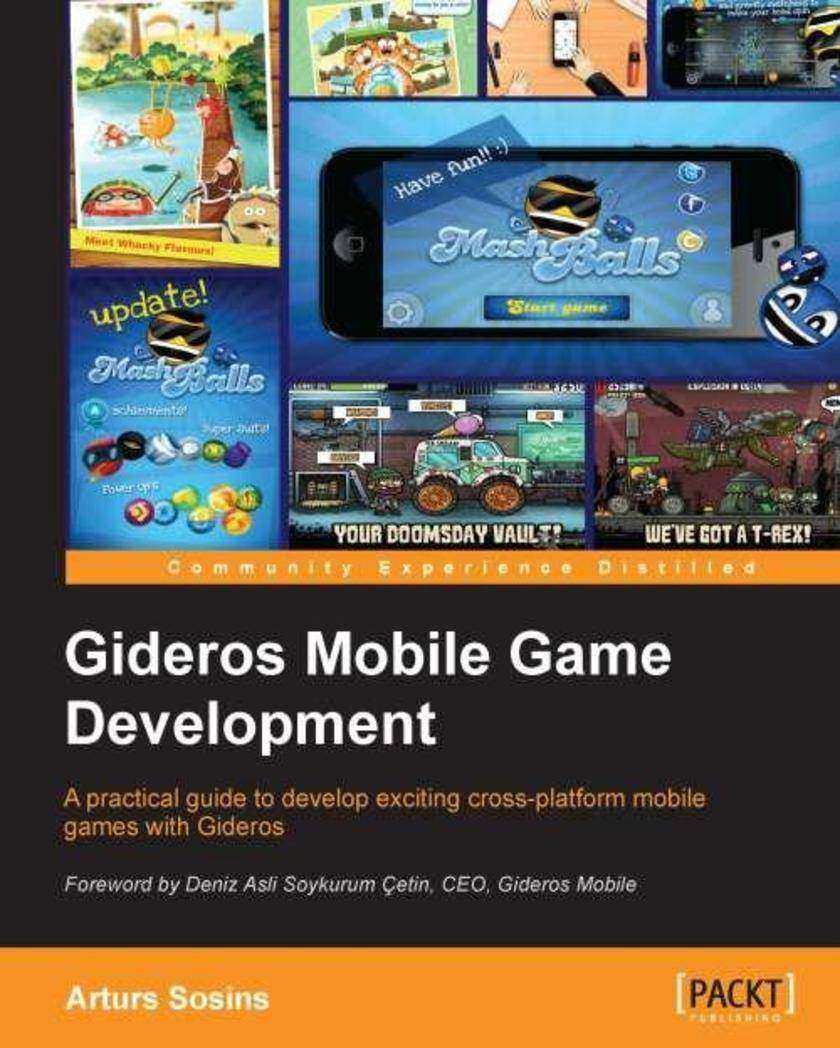
Gideros Mobile Game Development
¥63.21
This book is a detailed guide to create and deploy mobile games on multiple mobile platforms with an emphasis on practical examples that help you learn how to make your own games quickly and efficiently.This book is for developers who are new to mobile game development or who have tried the native development of mobile games and want a simpler, faster tool that can support a wide variety of platforms and devices. Readers are expected to be at least partially familiar with the Lua game *ing language that Gideros uses for its *s.
Learning zANTI2 for Android Pentesting
¥63.21
The book is intended for those who want to know more about network penetration tests and have no prior experience, as well as for those who are experienced in network systems and are interested in discovering more about this topic.
Apache Solr High Performance
¥63.21
This book is an easytofollow guide, full of handson, realworld examples. Each topic is explained and demonstrated in a specific and userfriendly flow, from search optimization using Solr to Deployment of Zookeeper applications. This book is ideal for Apache Solr developers and want to learn different techniques to optimize Solr performance with utmost efficiency, along with effectively troubleshooting the problems that usually occur while trying to boost performance. Familiarity with search servers and database querying is expected.
Reporting with Microsoft SQL Server 2012
¥63.21
This is a stepbystep tutorial that deals with Microsoft Server 2012 reporting tools:SSRS and Power View. If you are a BI developer, consultant, or architect who wishes to learn how to use SSRS and Power View, and want to understand the best use for each tool, then this book will get you up and running quickly. No prior experience is required with either tool!


