万本电子书0元读

万本电子书0元读

Microsoft Tabular Modeling Cookbook
Paul te Braak
¥99.18
This book follows a cookbook style with recipes explaining the steps for developing analytic data using Business Intelligence Semantic Models.This book is designed for developers who wish to develop powerful and dynamic models for users as well as those who are responsible for the administration of models in corporate environments. It is also targeted at analysts and users of Excel who wish to advance their knowledge of Excel through the development of tabular models or who wish to analyze data through tabular modeling techniques. We assume no prior knowledge of tabular modeling
OpenCL Programming by Example
Ravishekhar Banger
¥99.18
This book follows an example-driven, simplified, and practical approach to using OpenCL for general purpose GPU programming.If you are a beginner in parallel programming and would like to quickly accelerate your algorithms using OpenCL, this book is perfect for you! You will find the diverse topics and case studies in this book interesting and informative. You will only require a good knowledge of C programming for this book, and an understanding of parallel implementations will be useful, but not necessary.
Oracle 11g Anti-hacker's Cookbook
Adrian Neagu
¥99.18
This cookbook has recipes written in simple, easy to understand format with lots of screenshots and insightful tips and hints. If you are an Oracle Database Administrator, Security Manager or Security Auditor looking to secure the Oracle Database or prevent it from being hacked, then this book is for you. This book assumes you have a basic understanding of security concepts.
Oracle ADF Enterprise Application Development – Made Simple, Second Edition
Sten E. Vesterli
¥99.18
This book is written in an easytounderstand style, following an enterprise development process through all the phases of development and deployment. Concepts are illustrated with realworld examples and the methods used are explained stepbystep. This book is for Oracle developers looking to start using Oracle’s latest development tool and J2EE developers looking for a more productive way to build modern web applications. This book will guide you through the creation of a successful enterprise application with Oracle ADF 12c, and therefore it assumes you have basic knowledge of Java, JDeveloper, and databases.
SharePoint 2013 WCM Advanced Cookbook
John Chapman
¥99.18
You will be led carefully stepbystep through a detailed set of recipes. This book focuses on web content management using Microsoft SharePoint 2013 server. The practical examples are built logically throughout the chapters to create a common theme. This book is ideal for developers who want to broaden their understanding of the web content management features available with SharePoint 2013. It is assumed that you already have some experience using SharePoint and developing web content. Experience with Microsoft PowerShell and coding C# with Visual Studio will also be helpful, but is not essential.
SAP BusinessObjects Reporting Cookbook
Yoav Yahav
¥99.18
If you are a business analyst, BI developer, or an IT professional who wants to learn the A to Z of how to work with Web Intelligence reporting tools and different types of data, then this book is for you. The only thing you need is a basic understanding of what Business Intelligence is and data concepts.
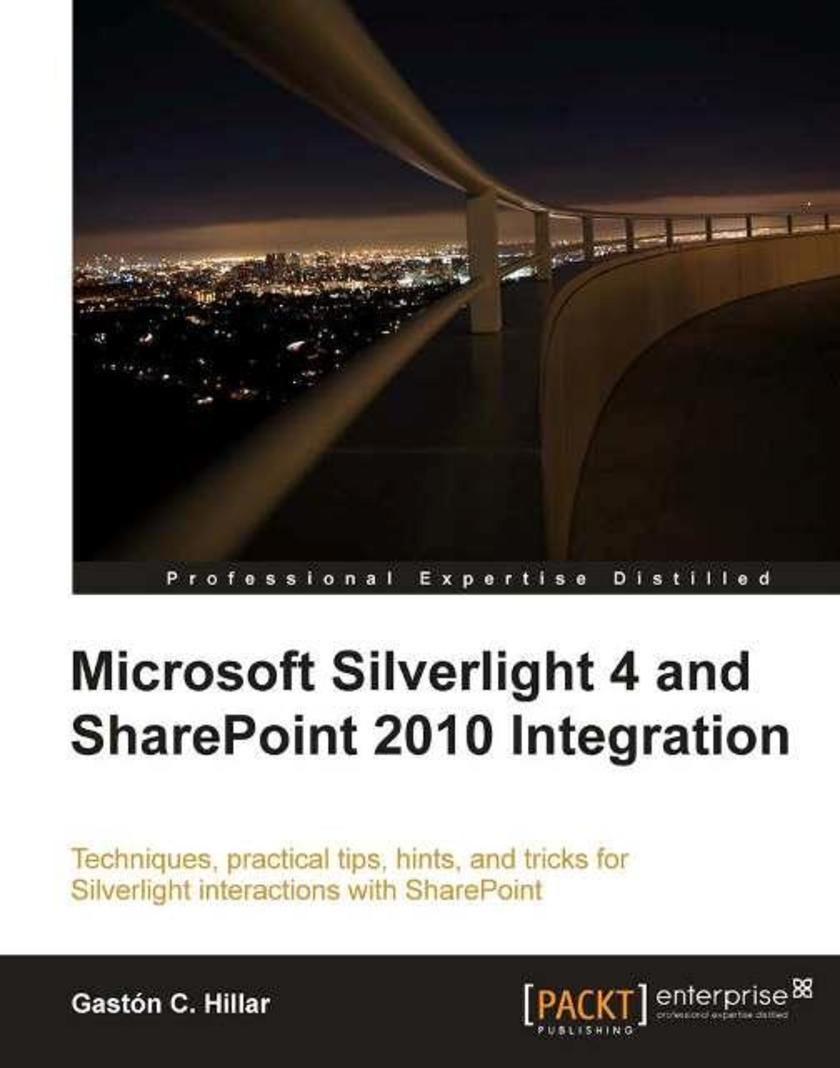
Microsoft Silverlight 4 and SharePoint 2010 Integration
Gaston C. Hillar
¥99.18
This is a practical book with step-by-step guidelines to integrate Silverlight 4 applications in a SharePoint 2010 Server environment. This book focuses on the integration of the two technologies and is not a primer for any of the individual technologies. It offers clear examples to successfully perform the most important integration tasks. If you are an application developer who wants to implement Silverlight 4 applications within a SharePoint 2010 environment, this book is for you. We assume that the reader has prior knowledge of Silverlight and SharePoint 2010 and this book focuses more on the integration of Silverlight with SharePoint 2010.
Learning Hyper-V
Learning Hyper-V
Vinícius R. Apolinário
¥99.18
This book focuses on readers starting their journey with Hyper-V, and assumes they have minimal or no knowledge of virtualization.
Learning SAP BusinessObjects Dashboards
Taha M. Mahmoud
¥99.18
This book will help beginners to create stylish and professional looking dashboards in no time. It is also intended for BI developers who want to use SAP BO to facilitate BI in their organizations. No prior knowledge is required, however, you must have a basic knowledge of MS Excel and some analytical skills to build expressive business charts.
WildFly Cookbook
WildFly Cookbook
Luigi Fugaro
¥99.18
This book is intended for middleware system administrators and Java developers, actually good Java developers, who care about architecture design and implementation. Whether you are new to WildFly, come from a previous version, such as JBoss AS 5, 6, and 7, or are an expert in it, you will be able to master both the basic and advanced features of WildFly. By the way, most of the core components of WildFly are totally new, such as its administration tool, that is, the CLI; its operational modes, which are, the standalone and domain modes; and its web server provided by Undertow, you can benefit from this book even if you have no experience in JBoss and WildFly at all.
Implementing Splunk - Second Edition
Vincent Bumgarner
¥99.18
If you are a data analyst with basic knowledge of Big Data analysis but no knowledge of Splunk, then this book will help you get started with Splunk. The book assumes that you have access to a copy of Splunk, ideally not in production, and many examples also assume you have administrator rights.
Drupal for Education and ELearning (2nd Edition)
James Gordon Robertson
¥99.18
With clear instructions and plenty of screenshots, this book provides all the support and guidance you will need as you begin to create your classroom website. Step-by-step tutorials show you how to use Drupal in the most efficient and effective ways possible. People new to Drupal will find a good introduction of the basics; while more experienced users will learn useful tips and tricks for using Drupal in a classroom context.If you are an teacher, tutor or an educator who wants to build a website for your classroom, be it elementary or any higher education, "Drupal 7 for Education and E-Learning (2nd Edition)" will guide you in achieving your goal at every step. No experience with programming languages, HTML, or CSS is needed to understand the examples in this book.
Mastering Data Analysis with R
Gergely Daróczi
¥99.18
Gain sharp insights into your data and solve real-world data science problems with R—from data munging to modeling and visualization About This Book Handle your data with precision and care for optimal business intelligence Restructure and transform your data to inform decision-making Packed with practical advice and tips to help you get to grips with data mining Who This Book Is For If you are a data scientist or R developer who wants to explore and optimize your use of R’s advanced features and tools, this is the book for you. A basic knowledge of R is required, along with an understanding of database logic. What You Will Learn Connect to and load data from R’s range of powerful databases Successfully fetch and parse structured and unstructured data Transform and restructure your data with efficient R packages Define and build complex statistical models with glm Develop and train machine learning algorithms Visualize social networks and graph data Deploy supervised and unsupervised classification algorithms Discover how to visualize spatial data with R In Detail R is an essential language for sharp and successful data analysis. Its numerous features and ease of use make it a powerful way of mining, managing, and interpreting large sets of data. In a world where understanding big data has become key, by mastering R you will be able to deal with your data effectively and efficiently. This book will give you the guidance you need to build and develop your knowledge and expertise. Bridging the gap between theory and practice, this book will help you to understand and use data for a competitive advantage. Beginning with taking you through essential data mining and management tasks such as munging, fetching, cleaning, and restructuring, the book then explores different model designs and the core components of effective analysis. You will then discover how to optimize your use of machine learning algorithms for classification and recommendation systems beside the traditional and more recent statistical methods. Style and approach Covering the essential tasks and skills within data science, Mastering Data Analysis provides you with solutions to the challenges of data science. Each section gives you a theoretical overview before demonstrating how to put the theory to work with real-world use cases and hands-on examples.
Mastering Machine Learning with R
Cory Lesmeister
¥99.18
Master machine learning techniques with R to deliver insights for complex projectsAbout This BookGet to grips with the application of Machine Learning methods using an extensive set of R packagesUnderstand the benefits and potential pitfalls of using machine learning methodsImplement the numerous powerful features offered by R with this comprehensive guide to building an independent R-based ML system Who This Book Is For If you want to learn how to use R's machine learning capabilities to solve complex business problems, then this book is for you. Some experience with R and a working knowledge of basic statistical or machine learning will prove helpful.What You Will LearnGain deep insights to learn the applications of machine learning tools to the industryManipulate data in R efficiently to prepare it for analysisMaster the skill of recognizing techniques for effective visualization of dataUnderstand why and how to create test and training data sets for analysisFamiliarize yourself with fundamental learning methods such as linear and logistic regressionComprehend advanced learning methods such as support vector machinesRealize why and how to apply unsupervised learning methods In Detail Machine learning is a field of Artificial Intelligence to build systems that learn from data. Given the growing prominence of R—a cross-platform, zero-cost statistical programming environment—there has never been a better time to start applying machine learning to your data. The book starts with introduction to Cross-Industry Standard Process for Data Mining. It takes you through Multivariate Regression in detail. Moving on, you will also address Classification and Regression trees. You will learn a couple of “Unsupervised techniques”. Finally, the book will walk you through text analysis and time series. The book will deliver practical and real-world solutions to problems and variety of tasks such as complex recommendation systems. By the end of this book, you will gain expertise in performing R machine learning and will be able to build complex ML projects using R and its packages.Style and approach This is a book explains complicated concepts with easy to follow theory and real-world, practical applications. It demonstrates the power of R and machine learning extensively while highlighting the constraints.
Mastering Python Data Visualization
Kirthi Raman
¥99.18
Generate effective results in a variety of visually appealing charts using the plotting packages in PythonAbout This BookExplore various tools and their strengths while building meaningful representations that can make it easier to understand dataPacked with computational methods and algorithms in diverse fields of scienceWritten in an easy-to-follow categorical style, this book discusses some niche techniques that will make your code easier to work with and reuse Who This Book Is For If you are a Python developer who performs data visualization and wants to develop existing knowledge about Python to build analytical results and produce some amazing visual display, then this book is for you. A basic knowledge level and understanding of Python libraries is assumed.What You Will LearnGather, cleanse, access, and map data to a visual frameworkRecognize which visualization method is applicable and learn best practices for data visualizationGet acquainted with reader-driven narratives and author-driven narratives and the principles of perceptionUnderstand why Python is an effective tool to be used for numerical computation much like MATLAB, and explore some interesting data structures that come with itExplore with various visualization choices how Python can be very useful in computation in the field of finance and statisticsGet to know why Python is the second choice after Java, and is used frequently in the field of machine learningCompare Python with other visualization approaches using Julia and a JavaScript-based framework such as D3.jsDiscover how Python can be used in conjunction with NoSQL such as Hive to produce results efficiently in a distributed environment In Detail Python has a handful of open source libraries for numerical computations involving optimization, linear algebra, integration, interpolation, and other special functions using array objects, machine learning, data mining, and plotting. Pandas have a productive environment for data analysis. These libraries have a specific purpose and play an important role in the research into diverse domains including economics, finance, biological sciences, social science, health care, and many more. The variety of tools and approaches available within Python community is stunning, and can bolster and enhance visual story experiences. This book offers practical guidance to help you on the journey to effective data visualization. Commencing with a chapter on the data framework, which explains the transformation of data into information and eventually knowledge, this book subsequently covers the complete visualization process using the most popular Python libraries with working examples. You will learn the usage of Numpy, Scipy, IPython, MatPlotLib, Pandas, Patsy, and Scikit-Learn with a focus on generating results that can be visualized in many different ways. Further chapters are aimed at not only showing advanced techniques such as interactive plotting; numerical, graphical linear, and non-linear regression; clustering and classification, but also in helping you understand the aesthetics and best practices of data visualization. The book concludes with interesting examples such as social networks, directed graph examples in real-life, data structures appropriate for these problems, and network analysis. By the end of this book, you will be able to effectively solve a broad set of data analysis problems.Style and approach The approach of this book is not step by step, but rather categorical. The categories are based on fields such as bioinformatics, statistical and machine learning, financial computation, and linear algebra. This approach is beneficial for the community in many different fields of work and also helps you learn how one approach can make sense across many fields
Learning Java Functional Programming
Richard M Reese
¥99.18
Create robust and maintainable Java applications using the functional style of programmingAbout This BookExplore how you can blend object-oriented and functional programming styles in JavaUse lambda expressions to write flexible and succinct codeA tutorial that strengthens your fundamentals in functional programming techniques to enhance your applications Who This Book Is For If you are a Java developer with object-oriented experience and want to use a functional programming approach in your applications, then this book is for you. All you need to get started is familiarity with basic Java object-oriented programming concepts.What You Will LearnUse lambda expressions to simplyfy codeUse function composition to achieve code fluencyApply streams to simply implementations and achieve parallelismIncorporate recursion to support an application’s functionalityProvide more robust implementations using OptionalsImplement design patterns with less codeRefactor object-oriented code to create a functional solutionUse debugging and testing techniques specific to functional programs In Detail Functional programming is an increasingly popular technology that allows you to simplify many tasks that are often cumbersome and awkward using an object-oriented approach. It is important to understand this approach and know how and when to apply it. Functional programming requires a different mindset, but once mastered it can be very rewarding. This book simplifies the learning process as a problem is described followed by its implementation using an object-oriented approach and then a solution is provided using appropriate functional programming techniques. Writing succinct and maintainable code is facilitated by many functional programming techniques including lambda expressions and streams. In this book, you will see numerous examples of how these techniques can be applied starting with an introduction to lambda expressions. Next, you will see how they can replace older approaches and be combined to achieve surprisingly elegant solutions to problems. This is followed by the investigation of related concepts such as the Optional class and monads, which offer an additional approach to handle problems. Design patterns have been instrumental in solving common problems. You will learn how these are enhanced with functional techniques. To transition from an object-oriented approach to a functional one, it is useful to have IDE support. IDE tools to refactor, debug, and test functional programs are demonstrated through the chapters. The end of the book brings together many of these functional programming techniques to create a more comprehensive application. You will find this book a very useful resource to learn and apply functional programming techniques in Java.Style and approach In this tutorial, each chapter starts with an introduction to the terms and concepts covered in that chapter. It quickly progresses to contrast an object-oriented approach with a functional approach using numerous code examples.
ArcGIS Pro 2.x Cookbook
Tripp Corbin, GISP
¥99.18
Creating and Sharing Maps and Data using ArcGIS Pro About This Book ? Leverage the power of ArcGIS to build beautiful 2D and 3D maps. ? Work with ArcGIS to analyze and process data. ? Extend the power of ArcGIS to ArcGIS Online to create and edit content. Who This Book Is For GIS developers who are comfortable using ArcGIS, and are looking to increase their capabilities and skills, will find this book useful. What You Will Learn ? Edit data using standard tools and topology ? Convert and link data together using joins and relates ? Create and share data using Projections and Coordinate Systems ? Access and collect data in the field using ArcGIS Collector ? Perform proximity analysis and map clusters with hotspot analysis ? Use the 3D Analyst Extension and perform advanced 3D analysis ? Share maps and data using ArcGIS Online via web and mobile apps In Detail ArcGIS is Esri's catalog of GIS applications with powerful tools for visualizing, maintaining, and analyzing data. ArcGIS makes use of the modern ribbon interface and 64-bit processing to increase the speed and efficiency of using GIS. It allows users to create amazing maps in both 2D and 3D quickly and easily. If you want to gain a thorough understanding of the various data formats that can be used in ArcGIS Pro and shared via ArcGIS Online, then this book is for you. Beginning with a refresher on ArcGIS Pro and how to work with projects, this book will quickly take you through recipes about using various data formats supported by the tool. You will learn the limits of each format, such as Shapefiles, Geodatabase, and CAD files, and learn how to link tables from outside sources to existing GIS data to expand the amount of data that can be used in ArcGIS. You'll learn methods for editing 2D and 3D data using ArcGIS Pro and how topology can be used to ensure data integrity. Lastly the book will show you how data and maps can be shared via ArcGIS Online and used with web and mobile applications. Style and approach This book takes a recipe-based approach, teaching you how to create and share maps and data using ArcGIS Pro.
SQL Server 2016 Reporting Services Cookbook
Dinesh Priyankara
¥99.18
Create interactive cross-platform reports and dashboards using SQL Server 2016 Reporting Services About This Book Get up to speed with the newly-introduced enhancements and the more advanced query and reporting features Easily access your important data by creating visually appealing dashboards in the Power BI practical recipe Create cross-browser and cross-platform reports using SQL Server 2016 Reporting Services Who This Book Is For This book is for software professionals who develop and implement reporting solutions using Microsoft SQL Server. It is especially relevant for professionals who are software engineers, software architects, DW/BI engineers, and DW/BI architects who perform simple to complex report authoring implementations. This book is also suitable for those who develop software solutions that integrate reporting solutions and are keen to learn about Microsoft SQL Server 2016’s features and capabilities. What You Will Learn Key capabilities, architecture, and components of Reporting Services New features that have been added to Reporting Services Design the architecture for reporting solutions Design the architecture for BI solutions Implement reporting solutions using Reporting Services Improve the performance, availability, and scalability of the reporting solution Enhance reporting solutions with custom programming and improved security In Detail Microsoft SQL Server 2016 Reporting Services comes with many new features. It offers different types of reporting such as Production, Ad-hoc, Dashboard, Mash-up, and Analytical. SQL Server 2016 also has a surfeit of new features including Mobile Reporting, and Power BI integration. This book contains recipes that explore the new and advanced features added to SQL Server 2016. The first few chapters cover recipes on configuring components and how to explore these new features. You’ll learn to build your own reporting solution with data tools and report builder, along with learning techniques to create visually appealing reports. This book also has recipes for enhanced mobile reporting solutions, accessing these solutions effectively, and delivering interactive business intelligence solutions. Towards the end of the book, you’ll get to grips with running reporting services in SharePoint integrated mode and be able to administer, monitor, and secure your reporting solution. This book covers about the new offerings of Microsoft SQL Server 2016 Reporting Services in comprehensive detail and uses examples of real-world problem-solving business scenarios. Style and approach This comprehensive cookbook follows a problem-solution approach to help you overcome any obstacle when creating interactive, visually-appealing reports using SQL Server 2016 Reporting Services. Each recipe focuses on a specific task and is written in a clear, solution-focused style.
Elasticsearch 5.x Cookbook - Third Edition
Alberto Paro
¥99.18
Over 170 advanced recipes to search, analyze, deploy, manage, and monitor data effectively with Elasticsearch 5.x About This Book Deploy and manage simple Elasticsearch nodes as well as complex cluster topologies Write native plugins to extend the functionalities of Elasticsearch 5.x to boost your business Packed with clear, step-by-step recipes to walk you through the capabilities of Elasticsearch 5.x Who This Book Is For If you are a developer who wants to get the most out of Elasticsearch for advanced search and analytics, this is the book for you. Some understanding of JSON is expected. If you want to extend Elasticsearch, understanding of Java and related technologies is also required. What You Will Learn Choose the best Elasticsearch cloud topology to deploy and power it up with external plugins Develop tailored mapping to take full control of index steps Build complex queries through managing indices and documents Optimize search results through executing analytics aggregations Monitor the performance of the cluster and nodes Install Kibana to monitor cluster and extend Kibana for plugins Integrate Elasticsearch in Java, Scala, Python and Big Data applications In Detail Elasticsearch is a Lucene-based distributed search server that allows users to index and search unstructured content with petabytes of data. This book is your one-stop guide to master the complete Elasticsearch ecosystem. We’ll guide you through comprehensive recipes on what’s new in Elasticsearch 5.x, showing you how to create complex queries and analytics, and perform index mapping, aggregation, and *ing. Further on, you will explore the modules of Cluster and Node monitoring and see ways to back up and restore a snapshot of an index. You will understand how to install Kibana to monitor a cluster and also to extend Kibana for plugins. Finally, you will also see how you can integrate your Java, Scala, Python, and Big Data applications such as Apache Spark and Pig with Elasticsearch, and add enhanced functionalities with custom plugins. By the end of this book, you will have an in-depth knowledge of the implementation of the Elasticsearch architecture and will be able to manage data efficiently and effectively with Elasticsearch. Style and approach This book follows a problem-solution approach to effectively use and manage Elasticsearch. Each recipe focuses on a particular task at hand, and is explained in a very simple, easy to understand manner.
Mastering Elastic Stack
Yuvraj Gupta
¥99.18
Get the most out of the Elastic Stack for various complex analytics using this comprehensive and practical guide About This Book Your one-stop solution to perform advanced analytics with Elasticsearch, Logstash, and Kibana Learn how to make better sense of your data by searching, analyzing, and logging data in a systematic way This highly practical guide takes you through an advanced implementation on the ELK stack in your enterprise environment Who This Book Is For This book cater to developers using the Elastic stack in their day-to-day work who are familiar with the basics of Elasticsearch, Logstash, and Kibana, and now want to become an expert at using the Elastic stack for data analytics. What You Will Learn Build a pipeline with help of Logstash and Beats to visualize Elasticsearch data in Kibana Use Beats to ship any type of data to the Elastic stack Understand Elasticsearch APIs, modules, and other advanced concepts Explore Logstash and it’s plugins Discover how to utilize the new Kibana UI for advanced analytics See how to work with the Elastic Stack using other advanced configurations Customize the Elastic Stack and plugin development for each of the component Work with the Elastic Stack in a production environment Explore the various components of X-Pack in detail. In Detail Even structured data is useless if it can’t help you to take strategic decisions and improve existing system. If you love to play with data, or your job requires you to process custom log formats, design a scalable analysis system, and manage logs to do real-time data analysis, this book is your one-stop solution. By combining the massively popular Elasticsearch, Logstash, Beats, and Kibana, elastic.co has advanced the end-to-end stack that delivers actionable insights in real time from almost any type of structured or unstructured data source. If your job requires you to process custom log formats, design a scalable analysis system, explore a variety of data, and manage logs, this book is your one-stop solution. You will learn how to create real-time dashboards and how to manage the life cycle of logs in detail through real-life scenarios. This book brushes up your basic knowledge on implementing the Elastic Stack and then dives deeper into complex and advanced implementations of the Elastic Stack. We’ll help you to solve data analytics challenges using the Elastic Stack and provide practical steps on centralized logging and real-time analytics with the Elastic Stack in production. You will get to grip with advanced techniques for log analysis and visualization. Newly announced features such as Beats and X-Pack are also covered in detail with examples. Toward the end, you will see how to use the Elastic stack for real-world case studies and we’ll show you some best practices and troubleshooting techniques for the Elastic Stack. Style and approach This practical guide shows you how to perform advanced analytics with the Elastic stack through real-world use cases. It includes common and some not so common scenarios to use the Elastic stack for data analysis.
MDX with Microsoft SQL Server 2016 Analysis Services Cookbook - Third Edition
Tomislav Piasevoli
¥99.18
Over 70 practical recipes to analyze multi-dimensional data in SQL Server 2016 Analysis Services cubes About This Book Updated for SQL Server 2016, this book helps you take advantage of the new MDX commands and the new features introduced in SSAS Perform time-related, context-aware, and business related-calculations with ease to enrich your Business Intelligence solutions Collection of techniques to write flexible and high performing MDX queries in SSAS with carefully structured examples Who This Book Is For This book is for anyone who has been involved in working with multidimensional data. If you are a multidimensional cube developer, a multidimensional database administrator, or a report developer who writes MDX queries to access multidimensional cube, this book will help you. If you are a power cube user or an experienced business analyst, you will also find this book invaluable in your data analysis. This book is for you are interested in doing more data analysis so that the management can make timely and accurate business decisions. What You Will Learn Grasp the fundamental MDX concepts, features, and techniques Work with sets Work with Time dimension and create time-aware calculations Make analytical reports compact, concise, and efficient Navigate cubes Master MDX for reporting with Reporting Services (new) Perform business analytics Design efficient cubes and efficient MDX queries Create metadata-driven calculations (new) Capture MDX queries and many other techniques In Detail If you're often faced with MDX challenges, this is a book for you. It will teach you how to solve various real-world business requirements using MDX queries and calculations. Examples in the book introduce an idea or a problem and then guide you through the process of implementing the solution in a step-by-step manner, inform you about the best practices and offer a deep knowledge in terms of how the solution works. Recipes are organized by chapters, each covering a single topic. They start slowly and logically progress to more advanced techniques. In case of complexity, things are broken down. Instead of one, there are series of recipes built one on top of another. This way you are able to see intermediate results and debug potential errors faster. Finally, the cookbook format is here to help you quickly identify the topic of interest and in it a wide range of practical solutions, that is – MDX recipes for your success. Style and approach This book is written in a cookbook format, where you can browse through and look for solutions to a particular problem in one place. Each recipe is short, to the point and grouped by relevancy. All the recipes are sequenced in a logical progression; you will be able to build up your understanding of the topic incrementally.