


 购物车
购物车 个人中心
个人中心

Performance Testing with JMeter - Second Edition
¥71.93
This book is great for developers, quality assurance engineers, testers, and test managers new to Apache JMeter, or those who are looking to get a good grounding in how to effectively use and become proficient with JMeter. No prior testing experience is required.
Microsoft Azure Machine Learning
¥71.93
The book is intended for those who want to learn how to use Azure Machine Learning. Perhaps you already know a bit about Machine Learning, but have never used ML Studio in Azure; or perhaps you are an absolute newbie. In either case, this book will get you up-and-running quickly.
ServiceDesk Plus 8.x Essentials
¥71.93
This is a practical, hands-on guide that assists you in setting up and efficiently managing ITSM.ServiceDesk Plus 8.x Essentials is for IT helpdesk managers, administrators, and staff, serving as a compendium for service management concepts useful for them.
Mongoose for Application Development
¥71.93
This book is a mini tutorial full of code examples and strategies to give you plenty of options when building your own applications with MongoDB.This book is ideal for people who want to develop applications on the Node.js stack quickly and efficiently. Prior knowledge of the stack is not essential as the book briefly covers the installation of the core components and builds all aspects of the example application. The focus of the book is on what Mongoose adds to you applications, so experienced Node.js developers will also benefit.
Microsoft SQL Server 2012 with Hadoop
¥71.93
This book will be a step-by-step tutorial, which practically teaches working with big data on SQL Server through sample examples in increasing complexity.Microsoft SQL Server 2012 with Hadoop is specifically targeted at readers who want to cross-pollinate their Hadoop skills with SQL Server 2012 business intelligence and data analytics. A basic understanding of traditional RDBMS technologies and query processing techniques is essential.
Sage ACT! 2011 Dashboard and Report Cookbook
¥71.93
This is a cookbook of easy-to-follow recipes about ACT! 2011 dashboard and report practices. If you are an ACT! end user who wants to learn about the existing reports and dashboards available in ACT! 2009, 2010, and 2011, then this book is for you. If you are an ACT! administrator who wants to make changes to ACT!'s dashboard and reporting features or a sales manager who needs to measure the effectiveness of his sales force, you will also find this book helpful. New CRM users will learn how to measure the success of their database. Prior knowledge of ACT! is not essential; however, you'll find it helpful to have good working knowledge of how to add data to ACT!, or to work with an ACT! database that has already been populated with data.
PHP jQuery Cookbook
¥71.93
Written in Packt's cookbook style, this book presents numerous practical examples that you can use directly in your applications. The book covers most of the essential issues you will face while developing your web applications and gives solutions to them. Recipes in the book are written in a manner that will rapidly take you from a beginner to expert level. If you want to use PHP and jQuery together to create web applications this book is for you. It provides a large number of examples in each chapter that will take you from a basic developer to a pro by giving step-by-step instructions for each task in developing web applications using PHP and jQUery. All you need are JavaScript basics and you are on your way to building power web applications, with this book in hand.
Drupal 7 First Look
¥71.93
This hands-on guide takes a look at the main functional areas of Drupal that have significant new features. It explains these new features and how to use them, drawing attention to significant differences from how things used to behave, and giving the reader an idea of the kind of consequences these changes will bring to them. Drupal 7 First Look is written for site administrators, themers, and developers who have some experience with Drupal 6 (or even Drupal 5) and want to upgrade their sites, themes, or modules to Drupal 7 or just learn more about Drupal 7. No programming experience is required, but several code examples are covered for readers that want more in-depth information about building themes and modules.
Moodle 2.0 First Look
¥71.93
The book looks at the main functional areas of Moodle that have significant new features, explains the new features and how to use them. It draws attention to significant differences from how things used to behave, and gives the reader an idea of the kind of consequences these changes will bring to them. If you are an existing Moodle user, tutor, or administrator, then this book is for you. You are expected to be familiar with the operation of Moodle.
Visual Studio 2010 Best Practices
¥71.93
It will be a step-by-step tutorial that will discuss best practices. The book is structured in such a way that it can be read both from start to end or can dipped into. .Net developers using Visual Studio for programming will find this book useful. If you are developing your application with C#, you will find better ways to do things with Visual Studio. You should know basics of development with .Net Framework and need working knowledge on VIsual Studio
Java EE 7 First Look
¥71.93
An easy-to-follow guide to reveal the new features of Java EE 7 and how to efficiently utilize them.Given the main objectives pursued, this book targets three groups of people with a knowledge of the Java language. They are:Beginners in the Java EE platform who would like to have an idea about the main specifications of Java EE 7.Developers who have experimented with previous versions of Java EE and who would like to explore the new features of Java EE 7.Building architects who want to learn how to put together the various Java EE 7 specifications for building robust and secure enterprise applications

VMware vCloud Security
¥71.93
VMware vCloud Security provides the reader with in depth knowledge and practical exercises sufficient to implement a secured private cloud using VMware vCloud Director and vCloud Networking and Security.This book is primarily for technical professionals with system administration and security administration skills with significant VMware vCloud experience who want to learn about advanced concepts of vCloud security and compliance.
R Graph Essentials
¥71.93
This book is targeted at R programmers who want to learn the graphing capabilities of R. This book will presume that you have working knowledge of R.
Mobile Device Exploitation Cookbook
¥71.93
Over 40 recipes to master mobile device penetration testing with open source tools About This Book Learn application exploitation for popular mobile platforms Improve the current security level for mobile platforms and applications Discover tricks of the trade with the help of code snippets and screenshots Who This Book Is For This book is intended for mobile security enthusiasts and penetration testers who wish to secure mobile devices to prevent attacks and discover vulnerabilities to protect devices. What You Will Learn Install and configure Android SDK and ADB Analyze Android Permission Model using ADB and bypass Android Lock Screen Protection Set up the iOS Development Environment - Xcode and iOS Simulator Create a Simple Android app and iOS app and run it in Emulator and Simulator respectively Set up the Android and iOS Pentesting Environment Explore mobile malware, reverse engineering, and code your own malware Audit Android and iOS apps using static and dynamic analysis Examine iOS App Data storage and Keychain security vulnerabilities Set up the Wireless Pentesting Lab for Mobile Devices Configure traffic interception with Android and intercept Traffic using Burp Suite and Wireshark Attack mobile applications by playing around with traffic and SSL certificates Set up the Blackberry and Windows Phone Development Environment and Simulator Setting up the Blackberry and Windows Phone Pentesting Environment Steal data from Blackberry and Windows phones applications In Detail Mobile attacks are on the rise. We are adapting ourselves to new and improved smartphones, gadgets, and their accessories, and with this network of smart things, come bigger risks. Threat exposure increases and the possibility of data losses increase. Exploitations of mobile devices are significant sources of such attacks. Mobile devices come with different platforms, such as Android and iOS. Each platform has its own feature-set, programming language, and a different set of tools. This means that each platform has different exploitation tricks, different malware, and requires a unique approach in regards to forensics or penetration testing. Device exploitation is a broad subject which is widely discussed, equally explored by both Whitehats and Blackhats. This cookbook recipes take you through a wide variety of exploitation techniques across popular mobile platforms. The journey starts with an introduction to basic exploits on mobile platforms and reverse engineering for Android and iOS platforms. Setup and use Android and iOS SDKs and the Pentesting environment. Understand more about basic malware attacks and learn how the malware are coded. Further, perform security testing of Android and iOS applications and audit mobile applications via static and dynamic analysis. Moving further, you'll get introduced to mobile device forensics. Attack mobile application traffic and overcome SSL, before moving on to penetration testing and exploitation. The book concludes with the basics of platforms and exploit tricks on BlackBerry and Windows Phone. By the end of the book, you will be able to use variety of exploitation techniques across popular mobile platforms with stress on Android and iOS. Style and approach This is a hands-on recipe guide that walks you through different aspects of mobile device exploitation and securing your mobile devices against vulnerabilities. Recipes are packed with useful code snippets and screenshots.
Learning ClojureScript
¥71.93
Master the art of agile single page web application development with ClojureScript About This Book Set up interactive development workflows for the browser or Node.js thanks to the ClojureScript ecosystem Learn the basics of interactive single page web app development taking advantage of the functional nature of ClojureScript Delve into advanced rich web application development concepts such as Om, along with core.async, using zippers and logic programming, and preparing code for production with testing or optimizing via the Google Closure Compiler Who This Book Is For This book is for web application developers who want to benefit from the power of ClojureScript to get an agile and highly productive development platform that targets mainly browser JavaScript. You are not required to be fluent in Clojure, but it will be easier for you if you have a basic understanding of browser and server-side JavaScript. What You Will Learn Understand how the ClojureScript compiler operates Set up interactive development workflows for ClojureScript Grasp the basics of the ClojureScript language, including basic syntax, data structures, variable scoping, namespaces, and finally the powerful sequence abstraction Delve into advanced concepts such as functional programming, macro writing, asynchronous programming, app routing, and real-time web Develop simple one page web applications Explore techniques to make your web apps aware of the external world through external or embedded database access or Oauth 2 integration Learn more advanced ClojureScript concepts like in app routing, real-time web Prepare your work for production, getting insights into optional type-checking, writing portable Clojure/ClojureScript code, and testing In Detail Clojure is an expressive language that makes it possible to easily tackle complex software development challenges. Its bias toward interactive development has made it a powerful tool, enabling high developer productivity. In this book, you will first learn how to construct an interactive development experience for ClojureScript.. You will be guided through ClojureScript language concepts, looking at the basics first, then being introduced to advanced concepts such as functional programming or macro writing. After that, we elaborate on the subject of single page web applications, showcasing how to build a simple one, then covering different possible enhancements. We move on to study more advanced ClojureScript concepts, where you will be shown how to address some complex algorithmic cases. Finally, you'll learn about optional type-checking for your programs, how you can write portable code, test it, and put the advanced compilation mode of the Google Closure Compiler to good use. Style and approach This book is a comprehensive reference guide on ClojureScript development for the front end, and will gradually help you master interactive ClojureScript development workflows, through detailed step-by-step information illustrated with annotated code samples.
Internet of Things with ESP8266
¥71.93
Build amazing Internet of Things projects using the ESP8266 Wi-Fi chip About This Book Get to know the powerful and low cost ESP8266 and build interesting projects in the field of Internet of Things Configure your ESP8266 to the cloud and explore the networkable modules that will be utilized in the IoT projects This step-by-step guide teaches you the basics of IoT with ESP8266 and makes your life easier Who This Book Is For This book is for those who want to build powerful and inexpensive IoT projects using the ESP8266 WiFi chip, including those who are new to IoT, or those who already have experience with other platforms such as Arduino. What You Will Learn Control various devices from the cloud Interact with web services, such as Twitter or Facebook Make two ESP8266 boards communicate with each other via the cloud Send notifications to users of the ESP8266, via email, text message, or push notifications Build a physical device that indicates the current price of Bitcoin Build a simple home automation system that can be controlled from the cloud Create your own cloud platform to control ESP8266 devices In Detail The Internet of Things (IoT) is the network of objects such as physical things embedded with electronics, software, sensors, and connectivity, enabling data exchange. ESP8266 is a low cost WiFi microcontroller chip that has the ability to empower IoT and helps the exchange of information among various connected objects. ESP8266 consists of networkable microcontroller modules, and with this low cost chip, IoT is booming. This book will help deepen your knowledge of the ESP8266 WiFi chip platform and get you building exciting projects. Kick-starting with an introduction to the ESP8266 chip, we will demonstrate how to build a simple LED using the ESP8266. You will then learn how to read, send, and monitor data from the cloud. Next, you’ll see how to control your devices remotely from anywhere in the world. Furthermore, you’ll get to know how to use the ESP8266 to interact with web services such as Twitter and Facebook. In order to make several ESP8266s interact and exchange data without the need for human intervention, you will be introduced to the concept of machine-to-machine communication. The latter part of the book focuses more on projects, including a door lock controlled from the cloud, building a physical Bitcoin ticker, and doing wireless gardening. You’ll learn how to build a cloud-based ESP8266 home automation system and a cloud-controlled ESP8266 robot. Finally, you’ll discover how to build your own cloud platform to control ESP8266 devices. With this book, you will be able to create and program Internet of Things projects using the ESP8266 WiFi chip. Style and approach This is a step-by-step guide that provides great IOT projects with ESP8266. All the key concepts are explained details with the help of examples and demonstrations of the projects.
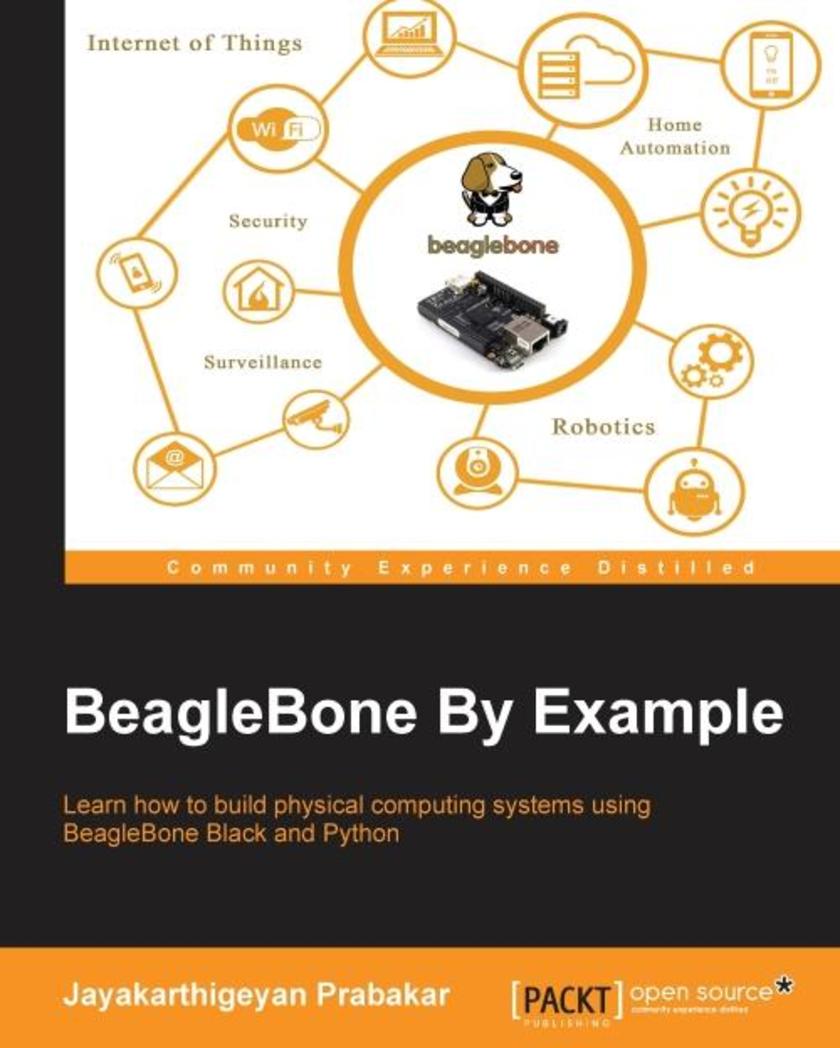
BeagleBone By Example
¥71.93
Learn how to build physical computing systems using BeagleBone Black and Python About This Book Get to grips with the fundamentals of BeagleBone Leverage Python *s to program BeagleBone for your requirements Build four exciting projects, from home automation to a tele-controlled robot Who This Book Is For This book is intended for hobbyists and consumers who wish to create impressive projects using BeagleBone. You must be familiar with Python programming. What You Will Learn Program on BeagleBone Black using Python Interface sensors and actuators to BeagleBone Black Build your own real-time physical computing systems Connect physical computing systems to cloud servers Build your own home automation and home security system Build your own tele-controlled robot with real-time video streaming In Detail BeagleBone is a low cost, community-supported development platform to develop a variety of electronic projects. This book will introduce you to BeagleBone and get you building fun, cool, and innovative projects with it. Start with the specifications of BeagleBone Black and its operating systems, then get to grips with the GPIOs available in BeagleBone Black. Work through four types of exciting projects: building real-time physical computing systems, home automation, image processing for a security system, and building your own tele-controlled robot and learn the fundamentals of a variety of projects in a single book. By the end of this book, you will be able to write code for BeagleBone in order to operate hardware and impart decision-making capabilities with the help of efficient coding in Python. Style and approach This book is a step by step guide that will walk you through the fundamentals of building different projects using BeagleBone Black.
Smart Internet of Things Projects
¥71.93
Discover how to build your own smart Internet of Things projects and bring a new degree of interconnectivity to your world About This Book Learn how to extract and analyse data from physical devices and build smart IoT projects Master the skills of building enticing projects such as a neural network autonomous car, computer vision through a camera, and cloud-based IoT applications This project-based guide leverages revolutionary computing chips such as Raspberry Pi, Arduino, and so on Who This Book Is For If you are hobbyist who is keen on making smart IoT projects, then this book is for you. You should have a basic knowledge of Python. What You Will Learn Implement data science in your IoT projects and build a smart temperature controller Create a simple machine learning application and implement decision system concepts Develop a vision machine using OpenCV Build a robot car with manual and automatic control Implement speech modules with your own voice commands for IoT projects Connect IoT to a cloud-based server In Detail Internet of Things (IoT) is a groundbreaking technology that involves connecting numerous physical devices to the Internet and controlling them. Creating basic IoT projects is common, but imagine building smart IoT projects that can extract data from physical devices, thereby making decisions by themselves. Our book overcomes the challenge of analyzing data from physical devices and accomplishes all that your imagination can dream up by teaching you how to build smart IoT projects. Basic statistics and various applied algorithms in data science and machine learning are introduced to accelerate your knowledge of how to integrate a decision system into a physical device. This book contains IoT projects such as building a smart temperature controller, creating your own vision machine project, building an autonomous mobile robot car, controlling IoT projects through voice commands, building IoT applications utilizing cloud technology and data science, and many more. We will also leverage a small yet powerful IoT chip, Raspberry Pi with Arduino, in order to integrate a smart decision-making system in the IoT projects. Style and approach The book follows a project-based approach to building smart IoT projects using powerful boards such as the Raspberry Pi, Arduino, and the IoT chip.
Xamarin 4 By Example
¥71.93
Design, develop, and publish your own mobile apps for iOS and Android using C# and Xamarin Studio About This Book Explore the exciting features of Xamarin Studio while learning to develop your own applications Develop a complete application from conceptualization through to publishing it on the app store The book walks you through the basics of cross-platform development with Xamarin using examples and best practices and tips for cross platform solutions. Who This Book Is For If you want to develop your own applications and want to explore the features of Xamarin Studio, then this is the book for you. It is expected that you have a basic understanding of technologies in mobile development, but prior knowledge of Xamarin is not required. What You Will Learn Understand the software development lifecycle for mobile applications Use Xamarin Studio and its wide range of features to write your programs in C# Use different options to create multi-platform applications using Xamarin and develop a cross-platform extension method Work with Xamarin forms and various UI controls Integrate synchronous and asynchronous communication module within your app Render images to work with Android and iOS Link a third-party application to your solution In Detail The mobile app market is increasing exponentially every year. Xamarin Studio with its modern and powerful IDEs makes creating applications a lot easier by simplifying the development process. Xamarin will allow you and your team to create native applications by taking advantage of one of the most evolved programming language in the world: C#. This book will provide you with the basic skills you need to start developing mobile apps using C# and Xamarin. By working through the examples in each chapter, you will gain hands-on experience of creating a complete app that is fully functional by all means. Finally, you will learn to publish the app you created on the app market. Each project in this book will take you one step closer to becoming a professional app developer. Style and approach The step-by-guide will walk you through the process of creating an application of with the help of small projects that will teach you everything you need to know to build a complete application of your own.
Enduring CSS
¥71.93
Learn to really THINK about CSS, and how to create CSS that endures continual iteration, multiple authors, and yet always produces predictable results About This Book Address the problems of CSS at scale, avoiding the shortfalls of scaling CSS. The shortfalls of conventional approaches to scaling CSS. Develop consistent and enforceable selector naming conventions with ECSS. Learn how to organize project structure to more easily isolate and decouple visual components. Who This Book Is For This is a book for working CSS authors involved in large projects. This is a book that tackles create enduring CSS for large-scale projects. What You Will Learn The problems of CSS at scale—specificity, the cascade and styles intrinsically tied to element structure. The shortfalls of conventional approaches to scaling CSS. The ECSS methodology and the problems it solves. How to develop consistent and enforceable selector naming conventions with ECSS. How to organise project structure to more easily isolate and decouple visual components. How to handle state changes in the DOM with ARIA or override selectors. How to apply ECSS to web applications and visual modules. Considerations of CSS tooling and processing: Sass/PostCSS and linting. Addressing the notion of CSS selector speed with hard data and browser representative insight In Detail Learn with me, Ben Frain, about how to really THINK about CSS and how to use CSS for any size project! I'll show you how to write CSS that endures continual iteration, multiple authors, and yet always produces predictable results. Enduring CSS, often referred to as ECSS, offers you a robust and proven approach to authoring and maintaining style sheets at scale. Enduring CSS is not a book about writing CSS, as in the stuff inside the curly braces. This is a book showing you how to think about CSS, and be a smarter developer with that thinking! It's about the organisation and architecture of CSS—the parts outside the braces. I will help you think about the aspects of CSS development that become the most difficult part of writing CSS in larger projects. You’ll learn about the problems of authoring CSS at scale—including specificity, the cascade and styles intrinsically tied to document structure. I'll introduce you to the ECSS methodology, and show you how to develop consistent and enforceable selector naming conventions. We'll cover how to apply ECSS to your web applications and visual model, and how you can organize your project structure wisely, and handle visual state changes with ARIA, providing greater accessibility considerations. In addition, we'll take a deep look into CSS tooling and process considerations. Finally we will address performance considerations by examining topics such as CSS selector speed with hard data and browser-representative insight. Style and approach Learn with me, Ben Frain, about how to really think about CSS. This is a book to deal with writing CSS for large-scale, rapidly changing web projects and applications. This isn't a book about writing CSS, as in the stuff inside the curly braces - this is a book about the organisation and architecture of CSS; the parts outside the braces!
PostgreSQL Development Essentials
¥71.93
Develop programmatic functions to create powerful database applications About This Book Write complex SQL queries and design a robust database design that fits your application's need Improve database performance by indexing, partitioning tables, and query optimizing A comprehensive guide covering the advanced PostgreSQL concepts without any hassle Who This Book Is For If you are a PostgreSQL developer with a basic knowledge of PostgreSQL development and you’re want deeper knowledge to develop applications, then this book is for you. As this book does not cover basic installation and configurations, you should have PostgreSQL installed on your machine as a prerequisite. What You Will Learn Write more complex queries with advanced SQL queries Design a database that works with the application exactly the way you want Make the database work in extreme conditions by tuning, optimizing, partitioning, and indexing Develop applications in other programming languages such as Java and PHP Use extensions to get extra benefits in terms of functionality and performance Build an application that does not get locked by data manipulation Explore in-built db functions and data type conversions In Detail PostgreSQL is the most advanced open source database in the world. It is easy to install, configure, and maintain by following the documentation; however, it’s difficult to develop applications using programming languages and design databases accordingly. This book is what you need to get the most out of PostgreSQL You will begin with advanced SQL topics such as views, materialized views, and cursors, and learn about performing data type conversions. You will then perform trigger operations and use trigger functions in PostgreSQL. Next we walk through data modeling, normalization concepts, and the effect of transactions and locking on the database. The next half of the book covers the types of indexes, constrains, and the concepts of table partitioning, as well as the different mechanisms and approaches available to write efficient queries or code. Later, we explore PostgreSQL Extensions and Large Object Support in PostgreSQL. Finally, you will perform database operations in PostgreSQL using PHP and Java. By the end of this book, you will have mastered all the aspects of PostgreSQL development. You will be able to build efficient enterprise-grade applications with PostgreSQL by making use of these concepts Style and approach Every chapter follows a step by step approach that first explains the concept , then shows you how to execute it practically so that you can implement them in your application.


