


 购物车
购物车 个人中心
个人中心
Windows Application Development Cookbook
¥90.46
Discover over 125 solution-based recipes to help you build applications for smartphones, tablets, and desktops About This Book Learn to build applications for Windows 10, the latest Windows version Develop your applications to be compatible with smartphones, tablets, and desktops This guide is packed with recipes covering major solutions to day-to-day problems faced by Windows programmers Who This Book Is For The book is dedicated to programmers with various experience of developing applications for Windows-based smartphones, tablets, and desktops—even beginners can find suitable content. What You Will Learn Start developing universal applications for Windows 10 Design user interface in the XAML language Use the MVVM design pattern with data binding Store data in files and in a database Use multimedia content and animations Capture data from built-in sensors Handle various Internet-based scenarios Test the application and submit it to the Windows Store In Detail Need to ensure you can always create the best Windows apps regardless of platformWhat you need are solutions to the biggest issues you can face, so you can always ensure you’re making the right choices and creating the best apps you can. The book starts with recipes that will help you set up the integrated development environment before you go ahead and design the user interface. You will learn how to use the MVVM design pattern together with data binding, as well as how to work with data in different file formats. Moving on, you will explore techniques to add animations and graphics to your application, and enable your solution to work with multimedia content. You will also see how to use sensors, such as an accelerometer and a compass, as well as obtain the current GPS location. You will make your application ready to work with Internet-based scenarios, such as composing e-mails or downloading files, before finally testing the project and submitting it to the Windows Store. By the end of the book, you will have a market-ready application compatible across different Windows devices, including smartphones, tablets, and desktops. Style and approach This quick-start book takes a cookbook format with recipes covering more than 125 solutions to help you create and build applications for Windows 10. The examples presented in the book use the free integrated development environment. A supporting set of codes that present solutions to problems described in particular chapters is available as well.
Fast Data Processing Systems with SMACK Stack
¥90.46
Combine the incredible powers of Spark, Mesos, Akka, Cassandra, and Kafka to build data processing platforms that can take on even the hardest of your data troubles! About This Book This highly practical guide shows you how to use the best of the big data technologies to solve your response-critical problems Learn the art of making cheap-yet-effective big data architecture without using complex Greek-letter architectures Use this easy-to-follow guide to build fast data processing systems for your organization Who This Book Is For If you are a developer, data architect, or a data scientist looking for information on how to integrate the Big Data stack architecture and how to choose the correct technology in every layer, this book is what you are looking for. What You Will Learn Design and implement a fast data Pipeline architecture Think and solve programming challenges in a functional way with Scala Learn to use Akka, the actors model implementation for the JVM Make on memory processing and data analysis with Spark to solve modern business demands Build a powerful and effective cluster infrastructure with Mesos and Docker Manage and consume unstructured and No-SQL data sources with Cassandra Consume and produce messages in a massive way with Kafka In Detail SMACK is an open source full stack for big data architecture. It is a combination of Spark, Mesos, Akka, Cassandra, and Kafka. This stack is the newest technique developers have begun to use to tackle critical real-time analytics for big data. This highly practical guide will teach you how to integrate these technologies to create a highly efficient data analysis system for fast data processing. We’ll start off with an introduction to SMACK and show you when to use it. First you’ll get to grips with functional thinking and problem solving using Scala. Next you’ll come to understand the Akka architecture. Then you’ll get to know how to improve the data structure architecture and optimize resources using Apache Spark. Moving forward, you’ll learn how to perform linear scalability in databases with Apache Cassandra. You’ll grasp the high throughput distributed messaging systems using Apache Kafka. We’ll show you how to build a cheap but effective cluster infrastructure with Apache Mesos. Finally, you will deep dive into the different aspect of SMACK using a few case studies. By the end of the book, you will be able to integrate all the components of the SMACK stack and use them together to achieve highly effective and fast data processing. Style and approach With the help of various industry examples, you will learn about the full stack of big data architecture, taking the important aspects in every technology. You will learn how to integrate the technologies to build effective systems rather than getting incomplete information on single technologies. You will learn how various open source technologies can be used to build cheap and fast data processing systems with the help of various industry examples
Tableau Cookbook – Recipes for Data Visualization
¥90.46
Create beautiful data visualizations and interactive dashboards with Tableau About This Book Delve into the features and functionalities of Tableau from the ground up with this step-by-step guide that has over 50 "follow-me" recipes Build rich visualizations to effectively highlight the underlying trends and patterns in your data Build beautiful interactive dashboards and storyboards to stitch your visualizations together and tell a story Who This Book Is For This book is for anyone who wishes to use Tableau. It will be of use to both beginners who want to learn Tableau from scratch and to more seasoned users who simply want a quick reference guide. This book is a ready reckoner guide for you. The book will be such that both new & existing Tableau users who don’t know, or can’t recall how to perform different Tableau tasks can use the book and be benefited from it. What You Will Learn Get to grips with the Tableau workspace and terminologies and understand what data sources you can connect Learn to create basic charts like bar chart, stacked bar, pie chart, line chart, area chart, tree map & word cloud Go even further with more advanced visualizations such as scatter plot, box & whiskers plot, dual axis, bullet chart, Histograms, Maps, etc Use pre-defined calculation and change its scope and direction to affect outcome Learn to define Parameters and call them into parametric calculations that provide outcomes based on user inputs Build Dashboards and use Actions to link multiple sheets on the dashboard Connect to multiple data sources using Data Blending, Multiple Table Join within the same data source as well as across data sources, Custom SQL and learn to work with data Extracts Compute statistical trends, build forecasting models and use Reference lines for benchmarking In Detail Data is everywhere and everything is data! Visualization of data allows us to bring out the underlying trends and patterns inherent in the data and gain insights that enable faster and smarter decision making. Tableau is one of the fastest growing and industry leading Business Intelligence platforms that empowers business users to easily visualize their data and discover insights at the speed of thought. Tableau is a self-service BI platform designed to make data visualization and analysis as intuitive as possible. Creating visualizations with simple drag-and-drop, you can be up and running on Tableau in no time. Starting from the fundamentals such as getting familiarized with Tableau Desktop, connecting to common data sources and building standard charts; you will walk through the nitty gritty of Tableau such as creating dynamic analytics with parameters, blended data sources, and advanced calculations. You will also learn to group members into higher levels, sort the data in a specific order & filter out the unnecessary information. You will then create calculations in Tableau & understand the flexibility & power they have and go on to building story-boards and share your insights with others. Whether you are just getting started or whether you need a quick reference on a "how-to" question, This book is the perfect companion for you Style and approach This cookbook takes a step-by-step approach and the text systematically evolves to cover more involved functionalities. Every recipe includes illustrative screenshots which provide a detailed visual resource for each step.
Mastering Scala Machine Learning
¥90.46
Advance your skills in efficient data analysis and data processing using the powerful tools of Scala, Spark, and Hadoop About This Book This is a primer on functional-programming-style techniques to help you efficiently process and analyze all of your data Get acquainted with the best and newest tools available such as Scala, Spark, Parquet and MLlib for machine learning Learn the best practices to incorporate new Big Data machine learning in your data-driven enterprise to gain future scalability and maintainability Who This Book Is For Mastering Scala Machine Learning is intended for enthusiasts who want to plunge into the new pool of emerging techniques for machine learning. Some familiarity with standard statistical techniques is required. What You Will Learn Sharpen your functional programming skills in Scala using REPL Apply standard and advanced machine learning techniques using Scala Get acquainted with Big Data technologies and grasp why we need a functional approach to Big Data Discover new data structures, algorithms, approaches, and habits that will allow you to work effectively with large amounts of data Understand the principles of supervised and unsupervised learning in machine learning Work with unstructured data and serialize it using Kryo, Protobuf, Avro, and AvroParquet Construct reliable and robust data pipelines and manage data in a data-driven enterprise Implement scalable model monitoring and alerts with Scala In Detail Since the advent of object-oriented programming, new technologies related to Big Data are constantly popping up on the market. One such technology is Scala, which is considered to be a successor to Java in the area of Big Data by many, like Java was to C/C++ in the area of distributed programing. This book aims to take your knowledge to next level and help you impart that knowledge to build advanced applications such as social media mining, intelligent news portals, and more. After a quick refresher on functional programming concepts using REPL, you will see some practical examples of setting up the development environment and tinkering with data. We will then explore working with Spark and MLlib using k-means and decision trees. Most of the data that we produce today is unstructured and raw, and you will learn to tackle this type of data with advanced topics such as regression, classification, integration, and working with graph algorithms. Finally, you will discover at how to use Scala to perform complex concept analysis, to monitor model performance, and to build a model repository. By the end of this book, you will have gained expertise in performing Scala machine learning and will be able to build complex machine learning projects using Scala. Style and approach This hands-on guide dives straight into implementing Scala for machine learning without delving much into mathematical proofs or validations. There are ample code examples and tricks that will help you sail through using the standard techniques and libraries. This book provides practical examples from the field on how to correctly tackle data analysis problems, particularly for modern Big Data datasets.
Mastering Python Data Analysis
¥90.46
Become an expert at using Python for advanced statistical analysis of data using real-world examples About This Book Clean, format, and explore data using graphical and numerical summaries Leverage the IPython environment to efficiently analyze data with Python Packed with easy-to-follow examples to develop advanced computational skills for the analysis of complex data Who This Book Is For If you are a competent Python developer who wants to take your data analysis skills to the next level by solving complex problems, then this advanced guide is for you. Familiarity with the basics of applying Python libraries to data sets is assumed. What You Will Learn Read, sort, and map various data into Python and Pandas Recognise patterns so you can understand and explore data Use statistical models to discover patterns in data Review classical statistical inference using Python, Pandas, and SciPy Detect similarities and differences in data with clustering Clean your data to make it useful Work in Jupyter Notebook to produce publication ready figures to be included in reports In Detail Python, a multi-paradigm programming language, has become the language of choice for data scientists for data analysis, visualization, and machine learning. Ever imagined how to become an expert at effectively approaching data analysis problems, solving them, and extracting all of the available information from your dataWell, look no further, this is the book you want! Through this comprehensive guide, you will explore data and present results and conclusions from statistical analysis in a meaningful way. You’ll be able to quickly and accurately perform the hands-on sorting, reduction, and subsequent analysis, and fully appreciate how data analysis methods can support business decision-making. You’ll start off by learning about the tools available for data analysis in Python and will then explore the statistical models that are used to identify patterns in data. Gradually, you’ll move on to review statistical inference using Python, Pandas, and SciPy. After that, we’ll focus on performing regression using computational tools and you’ll get to understand the problem of identifying clusters in data in an algorithmic way. Finally, we delve into advanced techniques to quantify cause and effect using Bayesian methods and you’ll discover how to use Python’s tools for supervised machine learning. Style and approach This book takes a step-by-step approach to reading, processing, and analyzing data in Python using various methods and tools. Rich in examples, each topic connects to real-world examples and retrieves data directly online where possible. With this book, you are given the knowledge and tools to explore any data on your own, encouraging a curiosity befitting all data scientists.
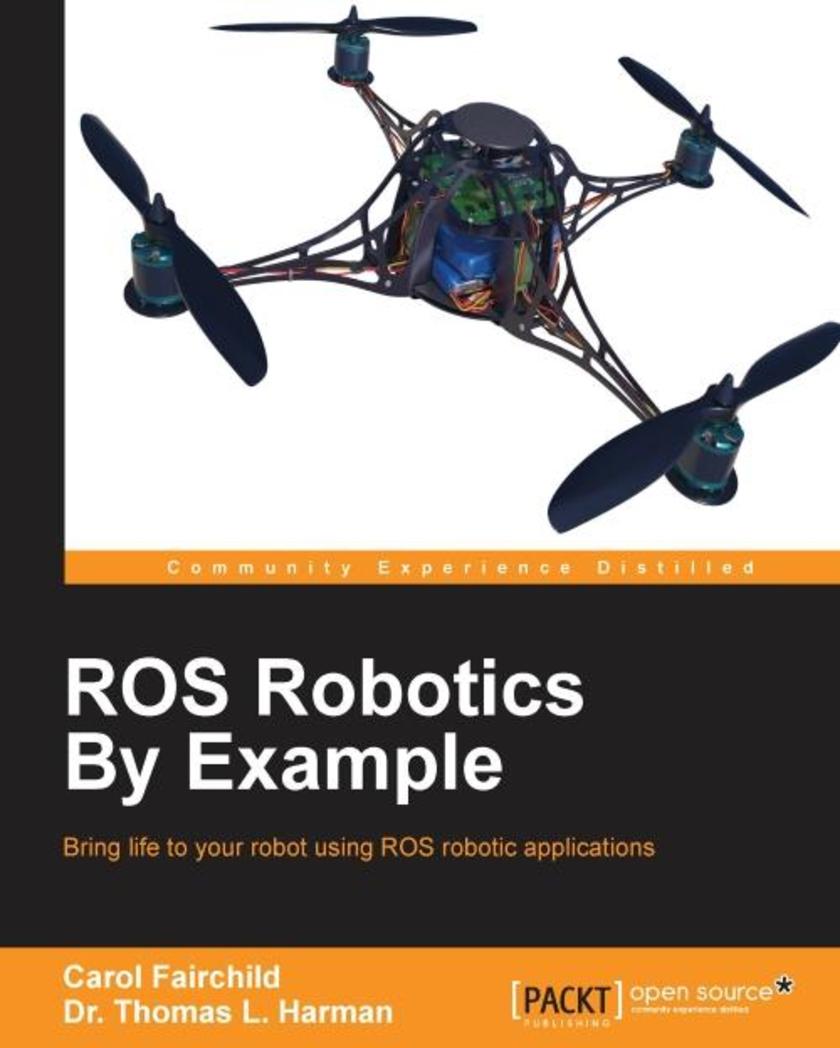
ROS Robotics By Example
¥90.46
Bring life to your robot using ROS robotic applications About This Book .This book will help you boost your knowledge of ROS and give you advanced practical experience you can apply to your ROS robot platforms.This is the only book that offers you step-by-step instructions to solidify your ROS understanding and gain experience using ROS tools.From eminent authors, this book offers you a plethora of fun-filled examples to make your own quadcopter, turtlebot, and two-armed robots Who This Book Is For If you are a robotics developer, whether a hobbyist, researchers or professional, and are interested in learning about ROS through a hands-on approach, then this book is for you. You are encouraged to have a working knowledge of GNU/Linux systems and Python. What You Will Learn .Get to know the fundamentals of ROS and apply its concepts to real robot examples.Control a mobile robot to navigate autonomously in an environment.Model your robot designs using URDF and Xacro, and operate them in a ROS Gazebo simulation.Control a 7 degree-of-freedom robot arm for visual servoing.Fly a quadcopter to autonomous waypoints.Gain working knowledge of ROS tools such as Gazebo, rviz, rqt, and Move-It.Control robots with mobile devices and controller boards In Detail The visionaries who created ROS developed a framework for robotics centered on the commonality of robotic systems and exploited this commonality in ROS to expedite the development of future robotic systems. From the fundamental concepts to advanced practical experience, this book will provide you with an incremental knowledge of the ROS framework, the backbone of the robotics evolution. ROS standardizes many layers of robotics functionality from low-level device drivers to process control to message passing to software package management. This book provides step-by-step examples of mobile, armed, and flying robots, describing the ROS implementation as the basic model for other robots of these types. By controlling these robots, whether in simulation or in reality, you will use ROS to drive, move, and fly robots using ROS control. Style and approach This is an easy-to-follow guide with hands-on examples of ROS robots, both real and in simulation.
Simulation for Data Science with R
¥90.46
Harness actionable insights from your data with computational statistics and simulations using R About This Book Learn five different simulation techniques (Monte Carlo, Discrete Event Simulation, System Dynamics, Agent-Based Modeling, and Resampling) in-depth using real-world case studies A unique book that teaches you the essential and fundamental concepts in statistical modeling and simulation Who This Book Is For This book is for users who are familiar with computational methods. If you want to learn about the advanced features of R, including the computer-intense Monte-Carlo methods as well as computational tools for statistical simulation, then this book is for you. Good knowledge of R programming is assumed/required. What You Will Learn The book aims to explore advanced R features to simulate data to extract insights from your data. Get to know the advanced features of R including high-performance computing and advanced data manipulation See random number simulation used to simulate distributions, data sets, and populations Simulate close-to-reality populations as the basis for agent-based micro-, model- and design-based simulations Applications to design statistical solutions with R for solving scientific and real world problems Comprehensive coverage of several R statistical packages like boot, simPop, VIM, data.table, dplyr, parallel, StatDA, simecol, simecolModels, deSolve and many more. In Detail Data Science with R aims to teach you how to begin performing data science tasks by taking advantage of Rs powerful ecosystem of packages. R being the most widely used programming language when used with data science can be a powerful combination to solve complexities involved with varied data sets in the real world. The book will provide a computational and methodological framework for statistical simulation to the users. Through this book, you will get in grips with the software environment R. After getting to know the background of popular methods in the area of computational statistics, you will see some applications in R to better understand the methods as well as gaining experience of working with real-world data and real-world problems. This book helps uncover the large-scale patterns in complex systems where interdependencies and variation are critical. An effective simulation is driven by data generating processes that accurately reflect real physical populations. You will learn how to plan and structure a simulation project to aid in the decision-making process as well as the presentation of results. By the end of this book, you reader will get in touch with the software environment R. After getting background on popular methods in the area, you will see applications in R to better understand the methods as well as to gain experience when working on real-world data and real-world problems. Style and approach This book takes a practical, hands-on approach to explain the statistical computing methods, gives advice on the usage of these methods, and provides computational tools to help you solve common problems in statistical simulation and computer-intense methods.
Ubuntu Server Cookbook
¥90.46
Arm yourself to make the most of the versatile, powerful Ubuntu Server with over 100 hands-on recipes About This Book Master the skills to setup secure and scalable web services with popular tools like Apache, Nginx, MySQL and HAProxy Set up your own cloud with Open Stack and quickly deploy applications with Docker or LXD Packed with clear, step-by-step recipes to let you protect you valuable data with your own chat servers, code hosting and collaboration tools. Who This Book Is For Ubuntu Server Cookbook is for system administrators or software developers with a basic understanding of the Linux operating system who want to set up their own servers. You are not required to have in-depth knowledge or hands-on experience with Ubuntu, but you should know the basics commands for directory navigation, file management, and the file editing tool. An understanding of computer networks is advisable What You Will Learn Set up high performance, scalable, and fault-tolerant back ends with web and database servers Facilitate team communication with a real-time chat service and collaboration tools Quickly deploy your applications to their own containers and scale your infrastructure as and when needed Find out how to set up your own cloud infrastructure for your internal use or rent it to the public Ensure quick and easy access for your users while also securing your infrastructure from intruders Set up a high performance private network with a personal VPN server and centralized authentication system Swiftly start a content streaming service Set up network storage for private data and source code and say good bye to costly and unreliable cloud services In Detail Ubuntu is one of the most secure operating systems and defines the highest level of security as compared other operating system. Ubuntu server is a popular Linux distribution and the first choice when deploying a Linux server. It can be used with a $35 Raspberry Pi to top-notch, thousand-dollar-per-month cloud hardware. Built with lists that there are 4 million + websites built using Ubuntu. With its easy-to-use package management tools and availability of well-known packages, we can quickly set up our own services such as web servers and database servers using Ubuntu. This book will help you develop the skills required to set up high performance and secure services with open source tools. Starting from user management and an in-depth look at networking, we then move on to cover the installation and management of web servers and database servers, as well as load balancing various services. You will quickly learn to set up your own cloud and minimize costs and efforts with application containers. Next, you will get to grips with setting up a secure real-time communication system. Finally, we’ll explore source code hosting and various collaboration tools. By the end of this book, you will be able to make the most of Ubuntu’s advanced functionalities. Style and approach This easy-to-follow guide contains a series of step-by-step recipes ranging from simple to complex. Each topic will start with basic introduction to each technology followed by a detailed step-by-step installation guide and then a detailed explanation of the approach taken during installation and the various advanced options available.
Entity Framework Core Cookbook - Second Edition
¥90.46
Leverage the full potential of Entity Framework with this collection of powerful and easy-to-follow recipes About This Book Learn how to use the new features of Entity Framework Core 1 Improve your queries by leveraging some of the advanced features Avoid common pitfalls Make the best of your .NET APIs by integrating with Entity Framework Who This Book Is For This book is for .NET developers who work with relational databases on a daily basis and understand the basics of Entity Framework, but now want to use it in a more efficient manner. You are expected to have some prior knowledge of Entity Framework. What You Will Learn Master the technique of using sequence key generators Validate groups of entities that are to be saved / updated Improve MVC applications that cover applications developed using ASP.NET MVC Core 1 Retrieve database information (table, column names, and so on) for entities Discover optimistic concurrency control and pessimistic concurrency control. Implement Multilatency on the data side of things. Enhance the performance and/or scalability of Entity Framework Core Explore and overcome the pitfalls of Entity Framework Core In Detail Entity Framework is a highly recommended Object Relation Mapping tool used to build complex systems. In order to survive in this growing market, the knowledge of a framework that helps provide easy access to databases, that is, Entity Framework has become a necessity. This book will provide .NET developers with this knowledge and guide them through working efficiently with data using Entity Framework Core. You will start off by learning how to efficiently use Entity Framework in practical situations. You will gain a deep understanding of mapping properties and find out how to handle validation in Entity Framework. The book will then explain how to work with transactions and stored procedures along with improving Entity Framework using query libraries. Moving on, you will learn to improve complex query scenarios and implement transaction and concurrency control. You will then be taught to improve and develop Entity Framework in complex business scenarios. With the concluding chapter on performance and scalability, this book will get you ready to use Entity Framework proficiently. Style and approach Filled with rich code-based examples, this book takes a recipe-based approach that will teach .NET developers to improve their understanding of Entity Framework and help them effortlessly apply this knowledge in everyday situations.
Learning Xcode 8
¥90.46
Learn how to use the power of Xcode to turn your next great app idea into a reality About This Book Learn the theory and tools behind app development using Swift 3 and Xcode 8 Build a fully featured iOS app, including a companion app for the Apple Watch Optimize, debug, and ultimately release your app on Test Flight and the App Store Who This Book Is For This book is intended for programmers looking to get a jump-start into the world of iOS development. Whether you’re a young student who has only spent a few months with Java, or a seasoned developer who has spent their career developing for a different platform, all that is expected is a basic understanding of a programming language such as C++, C#, or Java. What You Will Learn Understand the most important features of the Xcode IDE Write Swift 3 code for application data models and view controllers Prepare visual layouts for an iOS application using storyboards, size classes, and auto-layout Integrate many common technologies into an app, such as multi-touch gestures, CoreData, and notifications Build companion applications for the Apple Watch with watchOS 3 Debug applications using Xcode’s suite of debugging tools, and prevent bugs with unit testing Optimize an application using Xcode 8’s profiling tools and asset catalogs Distribute a beta application through TestFlight, and a finished application through the App Store In Detail Over the last few years, we’ve seen a breakthrough in mobile computing and the birth of world-changing mobile apps. With a reputation as one of the most user-centric and developer-friendly platforms, iOS is the best place to launch your next great app idea. As the official tool to create iOS applications, Xcode is chock full of features aimed at making a developer’s job easier, faster, and more fun. This book will take you from complete novice to a published app developer, and covers every step in between. You’ll learn the basics of iOS application development by taking a guided tour through the Xcode software and Swift programming language, before putting that knowledge to use by building your first app called “Snippets.” Over the course of the book, you will continue to explore the many facets of iOS development in Xcode by adding new features to your app, integrating gestures and sensors, and even creating an Apple Watch companion app. You’ll also learn how to use the debugging tools, write unit tests, and optimize and distribute your app. By the time you make it to the end of this book, you will have successfully built and published your first iOS application. Style and approach This easy-to-follow guide presents topics in a hands-on lecture format where concepts are introduced and explained, then used in an example as reinforcement. The first third of the book covers the separate building blocks of development, while the second two thirds cover the development of an app from start to finish.
Docker Networking Cookbook
¥90.46
60 practical recipes that help you gain expertise with Docker networking and understand the underlying constructs that make it all work About This Book Enhance your Docker networking skills and protect your organization using advanced networking functions Learn how to use third party tools to extend Docker networking This practical and recipe-based book demonstrates the different ways in which you can network containers leveraging the Docker engine. Who This Book Is For The book is for system administrators as well as developers who are well versed with the concepts of Docker and have basic knowledge of Docker networking. You should also have sound knowledge of networking in general. What You Will Learn Configure Linux networking primitives used by Docker networking Build and deploy user-defined Docker networks Examine the different options for resolving and linking containers Implement custom networks for Docker to consume Discover third-party networking plugins such as Weave and Flannel Work through solutions to secure Docker containers and networks Observe methodologies for troubleshooting container networks Explore advanced and experimental Docker networking features In Detail Networking functionality in Docker has changed considerably since its first release, evolving to offer a rich set of built-in networking features, as well as an extensible plugin model allowing for a wide variety of networking functionality. This book explores Docker networking capabilities from end to end. Begin by examining the building blocks used by Docker to implement fundamental containing networking before learning how to consume built-in networking constructs as well as custom networks you create on your own. Next, explore common third-party networking plugins, including detailed information on how these plugins inter-operate with the Docker engine. Consider available options for securing container networks, as well as a process for troubleshooting container connectivity. Finally, examine advanced Docker networking functions and their relevant use cases, tying together everything you need to succeed with your own projects. Style and approach This practical recipe-based book will take readers to next level of Docker networking. It covers relevant use cases and the advanced features of Docker
Tableau 10 Business Intelligence Cookbook
¥90.46
Create powerful, effective visualizations to help analyze your data with Tableau 10 by your side About This Book Cook your favorite Tableau 10 business intelligence recipe with the help of this easy-to-follow book Build beautiful, interactive dashboards and visualizations in Tableau 10 that help you make informed decisions This rich collection of independent recipes cover everything needed to become an advanced Tableau user and get an edge over other Tableau users Who This Book Is For This book is targeted to business, data, and analytics professionals who want to build rich interactive visualizations using Tableau. Familiarity with previous versions of Tableau would be helpful, but is not necessary. What You Will Learn Become familiar with the Tableau interface Build basic to more advanced charts with step-by-step recipes Use filters, calculated fields, parameters, and actions to add interactivity to charts and dashboards Prepare and transform data for analysis using Tableau’s built-in tools and functions Create effective and compelling dashboards and story points Leverage Tableau’s mapping capabilities to visualize location and shape data Integrate analytics and forecasting to enhance data analysis Get to know tips and tricks to work more quickly and effectively in Tableau Increase your confidence and competence in creating rich, interactive visualizations in Tableau In Detail Tableau is a software tool that can speed up data analysis through its rich visualization capabilities, and help uncover insights for better and smarter decision making. This book is for the business, technology, data and analytics professionals who use and analyze data and data-driven approaches to support business operations and strategic initiatives in their organizations. This book provides easy-to-follow recipes to get the reader up and running with Tableau 10, and covers basic to advanced use cases and scenarios. The book starts with building basic charts in Tableau and moves on to building more complex charts by incorporating different Tableau features and interactivity components. There is an entire chapter dedicated to dashboard techniques and best practices. A number of recipes specifically for geospatial visualization, analytics, and data preparation are also covered. By the end of this book, you’ll have gained confidence and competence to analyze and communicate data and insights more efficiently and effectively by creating compelling interactive charts, dashboards, and stories in Tableau. Style and approach This book is a collection of independent recipes that cover a wide range of options for data visualization on offer with Tableau. With the help of the recipes in this book, you can explore Tableau and pick the business intelligence solution that’s best suited for your needs.
Mastering Node.js - Second Edition
¥90.46
Expert techniques for building fast servers and scalable, real-time network applications with minimal effort; rewritten for Node.js 8 and Node.js 9 About This Book ? Packed with practical examples and explanations, Mastering Node.js contains everything you need to take your applications to the next level. ? Unleash the full potential of Node.js 9 to build real-time and scalable applications. ? Gain in-depth knowledge of asynchronous programming, event loops, and parallel data processing. ? Explore Node's innovative event-non-blocking design, and build professional applications with the help of detailed examples. Who This Book Is For This book is targeted at JavaScript developers who want to take an in-depth look at the latest Node.js framework to create faster, scalable, real-time backend applications. Basic JavaScript programming knowledge—and also some previous Node.js development experience—are mandatory to get the best out of this book What You Will Learn ? Build an Electron desktop app using Node that manages a filesystem ? Explore Streams and understand how they apply to building networked services ? Develop and deploy an SMS-driven customer service application ? Use WebSockets for rapid bi-directional communication ? Construct serverless applications with Amazon Lambda ? Test and debug with headless browsers, CPU profiling, Mocha, Sinon, and more ? Scale applications vertically and horizontally across multiple cores and web services In Detail Node.js, a modern development environment that enables developers to write server- and client-side code with JavaScript, thus becoming a popular choice among developers. This book covers the features of Node that are especially helpful to developers creating highly concurrent real-time applications. It takes you on a tour of Node's innovative event non-blocking design, showing you how to build professional applications. This edition has been updated to cover the latest features of Node 9 and ES6. All code examples and demo applications have been completely rewritten using the latest techniques, introducing Promises, functional programming, async/await, and other cutting-edge patterns for writing JavaScript code. Learn how to use microservices to simplify the design and composition of distributed systems. From building serverless cloud functions to native C++ plugins, from chatbots to massively scalable SMS-driven applications, you'll be prepared for building the next generation of distributed software. By the end of this book, you'll be building better Node applications more quickly, with less code and more power, and know how to run them at scale in production environments. Style and approach Mastering Node.js contains all of the examples and explanations you'll need to build applications in a short amount of time and at a low cost, running rapidly and at scale.
Mastering Entity Framework Core 2.0
¥90.46
Learn how to leverage the features of the new Entity Framework Core APIs and use them to build pure .NET Core applications. About This Book ? Learn how to effectively manage your database to make it more productive and maintainable. ? Write simplified queries using LINQ to acquire the desired data easily ? Raise the abstraction level from data to objects so teams can function independently, resulting in easily maintainable code Who This Book Is For This book is for .NET Core developers who would like to integrate EF Core in their application. Prior knowledge of .NET Core and C# is assumed. What You Will Learn ? Create databases and perform CRUD operations on them ? Understand and build relationships (related to entities, keys, and properties) ? Understand in-built, custom, and remote validation (both client and server side) ? You will learn to handle concurrency to build responsive applications ? You will handle transactions and multi-tenancy while also improving performance In Detail Being able to create and maintain data-oriented applications has become crucial in modern programming. This is why Microsoft came up with Entity Framework so architects can optimize storage requirements while also writing efficient and maintainable application code. This book is a comprehensive guide that will show how to utilize the power of the Entity Framework to build efficient .NET Core applications. It not only teaches all the fundamentals of Entity Framework Core but also demonstrates how to use it practically so you can implement it in your software development. The book is divided into three modules. The first module focuses on building entities and relationships. Here you will also learn about different mapping techniques, which will help you choose the one best suited to your application design. Once you have understood the fundamentals of the Entity Framework, you will move on to learn about validation and querying in the second module. It will also teach you how to execute raw SQL queries and extend the Entity Framework to leverage Query Objects using the Query Object Pattern. The final module of the book focuses on performance optimization and managing the security of your application. You will learn to implement failsafe mechanisms using concurrency tokens. The book also explores row-level security and multitenant databases in detail. By the end of the book, you will be proficient in implementing Entity Framework on your .NET Core applications. Style and approach This book is filled with various examples that will help you use Entity Framework Core 2.0 to write efficient software.
ArcPy and ArcGIS - Second Edition
¥90.46
Use Python modules such as ArcPy, ArcREST and the ArcGIS API for Python to automate the analysis and mapping of geospatial data. About This Book ? Perform GIS analysis faster by automating tasks. ? Access the spatial data contained within shapefiles and geodatabases and transform between spatial reference systems. ? Automate the mapping of geospatial analyses and production of map books. Who This Book Is For If you are a GIS student or professional who needs an understanding of how to use ArcPy to reduce repetitive tasks and perform analysis faster, this book is for you. It is also a valuable book for Python programmers who want to understand how to automate geospatial analyses and implement ArcGIS Online data management. What You Will Learn ? Understand how to integrate Python into ArcGIS and make GIS analysis faster and easier. ? Create Python * using ArcGIS ModelBuilder. ? Learn to use ArcGIS online feature services and the basics of the ArcGIS REST API ? Understand the unique Python environment that is new with ArcGIS Pro ? Learn about the new ArcGIS Python API and how to use Anaconda and Jupyter with it ? Learn to control ArcGIS Enterprise using ArcPy In Detail ArcGIS allows for complex analyses of geographic information. The ArcPy module is used to * these ArcGIS analyses, providing a productive way to perform geo-analyses and automate map production. The second edition of the book focuses on new Python tools, such as the ArcGIS API for Python. Using Python, this book will guide you from basic Python *ing to advanced ArcPy * tools. This book starts off with setting up your Python environment for ArcGIS automation. Then you will learn how to output maps using ArcPy in MXD and update feature class in a geodatabase using arcpy and ArcGIS Online. Next, you will be introduced to ArcREST library followed by examples on querying, updating and manipulating ArcGIS Online feature services. Further, you will be enabling your *s in the browser and directly interacting with ArcGIS Online using Jupyter notebook. Finally, you can learn ways to use of ArcPy to control ArcGIS Enterprise and explore topics on deployments, data quality assurances, data updates, version control, and editing safeguards. By the end of the book, you will be equipped with the knowledge required to create automated analysis with administration reducing the time-consuming nature of GIS. Style and approach The book takes a pragmatic approach, showing ways to automate repetitive tasks and utilizing features of ArcPy with ArcGIS Pro and ArcGIS online.
Pentaho 8 Reporting for Java Developers
¥90.46
Create reports and solve common report problems with minimal fuss. About This Book ? Use this unique book to master the basics and advanced features of Pentaho 8 Reporting. ? A book showing developers and analysts with IT skills how to create and use the best possible reports using the Pentaho platform. ? Written with a very practical approach: full of tutorials and practical examples (source code included). Who This Book Is For This book is written for two types of professionals and students: Information Technologists with a basic knowledge of Databases and Java Developers with medium seniority. Developers will be interested to discover how to embed reports in a third-party Java application. What You Will Learn ? The basics of Pentaho Reporting (Designer and SDK) and its initial setup. ? Develop the most attractive reports on top of a wide range of data sources. ? Perform detailed customization of layout, parameterization, internationalization, behaviors, and more for your custom reports developed with Pentaho Reporting. ? Integrate Pentaho reports into third-party Java application with full control over interactions, layout, and behavior in general. ? Use Pentaho reports in the other components of the Pentaho Suite (BA Platform and PDI). In Detail This hands-on tutorial, filled with exercises and examples, introduces the reader to a variety of concepts within Pentaho Reporting. With screenshots that show you how reports look at design time as well as how they should look when rendered as PDF, Excel, HTML, Text, Rich-Text-File, XML, and CSV, this book also contains complete example source code that you can copy and paste into your environment to get up-and-running quickly. Updated to cover the features of Pentaho 8, this book will teach you everything you need to know to build fast, efficient reports using Pentaho. If your interest lies in the technical details of creating reports and you want to see how to solve common reporting problems with a minimum of fuss, this is the book for you. Style and approach A step-by-step guide covering technical topics relating to environments, best practices, and source code, to enable the reader to assemble the best reports and use them in existing Java applications.
Machine Learning With Go
¥90.46
Build simple, maintainable, and easy to deploy machine learning applications. About This Book ? Build simple, but powerful, machine learning applications that leverage Go’s standard library along with popular Go packages. ? Learn the statistics, algorithms, and techniques needed to successfully implement machine learning in Go ? Understand when and how to integrate certain types of machine learning model in Go applications. Who This Book Is For This book is for Go developers who are familiar with the Go syntax and can develop, build, and run basic Go programs. If you want to explore the field of machine learning and you love Go, then this book is for you! Machine Learning with Go will give readers the practical skills to perform the most common machine learning tasks with Go. Familiarity with some statistics and math topics is necessary. What You Will Learn ? Learn about data gathering, organization, parsing, and cleaning. ? Explore matrices, linear algebra, statistics, and probability. ? See how to evaluate and validate models. ? Look at regression, classification, clustering. ? Learn about neural networks and deep learning ? Utilize times series models and anomaly detection. ? Get to grip with techniques for deploying and distributing analyses and models. ? Optimize machine learning workflow techniques In Detail The mission of this book is to turn readers into productive, innovative data analysts who leverage Go to build robust and valuable applications. To this end, the book clearly introduces the technical aspects of building predictive models in Go, but it also helps the reader understand how machine learning workflows are being applied in real-world scenarios. Machine Learning with Go shows readers how to be productive in machine learning while also producing applications that maintain a high level of integrity. It also gives readers patterns to overcome challenges that are often encountered when trying to integrate machine learning in an engineering organization. The readers will begin by gaining a solid understanding of how to gather, organize, and parse real-work data from a variety of sources. Readers will then develop a solid statistical toolkit that will allow them to quickly understand gain intuition about the content of a dataset. Finally, the readers will gain hands-on experience implementing essential machine learning techniques (regression, classification, clustering, and so on) with the relevant Go packages. Finally, the reader will have a solid machine learning mindset and a powerful Go toolkit of techniques, packages, and example implementations. Style and approach This book connects the fundamental, theoretical concepts behind Machine Learning to practical implementations using the Go programming language.
Nmap: Network Exploration and Security Auditing Cookbook - Second Edition
¥90.46
Over 100 practical recipes related to network and application security auditing using the powerful Nmap About This Book ? Learn through practical recipes how to use Nmap for a wide range of tasks for system administrators and penetration testers. ? Learn the latest and most useful features of Nmap and the Nmap Scripting Engine. ? Learn to audit the security of networks, web applications, databases, mail servers, Microsoft Windows servers/workstations and even ICS systems. ? Learn to develop your own modules for the Nmap Scripting Engine. ? Become familiar with Lua programming. ? 100% practical tasks, relevant and explained step-by-step with exact commands and optional arguments de*ion Who This Book Is For The book is for anyone who wants to master Nmap and its *ing engine to perform real life security auditing checks for system administrators and penetration testers. This book is also recommended to anyone looking to learn about network security auditing. Finally, novice Nmap users will also learn a lot from this book as it covers several advanced internal aspects of Nmap and related tools. What You Will Learn ? Learn about Nmap and related tools, such as Ncat, Ncrack, Ndiff, Zenmap and the Nmap Scripting Engine ? Master basic and advanced techniques to perform port scanning and host discovery ? Detect insecure configurations and vulnerabilities in web servers, databases, and mail servers ? Learn how to detect insecure Microsoft Windows workstations and scan networks using the Active Directory technology ? Learn how to safely identify and scan critical ICS/SCADA systems ? Learn how to optimize the performance and behavior of your scans ? Learn about advanced reporting ? Learn the fundamentals of Lua programming ? Become familiar with the development libraries shipped with the NSE ? Write your own Nmap Scripting Engine *s In Detail This is the second edition of 'Nmap 6: Network Exploration and Security Auditing Cookbook'. A book aimed for anyone who wants to master Nmap and its *ing engine through practical tasks for system administrators and penetration testers. Besides introducing the most powerful features of Nmap and related tools, common security auditing tasks for local and remote networks, web applications, databases, mail servers, Microsoft Windows machines and even ICS SCADA systems are explained step by step with exact commands and argument explanations. The book starts with the basic usage of Nmap and related tools like Ncat, Ncrack, Ndiff and Zenmap. The Nmap Scripting Engine is thoroughly covered through security checks used commonly in real-life scenarios applied for different types of systems. New chapters for Microsoft Windows and ICS SCADA systems were added and every recipe was revised. This edition reflects the latest updates and hottest additions to the Nmap project to date. The book will also introduce you to Lua programming and NSE * development allowing you to extend further the power of Nmap. Style and approach This book consists of practical recipes on network exploration and security auditing techniques, enabling you to get hands-on experience through real life scenarios.
Python GUI Programming Cookbook - Second Edition
¥90.46
Master over 80 object-oriented recipes to create amazing GUIs in Python and revolutionize your applications today About This Book ? Use object-oriented programming to develop amazing GUIs in Python ? Create a working GUI project as a central resource for developing your Python GUIs ? Easy-to-follow recipes to help you develop code using the latest released version of Python Who This Book Is For This book is for intermediate Python programmers who wish to enhance their Python skills by writing powerful GUIs in Python. As Python is such a great and easy to learn language, this book is also ideal for any developer with experience of other languages and enthusiasm to expand their horizon. What You Will Learn ? Create the GUI Form and add widgets ? Arrange the widgets using layout managers ? Use object-oriented programming to create GUIs ? Create Matplotlib charts ? Use threads and talking to networks ? Talk to a MySQL database via the GUI ? Perform unit-testing and internationalizing the GUI ? Extend the GUI with third-party graphical libraries ? Get to know the best practices to create GUIs In Detail Python is a multi-domain, interpreted programming language. It is a widely used general-purpose, high-level programming language. It is often used as a *ing language because of its forgiving syntax and compatibility with a wide variety of different eco-systems. Python GUI Programming Cookbook follows a task-based approach to help you create beautiful and very effective GUIs with the least amount of code necessary. This book will guide you through the very basics of creating a fully functional GUI in Python with only a few lines of code. Each and every recipe adds more widgets to the GUIs we are creating. While the cookbook recipes all stand on their own, there is a common theme running through all of them. As our GUIs keep expanding, using more and more widgets, we start to talk to networks, databases, and graphical libraries that greatly enhance our GUI’s functionality. This book is what you need to expand your knowledge on the subject of GUIs, and make sure you’re not missing out in the long run. Style and approach This programming cookbook consists of standalone recipes, and this approach makes it unique.. While each recipe explains a certain concept, throughout the book you’ll build a more and more advanced GUI, recipe after recipe. In some of the advanced topics, we simply create a new GUI in order to explore these topics in depth.
Python Machine Learning By Example
¥90.46
Take tiny steps to enter the big world of data science through this interesting guide About This Book ? Learn the fundamentals of machine learning and build your own intelligent applications ? Master the art of building your own machine learning systems with this example-based practical guide ? Work with important classification and regression algorithms and other machine learning techniques Who This Book Is For This book is for anyone interested in entering the data science stream with machine learning. Basic familiarity with Python is assumed. What You Will Learn ? Exploit the power of Python to handle data extraction, manipulation, and exploration techniques ? Use Python to visualize data spread across multiple dimensions and extract useful features ? Dive deep into the world of analytics to predict situations correctly ? Implement machine learning classification and regression algorithms from scratch in Python ? Be amazed to see the algorithms in action ? Evaluate the performance of a machine learning model and optimize it ? Solve interesting real-world problems using machine learning and Python as the journey unfolds In Detail Data science and machine learning are some of the top buzzwords in the technical world today. A resurging interest in machine learning is due to the same factors that have made data mining and Bayesian analysis more popular than ever. This book is your entry point to machine learning. This book starts with an introduction to machine learning and the Python language and shows you how to complete the setup. Moving ahead, you will learn all the important concepts such as, exploratory data analysis, data preprocessing, feature extraction, data visualization and clustering, classification, regression and model performance evaluation. With the help of various projects included, you will find it intriguing to acquire the mechanics of several important machine learning algorithms – they are no more obscure as they thought. Also, you will be guided step by step to build your own models from scratch. Toward the end, you will gather a broad picture of the machine learning ecosystem and best practices of applying machine learning techniques. Through this book, you will learn to tackle data-driven problems and implement your solutions with the powerful yet simple language, Python. Interesting and easy-to-follow examples, to name some, news topic classification, spam email detection, online ad click-through prediction, stock prices forecast, will keep you glued till you reach your goal. Style and approach This book is an enticing journey that starts from the very basics and gradually picks up pace as the story unfolds. Each concept is first succinctly defined in the larger context of things, followed by a detailed explanation of their application. Every concept is explained with the help of a project that solves a real-world problem, and involves hands-on work—giving you a deep insight into the world of machine learning. With simple yet rich language—Python—you will understand and be able to implement the examples with ease.
Learning Robotic Process Automation
¥90.46
Design RPA solutions to perform a wide range of transactional tasks with minimal cost and maximum ROI About This Book ? A beginner's guide to learn Robotic Process Automation and its impact on the modern world ? Design, test, and perform enterprise automation task with UiPath ? Create Automation apps and deploy them to all the computers in your department. Who This Book Is For If you would like to pursue a career in Robotic Process Automation or improve the efficiency of your businesses by automating common tasks, then this book is perfect for you. Prior programming knowledge of either Visual Basic or C# will be useful. What You Will Learn ? Understand Robotic Process Automation technology ? Learn UiPath programming techniques to deploy robot configurations ? Explore various data extraction techniques ? Learn about integrations with various popular applications such as SAP and MS Office ? Debug a programmed robot including logging and exception handling ? Maintain code version and source control ? Deploy and control Bots with UiPath Orchestrator In Detail Robotic Process Automation (RPA) enables automating business processes using software robots. Software robots interpret, trigger responses, and communicate with other systems just like humans do. Robotic processes and intelligent automation tools can help businesses improve the effectiveness of services faster and at a lower cost than current methods. This book is the perfect start to your automation journey, with a special focus on one of the most popular RPA tools: UiPath. Learning Robotic Process Automation takes you on a journey from understanding the basics of RPA to advanced implementation techniques. You will become oriented in the UiPath interface and learn about its workflow. Once you are familiar with the environment, we will get hands-on with automating different applications such as Excel, SAP, Windows and web applications, screen and web scraping, working with user events, as well as understanding exceptions and debugging. By the end of the book, you'll not only be able to build your first software bot, but also you'll wire it to perform various automation tasks with the help of best practices for bot deployment. Style and approach This book will help you kick-start your automation journey with a special focus on one of the most popular RPA tools: UiPath.


