万本电子书0元读

万本电子书0元读

OData Programming Cookbook for .NET Developers
Steven Cheng
¥90.46
The recipes in this book are easy to understand and follow as the author discusses real-world scenarios. It is not a comprehensive reference to the whole of OData, but a practical guide that boosts proficiency when working with the various aspects of OData programming. The examples are supported by relevant background information for ease of understanding. If you are a .NET developer and you want to learn how to use OData in real-world data access application development, then this book is for you. To follow the recipes you will need to be comfortable with .NET Framework, Visual Studio IDE, C# language, and the basics of web programming like HTTP, XML, JSON.
Metasploit Penetration Testing Cookbook
Abhinav Singh
¥90.46
Over 80 recipes to master the most widely used penetration testing framework
Microsoft Dynamics AX 2012 Development Cookbook
Mindaugas Pocius
¥90.46
Microsoft Dynamics AX 2012 Development Cookbook' is full of immediately useable recipes showing you how to manage your company’s ERP information and operations efficiently, and solve your business process problems in an effective and quick way. This book contains a list of useful Dynamics AX modifications – recipes – along with all required code and in-depth explanations. Most of the recipes are presented using real-world examples in a variety of Dynamics AX modules. In addition to its cookbook style, which ensures the solutions are presented in a clear step-by-step manner, its explanations go into great detail, which makes it good learning material for everyone who has experience in Dynamics AX and wants to improve. The book is designed in such a way that most of the recipes are presented as separate, standalone entities and reading of other, prior recipes is not required. Some recipes however, are extensions of the prior ones. If you are a Dynamics AX developer who is primarily focused on delivering time-proven application modifications, then this book is for you. Although new X++ developers will find this book useful, this book is focused more towards developers who already know the basics of Dynamics AX programming and want to step up to the next level and at the same time learn the functional aspects of Dynamics AX. Some Dynamics AX coding experience is expected.
Drupal 7 Business Solutions
Trevor James
¥90.46
This book takes a step-by-step approach to building a complete business website using Drupal and enhancing it to include modern technology used by cutting-edge companies. All instructions are written in such a way that they make sense to readers of any technical level. This book is for anyone who wants to learn how to set up a website quickly for their business using the super powerful Drupal open source content management software.
Qooxdoo 1.4 Beginner's Guide
Mohamed Raffi
¥90.46
This is a Packt beginner's guide. The unique style of the book is to set the requirements for an application, Team Twitter, in the first chapter and apply the concepts in the application as you learn in the following chapters. When you complete this book, you would have developed a complete application. Although the scope of this book is only on the Qooxdoo framework, which is a client side framework, we have explained how to set up one of the RPC servers and demonstrated the end to end application in the Team Twitter. This book is intended for the client side developers who design and develop internet web applications and enterprise web applications. If you want to start developing RIA applications in Qooxdoo, this book would be a great help to jump start your development. If you are already developing Qooxdoo applications, this book will help you to go through the Qooxdoo framework quickly to improve your contribution to your project. This book is also intended for the desktop application developers who want to move into RIA development and develop internet web applications and rich enterprise web applications. It also provides an idea for the Architects and Lead developers to know about Qooxdoo and evaluate the framework. It helps beginners in Qooxdoo to easily set up the development environment and explains the concepts in an order that is easily graspable by beginners.
Spring Roo 1.1 Cookbook
Ashish Sarin
¥90.46
This is a cookbook full of recipes with the essential code explained clearly and comprehensively. The recipes are organized so well that you will have no problems in using this cookbook as a reference too. Spring Roo 1.1 Cookbook is for developers new to the Spring Roo tool but with experience developing applications using Spring framework, AspectJ, JPA, GWT, and technologies/frameworks supported by Spring Roo. If you are new to the Spring framework, then it is recommended to refer to a text covering Spring, before reading this Cookbook.
Microsoft SharePoint 2010 Development with Visual Studio 2010: Expert Cookbook
Balaji Kithiganahalli
¥90.46
This book follows a step-by-step approach to learning the building blocks of SharePoint application development. This book focuses on SharePoint 2010 development using Visual studio 2010. The book provides a hands-on approach to solving problems and creating business solutions for enhancing SharePoint 2010 environment. This book is for .NET developers to understand the building blocks for SharePoint 2010. Although the book can be used by beginners, it is recommended to have understanding of the previous versions of SharePoint. Developing SharePoint solutions needs solid understanding of ASP.NET architecture. The book assumes that the reader is familiar with ASP.NET technology and development concepts.
Windows Phone 7 Silverlight Cookbook
Jonathan Marbutt
¥90.46
The book is written in a cookbook style, presenting examples in the style of recipes, allowing you to go directly to your topic of interest, or follow topics throughout a chapter to gain in-depth knowledge. All levels of developers and designers will be able to utilize this book. The language and examples are written for beginners but there are plenty of deeper concepts to explore and code to master.
Microsoft Windows Azure Development Cookbook
Neil Mackenzie
¥90.46
This cookbook offers practical, immediately usable task-based recipes covering a wide range of advanced development techniques for building highly scalable cloud-based services on the Windows Azure platform. It shows you how to improve these services and how to solve particular problems/scenarios when developing them on the Windows Azure platform. The solutions are presented in a clear step-by-step manner and explained in great detail, which makes them good learning material for everyone who has experience of the Windows Azure platform and wants to improve. The book is designed so that you can read it chapter by chapter or refer to recipes in no particular order. If you are an experienced Windows Azure developer or architect who wants to understand advanced development techniques when building highly scalable services using the Windows Azure platform, then this book is for you. You should have some exposure to Windows Azure and need basic understanding of Visual Studio, C#, SQL, .NET development, XML, and Web development concepts (HTTP, Services).
OpenCV with Python By Example
Prateek Joshi
¥90.46
Build real-world computer vision applications and develop cool demos using OpenCV for Python About This Book Learn how to apply complex visual effects to images using geometric transformations and image filters Extract features from an image and use them to develop advanced applications Build algorithms to help you understand the image content and perform visual searches Who This Book Is For This book is intended for Python developers who are new to OpenCV and want to develop computer vision applications with OpenCV-Python. This book is also useful for generic software developers who want to deploy computer vision applications on the cloud. It would be helpful to have some familiarity with basic mathematical concepts such as vectors, matrices, and so on. What You Will Learn Apply geometric transformations to images, perform image filtering, and convert an image into a cartoon-like image Detect and track various body parts such as the face, nose, eyes, ears, and mouth Stitch multiple images of a scene together to create a panoramic image Make an object disappear from an image Identify different shapes, segment an image, and track an object in a live video Recognize an object in an image and build a visual search engine Reconstruct a 3D map from images Build an augmented reality application In Detail Computer vision is found everywhere in modern technology. OpenCV for Python enables us to run computer vision algorithms in real time. With the advent of powerful machines, we are getting more processing power to work with. Using this technology, we can seamlessly integrate our computer vision applications into the cloud. Web developers can develop complex applications without having to reinvent the wheel. This book will walk you through all the building blocks needed to build amazing computer vision applications with ease. We start off with applying geometric transformations to images. We then discuss affine and projective transformations and see how we can use them to apply cool geometric effects to photos. We will then cover techniques used for object recognition, 3D reconstruction, stereo imaging, and other computer vision applications. This book will also provide clear examples written in Python to build OpenCV applications. The book starts off with simple beginner’s level tasks such as basic processing and handling images, image mapping, and detecting images. It also covers popular OpenCV libraries with the help of examples. The book is a practical tutorial that covers various examples at different levels, teaching you about the different functions of OpenCV and their actual implementation. Style and approach This is a conversational-style book filled with hands-on examples that are really easy to understand. Each topic is explained very clearly and is followed by a programmatic implementation so that the concept is solidified. Each topic contributes to something bigger in the following chapters, which helps you understand how to piece things together to build something big and complex.
Learning Object-Oriented Programming
Gastón C. Hillar
¥90.46
If you're a Python, JavaScript, or C# developer and want to learn the basics of object-oriented programming with real-world examples, then this book is for you.
Mastering OpenStack
Mastering OpenStack
Omar Khedher
¥90.46
This book is intended for system administrators, cloud engineers, and system architects who want to deploy a cloud based on OpenStack in a mid- to large-sized IT infrastructure. If you have a fundamental understanding of cloud computing and OpenStack and want to expand your knowledge, then this book is an excellent checkpoint to move forward.
Learning AWS
Learning AWS
Aurobindo Sarkar
¥90.46
This book is targeted at expert programmers and architects wanting to learn AWS. Some familiarity with Spring, MySQL, and RESTful web services is assumed.
Mastering Google App Engine
Mohsin Shafique Hijazee
¥90.46
Build robust and highly scalable web applications with Google App EngineAbout This BookGet an in-depth look at how Google App Engine works under the hoodDesign and model your application around Google's highly scalable distributed NoSQL datastore to unlock its full potentialA comprehensive guide to ensure your mastery of Google App Engine Who This Book Is For If you have been developing web applications in Python or any other dynamic language but have always wondered how to write highly scalable web applications without getting into system administration and other plumbing, then this is the book for you. No experience in writing scalable applications is required.What You Will LearnScale and develop your applications with Google App Engine's runtime environmentGet to grips with request handling mechanism and write request handlersDeep dive into Google's distributed NoSQL and highly scalable datastore and design your application around itImplement powerful search with scalable datastorePerform long-running tasks in the background using task queuesWrite compartmentalized apps using multi tenancy, memcache, and other Google App Engine runtime servicesHandle web requests using the CGI, WSGI, and multi-threaded configurationsDeploy, tweak, and manage apps in production on Google App Engine In Detail Developing web applications that serve millions of users is no easy task, as it involves a number of configurations and administrative tasks for the underlying software and hardware stack. This whole configuration requires not only expertise, but also a fair amount of time as well. Time that could have been spent on actual application functionality. Google App Engine allows you develop highly scalable web applications or backends for mobile applications without worrying about the system administration plumbing or hardware provisioning issues. Just focus writing on your business logic, the meat of the application, and let Google's powerful infrastructure scale it to thousands of requests per second and millions of users without any effort on your part. This book takes you from explaining how scalable applications work to designing and developing robust scalable web applications of your own, utilizing services available on Google App Engine. Starting with a walkthrough of scalability is and how scalable web applications work, this book introduces you to the environment under which your applications exist on Google App Engine. Next, you will learn about Google's datastore, which is a massively scalable distributed NoSQL solution built on top of BigTable. You will examine the BigTable concepts and operations in detail and reveal how it is used to build Google datastore. Armed with this knowledge, you will then advance towards how to best model your data and query that along with transactions. To augment the powerful distributed dataset, you will deep dive into search functionality offered on Google App Engine. With the search and storage sorted out, you will get a look into performing long running tasks in the background using Google App Engine task queues along with sending and receiving emails. You will also examine the memcache to boost web application performance, image processing for common image manipulation tasks. You will then explore uploading, storing, and serving large files using Blobstore and Cloud storage. Finally, you will be presented with the deployment and monitoring of your applications in production along with a detailed look at dividing applications into different working modules.Style and approach This book is an in-depth guide where you will examine the problems in the context of highly scalable web applications. This book will take you through the libraries, services, and required configuration and finally puts everything together into a small web application that showcases all the capabilities of Google App Engine.
Learning OpenStack Networking (Neutron) - Second Edition
James Denton
¥90.46
Wield the power of OpenStack Neutron networking to bring network infrastructure and capabilities to your cloud About This Book This completely up-to-date edition will show you how to deploy a cloud on OpenStack using community-driven processes. It includes rich examples that will help you understand complex networking topics with ease Understand every aspect of designing, creating, customizing, and maintaining the core network foundation of an OpenStack cloud using OpenStack Neutron all in one book Written by best-selling author James Denton, who has more than 15 years of experience in system administration and networking. James has experience of deploying, operating, and maintaining OpenStack clouds and has worked with top enterprises and organizations Who This Book Is For If you are an OpenStack-based cloud operator and administrator who is new to Neutron networking and wants to build your very own OpenStack cloud, then this book is for you. Prior networking experience and a physical server and network infrastructure is recommended to follow along with concepts demonstrated in the book. What You Will Learn Architect and install the latest release of OpenStack on Ubuntu Linux 14.04 LTS Review the components of OpenStack networking, including plugins, agents, and services, and learn how they work together to coordinate network operations Build a virtual switching infrastructure using reference architectures based on ML2 + Open vSwitch or ML2 + LinuxBridge Create networks, subnets, and routers that connect virtual machine instances to the network Deploy highly available routers using DVR or VRRP-based methods Scale your application with haproxy and Load Balancing as-a-Service Implement port and router-level security using Security Groups and Firewall as-a-Service Provide connectivity to tenant networks with Virtual Private Networking as-a-Service (VPNaaS) Find out how to manage OpenStack networking resources using CLI and GUI-driven methods In Detail OpenStack Neutron is an OpenStack component that provides networking as a service for other OpenStack services to architect networks and create virtual machines through its API. This API lets you define network connectivity in order to leverage network capabilities to cloud deployments. Through this practical book, you will build a strong foundational knowledge of Neutron, and will architect and build an OpenStack cloud using advanced networking features. We start with an introduction to OpenStack Neutron and its various components, including virtual switching, routing, FWaaS, VPNaaS, and LBaaS. You’ll also get hands-on by installing OpenStack and Neutron and its components, and use agents and plugins to orchestrate network connectivity and build a virtual switching infrastructure. Moving on, you’ll get to grips with the HA routing capabilities utilizing VRRP and distributed virtual routers in Neutron. You’ll also discover load balancing fundamentals, including the difference between nodes, pools, pool members, and virtual IPs. You’ll discover the purpose of security groups and learn how to apply the security concept to your cloud/tenant/instance. Finally, you'll configure virtual private networks that will allow you to avoid the use of SNAT and floating IPs when connecting to remote networks. Style and approach This easy-to-follow guide on networking in OpenStack follows a step-by-step process to installing OpenStack and configuring the base networking components. Each major networking component has a dedicated chapter that will build on your experience gained from prior chapters.
Learning Predictive Analytics with R
Eric Mayor
¥90.46
Get to grips with key data visualization and predictive analytic skills using R About This Book Acquire predictive analytic skills using various tools of R Make predictions about future events by discovering valuable information from data using R Comprehensible guidelines that focus on predictive model design with real-world data Who This Book Is For If you are a statistician, chief information officer, data scientist, ML engineer, ML practitioner, quantitative analyst, and student of machine learning, this is the book for you. You should have basic knowledge of the use of R. Readers without previous experience of programming in R will also be able to use the tools in the book. What You Will Learn Customize R by installing and loading new packages Explore the structure of data using clustering algorithms Turn unstructured text into ordered data, and acquire knowledge from the data Classify your observations using Na?ve Bayes, k-NN, and decision trees Reduce the dimensionality of your data using principal component analysis Discover association rules using Apriori Understand how statistical distributions can help retrieve information from data using correlations, linear regression, and multilevel regression Use PMML to deploy the models generated in R In Detail R is statistical software that is used for data analysis. There are two main types of learning from data: unsupervised learning, where the structure of data is extracted automatically; and supervised learning, where a labeled part of the data is used to learn the relationship or scores in a target attribute. As important information is often hidden in a lot of data, R helps to extract that information with its many standard and cutting-edge statistical functions. This book is packed with easy-to-follow guidelines that explain the workings of the many key data mining tools of R, which are used to discover knowledge from your data. You will learn how to perform key predictive analytics tasks using R, such as train and test predictive models for classification and regression tasks, score new data sets and so on. All chapters will guide you in acquiring the skills in a practical way. Most chapters also include a theoretical introduction that will sharpen your understanding of the subject matter and invite you to go further. The book familiarizes you with the most common data mining tools of R, such as k-means, hierarchical regression, linear regression, association rules, principal component analysis, multilevel modeling, k-NN, Na?ve Bayes, decision trees, and text mining. It also provides a de*ion of visualization techniques using the basic visualization tools of R as well as lattice for visualizing patterns in data organized in groups. This book is invaluable for anyone fascinated by the data mining opportunities offered by GNU R and its packages. Style and approach This is a practical book, which analyzes compelling data about life, health, and death with the help of tutorials. It offers you a useful way of interpreting the data that’s specific to this book, but that can also be applied to any other data.
QGIS Blueprints
QGIS Blueprints
Ben Mearns
¥90.46
Develop analytical location-based web applications with QGIS About This Book Tame geographic information workflows with QGIS blueprints for smart web applications Create geographic web applications using QGIS and free/open source software Blueprints provide real-world applications covering many use cases Who This Book Is For This book encompasses relatively experienced GIS developers who have a strong grounding in the fundamentals of GIS development. They will have used QGIS before, but are looking to understand how to develop more complex, layered map applications that expose various data sets, utilize different visualizations, and are consumable (usable) by end users What You Will Learn Review geographic information principles and the application of these principles in the QGIS free/open source ecosystem Perform advanced analysis with site selection, hydrologic, and topological networks Build performant web applications by tile caching and generating static assets Provide collaborative editing capabilities for your team or community Develop custom and dynamic analysis and visualization capabilities Select the best components from desktop and web, for your use case Integrate it with social media and crowdsourcing In Detail QGIS, the world’s most popular free/open source desktop geographic information system software, enables a wide variety of use cases involving location – previously only available through expensive specialized commercial software. However, designing and executing a multi-tiered project from scratch on this complex ecosystem remains a significant challenge. This book starts with a primer on QGIS and closely related data, software, and systems. We’ll guide you through six use-case blueprints for geographic web applications. Each blueprint boils down a complex workflow into steps you can follow to reduce time lost to trial and error. By the end of this book readers should be able to build complex layered applications that visualize multiple data sets, employing different types of visualization, and give end users the ability to interact with and manipulate this data for the purpose of analysis. Style and approach This is a comprehensive guide to the application of QGIS and free/open source software in creating web applications from analysis. Step-by-step blueprints guide the reader through analytical and web development topics and designs.
JIRA 6.x Administration Cookbook
Patrick Li
¥90.46
A comprehensive guide, full of practical recipes with real-life JIRA administration challenges, solutions, and examples with illustrations from the actual application. If you are an administrator who will be customizing, supporting, and maintaining JIRA for your organization, this book is for you. Familiarity with the core concepts of JIRA is essential. For some recipes, basic understanding in HTML, CSS, and JavaScript will also be helpful.
ElasticSearch Server Second Edition
Rafa? Ku?
¥90.46
This book is a detailed, practical, handson guide packed with reallife scenarios and examples which will show you how to implement an ElasticSearch search engine on your own websites. If you are a web developer or a user who wants to learn more about ElasticSearch, then this is the book for you. You do not need to know anything about ElastiSeach, Java, or Apache Lucene in order to use this book, though basic knowledge about databases and queries is required.
WebGL Hotshot
WebGL Hotshot
Mitch Williams
¥90.46
Every chapter starts with a 'mission briefing' section that describes what is to be achieved by the end of the chapter. This is followed with the decisions and steps required to accomplish the mission objective with challenges to take the project further. The scope for the book thus mimics the reallife requirements of a developer and gets you ready to successfully build your own project. If you are a web designer looking to expand your knowledge of 3D graphics concepts and broaden your existing skill set, then this book is for you. Those looking for an introduction to 3D graphics will benefit from WebGL Hotshot as it is a perfect guide to master 3D concepts, helping you build and deploy 3D worlds much quicker. The book assumes a basic knowledge of HTML, though it can be learned concurrently while reading this book. Basic programming knowledge is useful; however, the graphical nature of web 3D content allows you to learn programming through experimentation.
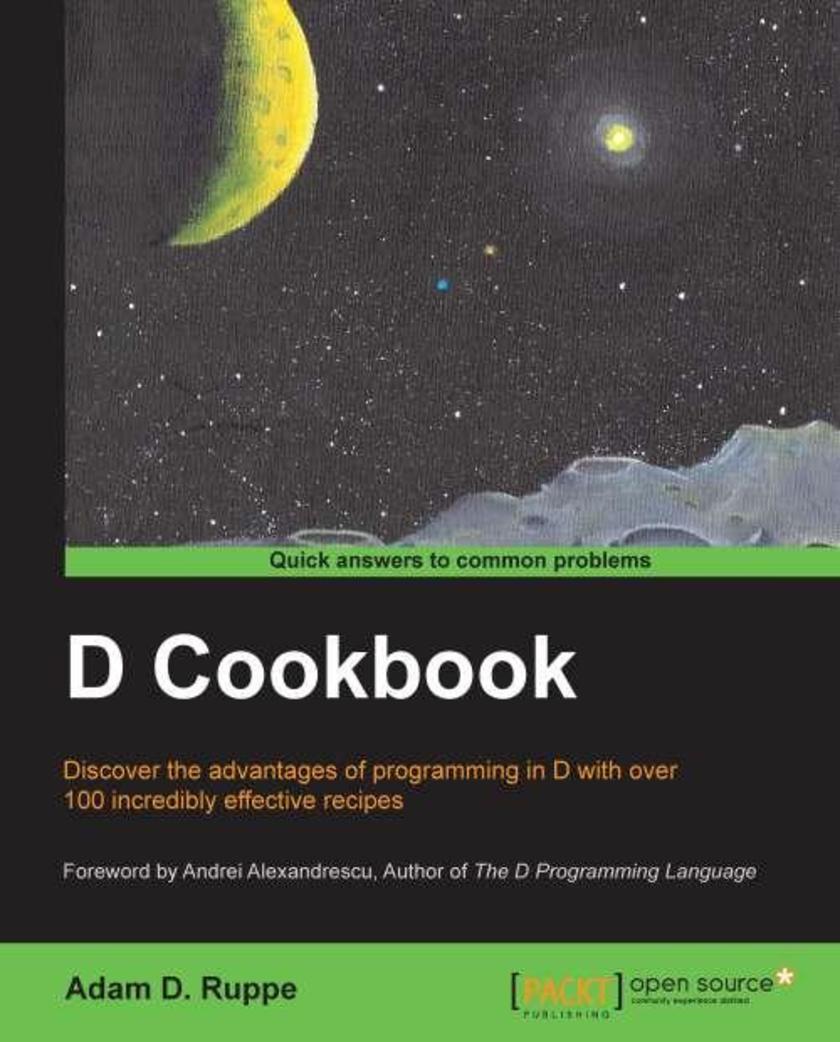
D Cookbook
D Cookbook
Adam D. Ruppe
¥90.46
A recipepacked reference guide filled with practical tasks that are concisely explained to develop and broaden the user's abilities with the D programming language. If you are an experienced programmer who is looking to explore a language that offers plenty of advantages over more established programming languages, this is the book for you. We assume that you are already familiar with general programming language basics, but you do not need to be a proficient user of D.