


 购物车
购物车 个人中心
个人中心
Cloud Analytics with Google Cloud Platform
¥73.02
Combine the power of analytics and cloud computing for faster and efficient insights About This Book ? Master the concept of analytics on the cloud: and how organizations are using it ? Learn the design considerations and while applying a cloud analytics solution ? Design an end-to-end analytics pipeline on the cloud Who This Book Is For This book is targeted at CIOs, CTOs, and even analytics professionals looking for various alternatives to implement their analytics pipeline on the cloud. Data professionals looking to get started with cloud-based analytics will also find this book useful. Some basic exposure to cloud platforms such as GCP will be helpful, but not mandatory. What You Will Learn ? Explore the basics of cloud analytics and the major cloud solutions ? Learn how organizations are using cloud analytics to improve the ROI ? Explore the design considerations while adopting cloud services ? Work with the ingestion and storage tools of GCP such as Cloud Pub/Sub ? Process your data with tools such as Cloud Dataproc, BigQuery, etc ? Over 70 GCP tools to build an analytics engine for cloud analytics ? Implement machine learning and other AI techniques on GCP In Detail With the ongoing data explosion, more and more organizations all over the world are slowly migrating their infrastructure to the cloud. These cloud platforms also provide their distinct analytics services to help you get faster insights from your data. This book will give you an introduction to the concept of analytics on the cloud, and the different cloud services popularly used for processing and analyzing data. If you’re planning to adopt the cloud analytics model for your business, this book will help you understand the design and business considerations to be kept in mind, and choose the best tools and alternatives for analytics, based on your requirements. The chapters in this book will take you through the 70+ services available in Google Cloud Platform and their implementation for practical purposes. From ingestion to processing your data, this book contains best practices on building an end-to-end analytics pipeline on the cloud by leveraging popular concepts such as machine learning and deep learning. By the end of this book, you will have a better understanding of cloud analytics as a concept as well as a practical know-how of its implementation Style and approach Comprehensive guide with a perfect blend of theory, examples, and implementation of real-world use-cases
Serverless Design Patterns and Best Practices
¥81.74
Get started with designing your serverless application using optimum design patterns and industry standard practices About This Book ? Learn the details of popular software patterns and how they are applied to serverless applications ? Understand key concepts and components in serverless designs ? Walk away with a thorough understanding of architecting serverless applications Who This Book Is For If you're a software architect, engineer, or someone who wants to build serverless applications, which are non-trivial in complexity and scope, then this book is for you. Basic knowledge of programming and serverless computing concepts are assumed. What You Will Learn ? Comprehend the popular design patterns currently being used with serverless architectures ? Understand the various design options and corresponding implementations for serverless web application APIs ? Learn multiple patterns for data-intensive serverless systems and pipelines, including MapReduce and Lambda Architecture ? Learn how to leverage hosted databases, queues, streams, storage services, and notification services ? Understand error handling and system monitoring in a serverless architecture a serverless architecture ? Learn how to set up a serverless application for continuous integration, continuous delivery, and continuous deployment In Detail Serverless applications handle many problems that developers face when running systems and servers. The serverless pay-per-invocation model can also result in drastic cost savings, contributing to its popularity. While it's simple to create a basic serverless application, it's critical to structure your software correctly to ensure it continues to succeed as it grows. Serverless Design Patterns and Best Practices presents patterns that can be adapted to run in a serverless environment. You will learn how to develop applications that are scalable, fault tolerant, and well-tested. The book begins with an introduction to the different design pattern categories available for serverless applications. You will learn the trade-offs between GraphQL and REST and how they fare regarding overall application design in a serverless ecosystem. The book will also show you how to migrate an existing API to a serverless backend using AWS API Gateway. You will learn how to build event-driven applications using queuing and streaming systems, such as AWS Simple Queuing Service (SQS) and AWS Kinesis. Patterns for data-intensive serverless application are also explained, including the lambda architecture and MapReduce. This book will equip you with the knowledge and skills you need to develop scalable and resilient serverless applications confidently. Style and approach Readers will be taken through a set of specific software patterns and learn, in detail, how to apply these patterns and build working software on top of a serverless system. At each step along the way, the reader will learn about the subcomponents and subsystems which comprise the larger system and which may be used in the future to solve different types of challenges.
Functional Python Programming
¥90.46
Create succinct and expressive implementations with functional programming in Python About This Book ? Learn how to choose between imperative and functional approaches based on expressiveness, clarity, and performance ? Get familiar with complex concepts such as monads, concurrency, and immutability ? Apply functional Python to common Exploratory Data Analysis (EDA) programming problems Who This Book Is For This book is for Python developers who would like to perform Functional programming with Python. Python Programming knowledge is assumed. What You Will Learn ? Use Python's generator functions and generator expressions to work with collections in a non-strict (or lazy) manner ? Utilize Python library modules including itertools, functools, multiprocessing, and concurrent features to ensure efficient functional programs ? Use Python strings with object-oriented suffix notation and prefix notation ? Avoid stateful classes with families of tuples ? Design and implement decorators to create composite functions ? Use functions such as max(), min(), map(), filter(), and sorted() ? Write higher-order functions In Detail If you’re a Python developer who wants to discover how to take the power of functional programming (FP) and bring it into your own programs, then this book is essential for you, even if you know next to nothing about the paradigm. Starting with a general overview of functional concepts, you’ll explore common functional features such as first-class and higher-order functions, pure functions, and more. You’ll see how these are accomplished in Python 3.6 to give you the core foundations you’ll build upon. After that, you’ll discover common functional optimizations for Python to help your apps reach even higher speeds. You’ll learn FP concepts such as lazy evaluation using Python’s generator functions and expressions. Moving forward, you’ll learn to design and implement decorators to create composite functions. You'll also explore data preparation techniques and data exploration in depth, and see how the Python standard library fits the functional programming model. Finally, to top off your journey into the world of functional Python, you’ll at look at the PyMonad project and some larger examples to put everything into perspective. Style and approach This book provides a general overview of functional concepts and then delves deeper into the functional features, showing you how the Python standard library fits the functional programming model. It also demonstrates how to implement common functional programming design patterns and techniques in Python.
Practical Game Design
¥81.74
Design accessible and creative games across genres, platforms, and development realities About This Book ? Implement the skills and techniques required to work in a professional studio ? Ace the core principles and processes of level design, world building, and storytelling ? Design interactive characters that animate the gaming world Who This Book Is For Whether you are a student eager to design a game or a junior game designer looking for your first role as a professional, this book will help you with the fundamentals of game design. By focusing on best practices and a pragmatic approach, Practical Game Design provides insights into the arts and crafts from two senior game designers that will interest more seasoned professionals in the game industry. What You Will Learn ? Define the scope and structure of a game project ? Conceptualize a game idea and present it to others ? Design gameplay systems and communicate them clearly and thoroughly ? Build and validate engaging game mechanics ? Design successful business models and prepare your games for live operations ? Master the principles behind level design, worldbuilding and storytelling ? Improve the quality of a game by playtesting and polishing it In Detail If you are looking for an up-to-date and highly applicable guide to game design, then you have come to the right place! Immerse yourself in the fundamentals of game design with this book, written by two highly experienced industry professionals to share their profound insights as well as give valuable advice on creating games across genres and development platforms. Practical Game Design covers the basics of game design one piece at a time. Starting with learning how to conceptualize a game idea and present it to the development team, you will gradually move on to devising a design plan for the whole project and adapting solutions from other games. You will also discover how to produce original game mechanics without relying on existing reference material, and test and eliminate anticipated design risks. You will then design elements that compose the playtime of a game, followed by making game mechanics, content, and interface accessible to all players. You will also find out how to simultaneously ensure that the gameplay mechanics and content are working as intended. As the book reaches its final chapters, you will learn to wrap up a game ahead of its release date, work through the different challenges of designing free-to-play games, and understand how to significantly improve their quality through iteration, polishing and playtesting. Style and approach A practical step by step guide to get you up and running with Game Design from scratch
Amazon Fargate Quick Start Guide
¥52.31
This book gets you started and gives you knowledge about AWS Fargate in order to successfully incorporate it in your ECS container application. Key Features *Gives you a quick walk-through over the Amazon Elastic Container Services (ECS) *Provides an in depth knowledge of the components that Amazon Fargate has to offer. *Learn the practical aspects of Docker application development with a managed service Book Description Amazon Fargate is new launch type for the Amazon Elastic Container Service (ECS). ECS is an AWS service for Docker container orchestration. Docker is the de facto containerization framework and has revolutionized packaging and deployment of software. The introduction of Fargate has made the ECS platform serverless. The book takes you through how Amazon Fargate runs ECS services composed of tasks and Docker containers and exposes the containers to the user. Fargate has simplified the ECS platform. We will learn how Fargate creates an Elastic Network Interface (ENI) for each task and how auto scaling can be enabled for ECS tasks. You will also learn about using an IAM policy to download Docker images and send logs to CloudWatch. Finally, by the end of this book, you will have learned about how to use ECS CLI to create an ECS cluster and deploy tasks with Docker Compose. What you will learn *Running Docker containers with a managed service *Use Amazon ECS in Fargate launch mode *Configure CloudWatch Logging with Fargate *Use an IAM Role with Fargate *Understand how ECS CLI is used with Fargate *Learn how to use an Application Load Balancer with Fargate *Learn about Auto Scaling with Fargate Who this book is for This book is for Docker users and developers who want to learn about the Fargate platform. Typical job roles for which the book is suitable are DevOps Architect, Docker Engineer, and AWS Cloud Engineer. Prior knowledge of AWS and ECS is helpful but not mandatory.
Ethereum Projects for Beginners
¥42.50
Understand the Ethereum platform to build distributed applications that are secured and decentralized using blockchain technology Key Features *Build your own decentralized applications using real-world blockchain examples *Implement Ethereum for building smart contracts and cryptocurrency applications with easy-to-follow projects *Enhance your application security with blockchain Book Description Ethereum enables the development of efficient, smart contracts that contain code. These smart contracts can interact with other smart contracts to make decisions, store data, and send Ether to others.Ethereum Projects for Beginners provides you with a clear introduction to creating cryptocurrencies, smart contracts, and decentralized applications. As you make your way through the book, you’ll get to grips with detailed step-by-step processes to build advanced Ethereum projects. Each project will teach you enough about Ethereum to be productive right away. You will learn how tokenization works, think in a decentralized way, and build blockchain-based distributed computing systems. Towards the end of the book, you will develop interesting Ethereum projects such as creating wallets and secure data sharing.By the end of this book, you will be able to tackle blockchain challenges by implementing end-to-end projects using the full power of the Ethereum blockchain. What you will learn *Develop your ideas fast and efficiently using the Ethereum blockchain *Make writing and deploying smart contracts easy and manageable *Work with private data in blockchain applications *Handle large files in blockchain applications *Ensure your decentralized applications are safe *Explore how Ethereum development frameworks work *Create your own cryptocurrency or token on the Ethereum blockchain *Make sure your cryptocurrency is ERC20-compliant to launch an ICO Who this book is for This book is for individuals who want to build decentralized applications using blockchain technology and the power of Ethereum from scratch. Some prior knowledge of JavaScript is required, since most examples use a web frontend.
Building RESTful Web Services with Java EE 8
¥52.31
Architect and design data-intensive applications and, in the process, learn how to collect, process, store, govern, and expose data for a variety of use cases Key Features *Integrate the data-intensive approach into your application architecture *Create a robust application layout with effective messaging and data querying architecture *Enable smooth data flow and make the data of your application intensive and fast Book Description Are you an architect or a developer who looks at your own applications gingerly while browsing through Facebook and applauding it silently for its data-intensive, yet ?uent and efficient, behaviour? This book is your gateway to build smart data-intensive systems by incorporating the core data-intensive architectural principles, patterns, and techniques directly into your application architecture. This book starts by taking you through the primary design challenges involved with architecting data-intensive applications. You will learn how to implement data curation and data dissemination, depending on the volume of your data. You will then implement your application architecture one step at a time. You will get to grips with implementing the correct message delivery protocols and creating a data layer that doesn’t fail when running high traffic. This book will show you how you can divide your application into layers, each of which adheres to the single responsibility principle. By the end of this book, you will learn to streamline your thoughts and make the right choice in terms of technologies and architectural principles based on the problem at hand. What you will learn *Understand how to envision a data-intensive system *Identify and compare the non-functional requirements of a data collection component *Understand patterns involving data processing, as well as technologies that help to speed up the development of data processing systems *Understand how to implement Data Governance policies at design time using various Open Source Tools *Recognize the anti-patterns to avoid while designing a data store for applications *Understand the different data dissemination technologies available to query the data in an efficient manner *Implement a simple data governance policy that can be extended using Apache Falcon Who this book is for This book is for developers and data architects who have to code, test, deploy, and/or maintain large-scale, high data volume applications. It is also useful for system architects who need to understand various non-functional aspects revolving around Data Intensive Systems.
Learn pfSense 2.4
¥78.47
Build, design, and style beautiful and informative applications on the Salesforce Lightning platform Key Features *Build and Test Lightning Components that enhance application usability and adaptability *Apply Security Best Practices to your Custom Lightning Components *Design Lightning Components for Salesforce UIs such as Lightning Pages, Salesforce 1 Application, Communities, and more. Book Description Built on the Salesforce App Cloud, the new Salesforce Lightning Experience combines three major components: Lightning Design System, Lightning App Builder, and Lightning Components, to provide an enhanced user experience. This book will enable you to quickly create modern, enterprise apps with Lightning Component Framework. You will start by building simple Lightning Components and understanding the Lightning Components architecture. The chapters cover the basics of Lightning Component Framework semantics and syntax, the security features provided by Locker Service, and use of third-party libraries inside Lightning Components. The later chapters focus on debugging, performance tuning, testing using Lightning Testing Services, and how to publish Lightning Components on Salesforce AppExchange. What you will learn *Understand Lightning Components architecture *Learn Locker security best practices *Debug and Improve performance of your Lightning Components *Use third-party libraries along with Lightning Component Framework *Learn how to publish Lightning Components on AppExchange *Use Lightning Out to take your Lightning Components outside the Salesforce platform Who this book is for This book is for Salesforce developers or developers from other platforms who are familiar with HTML, CSS, and JavaScript and want to build and test Salesforce Lightning components. No knowledge of Salesforce Lightning is required.
Python Artificial Intelligence Projects for Beginners
¥43.59
Real-world examples of cross-browser, mobile, and data-driven testing with all the latest features of Selenium WebDriver 3 Key Features *Unlock the full potential of Selenium to test your web applications *Use Selenium Grid for faster, parallel running, and cross-browser testing *Test iOS and Android Apps with Appium Book Description Selenium WebDriver is an open source automation tool implemented through a browser-specific driver, which sends commands to a browser and retrieves results. The latest version of Selenium 3 brings with it a lot of new features that change the way you use and setup Selenium WebDriver. This book covers all those features along with the source code, including a demo website that allows you to work with an HMTL5 application and other examples throughout the book. Selenium WebDriver 3 Practical Guide will walk you through the various APIs of Selenium WebDriver, which are used in automation tests, followed by a discussion of the various WebDriver implementations available. You will learn to strategize and handle rich web UI using advanced WebDriver API along with real-time challenges faced in WebDriver and solutions to handle them. You will discover different types and domains of testing such as cross-browser testing, load testing, and mobile testing with Selenium. Finally, you will also be introduced to data-driven testing using TestNG to create your own automation framework. By the end of this book, you will be able to select any web application and automate it the way you want. What you will learn *Understand what Selenium 3 is and how is has been improved than its predecessor *Use different mobile and desktop browser platforms with Selenium 3 *Perform advanced actions, such as drag-and-drop and action builders on web page *Learn to use Java 8 API and Selenium 3 together *Explore remote WebDriver and discover how to use it *Perform cross browser and distributed testing with Selenium Grid *Use Actions API for performing various keyboard and mouse actions Who this book is for Selenium WebDriver 3 Practical Guide is for software quality assurance/testing professionals, software project managers, or software developers interested in using Selenium for testing their applications. Prior programming experience in Java is necessary.
Hands-On Full Stack Web Development with Aurelia
¥73.02
Develop rich and scalable web applications with Node.js, Express.js, and MongoDB About This Book ? Learn the advanced features of Aurelia to build responsive web applications ? Write clean, modular, and testable code that will be easy to maintain and evolve ? Harness the power of JavaScript on the client and server side to build full-stack applications Who This Book Is For Hands-On Full Stack Web Development with Aurelia is for you if you are a web or full-stack JavaScript developer who has experience with traditional stacks such as LAMP, MEAN, or MERN and wish to explore the power of Aurelia and new stack with modern web technologies. What You Will Learn ? Employ best practices and modern approaches to create frontend applications ? Learn about modern CSS preprocessors and improve the readability of your application ? Use the Aurelia framework to create navigable web applications ? Write your own tests, making your application secure and fault-tolerant ? Create solid RESTful APIs using the microservice architecture ? Understand the NoSQL paradigm and get the best performance from your database ? Integrate third-party libraries such as Gmail for Single Sign On ? Write UI testing scripts and integration tests to build extensible apps In Detail Hands-On Full Stack Web Development with Aurelia begins with a review of basic JavaScript concepts and the structure of an Aurelia application generated with the Aurelia-CLI tool. You will learn how to create interesting and intuitive application using the Aurelia-Materialize plugin, which implements the material design approach. Once you fully configure a FIFA World Cup 2018 app, you'll start creating the initial components through TDD practices and then develop backend services to process and store all the user data. This book lets you explore the NoSQL model and implement it using one of the most popular NoSQL databases, MongoDB, with some exciting libraries to make the experience effortless. You'll also be able to add some advanced behavior to your components, from managing the lifecycle properly to using dynamic binding, field validations, and the custom service layer. You will integrate your application with Google OAuth Service and learn best practices to secure your applications. Furthermore, you'll write UI Testing scripts to create high-quality Aurelia Apps and explore the most used tools to run end-to-end tests. In the concluding chapters, you'll be able to deploy your application to the Cloud and Docker containers. By the end of this book, you will have learned how to create rich applications using best practices and modern approaches. Style and approach This is a comprehensive example-based book that guides you to create highly scalable applications using the new MEAN Stack.
Hands-On Design Patterns with Kotlin
¥81.74
Make the most of Kotlin by leveraging design patterns and best practices to build scalable and high performing apps About This Book ? Understand traditional GOF design patterns to apply generic solutions ? Shift from OOP to FP; covering reactive and concurrent patterns in a step-by-step manner ? Choose the best microservices architecture and MVC for your development environment Who This Book Is For This book is for developers who would like to master design patterns with Kotlin to build efficient and scalable applications. Basic Java or Kotlin programming knowledge is assumed What You Will Learn ? Get to grips with Kotlin principles, including its strengths and weaknesses ? Understand classical design patterns in Kotlin ? Explore functional programming using built-in features of Kotlin ? Solve real-world problems using reactive and concurrent design patterns ? Use threads and coroutines to simplify concurrent code flow ? Understand antipatterns to write clean Kotlin code, avoiding common pitfalls ? Learn about the design considerations necessary while choosing between architectures In Detail Design patterns enable you as a developer to speed up the development process by providing you with proven development paradigms. Reusing design patterns helps prevent complex issues that can cause major problems, improves your code base, promotes code reuse, and makes an architecture more robust. The mission of this book is to ease the adoption of design patterns in Kotlin and provide good practices for programmers. The book begins by showing you the practical aspects of smarter coding in Kotlin, explaining the basic Kotlin syntax and the impact of design patterns. From there, the book provides an in-depth explanation of the classical design patterns of creational, structural, and behavioral families, before heading into functional programming. It then takes you through reactive and concurrent patterns, teaching you about using streams, threads, and coroutines to write better code along the way By the end of the book, you will be able to efficiently address common problems faced while developing applications and be comfortable working on scalable and maintainable projects of any size. Style and approach This book explains design patterns in a step-by-step manner with clear and concise code examples
Introduction to Programming
¥73.02
Get a solid understanding of Java fundamentals to master programming through a series of practical steps About This Book ? Enjoy your first step into the world of programming ? Understand what a language is and use its features to build applications ? Learn about a wide variety of programming applications Who This Book Is For Introduction to Programming is for anybody who wants to learn programming. All you’ll need is a computer, internet connection, and a cup of coffee. What You Will Learn ? Understand what Java is ? Install Java and learn how to run it ? Write and execute a Java program ? Write and execute the test for your program ? Install components and confgure your development environment ? Learn and use Java language fundamentals ? Learn object-oriented design principles ? Master the frequently used Java constructs In Detail Have you ever thought about making your computer do what you want it to do? Do you want to learn to program, but just don't know where to start? Instead of guiding you in the right direction, have other learning resources got you confused with over-explanations? Don't worry. Look no further. Introduction to Programming is here to help. Written by an industry expert who understands the challenges faced by those from a non-programming background, this book takes a gentle, hand-holding approach to introducing you to the world of programming. Beginning with an introduction to what programming is, you'll go on to learn about languages, their syntax, and development environments. With plenty of examples for you to code alongside reading, the book's practical approach will help you to grasp everything it has to offer. More importantly, you'll understand several aspects of application development. As a result, you'll have your very own application running by the end of the book. To help you comprehensively understand Java programming, there are exercises at the end of each chapter to keep things interesting and encourage you to add your own personal touch to the code and, ultimately, your application. Style and approach This step-by-step guide will familiarize you with programming using some practical examples.

Hands-On Data Visualization with Bokeh
¥54.49
Learn how to create interactive and visually aesthetic plots using the Bokeh package in Python About This Book ? A step by step approach to creating interactive plots with Bokeh ? Go from nstallation all the way to deploying your very own Bokeh application ? Work with a real time datasets to practice and create your very own plots and applications Who This Book Is For This book is well suited for data scientists and data analysts who want to perform interactive data visualization on their web browsers using Bokeh. Some exposure to Python programming will be helpful, but prior experience with Bokeh is not required. What You Will Learn ? Installing Bokeh and understanding its key concepts ? Creating plots using glyphs, the fundamental building blocks of Bokeh ? Creating plots using different data structures like NumPy and Pandas ? Using layouts and widgets to visually enhance your plots and add a layer of interactivity ? Building and hosting applications on the Bokeh server ? Creating advanced plots using spatial data In Detail Adding a layer of interactivity to your plots and converting these plots into applications hold immense value in the field of data science. The standard approach to adding interactivity would be to use paid software such as Tableau, but the Bokeh package in Python offers users a way to create both interactive and visually aesthetic plots for free. This book gets you up to speed with Bokeh - a popular Python library for interactive data visualization. The book starts out by helping you understand how Bokeh works internally and how you can set up and install the package in your local machine. You then use a real world data set which uses stock data from Kaggle to create interactive and visually stunning plots. You will also learn how to leverage Bokeh using some advanced concepts such as plotting with spatial and geo data. Finally you will use all the concepts that you have learned in the previous chapters to create your very own Bokeh application from scratch. By the end of the book you will be able to create your very own Bokeh application. You will have gone through a step by step process that starts with understanding what Bokeh actually is and ends with building your very own Bokeh application filled with interactive and visually aesthetic plots. Style and approach This books take you through a step by step process that starts with understanding what Bokeh actually is and ends with building your very own Bokeh application filled with interactive and visually aesthetic plots that will amaze your users.
Learning ServiceNow
¥90.46
IT service management automation at your fingertips About This Book ? Learn to leverage ServiceNow’s capabilities for improved IT automation by following step-by-step, practical instructions ? Build core administration, development, and maintenance skills with IT service management in ServiceNow ? Improve your workflow efficiency by designing and creating responsive and automated workflows, business logic, and front-end automation Who This Book Is For This book is for IT professionals and administrators who are planning to or are already trying to implement ServiceNow in their organization for Enterprise IT service management tasks. Some familiarity with web technologies (JavaScript) would be helpful. Prior ServiceNow experience is not necessary. What You Will Learn ? Read and write clear, effective code for the ServiceNow platform ? Identify and avoid common pitfalls and missteps that could seriously impact future progress and upgradeability ? Use debugging tools to troubleshoot when things go wrong ? Discover tips and tricks from top ServiceNow developers, architects, and administrators. Find out what the pros wish they knew when they were starting out In Detail This book is an updated version of Learning ServiceNow, that will cover the new and updated features of the ServiceNow platform. It will show you how to put important ServiceNow features to work in the real world, while introducing key concepts via examples of managing and automating IT services. It'll help you build a solid foundation of knowledge, and will demonstrate how to effectively implement and configure modules within ServiceNow. We'll show you how to configure and administer your instance, and then move on to building strong user interfaces and creating powerful workflows. We also cover other key elements of ServiceNow, such as notifications, security, reporting, and custom development. You will learn how to improve and automate your business' workflow and processes. By the end of this book, you will be able to successfully configure and manage ServiceNow like a pro. Style and approach This book is a step-by-step practical tutorial to help you quickly deploy and configure ServiceNow in your organization. It guides you through the process of building applications and understanding the underlying systems, to help you become a more effective ServiceNow/ITSM administrator and/or developer.
Hands-On Blockchain with Hyperledger
¥82.83
Leverage the power of Hyperledger Fabric to develop Blockchain-based distributed ledgers with ease About This Book ? Write your own chaincode/smart contracts using Golang on hyperledger network ? Build and deploy decentralized applications (DApps) ? Dive into real world blockchain challenges such as integration and scalability Who This Book Is For The book benefits business leaders as it provides a comprehensive view on blockchain business models, governance structure, and business design considerations of blockchain solutions. Technology leaders stand to gain a lot from the detailed discussion around the technology landscape, technology design, and architecture considerations in the book. With model-driven application development, this guide will speed up understanding and concept development for blockchain application developers. The simple and well organized content will put novices at ease with blockchain concepts and constructs. What You Will Learn ? Discover why blockchain is a game changer in the technology landscape ? Set up blockchain networks using basic Hyperledger Fabric deployment ? Understand the considerations for creating decentralized applications ? Learn the process of creating good business networks using Hyperledger ? Write Smart Contracts quickly with Hyperledger Composer ? Design transaction model and chaincode with Golang ? Deploy Composer REST Gateway to access the Composer transactions ? Discern how business network impacts your Hyperledger Fabric solutions In Detail Blockchain and Hyperledger technologies are hot topics. Hyperledger Fabric and Hyperledger Composer are open source projects that help organizations create private, permissioned blockchain networks. Applications that exploit them include finance, banking, supply chains, IoT, and much more. This book will be an easy reference to explore and build blockchain networks using Hyperledger technologies. This book will start by explaining the blockchain evolution, including an overview of relevant blockchain technologies. You will learn how to configure Hyperledger Fabric on a cloud platform. Understand the architectural components of Hyperledger Fabric, and how they are configured to build private blockchain networks, and applications that connect to them. You'll build up a network and application from scratch, starting with first principles. You'll learn how to implement smart contracts in chaincode and much more on the Hyperledger network. By the end of this book, you will be able to build and deploy your own decentralized applications using Hyperledger, addressing the key pain points encountered in the blockchain life cycle. Style and approach An easy-to-follow step by step guide which will help you get to grips with real world application of Hyperledger
Practical Web Penetration Testing
¥73.02
Learn how to execute web application penetration testing end-to-end About This Book ? Build an end-to-end threat model landscape for web application security ? Learn both web application vulnerabilities and web intrusion testing ? Associate network vulnerabilities with a web application infrastructure Who This Book Is For Practical Web Penetration Testing is for you if you are a security professional, penetration tester, or stakeholder who wants to execute penetration testing using the latest and most popular tools. Basic knowledge of ethical hacking would be an added advantage. What You Will Learn ? Learn how to use Burp Suite effectively ? Use Nmap, Metasploit, and more tools for network infrastructure tests ? Practice using all web application hacking tools for intrusion tests using Kali Linux ? Learn how to analyze a web application using application threat modeling ? Know how to conduct web intrusion tests ? Understand how to execute network infrastructure tests ? Master automation of penetration testing functions for maximum efficiency using Python In Detail Companies all over the world want to hire professionals dedicated to application security. Practical Web Penetration Testing focuses on this very trend, teaching you how to conduct application security testing using real-life scenarios. To start with, you’ll set up an environment to perform web application penetration testing. You will then explore different penetration testing concepts such as threat modeling, intrusion test, infrastructure security threat, and more, in combination with advanced concepts such as Python scripting for automation. Once you are done learning the basics, you will discover end-to-end implementation of tools such as Metasploit, Burp Suite, and Kali Linux. Many companies deliver projects into production by using either Agile or Waterfall methodology. This book shows you how to assist any company with their SDLC approach and helps you on your journey to becoming an application security specialist. By the end of this book, you will have hands-on knowledge of using different tools for penetration testing. Style and approach In this book, you will learn and understand the workflow of application security testing. Starting from analysis using threat modeling until the testing phase and before the web project goes into production, you will be able conduct effective penetrating testing using web intrusion tests , network infrastructure tests, and code review.
Truffle Quick Start Guide
¥50.13
Develop, test, and deploy decentralized applications for Ethereum platform About This Book ? Build your first Ethereum Dapp with Truffle: the most popular Ethereum development framework ? Build, compile, and deploy smart contracts in your development environment ? Embrace Blockchains and utilize it to create new generation of secured and scalable apps Who This Book Is For This book is for web developers who are interested in the new world blockchain. Some basic understanding of JavaScript and web services is required. No prior knowledge of Decentralized applications or blockchain is required. What You Will Learn ? Understand the fundamentals of Truffle and Web3 ? Build a decentralized application with Truffle, while choosing the correct Ethereum client ? Connect your Dapp to Ethereum clients including Geth, Parity, and Ganache ? Migrate and test your Dapp with the correct networks such as Ropsten and Rinkeby ? Package a decentralized application into a user-friendly product by integrating Truffle with JavaScript frameworks such as Angular, React and Vue ? Explore tools including Ethereum Package Manager, the Registrar and browser wallets, and exploit third-party smart contract libraries. ? Evaluate the common migration pitfalls and how to mitigate them In Detail Truffle is a world-class development environment, testing framework and asset pipeline for Ethereum, aiming to make life as an Ethereum developer easier. If you are a web developer wanting to try your hand at developing Dapps with Truffle, then this is the book for you. This book will teach you to write smart contracts and build Dapps with Truffle. You will begin with covering the basics of Truffle, briefly explaining how it integrates Solidity and Web3, in orderto start building a mini decentralized application. Also, you will dive into migration, testing and integrating Truffle with the use of popular JavaScript frameworks. Lastly, you will ship your decentralized application and package it into a product. Moreover, you will go through the best practices in Truffle,so as to increase your proficiency in building Dapps with Truffle. By the end of the book, you will be able to write smart contracts and build decentralized applications with Truffle on Ethereum blockchains. Style and approach An intuitive, step-by-step and engaging guide that will teach you to build a real-world, decentralized application with Truffle.
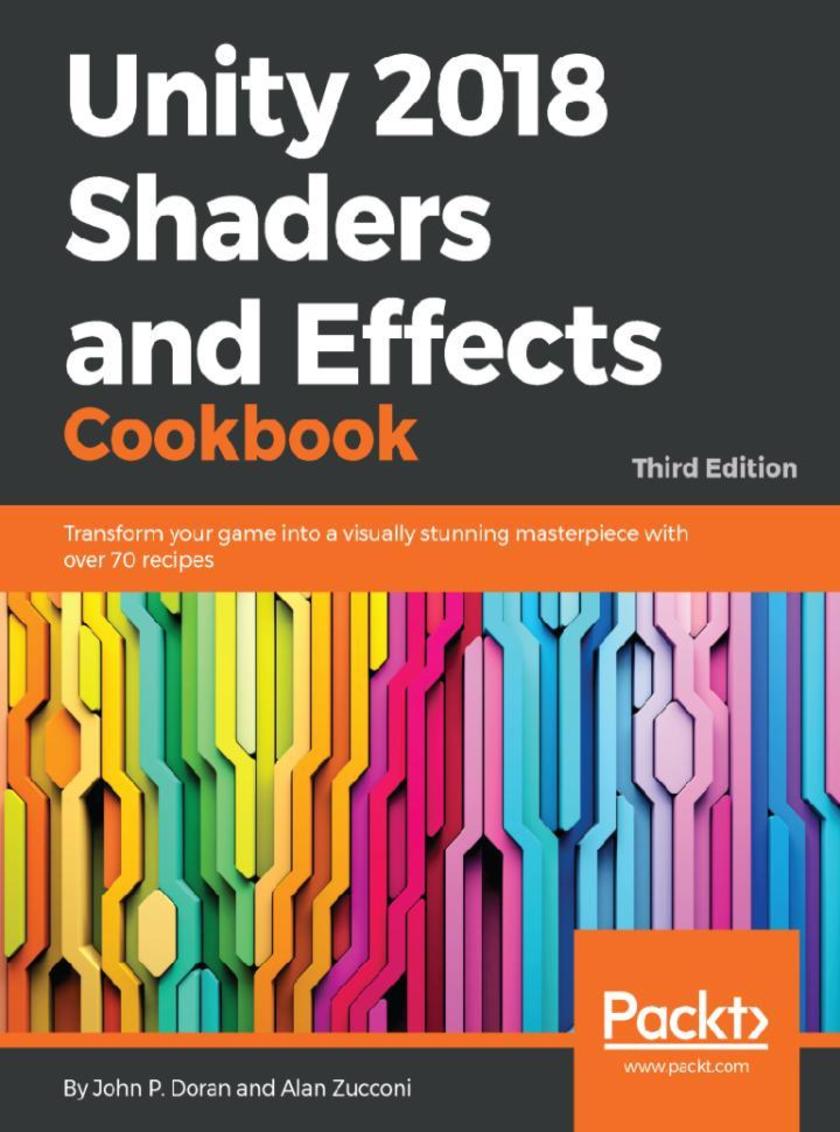
Unity 2018 Shaders and Effects Cookbook
¥90.46
Bring realism to your games by mastering post-processing effects and advanced shading techniques in Unity 2018 About This Book ? Learn the secrets of creating AAA quality shaders without writing long algorithms ? Master shader programming through easy-to-follow examples ? Create stunning visual effects that can be used in 3D games Who This Book Is For Unity Shaders and Effects Cookbook is for developers who want to create their first shaders in Unity 2018 or wish to take their game to a whole new level by adding professional post-processing effects. A solid understanding of Unity is required to get the most from this book. What You Will Learn ? Understand physically based rendering to fit the aesthetic of your game ? Write shaders from scratch in ShaderLab and HLSL/Cg ? Combine shader programming with interactive scripts to add life to your materials ? Design efficient shaders for mobile platforms without sacrificing their realism ? Use state-of-the-art techniques, such as volumetric explosions and fur shading ? Master the math and algorithms behind the most used lighting models ? Understand how shader models have evolved and how you can create your own In Detail Since their introduction to Unity, shaders have been seen as notoriously difficult to understand and implement in games. Complex mathematics has always stood in the way of creating your own shaders and attaining the level of realism you crave. Unity 2018 Shaders and Effects Cookbook changes that by giving you a recipe-based guide to creating shaders using Unity. It will show you everything you need to know about vectors, how lighting is constructed with them, and how textures are used to create complex effects without the heavy math. This book starts by teaching you how to use shaders without writing code with the post-processing stack. Then, you’ll learn how to write shaders from scratch, build up essential lighting, and finish by creating stunning screen effects just like those in high-quality 3D and mobile games. You'll discover techniques, such as normal mapping, image-based lighting, and animating your models inside a shader. We'll explore how to use physically based rendering to treat light the way it behaves in the real world. At the end, we’ll even look at Unity 2018’s new Shader Graph system. With this book, what seems like a dark art today will be second nature by tomorrow. Style and approach The recipes in this book contain step-by-step instructions, complemented with screenshots, code, and real-world examples.
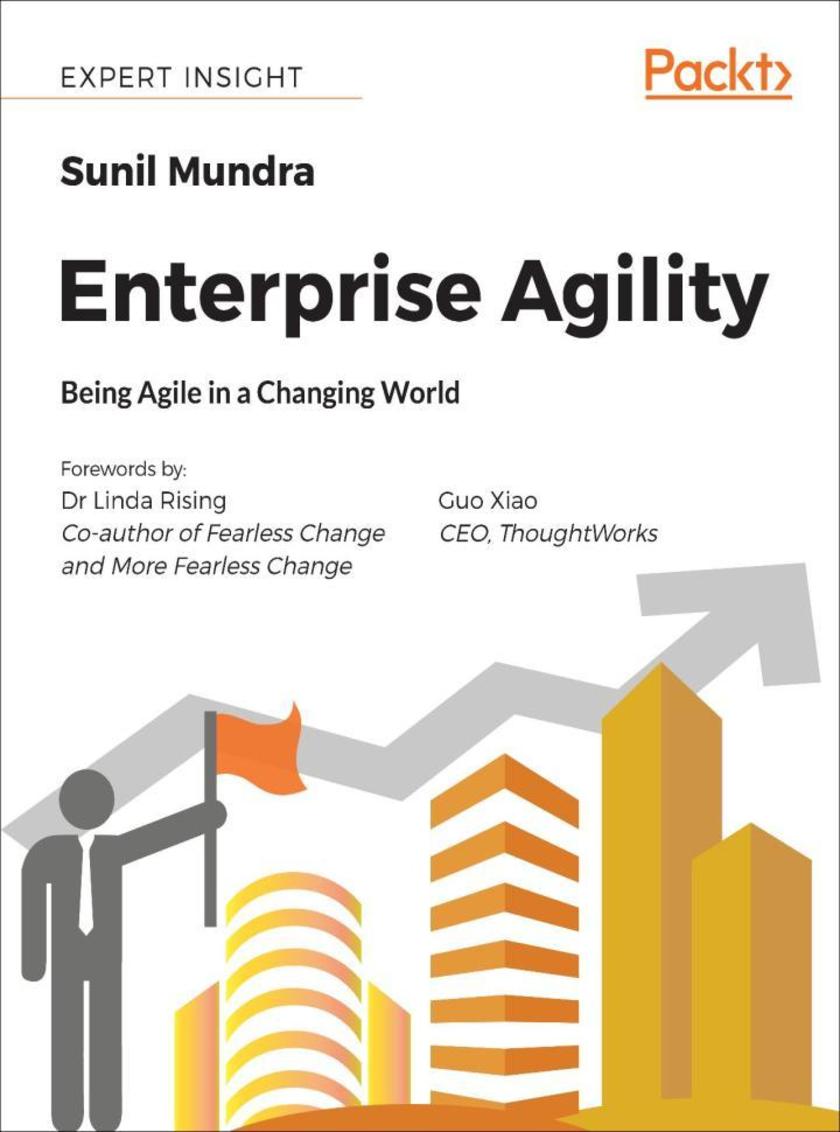
Enterprise Agility
¥63.21
Enterprise Agility is practical framework for enhancing Agility and equipping your company with the tools to survive. About This Book ? Prepare your company to navigate the rapidly-moving business world ? Enhance Agility in every component of your organization ? Build a framework that meets the unique requirements of your enterprise Who This Book Is For Enterprise Agility is a tool for anyone with the motivation to influence outcomes in an enterprise, who aspires to improve Agility. Readers from the following backgrounds will benefit: chief executive officer, chief information officer, people/human resource director, information technology director, head of change program, head of transformation, and Agile coach/consultant. What You Will Learn ? Drive agility-oriented change across the enterprise ? Understand why agility matters (more than ever) to modern enterprises ? Adopt and influence an Agile mindset in your teams and in your organization ? Understand the concept of a CAS and how to model enterprise and leadership behaviors on CAS characteristics to enhance enterprise agility ? Understand and convey the differences between Agile and true enterprise agility ? Create an enterprise-specific action plan to enhance agility ? Become a champion for enterprise agility ? Recognize the advantages and challenges of distributed teams, and how Agile ways of working can remedy the rough spots ? Enable and motivate your IT partners to adopt Agile ways of working In Detail The biggest challenge enterprises face today is dealing with fast-paced change in all spheres of business. Enterprise Agility shows how an enterprise can address this challenge head on and thrive in the dynamic environment. Avoiding the mechanistic construction of existing enterprises that focus on predictability and certainty, Enterprise Agility delivers practical advice for responding and adapting to the scale and accelerating pace of disruptive change in the business environment. Agility is a fundamental shift in thinking about how enterprises work to effectively deal with disruptive changes in the business environment. The core belief underlying agility is that enterprises are open and living systems. These living systems, also known as complex adaptive systems (CAS), are ideally suited to deal with change very effectively. Agility is to enterprises what health is to humans. There are some foundational principles that can be broadly applied, but the definition of healthy is very specific to each individual. Enterprise Agility takes a similar approach with regard to agility: it suggests foundational practices to improve the overall health of the body—culture, mindset, and leadership—and the health of its various organs: people, process, governance, structure, technology, and customers. The book also suggests a practical framework to create a plan to enhance agility. Style and approach Enterprise Agility is a step-by-step guide to facing change and uncertainty head-on. The books provides practical ways to apply Agile methodologies and boost Agility throughout a business.
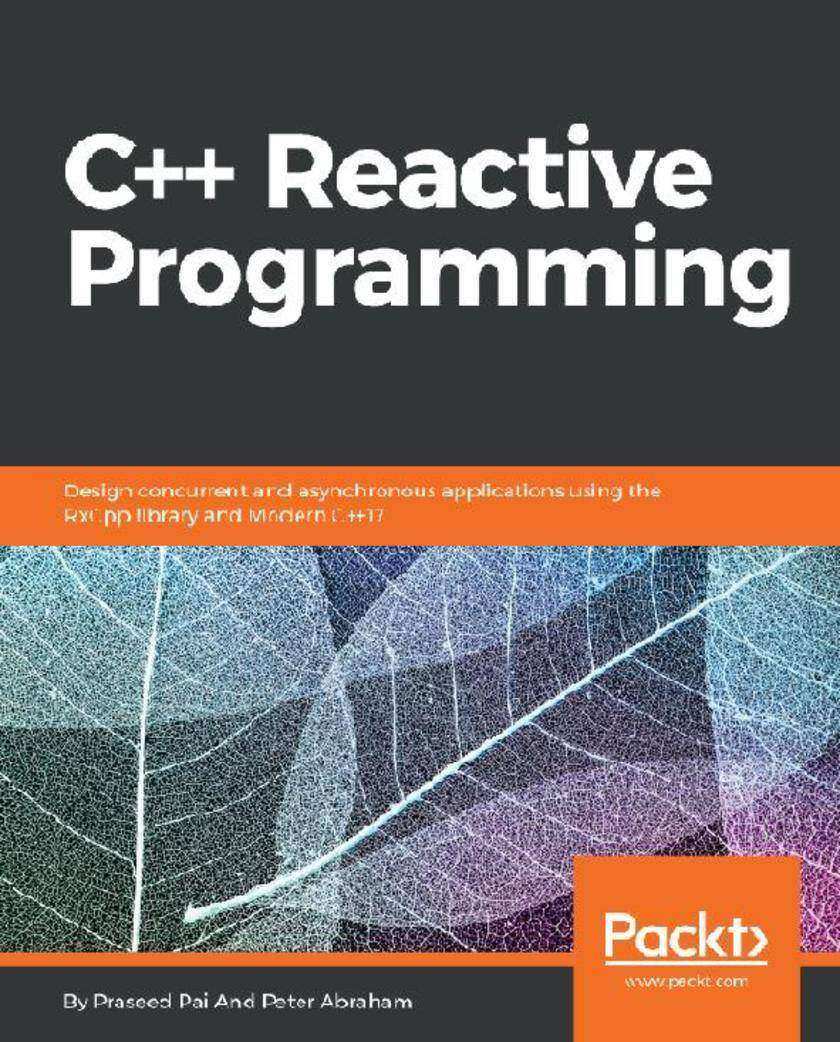
C++ Reactive Programming
¥81.74
Learn how to implement the reactive programming paradigm with C++ and build asynchronous and concurrent applications About This Book ? Efficiently exploit concurrency and parallelism in your programs ? Use the Functional Reactive programming model to structure programs ? Understand reactive GUI programming to make your own applications using Qt Who This Book Is For If you’re a C++ developer interested in using reactive programming to build asynchronous and concurrent applications, you’ll find this book extremely useful. This book doesn’t assume any previous knowledge of reactive programming. What You Will Learn ? Understand language-level concurrency in C++ ? Explore advanced C++ programming for the FRP ? Uncover the RxCpp library and its programming model ? Mix the FP and OOP constructs in C++ 17 to write well-structured programs ? Master reactive microservices in C++ ? Create custom operators for RxCpp ? Learn advanced stream processing and error handling In Detail Reactive programming is an effective way to build highly responsive applications with an easy-to-maintain code base. This book covers the essential functional reactive concepts that will help you build highly concurrent, event-driven, and asynchronous applications in a simpler and less error-prone way. C++ Reactive Programming begins with a discussion on how event processing was undertaken by different programming systems earlier. After a brisk introduction to modern C++ (C++17), you’ll be taken through language-level concurrency and the lock-free programming model to set the stage for our foray into the Functional Programming model. Following this, you’ll be introduced to RxCpp and its programming model. You’ll be able to gain deep insights into the RxCpp library, which facilitates reactive programming. You’ll learn how to deal with reactive programming using Qt/C++ (for the desktop) and C++ microservices for the Web. By the end of the book, you will be well versed with advanced reactive programming concepts in modern C++ (C++17). Style and approach The book includes real-world problems that you will solve with the reactive programming model. It highlights the way event processing has evolved in the programming world.
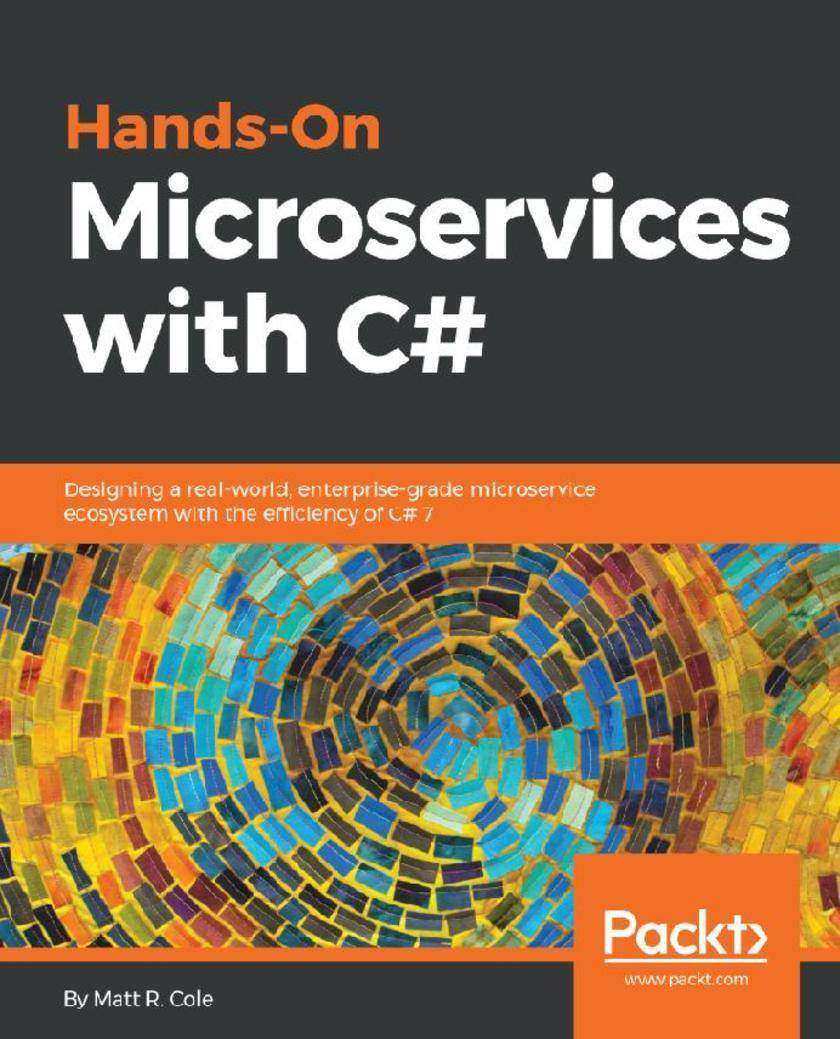
Hands-On Microservices with C#
¥81.74
Build enterprise-grade microservice ecosystems with intensive case studies using C# About This Book ? Learn to build message-based microservices ? Packed with case studies to explain the intricacies of large-scale microservices ? Build scalable, modular, and robust architectures with C# Who This Book Is For C# developers, software architects, and professionals who want to master the art of designing the microservice architecture that is scalable based on environment. Developers should have a basic understanding of.NET application development using C# and Visual Studio What You Will Learn ? Explore different open source tools within the context of designing microservices ? Learn to provide insulation to exception-prone function calls ? Build common messages used between microservices for communication ? Learn to create a microservice using our base class and interface ? Design a quantitative financial machine microservice ? Learn to design a microservice that is capable of using Blockchain technology In Detail C# is a powerful language when it comes to building applications and software architecture using rich libraries and tools such as .NET. This book will harness the strength of C# in developing microservices architectures and applications. This book shows developers how to develop an enterprise-grade, event-driven, asynchronous, message-based microservice framework using C#, .NET, and various open source tools. We will discuss how to send and receive messages, how to design many types of microservice that are truly usable in a corporate environment. We will also dissect each case and explain the code, best practices, pros and cons, and more. Through our journey, we will use many open source tools, and create file monitors, a machine learning microservice, a quantitative financial microservice that can handle bonds and credit default swaps, a deployment microservice to show you how to better manage your deployments, and memory, health status, and other microservices. By the end of this book, you will have a complete microservice ecosystem you can place into production or customize in no time. Style and approach A step-by-step guide that enables readers to create a complete microservice ecosystem they can place into production or customize in no time.


