


 购物车
购物车 个人中心
个人中心
Regression Analysis with Python
¥80.65
Learn the art of regression analysis with PythonAbout This BookBecome competent at implementing regression analysis in PythonSolve some of the complex data science problems related to predicting outcomesGet to grips with various types of regression for effective data analysisWho This Book Is ForThe book targets Python developers, with a basic understanding of data science, statistics, and math, who want to learn how to do regression analysis on a dataset. It is beneficial if you have some knowledge of statistics and data science.What You Will LearnFormat a dataset for regression and evaluate its performanceApply multiple linear regression to real-world problemsLearn to classify training pointsCreate an observation matrix, using different techniques of data analysis and cleaningApply several techniques to decrease (and eventually fix) any overfitting problemLearn to scale linear models to a big dataset and deal with incremental dataIn DetailRegression is the process of learning relationships between inputs and continuous outputs from example data, which enables predictions for novel inputs. There are many kinds of regression algorithms, and the aim of this book is to explain which is the right one to use for each set of problems and how to prepare real-world data for it. With this book you will learn to define a simple regression problem and evaluate its performance. The book will help you understand how to properly parse a dataset, clean it, and create an output matrix optimally built for regression. You will begin with a simple regression algorithm to solve some data science problems and then progress to more complex algorithms. The book will enable you to use regression models to predict outcomes and take critical business decisions. Through the book, you will gain knowledge to use Python for building fast better linear models and to apply the results in Python or in any computer language you prefer.Style and approach This is a practical tutorial-based book. You will be given an example problem and then supplied with the relevant code and how to walk through it. The details are provided in a step by step manner, followed by a thorough explanation of the math underlying the solution. This approach will help you leverage your own data using the same techniques.
Ceph Cookbook
¥80.65
Over 100 effective recipes to help you design, implement, and manage the software-defined and massively scalable Ceph storage systemAbout This BookImplement a Ceph cluster successfully and gain deep insights into its best practicesHarness the abilities of experienced storage administrators and architects, and run your own software-defined storage systemThis comprehensive, step-by-step guide will show you how to build and manage Ceph storage in production environmentWho This Book Is ForThis book is aimed at storage and cloud system engineers, system administrators, and technical architects who are interested in building software-defined storage solutions to power their cloud and virtual infrastructure. If you have basic knowledge of GNU/Linux and storage systems, with no experience of software defined storage solutions and Ceph, but eager to learn this book is for you.What You Will LearnUnderstand, install, configure, and manage the Ceph storage systemGet to grips with performance tuning and benchmarking, and gain practical tips to run Ceph in productionIntegrate Ceph with OpenStack Cinder, Glance, and nova componentsDeep dive into Ceph object storage, including s3, swift, and keystone integrationBuild a Dropbox-like file sync and share service and Ceph federated gateway setupGain hands-on experience with Calamari and VSM for cluster monitoringFamiliarize yourself with Ceph operations such as maintenance, monitoring, and troubleshootingUnderstand advanced topics including erasure coding, CRUSH map, cache pool, and system maintenanceIn DetailCeph is a unified, distributed storage system designed for excellent performance, reliability, and scalability. This cutting-edge technology has been transforming the storage industry, and is evolving rapidly as a leader in software-defined storage space, extending full support to cloud platforms such as Openstack and Cloudstack, including virtualization platforms. It is the most popular storage backend for Openstack, public, and private clouds, so is the first choice for a storage solution. Ceph is backed by RedHat and is developed by a thriving open source community of individual developers as well as several companies across the globe.This book takes you from a basic knowledge of Ceph to an expert understanding of the most advanced features, walking you through building up a production-grade Ceph storage cluster and helping you develop all the skills you need to plan, deploy, and effectively manage your Ceph cluster. Beginning with the basics, you’ll create a Ceph cluster, followed by block, object, and file storage provisioning. Next, you’ll get a step-by-step tutorial on integrating it with OpenStack and building a Dropbox-like object storage solution. We’ll also take a look at federated architecture and CephFS, and you’ll dive into Calamari and VSM for monitoring the Ceph environment. You’ll develop expert knowledge on troubleshooting and benchmarking your Ceph storage cluster. Finally, you’ll get to grips with the best practices to operate Ceph in a production environment.Style and approach This step-by-step guide is filled with practical tutorials, making complex scenarios easy to understand.
Building Apple Watch Projects
¥80.65
Discover exciting and fun projects by building brilliant applications for the Apple WatchAbout This BookExplore the opportunities opened up to developers by Apple’s latest device: the Apple WatchBe a crackerjack at developing software across a broad range of watch app categoriesFrom an eminent author, master all stages of development, from the first stage through to a completed projectWho This Book Is ForIf you have some basic knowledge of programming in Swift and are looking for the best way to get started with Apple Watch development, this book is just the right one for you!What You Will LearnUnderstand the concept of the Apple Watch as an autonomous device as well as it being paired with the iPhoneGet your app up and runningDesign exciting, inspiring, and attractive layouts for your appsMake your user interface more engaging using images and animationEnable your Watch and iPhone apps to transport and share dataLeverage the feature-rich set of WatchKit technologies provided by AppleConnect your apps to the InternetSubmit your app to the App StoreIn DetailWith Apple’s eagerly anticipated entry into the wearable arena, the field is wide open for a new era of app development. The Apple Watch is one of the most important technologies of our time.This easy-to-understand book takes beginners on a delightful journey of discovering the features available to the developer, right up to the completion of medium-level projects ready for App Store submission. It provides the fastest way to develop real-world apps for the Apple Watch by teaching you the concepts of Watch UI, visual haptic and audio, message and data exchange between watch and phone, Web communication, and finally Visual, haptic as well as audio feedback for users.By the end of this book, you will have developed at least four fully functioning apps for deployment on watchOS 2.Style and approachThis is a step-by-step guide to developing apps for the Apple Watch with the help of screenshots and fully coded working examples.
Unreal Engine 4 AI Programming Essentials
¥63.21
Create responsive and intelligent game AI using Blueprints in Unreal Engine 4 About This Book Understand and apply your Game AI better through various projects such as adding randomness and probability, and introducing movement Configure and debug Game AI logic using multiple methodologies Bridge the gap between your knowledge and Game AI in Unreal Engine 4 Who This Book Is For This book is for programmers and artists who want to expand their knowledge of Game AI in relation to Unreal Engine 4. You are recommended to have some experience of exploring Unreal Engine 4 prior to this book because we jump straight into Game AI. What You Will Learn Understand the fundamental components of Game AI within Unreal Engine 4 Skillfully introduce Game AI within Unreal Engine 4 Configure, customize, and assign Navigation and AI components to your pawn Create, debug, and analyze Game AI behavior Design responsive Game AI using the Behavior Tree methodology Create smart objects designed to interact with AI Utilize advanced AI features within your project to maximize the user experience In Detail Unreal Engine is a powerful game development engine that provides rich functionalities to create 2D and 3D games. It is one of the three big game engines used, alongside Unity and CryEngine. Developers have the opportunity to build cross-platform mobile and desktop games from scratch. With Blueprints in Unreal Engine 4, you’re able to fully leverage the visual aid that Behavior Trees are built on. Rarely has there been an opportunity to prototype powerful Game AI and have immediate control over constructing, *ing, and viewing the response in a live gaming environment. This book will show you how to apply artificial intelligence (AI) techniques to your Unreal Script using C++ as your *ing language through multiple projects. With the knowledge gained through this book, you’ll be able to leverage the benefits of Unreal Engine 4. We’ll start with an introduction to AI, and you’ll learn how it is applied to gaming. Then you’ll jump right in and create a simple AI bot and apply basic behaviors to allow it to move randomly. Furthermore, you will get to know the difference between an AI Controller and a Player Controller. As you progress, you’ll find out how to implement randomness and probability traits. Using Navmesh, we will impart navigation components such as Character Movement, MoveTo Nodes, Settings, and World Objects, and implement behavior trees. You will see different techniques to sense the environment and create your own sensory system, and will implement Steering Behaviors, Path Following, Avoidance, and Projectiles. At the end of the book, we will troubleshoot any issues that might crop up while building the entire game. Style and approach This easy-to-follow project-based guide throws you directly into the excitement of Game AI in an approachable and comprehensive manner.
Getting Started with RethinkDB
¥63.21
Absorb the knowledge required to utilize, manage, and deploy RethinkDB using Node.js About This Book Make the most of this open source, scalable database—RethinkDB —to ease the construction of web applications Run powerful queries using ReQL, which is the most convenient language to manipulate JSON documents with Develop fully-fledged real-time web apps using Node.js and RethinkDB Who This Book Is For Getting Started with RethinkDB is ideal for developers who are new to RethinkDB and need a practical understanding to start working with it. No previous knowledge of database programming is required, although a basic knowledge of JavaScript or Node.js would be helpful. What You Will Learn Download and install the database on your system Configure RethinkDB’s settings and start using the web interface Import data into RethinkDB Run queries using the ReQL language Create shards, replicas, and RethinkDB clusters Use an index to improve database performance Get to know all the RethinkDB deployment techniques In Detail RethinkDB is a high-performance document-oriented database with a unique set of features. This increasingly popular NoSQL database is used to develop real-time web applications and, together with Node.js, it can be used to easily deploy them to the cloud with very little difficulty. Getting Started with RethinkDB is designed to get you working with RethinkDB as quickly as possible. Starting with the installation and configuration process, you will learn how to start importing data into the database and run simple queries using the intuitive ReQL query language. After successfully running a few simple queries, you will be introduced to other topics such as clustering and sharding. You will get to know how to set up a cluster of RethinkDB nodes and spread database load across multiple machines. We will then move on to advanced queries and optimization techniques. You will discover how to work with RethinkDB from a Node.js environment and find out all about deployment techniques. Finally, we’ll finish by working on a fully-fledged example that uses the Node.js framework and advanced features such as Changefeeds to develop a real-time web application. Style and approach This is a step-by-step book that provides a practical approach to RethinkDB programming, and is explained in a conversational, easy-to-follow style.

Building a Pentesting Lab for Wireless Networks
¥80.65
Build your own secure enterprise or home penetration testing lab to dig into the various hacking techniques About This Book Design and build an extendable penetration testing lab with wireless access suitable for home and enterprise use Fill the lab with various components and customize them according to your own needs and skill level Secure your lab from unauthorized access and external attacks Who This Book Is For If you are a beginner or a security professional who wishes to learn to build a home or enterprise lab environment where you can safely practice penetration testing techniques and improve your hacking skills, then this book is for you. No prior penetration testing experience is required, as the lab environment is suitable for various skill levels and is used for a wide range of techniques from basic to advance. Whether you are brand new to online learning or you are a seasoned expert, you will be able to set up your own hacking playground depending on your tasks. What You Will Learn Determine your needs and choose the appropriate lab components for them Build a virtual or hardware lab network Imitate an enterprise network and prepare intentionally vulnerable software and services Secure wired and wireless access to your lab Choose a penetration testing framework according to your needs Arm your own wireless hacking platform Get to know the methods to create a strong defense mechanism for your system In Detail Starting with the basics of wireless networking and its associated risks, we will guide you through the stages of creating a penetration testing lab with wireless access and preparing your wireless penetration testing machine. This book will guide you through configuring hardware and virtual network devices, filling the lab network with applications and security solutions, and making it look and work like a real enterprise network. The resulting lab protected with WPA-Enterprise will let you practice most of the attack techniques used in penetration testing projects. Along with a review of penetration testing frameworks, this book is also a detailed manual on preparing a platform for wireless penetration testing. By the end of this book, you will be at the point when you can practice, and research without worrying about your lab environment for every task. Style and approach This is an easy-to-follow guide full of hands-on examples and recipes. Each topic is explained thoroughly and supplies you with the necessary configuration settings. You can pick the recipes you want to follow depending on the task you need to perform.
Mastering RabbitMQ
¥99.18
Master the art of developing message-based applications with RabbitMQAbout This BookLearn how to administer, manage, and extend your own message broker, RabbitMQDevelop clients to make a message bridge between your software systems using RabbitMQDiscover how to achieve proficiency with RabbitMQ with the well-defined de*ions of the topicsWho This Book Is ForIf you are an intermediate-level RabbitMQ developer, who wants to achieve professional-level expertise in the subject, this book is for you. You’ll also need to have a decent understanding of message queuing.What You Will LearnAdminister RabbitMQ using different toolsUnderstand the roots and details of messaging, message brokers, and AMQP protocolScale the RabbitMQ server using the clusters and high availability techniquesExtend RabbitMQ by developing the Erlang OTP-based applications that use the RabbitMQ APIManage the RabbitMQ server using its powerful toolsMonitor the RabbitMQ Server using different open source tools such as Nagios, Munin, and ZabbixEnsure your RabbitMQ’s security using SSL, SASL, and access controlDevelop RabbitMQ clients using Java, Python, and C# with an industry exampleIn DetailRabbitMQ is one of the most powerful Open Source message broker software, which is widely used in tech companies such as Mozilla, VMware, Google, AT&T, and so on. RabbitMQ gives you lots of fantastic and easy-to-manage functionalities to control and manage the messaging facility with lots of community support. As scalability is one of our major modern problems, messaging with RabbitMQ is the main part of the solution to this problem.This book explains and demonstrates the RabbitMQ server in a detailed way. It provides you with lots of real-world examples and advanced solutions to tackle the scalability issues.You’ll begin your journey with the installation and configuration of the RabbitMQ server, while also being given specific details pertaining to the subject. Next, you’ll study the major problems that our server faces, including scalability and high availability, and try to get the solutions for both of these issues by using the RabbitMQ mechanisms. Following on from this, you’ll get to design and develop your own plugins using the Erlang language and RabbitMQ’s internal API. This knowledge will help you to start with the management and monitoring of the messages, tools, and applications. You’ll also gain an understanding of the security and integrity of the messaging facilities that RabbitMQ provides. In the last few chapters, you will build and keep track of your clients (senders and receivers) using Java, Python, and C#.Style and approach An easy-to-follow guide, full of hands-on examples based around managing, monitoring, extending, and securing RabbitMQ and its internal tools. You will learn how to develop your own clients using Java, Python, and C#.
Learning Elixir
¥63.21
Unveil many hidden gems of programming functionally by taking the foundational steps with ElixirAbout This BookExplore the functional paradigms of programming with Elixir through use of helpful examplesConcise step-by-step instructions to teach you difficult technical conceptsBridge the gap between functional programming and ElixirWho This Book Is ForThis book targets developers new to Elixir, as well as Erlang, in order to make them feel comfortable in functional programming with Elixir, thus enabling them to develop more scalable and fault-tolerant applications.Although no knowledge of Elixir is assumed, some programming experience with mainstream Object-Oriented programming languages such a Ruby, Python, Java, C# would be beneficial.What You Will LearnExplore Elixir to create resilient, scalable applicationsCreate fault-tolerant applicationsBecome better acquainted with Elixir code and see how it is structured to build and develop functional programsLearn the basics of functional programmingGain an understanding of effective OTP principlesDesign program-distributed applications and systemsWrite and create branching statements in ElixirLearn to do more with less using Elixir's metaprogrammingBe familiar with the facilities Elixir provides for metaprogramming, macros, and extending the Elixir languageIn DetailElixir, based on Erlang’s virtual machine and ecosystem, makes it easier to achieve scalability, concurrency, fault tolerance, and high availability goals that are pursued by developers using any programming language or programming paradigm. Elixir is a modern programming language that utilizes the benefits offered by Erlang VM without really incorporating the complex syntaxes of Erlang.Learning to program using Elixir will teach many things that are very beneficial to programming as a craft, even if at the end of the day, the programmer isn't using Elixir. This book will teach you concepts and principles important to any complex, scalable, and resilient application. Mostly, applications are historically difficult to reason about, but using the concepts in this book, they will become easy and enjoyable. It will teach you the functional programing ropes, to enable them to create better and more scalable applications, and you will explore how Elixir can help you achieve new programming heights. You will also glean a firm understanding of basics of OTP and the available generic, provided functionality for creating resilient complex systems. Furthermore, you will learn the basics of metaprogramming: modifying and extending Elixir to suite your needs.Style and approach An exploration of functional programming and Elixir with easy to follow examples using Elixir and the functional style. All the topics, concepts, and principles covered are clearly and concisely explained with either code examples or in depth discussions, or both!
R Data Science Essentials
¥63.21
Learn the essence of data science and visualization using R in no time at allAbout This BookBecome a pro at making stunning visualizations and dashboards quickly and without hassleFor better decision making in business, apply the R programming language with the help of useful statistical techniques.From seasoned authors comes a book that offers you a plethora of fast-paced techniques to detect and analyze data patternsWho This Book Is ForIf you are an aspiring data scientist or analyst who has a basic understanding of data science and has basic hands-on experience in R or any other analytics tool, then R Data Science Essentials is the book for you.What You Will LearnPerform data preprocessing and basic operations on dataImplement visual and non-visual implementation data exploration techniquesMine patterns from data using affinity and sequential analysisUse different clustering algorithms and visualize themImplement logistic and linear regression and find out how to evaluate and improve the performance of an algorithmExtract patterns through visualization and build a forecasting algorithmBuild a recommendation engine using different collaborative filtering algorithmsMake a stunning visualization and dashboard using ggplot and R shinyIn DetailWith organizations increasingly embedding data science across their enterprise and with management becoming more data-driven it is an urgent requirement for analysts and managers to understand the key concept of data science. The data science concepts discussed in this book will help you make key decisions and solve the complex problems you will inevitably face in this new world.R Data Science Essentials will introduce you to various important concepts in the field of data science using R. We start by reading data from multiple sources, then move on to processing the data, extracting hidden patterns, building predictive and forecasting models, building a recommendation engine, and communicating to the user through stunning visualizations and dashboards.By the end of this book, you will have an understanding of some very important techniques in data science, be able to implement them using R, understand and interpret the outcomes, and know how they helps businesses make a decision.Style and approachThis easy-to-follow guide contains hands-on examples of the concepts of data science using R.
Getting Started with Ionic
¥54.49
Get up and running with developing effective Hybrid Mobile Apps with IonicAbout This BookDevelop engaging mobile experiences with a native-looking UI in Ionic and AngularJSBuild mobile applications with a native UI and interactions with device APIs using popular web technologies such as HTML, CSS, and JavaScriptCreate an e-commerce mobile app using tutorials and code samplesWho This Book Is ForThis book is ideal for any web developer who wants to enter into the world of mobile app development but has no clue where to start. Ionic is an ideal starting point and provides a smooth learning curve to help you build hybrid apps using web technologies and to develop native apps for iOS and Android, you do not need to know multiple languages. This book will also be useful for Hybrid App developers who have not found the perfect framework to ensure users get a rich experience from your apps.What You Will LearnGet to know about Hybrid Apps and AngularJSSet up a development environment to build Hybrid AppsNavigate around the components and routing in IonicUse different Ionic directives for a mobile-specific experienceIntegrate an Ionic App with backend web servicesWork with plugins to include native functionality in your hybrid appsTest your apps on real devicesBuild an e-commerce app for iOS and Android from scratchIn DetailHybrid Apps are a promising choice in mobile app development to achieve cost effectiveness and rapid development. However, they were not preferred over native apps until few years back due to a poor performance and bad user experience, but everything has changed with the release of Ionic. It has evolved as the most popular choice for Hybrid Mobile App development as it tends to match the native experience and provides robust components/tools to build apps.Getting Started with Ionic equips any web developer with the basic knowledge needed to use modern web technologies to build amazing hybrid mobile apps using Ionic.This fast-paced, practical book explains all the important concepts of AngularJS and Cordova Framework required to develop apps, then gives you a brief introduction to hybrid mobile applications. It will guide you through setting up the environment to develop mobile apps, and through the multiple options and features available in Ionic so you can use them in your mobile apps. Features such as the Side Menu, Tabs, Touch Interactions, and native features such as Bar Code, Camera, and Geolocations are all covered.. Finally, we’ll show you how to use Cordova plugins and publish your apps.Style and approachGetting started with Ionic is a compact, easy-to-follow guide to developing hybrid mobile apps using Ionic with real world examples of building an e-commerce app.
Ionic Framework By Example
¥54.49
Build amazing cross-platform mobile apps with Ionic, the HTML5 framework that makes modern mobile application development simpleAbout This BookLearn how to use one of the most exciting mobile development frameworks around to build even better appsFollow the featured sample projects to experience Ionic’s impressive capabilitiesExtend your developer skillset to build, test, and launch mobile apps with confidenceWho This Book Is ForThis book is for anyone who wants to see Ionic in action - and find out how it could transform the way they build mobile apps. If you’re a JavaScript web developer, you’ll be building great projects in no time.What You Will LearnLearn Ionic by creating three complete mobile applicationsGet to know the Ionic CLIAdd basic and advanced features to the Ionic frameworkConnect an Ionic app with a Firebase back endIntegrate PhoneGap plugins with NG-CordovaTest your apps to improve and optimize performanceIn DetailChange doesn’t have to be challenging. Sometimes it can be simple – sometimes it just makes sense. With Ionic, mobile development has never been so simple, so elegant and obvious. By helping developers to harness AngularJS and HTML5 for mobile development, it’s the perfect framework for anyone obsessed with performance, and anyone that understands just how important a great user experience really is.This book shows you how to get started with Ionic framework immediately. But it doesn’t just give you instructions and then expect you to follow them. Instead it demonstrates what Ionic is capable of through three practical projects you can follow and build yourself.From a basic to-do list app, a London tourist app, to a complete social media app, all three projects have been designed to help you learn Ionic at its very best. From setting up your project to developing on both the server side and front end, and best practices for testing and debugging your projects, you’ll quickly become a better mobile developer, delivering high performance mobile apps that look awesome.Ionic Framework by Example is for people who don’t want to learn now, build later – it’s for people who want to learn and build at the same time – so they can meet today’s mobile development challenges head on and deliver better products than anyone else.Style and approachThis book isn’t just an instruction manual. It doesn’t just tell you what to do – it shows you. Featuring three sample projects, it’s been created so you can get started with Ionic immediately.
Getting Started with SpriteKit
¥71.93
Develop fun and exciting games and create amazing animations for your existing apps with SpriteKit, Apple's 2D game development frameworkAbout This BookLearn the key concepts of game development in iOSTake advantage of SpriteKit to create your own games and improve your appsFollow the step-by-step chapters to create a complete product ready to submit to the App StoreWho This Book Is ForGetting Started with SpriteKit is for beginner-level iOS developers who want to add an extra edge to their apps and create amazing games using SpriteKit. It doesn’t matter whether you have experience in iOS development or not as this book will show you the swift tricks you can use to create games.What You Will LearnCreate and configure a SpriteKit project from scratchLoad and manage the basic elements of games such as sprites, labels, and geometrical primitivesHandle touch events, detect collisions, and play sound audio filesCreate complex elements, animate sprites, and run the parallax effectComplete your games with key components such as a main menu, transitions between scenes, a tutorial, and the ability to load and save dataIncrease the efficiency of your device using the accelerometer or by adding shaders, lights, and shadowsGain complementary techniques such as creating or finding audio resources, applying SpriteKit to apps, or using third-party toolsIn DetailSpriteKit is Apple’s game engine to develop native iOS games. Strongly boosted by the Apple Inc., Cupertino, it has increased in popularity since its first release. This book shows you the solutions provided by SpriteKit to help you create any 2D game you can imagine and apply them to create animations that will highlight your existing apps.This book will give you the knowledge you need to apply SpriteKit to your existing apps or create your own games from scratch.Throughout the book, you will develop a complete game. The beautiful designs implemented in the game in this book will easily lead you to learn the basis of 2D game development, including creating and moving sprites, and adding them to a game scene. You will also discover how to apply advanced techniques such as collision detection, action execution, playing music, or running animations to give a more professional aspect to the game. You will finish your first game by learning how to add a main menu and a tutorial, as well as saving and loading data from and to the player’s device.Finally, you will find out how to apply some mobile games techniques such as accelerometer use or touch detection.Style and approachWritten in an informal way with plenty of illustrative screenshots, this easy-to-follow and practical guide will help you get the most from SpriteKit. The main part of the book provides step-by-step instructions to develop of a complete product, while the last chapters give you some complementary techniques than can be used in mobile 2D game development.
Procedural Content Generation for C++ Game Development
¥90.46
Get to know techniques and approaches to procedurally generate game content in C++ using Simple and Fast Multimedia LibraryAbout This BookThis book contains a bespoke Simple and Fast Multimedia Library (SFML) game engine with complete online documentationThrough this book, you’ll create games that are non-predictable and dynamic and have a high replayability factorGet a breakdown of the key techniques and approaches applied to a real game.Who This Book Is ForIf you are a game developer who is familiar with C++ and is looking to create bigger and more dynamic games, then this book is for you. The book assumes some prior experience with C++, but any intermediate concepts are clarified in detail. No prior experience with SFML is required.What You Will LearnDiscover the systems and ideology that lie at the heart of procedural systemsUse Random number generation (RNG) with C++ data types to create random but controlled resultsBuild levels procedurally with randomly located items and eventsCreate dynamic game objects at runtimeConstruct games using a component-based approachAssemble non-predictable game events and scenariosOperate procedural generation to create dynamic content fast and easilyGenerate game environments for endless replayabilityIn DetailProcedural generation is a growing trend in game development. It allows developers to create games that are bigger and more dynamic, giving the games a higher level of replayability. Procedural generation isn’t just one technique, it’s a collection of techniques and approaches that are used together to create dynamic systems and objects. C++ is the industry-standard programming language to write computer games. It’s at the heart of most engines, and is incredibly powerful. SFML is an easy-to-use, cross-platform, and open-source multimedia library. Access to computer hardware is broken into succinct modules, making it a great choice if you want to develop cross-platform games with ease.Using C++ and SFML technologies, this book will guide you through the techniques and approaches used to generate content procedurally within game development.Throughout the course of this book, we’ll look at examples of these technologies, starting with setting up a roguelike project using the C++ template. We’ll then move on to using RNG with C++ data types and randomly scattering objects within a game map. We will create simple console examples to implement in a real game by creating unique and randomised game items, dynamic sprites, and effects, and procedurally generating game events. Then we will walk you through generating random game maps. At the end, we will have a retrospective look at the project.By the end of the book, not only will you have a solid understanding of procedural generation, but you’ll also have a working roguelike game that you will have extended using the examples provided.Style and approachThis is an easy-to-follow guide where each topic is explained clearly and thoroughly through the use of a bespoke example, then implemented in a real game project.
Mastering Application Development with Force.com
¥63.21
Design and develop state-of-the-art applications using Force.com's powerful development platformAbout This BookFlaunt your skillsets by developing complex applications that include demanding concepts such as triggers, Visualforce controllers, batch jobs, and Lightning componentsEarn the gratitude of your colleagues by structuring a project so that multiple developers can work independently of each otherKevin Poorman, the author of the book and a Force.com MVP, shares his years of Force.com knowledge and experience with you through the medium of telling examplesWho This Book Is ForIf you're a Force.com developer with a fundamental understanding of Apex and JavaScript but now want to enhance your skills with tips, tricks, and guidance on the best architectural and engineering practices, then this book is for you.What You Will LearnCreating triggers, and the best practices for writing themDeveloping a number of Visualforce controllers and extensionsIntegrating third-party web APIs into your Apex codeWriting unit tests that cover testing bulk safety, user and profile settings, and negative testsCreating a Lightning component for use in Salesforce1Getting acquainted with various methods for deploying metadata between orgsUsing the Rest sObject API for access to Salesforce objects and data using the REST methodologyLearning about overarching architectural considerations such as naming conventions, testing practices, and data modeling practicesIn DetailForce.com is an extremely powerful, scalable, and secure cloud platform, delivering a complete technology stack, ranging from databases and security to workflow and the user interface. With salesforce.com's Force.com cloud platform, you can build any business application and run it on your servers.The book will help you enhance your skillset and develop complex applications using Force.com. It gets you started with a quick refresher of Force.com's development tools and methodologies, and moves to an in-depth discussion of triggers, bulkification, DML order of operations, and trigger frameworks. Next, you will learn to use batchable and schedulable interfaces to process massive amounts of information asynchronously. You will also be introduced to Salesforce Lightning and cover components—including backend (apex) controllers, frontend (JavaScript) controllers, events, and attributes—in detail.Moving on, the book will focus on testing various apex components: what to test, when to write the tests, and—most importantly—how to test. Next, you will develop a changeset and use it to migrate your code from one org to another, and learn what other tools are out there for deploying metadata. You will also use command-line tools to authenticate and access the Force.com Rest sObject API and the Bulk sObject API; additionally, you will write a custom Rest endpoint, and learn how to structure a project so that multiple developers can work independently of each other without causing metadata conflicts.Finally, you will take an in-depth look at the overarching best practices for architecture (structure) and engineering (code) applications on the Force.com platform.Style and approach A step-by-step tutorial, with plenty of tips and tricks that will help you develop complex Force.com applications.
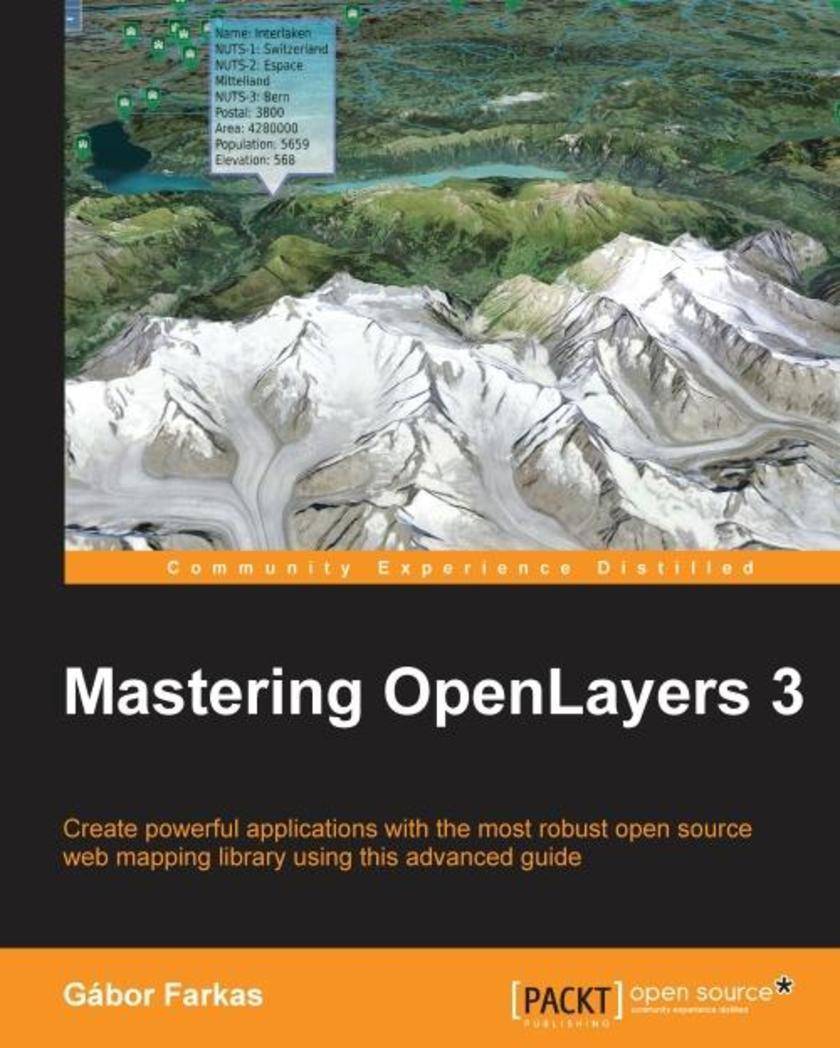
Mastering OpenLayers 3
¥90.46
Create powerful applications with the most robust open source web mapping library using this advanced guideAbout This BookDevelop responsive and platform-independent web mapping applications with OpenLayers 3Learn the key points of creating great applications with native JavaScript through the step-by-step examplesMaster the use of the library, from compiling custom builds to developing a complete WebGIS applicationWho This Book Is ForThis book is intended for front-end developers with basic understanding of JavaScript and GIS concepts, and preferably for those who are familiar with the fundamentals of OpenLayers 3. You might have never used OpenLayers 3 as a seasoned JavaScript developer. If this is the case and you are eager to learn web mapping, this book will definitely set you on the right track.What You Will LearnUse the advanced functionality of the OpenLayers 3 library effectivelyImplement the library in your application, shaping it to your needsManage layers and the layer stack dynamicallyCreate not only stunning but also accurate thematic mapsExtend OpenLayers 3 with your own custom classesDevelop mobile-friendly web mapping applicationsMake stunning effects with canvas manipulation, or visualize point clouds with WebGLIntegrate third-party applications, and create custom builds that completely satisfy your needsIn DetailOpenLayers 3 allows you to create stunning web mapping and WebGIS applications. It uses modern, cutting edge browser technologies. It is written with Closure Library, enabling you to build browser-independent applications without painful debugging ceremonies, which even have some limited fallback options for older browsers.With this guide, you will be introduced to the world of advanced web mapping and WebGIS.First, you will be introduced to the advanced features and functionalities available in OpenLayers 3. Next, you will be taken through the key points of creating custom applications with OpenLayers 3. You will then learn how to create the web mapping application of yours (or your company's) dream with this open source, expense-free, yet very powerful library. We’ll also show you how to make amazing looking thematic maps and create great effects with canvas manipulation.By the end of this book, you will have a strong command of web mapping and will be well on your way to creating amazing applications using OpenLayers 3.Style and approachThis is an advanced guide packed with comprehensive examples, and it concentrates on the advanced parts of OpenLayers 3 and JavaScript. It intentionally skips the basic and well-known methodologies, but discusses the hard-to-understand ones in great detail.
Object–Oriented Programming with Swift 2
¥80.65
Get to grips with object-oriented programming in Swift to efficiently build powerful real-world applicationsAbout This BookLeverage the most efficient object-oriented design patterns in your Swift applicationsWrite robust, safer, and better code using the blueprints that generate objectsBuild a platform with object-oriented code by using real-world elements and represent them in your appWho This Book Is ForIf you are an iOS developer who has a basic idea of object-oriented programming and want to incorporate its concepts with Swift to optimize your application's code and create reusable and easily to understand building blocks, then this book is for you. This is a very useful resource for developers who want to shift from Objective C, C#, Java, Python, JavaScript, or other object-oriented languages to SwiftWhat You Will LearnBuild solid, stable, and reliable applications using SwiftWork with encapsulation, abstraction, and polymorphism using Swift 2.0Customize constructors and destructors based on your needsDevelop Swift 2.0 with classes, instances, properties, and methodsTake advantage of generic code to maximize code reuse and generalize behaviorsUse state of inheritance, specialization, and the possibility to overload membersWrite high quality object-oriented code to build apps for iOS or Mac OS XIn DetailObject-Oriented Programming (OOP) is a programming paradigm based on the concept of objects; these are data structures that contain data in the form of fields, often known as attributes and code. Objects are everywhere, and so it is very important to recognize elements, known as objects, from real-world situations and know how they can easily be translated into object-oriented code.Object-Oriented Programming with Swift is an easy-to-follow guide packed full of hands-on examples of solutions to common problems encountered with object-oriented code in Swift. It starts by helping you to recognize objects using real-life scenarios and demonstrates how working with them makes it simpler to write code that is easy to understand and reuse.You will learn to protect and hide data with the data encapsulation features of Swift. Then, you will explore how to maximize code reuse by writing code capable of working with objects of different types. After that, you'll discover the power of parametric polymorphism and will combine generic code with inheritance and multiple inheritance. Later, you move on to refactoring your existing code and organizing your source for easy maintenance and extensions.By the end of the book, you will be able to create better, stronger, and more reusable code, which will help you build better applications.Style and approachThis simple guide is packed with practical examples of solutions to common problems. Each chapter includes exercises and the possibility for you to test your progress by answering questions.
Scala for Data Science
¥99.18
Leverage the power of Scala with different tools to build scalable, robust data science applicationsAbout This BookA complete guide for scalable data science solutions, from data ingestion to data visualizationDeploy horizontally scalable data processing pipelines and take advantage of web frameworks to build engaging visualizationsBuild functional, type-safe routines to interact with relational and NoSQL databases with the help of tutorials and examples providedWho This Book Is ForIf you are a Scala developer or data scientist, or if you want to enter the field of data science, then this book will give you all the tools you need to implement data science solutions.What You Will LearnTransform and filter tabular data to extract features for machine learningImplement your own algorithms or take advantage of MLLib’s extensive suite of models to build distributed machine learning pipelinesRead, transform, and write data to both SQL and NoSQL databases in a functional mannerWrite robust routines to query web APIsRead data from web APIs such as the GitHub or Twitter APIUse Scala to interact with MongoDB, which offers high performance and helps to store large data sets with uncertain query requirementsCreate Scala web applications that couple with JavaScript libraries such as D3 to create compelling interactive visualizationsDeploy scalable parallel applications using Apache Spark, loading data from HDFS or HiveIn DetailScala is a multi-paradigm programming language (it supports both object-oriented and functional programming) and *ing language used to build applications for the JVM. Languages such as R, Python, Java, and so on are mostly used for data science. It is particularly good at analyzing large sets of data without any significant impact on performance and thus Scala is being adopted by many developers and data scientists. Data scientists might be aware that building applications that are truly scalable is hard. Scala, with its powerful functional libraries for interacting with databases and building scalable frameworks will give you the tools to construct robust data pipelines.This book will introduce you to the libraries for ingesting, storing, manipulating, processing, and visualizing data in Scala.Packed with real-world examples and interesting data sets, this book will teach you to ingest data from flat files and web APIs and store it in a SQL or NoSQL database. It will show you how to design scalable architectures to process and modelling your data, starting from simple concurrency constructs such as parallel collections and futures, through to actor systems and Apache Spark. As well as Scala’s emphasis on functional structures and immutability, you will learn how to use the right parallel construct for the job at hand, minimizing development time without compromising scalability. Finally, you will learn how to build beautiful interactive visualizations using web frameworks.This book gives tutorials on some of the most common Scala libraries for data science, allowing you to quickly get up to speed with building data science and data engineering solutions.Style and approachA tutorial with complete examples, this book will give you the tools to start building useful data engineering and data science solutions straightaway
D Web Development
¥63.21
Leverage the power of D and the vibe.d framework to develop web applications that are incredibly fastAbout This BookUtilize the elegant vibe.d framework to build web applications easily and REST backends with the D programming languageLearn about all components of vibe.d to enhance your web development with DA hands-on guide to the vibe.d framework; from static web pages to template-based, interactive and localized web applications with database access and REST backendsWho This Book Is ForWhether you are new to the world of D, or already have developed applications in D, or if you want to leverage the power of D for web development, then this book is ideal for you. Basic knowledge of core web technologies like HTML 5 is helpful but not required. This book explains the difficult details to speed your web development.What You Will LearnCreate amazingly fast web applications with DUse Diet templates to easily create a web user interfaceUtilize the web framework for interactive applications with input validation and internationalizationAccess a database to provide persistent storage for your applicationExtend your application with a REST interface and access other applications via RESTUnderstand vibe.d’s fiber-based approach to asynchronous I/O and use it for integration of existing componentsCreate GUI applications with vibe.dIn DetailD is a programming language with C-like syntax and static typing. The vibe.d framework builds on powerful D concepts like template meta-programming and compile-time function execution to provide an easy-to-use environment for web applications. The combination of a feature-rich web programming framework with a language compiling to native code solves two common issues in web development today: it accelerates your development and it results in fast, native web applications. Learning the vibe.d framework before you start your application will help you to choose the right features to reach your goal.This book guides you through all aspects of web development with D and the vibe.d framework.Covering the popular operating systems today, this guide starts with the setup of your development system. From the first Hello World-style application you will move on to building static web pages with templates. The concise treatment of web forms will give you all the details about form handling and web security. Using the abstractions of the web framework you will learn how to easily validate user input. Next, you will add database access to your application, providing persistent storage for your data. Building on this foundation, you will expose your component and integrate other components via REST. Learning about the internals of vibe.d you will be able to use low-level techniques such as raw TCP access. The vibe.d concepts can also be used for GUI clients, which is the next topic that you will learn. vibe.d is supported by an active community, which adds new functionality. This comprehensive guide concludes with an overview of the most useful vibe.d extensions and where to find them. It also shows you how to integrate these extensions in your application.The concepts are always illustrated with source code, giving you an insight into how to apply them in your application.Style and approachA tutorial-style guide to develop web applications with D and the vibe.d framework. Each topic is explained in detail and illustrated with source code, providing you with hands-on assistance for your application.
Learning Drupal 8
¥80.65
Create complex websites quickly and easily using the building blocks of Drupal 8, the most powerful version of Drupal yetAbout This BookBuild complete, complex websites with no prior knowledge of web development entirely using the intuitive Drupal user interfaceFollow a practical case study chapter-by-chapter to construct a complete website as you progressEnsure your sites are modern, responsive and mobile-friendly through utilizing the full features available in Drupal 8Who This Book Is ForIf you want to learn to use Drupal 8 for the first time, or you are transitioning over from a previous version of Drupal, this is the book for you. No knowledge of PHP, MySQL, or HTML is assumed or requiredWhat You Will LearnSet up a local “stack” development environment and install your first Drupal 8 siteFind out what is available in Drupal 8 coreDefine content types and taxonomies—and find out when you should do soUse the powerful Views moduleGet hands-on with image and media handlingExtend Drupal using custom community modulesDevelop the look and feel of your website using Drupal themesManage site users and permissionsIn DetailDrupal 8 sets a new standard for ease of use, while offering countless new ways to tailor and deploy your content to the Web. Drupal 8 allows user to easily customize data structures, listings, and pages, and take advantage of new capabilities for displaying data on mobile devices, building APIs, and adapting to multilingual needs.The book takes you step by step through building a Drupal 8 website. Start with the basics, such as setting up a local “stack” development environment and installing your first Drupal 8 site, then move on to image and media handling, and extending Drupal modules. Push your knowledge by getting to grips with the modular nature of Drupal, and learning to extend it by adding new functionalities to create your new modules. By the end of the book, you will be able to develop and manage a modern and responsive website using Drupal.Style and approachThis is an absolute beginners’ guide, providing step-by-step instructions to help you learn Drupal 8 from scratch.
Learning VMware vRealize Automation
¥80.65
Learn the fundamentals of vRealize Automation to accelerate the delivery of your IT servicesAbout This BookLearn to install the vRealize Automation product in a distributed architecture using a load balancerPlan backup and recovery strategies for every vRealize automation componentUse vRealize Automation to manage applications and improve operational efficiency using this simple and intuitive guideWho This Book Is ForThis book is for anyone who wants to start their journey with vRealize Automation. It is your one-stop instruction guide to installing and configuring a distributed setup using NSX load balancer. Regardless of whether or not you have used vRealize Automation before, following the steps provided in each chapter will get you started with the product.What You Will LearnUnderstand the basic building blocks of vRealize Automation before embarking on the journey of installationFamiliarize yourself with the requirements and steps that need to be performed during the first phase of the distributed installationCarry out a functional validation of the first phase of installation before completing the installationBuild a blueprint for vSphere endpoint, an essential step for a successful deployment of a service catalogCreate, configure, and deploy tenants, endpoints, blueprints, and the service catalogGet to grips with the failover process for all components in vRealize AutomationLearn to configure the NSX loadbalancer for vRealize Orchestrator for high availabilityLeverage ASD to develop XaaS (Anything as a Service) in vRealize Automation to deliver valuable competenceIn DetailWith the growing interest in Software Defined Data Centers (SDDC), vRealize Automation offers data center users an organized service catalog and governance for administrators. This way, end users gain autonomy while the IT department stays in control, making sure security and compliance requirements are met. Learning what each component does and how they dovetail with each other will bolster your understanding of vRealize Automation.The book starts off with an introduction to the distributed architecture that has been tested and installed in large scale deployments. Implementing and configuring distributed architecture with custom certificates is unarguably a demanding task, and it will be covered next. After this, we will progress with the installation. A vRealize Automation blueprint can be prepared in multiple ways; we will focus solely on vSphere endpoint blueprint. After this, we will discuss the high availability configuration via NSX loadbalancer for vRealize Orchestrator. Finally, we end with Advanced Service Designer, which provides service architects with the ability to create advanced services and publish them as catalog items.Style and approachThis book takes a step-by-step approach, is explained in a conversational and easy-to-follow style, and includes ample screenshots . Each topic is explained sequentially through planning, preparing, installing, configuring, and validating of all vRealize Automation’s components.
Learning Python Design Patterns - Second Edition
¥71.93
Leverage the power of Python design patterns to solve real-world problems in software architecture and designAbout This BookUnderstand the structural, creational, and behavioral Python design patternsGet to know the context and application of design patterns to solve real-world problems in software architecture, design, and application developmentGet practical exposure through sample implementations in Python v3.5 for the design patterns featuredWho This Book Is ForThis book is for Software architects and Python application developers who are passionate about software design. It will be very useful to engineers with beginner level proficiency in Python and who love to work with Python 3.5What You Will LearnEnhance your skills to create better software architectureUnderstand proven solutions to commonly occurring design issuesExplore the design principles that form the basis of software design, such as loose coupling, the Hollywood principle and the Open Close principle among othersDelve into the object-oriented programming concepts and find out how they are used in software applicationsDevelop an understanding of Creational Design Patterns and the different object creation methods that help you solve issues in software developmentUse Structural Design Patterns and find out how objects and classes interact to build larger applicationsFocus on the interaction between objects with the command and observer patternsImprove the productivity and code base of your application using Python design patternsIn DetailWith the increasing focus on optimized software architecture and design it is important that software architects think about optimizations in object creation, code structure, and interaction between objects at the architecture or design level. This makes sure that the cost of software maintenance is low and code can be easily reused or is adaptable to change. The key to this is reusability and low maintenance in design patterns.Building on the success of the previous edition, Learning Python Design Patterns, Second Edition will help you implement real-world scenarios with Python’s latest release, Python v3.5.We start by introducing design patterns from the Python perspective. As you progress through the book, you will learn about Singleton patterns, Factory patterns, and Fa?ade patterns in detail. After this, we’ll look at how to control object access with proxy patterns. It also covers observer patterns, command patterns, and compound patterns.By the end of the book, you will have enhanced your professional abilities in software architecture, design, and development.Style and approachThis is an easy-to-follow guide to design patterns with hands-on examples of real-world scenarios and their implementation in Python v3.5. Each topic is explained and placed in context, and for the more inquisitive, there are more details on the concepts used.


