


 购物车
购物车 个人中心
个人中心

Head and Shoulders
¥9.24
In 1915 Horace Tarbox was thirteen years old. In that year he took the examinations for entrance to Prince-ton University and received the Grade A—excellent—in C?sar, Cicero, Vergil, Xenophon, Homer, Algebra, Plane Geometry, Solid Geometry, and Chemistry.??Two years later while George M. Cohan was composing "Over There," Horace was leading the sophomore class by several lengths and digging out theses on "The Syllogism as an Obsolete Scholastic Form," and during the battle of Ch?teau-Thierry he was sitting at his desk deciding whether or not to wait until his seventeenth birthday before beginning his series of essays on "The Pragmatic Bias of the New Realists."??After a while some newsboy told him that the war was over, and he was glad, because it meant that Peat Brothers, publishers, would get out their new edition of "Spinoza's Improvement of the Understanding." Wars were all very well in their way, made young men self-reliant or something but Horace felt that he could never forgive the President for allowing a brass band to play under his window the night of the false armistice, causing him to leave three important sentences out of his thesis on "German Idealism."

Porcelain and Pink
¥9.24
A room in the down-stairs of a summer cottage. High around the wall runs an art frieze of a fisherman with a pile of nets at his feet and a ship on a crimson ocean, a fisherman with a pile of nets at his feet and a ship on a crimson ocean, a fisherman with a pile of nets at his feet and so on. In one place on the frieze there is an overlapping—here we have half a fisher-man with half a pile of nets at his foot, crowded damply against half a ship on half a crimson ocean. The frieze is not in the plot, but frankly it fascinates me. I could continue indefinitely, but I am distracted by one of the two objects in the room—a blue porcelain bath-tub. It has character, this bath-tub. It is not one of the new racing bodies, but is small with a high tonneau and looks as if it were going to jump; dis-couraged, however, by the shortness of its legs, it has submitted to its environment and to its coat of sky-blue paint. But it grumpily refuses to allow any patron completely to stretch his legs—which brings us neatly to the second object in the room: SHE is a girl—clearly an appendage to the bath-tub, on-ly her head and throat—beautiful girls have throats instead of necks—and a suggestion of shoulder ap-pearing above the side. For the first ten minutes of the play the audience is engrossed in wondering if she really is playing the game fairly and hasn't any clothes on or whether it is being cheated and she is dressed. The girl's name is JULIE MARVIS. From the proud way she sits up in the bath-tub we deduce that she is not very tall and that she carries herself well. When she smiles, her upper tip rolls a little and reminds you of an Easter Bunny, She is within whispering distance of twenty years old.

The Jelly Bean
¥9.24
Jim Powell was a Jelly-bean. Much as I desire to make him an appealing character, I feel that it would be unscrupulous to deceive you on that point. He was a bred-in-the-bone, dyed-in-the-wool, ninety-nine three-quarters per cent Jelly-bean and he grew lazily all during Jelly-bean season, which is every season, down in the land of the Jelly-beans well below the Mason-Dixon line.Now if you call a Memphis man a Jelly-bean he will quite possibly pull a long sinewy rope from his hip pocket and hang you to a convenient telegraph-pole. If you Call a New Orleans man a Jelly-bean he will probably grin and ask you who is taking your girl to the Mardi Gras ball. The particular Jelly-bean patch which produced the protagonist of this history lies somewhere between the two—a little city of forty thousand that has dozed sleepily for forty thousand years in southern Georgia occasionally stirring in its slumbers and muttering something about a war that took place sometime, somewhere, and that everyone else has forgotten long ago.

Gadsby
¥9.24
"Gadsby" is a 1939 novel by Ernest Vincent Wright. The plot revolves around the dying fictional city of Branton Hills, which is revitalized thanks to the efforts of protagonist John Gadsby and a youth group he organizes.The novel is written as a lipogram and does not include words that contain the letter "e". Though self-published and little-noticed in its time, the book is a favourite of fans of constrained writing and is a sought-after rarity among some book collectors. Later editions of the book have sometimes carried the alternative subtitle "50,000 Word Novel Without the Letter 'E'". In 1968, the novel entered the public domain in the United States due to failure to renew copyright in the 28th year after publication.
The Clever Fox and the Crane
¥9.24
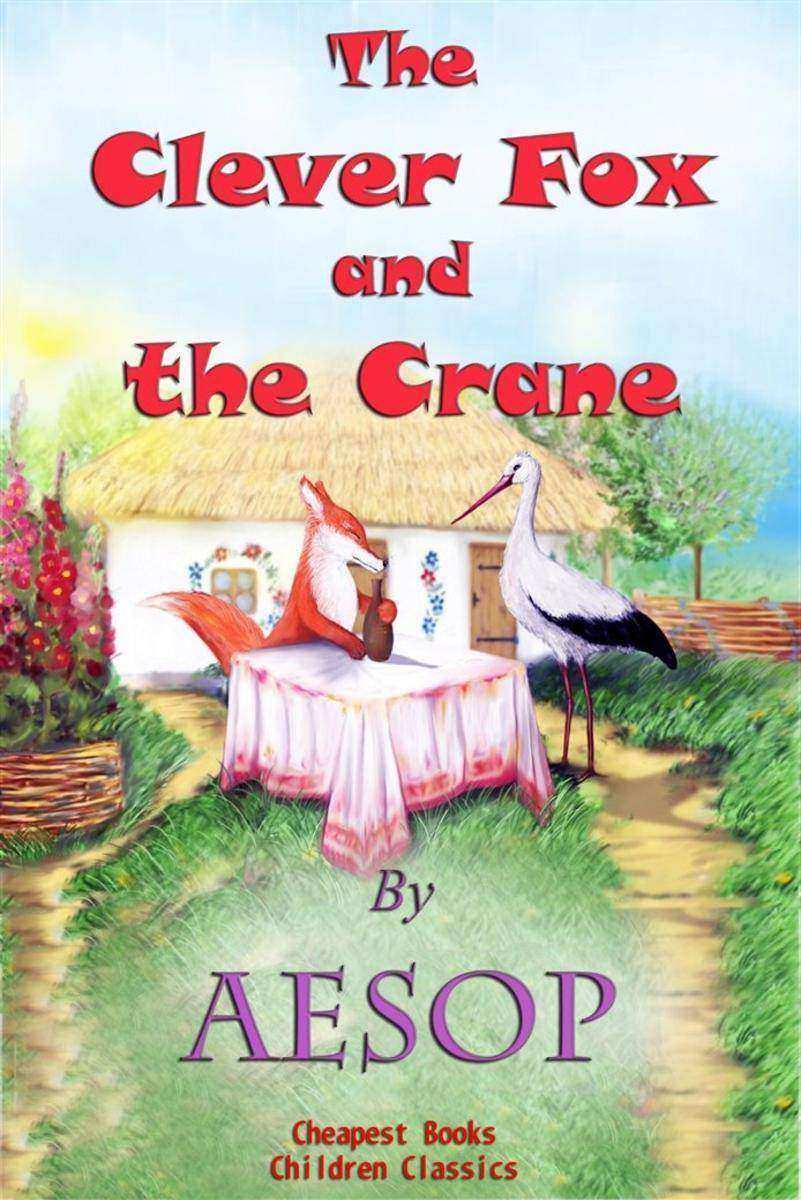
The clever fox made friends with the crane. The clever fox once had a notion to treat the crane to dinner and went to invite him to her house."Come godfather! Come dear! How I'll entertain you!"The crain went to the dinner party.The clever fox had cooked farina cereal and spread it over a plate.She served it and urged. "Eat, my friend-godfather, I cooked it myself. "

The Little Bun: "A Russian Folk Tale"
¥9.24
ONCE time ago, there lived an old man and old woman. The old man said, "Old woman, make me a little bun." "What can I make it from? I have no flour." "Eh, eh, old woman! Scrape the cupboard, sweep the flour bin, and you will find enough flour. "The old woman picked up a duster, scraped the cupboard, swept the flour bin and gathered about two handfuls of flour. She mixed the dough with sour cream, fried it in butter, and put the bun on the window sill to cool. The bun lay and lay there. Suddenly it rolled off the window sill to the bench, from the bench to the floor, from the floor to the door. Then it rolled over the threshold to the entrance hall, from the entrance hall to the porch, from the porch to the courtyard, from the courtyard trough the gate and on and on.

Jemina, the Mountain Girl
¥9.24
This don't pretend to be "Literature."??This is just a tale for red-blooded folks who want a story and not just a lot of "psychological" stuff or "analysis."??Boy, you'll love it! Read it here, see it in the movies, play it on the phonograph, run it through the sewing-machine.??* * *??It was night in the mountains of Kentucky. Wild hills rose on all sides. Swift mountain streams flowed rapidly up and down the mountains.?Jemima Tantrum was down at the stream, brewing whiskey at the family still.??She was a typical mountain girl.

The Adventure Girls at K Bar O
¥9.24
Though flattered by imitators galore Miss Potter's work stands supreme. Her many picture stories should be among the first books owned by children.Cecily Parsley lived in a pen,And brewed good ale for gentlemen; Gentlemen came every day,Till Cecily Parsley ran away.

The Island of Doctor Moreau: "Illustrated"
¥9.24
Once upon a time there was an old Sow with three little Pigs, and as she had not enough to keep them, she sent them out to seek their fortune. The first that went off met a Man with a bundle of straw, and said to him, "Please, Man, give me that straw to build me a house"; which the Man did, and the little Pig built a house with it. Presently came along a Wolf, and knocked at the door, and said, "Little Pig, little Pig, let me come in." To which the Pig answered, "No, no, by the hair of my chinny chin chin."

Cue for Quiet
¥9.24
Madame Bovary takes place in provincial northern France, near the town of Rouen in Normandy. The story begins and ends with Charles Bovary, a stolid, kindhearted man without much ability or ambition. As the novel opens, Charles is a shy, oddly dressed teenager arriving at a new school amidst the ridicule of his new classmates. Later, Charles struggles his way to a second-rate medical degree and becomes an officier de santé in the Public Health Service. His mother chooses a wife for him, an unpleasant but supposedly rich widow named Heloise Dubuc, and Charles sets out to build a practice in the village of Tostes (now T?tes). One day, Charles visits a local farm to set the owner's broken leg, and meets his client's daughter, Emma Rouault. Emma is a beautiful, daintily dressed young woman who has received a "good education" in a convent and who has a latent but powerful yearning for luxury and romance imbibed from the popular novels she has read. Charles is immediately attracted to her, and begins checking on his patient far more often than necessary until Heloise's jealousy puts a stop to the visits. When Heloise dies, Charles waits a decent interval, then begins courting Emma in earnest. Her father gives his consent, and Emma and Charles are married. ABOUT AUTHOR: Gustave Flaubert (French: December 12, 1821 – May 8, 1880) was an influential French writer widely considered one of the greatest novelists in Western literature. He is known especially for his first published novel, Madame Bovary (1857), for his Correspondence, and for his scrupulous devotion to his style and aesthetics. The celebrated short story writer Maupassant was a protégé of Flaubert. Early life and education:Flaubert was born on December 12, 1821, in Rouen, in the Seine-Maritime department of Upper Normandy, in northern France. He was the second son of Anne Justine Caroline (née Fleuriot; 1793–1872) and Achille-Cléophas Flaubert (1784–1846), a surgeon. He began writing at an early age, as early as eight according to some sources.He was educated at the Lycée Pierre Corneille in Rouen, and did not leave until 1840, when he went to Paris to study law. In Paris, he was an indifferent student and found the city distasteful. He made a few acquaintances, including Victor Hugo. Toward the end of 1840, he traveled in the Pyrenees and Corsica. In 1846, after an attack of epilepsy, he left Paris and abandoned the study of law. Writing career:His first finished work was November, a novella, which was completed in 1842.In September 1849, Flaubert completed the first version of a novel, The Temptation of Saint Anthony. He read the novel aloud to Louis Bouilhet and Maxime Du Camp over the course of four days, not allowing them to interrupt or give any opinions. At the end of the reading, his friends told him to throw the manuscript in the fire, suggesting instead that he focus on day-to-day life rather than fantastic subjects.In 1850, after returning from Egypt, Flaubert began work on Madame Bovary. The novel, which took five years to write, was serialized in the Revue de Paris in 1856. The government brought an action against the publisher and author on the charge of immorality, which was heard during the following year, but both were acquitted. When Madame Bovary appeared in book form, it met with a warm reception.In 1858, Flaubert traveled to Carthage to gather material for his next novel, Salammb?. The novel was completed in 1862 after four years of work.Drawing on his youth, Flaubert next wrote L'?ducation sentimentale (Sentimental Education), an effort that took seven years. This was his last complete novel, published in the year 1869.He wrote an unsuccessful drama, Le Candidat, and published a reworked version of Temptation of Saint Anthony.

Red Handed: An International Cozy Mystery and Crime Private Investigator Short S
¥9.24
Red Handed: An International Cozy Mystery and Crime Private Investigator Short Story
![The Story of Miss Moppet: [Illustrated]](https://platform-permanent.ddimg.cn/pt-media-info-soa-resource/digital/product/45/94/1901164594_ii_cover.jpg?version=7700df74-d05a-4284-a3bf-f64f29176bb1)
The Story of Miss Moppet: [Illustrated]
¥9.24
This is a Pussy called Miss Moppet, she thinks she has heard a mouse!??This is the Mouse peeping out behind the cupboard, and making fun of Miss Moppet. He is not afraid of a kitten.??This is Miss Moppet jumping just too late; she misses the Mouse and hits her own head.??She thinks it is a very hard cupboard!??The Mouse watches Miss Moppet from the top of the cupboard.??Miss Moppet ties up her head in a duster, and sits before the fire.??The Mouse thinks she is looking very ill. ?He comes sliding down the bell-pull.??Miss Moppet looks worse and worse. The Mouse comes a little nearer.??Miss Moppet holds her poor head in her paws, and looks at him through a hole in the duster. The Mouse comes very close.??And then all of a sudden—Miss Moppet jumps upon the Mouse!!
The Tale of Two Bad Mice: Illustrated
¥9.24
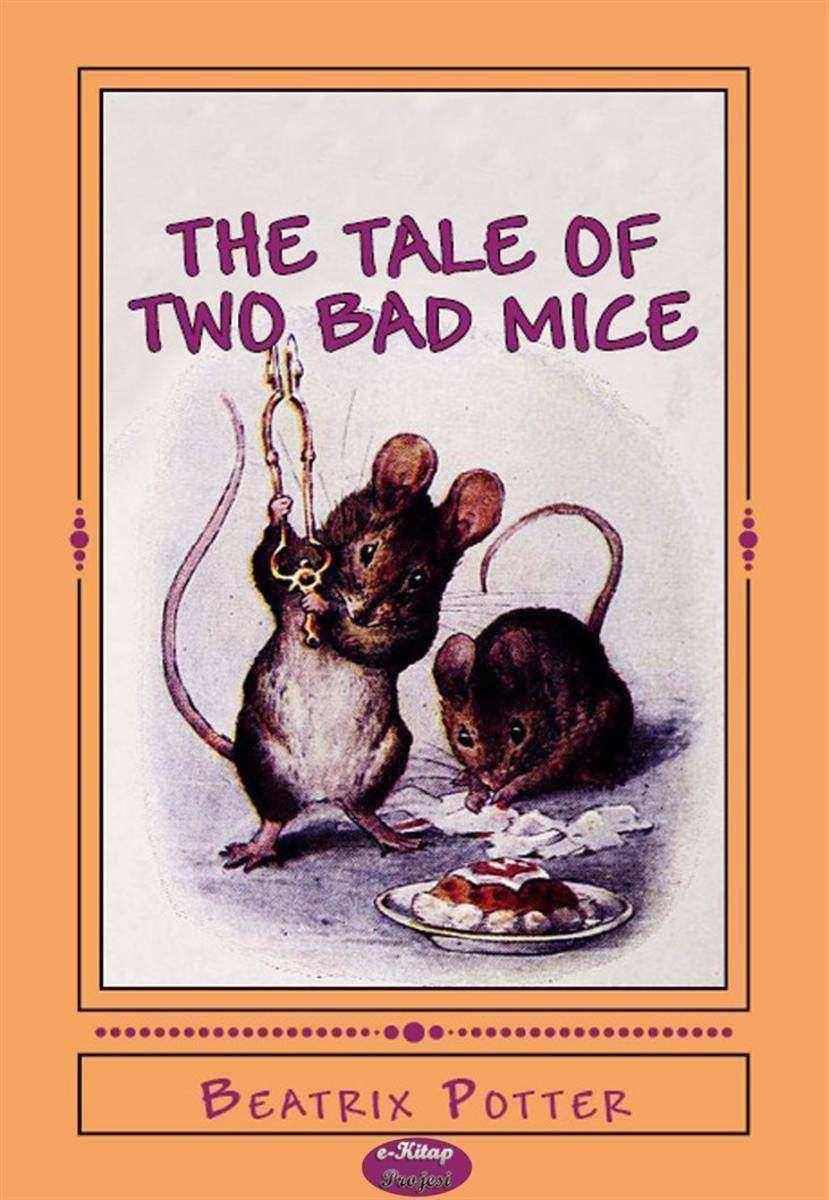
ONCE upon a time there was a very beautiful doll's-house; it was red brick with white windows, and it had real muslin curtains and a front door and a chimney.??IT belonged to two Dolls called Lucinda and Jane; least it belonged to Lucinda, but she never ordered meals.?Jane was the Cook; but she never did any cooking, because the dinner had been bought ready-made, in a box full of shavings. ??THERE were two red lobsters and a ham, a fish, a pudding, and some pears and oranges.?They would not come off the plates, but they were extremely beautiful.?ONE morning Lucinda and Jane had gone out for a drive in the doll's perambulator. There was no one in the nursery, and it was very quiet. Presently there was a little scuffling, scratching noise in a corner near the fire-place, where there was a hole under the skirting-board.?Tom Thumb put out his head for a moment, and then popped it in again.?Tom Thumb was a mouse. ??A MINUTE afterwards, Hunca Munca, his wife, put her head out, too; and when she saw that there was no one in the nursery, she ventured out on the oilcloth under the coal-box.

A Dog's Tale
¥9.24
SOON, the master stopped discussing a moment, and rang in the footman, and said, "Bury it in the far corner of the garden," and then went on with the discussion, and I trotted after the footman, very happy and grateful, for I knew the puppy was out of its pain now, because it was asleep. We went far down the garden to the farthest end, where the children and the nurse and the puppy and I used to play in the summer in the shade of a great elm, and there the footman dug a hole, and I saw he was going to plant the puppy, and I was glad, because it would grow and come up a fine handsome dog, like Robin Adair, and be a beautiful surprise for the family when they came home; so I tried to help him dig, but my lame leg was no good, being stiff, you know, and you have to have two, or it is no use. When the footman had finished and covered little Robin up, he patted my head, and there were tears in his eyes, and he said: "Poor little DOGGIE, you saved HIS child!" ABOUT AUTHOR: Mark Twain (1835-1910), was an American humorist, satirist, writer, and lecturer. Twain is most noted for his novels Adventures of Huckleberry Finn, which has since been called the Great American Novel, and The Adventures of Tom Sawyer. He is also known for his quotations. During his lifetime, Clemens became a friend to presidents, artists, leading industrialists, and European royalty. Clemens enjoyed immense public popularity, and his keen wit and incisive satire earned him praise from both critics and peers. American author William Faulkner called Twain "the father of American literature.”
![Sleeping Beauty in the Wood: [Colored Edition]](https://platform-permanent.ddimg.cn/pt-media-info-soa-resource/digital/product/54/65/1901165465_ii_cover.jpg?version=4d4744e0-befc-42a0-86c3-876d63ffbc5c)
Sleeping Beauty in the Wood: [Colored Edition]
¥9.24
There were formerly a King and a Queen, who were so sorry that they had no children, so sorry that it cannot be expressed. They went to all the waters in the world; vows, pilgrimages, all ways were tried and all to no purpose. At last, however, the Queen proved with child, and was brought to bed of a daughter. There was a very fine christening; and the Princess had for her godmothers all the Fairies they could find in the whole kingdom (they found seven), that every one of them might give her a gift, as was the custom of Fairies in those days, and that by this means the Princess might have all the perfections imaginable. After the ceremonies of the christening were over, all the company returned to the King's palace, where was prepared a great feast for the Fairies. There was placed before every one of them a magnificent cover with a case of massive gold, wherein were a spoon, knife and fork, all of pure gold set with diamonds and rubies. But as they were all sitting down at table, they saw come into the hall a very old Fairy whom they had not invited, because it was above fifty years since she had been out of a certain tower, and she was believed to be either dead or inchanted. The King ordered her a cover, but could not furnish her with a case of gold as the others, because they had seven only made for the seven Fairies.

The Princess on the Pea
¥9.24
Once, there was a Prince who wanted to marry a Princess. Only a real one would do. So he traveled through all the world to find her, and everywhere things went wrong. There were Princesses aplenty, but how was he to know whether they were real Princesses? There was something not quite right about them all. So he came home again and was unhappy, because he did so want to have a real Princess.

The Frog Princess: "A Russian Fairy Tale"
¥9.24
In days gone by there was a King who had three sons. When his sons came of age the King called them to him and said, "My dear lads, I want you to get married so that I may see your little ones, my grand-children, before I die." And his sons replied, "Very well, Father, give us your blessing. Who do you want us to marry?" "Each of you must take an arrow, go out into the green meadow and shoot it. Where the arrows fall, there shall your destiny be."So the sons bowed to their father, and each of them took an arrow and went out into the green meadow, where they drew their bows and let fly their arrows. The arrow of the eldest son fell in the courtyard of a nobleman, and the nobleman's daughter picked it up. The arrow of the middle son fell in the yard of a merchant, and the merchant's daughter picked it up. But the arrow of the youngest son, Prince Ivan, flew up and away he knew not where. He walked on and on in search of it, and at last he came to a marsh, where what should he see but a frog sitting on a leaf with the arrow in its mouth. Prince Ivan said to it, "Frog, frog, give me back my arrow." And the frog replied, "Marry me!" "How can I marry a frog?" "Marry me, for it is your destiny."

Maggie A Girl of the Streets
¥9.24
Suddenly we heard a yelp and a volley of furious blasphemy from the companion hatchway, and the deformed man with the black face came up hurriedly. He was immediately followed by a heavy red-haired man in a white cap. At the sight of the former the staghounds, who had all tired of barking at me by this time, became furiously excited, howling and leaping against their chains. The black hesitated before them, and this gave the red-haired man time to come up with him and deliver a tremendous blow between the shoulder-blades. The poor devil went down like a felled ox, and rolled in the dirt among the furiously excited dogs. It was lucky for him that they were muzzled. The red-haired man gave a yawp of exultation and stood staggering, and as it seemed to me in serious danger of either going backwards down the companion hatchway or forwards upon his victim. So soon as the second man had appeared, Montgomery had started forward. “Steady on there!” he cried, in a tone of remonstrance. A couple of sailors appeared on the forecastle. The black-faced man, howling in a singular voice rolled about under the feet of the dogs. No one attempted to help him. The brutes did their best to worry him, butting their muzzles at him. There was a quick dance of their lithe grey-figured bodies over the clumsy, prostrate figure. The sailors forward shouted, as though it was admirable sport. Montgomery gave an angry exclamation, and went striding down the deck, and I followed him. The black-faced man scrambled up and staggered forward, going and leaning over the bulwark by the main shrouds, where he remained, panting and glaring over his shoulder at the dogs. The red-haired man laughed a satisfied laugh. “Look here, Captain,” said Montgomery, with his lisp a little accentuated, gripping the elbows of the red-haired man, “this won't do!” I stood behind Montgomery. The captain came half round, and regarded him with the dull and solemn eyes of a drunken man. “Wha' won't do?” he said, and added, after looking sleepily into Montgomery's face for a minute, “Blasted Sawbones!” With a sudden movement he shook his arms free, and after two ineffectual attempts stuck his freckled fists into his side pockets.“That man's a passenger,” said Montgomery. “I'd advise you to keep your hands off him.” “Go to hell!” said the captain, loudly. He suddenly turned and staggered towards the side. “Do what I like on my own ship,” he said.
Drawn at a Venture
¥9.24
MYTH: ITS BIRTH AND GROWTH.“Unchecked by external truth, the mind of man has a fatal facility for ensnaring, entrapping, and entangling itself. But, happily, happily for the human race, some fragment of physical speculation has been built into every false system. Here is the weak point. Its inevitable destruction leaves a breach in the whole fabric, and through that breach the armies of truth march in.”Sir H. S. Maine. MYTH: ITS BIRTH AND GROWTH.CHAPTER IITS PRIMITIVE MEANING.It is barely thirty years ago since the world was startled by the publication of Buckle’s History of Civilisation, with its theory that human actions are the effect of causes as fixed and regular as those which operate in the universe; climate, soil, food, and scenery being the chief conditions determining progress. That book was a tour de force, not a lasting contribution to the question of man’s mental development. The publication of Darwin’s epoch-making Origin of Species[1] showed wherein it fell short; how the importance of the above-named causes was exaggerated and the existence of equally potent causes overlooked. Buckle probably had not read Herbert Spencer’s Social Statics, and he knew nothing of the profound revolution in silent preparation in the quiet of Darwin’s home; otherwise, his book must have been rewritten. This would have averted the oblivion from which not even its charm of style can rescue it. Its brilliant but defective theories are obscured in the fuller light of that doctrine of descent with modifications by which we learn that external circumstances do not alone account for the widely divergent types of men, so that a superior race, in supplanting an inferior one, will change the face and destiny of a country, “making the solitary place to be glad, and the desert to rejoice and blossom as the rose.” Darwin has given us the clue to those subtle and still obscure causes which bring about, stage by stage, the unseen adaptations to requirements varying a type and securing its survival, and which have resulted in the evolution of the manifold species of living things. The notion of a constant relation between man and his surroundings is therefore untenable. The object of this book is to present in compendious form the evidence which myths and dreams supply as to primitive man’s interpretation of his own nature and of the external world, and more especially to indicate how such evidence carries within itself the history of the origin and growth of beliefs in the supernatural. The examples are selected chiefly from barbaric races, as furnishing the nearest correspondences to the working of the mind in what may be called its “eocene” stage, but examples are also cited from civilised races, as witnessing to that continuity of ideas which is obscured by familiarity or ignored by prejudice.Had more illustrations been drawn from sources alike prolific, the evidence would have been swollen to undue dimensions without increasing its significance; as it is, repetition has been found needful here and there, under the difficulty of entirely detaching the arguments advanced in the two parts of this work.

Heidi: Illustrated Edition
¥9.24
The thing that went under the name of automobile wheezed into the ranchyard and rattled to a halt. With creaks and groans in every joint the car discharged its six very dusty, very weary occupants. At the same time, the screen door of the ranch house banged shut and a flying figure descended on the new arrivals. “Oh, Gale, but I’m glad to see you,” the girl from the ranch house declared hugging the foremost one of the visitors. Gale Howard returned the hug with equal warmth. The two were cousins, and Gale and her friends, The Adventure Girls, had traveled West to spend the summer on the K Bar O Ranch, owned by Gale’s uncle. “But don’t tell me you traveled all the way West in that!” Virginia Wilson murmured aghast, when the introductions and first greetings were over. “We wouldn’t have lived to tell the tale,” declared Carol Carter. “I never knew a car that had so many bumps in it.” “We came West to Phoenix on the train,” Gale explained. “It was there we bought the car and drove up here.” “You wouldn’t think we bought it second hand, would you?” Janet Gordon murmured. “No,” Phyllis Elton agreed with a twinkle in her eyes. “It looks as though we made it ourselves.” The last two of the new arrivals, Madge Reynolds and Valerie Wallace, who had been busy unstrapping luggage and tumbling bags onto the ground, turned now to the ranch girl. “What shall we do with our stuff?” Madge asked. “I suppose you will want to change from your traveling suits,” Virginia suggested, “so just bring along what you want now. Leave the rest here. Tom can bring it in later.” Tom was her elder brother and as the girls walked toward the ranch house he crossed the yard from the corral. Behind him came Gale’s uncle. Virginia called her mother and more greetings and introductions followed. “But how did you manage to leave home without a chaperon?” Virginia asked from her position on the bed in the room shared by Gale and Valerie. “It was all we could do to get away without one,” a laughing voice in the adjoining room declared, and Janet appeared on the threshold. “Finally our parents decided that Gale and Valerie, being the only sane and level-headed ones among us, could be trusted to see that we behaved properly,” Carol added, hanging over Janet’s shoulder. “That shows how much they really know Gale and Valerie,” added Janet mischievously. “If they had any sense at all, they would have appointed me guardian angel of the troupe.” “Then we would never have gotten this far,” Valerie declared, struggling to pull on a brown riding boot. “Yes, Virginia,” Gale laughed, “when we did let Janet drive for a little while, she ran us into a ditch, went the wrong way on a one way street in a little town below here, talked back to a policeman and nearly landed us all in jail.” “Yes, we had to let Gale drive thereafter for self preservation,” Carol murmured.

Polly
¥9.24
One Thursday, Camille, on returning from his office, brought with him a great fellow with square shoulders, whom he pushed in a familiar manner into the shop. "Mother," he said to Madame Raquin, pointing to the newcomer, "do you recognise this gentleman?" The old mercer looked at the strapping blade, seeking among her recollections and finding nothing, while Therese placidly observed the scene. "What!" resumed Camille, "you don't recognise Laurent, little Laurent, the son of daddy Laurent who owns those beautiful fields of corn out Jeufosse way. Don't you remember? I went to school with him; he came to fetch me of a morning on leaving the house of his uncle, who was our neighbour, and you used to give him slices of bread and jam." All at once Madame Raquin recollected little Laurent, whom she found very much grown. It was quite ten years since she had seen him. She now did her best to make him forget her lapse of memory in greeting him, by recalling a thousand little incidents of the past, and by adopting a wheedling manner towards him that was quite maternal. Laurent had seated himself. With a peaceful smile on his lips, he replied to the questions addressed to him in a clear voice, casting calm and easy glances around him. "Just imagine," said Camille, "this joker has been employed at the Orleans-Railway-Station for eighteen months, and it was only to-night that we met and recognised one another—the administration is so vast, so important!" As the young man made this remark, he opened his eyes wider, and pinched his lips, proud to be a humble wheel in such a large machine. Shaking his head, he continued: "Oh! but he is in a good position. He has studied. He already earns 1,500 francs a year. His father sent him to college. He had read for the bar, and learnt painting. That is so, is it not, Laurent? You'll dine with us?" "I am quite willing," boldly replied the other. He got rid of his hat and made himself comfortable in the shop, while Madame Raquin ran off to her stewpots. Therese, who had not yet pronounced a word, looked at the new arrival. She had never seen such a man before. Laurent, who was tall and robust, with a florid complexion, astonished her. It was with a feeling akin to admiration, that she contemplated his low forehead planted with coarse black hair, his full cheeks, his red lips, his regular features of sanguineous beauty. For an instant her eyes rested on his neck, a neck that was thick and short, fat and powerful. Then she became lost in the contemplation of his great hands which he kept spread out on his knees: the fingers were square; the clenched fist must be enormous and would fell an ox.


