周易集解补释(全二册)
¥59.99
传统《易学》主要分象数易和义理易两派,汉魏以象数为主,自王弼出,义理易大兴,而象数易式微,其说赖唐李鼎祚《周易集解》而得以保存。该书所收主要为汉唐象数易学,以纳甲、卦气、互体、爻变等说解说《周易》,是了解象数易*重要的书。曹元弼则对《周易集解》行补释,虽仍以象数易学为主,而于纳甲、卦气等并不特别看重,着重在互体与爻变,归宿于由乾坤实现既济,持论相对平和,兼具义理,不仅是对《周易集解》的补充之作,更是了解、研究《周易》的上乘之作。
周易集解补释(下册)
¥35.00
传统《易学》主要分象数易和义理易两派,汉魏以象数为主,自王弼出,义理易大兴,而象数易式微,其说赖唐李鼎祚《周易集解》而得以保存。该书所收主要为汉唐象数易学,以纳甲、卦气、互体、爻变等说解说《周易》,是了解象数易*重要的书。曹元弼则对《周易集解》行补释,虽仍以象数易学为主,而于纳甲、卦气等并不特别看重,着重在互体与爻变,归宿于由乾坤实现既济,持论相对平和,兼具义理,不仅是对《周易集解》的补充之作,更是了解、研究《周易》的上乘之作。
周易集解补释(上册)
¥35.00
传统《易学》主要分象数易和义理易两派,汉魏以象数为主,自王弼出,义理易大兴,而象数易式微,其说赖唐李鼎祚《周易集解》而得以保存。该书所收主要为汉唐象数易学,以纳甲、卦气、互体、爻变等说解说《周易》,是了解象数易*重要的书。曹元弼则对《周易集解》行补释,虽仍以象数易学为主,而于纳甲、卦气等并不特别看重,着重在互体与爻变,归宿于由乾坤实现既济,持论相对平和,兼具义理,不仅是对《周易集解》的补充之作,更是了解、研究《周易》的上乘之作。
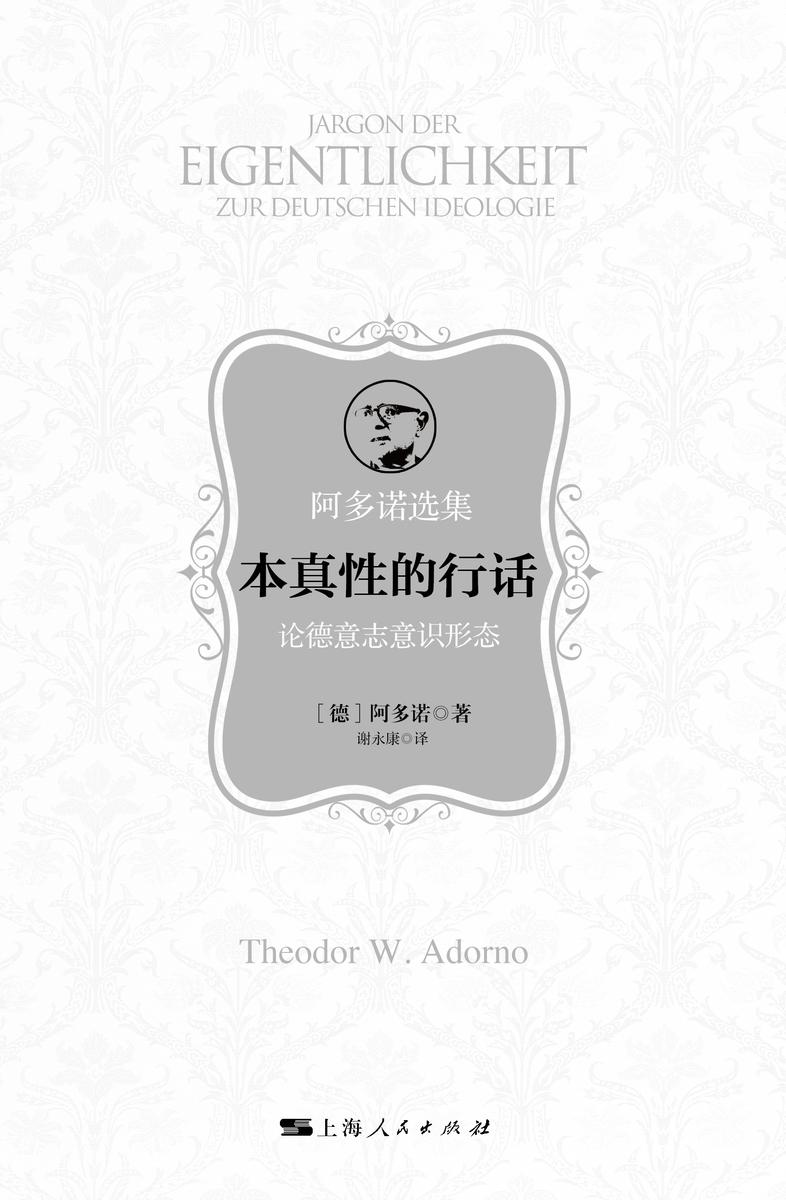
否定的辩证法
¥27.99
《否定的辩证法》是德国哲学家、西方马克思主义法兰克福学派重要代表阿多诺的主要代表作。在本书中阿多诺首先批判了哲学对同一性的追求,强调辩证法的本质是否定。他认为,古往今来哲学对“同一性”的追求是行不通的,根本不存在*的*性,任何想寻找原初事物或概念的哲学都走上了错误的道路,从而加强了社会上的极权主义和盲从主义倾向。辩证法的根本特征是否定性。其次,阿多诺绕辩证法的矛盾法则,落脚于法兰克福学派的社会批判主题。他认为真正意义上的辩证法不单是考察矛盾,而且还拒不承认矛盾是解释每一事物的图式。社会既不是个体主体的总和,也不是一种客观的事物,而是人类主体和物质客体的相互作用。自由的唯*意义在于否定,在于反思地否定各种具体的奴役。资本主义社会的*大弊端是商品交换价值法则的肆虐,把人和物降低到同一水平上和同质的无名地位上。随后,在本书中,阿多诺还举起“反体系”的旗帜,全力批判*哲学。他深刻意识到,真理的不变性是*哲学的幻想。本体论是对现状的辩解,是维护秩序的工具。此外,阿多诺认为,“否定的辩证法”是自由方便的立场,兼收并蓄的混合。“否定的辩证法”不仅与逻辑标准或事实标准无关,而且完全无视这些标准。这种无视实际上是“否定的辩证法”的本质。
道德哲学的问题
¥19.99
本书据阿多诺在1963年5月至7月的讲课稿整理而成,全书围绕着对康德道德哲学的评说而展,并结合阿多诺自身的体会,对整个西方哲学传统中的道德哲学予以了理论反思。在本书中,阿多诺分析了道德哲学与伦理学的区别,认为伦理学概念缩小和简化了对道德或伦理问题的深刻思考,因此他反对用伦理学概念代替道德哲学的概念,主张坚持使用康德意义上的“道德哲学”概念。同时,阿多诺不仅认为道德哲学是一种实践哲学,还认为在更深层次上,道德哲学也是一种理论哲学,因为理论和实践在根本上都来自生活,因而具有同一性。 在行文上,不同于阿多诺其他著作的晦涩难懂,本书朴实直白、明白晓畅,甚至不乏幽默诙谐之处,读者从字里行间也可领略到阿多诺的上课风格。
文本的深度耕犁——后马克思思潮哲学文本解读 第二卷
¥52.80
本书是作者关于当代国外马克思主义及后马克思思潮哲学文本研究的多卷本论著《文本的深度耕犁》的第二卷,其内容主要是对西方后马克思哲学思潮中经典文献的文本学研究。在本卷中,作者以文本学的深度解读模式分别批判性地解读了阿多诺的《否定的辩证法》、德波的《景观社会》、鲍德里亚的《生产之镜》、德里达的《马克思的幽灵》和齐泽克的《意识形态的崇高对象》等重要论著。
中国传统道德·普及本(重排本)
¥22.80
罗国杰,男,1928年1月生,河南内乡人。现为中国人民大学哲学系教授,博士生导师,中国伦理学名誉会长,曾任国务院学位委员会第二届哲学学科评议级成员,第三、四届哲学学科评议组召集人,中国人民大学副校长等职。主要研究方向为伦理学原理、中国传统伦理、思想品德教育。主要著作有《罗国杰文集》、《以德治国与公民道德建设》、《道德教育与价值导向》、《伦理学》(主编)等。在《人民日报》、《光明日报》、《哲学研究》等报刊杂志上发表论文300多篇。
儒家智慧活学活用
¥4.99
本书通过对儒家思想与精神的集中展现,用儒家的智慧来解决当今生活中的具体问题。内容包括做事先做人、自重意识的觉醒、修养“五字诀”、智慧的积累等
厚黑学看这本就够了
促销价:¥7.99|¥14.99
《厚黑学》一书见解深邃.文笔流畅轻松,语言幽默隽永,既能启迪心智,增长智慧,又能让读者学会如何得心应手地应对生活中的难题,是掌握当前社会*的“生存法则”。 《厚黑学》,一部处世奇书,问世百余年而畅销不衰。其内容涉及哲学、政治、经济学、心理学、社会学等,曾轰动中国思想界。林语堂、柏杨、南坯瑾、李敖等都曾为其作序。 “厚”,不是单纯的厚颜无耻,恬不知耻,而是隐忍、宽厚与醇厚。“黑”,也不是简单的诡计多端、狡诈阴险,它更包容了睿智、谋略与高瞻远瞩的深刻内涵。
心:稻盛和夫的一生嘱托
¥59.00
回首审视近90年的人生跨度,复盘超过半个世纪的经营经验,稻盛和夫想要把"构建人生的基石"的智慧传达出来。稻盛和夫认为,不管什么样的人,只要活着就有享受幸福的权利。而人生所有的际遇都是由自己的内心吸引而来,你在内心描绘的蓝图,决定了你将度过的人生。所以,心纯见真,了悟关于心的能量意义,就有机会大大改变人生。这既是给人生带来幸福的钥匙,也是通向成功的秘诀。
大爱妈祖:妈祖信仰在宁波
¥31.20
王国宝主编的《大爱妈祖(妈祖信仰在宁波)》是一本专题介绍宁波地区及其周边妈祖神迹的书籍,字里行间饱含妈祖大爱,从头至尾诠释宁波内涵,既有别于学术论著,又具有史料价值,信息量大,可读性强,出版后可谓惟贤惟德,益人益智。
生存还是毁灭:人生终极困境的坦率指南
¥36.75
我们出世,我们生活,我们一路上受苦,然后我们死去,此后永远地被抹除。我们的存在不过是宇宙时空中的一次小小波动。难怪很多人要问?:“这一切到底是为了什么?” 我在本书中主张,对上述问题的正确回答是?:“说到底,不为什么。”尽管有不多的慰藉,人的境况实际上仍是一种悲剧性的困境,这种困境无人可逃,因为困境不仅在于生,也在于死。 …… 书店里有整片的“自助”书籍区及其他鸡汤读物,却没有“无力自助”区和“悲观主义”区,因为这类思想的市场规模微乎其微。 我不是在认真主张我们无力自助。我是认为存在一些事情,我们的确对之无能为力,但即使依据一种现实的悲观看法,我们仍然可以做些事来减轻我们的困境。 一本悲观的书*有可能慰藉到的对象,是已经有同样看法却因此感到孤独或觉得自己有病的人。若能发觉有人跟自己看法相同,而且这些看法有不错的论证来支撑,这些人或许能因此得到安慰。 …… 无可否认,找到正确的道路很难,因为既要避免大而无当的宣言和过度修辞造成的故弄玄虚,也要避免深奥、乏味、细而又细的条分缕析。换言之,对复杂问题做出易懂、有趣而严格的探讨,并非易事。……不过,本书的写作确实有个目标,那就是既让有悟性的非专业读者能读、能懂,又足够严格,能满足构成本书期望读者群的另一部分人,即专业哲学家(及有志于哲学专业的读者)。但愿我取得了恰切的平衡。?
沉思录
¥9.99
《沉思录》的作者是古罗马帝国皇帝马可?奥勒留。他把一切事情都不看成是恶,认为痛苦和不安仅仅是来自内心,并且可以由自己的内心加以消除。书中记录了他摆脱激情和欲望、希望获得冷静而达观的生活态度,阐述了理性与死亡的关系,分析了个人德行以及个人对社会的责任,同时要求人们常常自省,并付诸行动。
马克思传(第4版)(马克思主义研究译丛·典藏版)
¥46.80
本书是英语世界*权威的马克思生平、思想研究文献之一。它的*特色:一是详细剖析了以往不为人注意和重视的后来发表的马克思的思想文献,如马克思的几大本经济学笔记;二是深细致地刻画了马克思一生的生活、工作和理论研究经历,揭示了许多鲜为人知的情况和资料。书中所提供的新资料对我国学界正在盛行的马克思著作的版本和文献研究,无疑有重要参考价值。
人人都该懂的认识论
¥32.90
究竟什么才是知识? 知识从何而来? 为什么有些信念的来源就是可靠的知识? 哲学家对知识的思考有哪些不同的答案呢? …… 关于知识的问题,几千年来一直是哲学家思考的重,他们彼此争论,寻求问题的答案。对知识的哲学研究就是认识论。在书中,你可以读到柏拉图、康德、笛卡儿等不同哲学家对知识的思考,重塑你对知识的认识,也能在外在主义、内在主义、怀疑主义、经验主义的理解中启你对哲学的思考。 但你不要期待能在书中找到关于知识的*终答案,因为哲学中没有公认的答案。阅读本书时,*好的做法是试着自己评估每一种哲学立场,判断它是否正确。这不仅仅是一种本能反应,因为每一种立场都会伴随着赞成或反对的观,这些观都值得你自己去仔细考量,从而判断它们是否令人信服。你甚至可以添加一些自己的思考,享受一次令人兴奋的体验。 《人人都该懂的认识论》属于湛庐文化重磅推出的“新核心素养”系列图书之一。本系列图书致力于推广通识阅读,扩展读者的阅读面,培养批判性思考的能力。其中涵盖了哲学、心理学、法律、艺术、物理学、生物科技等诸多人文科学和自然科学的知识,其中《人人都该懂的认识论》从哲学的角度出发,对知识行了一场哲学思考,可以帮助你更好地理解知识,探讨知识到底从何而来,启一场对哲学的重新思考。
Пришестя робот?в.
¥31.07
"Wilde è profetico sin dalle prima righe, quando denuncia la prevalenza dell’emozione sulla razionalità, male principe del nostro tempo, e poi del pietismo sull’emancipazione, male di tanta politica di pseudo sinistra" (dall'Introduzione di Alfredo Sgarlato). Wilde: ?perché la vita raggiunga la sua più elevata perfezione, ci vuole qualche cosa di più. Ciò che ci vuole è l'individualismo?, ?Utopia? Una carta geografica del mondo in cui non sia segnato il paese dell'Utopia, non varrebbe la pena d'essere guardata, perché vi mancherebbe il paese in cui l'Umanità atterra ogni giorno. Ma non appena v'è sbarcata, ella guarda più lontano, scorge una terra ancora più bella, e spiega di nuovo le vele. Progredire significa realizzare l'Utopia?. SOMMARIO: Introduzione (di Alfredo Sgarlato) - Postfazione. Breve biblio-nota ai testi e alla traduzione (di Fabrizio Pinna) - OSCAR WILDE Società e libertà: elogio dell'individualismo - APPENDICE I Oscar Wilde, Rapporti fra il socialismo e l'individualismo (di Luigi Fabbri, 1913) - APPENDICE II The Soul of Man under Socialism (1891). LA COLLANA IN/DEFINIZIONI
Скоропадський. Спогади 1917-1918
¥22.74
Potere, cortigianeria, dispotismo, libertà, uguaglianza... attuali o inattuali la satira d'Holbach e La Boétie? Cambiano i tempi e i nomi, ma la natura umana nel suo fondo negli ultimi secoli non è mutata. Com'è virtù di tutti i classici, le loro voci continuano a farci sorridere, indignare e riflettere non solo sul passato ma ugualmente sul presente e sul futuro, su quanto in esso ci possa essere di desiderabile o indesiderabile. In Appendice, i testi si possono leggere anche nella loro originaria edizione in francese. SOMMARIO?- Fabrizio Pinna, Una introduzione (in due tempi) e qualche digressione: I. Barone d'Holbach, "Quest'arte sublime dello strisciare"...; II. ?tienne de La Boétie, "Siate determinati di non voler più servire ed eccovi liberi"... . LIBERT? & POTERE: Paul Henri Thiry d'Holbach, Saggio sull'arte di strisciare ad uso dei cortigiani; Paul Henri Thiry d'Holbach, I Cortigiani; Jean le Rond d'Alembert, Cortigiano; ?tienne de La Boétie, La servitù volontaria. APPENDICE I: Libertà Uguaglianza (1799)- Il Cittadino Editore. APPENDICE II: Essai sur l’art de ramper, à l’usage des courtisans (1764) - Paul Henri Thiry d'Holbach; Des Courtisans (1773) - Paul Henri Thiry d'Holbach; Courtisan (1752) / Courtisane (1754) - Jean le Rond d'Alembert; Discours de la servitude volontaire o Contr'un (1549) - ?tienne de La Boétie.?LE COLLANE IN/DEFINIZIONI & CON(TRO)TESTI
Ruins of Ancient Cities: (Volume -II)
¥28.61
More’s “Utopia” was written in Latin, and is in two parts, of which the second, describing the place ([Greek text]—or Nusquama, as he called it sometimes in his letters—“Nowhere”), was probably written towards the close of 1515; the first part, introductory, early in 1516. The book was first printed at Louvain, late in 1516, under the editorship of Erasmus, Peter Giles, and other of More’s friends in Flanders. It was then revised by More, and printed by Frobenius at Basle in November, 1518. It was reprinted at Paris and Vienna, but was not printed in England during More’s lifetime. Its first publication in this country was in the English translation, made in Edward’s VI.’s reign (1551) by Ralph Robinson. It was translated with more literary skill by Gilbert Burnet, in 1684, soon after he had conducted the defence of his friend Lord William Russell, attended his execution, vindicated his memory, and been spitefully deprived by James II. of his lectureship at St. Clement’s. Burnet was drawn to the translation of “Utopia” by the same sense of unreason in high places that caused More to write the book. Burnet’s is the translation given in this volume. The name of the book has given an adjective to our language—we call an impracticable scheme Utopian. Yet, under the veil of a playful fiction, the talk is intensely earnest, and abounds in practical suggestion. It is the work of a scholarly and witty Englishman, who attacks in his own way the chief political and social evils of his time. Beginning with fact, More tells how he was sent into Flanders with Cuthbert Tunstal, “whom the king’s majesty of late, to the great rejoicing of all men, did prefer to the office of Master of the Rolls;” how the commissioners of Charles met them at Bruges, and presently returned to Brussels for instructions; and how More then went to Antwerp, where he found a pleasure in the society of Peter Giles which soothed his desire to see again his wife and children, from whom he had been four months away. Then fact slides into fiction with the finding of Raphael Hythloday (whose name, made of two Greek words [Greek text] and [Greek text], means “knowing in trifles”), a man who had been with Amerigo Vespucci in the three last of the voyages to the new world lately discovered, of which the account had been first printed in 1507, only nine years before Utopia was written. Designedly fantastic in suggestion of details, “Utopia” is the work of a scholar who had read Plato’s “Republic,” and had his fancy quickened after reading Plutarch’s account of Spartan life under Lycurgus. Beneath the veil of an ideal communism, into which there has been worked some witty extravagance, there lies a noble English argument. Sometimes More puts the case as of France when he means England. Sometimes there is ironical praise of the good faith of Christian kings, saving the book from censure as a political attack on the policy of Henry VIII. Erasmus wrote to a friend in 1517 that he should send for More’s “Utopia,” if he had not read it, and “wished to see the true source of all political evils.” And to More Erasmus wrote of his book, “A burgomaster of Antwerp is so pleased with it that he knows it all by heart.” Sir Thomas More, son of Sir John More, a justice of the King’s Bench, was born in 1478, in Milk Street, in the city of London. After his earlier education at St. Anthony’s School, in Threadneedle Street, he was placed, as a boy, in the household of Cardinal John Morton, Archbishop of Canterbury and Lord Chancellor. It was not unusual for persons of wealth or influence and sons of good families to be so established together in a relation of patron and client. The youth wore his patron’s livery, and added to his state. The patron used, afterwards, his wealth or influence in helping his young client forward in the world.
Nature
¥9.24
The Prince (Italian: Il Principe) is a political treatise by the Italian diplomat, historian and political theorist Niccolò Machiavelli. From correspondence a version appears to have been distributed in 1513, using a Latin title, De Principatibus (About Principalities). But the printed version was not published until 1532, five years after Machiavelli's death. This was done with the permission of the Medici pope Clement VII, but "long before then, in fact since the first appearance of the Prince in manuscript, controversy had swirled about his writings" Although it was written as if it were a traditional work in the Mirror of Princes style, it is generally agreed that it was especially innovative, and not only because it was written in Italian rather than Latin. The Prince is sometimes claimed to be one of the first works of modern philosophy, in which the effective truth is taken to be more important than any abstract ideal. It was also in direct conflict with the dominant Catholic and scholastic doctrines of the time concerning how to consider politics and ethics. Although it is relatively short, the treatise is the most remembered of his works and the one most responsible for bringing "Machiavellian" into wide usage as a pejorative term. It also helped make "Old Nick" an English term for the devil, and even contributed to the modern negative connotations of the words "politics" and "politician" in western countries. In terms of subject matter it overlaps with the much longer Discourses on Livy, which was written a few years later. In its use of examples who were politically active Italians who perpetrated criminal deeds for politics, another lesser-known work by Machiavelli which The Prince has been compared to is the Life of Castruccio Castracani. The descriptions within The Prince have the general theme of accepting that ends of princes, such as glory, and indeed survival, can justify the use of immoral means to achieve those ends.
Liberty Girl
¥19.05
Human reason, in one sphere of its cognition, is called upon to consider questions, which it cannot decline, as they are presented by its own nature, but which it cannot answer, as they transcend every faculty of the mind. It falls into this difficulty without any fault of its own. It begins with principles, which cannot be dispensed with in the field of experience, and the truth and sufficiency of which are, at the same time, insured by experience. With these principles it rises, in obedience to the laws of its own nature, to ever higher and more remote conditions. But it quickly discovers that, in this way, its labours must remain ever incomplete, because new questions never cease to present themselves; and thus it finds itself compelled to have recourse to principles which transcend the region of experience, while they are regarded by common sense without distrust. It thus falls into confusion and contradictions, from which it conjectures the presence of latent errors, which, however, it is unable to discover, because the principles it employs, transcending the limits of experience, cannot be tested by that criterion. The arena of these endless contests is called Metaphysic.Time was, when she was the queen of all the sciences; and, if we take the will for the deed, she certainly deserves, so far as regards the high importance of her object-matter, this title of honour. Now, it is the fashion of the time to heap contempt and scorn upon her; and the matron mourns, forlorn and forsaken, like Hecuba: At first, her gover Modo maxima rerum, Tot generis, natisque potens... Nunc trahor exul, inops. —Ovid, Metamorphoses. xiii under the administration of the dogmatists, was an absolute despotism. But, as the legislative continued to show traces of the ancient barbaric rule, her empire gradually broke up, and intestine wars introduced the reign of anarchy; while the sceptics, like nomadic tribes, who hate a permanent habitation and settled mode of living, attacked from time to time those who had organized themselves into civil communities. But their number was, very happily, small; and thus they could not entirely put a stop to the exertions of those who persisted in raising new edifices, although on no settled or uniform plan. In recent times the hope dawned upon us of seeing those disputes settled, and the legitimacy of her claims established by a kind of physiology of the human understanding—that of the celebrated Locke. But it was found that—although it was affirmed that this so-called queen could not refer her descent to any higher source than that of common experience, a circumstance which necessarily brought suspicion on her claims—as this genealogy was incorrect, she persisted in the advancement of her claims to sovereignty. Thus metaphysics necessarily fell back into the antiquated and rotten constitution of dogmatism, and again became obnoxious to the contempt from which efforts had been made to save it. At present, as all methods, according to the general persuasion, have been tried in vain, there reigns nought but weariness and complete indifferentism—the mother of chaos and night in the scientific world, but at the same time the source of, or at least the prelude to, the re-creation and reinstallation of a science, when it has fallen into confusion, obscurity, and disuse from ill directed effort. I do not mean by this a criticism of books and systems, but a critical inquiry into the faculty of reason, with reference to the cognitions to which it strives to attain without the aid of experience; in other words, the solution of the question regarding the possibility or impossibility of metaphysics, and the determination of the origin, as well as of the extent and limits of this science. All this must be done on the basis of principles. ABOUT AUTHOR: That all our knowledge begins with experience there can be no doubt. For how is it possible that the faculty of cognition should be awakened into exercise otherwise than by means of objects which affect our senses, and partly of themselves produce representations, partly rouse our powers of understanding into activity, to compare to connect, or to separate these, and so to convert the raw material of our sensuous impressions into a knowledge of objects, which is called experience? In respect of time, therefore, no knowledge of ours is antecedent to experience, but begins with it. But, though all our knowledge begins with experience, it by no means follows that all arises out of experience. For, on the contrary, it is quite possible that our empirical knowledge is a compound of that which we receive through impressions, and that which the faculty of cognition supplies from itself (sensuous impressions giving merely the occasion), an addition which we cannot distinguish from the original element given by sense, till long practice has made us attentive to, and skilful in separating it. It is, therefore, a question which requires close investigation, and not to b
The Sorrows of Young Werther
¥18.74
Among the notable books of later times-we may say, without exaggeration, of all time--must be reckoned The Confessions of Jean Jacques Rousseau. It deals with leading personages and transactions of a momentous epoch, when absolutism and feudalism were rallying for their last struggle against the modern spirit, chiefly represented by Voltaire, the Encyclopedists, and Rousseau himself--a struggle to which, after many fierce intestine quarrels and sanguinary wars throughout Europe and America, has succeeded the prevalence of those more tolerant and rational principles by which the statesmen of our own day are actuated. On these matters, however, it is not our province to enlarge; nor is it necessary to furnish any detailed account of our author's political, religious, and philosophic axioms and systems, his paradoxes and his errors in logic: these have been so long and so exhaustively disputed over by contending factions that little is left for even the most assiduous gleaner in the field. The inquirer will find, in Mr. John Money's excellent work, the opinions of Rousseau reviewed succinctly and impartially. The 'Contrat Social', the 'Lattres Ecrites de la Montagne', and other treatises that once aroused fierce controversy, may therefore be left in the repose to which they have long been consigned, so far as the mass of mankind is concerned, though they must always form part of the library of the politician and the historian. One prefers to turn to the man Rousseau as he paints himself in the remarkable work before us. That the task which he undertook in offering to show himself--as Persius puts it--'Intus et in cute', to posterity, exceeded his powers, is a trite criticism; like all human enterprises, his purpose was only imperfectly fulfilled; but this circumstance in no way lessens the attractive qualities of his book, not only for the student of history or psychology, but for the intelligent man of the world. Its startling frankness gives it a peculiar interest wanting in most other autobiographies. Many censors have elected to sit in judgment on the failings of this strangely constituted being, and some have pronounced upon him very severe sentences. Let it be said once for all that his faults and mistakes were generally due to causes over which he had but little control, such as a defective education, a too acute sensitiveness, which engendered suspicion of his fellows, irresolution, an overstrained sense of honour and independence, and an obstinate refusal to take advice from those who really wished to befriend him; nor should it be forgotten that he was afflicted during the greater part of his life with an incurable disease. Lord Byron had a soul near akin to Rousseau's, whose writings naturally made a deep impression on the poet's mind, and probably had an influence on his conduct and modes of thought: In some stanzas of 'Childe Harold' this sympathy is expressed with truth and power; especially is the weakness of the Swiss philosopher's character summed up in the following admirable lines: "Here the self-torturing sophist, wild Rousseau, The apostle of affliction, he who threw Enchantment over passion, and from woe Wrung overwhelming eloquence, first drew The breath which made him wretched; yet he knew How to make madness beautiful, and cast O'er erring deeds and thoughts a heavenly hue Of words, like sunbeams, dazzling as they passed The eyes, which o'er them shed tears feelingly and fast. "His life was one long war with self-sought foes, Or friends by him self-banished; for his mind Had grown Suspicion's sanctuary, and chose, For its own cruel sacrifice, the kind, 'Gainst whom he raged with fury strange and blind. But he was frenzied,-wherefore, who may know? Since cause might be which skill could never find; But he was frenzied by disease or woe To that worst pitch of all, which wears a reasoning show."

购物车
个人中心