


 购物车
购物车 个人中心
个人中心
Divine Comedy (Volume I): Paradise {Illustrated}
¥18.74
The Metamorphosis (German: Die Verwandlung, also sometimes translated as The Transformation) is a novella by Franz Kafka, first published in 1915. It has been cited as one of the seminal works of fiction of the 20th century and is studied in colleges and universities across the Western world. The story begins with a traveling salesman, Gregor Samsa, waking to find himself transformed (metamorphosed) into a large, monstrous insect-like creature. The cause of Samsa's transformation is never revealed, and Kafka never did give an explanation. The rest of Kafka's novella deals with Gregor's attempts to adjust to his new condition as he deals with being burdensome to his parents and sister, who are repulsed by the horrible, verminous creature Gregor has become. Part I: One day, Gregor Samsa, a traveling salesman, wakes up to find himself transformed into a "ungeheures Ungeziefer", literally "monstrous vermin", often interpreted as a giant bug or insect. He believes it is a dream, and reflects on how dreary life as a traveling salesman is. As he looks at the wall clock, he realizes he has overslept, and missed his train for work. He ponders on the consequences of this delay. Gregor becomes annoyed at how his boss never accepts excuses or explanations from any of his employees no matter how hard working they are, displaying an apparent lack of trusting abilities. Gregor's mother knocks on the door and he answers her. She is concerned for Gregor because he is late for work, which is unorthodox for Gregor. Gregor answers his mother and realizes that his voice has changed, but his answer is short so his mother does not notice the voice change. His sister, Grete, to whom he was very close, then whispers through the door and begs him to open the door. All his family members think that he is ill and ask him to open the door. He tries to get out of bed, but he is incapable of moving his body. While trying to move, he finds that his office manager, the chief clerk, has shown up to check on him. He finally rocks his body to the floor and calls out that he will open the door shortly.

Evolution of Love
¥18.74
In these times of ours, though concerning the exact year there is no need to be precise, a boat of dirty and disreputable appearance, with two figures in it, floated on the Thames, between Southwark bridge which is of iron, and London Bridge which is of stone, as an autumn evening was closing in. The figures in this boat were those of a strong man with ragged grizzled hair and a sun-browned face, and a dark girl of nineteen or twenty, sufficiently like him to be recognizable as his daughter. The girl rowed, pulling a pair of sculls very easily; the man, with the rudder-lines slack in his hands, and his hands loose in his waistband, kept an eager look out. He had no net, hook, or line, and he could not be a fisherman; his boat had no cushion for a sitter, no paint, no inscription, no appliance beyond a rusty boathook and a coil of rope, and he could not be a waterman; his boat was too crazy and too small to take in cargo for delivery, and he could not be a lighterman or river-carrier; there was no clue to what he looked for, but he looked for something, with a most intent and searching gaze. The tide, which had turned an hour before, was running down, and his eyes watched every little race and eddy in its broad sweep, as the boat made slight head-way against it, or drove stern foremost before it, according as he directed his daughter by a movement of his head. She watched his face as earnestly as he watched the river. But, in the intensity of her look there was a touch of dread or horror. Allied to the bottom of the river rather than the surface, by reason of the slime and ooze with which it was covered, and its sodden state, this boat and the two figures in it obviously were doing something that they often did, and were seeking what they often sought. Half savage as the man showed, with no covering on his matted head, with his brown arms bare to between the elbow and the shoulder, with the loose knot of a looser kerchief lying low on his bare breast in a wilderness of beard and whisker, with such dress as he wore seeming to be made out of the mud that begrimed his boat, still there was a business-like usage in his steady gaze. So with every lithe action of the girl, with every turn of her wrist, perhaps most of all with her look of dread or horror; they were things of usage. 'Keep her out, Lizzie. Tide runs strong here. Keep her well afore the sweep of it.' Trusting to the girl's skill and making no use of the rudder, he eyed the coming tide with an absorbed attention. So the girl eyed him. But, it happened now, that a slant of light from the setting sun glanced into the bottom of the boat, and, touching a rotten stain there which bore some resemblance to the outline of a muffled human form, coloured it as though with diluted blood. This caught the girl's eye, and she shivered. 'What ails you?' said the man, immediately aware of it, though so intent on the advancing waters; 'I see nothing afloat.' The red light was gone, the shudder was gone, and his gaze, which had come back to the boat for a moment, travelled away again. Wheresoever the strong tide met with an impediment, his gaze paused for an instant. At every mooring-chain and rope, at every stationery boat or barge that split the current into a broad-arrowhead, at the offsets from the piers of Southwark Bridge, at the paddles of the river steamboats as they beat the filthy water, at the floating logs of timber lashed together lying off certain wharves, his shining eyes darted a hungry look. After a darkening hour or so, suddenly the rudder-lines tightened in his hold, and he steered hard towards the Surrey shore. Always watching his face, the girl instantly answered to the action in her sculling; presently the boat swung round, quivered as from a sudden jerk, and the upper half of the man was stretched out over the stern.
Robinson Crusoe: Illustrated
¥18.74
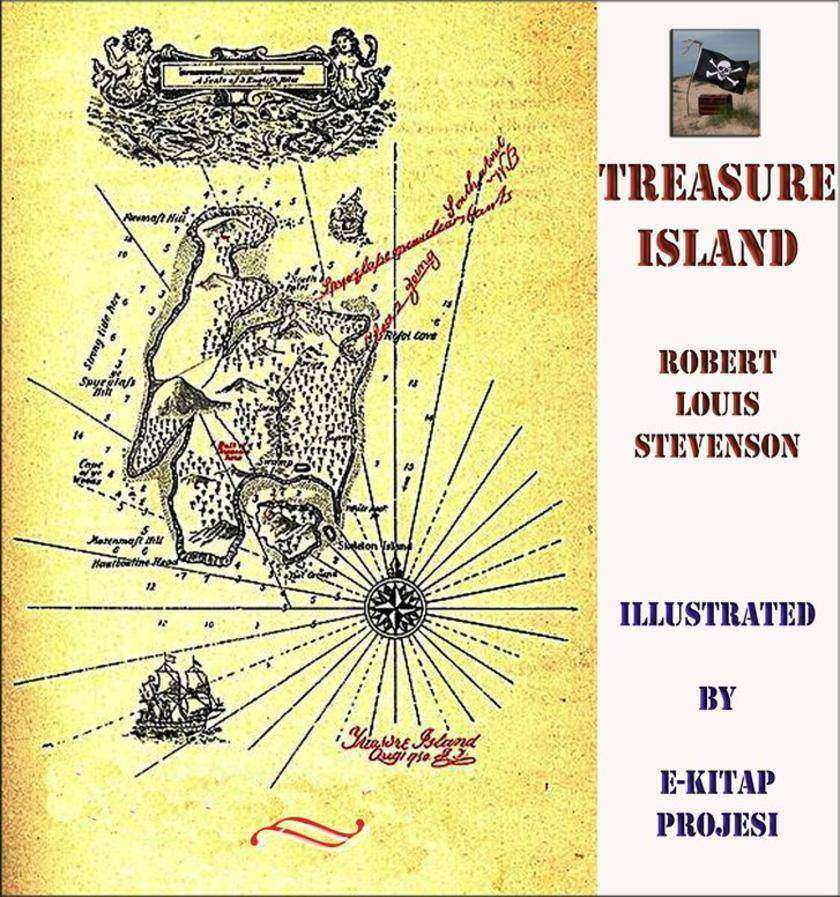
Treasure Island is an adventure novel by Scottish author Robert Louis Stevenson, narrating a tale of "buccaneers and buried gold". First published as a book on 23 May 1883, it was originally serialized in the children's magazine Young Folks between 1881 and 1882 under the title Treasure Island or, the mutiny of the Hispaniola with Stevenson adopting the pseudonym Captain George North. Traditionally considered a coming-of-age story, Treasure Island is a tale known for its atmosphere, characters and action, and also as a wry commentary on the ambiguity of morality — as seen in Long John Silver — unusual for children's literature now and then. It is one of the most frequently dramatized of all novels. The influence of Treasure Island on popular perceptions of pirates is enormous, including treasure maps marked with an "X", schooners, the Black Spot, tropical islands, and one-legged seamen carrying parrots on their shoulders. Short Summary of the Book:The novel is divided into six parts and 34 chapters: The novel opens in the seaside village of Black Hill Cove in south-west England (to Stevenson, in his letters and in the related fictional play Admiral Guinea, near Barnstaple, Devon) in the mid-18th century. The narrator, James "Jim" Hawkins, is the young son of the owners of the Admiral Benbow Inn. An old drunken seaman named Billy Bones becomes a long-term lodger at the inn, only paying for about the first week of his stay. Jim quickly realizes that Bones is in hiding, and that he particularly dreads meeting an unidentified seafaring man with one leg. Some months later, Bones is visited by a mysterious sailor named Black Dog. Their meeting turns violent, Black Dog flees and Bones suffers a stroke. While Jim cares for him, Bones confesses that he was once the mate of a notorious late pirate, Captain Flint, and that his old crewmates want Bones' sea chest. Some time later, another of Bones' crew mates, a blind man named Pew, appears at the inn and forces Jim to lead him to Bones. Pew gives Bones a paper. After Pew leaves, Bones opens the paper to discover it is marked with the Black Spot, a pirate summons, with the warning that he has until ten o'clock to meet their demands. Bones drops dead of apoplexy (in this context, a stroke) on the spot. Jim and his mother open Bones' sea chest to collect the amount due to them for Bones' room and board, but before they can count out the money that they are owed, they hear pirates approaching the inn and are forced to flee and hide, Jim taking with him a mysterious oilskin packet from the chest. The pirates, led by Pew, find the sea chest and the money, but are frustrated that there is no sign of "Flint's fist". Customs men approach and the pirates escape to their vessel (all except for Pew, who is accidentally run down and killed by the agents' horses).
Timaeus
¥18.74
Red Eve was written in the year 1911 by Henry Rider Haggard. This book is one of the most popular novels of Henry Rider Haggard, and has been translated into several other languages around the world.This book is published by Booklassic which brings young readers closer to classic literature globally.
Persuasion
¥18.74
Holmes decodes a warning from Porlock, an informant against arch-criminal Moriarty, for "Douglas" resident five years at "Birlstone". Scotland Yard's MacDonald asks them to investigate a corpse with the same look and circle-in-triangle brand on the forearm as Birlstone owner Douglas. The head was blown off by an American-style sawed-off shotgun. Apparently, an intruder dropped a card with VV341, and left across a shallow moat. Watson observes the bereaved English wife and best male friend in unusually good spirits. When Holmes pretends the moat will be drained, the conspirators retrieve a missing dumb-bell weighting down the visitor's clothes beneath the water. Douglas comes from hiding, to explain he killed the assassin Baldwin in self-defence; the plan was to save him from more attacks by criminal survivors of Vermissa Valley. He hands Dr. Watson the following account. Young McMurdo gains reputation as tough counterfeiter, Freemen Lodge member fleeing murder charges in Chicago. In the Vermissa coal mine area, McGinty rules Scowrers branded by a circle in square, the local Lodge 341 who extort, murder, and exchange vicious deeds with nearby Lodges. Pretty Ettie prefers McMurdo to nasty Baldwin, and wants to flee, but will wait some months. When word comes that Pinkerton sent Edwards, McMurdo gathers ringleaders in one room, and springs his trap on them, surrounded by the law. Although the worst were hanged, after ten years, villains were freed, and chased McMurdo-Edwards-Douglas, despite changes of name, location, and wife. He married Ettie, then she died in California, where he made a fortune. The Valley of Fear, notable for Professor Moriarty's involvement, is set before "The Final Problem", the short story in which Moriarty was introduced. This introduces a logical difficulty, as in "The Final Problem" Dr. Watson has never heard of Moriarty, whereas by the end of The Valley Of Fear he is, or should be, familiar with his name and character. The "Moriarty" element in the story is tied into the fate of the informer in the story. It ties the Molly Maguire background to another event of that period: the murder of James Carey, an informer who was shot on board a ship off the coast of Natal, South Africa in 1883 by Patrick O'Donnell, an Irish republican who had relatives in the Mollies and briefly visited the Pennsylvania coal mining district, supposedly looking for the suspected informer among them.
The Book of Dragons
¥18.74
Creep, Shadow! was written in the year 1934 by Abraham Merritt. This book is one of the most popular novels of Abraham Merritt, and has been translated into several other languages around the world.This book is published by Booklassic which brings young readers closer to classic literature globally.
Great Astronomers (Nicolaus Copernicus): Illustrated
¥18.74
Skye a világon mindennél jobban szereti az ikertesóját, Summert. Mindig mindent együtt csinálnak, ám a Skye újabban kezdi azt érezni, teljesen elt?nik testvére árnyékában, mellette mindig csak a második legjobb lehet. Emiatt is érinti annyira fájdalmasan, mikor kiderül, Alfie is csak azért barátkozik vele, hogy meghódíthassa Summer szívét. Skye szeretne ?nmaga lenni, megmutatni saját stílusát és egyéniségét. De nem k?nny? elszánnia magát, hiszen egy t?kéletes, men? és népszer? ikertestvér mellett miért lenne bárki pont rá kíváncsi? ?t lány, ?t néz?pont, ?t k?nyv. Cherry után a Mályvacukor égboltból megismerjük Skye t?rténetét. Egy k?nyvsorozat, melyben minden testvérnek megvan a maga t?rténete Neked melyik lány lesz a kedvenced? Talán a Mályvacukor égbolt f?h?se, Skye? ? az a lány, akinek sz?ke, hullámos a haja, kék a szeme, egy kissé talán kül?nc, de mindig vidám, kedves és barátságos. Igazi egyéniség. A szerz?r?l: Cathy Cassidy nyolc-kilencéves korában írta meg els? képesk?nyvét kis?ccsének, és azóta ontja magából a t?rténeteket. Magyarul els?ként a Csajok és csokik-sorozata jelent meg (a Cseresznyés ábrándot most a második k?tet, a Mályvacukor égbolt k?veti), melynek a vagány Tanberry-n?vérek a f?h?sei. De mellettük felt?nik néhány szupermen? srác is, valamint Cathy egyik legnagyobb szerelme, a csokoládé is fontos szerepet kap. Cathy Skóciában él a családjával. Az ?sszes munka k?zül, amivel valaha megpróbálkozott, az írást szereti a legjobban hiszen amikor ír, mást sem kell csinálnia, mint ébren álmodozni egész álló nap.
Japanese Fairy Tales: Illustrated
¥18.74
THE ARABIAN NIGHTS “THE ORIENT MAGIC” The Talking Bird, The Singing Tree, and the Golden WaterThe Story of the Fisherman and the GenieThe History of the Young King of the Black IslesThe Story of Gulnare of the SeaThe Story of Aladdin; Or, the Wonderful LampThe Story of Prince AgibThe Story of the City of BrassThe Story of Ali Baba and the Forty ThievesThe History of Codadad and His BrothersThe Story of Sinbad the Voyager The Talking Bird:It will be sufficient to break off a branch and carry it to plant in your gardenThe Fisherman and the GenieThe smoke ascended to the clouds, and extending itself along the sea and upon the shore formed a great mist The Young King of the Black IslesWhen he came to this part of his narrative the young king could not restrain his tearsGulnare of the SeaAnd she proceeded to burn perfume and repeat spells until the sea foamed and was agitatedAladdinAt the same time the earth, trembling, opened just before the magician, and uncovered a stone, laid horizontally, with a brass ring fixed into the middlePrince AgibAnd when the boat came to me I found in it a man of brass, with a tablet of lead upon his breast, engraven with names and talismans Prince AgibAt the approach of evening I opened the first closet and, entering it, found a mansion like paradiseThe City of BrassAnd when they had ascended that mountain they saw a city than which eyes had not beheld any greaterThe Story of Ali Baba and the Forty ThievesCassim ... was so alarmed at the danger he was in that the more he endeavoured to remember the word Sesame the more his memory was confoundedThe History of Codadad and His BrothersAs it drew near we saw ten or twelve armed pirates appear on the deckSecond Voyage of SinbadThe spot where she left me was encompassed on all sides by mountains that seemed to reach above the clouds, and so steep that there was no possibility of getting out of the valleyThird Voyage of SinbadHaving finished his repast, he returned to his porch, where he lay and fell asleep, snoring louder than thunder.. Little excuse is needed, perhaps, for any fresh selection from the famous "Tales of a Thousand and One Nights," provided it be representative enough, and worthy enough, to enlist a new army of youthful readers. Of the two hundred and sixty-four bewildering, unparalleled stories, the true lover can hardly spare one, yet there must always be favourites, even among these. We have chosen some of the most delightful, in our opinion; some, too, that chanced to appeal particularly to the genius of the artist. If, enticed by our choice and the beauty of the pictures, we manage to attract a few thousand more true lovers to the fountain-book, we shall have served our humble turn. The only real danger lies in neglecting it, in rearing a child who does not know it and has never fallen under its spell. You remember Maimoune, in the story of Prince Camaralzaman, and what she said to Danhasch, the genie who had just arrived from the farthest limits of China? "Be sure thou tellest me nothing but what is true or I shall clip thy wings!" This is what the modern child sometimes says to the genies of literature, and his own wings are too often clipped in consequence."The Empire of the Fairies is no more. Reason has banished them from ev'ry shore;Steam has outstripped their dragons and their cars,Gas has eclipsed their glow-worms and their stars."?douard Laboulaye says in his introduction to Nouveaux Contes Bleus: "Mothers who love your children, do not set them too soon to the study of history; let them dream while they are young.

Blaster Squad #1 Terror on the Moon
¥18.74
Blaster Squad #1 Terror on the Moon

Blaster Squad #5: Rise of the Empire
¥18.74
When Siren and the Kid are reported missing Nick Justice is determined to find them. After learning they are being held on a remote planet known as Poseidon, a water world far from Alliance space, he and his team race to their rescue. Blaster Squad soon finds themselves having to fight for survival. Someone is determined to stop them and Nick suspects the mysterious figure known as the Master is behind the attacks. They soon discover the Master is plotting to overthrow the galaxy and rule as Emperor throwing civilization into a new dark age ruled by terror and fear. Nick Justice and Blaster Squad are determined to stop them or die trying. ? ? .
Madame Bovary
¥18.74
The stranger came early in February, one wintry day, through a biting wind and a driving snow, the last snowfall of the year, over the down, walking from Bramblehurst railway station, and carrying a little black portmanteau in his thickly gloved hand. He was wrapped up from head to foot, and the brim of his soft felt hat hid every inch of his face but the shiny tip of his nose; the snow had piled itself against his shoulders and chest, and added a white crest to the burden he carried. He staggered into the "Coach and Horses" more dead than alive, and flung his portmanteau down. "A fire," he cried, "in the name of human charity! A room and a fire!" He stamped and shook the snow from off himself in the bar, and followed Mrs. Hall into her guest parlour to strike his bargain. And with that much introduction, that and a couple of sovereigns flung upon the table, he took up his quarters in the inn. Mrs. Hall lit the fire and left him there while she went to prepare him a meal with her own hands. A guest to stop at Iping in the wintertime was an unheard-of piece of luck, let alone a guest who was no "haggler," and she was resolved to show herself worthy of her good fortune. As soon as the bacon was well under way, and Millie, her lymphatic maid, had been brisked up a bit by a few deftly chosen expressions of contempt, she carried the cloth, plates, and glasses into the parlour and began to lay them with the utmost éclat. Although the fire was burning up briskly, she was surprised to see that her visitor still wore his hat and coat, standing with his back to her and staring out of the window at the falling snow in the yard. His gloved hands were clasped behind him, and he seemed to be lost in thought. She noticed that the melting snow that still sprinkled his shoulders dripped upon her carpet. "Can I take your hat and coat, sir?" she said, "and give them a good dry in the kitchen?"
Pride & Prejudice
¥18.74
Flaming Island:“Look, Dave. See those strange clouds?” Florence Huyler shaded her eyes to look away toward the horizon. Her face wore an expression of bewildered curiosity. “Yes, I see them. They are queer!” young “Captain Davie,” as everyone called him, replied as he wrinkled his brow. After giving the wheel of his motor-driven craft a turn, he studied those clouds. “Scurrying along the horizon,” he murmured, “they roll quite a bit, don’t they?” “Yes, and such a peculiar shade of yellow,” Florence added. “Oh well, clouds are different up here on Lake Superior.” “Nothing to worry about, I guess,” said Dave, as once again he gave his attention to the wheel.As for Florence, at the moment she had nothing to do but think. And such bitter-sweet thoughts as they were! She was cruising on Lake Superior. That was grand! She had always loved the water. What was still more magnificent, she was landing twice a week on the shores of that place of great enchantment—Isle Royale.Once, you will recall from reading The Phantom Violin, Florence with two companions had made her summer home on a huge wrecked ship off the rocky shores of this very island. What a summer that had been! Adventure? Plenty of it. The ship had at last been completely destroyed during a storm. They had barely escaped with their lives. The girl shuddered a little even now at the thought of it. Florence was large, strong, fearless. A marvelous swimmer and a grand athlete, she had little to fear on land or water. And yet, as her eyes swept the deck of the Wanderer, the sixty-foot motor-boat on which she rode, a troubled look came into her fine blue eyes. Nor were those low, circling clouds the cause of her worry. She and her cousin Dave, quite as courageous and venturesome as she, had embarked upon an enterprise that promised to be a failure.“Grandfather will lose his money. He can’t afford to lose, and it’s not all our fault,” she told herself a little bitterly. But now her thoughts were broken by a short, stout, bronze-faced man, an Indian who appeared at the cabin door.“Look, John!” she pointed, speaking to the Indian. “Look at those strange clouds!”“Huh!” he grunted. “Smoke!”“Sm-smoke!” the girl stared. Then she breathed a sigh of relief. “Oh, from Canada! Forest fires. I’ve heard—”

The Mark of Cain
¥18.74
There once lived, in a sequestered part of the county of Devonshire, one Mr Godfrey Nickleby: a worthy gentleman, who, taking it into his head rather late in life that he must get married, and not being young enough or rich enough to aspire to the hand of a lady of fortune, had wedded an old flame out of mere attachment, who in her turn had taken him for the same reason. Thus two people who cannot afford to play cards for money, sometimes sit down to a quiet game for love. Some ill-conditioned persons who sneer at the life-matrimonial, may perhaps suggest, in this place, that the good couple would be better likened to two principals in a sparring match, who, when fortune is low and backers scarce, will chivalrously set to, for the mere pleasure of the buffeting; and in one respect indeed this comparison would hold good; for, as the adventurous pair of the Fives' Court will afterwards send round a hat, and trust to the bounty of the lookers-on for the means of regaling themselves, so Mr Godfrey Nickleby and HIS partner, the honeymoon being over, looked out wistfully into the world, relying in no inconsiderable degree upon chance for the improvement of their means. Mr Nickleby's income, at the period of his marriage, fluctuated between sixty and eighty pounds PER ANNUM. There are people enough in the world, Heaven knows! and even in London (where Mr Nickleby dwelt in those days) but few complaints prevail, of the population being scanty. It is extraordinary how long a man may look among the crowd without discovering the face of a friend, but it is no less true. Mr Nickleby looked, and looked, till his eyes became sore as his heart, but no friend appeared; and when, growing tired of the search, he turned his eyes homeward, he saw very little there to relieve his weary vision. A painter who has gazed too long upon some glaring colour, refreshes his dazzled sight by looking upon a darker and more sombre tint; but everything that met Mr Nickleby's gaze wore so black and gloomy a hue, that he would have been beyond description refreshed by the very reverse of the contrast. At length, after five years, when Mrs Nickleby had presented her husband with a couple of sons, and that embarrassed gentleman, impressed with the necessity of making some provision for his family, was seriously revolving in his mind a little commercial speculation of insuring his life next quarter-day, and then falling from the top of the Monument by accident, there came, one morning, by the general post, a black-bordered letter to inform him how his uncle, Mr Ralph Nickleby, was dead, and had left him the bulk of his little property, amounting in all to five thousand pounds sterling.
The Picture of Dorian Gray
¥18.74
"?nsan ancak evcille?tirirse anlar," dedi tilki."?nsanlar?n art?k anlamaya zamanlar? yok. Dükk?nlardan her istediklerini sat?n al?yorlar. Ama dostluk sat?lan bir dükk?n olmad??? i?in dostlar? yok art?k. E?er dost istiyorsan beni evcille?tir.""Seni evcille?tirmek i?in ne yapmal?y?m?" diye sordu kü?ük prens."?ok sab?rl? olmal?s?n," dedi tilki. "?nce kar??ma, ??yle uza?a ?imenlerin üstüne oturacaks?n.G?zümün ucuyla sana bakaca??m, ama bir ?ey s?ylemeyeceksin. S?zler yanl?? anlamalar?n kayna??d?r. Her gün biraz daha yak?n?ma oturacaks?n..."Ertesi gün kü?ük prens yine geldi."Ayn? saatte gelmen daha iyi olur," dedi tilki. "?rne?in sen ??leden sonra d?rtte geleceksen, ben saat ü?te mutlu olmaya ba?lar?m. Mutlulu?um her dakika artar. Saat d?rtte art?k sevin?ten ve meraktan deli gibi olurum. Ne kadar mutlu oldu?umu g?rmü? olursun. Ama herhangi bir zamanda gelirsen yüre?im saat ka?ta senin i?in ?arpaca??n? bilemez. ?nsan?n belli al??kanl?klar? olmal?..." Tilkinin yan?na d?ndü sonra. "Ho??a kal," dedi. "Ho??a kal," dedi tilki. "??te sana bir s?r, ?ok basit bir ?ey: ?nsan yaln?z yüre?iyle do?ruyu g?rebilir. As?l g?rülmesi gerekeni g?zler g?remez." "As?l g?rülmesi gerekeni g?zler g?remez," diye yineledi kü?ük prens; unutmamal?yd? bunu. "Gülünü senin i?in ?nemli k?lan, onun i?in harcam?? oldu?un zamand?r." "Onun i?in harcam?? oldu?um zaman..." diye yineledi kü?ük prens. Unutmamal?yd? bunu. "?nsanlar unuttular bunu," dedi tilki. "Ama sen unutmamal?s?n. Evcille?tirdi?imiz ?eyden sorumlu oluruz. Sen gülünden sorumlusun..." "Ben gülümden sorumluyum," diye yineledi kü?ük prens. Bunu da unutmamal?yd?. ? Antoine Saint Exupéry (29 Haziran 1900 - 31 Temmuz 1944), Frans?z pilot, yazar ve ?airdir. ?zellikle "Kü?ük Prens" (Le Petit Prince) isimli eseriyle ünlenmi?tir. Fransa'n?n Lyon ?ehrinde do?du. Be? karde?in ü?üncüsüydü. Aristokrat bir aileye mensup olan Exupéry d?rt ya??ndayken babas?n? kaybetti. Babas?n?n ard?ndan aile h?zla yoksulla?t?. Anneleri kültürlü bir kad?nd?. ?lk ??retmenleri anneleri oldu. Exupéry okulda ba?ar?l? de?ildi. ?devlerle aras? yoktu, sürekli ceza al?yordu. U?aklarla 12 ya??nda tan??t?. Evlerinin yan?ndaki hava alan?na gizlice girer u?aklar? yak?ndan seyrederdi. 12 ya??ndayken bir pilot onu u?a??na ald? ve u?urdu. Karde?i Fran?ois'in ?lümü onu ve ailesini ?ok sarst?. Liseyi bitirdikten sonra pilot olmay? ?ok istedi?i halde annesini k?rmamak i?in denizcilik okuluna kaydoldu. 19 ya??nda Ecole des Beaux-Arts'ta mimarl?k fakültesine girdi. 21 ya??nda orduya ?a?r?ld?. E?itimini yar?da b?rak?p askere gitti. Askerlik g?revini Frans?z Hava Kuvvetlerinde teknisyen olarak yapt?. Strasbourg ?ehrinde pilotluk e?itimi ald?. Askerli?in ard?ndan ailesinin iste?i üzerine Paris'te bir ofiste kamyon sat?c?s? olarak ?al??maya ba?lad?. Ticaret ya?ant?s?nda ba?ar?s?z oldu. ? Kü?ük Prens Kü?ük Prens?(Frans?zca??zgün ad?:?Le Petit Prince), Frans?z yazar ve pilot?Antoine de Saint-Exupéry?taraf?ndan yaz?lan ve 1943'te yay?mlanan hik?ye. Dünyan?n en ?ok satan ve okunan kitaplar?ndan biridir.?Eserde bir ?ocu?un g?zünden büyüklerin dünyas? anlat?l?r.?Sahra ??lü'ne dü?en pilotun Kü?ük Prens'le kar??la?mas? ile ba?layan kitap yirmi yedi b?lümden olu?ur. ?zellikle Kü?ük Prens'in yurdundan ayr?l?p alt? ayr? gezegene yapt??? gezileri anlatan b?lümlerde baz? tipik yeti?kin ya?am bi?imlerinin ele?tirisi yap?l?r. Kral?n gezegeni otorite tutkusunu, sanat??n?n gezegeni, kendini be?enmi?li?i ve sanat??n?n toplumla yitirmi? oldu?u ileti?imsizli?i, sarho?un gezegeni, umutsuzluk ve buna dayanan unutma iste?ini, i?adam?n?n ya?ad??? gezegen, ama?s?z sahip olma tutkusunu, fenercinin gezegeni anlams?z ve sorgulamaks?z?n yerine getirilen g?rev duygusunu, co?rafyac?n?n ya?ad??? gezegen ise bilimi kimin i?in yapt???n? unutan bilim adam?n? ve bilim anlay???n? sembolize eder.?Son gezegen ise dünyad?r ve dünya insanlar?n kendi de?erlerinden daha ?ok giysileriyle anlam ve de?er kazand?klar?, bi?imin ?zden daha fazla ?nemli oldu?unu yans?tan bir imge g?rünümündedir. Yazar,?New York'ta bir otel odas?nda kaleme ald??? hik?yenin ?izimlerini de yapm??t?r. Exupéry hem ?izimleri hem de hik?yeleri bir ?ocuk kitab? gibi kurgulam?? olsa da, bu kitap onun moderniteye ve?II. Dünya Sava??'n?n etkilerinin sürmekte oldu?u topluma ele?tirisini ifade etti?i bir kitap olarak da de?erlendirilir. Yazar?n ilham?n? kendi ba??ndan ge?en olaylardan ald??? dü?ünülür. Bir pilot olan Exupéry, 1935 y?l?nda bir h?z rekorunu denerken, Sahra ??lü’nün ortas?na dü?mü?tü. Ayr?ca kar?s? Consuelo’nun Kü?ük Prens gibi bitmek bilmeyen arzular? ve korunma arzusu oldu?u, Kü?ük Prens’in gezegeni gibi volkanlarla dolu El Salvador’da ya?am??t?. Hik?ye ilk defa 6 Nisan 1943’te hem Frans?zca hem ?ngilizce olarak yay?mland?. Günümüzde 210 ayr? dil ve leh?eye ?evrildi.?Türk?e’de 15 farkl? dilde ?evirisi bulunur.?Selim ?leri,?Azra Erhat,?Nihal Ye?inobal?,?Tomris Uyar?ve?Cemal Süreya eseri Türk?e’ye ?evirenler aras?ndad?r. Yazar eseri, dostu Leon Werth’in ?ocuklu?una adam??t?r.
Treasure Island: Illustrated
¥18.74
Swallow was written in the year 1898 by Henry Rider Haggard. This book is one of the most popular novels of Henry Rider Haggard, and has been translated into several other languages around the world.This book is published by Booklassic which brings young readers closer to classic literature globally.

Golden Age
¥18.74
The Captain's Doll was written in the year 1923 by David Herbert Lawrence. This book is one of the most popular novels of David Herbert Lawrence, and has been translated into several other languages around the world.This book is published by Booklassic which brings young readers closer to classic literature globally.
Paradise Lost
¥18.74
Suddenly, Honath lost his temper. "Lose it, then!" he shouted. "Let us unlearn everything we know only by rote, go back to the beginning, learn all over again, and continue to learn, from our own experience. Spokesman, you are an old man, but there are still some of us who haven't forgotten what curiosity means!" "Quiet!" the Spokesman said. "We have heard enough. We call on Alaskon the Navigator.""Much of the Book is clearly untrue," Alaskon said flatly, rising. "As a handbook of small trades it has served us well. As a guide to how the universe is made, it is nonsense, in my opinion; Honath is too kind to it. I've made no secret of what I think, and I still think it." "And will pay for it," the Spokesman said, blinking slowly down at Alaskon. "Charl the Reader.""Nothing," Charl said, without standing, or even looking up."You do not deny the charges?""I've nothing to say," Charl said, but then, abruptly, his head jerked up, and he glared with desperate eyes at the Spokesman. "I can read, Spokesman. I have seen words in the Book of Laws that contradict each other. I've pointed them out. They're facts, they exist on the pages. I've taught nothing, told no lies, preached no unbelief. I've pointed to the facts. That's all.""Seth the Needlesmith, you may speak now." The guards took their hands gratefully off Seth's mouth; they had been bitten several times in the process of keeping him quiet up to now. Seth resumed shouting at once."I'm no part of this group! I'm the victim of gossip, envious neighbors, smiths jealous of my skill and my custom! No man can say worse of me than that I sold needles to this pursemaker—sold them in good faith! The charges against me are lies, all lies!" Honath jumped to his feet in fury, and then sat down again, choking back the answering shout almost without tasting its bitterness. What did it matter? Why should he bear witness against the young man? It would not help the others, and if Seth wanted to lie his way out of Hell, he might as well be given the chance.The Spokesman was looking down at Seth with the identical expression of outraged disbelief which he had first bent upon Honath. "Who was it cut the blasphemies into the hardwood tree, by the house of Hosi the Lawgiver?" he demanded. "Sharp needles were at work there, and there are witnesses to say that your hands held them.""More lies!"

Utopia
¥18.74
The Wanderer's Necklace was written in the year 1914 by Henry Rider Haggard. This book is one of the most popular novels of Henry Rider Haggard, and has been translated into several other languages around the world.This book is published by Booklassic which brings young readers closer to classic literature globally.
Great Astronomers (Isaac Newton): Illustrated
¥18.74
St Mawr was written in the year 1925 by David Herbert Lawrence. This book is one of the most popular novels of David Herbert Lawrence, and has been translated into several other languages around the world.This book is published by Booklassic which brings young readers closer to classic literature globally.
The Comic English Grammar
¥18.74
Children, as well as their interested parents, will eagerly welcome this beautiful edition of the one great nursery classic, just as a worthy edition of Shakespeare is welcomed by discriminating adult readers.? But some may ask what there is in these simple melodies, attributed to Mother Goose, which gives them so secure and beloved a place in the home, the school and the public library. Is it the humor, the action, the rhythm, or the mystery of the theme which appeals so strongly to critical little minds in each generation of childhood, and even to adult minds so fortunate as to have retained some of the refreshing naiveté of early years?? It is useless to try to explain the charm of these nonsense melodies. The children themselves do not know why they love them. No mother can tell us the magic of the spell which seems to be cast over her restless baby as she croons to it a Mother Goose lullaby. No primary teacher quite understands why the mere repetition or singing of a Mother Goose jingle will transform her listless, inattentive class into one all eagerness and attention. But mother and teacher agree that the best of these verses have an even more potent influence than that of innocently diverting and entertaining the child. The healthy moral, so subtly suggested in many of the rhymes, is unconsciously absorbed by the child's receptive mind, helping him to make his own distinction between right and wrong, bravery and cowardice, generosity and selfishness.?From a literary standpoint, also, these rhymes have proved of real value in creating a taste for the truly musical in poetry and song. They train the ear and stir the imagination of the child as no other verses do. Many famous poets and writers trace their first inspiration, and love for things literary, back to the nursery songs and fairy tales of their childhood.??Teachers well know that children who have reveled in these rhymes and stories, at the time of their strongest appeal, step naturally and appreciatively into the great fields of good literature which are beyond.?Knowing these things to be true, we do not hesitate to place this venerable classic on the shelf beside our Shakespeare, and to send our children there for delight and inspiration. They will understand Shakespeare the better for having known and loved Mother Goose.?But what about the personality of this classic writer? Was she really Mistress Elizabeth Goose who is said to have lived in Boston about two hundred years ago, and who crooned her nonsense jingles to a large and happy family of grandchildren? We are told that their father, Thomas Fleet, who was a printer by trade, thought to turn an honest penny with his mother-in-law's popular verses, so he published them in a small volume under the title of "Songs for the Nursery: or, Mother Goose's Melodies." A goose with a very long neck and a wide-open mouth flew across the title page, at least so the story goes. But we have to believe that it is only a story, for no copy of the book can be found, and nothing but tradition identifies Elizabeth Goose, the Boston grandmother, with the famous rhymester.
Kü?ük Prens: "Orijinal ?izimleriyle"
¥18.74
The Plumed Serpent was written in the year 1926 by David Herbert Lawrence. This book is one of the most popular novels of David Herbert Lawrence, and has been translated into several other languages around the world.This book is published by Booklassic which brings young readers closer to classic literature globally.


