


 购物车
购物车 个人中心
个人中心

Act Like a Success, Think Like a Success
¥88.56
Steve Harvey New York Times bestselling author, nationally syndicated television and radio host, accomplished entrepreneur, and esteemed philanthropist shares his personal principles of success, in this enlightening work that will guide you to a life of riches.Steve Harvey was not always the dynamic television host and internationally renowned funny man whom we know and love today. It took him years to recognize his personal gift his unique talent of making people laugh, and listen and even then he still struggled, at one point being homeless and living out of his car. But through it all he remained focused on his goals, using his gift and his tenacity to achieve unimaginable success. And now, in Act Like a Success, Think Like a Success, he's paying it forward to help you live your dreams and create your own legacy.Every person is born with a gift whether it's the ability to solve problems, connect with people, or create beauty with your hands and that gift can never be taken away from you. You need only to harness it, build it, and attach it to the right vehicle, using it in your job, your marriage, your community, and every aspect of your life. With Steve's easy advice and his sensible yet innovative principles, Act Like a Success, Think Like a Success is your road map to identifying your gift, perfecting it, and letting it transform your life.Finding success and creating a legacy is not easy it takes time, and courage. With this essential guide, and through Steve's warm humor and remarkable insights, you can harness your gift and create the life you've always wanted. You need only to open this book and begin.Act Like a Success, Think Like a Success will inspire you. It will motivate you. And it will change your life.

Visible Empire
¥529.74
Between 1777 and 1816, botanical expeditions crisscrossed the vast Spanish empire in an ambitious project to survey the flora of much of the Americas, the Caribbean, and the Philippines. While these voyages produced written texts and compiled collections of specimens, they dedicated an overwhelming proportion of their resources and energy to the creation of visual materials. European and American naturalists and artists collaborated to manufacture a staggering total of more than 12,000 botanical illustrations. Yet these images have remained largely overlooked-until now.In this lavishly illustrated volume, Daniela Bleichmar gives this archive its due, finding in these botanical images a window into the worlds of Enlightenment science, visual culture, and empire. Through innovative interdisciplinary scholarship that bridges the histories of science, visual culture, and the Hispanic world, Bleichmar uses these images to trace two related histories: the little-known history of scientific expeditions in the Hispanic Enlightenment and the history of visual evidence in both science and administration in the early modern Spanish empire. As Bleichmar shows, in the Spanish empire visual epistemology operated not only in scientific contexts but also as part of an imperial apparatus that had a long-established tradition of deploying visual evidence for administrative purposes.
Timing of Affect
¥288.41
Affect, or the process by which emotions come to be embodied, is a burgeoning area of interest in both the humanities and the sciences. For Timing of Affect, Marie-Luise Angerer, Bernd Bosel, and Michaela Ott have assembled leading scholars to explore the temporal aspects of affect through the perspectives of philosophy, music, film, media, and art, as well as technology and neurology. The contributions address possibilities for affect as a capacity of the body; as an anthropological in*ion and a primary, ontological conjunctive and disjunctive processes; as an interruption of chains of stimulus and response; and as an arena within cultural history for political, media, and psychopharmacological interventions. Showing how these and other temporal aspects of affect are articulated both throughout history and in contemporary society, the editors then explore the implications for the current knowledge structures surrounding affect today.
Tristan's Shadow
¥370.82
Das Rheingold, Die Walkre, and Siegfried. Parsifal. Tristan und Isolde. Both revered and reviled, Richard Wagner conceived some of the nineteenth century's most influential operas-and created some of the most indelible characters ever to grace the stage. But over the course of his polarizing career, Wagner also composed volumes of essays and pamphlets, some on topics seemingly quite distant from the opera house. His influential concept of Gesamtkunstwerk-the "e;total work of art"e;-famously and controversially offered a way to unify the different media of an opera into a coherent whole. Less well known, however, are Wagner's strange theories on sexuality-like his ideas about erotic acoustics and the metaphysics of sexual difference. Drawing on the discourses of psychoanalysis, evolutionary biology, and other emerging fields of study that informed Wagner's thinking, Adrian Daub traces the dual influence of Gesamtkunstwerk and eroticism from their classic expressions in Tristan und Isolde into the work of the generation of composers that followed, including Zemlinsky, d'Albert, Schreker, and Strauss. For decades after Wagner's death, Daub writes, these composers continued to grapple with his ideas and with his overwhelming legacy, trying in vain to write their way out from Tristan's shadow.

Victorian Scientific Naturalism
¥370.82
Victorian Scientific Naturalism examines the secular creeds of the generation of intellectuals who, in the wake of The Origin of Species, wrested cultural authority from the old Anglican establishment while installing themselves as a new professional scientific elite. These scientific naturalists-led by biologists, physicists, and mathematicians such as William Kingdon Clifford, Joseph Dalton Hooker, Thomas Henry Huxley, and John Tyndall-sought to persuade both the state and the public that scientists, not theologians, should be granted cultural authority, since their expertise gave them special insight into society, politics, and even ethics.?In Victorian Scientific Naturalism, Gowan Dawson and Bernard Lightman bring together new essays by leading historians of science and literary critics that recall these scientific naturalists, in light of recent scholarship that has tended to sideline them, and that reevaluate their place in the broader landscape of nineteenth-century Britain. Ranging in topic from daring climbing expeditions in the Alps to the maintenance of aristocratic protocols of conduct at Kew Gardens, these essays offer a series of new perspectives on Victorian scientific naturalism-as well as its subsequent incarnations in the early twentieth century-that together provide an innovative understanding of the movement centering on the issues of community, identity, and continuity.
Heidegger's Confessions
¥370.82
Although Martin Heidegger is nearly as notorious as Friedrich Nietzsche for embracing the death of God, the philosopher himself acknowledged that Christianity accompanied him at every stage of his career. In Heidegger's Confessions, Ryan Coyne isolates a crucially important player in this story: Saint Augustine. Uncovering the significance of Saint Augustine in Heidegger's philosophy, he details the complex and conflicted ways in which Heidegger paradoxically sought to define himself against the Christian tradition while at the same time making use of its resources.?Coyne first examines the role of Augustine in Heidegger's early period and the development of his magnum opus, Being and Time. He then goes on to show that Heidegger owed an abiding debt to Augustine even following his own rise as a secular philosopher, tracing his early encounters with theological texts through to his late thoughts and writings. Bringing a fresh and unexpected perspective to bear on Heidegger's profoundly influential critique of modern metaphysics, Coyne traces a larger lineage between religious and theological discourse and continental philosophy.
Gravity's Ghost
¥353.16
In theory, at least, gravitational waves do exist. We are constantly bathed in gravitational radiation, which is generated when stars explode or collide and a portion of their mass becomes energy that ripples out like a disturbance on the surface of a serene pond. But unfortunately no gravitational wave has ever been directly detected even though the search has lasted more than forty years.As the leading chronicler of the search for gravitational waves, Harry Collins has been right there with the scientists since the start. The result of his unprecedented access to the front lines of physical science is Gravity's Ghost, a thrilling chronicle of high-stakes research and cutting-edge discovery. Here, Collins reveals that scientific discovery and nondiscovery can turn on scientific traditions and rivalries, that ideal statistical analysis rests on impossible procedures and unattainable knowledge, and that fact in one place is baseless assumption in another.?He also argues that sciences like gravitational wave detection, in exemplifying how the intractable is to be handled, can offer scientific leadership a moral beacon for the twenty-first century. In the end, Gravity's Ghost shows that discoveries are the denouements of dramatic scientific mysteries.
Renaissance Rediscovery of Intimacy
¥353.16
In 1345, when Petrarch recovered a lost collection of letters from Cicero to his best friend Atticus, he discovered an intimate Cicero, a man very different from either the well-known orator of the Roman forum or the measured spokesman for the ancient schools of philosophy. It was Petrarch's encounter with this previously unknown Cicero and his letters that Kathy Eden argues fundamentally changed the way Europeans from the fourteenth through the sixteenth centuries were expected to read and write.The Renaissance Rediscovery of Intimacy explores the way ancient epistolary theory and practice were understood and imitated in the European Renaissance.Eden draws chiefly upon Aristotle, Cicero, and Seneca-but also upon Plato, Demetrius, Quintilian, and many others-to show how the classical genre of the "e;familiar"e; letter emerged centuries later in the intimate styles of Petrarch, Erasmus, and Montaigne. Along the way, she reveals how the complex concept of intimacy in the Renaissance-leveraging the legal, affective, and stylistic dimensions of its prehistory in antiquity-pervades the literary production and reception of the period and sets the course for much that is modern in the literature of subsequent centuries. Eden's important study will interest students and scholars in a number of areas, including classical, Renaissance, and early modern studies; comparative literature; and the history of reading, rhetoric, and writing.

Discovery of Insulin
¥265.87
In a brilliant, definitive history of one of the most significant and controversial medical events of modern times, award-winning historian Michael Bliss brings to light a bizarre clash of scientific personalities. When F. G. Banting and J. J. R. Macleod won the 1923 Nobel Prize for discovering and isolating insulin, Banting immediately announced that he was dividing his share of the prize with his young associate, C. H. Best. Macleod divided his share with a fourth member of the team, J. B. Collip. For the next sixty years medical opinion was intensely divided over the allotment of credit for the discovery of insulin. In resolving this controversy, Bliss also offers a wealth of new detail on such subjects as the treatment of diabetes before insulin and the life-and-death struggle to manufacture insulin.
Interaction and Coevolution
¥165.81
"e;It is not only the species that change evolutionarily through interactions . . . the interactions themselves also change."e; Thus states John N. Thompson in the foreword to Interaction and Coevolution, the first title in his series of books exploring the relentless nature of evolution and the processes that shape the web of life. Originally published in 1982 more as an idea piece-an early attempt to synthesize then academically distinct but logically linked strands of ecological thought and to suggest avenues for further research-than as a data-driven monograph, Interaction and Coevolution would go on to be considered a landmark study that pointed to the beginning of a new discipline. Through chapters on antagonism, mutualism, and the effects of these interactions on populations, speciation, and community structure, Thompson seeks to explain not only how interactions differ in the selection pressures they exert on species, but also when interactions are most likely to lead to coevolution. In this era of climate change and swiftly transforming environments, the ideas Thompson puts forward in Interaction and Coevolution are more relevant than ever before.
History of the Twentieth Century in 100 Maps
¥317.84
The twentieth century was a golden age of mapmaking, an era of cartographic boom. Maps proliferated and permeated almost every aspect of daily life, not only chronicling geography and history but also charting and conveying myriad political and social agendas. Here Tim Bryars and Tom Harper select one hundred maps from the millions printed, drawn, or otherwise constructed during the twentieth century and recount through them a narrative of the century's key events and developments.?As Bryars and Harper reveal, maps make ideal narrators, and the maps in this book tell the story of the 1900s-which saw two world wars, the Great Depression, the Swinging Sixties, the Cold War, feminism, leisure, and the Internet. Several of the maps have already gained recognition for their historical significance-for example, Harry Beck's iconic London Underground map-but the majority of maps on these pages have rarely, if ever, been seen in print since they first appeared. There are maps that were printed on handkerchiefs and on the endpapers of books; maps that were used in advertising or propaganda; maps that were strictly official and those that were entirely commercial; maps that were printed by the thousand, and highly specialist maps issued in editions of just a few dozen; maps that were envisaged as permanent keepsakes of major events, and maps that were relevant for a matter of hours or days.?As much a pleasure to view as it is to read, A History of the Twentieth Century in 100 Maps celebrates the visual variety of twentieth century maps and the hilarious, shocking, or poignant narratives of the individuals and institutions caught up in their production and use.
Phytomedicines, Herbal Drugs, and Poisons
¥317.84
Plants have been used to treat disease throughout human history. On a clay slab that dates back approximately five thousand years, the Sumerians recorded medicinal recipes that made use of hundreds of plants, including poppy, henbane, and mandrake. During the Middle Ages, monks commonly grew and prescribed plants such as sage, anise, and mint in their monasteries. And as the market for herbal remedies and natural medicine grows, we continue to search the globe for plants and plant compounds to combat our various ailments.?In Phytomedicines, Herbal Drugs, and Poisons, Ben-Erik van Wyk offers a richly illustrated, scientific guide to medicinal and poisonous plants, including those used for their mind-altering effects. Van Wyk covers approximately 350 species-from Aloe vera and Ephedra sinica to Cannabis sativa and Coffea arabica-detailing their botanical, geographical, pharmacological, and toxicological data as well as the chemical structures of the active compounds in each. Readers learn, for example, that Acacia senegal, or gum acacia, is used primarily in Sudan and Ethiopia as a topical ointment to protect the skin and mucosa from bacterial and fungal infections, and that Aconitum napellus, more commonly known as aconite, is used in cough syrups but can be psychedelic when smoked or absorbed through the skin. With 350 full-color photographs featuring the plants and some of their derivative products, Phytomedicines, Herbal Drugs, and Poisons will be an invaluable reference not only for those in the health care field but also for those growing their own medicinal herb gardens, as well as anyone who needs a quick answer to whether a plant is a panacea or a poison.
Why It's Great to Be a Girl
¥55.94
Why It's Great to Be a Girl is a must-have for every girl from six to sixteen! Chock-full of fascinating facts, enlightening girl-knowledge, and important historical milestones even a list of great books written by women here is a guaranteed self-esteem booster for young females everywhere . . . and it's lots of fun too! After all, what girl wouldn't feel great about herself knowing that: girls hear better than boys girls drive better than boys girls' bodies are stronger than boys' in every way, except for muscles girls are less susceptible to major diseases and, according to many anthropologists and archaeologists, girls actually "civilized" humankind! So get ready for an eye-opening journey through the awesomeness of girldom with the ultimate guide to why being a girl is the ultimate in cool!
When Children Grieve
¥94.10
To watch a child grieve and not know what to do is a profoundly difficult experience for parents, teachers, and caregivers. Yet, there are guidelines for helping children develop a lifelong, healthy response to loss.In When Children Grieve, the authors offer a cutting-edge volume to free children from the false idea of "not feeling bad" and to empower them with positive, effective methods of dealing with loss.There are many life experiences that can produce feelings of grief in a child, from the death of a relative or a divorce in the family to more everyday experiences such as moving to a new neighborhood or losing a prized possession. No matter the reason or degree of severity, if a child you love is grieving, the guidelines examined in this thoughtful book can make a difference.

The Vitamin E Factor
¥84.16
It is too early to conclude that vitamin E has all the beneficial effects attributed to it, but even if only 25% of current expectations were to be fulfilled, vitamin E would become an important weapon against a range of chronic diseases.The book is not simply scientific and education but also a please to read.
The Heart of Addiction
¥83.03
Nobody has had an answer for why people with addictions continue to repeat them -- until now.For more than twenty years, distinguished psychiatrist Dr. Lance Dodes has been successfully helping people master their addictions -- alcoholism, compulsive gambling, smoking, sexual addiction, and more with a radical approach. Dr. Dodes describes how all addictions have, at their heart, unrecognized emotional factors that explain: Why we feel the impulse Why we feel it when we do What alternatives (really) work in that critical moment In this refreshing book filled with compelling case studies, Dr. Dodes debunks several such widely accepted myths as:Addictions are fundamentally a physical problem. People with addictions are different from other people. You have to hit bottom before you can get well. You are wasting your time if you ask "why" you have an addiction.
Cinderella Ate My Daughter
¥88.56
The acclaimed author of the groundbreaking bestseller Schoolgirls reveals the dark side of pink and pretty: the rise of the girlie-girl, she warns, is not that innocent. Pink and pretty or predatory and hardened, sexualized girlhood influences our daughters from infancy onward, telling them that how a girl looks matters more than who she is. Somewhere between the exhilarating rise of Girl Power in the 1990s and today, the pursuit of physical perfection has been recast as a source the source of female empowerment. And commercialization has spread the message faster and farther, reaching girls at ever-younger ages.But, realistically, how many times can you say no when your daughter begs for a pint-size wedding gown or the latest Hannah Montana CDAnd how dangerous is pink and pretty anyway especially given girls' successes in the classroom and on the playing fieldBeing a princess is just make-believe, after all; eventually they grow out of it. Or do theyDoes playing Cinderella shield girls from early sexualization or prime them for itCould today's little princess become tomorrow's sexting teenAnd what if she doesWould that make her in charge of her sexuality or an unwitting captive to it?Those questions hit home with Peggy Orenstein, so she went sleuthing. She visited Disneyland and the international toy fair, trolled American Girl Place and Pottery Barn Kids, and met beauty pageant parents with preschoolers tricked out like Vegas showgirls. She dissected the science, created an online avatar, and parsed the original fairy tales. The stakes turn out to be higher than she or we ever imagined: nothing less than the health, development, and futures of our girls. From premature sexualization to the risk of depression to rising rates of narcissism, the potential negative impact of this new girlie-girl culture is undeniable yet armed with awareness and recognition, parents can effectively counterbalance its influence in their daughters' lives.Cinderella Ate My Daughter is a must-read for anyone who cares about girls, and for parents helping their daughters navigate the rocky road to adulthood.
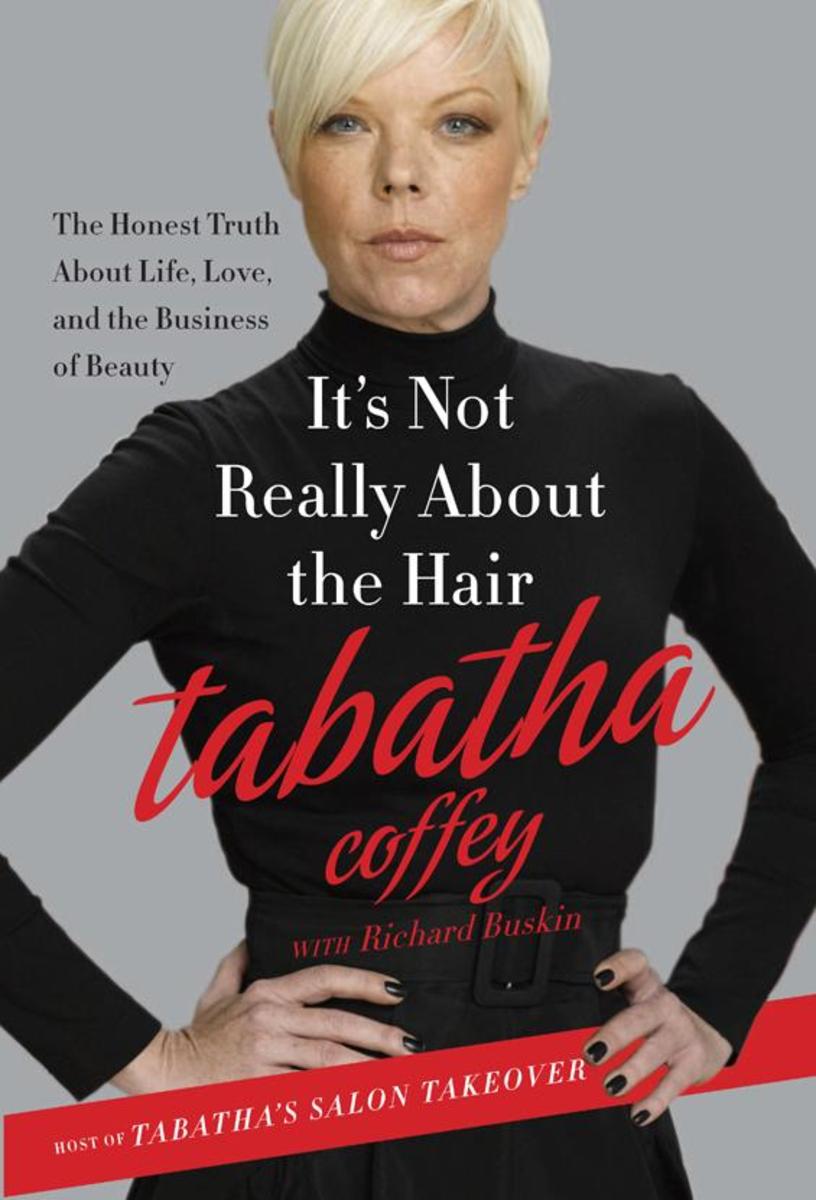
It's Not Really About the Hair
¥83.03
Fans of the hit Bravo show Tabatha's Salon Takeover tune in for the straight-shooting, unvarnished commentary of its ballsy, stylish, and savvy star. Though millions admire Tabatha Coffey's unflinching honesty and never-say-die attitude, some do not and have even taken to name-calling. Refusing to let others define her, she has reclaimed the word "bitch," transforming it to fit the person she is: Brave, Intelligent, Tenacious, Creative, and Honest. In It's Not Really About the Hair, this deeply private woman shares the experiences of her own life to encourage you to get in touch with your own inner bitch. Tabatha reveals how she used her strength and openness to help define her signature look, personal relationships, life choices, and tenacious work ethic—one that in her own words likens her to "a pit bull with a bone." Here are the people and the circumstances that have led her to a place of honesty, self-assurance, satisfaction, and success—from her tough-minded mum to her famous mentors, her peers, and clients. Part memoir, part business manual, and part coaching guide on achieving self-acceptance and love, It's Not Really About the Hair teaches you that it's all right to be who you are, stand up for what you believe in, and do what makes you happy without being defined by others. Tabatha Coffey's raw, funny, shocking, and always inspirational story will encourage you to celebrate the long-lasting and most important beauty of all—the true beauty that is you.

The Epidemic
¥84.16
A call for parents to take responsibility for their children and give them what they truly need in order to grow, thrive, and love.Take a good look around you: you can't go into stores or restaurants without seeing joyless children screaming and sulking while their parents ignore them. According to esteemed child psychiatrist Robert Shaw, this epidemic has become so much the norm that we often don't recognize its warning signs. This bold and timely book tells you how to save your child and your family with a commonsense approach that cuts to the core of the problem and shows us the cure. The Epidemic covers: Developing your child's ability to love Managing child care and minimizing the damage Raising cooperative, joyful, and creative children Promoting self-esteem and confidence rather than self-centeredness Avoiding the harmful effects of electronic media Healing angry, contemptuous, withdrawn, and out-of-control children
The Rabbi and the Hit Man
¥94.10
A fascinating true-crime narrative about the first rabbi ever accused of murder and what the case says about the role of clergy in America.On the evening of November 1, 1994, Rabbi Fred Neulander returned home to find his wife, Carol, facedown on the living room floor, blood everywhere. He called for help, but it was too late. Two trials and eight years later, the founder of the largest reform synagogue in southern New Jersey became the first rabbi ever convicted of murder and sentenced to life in prison.In a gripping examination of the misuses of the pulpit and the self-delusions of power, Arthur J. Magida paints a devastating portrait of a manipulative man who used his position of trust in the temple to attract several mistresses -- and to befriend a lonely recovering alcoholic, whom he convinced to kill his wife "for the good of Israel."The Rabbi and the Hit Man straddles the juncture of faith and trust, and confronts issues of sex, narcissism, arrogance, and adultery. It is the definitive account of a charismatic clergyman who paid the ultimate price for ignoring his own words of wisdom: "We live at any moment with our total past ... What we do will stay with us forever."

Happiness on $10 a Day
¥56.15
Money might buy happiness . . . but what if you're on a budget?Forget the $300 therapy bills, the 197 secrets of happy people, the 18 steps to contentment. Happiness on $10 a Day is all you need to rediscover your joie de vivre without breaking the bank. Whether you're into schadenfreude, mooching, or just good old-fashioned fun, this wallet-friendly guidebook offers dozens of contentment-inducing activities. Along the way, handy icons help you find the right activity for your mood and finances.Feeling dramaticTry harassing a telemarketer.Craving cute animalsStalk a puppy.Need a party themeThrow a celebrity sex tape screening.Totally brokeTime for a pub crawl pyramid scheme!Free!Winter or summer, city or country, alone or with friends, you don't need a trust fund to find delight in daily life. If you've got a sense of adventure, a love of mischief, and $10 to buy this book, what are you waiting for?


