


 购物车
购物车 个人中心
个人中心
Rujub the Juggler
¥8.09
Historical novel set in British India in the 19th century. The Introduction begins: ""Rujub, the Juggler," is mainly an historical tale for young and old, dealing with the Sepoy Mutiny, in India, during the years 1857 to 1859. This famous mutiny occurred while the reins of British rule in India were in the hands of Lord Canning. Chupattees (cakes of flour and water) were circulated among the natives, placards protesting against British rule were posted at Delhi, and when the Enfield rifle with its greased cartridges was introduced among the Sepoy soldiers serving the Queen it was rumored that the cartridges were smeared with the forbidden pig's fat, so that the power of the Sepoys might forever be destroyed." According to Wikipedia: "George Alfred Henty (8 December 1832 - 16 November 1902), referred to as G. A. Henty, was a prolific English novelist, special correspondent, and Imperialist born in Trumpington, Cambridgeshire, England. He is best known for his historical adventure stories that were popular in the late 19th century. His works include Out on the Pampas (1871), The Young Buglers (1880), With Clive in India (1884) and Wulf the Saxon (1895)."
With Wolfe in Canada
¥8.09
Historical novel set in Canada during the French and Indian War. The Preface begins: "In the present volume I have endeavoured to give the details of the principal events in a struggle whose importance can hardly be overrated. At its commencement the English occupied a mere patch of land on the eastern seaboard of America, hemmed in on all sides by the French, who occupied not only Canada in the north and Louisiana in the south, but possessed a chain of posts connecting them, so cutting off the English from all access to the vast countries of the west." According to Wikipedia: "George Alfred Henty (8 December 1832 - 16 November 1902), referred to as G. A. Henty, was a prolific English novelist, special correspondent, and Imperialist born in Trumpington, Cambridgeshire, England. He is best known for his historical adventure stories that were popular in the late 19th century. His works include Out on the Pampas (1871), The Young Buglers (1880), With Clive in India (1884) and Wulf the Saxon (1895)."
With Clive in India
¥8.09
Historical novel set in India in the 18th century. The Preface begins: " In the following pages I have endeavoured to give a vivid picture of the wonderful events of the ten years, which at their commencement saw Madras in the hands of the French--Calcutta at the mercy of the Nabob of Bengal--and English influence apparently at the point of extinction in India--and which ended in the final triumph of the English, both in Bengal and Madras. There were yet great battles to be fought, great efforts to be made, before the vast Empire of India fell altogether into British hands; but these were but the sequel of the events I have described." According to Wikipedia: "George Alfred Henty (8 December 1832 - 16 November 1902), referred to as G. A. Henty, was a prolific English novelist, special correspondent, and Imperialist born in Trumpington, Cambridgeshire, England. He is best known for his historical adventure stories that were popular in the late 19th century. His works include Out on the Pampas (1871), The Young Buglers (1880), With Clive in India (1884) and Wulf the Saxon (1895)."
Thankful Blossom
¥8.09
Historical novel set in New Jersey during the American Revolution. According to Wikipedia: "Bret Harte (August 25, 1836[2] – May 6, 1902) was an American author and poet, best remembered for his accounts of pioneering life in California. He was born in Albany, New York. ... He moved to California in 1853, later working there in a number of capacities, including miner, teacher, messenger, and journalist. He spent part of his life in the northern California coast town now known as Arcata, then just a mining camp on Humboldt Bay. His first literary efforts, including poetry and prose, appeared in The Californian, an early literary journal edited by Charles Henry Webb. In 1868 he became editor of The Overland Monthly, another new literary magazine, but this one more in tune with the pioneering spirit of excitement in California. His story, "The Luck of Roaring Camp," appeared in the magazine's second edition, propelling Harte to nationwide fame... Determined to pursue his literary career, in 1871 he and his family traveled back East, to New York and eventually to Boston, where he contracted with the publisher of The Atlantic Monthly for an annual salary of $10,000, "an unprecedented sum at the time." His popularity waned, however, and by the end of 1872 he was without a publishing contract and increasingly desperate. He spent the next few years struggling to publish new work (or republish old), delivering lectures about the gold rush, and even selling an advertising jingle to a soap company. In 1878 Harte was appointed to the position of United States Consul in the town of Krefeld, Germany and then to Glasgow in 1880. In 1885 he settled in London. During the thirty years he spent in Europe, he never abandoned writing, and maintained a prodigious output of stories that retained the freshness of his earlier work. He died in England in 1902 of throat cancer and is buried at Frimley."
The Corsican Brothers
¥8.09
Historical novel set on the island of Corsica. The translator notes in the Preface: "The story of "The Corsican Brothers" is written in an easy, sketchy style, presenting on the one side an interesting picture of the habits, prejudices and superstitions of the Corsicans, and particularly of the "Vendetta," or war of vengeance, carried on between families and connections, sometimes for several generations; while, on the other, it gives a lively outline of the effects of Parisian life upon a sensitive and unsophisticated nature." According to Wikipedia: "Alexandre Dumas, père (French for "father", akin to 'Senior' in English), born Dumas Davy de la Pailleterie (1802 — 1870) was a French writer, best known for his numerous historical novels of high adventure which have made him one of the most widely read French authors in the world. Many of his novels, including The Count of Monte Cristo, The Three Musketeers, Twenty Years After, and The Vicomte de Bragelonne were serialized. He also wrote plays and magazine articles and was a prolific correspondent.
Richard I
¥8.09
According to Wikipedia: "Richard I (8 September 1157 – 6 April 1199) was King of England from 6 July 1189 until his death. He also ruled as Duke of Normandy, Duke of Aquitaine, Duke of Gascony, Lord of Ireland, Lord of Cyprus, Count of Anjou, Count of Maine, Count of Nantes, and Overlord of Brittany at various times during the same period. He was known as C?ur de Lion, or Richard the Lionheart, even before his accession, because of his reputation as a great military leader and warrior.[1] The Saracens called him Melek-Ric or Malek al-Inkitar - King of England. By age 16, Richard was commanding his own army, putting down rebellions in Poitou against his father, King Henry II.[1] Richard was a central Christian commander during the Third Crusade, effectively leading the campaign after the departure of Philip Augustus and scoring considerable victories against his Muslim counterpart, Saladin, but was unable to reconquer Jerusalem. Although only speaking French and spending very little time in England (he lived in his Duchy of Aquitaine, in the southwest of France, preferring to use his kingdom as a source of revenue to support his armies), he was seen as a pious hero by his subjects. He remains one of the very few Kings of England remembered by his epithet, rather than regnal number, and is an enduring, iconic figure in England."
Ivanhoe
¥8.09
Historical novel, first published in 1819. Set in Yorkshire and Leicestershire, England, in 1194. According to Wikipedia: "Sir Walter Scott, 1st Baronet (1771 – 1832) was a prolific Scottish historical novelist and poet popular throughout Europe during his time. In some ways Scott was the first English-language author to have a truly international career in his lifetime, with many contemporary readers all over Europe, Australia, and North America. His novels and poetry are still read, and many of his works remain classics of both English-language literature and of Scottish literature. Famous titles include Ivanhoe, Rob Roy, The Lady of The Lake, Waverley, The Heart of Midlothian and The Bride of Lammermoor."
Peter the Great
¥8.09
According to Wikipedia: "Peter I the Great or Pyotr Alexeyevich Romanov (9 June [O.S. 30 May] 1672 – 8 February 1725) ruled Russia and later the Russian Empire from 7 May 1682 until his death, jointly ruling before 1696 with his weak and sickly half-brother, Ivan V. He carried out a policy of modernization and expansion that transformed the Tsardom of Russia into a 3-billion acre Russian Empire, a major European power."
The Talisman
¥8.09
Historical novel, first published in 1825. Set during the Crusades, in Syria in 1191. According to Wikipedia: "Sir Walter Scott, 1st Baronet (1771 – 1832) was a prolific Scottish historical novelist and poet popular throughout Europe during his time. In some ways Scott was the first English-language author to have a truly international career in his lifetime, with many contemporary readers all over Europe, Australia, and North America. His novels and poetry are still read, and many of his works remain classics of both English-language literature and of Scottish literature. Famous titles include Ivanhoe, Rob Roy, The Lady of The Lake, Waverley, The Heart of Midlothian and The Bride of Lammermoor."
Quentin Durward
¥8.09
Historical novel, originally published in 1823. Set in France and Belgium in 1468. According to Wikipedia: "Sir Walter Scott, 1st Baronet (1771 – 1832) was a prolific Scottish historical novelist and poet popular throughout Europe during his time. In some ways Scott was the first English-language author to have a truly international career in his lifetime, with many contemporary readers all over Europe, Australia, and North America. His novels and poetry are still read, and many of his works remain classics of both English-language literature and of Scottish literature. Famous titles include Ivanhoe, Rob Roy, The Lady of The Lake, Waverley, The Heart of Midlothian and The Bride of Lammermoor.
St. Ronan's Well
¥8.09
Historical novel, originally published in 1824. Set in southern Scotland in the 1800s. According to Wikipedia: "Sir Walter Scott, 1st Baronet (1771 – 1832) was a prolific Scottish historical novelist and poet popular throughout Europe during his time. In some ways Scott was the first English-language author to have a truly international career in his lifetime, with many contemporary readers all over Europe, Australia, and North America. His novels and poetry are still read, and many of his works remain classics of both English-language literature and of Scottish literature. Famous titles include Ivanhoe, Rob Roy, The Lady of The Lake, Waverley, The Heart of Midlothian and The Bride of Lammermoor."
One of the 28th
¥8.09
Historical novel, set at the Battle of Waterloo in 1815. The Preface begins: "Although in the present story a boy plays the principal part, and encounters many adventures by land and sea, a woman is the real heroine, and the part she played demanded an amount of nerve and courage fully equal to that necessary for those who take part in active warfare. Boys are rather apt to think, mistakenly, that their sex has a monopoly of courage, but I believe that in moments of great peril women are to the full as brave and as collected as men. Indeed, my own somewhat extensive experience leads me to go even further, and to assert that among a civil population, untrained to arms, the average woman is cooler and more courageous than the average man." According to Wikipedia: "George Alfred Henty (8 December 1832 - 16 November 1902), referred to as G. A. Henty, was a prolific English novelist, special correspondent, and Imperialist born in Trumpington, Cambridgeshire, England. He is best known for his historical adventure stories that were popular in the late 19th century. His works include Out on the Pampas (1871), The Young Buglers (1880), With Clive in India (1884) and Wulf the Saxon (1895)."
The Fugitive
¥8.09
Poetry. According to Wikipedia: "Rabindranath Tagore (7 May 1861 – 7 August 1941), sobriquet Gurudev, was a Bengali poet, novelist, musician, painter and playwright who reshaped Bengali literature and music. As author of Gitanjali and its "profoundly sensitive, fresh and beautiful verse", he was the first non-European who was awarded the Nobel Prize for Literature in 1913. His poetry in translation was viewed as spiritual, and this together with his mesmerizing persona gave him a prophet-like aura in the west. His "elegant prose and magical poetry" still remain largely unknown outside the confines of Bengal."
The Hungry Stones and Other Stories
¥8.09
Collection of short stories. According to Wikipedia: "Rabindranath Tagore (7 May 1861 – 7 August 1941), sobriquet Gurudev, was a Bengali poet, novelist, musician, painter and playwright who reshaped Bengali literature and music. As author of Gitanjali and its "profoundly sensitive, fresh and beautiful verse", he was the first non-European who was awarded the Nobel Prize for Literature in 1913. His poetry in translation was viewed as spiritual, and this together with his mesmerizing persona gave him a prophet-like aura in the west. His "elegant prose and magical poetry" still remain largely unknown outside the confines of Bengal."
Winning His Spurs
¥8.09
Historical novel, set in the Holy Land during the Crusades, in the time of King Richard I of England. According to Wikipedia: "George Alfred Henty (8 December 1832 - 16 November 1902), referred to as G. A. Henty, was a prolific English novelist, special correspondent, and Imperialist born in Trumpington, Cambridgeshire, England. He is best known for his historical adventure stories that were popular in the late 19th century. His works include Out on the Pampas (1871), The Young Buglers (1880), With Clive in India (1884) and Wulf the Saxon (1895)."
By Sheer Pluck
¥8.09
Historical novel, set in West Africa, during a 19th century colonial war. According to Wikipedia: "George Alfred Henty (8 December 1832 - 16 November 1902), referred to as G. A. Henty, was a prolific English novelist, special correspondent, and Imperialist born in Trumpington, Cambridgeshire, England. He is best known for his historical adventure stories that were popular in the late 19th century. His works include Out on the Pampas (1871), The Young Buglers (1880), With Clive in India (1884) and Wulf the Saxon (1895)"
The Spirit of the Border, A Romance of the Early Settlers of the Ohio Valley. Se
¥8.09
Historical novel, set soon after the American Revolution. Sequel to Betty Zane. According to Wikipedia: "Zane Grey (1872 – 1939) was an American author best known for his popular adventure novels and stories that presented an idealized image of the rugged Old West. As of June 2007, the Internet Movie Database credits Grey with 110 films, one TV episode, and a series, Dick Powell's Zane Grey Theater based loosely on his novels and short stories."
A Negro Explorer at the North Pole
¥8.09
According to the Foreword: "Friends of Arctic exploration and discovery, with whom I have come in contact, and many whom I know only by letter, have been greatly interested in the fact of a colored man being an effective member of a serious Arctic expedition, and going north, not once, but numerous times during a period of over twenty years, in a way that showed that he not only could and did endure all the stress of Arctic conditions and work, but that he evidently found pleasure in the work. The example and experience of Matthew Henson, who has been a member of each and of all my Arctic expeditions, since '91 (my trip in 1886 was taken before I knew Henson) is only another one of the multiplying illustrations of the fact that race, or color, or bringing-up, or environment, count nothing against a determined heart, if it is backed and aided by intelligence. Henson proved his fitness by long and thorough apprenticeship, and his participation in the final victory which planted the Stars and Stripes at the North Pole, and won for this country the international prize of nearly four centuries, is a distinct credit and feather in the cap of his race." First published in 1912.
A Century of Negro Migration
¥8.09
First published in 1918. According to the Preface: "In treating this movement of the Negroes, the writer does not presume to say the last word on the subject. The exodus of the Negroes from the South has just begun. The blacks have recently realized that they have freedom of body and they will now proceed to exercise that right. To presume, therefore, to exhaust the treatment of this movement in its incipiency is far from the intention of the writer. The aim here is rather to direct attention to this new phase of Negro American life which will doubtless prove to be the most significant event in our local history since the Civil War."
What a Young Husband Ought to Know
¥8.09
Practical advice on marital relations and sex, first published in 1897. The Preface explains: "In approaching the work which we have undertaken in these pages, we have not been blind to the difficulties which confront us in entering upon so delicate a subject. If we had thought only of these, we would never have taken up our pen in this work. We have been moved to it by the cries of disappointment and anguish which may be heard everywhere throughout our land, and by the pleadings that come up out of the dense ignorance which envelops palace and hovel alike. Knowing the importance of these "matters which are so central in our physical life, so essential in their relation to the condition, character, career and destiny of every individual, and so fundamental and vital to every institution and interest of society;" knowing also the importance of proper intelligence concerning the laws which govern our bodies, and knowing how the honest and the pure who seek information concerning these most sacred relations of human life are exposed, amid the dearth of pure and reliable books, to contamination by books whose secret character designedly fosters the very lusts and evils which they are professedly written to denounce, we have felt that we would be recreant to duty, to humanity and to God if we allowed difficulties to bar us from this important work."
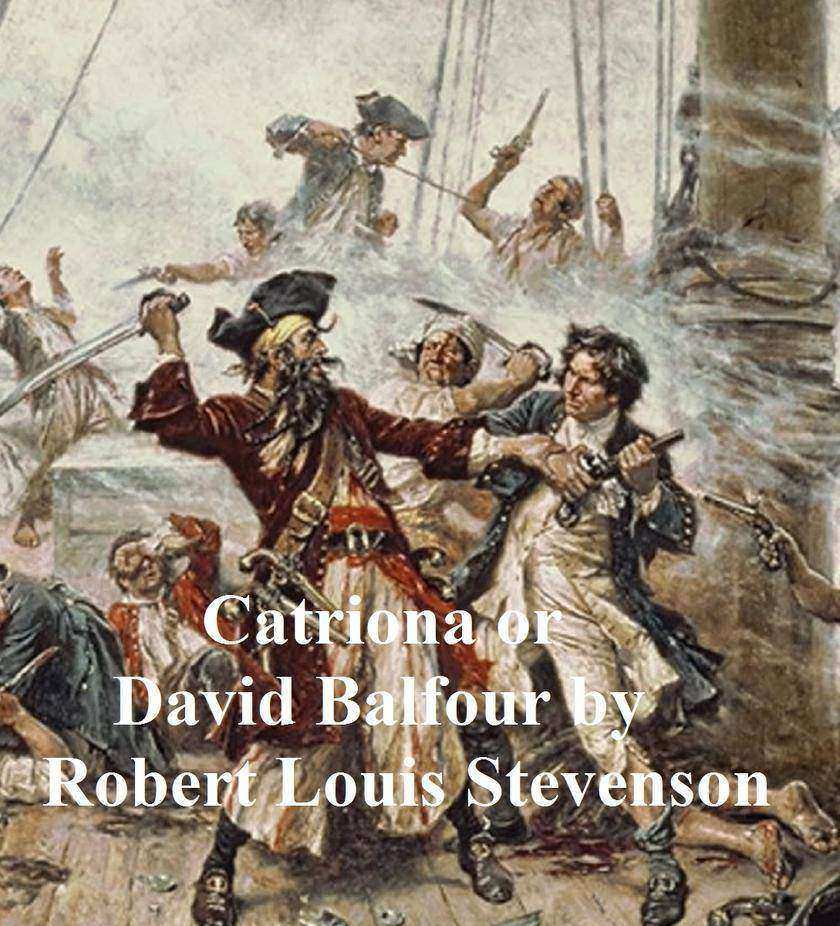
Catriona or David Balfour
¥8.09
Historical novel. According to the Dedication: "It is the fate of sequels to disappoint those who have waited for them; and my David, having been left to kick his heels for more than a lustre in the British Linen Company's office, must expect his late reappearance to be greeted with hoots, if not with missiles. Yet, when I remember the days of our explorations, I am not without hope. There should be left in our native city some seed of the elect; some long-legged, hot-headed youth must repeat to-day our dreams and wanderings of so many years ago; he will relish the pleasure, which should have been ours, to follow among named streets and numbered houses the country walks of David Balfour, to identify Dean, and Silvermills, and Broughton, and Hope Park, and Pilrig, and poor old Lochend - if it still be standing, and the Figgate Whins - if there be any of them left; or to push (on a long holiday) so far afield as Gillane or the Bass..." According to Wikipedia: "Robert Louis Balfour Stevenson (13 November 1850–3 December 1894), was a Scottish novelist, poet, essayist and travel writer. He was the man who "seemed to pick the right word up on the point of his pen, like a man playing spillikins", as G. K. Chesterton put it."


