


 购物车
购物车 个人中心
个人中心
Beyond the City
¥8.09
According to Wikipedia: "Beyond the City (1892) is a novel by Scottish author Sir Arthur Conan Doyle… Sir Arthur Ignatius Conan Doyle (22 May 1859 – 7 July 1930) was a Scottish physician and writer who is most noted for his fictional stories about the detective Sherlock Holmes, which are generally considered milestones in the field of crime fiction. He is also known for writing the fictional adventures of a second character he invented, Professor Challenger, and for popularising the mystery of the Mary Celeste. He was a prolific writer whose other works include fantasy and science fiction stories, plays, romances, poetry, non-fiction, and historical novels."
Fathers of Men
¥8.09
First published in 1912. According to Wikipedia: "Ernest William Hornung (7 June 1866 – 22 March 1921) was an English author and poet perhaps best known for writing the A. J. Raffles series of stories about a gentleman thief in late 19th-century London. Hornung was educated at Uppingham School; as a result of poor health he left the school in December 1883 to travel to Sydney, where he stayed for two years. He drew on his Australian experiences as a background when he began writing, initially short stories and later novels... Although much of Hornung's work has fallen into obscurity, his Raffles stories continued to be popular, and have formed numerous film and television adaptations. Hornung's stories dealt with a wider range of themes than crime: he examined scientific and medical developments, guilt, class and the unequal role played by women in society. Above all there are two threads that run through a sizeable proportion of his books: Australia and cricket, the latter was also a lifelong passion."
Lives of the Necromancers
¥8.09
Book on magic and magicians by the father of Mary Shelley, who was the author of Frankenstein. First published in 1834. According to the Preface: " The main purpose of this book is to exhibit a fair delineation of the credulity of the human mind. Such an exhibition cannot fail to be productive of the most salutary lessons. One view of the subject will teach us a useful pride in the abundance of our faculties. Without pride man is in reality of little value. It is pride that stimulates us to all our great undertakings. Without pride, and the secret persuasion of extraordinary talents, what man would take up the pen with a view to produce an important work, whether of imagination and poetry, or of profound science, or of acute and subtle reasoning and intellectual anatomy? It is pride in this sense that makes the great general and the consummate legislator, that animates us to tasks the most laborious, and causes us to shrink from no difficulty, and to be confounded and overwhelmed with no obstacle that can be interposed in our path." According to Wikipedia: "William Godwin (3 March 1756 – 7 April 1836) was an English journalist, political philosopher and novelist. He is considered one of the first exponents of utilitarianism, and the first modern proponent of anarchism."
Some Persons Unknown
¥8.09
First published in 1898. Collection of stories by the classic mystery writer. The stories include: "KENYON'S INNINGS, A LITERARY COINCIDENCE, "AUTHOR! AUTHOR!" THE WIDOW OF PIPER'S POINT, AFTER THE FACT, THE MAGIC CIGAR, THE GOVERNESS AT GREENBUSH, A FAREWELL PERFORMANCE, A SPIN OF THE COIN, THE STAR OF THE GRASMERE. According to Wikipedia: "Ernest William Hornung (7 June 1866 – 22 March 1921) was an English author and poet known for writing the A. J. Raffles series of stories about a gentleman thief in late 19th-century London. Hornung was educated at Uppingham School; as a result of poor health he left the school in December 1883 to travel to Sydney, where he stayed for two years. He drew on his Australian experiences as a background when he began writing, initially short stories and later novels. In 1898 he wrote "In the Chains of Crime", which introduced Raffles and his sidekick, Bunny Manders; the characters were based partly on his friends Oscar Wilde and his lover, Lord Alfred Douglas, and also on Sherlock Holmes and Dr. Watson. The series of Raffles short stories were collected for sale in book form in 1899, and two further books of Raffles short stories followed, as well as a poorly received novel. Aside from his Raffles stories, Hornung was a prodigious writer of fiction, publishing numerous books from 1890, with A Bride from the Bush to his 1914 novel The Crime Doctor."
The Bride of the Sun
¥8.09
According to Wikipedia: "Gaston Louis Alfred Leroux (6 May 1868, Paris, France – 15 April 1927) was a French journalist and author of detective fiction. In the English-speaking world, he is best known for writing the novel The Phantom of the Opera (Le Fant?me de l'Opéra, 1910), which has been made into several film and stage productions of the same name, such as the 1925 film starring Lon Chaney; and Andrew Lloyd Webber's 1986 musical. It was also the basis of the 1990 novel Phantom by Susan Kay... He suddenly left journalism in 1907, and began writing fiction. In 1909, he and Arthur Bernède formed their own film company, Société des Cinéromans to simultaneously publish novels and turn them into films. He first wrote a mystery novel entitled Le mystère de la chambre jaune (1908; The Mystery of the Yellow Room), starring the amateur detective Joseph Rouletabille. Leroux's contribution to French detective fiction is considered a parallel to Sir Arthur Conan Doyle's in the United Kingdom and Edgar Allan Poe's in America."
The Holly Tree -- Three Branches, a short story
¥8.09
Classic short story. According to Wikipedia: "Charles John Huffam Dickens, (1812 - 1870), pen-name "Boz", was the foremost English novelist of the Victorian era, as well as a vigorous social campaigner. Considered one of the English language's greatest writers, he was acclaimed for his rich storytelling and memorable characters, and achieved massive worldwide popularity in his lifetime. Later critics, beginning with George Gissing and G. K. Chesterton, championed his mastery of prose, his endless invention of unique, clever personalities and his powerful social sensibilities, but fellow writers such as George Henry Lewes, Henry James and Virginia Woolf fault his work for sentimentality, implausible occurrence and grotesque characters. The popularity of Dickens' novels and short stories has meant that not one has ever gone out of print. Dickens wrote serialised novels, the usual format for fiction at the time, and each new part of his stories was eagerly anticipated by the reading public."
The Tyranny of the Dark
¥8.09
Classic western novel. According to Wikipedia: "Hamlin Hannibal Garland (September 14, 1860 – March 4, 1940) was an American novelist, poet, essayist, and short story writer. He is best known for his fiction involving hard-working Midwestern farmers."
The Swiss Family Robinson
¥8.09
With 9 color illustrations. "Or Adventures on a Desert Island." According to Wikipedia: "The Swiss Family Robinson (German: Der Schweizerische Robinson) is a novel by Johann David Wyss, first published in 1812, about a Swiss family shipwrecked in the East Indies en route to Port Jackson, Australia... Johann David Wyss (March 4, 1743 - January 11, 1818) is best remembered for his book The Swiss Family Robinson. It is said that he was inspired by Defoe's Robinson Crusoe, but wanted to write a story from which his own children would learn, as the father in the story taught important lessons to his children. The Swiss Family Robinson was first published in 1812 and translated into English two years later. It has since become one of the most popular books of all time."
The Flying-U's Last Stand
¥8.09
Classic western. " An amusing account of Chip and the other boys opposing a party of school teachers." According to Wikipedia: "Bertha Muzzy Sinclair or Sinclair-Cowan, née Muzzy (November 15, 1871 – July 23, 1940), best known by her pseudonym B. M. Bower, was an American novelist who wrote fictional stories about the American Old West. Born Bertha Muzzy in Cleveland, Minnesota, she was married three times: to Clayton Bower, in 1890; to Bertrand W. Sinclair, in 1912; and to Robert Elsworth Cowan, in 1921. She wrote 57 Western novels, several of which were turned into films."

Good Indian
¥8.09
Classic western. "A stirring romance of life on an Idaho ranch." According to Wikipedia: "Bertha Muzzy Sinclair or Sinclair-Cowan, née Muzzy (November 15, 1871 – July 23, 1940), best known by her pseudonym B. M. Bower, was an American novelist who wrote fictional stories about the American Old West. She wrote 57 Western novels, several of which were turned into films."
A Knight of the Cumberland
¥8.09
Classic western. According to Wikipedia: "Born in Stony Point, Kentucky to John William Fox, Sr., and Minerva Worth Carr, Fox studied English at Harvard University. He graduated in 1883 before becoming a reporter in New York City. After working for both New York Times and the New York Sun, he published a successful serialization of his first novel, A Mountain Europa, in Century magazine in 1892. Two moderately successful short story collections followed, as well as his first conventional novel, The Kentuckians in 1898. Fox gained a following as a war correspondent, working for Harper's Weekly in Cuba during the Spanish-American War of 1898, where he served with the "Rough Riders." Six years later he traveled to Asia to report on the Russo-Japanese War for Scribner's magazine. Though he occasionally wrote for periodicals, after 1904, Fox dedicated much of his attention to fiction. The Little Shepherd of Kingdom Come (published in 1903) and The Trail of the Lonesome Pine (published in 1908) are arguably his most well known and successful works, entering the New York Times top ten list of bestselling novels for 1903, 1904, 1908, and 1909 respectively. Many of his works reflected the naturalist style, his childhood in Kentucky's Bluegrass region, and his life among the coal miners of Big Stone Gap, Virginia. Many of his novels were historical romances or period dramas set in that region."
Penrod and Sam
¥8.09
According to Wikipedia: "Newton Booth Tarkington (July 29, 1869, Indianapolis – May 19, 1946) was an American novelist and dramatist best known for his Pulitzer Prize-winning novels The Magnificent Ambersons and Alice Adams…. Much of Tarkington's work consists of satirical and closely observed studies of the American class system and its foibles. He himself came from a patrician family that came down in the world after the Panic of 1873. Today he is best known for his novel The Magnificent Ambersons, which Orson Welles filmed in 1942. It is included in the Modern Library's list of top-100 novels."
Seventeen
¥8.09
According to Wikipedia: "Newton Booth Tarkington (July 29, 1869, Indianapolis – May 19, 1946) was an American novelist and dramatist best known for his Pulitzer Prize-winning novels The Magnificent Ambersons and Alice Adams…. Much of Tarkington's work consists of satirical and closely observed studies of the American class system and its foibles. He himself came from a patrician family that came down in the world after the Panic of 1873. Today he is best known for his novel The Magnificent Ambersons, which Orson Welles filmed in 1942. It is included in the Modern Library's list of top-100 novels."
Heart of the West
¥8.09
According to Wikipedia: "O. Henry was the pen name of American writer William Sydney Porter (September 11, 1862 – June 5, 1910). O. Henry short stories are known for wit, wordplay, warm characterization and clever twist endings…. Most of O. Henry's stories are set in his own time, the early years of the 20th century. Many take place in New York City, and deal for the most part with ordinary people: clerks, policemen, waitresses. Fundamentally a product of his time, O. Henry's work provides one of the best English examples of catching the entire flavor of an age. Whether roaming the cattle-lands of Texas, exploring the art of the "gentle grafter," or investigating the tensions of class and wealth in turn-of-the-century New York, O. Henry had an inimitable hand for isolating some element of society and describing it with an incredible economy and grace of language. Some of his best and least-known work resides in the collection Cabbages and Kings, a series of stories which each explore some individual aspect of life in a paralytically sleepy Central American town while each advancing some aspect of the larger plot and relating back one to another in a complex structure which slowly explicates its own background even as it painstakingly erects a town which is one of the most detailed literary creations of the period. The Four Million is another collection of stories. It opens with a reference to Ward McAllister's "assertion that there were only 'Four Hundred' people in New York City who were really worth noticing. But a wiser man has arisen—the census taker—and his larger estimate of human interest has been preferred in marking out the field of these little stories of the 'Four Million.'" To O. Henry, everyone in New York counted. He had an obvious affection for the city, which he called "Bagdad-on-the-Subway,"
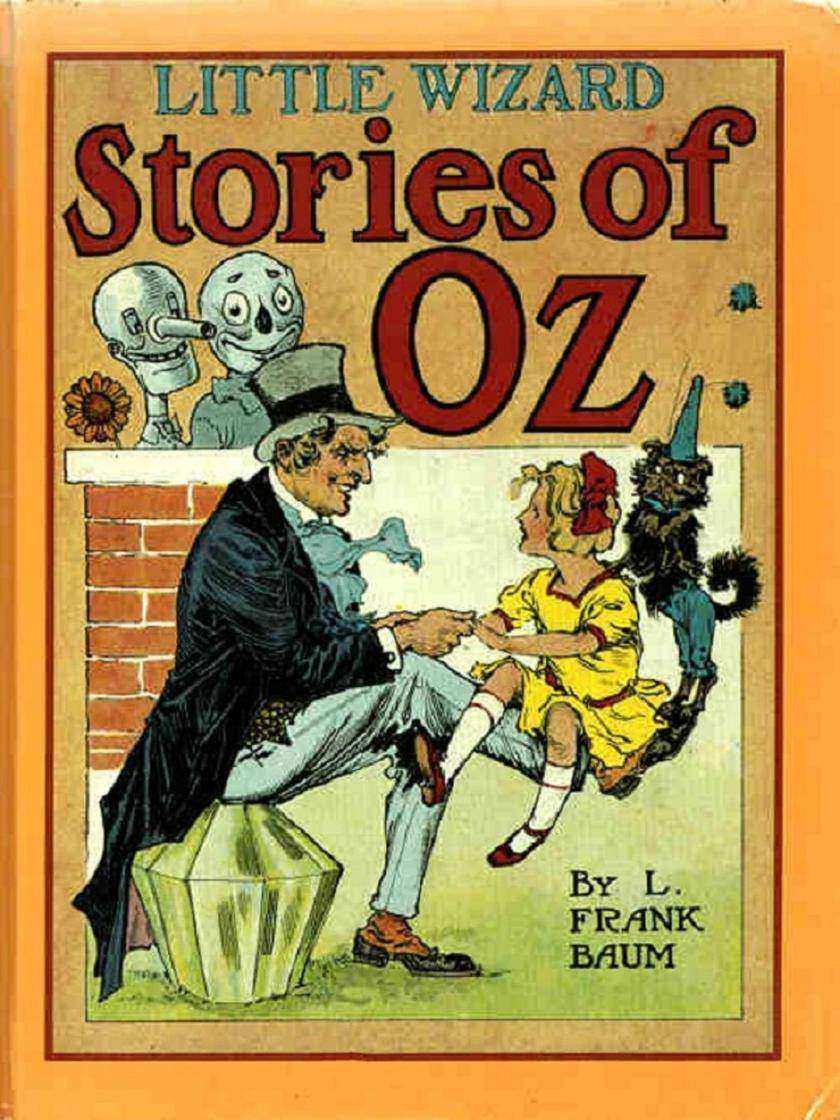
Little Wizard Stories of Oz
¥8.09
46 color illustrations. A short collection of short stories, including: The Cowardly Lion and the Hungry Tiger, Little Dorothy and Toto, Tiktok and the Nome King, Ozma and the Little Wizard, Jack Pumpkinhead and the Sawhorse, and The Scarecrow and the Tin Woodman. According to Wikipedia: "Little Wizard Stories of Oz is a set of six short stories written for young children by L. Frank Baum, the creator of the Oz books. The six tales were published in separate small booklets, "Oz books in miniature," in 1913, and then in a collected edition in 1914 with illustrations by John R. Neill.[1][2] Each booklet was 29 pages long, and printed in blue ink rather than black. The stories were part of a project, by Baum and his publisher Reilly & Britton, to revitalize and continue the series of Oz books that Baum had written up to that date. The story collection effectively constitutes a fifteenth Oz book by Baum
A Drift from Redwood Camp
¥8.09
Western short story. According to Wikipedia: "Bret Harte (August 25, 1836[2] – May 6, 1902) was an American author and poet, best remembered for his accounts of pioneering life in California. He was born in Albany, New York. ... He moved to California in 1853, later working there in a number of capacities, including miner, teacher, messenger, and journalist. He spent part of his life in the northern California coast town now known as Arcata, then just a mining camp on Humboldt Bay. His first literary efforts, including poetry and prose, appeared in The Californian, an early literary journal edited by Charles Henry Webb. In 1868 he became editor of The Overland Monthly, another new literary magazine, but this one more in tune with the pioneering spirit of excitement in California. His story, "The Luck of Roaring Camp," appeared in the magazine's second edition, propelling Harte to nationwide fame... Determined to pursue his literary career, in 1871 he and his family traveled back East, to New York and eventually to Boston, where he contracted with the publisher of The Atlantic Monthly for an annual salary of $10,000, "an unprecedented sum at the time." His popularity waned, however, and by the end of 1872 he was without a publishing contract and increasingly desperate. He spent the next few years struggling to publish new work (or republish old), delivering lectures about the gold rush, and even selling an advertising jingle to a soap company. In 1878 Harte was appointed to the position of United States Consul in the town of Krefeld, Germany and then to Glasgow in 1880. In 1885 he settled in London. During the thirty years he spent in Europe, he never abandoned writing, and maintained a prodigious output of stories that retained the freshness of his earlier work. He died in England in 1902 of throat cancer and is buried at Frimley."
Salomy Jane
¥8.09
Western short story. According to Wikipedia: "Bret Harte (August 25, 1836[2] – May 6, 1902) was an American author and poet, best remembered for his accounts of pioneering life in California. He was born in Albany, New York. ... He moved to California in 1853, later working there in a number of capacities, including miner, teacher, messenger, and journalist. He spent part of his life in the northern California coast town now known as Arcata, then just a mining camp on Humboldt Bay. His first literary efforts, including poetry and prose, appeared in The Californian, an early literary journal edited by Charles Henry Webb. In 1868 he became editor of The Overland Monthly, another new literary magazine, but this one more in tune with the pioneering spirit of excitement in California. His story, "The Luck of Roaring Camp," appeared in the magazine's second edition, propelling Harte to nationwide fame... Determined to pursue his literary career, in 1871 he and his family traveled back East, to New York and eventually to Boston, where he contracted with the publisher of The Atlantic Monthly for an annual salary of $10,000, "an unprecedented sum at the time." His popularity waned, however, and by the end of 1872 he was without a publishing contract and increasingly desperate. He spent the next few years struggling to publish new work (or republish old), delivering lectures about the gold rush, and even selling an advertising jingle to a soap company. In 1878 Harte was appointed to the position of United States Consul in the town of Krefeld, Germany and then to Glasgow in 1880. In 1885 he settled in London. During the thirty years he spent in Europe, he never abandoned writing, and maintained a prodigious output of stories that retained the freshness of his earlier work. He died in England in 1902 of throat cancer and is buried at Frimley."
L'Assomoir, in English
¥8.09
Zola's best-known novel, first published in 1877. According to Wikipedia: "Emile Zola (2 April 1840 - 29 September 1902) was an influential French writer, the most important example of the literary school of naturalism, and a major figure in the political liberalization of France...After his first major novel, Therese Raquin (1867), Zola started the long series called Les Rougon Macquart, about a family under the Second Empire... More than half of Zola's novels were part of this set of 20 collectively known as Les Rougon-Macquart. Unlike Balzac who in the midst of his literary career re synthetized his work into La Comedie Humaine, Zola from the outset at the age of 28 had thought of the complete layout of the series. Set in France's Second Empire, the series traces the "environmental" influences of violence, alcohol, and prostitution which became more prevalent during the second wave of the industrial revolution."

Aviation in Peace and War
¥8.09
First published in 1922, written by a major-general, former chief of the ir staff. The introduction begins: " Since the earliest communities of human beings first struggled for supremacy and protection, the principles of warfare have remained unchanged. New methods have been evolved and adopted with the progress of science, but no discovery, save perhaps that of gunpowder, has done so much in so short a time to revolutionize the conduct of war as aviation, the youngest, yet destined perhaps to be the most effective fighting-arm. Yet to-day we are only on the threshold of our knowledge, and, striking as was the impetus given to every branch of aeronautics during the four years of war, its future power can only dimly be seen."

Old-Fashioned Christmas in America, a Collection of Christmas Stories
¥8.09
Collection of classic Christmas stories. The Abbott's Ghost by Louisa May Alcott, Beasley's Christmas Party by Booth Tarkington, First Christmas in New England by Harriet Beecher Stowe, Christmas Every Day by William Dean Howells, Old Christmas by Washington Irving, Gift of the Magi by O. Henry, Christmas Even on Lonesome by John Fox, Jr.
Greenmantle
¥8.09
According to Wikipedia, "Greenmantle is the second of five novels by John Buchan featuring the character of Richard Hannay, first published in 1916 by Hodder & Stoughton, London. Hannay is called in to investigate rumours of an uprising in the Muslim world, and undertakes a perilous journey through enemy territory to meet up with his friend Sandy in Constantinople. Once there, he and his friends must thwart the Germans' plans to use religion to help them win the war, climaxing at the battle of Erzurum. It (Greenmantle) is one of two Hannay novels set during the First World War, the other being Mr Standfast (1919); Hannay's first and best-known adventure, The Thirty-Nine Steps (1915), is set in the period immediately preceding the war. John Buchan, 1st Baron Tweedsmuir (26 August 1875 – 11 February 1940) was a Scottish novelist and Unionist politician who served as Governor General of Canada. Buchan's 100 works include nearly thirty novels, seven collections of short stories and biographies of Sir Walter Scott, Caesar Augustus, and Oliver Cromwell. Buchan's most famous of his books were the spy thrillers (including) The 39 Steps (which was converted to a play as well as an Alfred Hitchcock movie starring Robert Donat as Richard Hannay, though with Buchan's story much altered.) The "last Buchan" (as Graham Greene entitled his appreciative review) was the 1941 novel Sick Heart River (American title: Mountain Meadow), in which a dying protagonist confronts in the Canadian wilderness the questions of the meaning of life. The insightful quotation "It's a great life, if you don't weaken" is famously attributed to Buchan, as is "No great cause is ever lost or won, The battle must always be renewed, And the creed must always be restated."


