


 购物车
购物车 个人中心
个人中心
Where There's a Will
¥8.09
According to Wikipedia: "Mary Roberts Rinehart (August 12, 1876-September 22, 1958) was a prolific author often called the American Agatha Christie.[1] She is considered the source of the phrase "The butler did it", although she did not actually use the phrase herself, and also considered to have invented the "Had-I-But-Known" school of mystery writing.... Rinehart wrote hundreds of short stories, poems, travelogues and special articles. Many of her books and plays, such as The Bat (1920) were adapted for movies, such as The Bat (1926), The Bat Whispers (1930), and The Bat (1959). While many of her books were best-sellers, critics were most appreciative of her murder mysteries. Rinehart, in The Circular Staircase (1908), is credited with inventing the "Had-I-But-Known" school of mystery writing. The Circular Staircase is a novel in which "a middle-aged spinster is persuaded by her niece and nephew to rent a country house for the summer. The house they choose belonged to a bank defaulter who had hidden stolen securities in the walls. The gentle, peace-loving trio is plunged into a series of crimes solved with the help of the aunt. This novel is credited with being the first in the "Had-I-But-Known" school."[3] The Had-I-But-Known mystery novel is one where the principal character (frequently female) does less than sensible things in connection with a crime which have the effect of prolonging the action of the novel. Ogden Nash parodied the school in his poem Don't Guess Let Me Tell You: "Sometimes the Had I But Known then what I know now I could have saved at least three lives by revealing to the Inspector the conversation I heard through that fortuitous hole in the floor." The phrase "The butler did it", which has become a cliché, came from Rinehart's novel The Door, in which the butler actually did do it, although that exact phrase does not actually appear in the work."

To the Last Man
¥8.09
Classic Western. According to Wikipedia: "Zane Grey (1872 – 1939) was an American author best known for his popular adventure novels and stories that presented an idealized image of the rugged Old West. As of June 2007, the Internet Movie Database credits Grey with 110 films, one TV episode, and a series, Dick Powell's Zane Grey Theater based loosely on his novels and short stories."
Beasley's Christmas Party
¥8.09
A long short story. According to Wikipedia: "Newton Booth Tarkington (July 29, 1869, Indianapolis – May 19, 1946) was an American novelist and dramatist best known for his Pulitzer Prize-winning novels The Magnificent Ambersons and Alice Adams…. Much of Tarkington's work consists of satirical and closely observed studies of the American class system and its foibles. He himself came from a patrician family that came down in the world after the Panic of 1873. Today he is best known for his novel The Magnificent Ambersons, which Orson Welles filmed in 1942. It is included in the Modern Library's list of top-100 novels."
The Magnificent Ambersons
¥8.09
According to Wikipedia: "Newton Booth Tarkington (July 29, 1869, Indianapolis – May 19, 1946) was an American novelist and dramatist best known for his Pulitzer Prize-winning novels The Magnificent Ambersons and Alice Adams…. Much of Tarkington's work consists of satirical and closely observed studies of the American class system and its foibles. He himself came from a patrician family that came down in the world after the Panic of 1873. Today he is best known for his novel The Magnificent Ambersons, which Orson Welles filmed in 1942. It is included in the Modern Library's list of top-100 novels."

The Cricket on the Hearth: A Fairy Tale of Home
¥8.09
Dodo Collections brings you another classic from Charles Dickens, ‘The Cricket on the Hearth: A Fairy Tale of Home.’ ? Dickens gave his first formal expression to his Christmas thoughts in his series of small books, the first of which was the famous "Christmas Carol." There followed four others: "The Chimes," "The Cricket on the Hearth," "The Battle of Life," and "The Haunted Man." The five are known today as the "Christmas Books." Of them all the "Carol" is the best known and loved, and "The Cricket on the Hearth," although third in the series, is perhaps next in popularity, and is especially familiar to Americans through Joseph Jefferson's characterisation of Caleb Plummer. ? The title creature is a sort of barometer of life at the home of John Peerybingle and his much younger wife Dot. When things go well, the cricket on the hearth chirps; it is silent when there is sorrow. Tackleton, a jealous old man, poisons John's mind about Dot, but the cricket through its supernatural powers restores John's confidence and all ends happily. ? Charles Dickens was an English writer and social critic. He created some of the world's best-known fictional characters and is regarded as the greatest novelist of the Victorian era. His works enjoyed unprecedented popularity during his lifetime, and by the twentieth century critics and scholars had recognised him as a literary genius. His novels and short stories enjoy lasting popularity. Born in Portsmouth, Dickens left school to work in a factory when his father was incarcerated in a debtors' prison. Despite his lack of formal education, he edited a weekly journal for 20 years, wrote 15 novels, five novellas, hundreds of short stories and non-fiction articles, lectured and performed extensively, was an indefatigable letter writer, and campaigned vigorously for children's rights, education, and other social reforms. ? A prolific 19th Century author of short stories, plays, novellas, novels, fiction and non-fiction; during his lifetime Dickens became known the world over for his remarkable characters, his mastery of prose in the telling of their lives, and his depictions of the social classes, morals and values of his times. Some considered him the spokesman for the poor, for he definitely brought much awareness to their plight, the downtrodden and the have-nots. He had his share of critics, like Virginia Woolf and Henry James, but also many admirers, even into the 21st Century.
Four Meetings
¥8.09
Dodo Classics brings you another classic from Henry James, ‘Four Meetings.’ My relative, as it proved, was not sufficiently restored to leave the place by the afternoon train; so that as the autumn dusk began to fall I found myself at liberty to call at the establishment named to me by my friends. I must confess that I had spent much of the interval in wondering what the disagreeable thing was that the less attractive of these had been telling the other. Henry James, OM, son of theologian Henry James Sr., brother of the philosopher and psychologist William James and diarist Alice James, was an American-born author, one of the founders and leaders of a school of realism in fiction. He spent much of his life in England and became a British subject shortly before his death. He is primarily known for a series of major novels in which he portrayed the encounter of America with Europe. His plots centered on personal relationships, the proper exercise of power in such relationships, and other moral questions. His method of writing from the point of view of a character within a tale allowed him to explore the phenomena of consciousness and perception, and his style in later works has been compared to impressionist painting. ? James insisted that writers in Great Britain and America should be allowed the greatest freedom possible in presenting their view of the world, as French authors were. His imaginative use of point of view, interior monologue and unreliable narrators in his own novels and tales brought a new depth and interest to realistic fiction, and foreshadowed the modernist work of the twentieth century. An extraordinarily productive writer, in addition to his voluminous works of fiction he published articles and books of travel writing, biography, autobiography, and criticism,and wrote plays, some of which were performed during his lifetime with moderate success. His theatrical work is thought to have profoundly influenced his later novels and tales.
The Altar of the Dead
¥8.09
Dodo Classics brings you another classic from Henry James, ‘The Altar of the Dead’. ? "The Altar of the Dead" is a short story by Henry James, first published in his collection Terminations in 1895. A fable of literally life and death significance, the story explores how the protagonist tries to keep the remembrance of his dead friends, to save them from being forgotten entirely in the rush of everyday events. He meets a woman who shares his ideals, only to find that the past places what seems to be an impassable barrier between them. Although James was not religious in any conventional sense, the story shows a deep spirituality in its treatment of mortality and the transcendent power of unselfish love. ? Henry James, OM (15 April 1843 – 28 February 1916) was an American writer who spent most of his writing career in Britain. He is regarded as one of the key figures of 19th-century literary realism. He was the son of Henry James, Sr. and the brother of philosopher and psychologist William James and diarist Alice James. ? He is best known for a number of novels showing Americans encountering Europe and Europeans. His method of writing from a character's point of view allowed him to explore issues related to consciousness and perception, and his style in later works has been compared to impressionist painting. His imaginative use of point of view, interior monologue and unreliable narrators brought a new depth to narrative fiction. ? James contributed significantly to literary criticism, particularly in his insistence that writers be allowed the greatest possible freedom in presenting their view of the world. James claimed that a text must first and foremost be realistic and contain a representation of life that is recognizable to its readers. Good novels, to James, show life in action and are, most importantly, interesting. In addition to his voluminous works of fiction he published articles and books of travel, biography, autobiography, and criticism, and wrote plays. James alternated between America and Europe for the first twenty years of his life; eventually he settled in England, becoming a British subject in 1915, one year before his death. James was nominated for the Nobel Prize in Literature in 1911, 1912, and 1916.
The House of the Dead or Prison Life in Siberia
¥8.09
Autobiographical novel, first published in 1861. According to Wikipedia: "The House of the Dead is a novel published in 1861 in the journal Vremya by Russian author Fyodor Dostoyevsky, which portrays the life of convicts in a Siberian prison camp. The novel has also been published under the titles Memoirs from the House of The Dead and Notes from the Dead House. The book is a loosely-knit collection of facts and events connected to life in a Siberian prison, organised by "theme" rather than as a continuous story. Dostoyevsky himself spent four years in exile in such a camp following his conviction for involvement in the Petrashevsky Circle. This experience allowed him to describe with great authenticity the conditions of prison life and the characters of the convicts."
Dubliners
¥8.09
According to Wikipedia: "Dubliners is a collection of 15 short stories by James Joyce, first published in 1914. The fifteen stories were meant to be a naturalistic depiction of the Irish middle class life in and around Dublin in the early years of the 20th century. The stories were written at the time when Irish nationalism was at its peak, and a search for a national identity and purpose was raging; at a crossroads of history and culture, Ireland was jolted by various converging ideas and influences. They centre on Joyce's idea of an epiphany: a moment where a character has a special moment of self-understanding or illumination. Many of the characters in Dubliners later appear in minor roles in Joyce's novel Ulysses. The initial stories in the collection are narrated by children as protagonists, and as the stories continue, they deal with the lives and concerns of progressively older people. This is in line with Joyce's tripartite division of the collection into childhood, adolescence and maturity."

The Mantle and Other Stories
¥8.09
This collection includes: The Mantle (AKA The Cloak), The Nose, Memoirs of a Madman, A May Night, and The Viy. According to Wikipedia: "Nikolai Vasilievich Gogol (31 March 1809[4] – 4 March 1852[5]) was a Ukrainian-born Russian humorist, dramatist, and novelist. He is considered the father of modern Russian Realism, but, at the same time, his work is very much in the genre of Romanticism. His early works, such as Evenings on a Farm Near Dikanka, were heavily influenced by Ukrainian culture and folklore. His more mature writing satirised political corruption in the Russian Empire, leading to his exile. After briefly flirting with conversion to Roman Catholicism while in Italy, on his return to Russia Gogol immersed himself in the Russian Orthodox Church. The novels Taras Bul'ba (1835; 1842 [revised edition]) and Dead Souls (1842), the play The Government Inspector (1836, 1842), and the short stories "Diary of a Madman", "The Nose", and "The Overcoat" (1842) are among his best-known works. With their scrupulous and scathing realism, ethical criticism, as well as philosophical depth, they remain some of the most important works ever written."
The Satyricon
¥8.09
According to Wikipedia: "Satyricon (or Satyrica) is a Latin work of fiction in a mixture of prose and poetry. It is believed to have been written by Gaius Petronius, though the manuscript tradition identifies the author as a certain Titus Petronius. As with the Metamorphoses of Apuleius, classical scholars often describe it as a "Roman novel", without necessarily implying continuity with the modern literary form. The surviving portions of the text detail the misadventures of the narrator, Encolpius, and his lover, a handsome sixteen-year-old boy named Giton. Throughout the novel, Encolpius has a hard time keeping his lover faithful to him as he is constantly being enticed away by others. Encolpius's friend Ascyltus (who seems to have previously been in a relationship with Encolpius) is another major character. It is a rare example of a Roman novel, the only other surviving example (quite different in style and plot) being Metamorphoses written by Lucius Apuleius. It is also extremely important evidence for the reconstruction of what everyday life must have been like for the lower classes during the early Roman Empire."
The Old Man of the Sea
¥8.09
Dodo Collections brings you another classic from W.W Jacobs, ‘The Old Man of the Sea.’ ? "What I want you to do," said Mr. George Wright, as he leaned towards the old sailor, "is to be an uncle to me." "Aye, aye," said the mystified Mr. Kemp, pausing with a mug of beer midway to his lips. "A rich uncle," continued the young man, lowering his voice to prevent any keen ears in the next bar from acquiring useless knowledge. "An uncle from New Zealand, who is going to leave me all 'is money." "Where's it coming from?" demanded Mr. Kemp, with a little excitement. ? In 1896 Jacobs' first collection of short stories was titled Many Cargoes of which Punch magazine said his favourite subjects were "men who go down to the sea in ships of moderate tonnage." It was followed in 1897 by a novelette titled The Skipper's Wooing and in 1898 by another collection of short stories Sea Urchins. By 1899 Jacobs was confident enough to resign from the civil service to devote his full time to writing. In 1900 he married suffragette Agnes Eleanor with whom he would have two sons and three daughters.
The Palace in the Garden
¥8.09
Popular children's novel, first published in 1887. According to Wikipedia: "Mary Louisa Molesworth (29 May 1839 – 20 January 1921) was an English writer of children's stories who wrote for children under the name of Mrs Molesworth."
Louise de la Valliere
¥8.09
Louise de la Valliere is a self-contained novel, fifth of a series of six novels -- The Three Musketeers (covering 1625-1628), Twenty Years After (covering 1648-49), The Vicomte de Bragelonne (covering 1660), Ten Years Later (covering 1660-1661), Louise de la Valliere (covering 1661), The Man in the Iron Mask (covering 1661-1673). D'Artagnan, the fourth and most important musketeer is based on an historical figure, who was eventually promoted to commander of the musketeers. You can read about him at Wikipedia. According to Wikipedia: "Alexandre Dumas, père (French for "father", akin to 'Senior' in English), born Dumas Davy de la Pailleterie (1802 — 1870) was a French writer, best known for his numerous historical novels of high adventure which have made him one of the most widely read French authors in the world. Many of his novels, including The Count of Monte Cristo, The Three Musketeers, Twenty Years After, and The Vicomte de Bragelonne were serialized. He also wrote plays and magazine articles and was a prolific correspondent.

How It Works
¥8.09
Manual of how things work, with 233 illustrations, first published around 1905. "Dealing in Simple Language With Steam, Electricity, Light, Heat, Sound Hydraulics, Optics etc." According to Wikipedia: "Archibald Williams (1871-1934) was an English technical journalist and fellow of hte Royal Geographical Society."
Maria or the Wrongs of Woman
¥8.09
Novel by the pioneering champion of women's rights (and the mother of Mary Shelley, author of Frankenstein). According to Wikipedia: "Maria: or, The Wrongs of Woman is the 18th century British feminist Mary Wollstonecraft's unfinished novelistic sequel to her revolutionary political treatise A Vindication of the Rights of Woman (1792). The Wrongs of Woman was published posthumously in 1798 by her husband, William Godwin, and is often considered her most radical feminist work. Wollstonecraft's philosophical and gothicpatriarchal institution of marriage in eighteenth-century Britain and the legal system that protected it. However, the heroine's inability to relinquish her romantic fantasies also reveals women's collusion in their oppression through false and damaging sentimentalism. The novel pioneered the celebration of female sexuality and cross-class identification between women. Such themes, coupled with the publication of Godwin's scandalous Memoirs of Wollstonecraft's life, made the novel unpopular at the time it was published.Twentieth-century feminist critics embraced the work, integrating it into the history of the novel and feminist discourse. It is most often viewed as a fictionalized popularization of the Rights of Woman, as an extension of Wollstonecraft's feminist arguments in Rights of Woman, and as autobiographical." novel revolves around the story of a woman imprisoned in an insane asylum by her husband. It focuses on the societal rather than the individual "wrongs of woman" and criticizes what Wollstonecraft viewed as autobiographical."
Polly Oliver's Problem
¥8.09
Novel for children and teens. According to Wikipedia: "Kate Douglas Wiggin ( 1856 - 1923) was an American children's author and educator. Kate Douglas Smith Wiggin was born in Philadelphia, and was of Welsh descent. She started the first free kindergarten in San Francisco in 1878 (the Silver Street Free Kindergarten). With her sister in the 1880s she also established a training school for kindergarten teachers. She was also a writer of children's books, the best known being The Birds' Christmas Carol (1887) and Rebecca of Sunnybrook Farm (1903)."
New Treasure Seekers
¥8.09
Novel for children. According to Wikipedia: "Edith Nesbit (married name Edith Bland; 15 August 1858 – 4 May 1924) was an English author and poet whose children's works were published under the name of E. Nesbit. She wrote or collaborated on over 60 books of fiction for children, several of which have been adapted for film and television. She was also a political activist and co-founded the Fabian Society, a precursor to the modern Labour Party.... Nesbit published approximately 40 books for children, both novels and collections of stories. Collaborating with others, she published almost as many more. According to her biographer Julia Briggs, Nesbit was "the first modern writer for children": "(Nesbit) helped to reverse the great tradition of children's literature inaugurated by [Lewis] Carroll, [George] MacDonald and Kenneth Grahame, in turning away from their secondary worlds to the tough truths to be won from encounters with things-as-they-are, previously the province of adult novels." Briggs also credits Nesbit with having invented the children's adventure story. Among Nesbit's best-known books are The Story of the Treasure Seekers (1898) and The Wouldbegoods (1899), which both recount stories about the Bastables, a middle class family that has fallen on relatively hard times. Her children's writing also included numerous plays and collections of verse. She created an innovative body of work that combined realistic, contemporary children in real-world settings with magical objects and adventures and sometimes travel to fantastic worlds."
The Shuttle
¥8.09
Novel for children. According to Wikipedia: "Frances Hodgson Burnett, ( 1849 - 1924) was an English–American playwright and author. She is best known for her children's stories, in particular The Secret Garden, A Little Princess, and Little Lord Fauntleroy. Born Frances Eliza Hodgson in Cheetham Hill, Manchester, her father died in 1854, and the family had to endure poverty and squalor in the Victorian slums of Manchester. Following the death of her mother in 1867, an 18-year-old Frances was now the head of a family of four younger siblings. She turned to writing to support them all, with a first story published in Godey's Lady's Book in 1868. Soon after she was being published regularly in Godey's, Scribner's Monthly, Peterson's Ladies' Magazine and Harper's Bazaar. Her main writing talent was combining realistic detail of working-class life with a romantic plot. Her first novel was published in 1877; That Lass o' Lowrie's was a story of Lancashire life. After moving with her husband to Washington, D.C., Burnett wrote the novels Haworth's (1879), Louisiana (1880), A Fair Barbarian (1881), and Through One Administration (1883), as well as a play, Esmeralda (1881), written with William Gillette...Her later works include Sara Crewe (1888) - later rewritten as A Little Princess (1905); The Lady of Quality (1896) - considered one of the best of her plays; and The Secret Garden (1909), the children's novel for which she is probably best known today. The Lost Prince was published in 1915..."
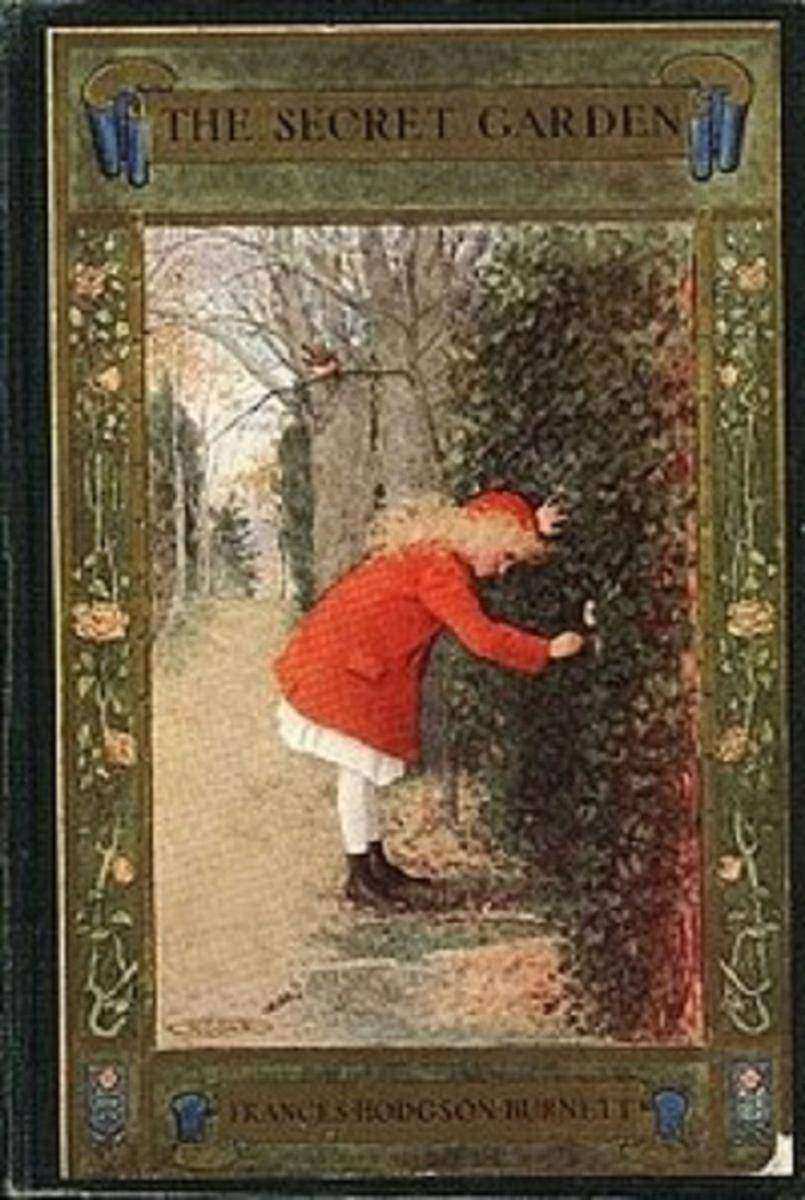
The Secret Garden
¥8.09
Novel for children. Burnett's best known book. According to Wikipedia: "The Secret Garden is a novel by Frances Hodgson Burnett. It was initially published in serial format starting in the autumn of 1910, and was first published in its entirety in 1911. It is now one of Burnett's most popular novels, and is considered to be a classic of English children's literature. Several stage and film adaptations have been produced.... Frances Hodgson Burnett, ( 1849 - 1924) was an English–American playwright and author. She is best known for her children's stories, in particular The Secret Garden, A Little Princess, and Little Lord Fauntleroy. Born Frances Eliza Hodgson in Cheetham Hill, Manchester, her father died in 1854, and the family had to endure poverty and squalor in the Victorian slums of Manchester. Following the death of her mother in 1867, an 18-year-old Frances was now the head of a family of four younger siblings. She turned to writing to support them all, with a first story published in Godey's Lady's Book in 1868. Soon after she was being published regularly in Godey's, Scribner's Monthly, Peterson's Ladies' Magazine and Harper's Bazaar. Her main writing talent was combining realistic detail of working-class life with a romantic plot. Her first novel was published in 1877; That Lass o' Lowrie's was a story of Lancashire life. After moving with her husband to Washington, D.C., Burnett wrote the novels Haworth's (1879), Louisiana (1880), A Fair Barbarian (1881), and Through One Administration (1883), as well as a play, Esmeralda (1881), written with William Gillette...Her later works include Sara Crewe (1888) - later rewritten as A Little Princess (1905); The Lady of Quality (1896) - considered one of the best of her plays; and The Secret Garden (1909), the children's novel for which she is probably best known today. The Lost Prince was published in 1915..."
A Monk of Fife
¥8.09
Novelized retelling of a medieval romance. According to Wikipedia: "Andrew Lang (March 31, 1844, Selkirk - July 20, 1912, Banchory, Kincardineshire) was a prolific Scots man of letters. He was a poet, novelist, and literary critic, and contributor to anthropology. He now is best known as the collector of folk and fairy tales."


