


 购物车
购物车 个人中心
个人中心

Third Warning: "A Mystery Story for Girls"
¥9.24
Schopenhauer, bir yanda insan zihninin u?a?? olacak denli bedene ya da fiziksel organizmaya ba??ml? oldu?una y?nelik savunusuyla, ?bür yanda isten? ile tutkular?n ?o?unlukla us yoluyla bast?r?l?p ?arp?t?ld???na y?nelik saptamas?yla, Freudcu ruh??zümleme kuram?n? da ?ncelemeyi ba?arm??t?r. Schopenhauer’a g?re “yeter neden ilkesi”nin bütün tasar?mlar?n (ya da g?rüngülerin) kendisine uymak zorunda oldu?u d?rt temel bi?imi vard?r. Schopenhauer, yeter neden ilkesinin k?künü olu?turan bu d?rt temel bi?imi s?ras?yla,? (?) “olu?”; (??) “varolma”; (???) “bilme”; (?v) “eyleme” olarak belirlemi?tir. ??Schopenhauer’in Jeana üniversitesinde doktora tezi olarak sundu?u “Yeter Neden ilkesinin D?rt Sa?akl? K?kü, 1813″ ba?l?kl? ?al??mas?, pek ?ok bak?mdan ya?am?n?n ilerleyen y?llar?nda verece?i felsefe yap?tlar?n?n temelini ‘olu?turmas?yla olduk?a ?nemlidir. Tezin temel sav?, Kant’?n “g?rüngüler (pheinomenon) dünyas?”na kar??l?k gelen “tasar?mlar dünyas?”n?n bütünüyle “yeter neden ilkesi”nce y?netildi?idir. Bu ilkeye g?re, olanakl? bütün nesneler, hem ?teki nesnelerce belirlendikleri hem de kendileri d???ndaki bütün ?teki nesneleri belirledikleri zorunlu bir ili?ki i?inde bulunmaktad?rlar. Dolay?s?yla, her bilin? nesnesi ancak ?teki nesnelerle ili?kisi do?rultusunda a??klanabilirdir. Bu noktada Schopenhauer, ancak bu durumu ba?tan benimsemek ko?uluyla, Kant’?n tan?mlad??? anlamda dünyaya ili?kin birtak?m zorunlu sentetik a priori do?rular?n bilinmesinin olanakl? oldu?u saptamas?nda bulunur. ? ?Schopenhauer, tasar?mlar aras?ndaki bu zorunlu ili?ki türlerinden, §? “olu?”ta nedensellik ilkesi diye de bilinen neden sonu? ili?kisini; §? “varolma”da uzam-zaman ili?kisini; §? “bilme”de ?ncül-sonu? aras?ndaki kavramsal ili?kiyi; §? “eyleme” de eylem-itki ili?kisini temellendirmektedir. ? ????NDEK?LER: ? SHOPENAUER’?N HAYATI ve ?ALI?MALARIA?KIN METAF?Z??? ?ZER?NE?L?M VE ?L?M KORKUSU ?ZER?NE…SHOPENHAUER’IN AHLAK FELSEFES?AHLAKSHOPENHAUER VE KADINLARSHOPENHAUER VE M?Z?K…?STEN? VE TASARIM OLARAK D?NYAYA?AM B?LGEL??? ?ZER?NE AFOR?ZMALAR?L?M ?ZER?NE..SANAT ?ZER?NE..SHOPENHAUER VE D?N ?ZER?NE…SHOPENHAUER’IN C?NNET & C?NAYET FELSEFES?Nietzsche ve Schopenhauer :Hayat?n De?eriSchopenhauer ve H?ristiyanl?k?Ele?tirisi?lk Günah DoktriniHristiyan Ahlak?H?ristiyani ??retilerin Yaratt??? ?eli?kiler:H?ristiyan ??retilerin ?Ahlak ?zerindeki Olumsuz EtkileriH?ristiyanlar Mevcut Olan Ac?lar? ?o?u Zaman Daha da Art?rmaktalar:H?ristiyanl?k ?lüm Korkusunun ?stesinden GelmiyorTarihi Olaylar ile ?rülmü? Yak?n Ba?lant? ve Tarihsel DogmaH?ristiyanl?kta Hayvanlara Kar?? Tutunulan Tav?rSCHOPENHAURDEN ?ZL? S?ZLER…?
Harry's Ladder to Learning: "[With Two Hundred Thirty Illustrations"
¥9.24
Samson and Delilah was written in the year 1917 by David Herbert Lawrence. This book is one of the most popular novels of David Herbert Lawrence, and has been translated into several other languages around the world.This book is published by Booklassic which brings young readers closer to classic literature globally.
The Story of the Three Little Pigs
¥9.24
Three Lines of Old French was written in the year 1919 by Abraham Merritt. This book is one of the most popular novels of Abraham Merritt, and has been translated into several other languages around the world.This book is published by Booklassic which brings young readers closer to classic literature globally.

Macbeth: "Illustrated"
¥9.24
Towards the end of November, during a thaw, at nine o'clock one morning, a train on the Warsaw and Petersburg railway was approaching the latter city at full speed. The morning was so damp and misty that it was only with great difficulty that the day succeeded in breaking; and it was impossible to distinguish anything more than a few yards away from the carriage windows.Some of the passengers by this particular train were returning from abroad; but the third-class carriages were the best filled, chiefly with insignificant persons of various occupations and degrees, picked up at the different stations nearer town. All of them seemed weary, and most of them had sleepy eyes and a shivering expression, while their complexions generally appeared to have taken on the colour of the fog outside. When day dawned, two passengers in one of the third-class carriages found themselves opposite each other. Both were young fellows, both were rather poorly dressed, both had remarkable faces, and both were evidently anxious to start a conversation. If they had but known why, at this particular moment, they were both remarkable persons, they would undoubtedly have wondered at the strange chance which had set them down opposite to one another in a third-class carriage of the Warsaw Railway Company. One of them was a young fellow of about twenty-seven, not tall, with black curling hair, and small, grey, fiery eyes. His nose was broad and flat, and he had high cheek bones; his thin lips were constantly compressed into an impudent, ironical—it might almost be called a malicious—smile; but his forehead was high and well formed, and atoned for a good deal of the ugliness of the lower part of his face. A special feature of this physiognomy was its death-like pallor, which gave to the whole man an indescribably emaciated appearance in spite of his hard look, and at the same time a sort of passionate and suffering expression which did not harmonize with his impudent, sarcastic smile and keen, self-satisfied bearing. He wore a large fur—or rather astrachan—overcoat, which had kept him warm all night, while his neighbour had been obliged to bear the full severity of a Russian November night entirely unprepared. His wide sleeveless mantle with a large cape to it—the sort of cloak one sees upon travellers during the winter months in Switzerland or North Italy—was by no means adapted to the long cold journey through Russia, from Eydkuhnen to St. Petersburg. Copyright, Illustrated version of "the Idiot" by e-Kitap Projesi, 2014

The Story of a Fierce Bad Rabbit
¥9.24
There is a woman in the state of Nevada to whom I once lied continuously, consistently, and shamelessly, for the matter of a couple of hours. I don't want to apologize to her. Far be it from me. But I do want to explain. Unfortunately, I do not know her name, much less her present address. If her eyes should chance upon these lines, I hope she will write to me.It was in Reno, Nevada, in the summer of 1892. Also, it was fair-time, and the town was filled with petty crooks and tin-horns, to say nothing of a vast and hungry horde of hoboes. It was the hungry hoboes that made the town a "hungry" town. They "battered" the back doors of the homes of the citizens until the back doors became unresponsive.A hard town for "scoffings," was what the hoboes called it at that time. I know that I missed many a meal, in spite of the fact that I could "throw my feet" with the next one when it came to "slamming a gate for a "poke-out" or a "set-down," "or hitting for a light piece" on the street. Why, I was so hard put in that town, one day, that I gave the porter the slip and invaded the private car of some itinerant millionnaire. The train started as I made the platform, and I headed for the aforesaid millionnaire with the porter one jump behind and reaching for me. It was a dead heat, for I reached the millionnaire at the same instant that the porter reached me. I had no time for formalities. "Gimme a quarter to eat on," I blurted out. And as I live, that millionnaire dipped into his pocket and gave me ... just ... precisely ... a quarter. It is my conviction that he was so flabbergasted that he obeyed automatically, and it has been a matter of keen regret ever since, on my part, that I didn't ask him for a dollar. I know that I'd have got it. I swung off the platform of that private car with the porter manoeuvering to kick me in the face. He missed me. One is at a terrible disadvantage when trying to swing off the lowest step of a car and not break his neck on the right of way, with, at the same time, an irate Ethiopian on the platform above trying to land him in the face with a number eleven. But I got the quarter! I got it!But to return to the woman to whom I so shamelessly lied. It was in the evening of my last day in Reno. I had been out to the race-track watching the ponies run, and had missed my dinner (i.e. the midday meal). I was hungry, and, furthermore, a committee of public safety had just been organized to rid the town of just such hungry mortals as I. Already a lot of my brother hoboes had been gathered in by John Law, and I could hear the sunny valleys of California calling to me over the cold crests of the Sierras. Two acts remained for me to perform before I shook the dust of Reno from my feet. One was to catch the blind baggage on the westbound overland that night. The other was first to get something to eat. Even youth will hesitate at an all-night ride, on an empty stomach, outside a train that is tearing the atmosphere through the snow-sheds, tunnels, and eternal snows of heaven-aspiring mountains.But that something to eat was a hard proposition. I was "turned down" at a dozen houses. Sometimes I received insulting remarks and was informed of the barred domicile that should be mine if I had my just deserts. The worst of it was that such assertions were only too true. That was why I was pulling west that night. John Law was abroad in the town, seeking eagerly for the hungry and homeless, for by such was his barred domicile tenanted.At other houses the doors were slammed in my face, cutting short my politely and humbly couched request for something to eat. At one house they did not open the door. I stood on the porch and knocked, and they looked out at me through the window. They even held one sturdy little boy aloft so that he could see over the shoulders of his elders the tramp who wasn't going to get anything to eat at their house.

Red Handed: An International Cozy Mystery and Crime Private Investigator Short S
¥9.24
Red Handed: An International Cozy Mystery and Crime Private Investigator Short Story

Jemina, the Mountain Girl
¥9.24
This don't pretend to be "Literature."??This is just a tale for red-blooded folks who want a story and not just a lot of "psychological" stuff or "analysis."??Boy, you'll love it! Read it here, see it in the movies, play it on the phonograph, run it through the sewing-machine.??* * *??It was night in the mountains of Kentucky. Wild hills rose on all sides. Swift mountain streams flowed rapidly up and down the mountains.?Jemima Tantrum was down at the stream, brewing whiskey at the family still.??She was a typical mountain girl.

The Tale of Two Bad Mice: Illustrated
¥9.24
ONCE upon a time there was a very beautiful doll's-house; it was red brick with white windows, and it had real muslin curtains and a front door and a chimney.??IT belonged to two Dolls called Lucinda and Jane; least it belonged to Lucinda, but she never ordered meals.?Jane was the Cook; but she never did any cooking, because the dinner had been bought ready-made, in a box full of shavings. ??THERE were two red lobsters and a ham, a fish, a pudding, and some pears and oranges.?They would not come off the plates, but they were extremely beautiful.?ONE morning Lucinda and Jane had gone out for a drive in the doll's perambulator. There was no one in the nursery, and it was very quiet. Presently there was a little scuffling, scratching noise in a corner near the fire-place, where there was a hole under the skirting-board.?Tom Thumb put out his head for a moment, and then popped it in again.?Tom Thumb was a mouse. ??A MINUTE afterwards, Hunca Munca, his wife, put her head out, too; and when she saw that there was no one in the nursery, she ventured out on the oilcloth under the coal-box.

Cue for Quiet
¥9.24
Madame Bovary takes place in provincial northern France, near the town of Rouen in Normandy. The story begins and ends with Charles Bovary, a stolid, kindhearted man without much ability or ambition. As the novel opens, Charles is a shy, oddly dressed teenager arriving at a new school amidst the ridicule of his new classmates. Later, Charles struggles his way to a second-rate medical degree and becomes an officier de santé in the Public Health Service. His mother chooses a wife for him, an unpleasant but supposedly rich widow named Heloise Dubuc, and Charles sets out to build a practice in the village of Tostes (now T?tes). One day, Charles visits a local farm to set the owner's broken leg, and meets his client's daughter, Emma Rouault. Emma is a beautiful, daintily dressed young woman who has received a "good education" in a convent and who has a latent but powerful yearning for luxury and romance imbibed from the popular novels she has read. Charles is immediately attracted to her, and begins checking on his patient far more often than necessary until Heloise's jealousy puts a stop to the visits. When Heloise dies, Charles waits a decent interval, then begins courting Emma in earnest. Her father gives his consent, and Emma and Charles are married. ABOUT AUTHOR: Gustave Flaubert (French: December 12, 1821 – May 8, 1880) was an influential French writer widely considered one of the greatest novelists in Western literature. He is known especially for his first published novel, Madame Bovary (1857), for his Correspondence, and for his scrupulous devotion to his style and aesthetics. The celebrated short story writer Maupassant was a protégé of Flaubert. Early life and education:Flaubert was born on December 12, 1821, in Rouen, in the Seine-Maritime department of Upper Normandy, in northern France. He was the second son of Anne Justine Caroline (née Fleuriot; 1793–1872) and Achille-Cléophas Flaubert (1784–1846), a surgeon. He began writing at an early age, as early as eight according to some sources.He was educated at the Lycée Pierre Corneille in Rouen, and did not leave until 1840, when he went to Paris to study law. In Paris, he was an indifferent student and found the city distasteful. He made a few acquaintances, including Victor Hugo. Toward the end of 1840, he traveled in the Pyrenees and Corsica. In 1846, after an attack of epilepsy, he left Paris and abandoned the study of law. Writing career:His first finished work was November, a novella, which was completed in 1842.In September 1849, Flaubert completed the first version of a novel, The Temptation of Saint Anthony. He read the novel aloud to Louis Bouilhet and Maxime Du Camp over the course of four days, not allowing them to interrupt or give any opinions. At the end of the reading, his friends told him to throw the manuscript in the fire, suggesting instead that he focus on day-to-day life rather than fantastic subjects.In 1850, after returning from Egypt, Flaubert began work on Madame Bovary. The novel, which took five years to write, was serialized in the Revue de Paris in 1856. The government brought an action against the publisher and author on the charge of immorality, which was heard during the following year, but both were acquitted. When Madame Bovary appeared in book form, it met with a warm reception.In 1858, Flaubert traveled to Carthage to gather material for his next novel, Salammb?. The novel was completed in 1862 after four years of work.Drawing on his youth, Flaubert next wrote L'?ducation sentimentale (Sentimental Education), an effort that took seven years. This was his last complete novel, published in the year 1869.He wrote an unsuccessful drama, Le Candidat, and published a reworked version of Temptation of Saint Anthony.

The Colonists
¥9.24
Leonardo Da Vinci, the many-sided genius of the Italian Renaissance, was born, as his name implies, at the little town of Vinci, which is about six miles from Empoli and twenty miles west of Florence. Vinci is still very inaccessible, and the only means of conveyance is the cart of a general carrier and postman, who sets out on his journey from Empoli at sunrise and sunset. Outside a house in the middle of the main street of Vinci to-day a modern and white-washed bust of the great artist is pointed to with much pride by the inhabitants. Leonardo's traditional birthplace on the outskirts of the town still exists, and serves now as the headquarters of a farmer and small wine exporter.Leonardo di Ser Piero d'Antonio di Ser Piero di Ser Guido da Vinci—for that was his full legal name—was the natural and first-born son of Ser Piero, a country notary, who, like his father, grandfather, and great-grandfather, followed that honourable vocation with distinction and success, and who subsequently—when Leonardo was a youth—was appointed notary to the Signoria of Florence. Leonardo's mother was one Caterina, who afterwards married Accabriga di Piero del Vaccha of Vinci. His BirthLeonardo Da Vinci, the many-sided genius of the Italian Renaissance, was born, as his name implies, at the little town of Vinci, which is about six miles from Empoli and twenty miles west of Florence. Vinci is still very inaccessible, and the only means of conveyance is the cart of a general carrier and postman, who sets out on his journey from Empoli at sunrise and sunset. Outside a house in the middle of the main street of Vinci to-day a modern and white-washed bust of the great artist is pointed to with much pride by the inhabitants. Leonardo's traditional birthplace on the outskirts of the town still exists, and serves now as the headquarters of a farmer and small wine exporter. His ArtLeonardo, whose birth antedates that of Michelangelo and Raphael by twenty three and thirty-one years respectively, was thus in the forefront of the Florentine Renaissance, his life coinciding almost exactly with the best period of Tuscan painting.Leonardo was the first to investigate scientifically and to apply to art the laws of light and shade, though the preliminary investigations of Piero della Francesca deserve to be recorded.He observed with strict accuracy the subtleties of chiaroscuro—light and shade apart from colour; but, as one critic has pointed out, his gift of chiaroscuro cost the colour-life of many a noble picture. Leonardo was "a tonist, not a colourist," before whom the whole book of nature lay open. His MindWe can readily believe the statements of Benvenuto Cellini, the sixteenth-century Goldsmith, that Francis I. "did not believe that any other man had come into the world who had attained so great a knowledge as Leonardo, and that not only as sculptor, painter, and architect, for beyond that he was a profound philosopher." Leonardo anticipated many eminent scientists and inventors in the methods of investigation which they adopted to solve the many problems with which their names are coupled. Among these may be cited Copernicus' theory of the earth's movement, Lamarck's classification of vertebrate and invertebrate animals, the laws of friction, the laws of combustion and respiration, the elevation of the continents, the laws of gravitation, the undulatory theory of light and heat, steam as a motive power in navigation, flying machines, the invention of the camera obscura, magnetic attraction, the use of the stone saw, the system of canalisation, breech loading cannon, the construction of fortifications, the circulation of the blood, the swimming belt, the wheelbarrow, the composition of explosives, the invention of paddle wheels, the smoke stack, the mincing machine! It is, therefore, easy to see why he called "Mechanics the Paradise of the Sciences."Leonardo was a SUPERMAN.

The Island of Doctor Moreau: "Illustrated"
¥9.24
Once upon a time there was an old Sow with three little Pigs, and as she had not enough to keep them, she sent them out to seek their fortune. The first that went off met a Man with a bundle of straw, and said to him, "Please, Man, give me that straw to build me a house"; which the Man did, and the little Pig built a house with it. Presently came along a Wolf, and knocked at the door, and said, "Little Pig, little Pig, let me come in." To which the Pig answered, "No, no, by the hair of my chinny chin chin."

The Snow Image: "A Childish Miracle"
¥9.24
This book is merely a personal narrative, and not a pretentious history or a philosophical dissertation. It is a record of several years of variegated vagabondizing, and its object is rather to help the resting reader while away an idle hour than afflict him with metaphysics, or goad him with science. Still, there is information in the volume; information concerning an interesting episode in the history of the Far West, about which no books have been written by persons who were on the ground in person, and saw the happenings of the time with their own eyes. I allude to the rise, growth and culmination of the silver-mining fever in Nevada -a curious episode, in some respects; the only one, of its peculiar kind, that has occurred in the land; and the only one, indeed, that is likely to occur in it.Yes, take it all around, there is quite a good deal of information in the book. I regret this very much; but really it could not be helped: information appears to stew out of me naturally, like the precious ottar of roses out of the otter. Sometimes it has seemed to me that I would give worlds if I could retain my facts; but it cannot be. The more I calk up the sources, and the tighter I get, the more I leak wisdom. Therefore, I can only claim indulgence at the hands of the reader, not justification. THE AUTHOR."My brother had just been appointed Secretary of Nevada Territory--?an office of such majesty that it concentrated in itself the duties and dignities of Treasurer, Comptroller, Secretary of State, and Acting Governor in the Governor's absence. A salary of eighteen hundred dollars a year and the title of "Mr. Secretary," gave to the great position an air of wild and imposing grandeur. I was young and ignorant, and I envied my brother. I coveted his distinction and his financial splendor, but particularly and especially the long, strange journey he was going to make, and the curious new world he was going to explore. He was going to travel! I never had been away from home, and that word "travel" had a seductive charm for me. Pretty soon he would be hundreds and hundreds of miles away on the great plains and deserts, and among the mountains of the Far West, and would see buffaloes and Indians, and prairie dogs, and antelopes, and have all kinds of adventures, and may be get hanged or scalped, and have ever such a fine time, and write home and tell us all about it, and be a hero. And he would see the gold mines and the silver mines, and maybe go about of an afternoon when his work was done, and pick up two or three pailfuls of shining slugs, and nuggets of gold and silver on the hillside. And by and by he would become very rich, and return home by sea, and be able to talk as calmly about San Francisco and the ocean, and "the isthmus" as if it was nothing of any consequence to have seen those marvels face to face. What I suffered in contemplating his happiness, pen cannot describe. And so, when he offered me, in cold blood, the sublime position of private secretary under him, it appeared to me that the heavens and the earth passed away, and the firmament was rolled together as a scroll! I had nothing more to desire. My contentment was complete.At the end of an hour or two I was ready for the journey. Not much packing up was necessary, because we were going in the overland stage from the Missouri frontier to Nevada, and passengers were only allowed a small quantity of baggage apiece. There was no Pacific railroad in those fine times of ten or twelve years ago--?not a single rail of it. I only proposed to stay in Nevada three months--?I had no thought of staying longer than that. I meant to see all I could that was new and strange, and then hurry home to business. I little thought that I would not see the end of that three-month pleasure excursion for six or seven uncommonly long years!

The Thing in the Attic
¥9.24
The first published novel by Leo Tolstoy released in November 1852. It is the first in a series of three novels and is followed by Boyhood and Youth. Published when Tolstoy was just twenty-three years old, the book was an immediate success, earning notice from other Russian novelists including Ivan Turgenev, who heralded the young Tolstoy as a major up-and-coming figure in Russian literature. Well-worth reading if you are interested in 19th century literature. Count Lev Nikolayevich Tolstoy (1828 – 1910), usually referred to in English as Leo Tolstoy, was a Russian novelist today regarded as one of the greatest of all time. He is best known for War and Peace (1869) and Anna Karenina (1877). He first achieved literary acclaim in his 20s with his semi-autobiographical trilogy, Childhood, Boyhood, and Youth (1852–1856), and Sevastopol Sketches (1855), based upon his experiences in the Crimean War. Tolstoy's fiction includes dozens of short stories and several novellas such as The Death of Ivan Ilyich, Family Happiness, and Hadji Murad. He also wrote plays and numerous philosophical essays. In the 1870s Tolstoy experienced a profound moral crisis, followed by what he regarded as an equally profound spiritual awakening. His literal interpretation of the ethical teachings of Jesus, centering on the Sermon on the Mount, caused him to become a fervent Christian anarchist and pacifist. His new-found asceticism and determination to renounce his considerable wealth tipped his marriage into bitter turmoil, which continued right up to his death at the age of 82 in the waiting room of an, until then, obscure Russian railway station. Tolstoy's ideas on nonviolent resistance, expressed in such works as The Kingdom of God Is Within You, were to have a profound impact on such pivotal 20th-century figures as Mohandas Gandhi, Martin Luther King, Jr., and James Bevel.

Polly
¥9.24
One Thursday, Camille, on returning from his office, brought with him a great fellow with square shoulders, whom he pushed in a familiar manner into the shop. "Mother," he said to Madame Raquin, pointing to the newcomer, "do you recognise this gentleman?" The old mercer looked at the strapping blade, seeking among her recollections and finding nothing, while Therese placidly observed the scene. "What!" resumed Camille, "you don't recognise Laurent, little Laurent, the son of daddy Laurent who owns those beautiful fields of corn out Jeufosse way. Don't you remember? I went to school with him; he came to fetch me of a morning on leaving the house of his uncle, who was our neighbour, and you used to give him slices of bread and jam." All at once Madame Raquin recollected little Laurent, whom she found very much grown. It was quite ten years since she had seen him. She now did her best to make him forget her lapse of memory in greeting him, by recalling a thousand little incidents of the past, and by adopting a wheedling manner towards him that was quite maternal. Laurent had seated himself. With a peaceful smile on his lips, he replied to the questions addressed to him in a clear voice, casting calm and easy glances around him. "Just imagine," said Camille, "this joker has been employed at the Orleans-Railway-Station for eighteen months, and it was only to-night that we met and recognised one another—the administration is so vast, so important!" As the young man made this remark, he opened his eyes wider, and pinched his lips, proud to be a humble wheel in such a large machine. Shaking his head, he continued: "Oh! but he is in a good position. He has studied. He already earns 1,500 francs a year. His father sent him to college. He had read for the bar, and learnt painting. That is so, is it not, Laurent? You'll dine with us?" "I am quite willing," boldly replied the other. He got rid of his hat and made himself comfortable in the shop, while Madame Raquin ran off to her stewpots. Therese, who had not yet pronounced a word, looked at the new arrival. She had never seen such a man before. Laurent, who was tall and robust, with a florid complexion, astonished her. It was with a feeling akin to admiration, that she contemplated his low forehead planted with coarse black hair, his full cheeks, his red lips, his regular features of sanguineous beauty. For an instant her eyes rested on his neck, a neck that was thick and short, fat and powerful. Then she became lost in the contemplation of his great hands which he kept spread out on his knees: the fingers were square; the clenched fist must be enormous and would fell an ox.
![Sleeping Beauty in the Wood: [Colored Edition]](https://platform-permanent.ddimg.cn/pt-media-info-soa-resource/digital/product/54/65/1901165465_ii_cover.jpg?version=4d4744e0-befc-42a0-86c3-876d63ffbc5c)
Sleeping Beauty in the Wood: [Colored Edition]
¥9.24
There were formerly a King and a Queen, who were so sorry that they had no children, so sorry that it cannot be expressed. They went to all the waters in the world; vows, pilgrimages, all ways were tried and all to no purpose. At last, however, the Queen proved with child, and was brought to bed of a daughter. There was a very fine christening; and the Princess had for her godmothers all the Fairies they could find in the whole kingdom (they found seven), that every one of them might give her a gift, as was the custom of Fairies in those days, and that by this means the Princess might have all the perfections imaginable. After the ceremonies of the christening were over, all the company returned to the King's palace, where was prepared a great feast for the Fairies. There was placed before every one of them a magnificent cover with a case of massive gold, wherein were a spoon, knife and fork, all of pure gold set with diamonds and rubies. But as they were all sitting down at table, they saw come into the hall a very old Fairy whom they had not invited, because it was above fifty years since she had been out of a certain tower, and she was believed to be either dead or inchanted. The King ordered her a cover, but could not furnish her with a case of gold as the others, because they had seven only made for the seven Fairies.

The Princess on the Pea
¥9.24
Once, there was a Prince who wanted to marry a Princess. Only a real one would do. So he traveled through all the world to find her, and everywhere things went wrong. There were Princesses aplenty, but how was he to know whether they were real Princesses? There was something not quite right about them all. So he came home again and was unhappy, because he did so want to have a real Princess.

The Frog Princess: "A Russian Fairy Tale"
¥9.24
In days gone by there was a King who had three sons. When his sons came of age the King called them to him and said, "My dear lads, I want you to get married so that I may see your little ones, my grand-children, before I die." And his sons replied, "Very well, Father, give us your blessing. Who do you want us to marry?" "Each of you must take an arrow, go out into the green meadow and shoot it. Where the arrows fall, there shall your destiny be."So the sons bowed to their father, and each of them took an arrow and went out into the green meadow, where they drew their bows and let fly their arrows. The arrow of the eldest son fell in the courtyard of a nobleman, and the nobleman's daughter picked it up. The arrow of the middle son fell in the yard of a merchant, and the merchant's daughter picked it up. But the arrow of the youngest son, Prince Ivan, flew up and away he knew not where. He walked on and on in search of it, and at last he came to a marsh, where what should he see but a frog sitting on a leaf with the arrow in its mouth. Prince Ivan said to it, "Frog, frog, give me back my arrow." And the frog replied, "Marry me!" "How can I marry a frog?" "Marry me, for it is your destiny."

Head and Shoulders
¥9.24
In 1915 Horace Tarbox was thirteen years old. In that year he took the examinations for entrance to Prince-ton University and received the Grade A—excellent—in C?sar, Cicero, Vergil, Xenophon, Homer, Algebra, Plane Geometry, Solid Geometry, and Chemistry.??Two years later while George M. Cohan was composing "Over There," Horace was leading the sophomore class by several lengths and digging out theses on "The Syllogism as an Obsolete Scholastic Form," and during the battle of Ch?teau-Thierry he was sitting at his desk deciding whether or not to wait until his seventeenth birthday before beginning his series of essays on "The Pragmatic Bias of the New Realists."??After a while some newsboy told him that the war was over, and he was glad, because it meant that Peat Brothers, publishers, would get out their new edition of "Spinoza's Improvement of the Understanding." Wars were all very well in their way, made young men self-reliant or something but Horace felt that he could never forgive the President for allowing a brass band to play under his window the night of the false armistice, causing him to leave three important sentences out of his thesis on "German Idealism."
Porcelain and Pink
¥9.24
A room in the down-stairs of a summer cottage. High around the wall runs an art frieze of a fisherman with a pile of nets at his feet and a ship on a crimson ocean, a fisherman with a pile of nets at his feet and a ship on a crimson ocean, a fisherman with a pile of nets at his feet and so on. In one place on the frieze there is an overlapping—here we have half a fisher-man with half a pile of nets at his foot, crowded damply against half a ship on half a crimson ocean. The frieze is not in the plot, but frankly it fascinates me. I could continue indefinitely, but I am distracted by one of the two objects in the room—a blue porcelain bath-tub. It has character, this bath-tub. It is not one of the new racing bodies, but is small with a high tonneau and looks as if it were going to jump; dis-couraged, however, by the shortness of its legs, it has submitted to its environment and to its coat of sky-blue paint. But it grumpily refuses to allow any patron completely to stretch his legs—which brings us neatly to the second object in the room: SHE is a girl—clearly an appendage to the bath-tub, on-ly her head and throat—beautiful girls have throats instead of necks—and a suggestion of shoulder ap-pearing above the side. For the first ten minutes of the play the audience is engrossed in wondering if she really is playing the game fairly and hasn't any clothes on or whether it is being cheated and she is dressed. The girl's name is JULIE MARVIS. From the proud way she sits up in the bath-tub we deduce that she is not very tall and that she carries herself well. When she smiles, her upper tip rolls a little and reminds you of an Easter Bunny, She is within whispering distance of twenty years old.
![The Story of Miss Moppet: [Illustrated]](https://platform-permanent.ddimg.cn/pt-media-info-soa-resource/digital/product/45/94/1901164594_ii_cover.jpg?version=7700df74-d05a-4284-a3bf-f64f29176bb1)
The Story of Miss Moppet: [Illustrated]
¥9.24
This is a Pussy called Miss Moppet, she thinks she has heard a mouse!??This is the Mouse peeping out behind the cupboard, and making fun of Miss Moppet. He is not afraid of a kitten.??This is Miss Moppet jumping just too late; she misses the Mouse and hits her own head.??She thinks it is a very hard cupboard!??The Mouse watches Miss Moppet from the top of the cupboard.??Miss Moppet ties up her head in a duster, and sits before the fire.??The Mouse thinks she is looking very ill. ?He comes sliding down the bell-pull.??Miss Moppet looks worse and worse. The Mouse comes a little nearer.??Miss Moppet holds her poor head in her paws, and looks at him through a hole in the duster. The Mouse comes very close.??And then all of a sudden—Miss Moppet jumps upon the Mouse!!
The Clever Fox and the Crane
¥9.24
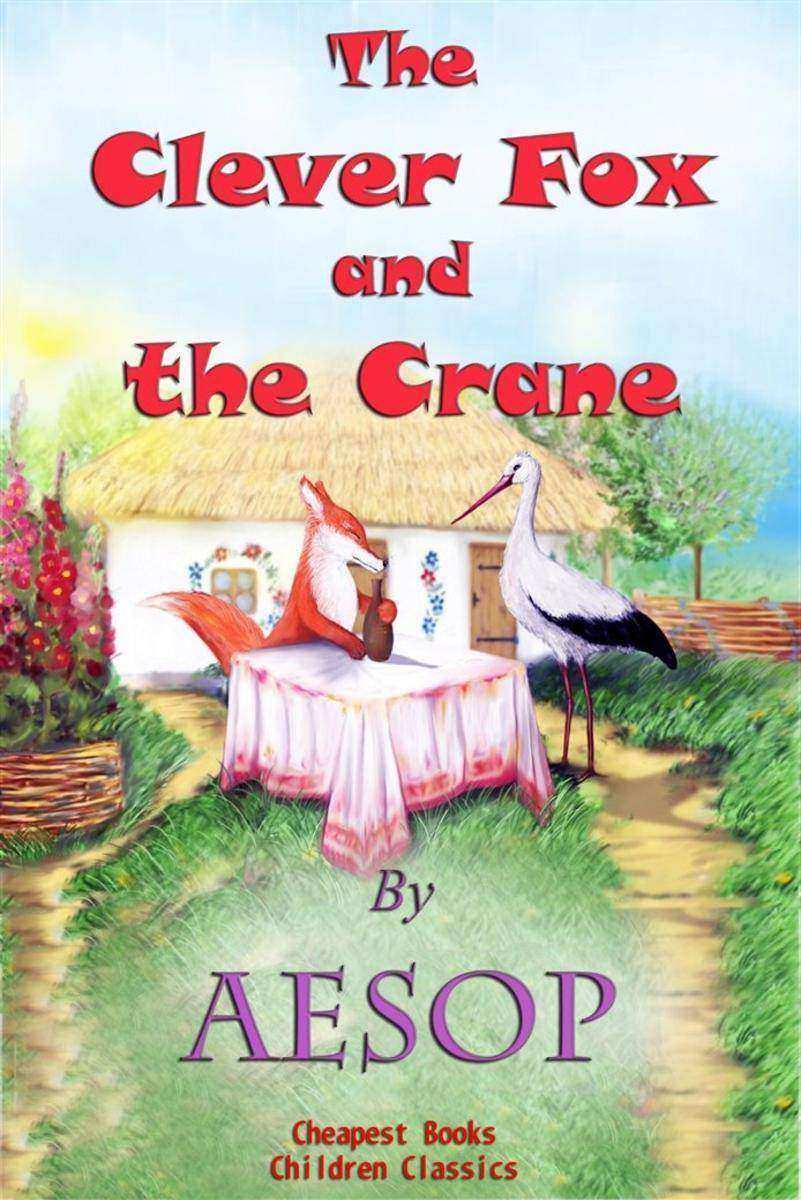
The clever fox made friends with the crane. The clever fox once had a notion to treat the crane to dinner and went to invite him to her house."Come godfather! Come dear! How I'll entertain you!"The crain went to the dinner party.The clever fox had cooked farina cereal and spread it over a plate.She served it and urged. "Eat, my friend-godfather, I cooked it myself. "


