


 购物车
购物车 个人中心
个人中心
Amazon Web Services Bootcamp
¥73.02
This fast-paced guide will quickly enhance your skills to develop a highly scalable Cloud environment About This Book ? Efficiently build a highly scalable and reliable cloud environment for your applications with AWS ? Leverage the various AWS components and services to build a secure, reliable, and robust environment to host your applications on ? This quick-start guide will quickly enhance your skills to develop highly scalable services Who This Book Is For This book is for IT professionals and system administrators looking to design, deploy, and manage your applications and services on the AWS cloud platform. It’s also ideal for developers looking to build highly scalable cloud-based services. A basic understanding of AWS would be beneficial. What You Will Learn ? Find out about IAM to access AWS services securely ? Explore EC2 (virtual server) and scale up/down your application based on heavy traffic ? Learn about unlimited data storage service S3 and host a static website within minutes ? Get to grips with Relational Databases and NoSQL databases under the AWS ecosystem ? Understand the caching mechanism ? Get to know about notifications service and monitor AWS services ? Secure and troubleshoot your AWS architecture In Detail AWS is at the forefront of Cloud Computing today. Businesses are adopting AWS Cloud because of its reliability, versatility, and flexible design. The main focus of this book is teaching you how to build and manage highly reliable and scalable applications and services on AWS. It will provide you with all the necessary skills to design, deploy, and manage your applications and services on the AWS cloud platform. We’ll start by exploring Amazon S3, EC2, and so on to get you well-versed with core Amazon services. Moving on, we’ll teach you how to design and deploy highly scalable and optimized workloads. You’ll also discover easy-to-follow, hands-on steps, tips, and recommendations throughout the book and get to know essential security and troubleshooting concepts. By the end of the book, you’ll be able to create a highly secure, fault tolerant, and scalable environment for your applications to run on. Style and approach This book is all about fast and intensive learning. That means we don’t waste time helping you get started. The new features provided by AWS resources are being covered with highly-effective examples to develop new things, demonstrating different ways to create and use the AWS resources efficiently.
Deep Learning with TensorFlow - Second Edition
¥73.02
Delve into neural networks, implement deep learning algorithms, and explore layers of data abstraction with the help of TensorFlow v1.7. About This Book ? Learn how to implement advanced techniques in deep learning with Google's brainchild, TensorFlow v1.7 ? Explore deep neural networks and layers of data abstraction with the help of this comprehensive guide ? Gain real-world contextualization through some deep learning problems concerning research and application Who This Book Is For The book is for people interested in machine learning and machine intelligence. A rudimentary level of programming in one language is assumed, as is a basic familiarity with computer science techniques and technologies, including a basic awareness of computer hardware and algorithms. Some competence in mathematics is needed to the level of elementary linear algebra and calculus. What You Will Learn ? Apply deep machine intelligence and GPU computing with TensorFlow v1.7 ? Access public datasets and use TensorFlow to load, process, and transform the data ? Discover how to use the high-level TensorFlow API to build more powerful applications ? Use deep learning for scalable object detection and mobile computing ? Train machines quickly to learn from data by exploring reinforcement learning techniques ? Explore active areas of deep learning research and applications In Detail Deep learning is a branch of machine learning algorithms based on learning multiple levels of abstraction. Neural networks, which are at the core of deep learning, are being used in predictive analytics, computer vision, natural language processing, time series forecasting, and to perform a myriad of other complex tasks. This book is conceived for developers, data analysts, machine learning practitioners and deep learning enthusiasts who want to build powerful, robust, and accurate predictive models with the power of TensorFlow v1.7, combined with other open source Python libraries. Throughout the book, you’ll learn how to develop deep learning applications for machine learning systems using Feedforward Neural Networks, Convolutional Neural Networks, Recurrent Neural Networks, Autoencoders, and Factorization Machines. Discover how to attain deep learning programming on GPU in a distributed way. You'll come away with an in-depth knowledge of machine learning techniques and the skills to apply them to real-world projects. Style and approach This step-by-step guide explores common, and not so common, deep neural networks, and shows how they can be exploited in the real world with complex raw data. Benefit from practical examples, and learn how to implement different types of neural nets to build smart applications related to text, speech, and image data processing.

15 Most Powerful Features Of Pivot Tables: Save Your Time With MS Excel
¥24.44
15 Most Powerful Features Of Pivot Tables: Save Your Time With MS Excel
Redis 4.x Cookbook
¥73.02
Leverage the power of Redis 4.x to develop, optimize and administer your Redis solutions with ease About This Book ? Build, deploy and administer high performance and scalable applications in Redis ? Covers a range of important tasks - including development and administration of Redis ? A practical guide that takes your understanding of Redis to the next level Who This Book Is For This book is for database administrators, developers and architects who want to tackle the common and not so common problems associated with the different development and administration-related tasks in Redis. A fundamental understanding of Redis is expected to get the best out of this book. What You Will Learn ? Install and configure your Redis instance ? Explore various data types and commands in Redis ? Build client-side applications as well as a Big Data framework with Redis ? Manage data replication and persistence in Redis ? Implement high availability and data sharding in Redis ? Extend Redis with Redis Module ? Benchmark, debug, fine-tune and troubleshoot various issues in Redis In Detail Redis is considered the world's most popular key-value store database. Its versatility and the wide variety of use cases it enables have made it a popular choice of database for many enterprises. Based on the latest version of Redis, this book provides both step-by-step recipes and relevant the background information required to utilize its features to the fullest. It covers everything from a basic understanding of Redis data types to advanced aspects of Redis high availability, clustering, administration, and troubleshooting. This book will be your great companion to master all aspects of Redis. The book starts off by installing and configuring Redis for you to get started with ease. Moving on, all the data types and features of Redis are introduced in detail. Next, you will learn how to develop applications with Redis in Java, Python, and the Spring Boot web framework. You will also learn replication tasks, which will help you to troubleshoot replication issues. Furthermore, you will learn the steps that need to be undertaken to ensure high availability on your cluster and during production deployment. Toward the end of the book, you will learn the topmost tasks that will help you to troubleshoot your ecosystem efficiently, along with extending Redis by using different modules. Style and approach This book is a rich collection of recipes that will come in handy when you are working with Redis. It addresses your common and not-so-common pain points, so this is a book of Redis that you must have on the shelf.

Virtual Reality Blueprints
¥73.02
Join the virtual reality revolution by creating immersive 3D games and applications with Cardboard VR, Gear VR, OculusVR, and HTC Vive About This Book ? Develop robust, immersive VR experiences that are easy on the eye. ? Code 3D games and applications using Unity 3D game engine. ? Learn the basic principles of virtual reality applications Who This Book Is For If you are a game developer and a VR enthusiast now looking to get stuck into the VR app development process by creating VR apps for different platforms, then this is the book for you. Familiarity with the Unity game engine and the C# language is key to getting the most from this book. What You Will Learn ? Use Unity assets to create object simulation. ? Implement simple touch controls in your application. ? Apply artificial intelligence to achieve player and character interaction. ? Add *s for movement, tracking, grasping, and spawning. ? Create animated walkthroughs, use 360-degree media, and build engaging VR experiences. ? Deploy your games on multiple VR platforms. In Detail Are you new to virtual reality? Do you want to create exciting interactive VR applications? There's no need to be daunted by the thought of creating interactive VR applications, it's much easier than you think with this hands-on, project-based guide that will take you through VR development essentials for desktop and mobile-based games and applications. Explore the three top platforms—Cardboard VR, Gear VR, and OculusVR —to design immersive experiences from scratch. You’ll start by understanding the science-fiction roots of virtual reality and then build your first VR experience using Cardboard VR. You'll then delve into user interactions in virtual space for the Google Cardboard then move on to creating a virtual gallery with Gear VR. Then you will learn all about virtual movements, state machines, and spawning while you shoot zombies in the Oculus Rift headset. Next, you'll construct a Carnival Midway, complete with two common games to entertain players. Along the way, you will explore the best practices for VR development, review game design tips, discuss methods for combating motion sickness and identify alternate uses for VR applications Style and approach A project-based guide with every project built across chapters.

R Deep Learning Projects
¥63.21
5 real-world projects to help you master deep learning concepts About This Book ? Master the different deep learning paradigms and build real-world projects related to text generation, sentiment analysis, fraud detection, and more ? Get to grips with R's impressive range of Deep Learning libraries and frameworks such as deepnet, MXNetR, Tensorflow, H2O, Keras, and text2vec ? Practical projects that show you how to implement different neural networks with helpful tips, tricks, and best practices Who This Book Is For Machine learning professionals and data scientists looking to master deep learning by implementing practical projects in R will find this book a useful resource. A knowledge of R programming and the basic concepts of deep learning is required to get the best out of this book. What You Will Learn ? Instrument Deep Learning models with packages such as deepnet, MXNetR, Tensorflow, H2O, Keras, and text2vec ? Apply neural networks to perform handwritten digit recognition using MXNet ? Get the knack of CNN models, Neural Network API, Keras, and TensorFlow for traffic sign classification ? Implement credit card fraud detection with Autoencoders ? Master reconstructing images using variational autoencoders ? Wade through sentiment analysis from movie reviews ? Run from past to future and vice versa with bidirectional Long Short-Term Memory (LSTM) networks ? Understand the applications of Autoencoder Neural Networks in clustering and dimensionality reduction In Detail R is a popular programming language used by statisticians and mathematicians for statistical analysis, and is popularly used for deep learning. Deep Learning, as we all know, is one of the trending topics today, and is finding practical applications in a lot of domains. This book demonstrates end-to-end implementations of five real-world projects on popular topics in deep learning such as handwritten digit recognition, traffic light detection, fraud detection, text generation, and sentiment analysis. You'll learn how to train effective neural networks in R—including convolutional neural networks, recurrent neural networks, and LSTMs—and apply them in practical scenarios. The book also highlights how neural networks can be trained using GPU capabilities. You will use popular R libraries and packages—such as MXNetR, H2O, deepnet, and more—to implement the projects. By the end of this book, you will have a better understanding of deep learning concepts and techniques and how to use them in a practical setting. Style and approach This book's unique, learn-as-you-do approach ensures the reader builds on his understanding of deep learning progressively with each project. This book is designed in such a way that implementing each project will empower you with a unique skillset and enable you to implement the next project more confidently.

Ethereum Smart Contract Development
¥63.21
Become an Ethereum Blockchain developer using a blend of concepts and hands-on implementations About This Book ? Understand the Ethereum Ecosystem and its differences from its rich cousin Bitcoin ? Explore the Solidity programming language and smart contract optimizations ? Get a developer’s perspective of Blockchain-as-a-technology with exposure to common challenges faced while building decentralized applications Who This Book Is For If you want to know the ins and outs of the Ethereum network and build your own decentralized applications, then this book is what you need! This book is for anyone who is interested in blockchain and wants to become an Ethereum developer. It’s ideal for existing Ethereum developers who want to develop Ethereum using smart contracts. Basic knowledge of cryptography is expected but is not mandatory. What You Will Learn ? Know how to build your own smart contracts and cryptocurrencies ? Understand the Solidity language ? Find out about data types, control structure, functions, inheritance, mathematical operations, and much more ? See the various types of forks and discover how they are related to Ethereum ? Get to know the various concepts of web3.js and its APIs so you can build client-side apps ? Build a DAO from scratch and acquire basic knowledge of DApps on Ethercast ? Be guided through the project so you can optimize EVM for smart contracts ? Build your own decentralized applications (DApps) by taking a practical approach In Detail Ethereum is a public, blockchain-based distributed computing platform featuring smart contract functionality. This book is your one-stop guide to blockchain and Ethereum smart contract development. We start by introducing you to the basics of blockchain. You'll learn about hash functions, Merkle trees, forking, mining, and much more. Then you'll learn about Ethereum and smart contracts, and we'll cover Ethereum virtual machine (EVM) in detail. Next, you'll get acquainted with DApps and DAOs and see how they work. We'll also delve into the mechanisms of advanced smart contracts, taking a practical approach. You'll also learn how to develop your own cryptocurrency from scratch in order to understand the business behind ICO. Further on, you'll get to know the key concepts of the Solidity programming language, enabling you to build decentralized blockchain-based applications. We'll also look at enterprise use cases, where you'll build a decentralized microblogging site. At the end of this book, we discuss blockchain-as-a-service, the dark web marketplace, and various advanced topics so you can get well versed with the blockchain principles and ecosystem. Style and approach This comprehensive guide takes a practical approach by showing you how to implement Blockchain in different Enterprise use cases. You’ll quickly brush up on the basics of the blockchain database, then learn the advanced intricacies of smart contract development.
Windows Presentation Foundation Development Cookbook
¥108.99
Gain comprehensive insight into WPF mechanics and capabilities. About This Book ? Gain a strong foundation in WPF features and patterns ? Leverage the MVVM pattern to build decoupled, maintainable apps ? Increase efficiency through Performance tuning and UI automation Who This Book Is For The book is intended for developers who are relatively new to WPF (Windows Presentation Foundation), or those who have been working with WPF for some time, but want to get a deeper understanding of its foundation and concepts to gain practical knowledge. Basic knowledge of C# and Visual Studio is assumed. What You Will Learn ? Understand the fundamentals of WPF ? Explore the major controls and manage element layout ? Implement data binding ? Create custom elements that lead to a particular implementation path ? Customize controls, styles, and templates in XAML ? Leverage the MVVM pattern to maintain a clean and reusable structure in your code ? Master practical animations ? Integrate WCF services in a WPF application ? Implement WPFs support for debugging and asynchronous operations In Detail Windows Presentation Foundation (WPF) is Microsoft's development tool for building rich Windows client user experiences that incorporate UIs, media, and documents. With the updates in .NET 4.7, Visual Studio 2017, C# 7, and .NET Standard 2.0, WPF has taken giant strides and is now easier than ever for developers to use. If you want to get an in-depth view of WPF mechanics and capabilities, then this book is for you. The book begins by teaching you about the fundamentals of WPF and then quickly shows you the standard controls and the layout options. It teaches you about data bindings and how to utilize resources and the MVVM pattern to maintain a clean and reusable structure in your code. After this, you will explore the animation capabilities of WPF and see how they integrate with other mechanisms. Towards the end of the book, you will learn about WCF services and explore WPF's support for debugging and asynchronous operations. By the end of the book, you will have a deep understanding of WPF and will know how to build resilient applications. Style and approach This book takes a recipe-based approach to teaching you how to create fault-tolerant WPF applications.
Hybrid Cloud for Architects
¥73.02
Build your own hybrid cloud strategy with this comprehensive learning guide. About This Book ? Build a hybrid cloud strategy for your organization with AWS and OpenStack ? Leverage Hybrid Cloud to design a complex deployment pipeline ? Learn to implement security and monitoring best practices with real-world examples Who This Book Is For This book is targeted at cloud architects, cloud solution providers, DevOps engineers, or any working stakeholder who wants to learn about the hybrid cloud architecture. A basic understanding of public and private cloud is desirable. What You Will Learn ? Learn the demographics and definitions of Hybrid Cloud ? Understand the different architecture and design of Hybrid Cloud ? Explore multi-cloud strategy and use it with your hybrid cloud ? Implement a Hybrid Cloud using CMP / Common API’s ? Implement a Hybrid Cloud using Containers ? Overcome various challenges and issues while working with your Hybrid Cloud ? Understand how to monitor your Hybrid Cloud ? Discover the security implications in the Hybrid Cloud In Detail Hybrid cloud is currently the buzz word in the cloud world. Organizations are planning to adopt hybrid cloud strategy due to its advantages such as untested workloads, cloud-bursting, cloud service brokering and so on. This book will help you understand the dynamics, design principles, and deployment strategies of a Hybrid Cloud. You will start by understanding the concepts of hybrid cloud and the problems it solves as compared to a stand-alone public and private cloud. You will be delving into the different architecture and design of hybrid cloud. The book will then cover advanced concepts such as building a deployment pipeline, containerization strategy, and data storage mechanism. Next up, you will be able to deploy an external CMP to run a Hybrid cloud and integrate it with your OpenStack and AWS environments. You will also understand the strategy for designing a Hybrid Cloud using containerization and work with pre-built solutions like vCloud Air, VMware for AWS, and Azure Stack. Finally, the book will cover security and monitoring related best practices that will help you secure your cloud infrastructure. By the end of the book, you will be in a position to build a hybrid cloud strategy for your organization. Style and approach This book follows a step-by-step, practical approach to deploying and implementing hybrid cloud architectures using AWS and OpenStack.
Deep Learning with PyTorch
¥73.02
Build neural network models in text, vision and advanced analytics using PyTorch About This Book ? Learn PyTorch for implementing cutting-edge deep learning algorithms. ? Train your neural networks for higher speed and flexibility and learn how to implement them in various scenarios; ? Cover various advanced neural network architecture such as ResNet, Inception, DenseNet and more with practical examples; Who This Book Is For This book is for machine learning engineers, data analysts, data scientists interested in deep learning and are looking to explore implementing advanced algorithms in PyTorch. Some knowledge of machine learning is helpful but not a mandatory need. Working knowledge of Python programming is expected. What You Will Learn ? Use PyTorch for GPU-accelerated tensor computations ? Build custom datasets and data loaders for images and test the models using torchvision and torchtext ? Build an image classifier by implementing CNN architectures using PyTorch ? Build systems that do text classification and language modeling using RNN, LSTM, and GRU ? Learn advanced CNN architectures such as ResNet, Inception, Densenet, and learn how to use them for transfer learning ? Learn how to mix multiple models for a powerful ensemble model ? Generate new images using GAN’s and generate artistic images using style transfer In Detail Deep learning powers the most intelligent systems in the world, such as Google Voice, Siri, and Alexa. Advancements in powerful hardware, such as GPUs, software frameworks such as PyTorch, Keras, Tensorflow, and CNTK along with the availability of big data have made it easier to implement solutions to problems in the areas of text, vision, and advanced analytics. This book will get you up and running with one of the most cutting-edge deep learning libraries—PyTorch. PyTorch is grabbing the attention of deep learning researchers and data science professionals due to its accessibility, efficiency and being more native to Python way of development. You'll start off by installing PyTorch, then quickly move on to learn various fundamental blocks that power modern deep learning. You will also learn how to use CNN, RNN, LSTM and other networks to solve real-world problems. This book explains the concepts of various state-of-the-art deep learning architectures, such as ResNet, DenseNet, Inception, and Seq2Seq, without diving deep into the math behind them. You will also learn about GPU computing during the course of the book. You will see how to train a model with PyTorch and dive into complex neural networks such as generative networks for producing text and images. By the end of the book, you'll be able to implement deep learning applications in PyTorch with ease. Style and approach An end-to-end guide that teaches you all about PyTorch and how to implement it in various scenarios.
Cloud-Native Applications in Java
¥90.46
Highly available microservice-based web apps for Cloud with Java About This Book ? Take advantage of the simplicity of Spring to build a full-fledged application ? Let your applications run faster while generating smaller cloud service bills ? Integrate your application with various tools such as Docker and ElasticSearch and use specific tools in Azure and AWS Who This Book Is For Java developers who want to build secure, resilient, robust and scalable applications that are targeted for cloud based deployment, will find this book helpful. Some knowledge of Java, Spring, web programming and public cloud providers (AWS, Azure) should be sufficient to get you through the book. What You Will Learn ? See the benefits of the cloud environment when it comes to variability, provisioning, and tooling support ? Understand the architecture patterns and considerations when developing on the cloud ? Find out how to perform cloud-native techniques/patterns for request routing, RESTful service creation, Event Sourcing, and more ? Create Docker containers for microservices and set up continuous integration using Jenkins ? Monitor and troubleshoot an application deployed in the cloud environment ? Explore tools such as Docker and Kubernetes for containerization and the ELK stack for log aggregation and visualization ? Use AWS and Azure specific tools to design, develop, deploy, and manage applications ? Migrate from monolithic architectures to a cloud native deployment In Detail Businesses today are evolving so rapidly that they are resorting to the elasticity of the cloud to provide a platform to build and deploy their highly scalable applications. This means developers now are faced with the challenge of building build applications that are native to the cloud. For this, they need to be aware of the environment, tools, and resources they’re coding against. If you’re a Java developer who wants to build secure, resilient, robust, and scalable applications that are targeted for cloud-based deployment, this is the book for you. It will be your one stop guide to building cloud-native applications in Java Spring that are hosted in On-prem or cloud providers - AWS and Azure The book begins by explaining the driving factors for cloud adoption and shows you how cloud deployment is different from regular application deployment on a standard data centre. You will learn about design patterns specific to applications running in the cloud and find out how you can build a microservice in Java Spring using REST APIs You will then take a deep dive into the lifecycle of building, testing, and deploying applications with maximum automation to reduce the deployment cycle time. Gradually, you will move on to configuring the AWS and Azure platforms and working with their APIs to deploy your application. Finally, you’ll take a look at API design concerns and their best practices. You’ll also learn how to migrate an existing monolithic application into distributed cloud native applications. By the end, you will understand how to build and monitor a scalable, resilient, and robust cloud native application that is always available and fault tolerant. Style and approach Filled with examples, this book will build you an entire cloud-native application through its course and will stop at each point and explain in depth the functioning and design considerations that will make a robust, highly available application
Delphi High Performance
¥81.74
Build fast, scalable, and high performing applications with Delphi About This Book ? Build efficient and concurrent applications in Delphi with focused examples ? Identify performance bottlenecks and apply the correct algorithm to increase the performance of applications. ? Delve into parallel programming and memory management to optimize your code Who This Book Is For This book is for Delphi developers who would like to build high performance applications with Delphi. Prior knowledge of Delphi is assumed. What You Will Learn ? Find performance bottlenecks and easily mitigate them ? Discover different approaches to fix algorithms ? Understand parallel programming and work with various tools included with Delphi ? Master the RTL for code optimization ? Explore memory managers and their implementation ? Leverage external libraries to write better performing programs In Detail Delphi is a cross-platform Integrated Development Environment (IDE) that supports rapid application development for Microsoft Windows, Apple Mac OS X, Google Android, iOS, and now Linux with RAD Studio 10.2. This book will be your guide to build efficient high performance applications with Delphi. The book begins by explaining how to find performance bottlenecks and apply the correct algorithm to fix them. It will teach you how to improve your algorithms before taking you through parallel programming. You’ll then explore various tools to build highly concurrent applications. After that, you’ll delve into improving the performance of your code and master cross-platform RTL improvements. Finally, we’ll go through memory management with Delphi and you’ll see how to leverage several external libraries to write better performing programs. By the end of the book, you’ll have the knowledge to create high performance applications with Delphi. Style and approach This book will take a step-by-step approach with focused examples to teach you how to increase the performance of applications.
Spring Boot 2.0 Cookbook - Second Edition
¥81.74
Take your application development skills to the next level by implementing Spring Boot features effectively About This Book ? This collection of effective recipes serves as guidelines for Spring Boot application development ? Get up to date with features of the latest version of Spring Boot 2.0 ? Tips and tricks to improve your efficiency through the stages of software development Who This Book Is For This book is for Java Developers who have good knowledge and understanding of Spring and Java application development. What You Will Learn ? Get to know Spring Boot Starters and create custom auto-configurations ? Work with custom annotations that enable bean activation ? Use DevTools to easily develop and debug applications ? Learn the effective testing techniques by integrating Cucumber and Spock ? Observe an eternal application configuration using Consul ? Move your existing Spring Boot applications to the cloud ? Use Hashicorp Consul and Netflix Eureka for dynamic Service Discovery ? Understand the various mechanisms that Spring Boot provides to examine an application’s health In Detail The Spring framework provides great flexibility for Java development, which also results in tedious configuration work. Spring Boot addresses the configuration difficulties of Spring and makes it easy to create standalone, production-grade Spring-based applications. This practical guide makes the existing development process more efficient. Spring Boot Cookbook 2.0 Second Edition smartly combines all the skills and expertise to efficiently develop, test, deploy, and monitor applications using Spring Boot on premise and in the cloud. We start with an overview of the important Spring Boot features you will learn to create a web application for a RESTful service. Learn to fine-tune the behavior of a web application by learning about custom routes and asset paths and how to modify routing patterns. Address the requirements of a complex enterprise application and cover the creation of custom Spring Boot starters. This book also includes examples of the new and improved facilities available to create various kinds of tests introduced in Spring Boot 1.4 and 2.0, and gain insights into Spring Boot DevTools. Explore the basics of Spring Boot Cloud modules and various Cloud starters to make applications in “Cloud Native” and take advantage of Service Discovery and Circuit Breakers. Style and approach This practical guide follows a recipe-based approach and provides extremely helpful guidelines to build, configure, and customize your Spring Boot applications.
Mastering ROS for Robotics Programming - Second Edition
¥90.46
Discover best practices and troubleshooting solutions when working on ROS About This Book ? Develop complex robotic applications using ROS to interface robot manipulators and mobile robots ? Gain insight into autonomous navigation in mobile robots and motion planning in robot manipulators ? Discover best practices and troubleshooting solutions Who This Book Is For If you are a robotics enthusiast or researcher who want to learn more about building robot applications using ROS, this book is for you. In order to learn from this book, you should have a basic knowledge of ROS, GNU/Linux, and C++ programming concepts. The book is also excellent for programmers who want to explore the advanced features of ROS. What You Will Learn ? Create a robot model with a seven-DOF robotic arm and a differential wheeled mobile robot ? Work with Gazebo and V-REP robotic simulator ? Implement autonomous navigation in differential drive robots using SLAM and AMCL packages ? Explore the ROS Pluginlib, ROS nodelets, and Gazebo plugins ? Interface I/O boards such as Arduino, robot sensors, and high-end actuators ? Simulate and motion plan an ABB and universal arm using ROS Industrial ? Explore the latest version of the ROS framework ? Work with the motion planning of a seven-DOF arm using MoveIt! In Detail In this day and age, robotics has been gaining a lot of traction in various industries where consistency and perfection matter. Automation is achieved via robotic applications and various platforms that support robotics. The Robot Operating System (ROS) is a modular software platform to develop generic robotic applications. This book focuses on the most stable release of ROS (Kinetic Kame), discusses advanced concepts, and effectively teaches you programming using ROS. We begin with aninformative overview of the ROS framework, which will give you a clear idea of how ROS works. During the course of this book, you’ll learn to build models of complex robots, and simulate and interface the robot using the ROS MoveIt! motion planning library and ROS navigation stacks. Learn to leverage several ROS packages to embrace your robot models. After covering robot manipulation and navigation, you’ll get to grips with the interfacing I/O boards, sensors, and actuators of ROS. Vision sensors are a key component of robots, and an entire chapter is dedicated to the vision sensor and image elaboration, its interface in ROS and programming. You’ll also understand the hardware interface and simulation of complex robots to ROS and ROS Industrial. At the end of this book, you’ll discover the best practices to follow when programming using ROS. Style and approach This is a simplified guide to help you learn and master advanced topics in ROS using hands-on examples.
Advanced Infrastructure Penetration Testing
¥81.74
A highly detailed guide to performing powerful attack vectors in many hands-on scenarios and defending significant security flaws in your company's infrastructure About This Book ? Advanced exploitation techniques to breach modern operating systems and complex network devices ? Learn about Docker breakouts, Active Directory delegation, and CRON jobs ? Practical use cases to deliver an intelligent endpoint-protected system Who This Book Is For If you are a system administrator, SOC analyst, penetration tester, or a network engineer and want to take your penetration testing skills and security knowledge to the next level, then this book is for you. Some prior experience with penetration testing tools and knowledge of Linux and Windows command-line syntax is beneficial. What You Will Learn ? Exposure to advanced infrastructure penetration testing techniques and methodologies ? Gain hands-on experience of penetration testing in Linux system vulnerabilities and memory exploitation ? Understand what it takes to break into enterprise networks ? Learn to secure the configuration management environment and continuous delivery pipeline ? Gain an understanding of how to exploit networks and IoT devices ? Discover real-world, post-exploitation techniques and countermeasures In Detail It has always been difficult to gain hands-on experience and a comprehensive understanding of advanced penetration testing techniques and vulnerability assessment and management. This book will be your one-stop solution to compromising complex network devices and modern operating systems. This book provides you with advanced penetration testing techniques that will help you exploit databases, web and application servers, switches or routers, Docker, VLAN, VoIP, and VPN. With this book, you will explore exploitation abilities such as offensive PowerShell tools and techniques, CI servers, database exploitation, Active Directory delegation, kernel exploits, cron jobs, VLAN hopping, and Docker breakouts. Moving on, this book will not only walk you through managing vulnerabilities, but will also teach you how to ensure endpoint protection. Toward the end of this book, you will also discover post-exploitation tips, tools, and methodologies to help your organization build an intelligent security system. By the end of this book, you will have mastered the skills and methodologies needed to breach infrastructures and provide complete endpoint protection for your system. Style and approach Your one-stop guide to mastering the skills and methodologies of breaching infrastructures and providing complete endpoint protection to your system.
The Agile Developer's Handbook
¥73.02
A pragmatic companion guide to your Agile journey About This Book ? Make your team Agile by implementing industry-standard Agile techniques ? Assess scope, scale up efficiently ? Create the correct roles and identify the right candidates for your team ? Finish your projects faster and stay ahead of the curve Who This Book Is For If you’re a software developer or a project manager with little to no experience of Agile, but you want to efficiently implement it, this is the book for you. What You Will Learn ? Create a solid foundation that gives your team an Agile jumpstart ? Understand how to select and evolve practices to increase your team’s agility ? Use experiments to accelerate your team’s understanding ? Fine-tune your approach by incorporating aspects of Lean and Lean Startup ? Know how to foster an environment of continuous improvement and learning that will become self-sustaining In Detail This book will help you overcome the common challenges you’ll face when transforming your working practices from waterfall to Agile. Each chapter builds on the last, starting with easy-to-grasp ways to get going with Agile. Next you’ll see how to choose the right Agile framework for your organization. Moving on, you’ll implement systematic product delivery and measure and report progress with visualization. Then you’ll learn how to create high performing teams, develop people in Agile, manage in Agile, and perform distributed Agile and collaborative governance. At the end of the book, you’ll discover how Agile will help your company progressively deliver software to customers, increase customer satisfaction, and improve the level of efficiency in software development teams. Style and approach Think of this book like a manual, rather than a theoretical textbook. It’s packed full of visual ways to understand Agile, helpful tips to get you set up quickly, tried and tested solutions when challenges arise, and heaps of support to get the day-to-day tasks in Agile done. You’ll want to keep a copy on your desk, right next to your coffee cup.
Building Smart Drones with ESP8266 and Arduino
¥54.49
Leverage the WiFi chip to build exciting Quadcopters About This Book ? Learn to create a fully functional Drone with Arduino and ESP8266 and their modified versions of hardware. ? Enhance your drone's functionalities by implementing smart features. ? A project-based guide that will get you developing next-level drones to help you monitor a particular area with mobile-like devices. Who This Book Is For If you are a programmer or a DIY enthusiast and keen to create a fully functional drone with Arduino and ESP8266, then this book is for you. Basic skills in electronics and programming would be beneficial. This book is not for the beginners as it includes lots of ideas not detailed how you can do that. If you are a beginner, then you might get lost here. The prerequisites of the book include a good knowledge of Arduino, electronics, programming in C or C++ and lots of interest in creating things out of nothing. What You Will Learn ? Includes a number of projects that utilize different ESP8266 and Arduino capabilities, while interfacing with external hardware ? Covers electrical engineering and programming concepts, interfacing with the World through analog and digital sensors, communicating with a computer and other devices, and internet connectivity ? Control and fly your quadcopter, taking into account weather conditions ? Build a drone that can follow the user wherever he/she goes ? Build a mission-control drone and learn how to use it effectively ? Maintain your vehicle as much as possible and repair it whenever required In Detail With the use of drones, DIY projects have taken off. Programmers are rapidly moving from traditional application programming to developing exciting multi-utility projects. This book will teach you to build industry-level drones with Arduino and ESP8266 and their modified versions of hardware. With this book, you will explore techniques for leveraging the tiny WiFi chip to enhance your drone and control it over a mobile phone. This book will start with teaching you how to solve problems while building your own WiFi controlled Arduino based drone. You will also learn how to build a Quadcopter and a mission critical drone. Moving on you will learn how to build a prototype drone that will be given a mission to complete which it will do it itself. You will also learn to build various exciting projects such as gliding and racing drones. By the end of this book you will learn how to maintain and troubleshoot your drone. By the end of this book, you will have learned to build drones using ESP8266 and Arduino and leverage their functionalities to the fullest. Style and approach This is an easy-to-follow guide with illustrations and technical de*ions to help you assemble your vehicle.
Extending OpenStack
¥73.02
Discover new opportunities to empower your private cloud by making the most of the OpenStack universe About This Book ? This practical guide teaches you how to extend the core functionalities of OpenStack ? Discover OpenStack's flexibility by writing custom applications and network plugins ? Deploy a containerized environment in OpenStack through a hands-on and example-driven approach Who This Book Is For This book is for system administrators, cloud architects, and developers who have experience working with OpenStack and are ready to step up and extend its functionalities. A good knowledge of basic OpenStack components is required. In addition, familiarity with Linux boxes and a good understanding of network and virtualization jargon is required. What You Will Learn ? Explore new incubated projects in the OpenStack ecosystem and see how they work ? Architect your OpenStack private cloud with extended features of the latest versions ? Consolidate OpenStack authentication in your large infrastructure to avoid complexity ? Find out how to expand your computing power in OpenStack on a large scale ? Reduce your OpenStack storage cost management by taking advantage of external tools ? Provide easy, on-demand, cloud-ready applications to developers using OpenStack in no time ? Enter the big data world and find out how to launch elastic jobs easily in OpenStack ? Boost your extended OpenStack private cloud performance through real-world scenarios In Detail OpenStack is a very popular cloud computing platform that has enabled several organizations during the last few years to successfully implement their Infrastructure as a Service (IaaS) platforms. This book will guide you through new features of the latest OpenStack releases and how to bring them into production straightaway in an agile way. It starts by showing you how to expand your current OpenStack setup and how to approach your next OpenStack Data Center generation deployment. You will discover how to extend your storage and network capacity and also take advantage of containerization technology such as Docker and Kubernetes in OpenStack. Additionally, you'll explore the power of big data as a Service terminology implemented in OpenStack by integrating the Sahara project. This book will teach you how to build Hadoop clusters and launch jobs in a very simple way. Then you'll automate and deploy applications on top of OpenStack. You will discover how to write your own plugin in the Murano project. The final part of the book will go through best practices for security such as identity, access management, and authentication exposed by Keystone in OpenStack. By the end of this book, you will be ready to extend and customize your private cloud based on your requirements. Style and approach This guide is filled with practical scenarios on how to extend and enhance OpenStack's functionality. We will be covering various installation and configuration platforms along with a focus on plugins and extending OpenStack's core functionalities.
Fixing Bad UX Designs
¥73.02
A practical guide filled with case studies and easy solutions to solve the most common user experience issues About This Book ? Understand and fix the pain points of a bad UX design to ensure greater customer satisfaction. ? Correct UX issues at various stages of a UX Design with the help of different methodologies for fixing bad UXs ? See best practices and established principles in UX with case studies illustrating these practices and principles Who This Book Is For This book is for anyone confronted with a poorly designed UX. It is ideal for UX professionals who want to solve problems with existing UX designs, and UX designers who want to enhance their designs or analyze and rectify where they went wrong. What You Will Learn ? Learn about ROI and metrics in UX ? Understand the importance of getting stakeholders involved ? Learn through real cases how to fix bad UX ? Identify and fix UX issues using different methodologies ? Learn how to turn insights and finding into practical UX solutions ? Learn to validate, test and measure the UX solutions implemented ? Learn about UX refactoring In Detail Have your web applications been experiencing more hits and less conversions? Are bad designs consuming your time and money? This book is the answer to these problems. With intuitive case studies, you’ll learn to simplify, fix, and enhance some common, real-world application designs. You’ll look at the common issues of simplicity, navigation, appearance, maintenance, and many more. The challenge that most UX designers face is to ensure that the UX is user-friendly. In this book, we address this with individual case studies starting with some common UX applications and then move on to complex applications. Each case study will help you understand the issues faced by a bad UX and teach you to break it down and fix these problems. As we progress, you’ll learn about the information architecture, usability testing, iteration, UX refactoring, and many other related features with the help of various case studies. You’ll also learn some interesting UX design tools with the projects covered in the book. By the end of the book, you’ll be armed with the knowledge to fix bad UX designs and to ensure great customer satisfaction for your applications. Style and approach This book takes a practical approach, with case studies, best practices, and practical solutions to bad design
Deep Learning By Example
¥73.02
Grasp the fundamental concepts of deep learning using Tensorflow in a hands-on manner About This Book ? Get a first-hand experience of the deep learning concepts and techniques with this easy-to-follow guide ? Train different types of neural networks using Tensorflow for real-world problems in language processing, computer vision, transfer learning, and more ? Designed for those who believe in the concept of 'learn by doing', this book is a perfect blend of theory and code examples Who This Book Is For This book targets data scientists and machine learning developers who wish to get started with deep learning. If you know what deep learning is but are not quite sure of how to use it, this book will help you as well. An understanding of statistics and data science concepts is required. Some familiarity with Python programming will also be beneficial. What You Will Learn ? Understand the fundamentals of deep learning and how it is different from machine learning ? Get familiarized with Tensorflow, one of the most popular libraries for advanced machine learning ? Increase the predictive power of your model using feature engineering ? Understand the basics of deep learning by solving a digit classification problem of MNIST ? Demonstrate face generation based on the CelebA database, a promising application of generative models ? Apply deep learning to other domains like language modeling, sentiment analysis, and machine translation In Detail Deep learning is a popular subset of machine learning, and it allows you to build complex models that are faster and give more accurate predictions. This book is your companion to take your first steps into the world of deep learning, with hands-on examples to boost your understanding of the topic. This book starts with a quick overview of the essential concepts of data science and machine learning which are required to get started with deep learning. It introduces you to Tensorflow, the most widely used machine learning library for training deep learning models. You will then work on your first deep learning problem by training a deep feed-forward neural network for digit classification, and move on to tackle other real-world problems in computer vision, language processing, sentiment analysis, and more. Advanced deep learning models such as generative adversarial networks and their applications are also covered in this book. By the end of this book, you will have a solid understanding of all the essential concepts in deep learning. With the help of the examples and code provided in this book, you will be equipped to train your own deep learning models with more confidence. Style and approach A step-by-step guide filled with multiple examples to help you get started with data science and deep learning.
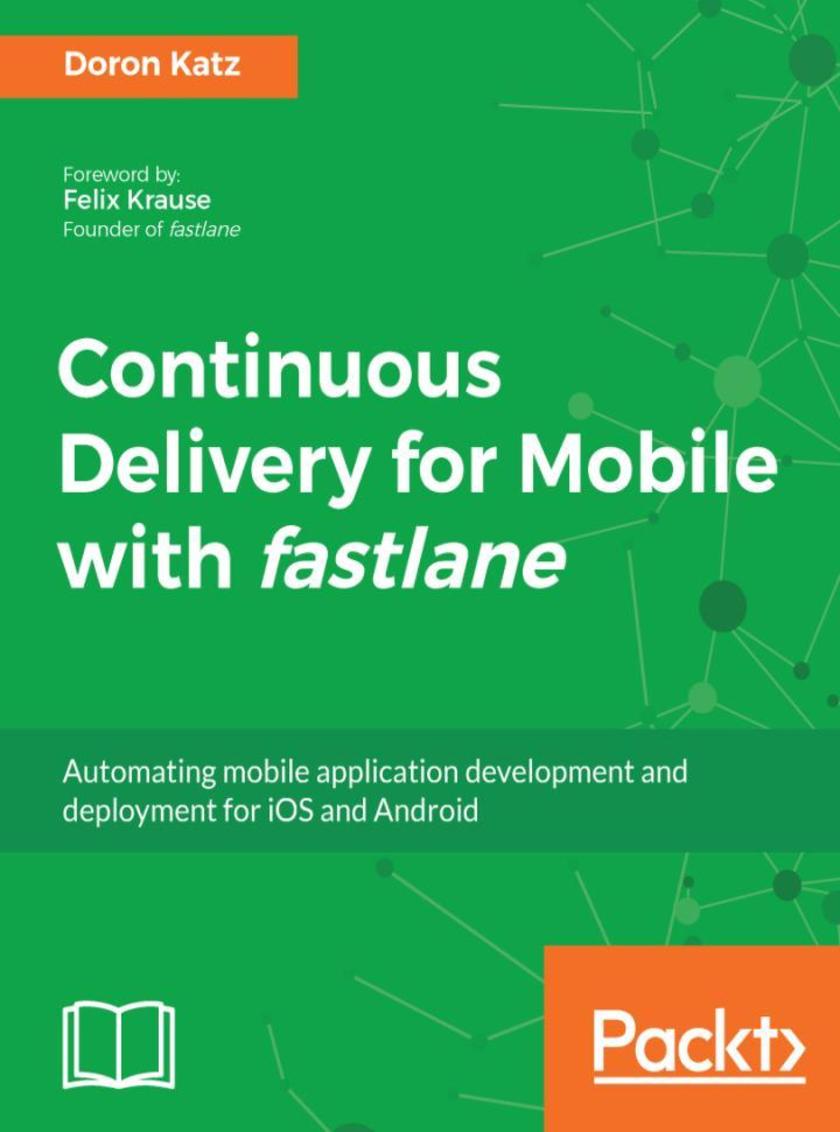
Continuous Delivery for Mobile with fastlane
¥81.74
Learn continuous deployment and automation with code-signing, continuous testing, building, deploying, and releasing of your app. About This Book ? A practical guide on automating your mobile development pipeline with Fastlane, Jenkins, and Slack. ? Build, test, run and deploy your mobile application release with this end to end guide. ? Implement Continuous Integration, delivery, and deployment practices to optimize your application development workflow for faster and efficient release builds. Who This Book Is For This book is intended for mobile developers who are keen on incorporating Continuous integration and deployment practices in their workflow. What You Will Learn ? Harness the fastlane tools for the Continuous Deployment strategy ? Integrate Continuous Deployment with existing Continuous Integration. ? Automate upload of screenshots across all device screen-sizes ? Manage push notifications, provisioning profiles, and code-signing certificates ? Orchestrate automated build and deployments of new versions of your app ? Regulate your TestFlight users and on-board new testers In Detail Competitive mobile apps depend strongly on the development team’s ability to deliver successful releases, consistently and often. Although continuous integration took a more mainstream priority among the development industry, companies are starting to realize the importance of continuity beyond integration and testing. This book starts off with a brief introduction to fastlane—a robust command-line tool that enables iOS and Android developers to automate their releasing workflow. The book then explores and guides you through all of its features and utilities; it provides the reader a comprehensive understanding of the tool and how to implement them. Themes include setting up and managing your certificates and provisioning and push notification profiles; automating the creation of apps and managing the app metadata on iTunes Connect and the Apple Developer Portal; and building, distributing and publishing your apps to the App Store. You will also learn how to automate the generation of localized screenshots and mesh your continuous delivery workflow into a continuous integration workflow for a more robust setup. By the end of the book, you will gain substantial knowledge on delivering bug free, developer-independent, and stable application release cycle. Style and approach A step by step guide taking the readers through all the tools of fastlane.


