


 购物车
购物车 个人中心
个人中心
At the Foot of the Rainbow
¥8.09
At the Foot of the Rainbow
A Daughter of the Land
¥8.09
A Daughter of the Land
The Life of George Washington: All Five Volumes in a Single File
¥8.09
The Life of George Washington: All Five Volumes in a Single File
The Twenty-Fourth of June
¥8.09
The Twenty-Fourth of June
Les Trois Mousquetaires
¥8.09
Vreau s? cred c? drumul lui Eugenio Barba este cel ?n care ?nt?lne?te copacul de care at?rn? pe creanga cea mai de sus un m?r de aur ?i f?r? s? ?i pese de cei din jurul lui, de privirile lor arogante sau sc?nteind a dispre?, se ca??r? ?n copac, ?n plin? lumin? de zi, ?i culege m?rul. M?rul norocos al destinului. Curaj, perseveren??, credin?? de nezdruncinat ?n vocea l?untrului care mereu ?i ?opte?te drumul pe care s?-l urmeze, c?ci este drumul lui.Eugenio Barba, vizionar, reformator, artist, dramaturg-regizor, maestru, scriitor, ?n dramaturgia sa, ?n cuvintele sale imortalizate ?n reflec?ii asupra sensului ?i condi?iei artei teatrului ?i a artistului, ?n cercet?rile de natur? artistic? ?i ?tiin?ific?, ?n laboratorul de teatru, sesiunile ?colii Interna?ionale de Antropologie Teatral? forjeaz? un act artistic unificator prin coprezen?e ale contrariilor, ?ntrup?ri ale simultaneit??ilor, combin?ri temporale ?i spa?iale, dintre trecut ?i viitor, dintre Est ?i Vest, declan??nd ?o revolu?ie copernician? f?r? de care ?tiin?a teatrului de la sf?r?itul secolului XX ar fi incomprehensibil?“. (Diana Cozma)
Strictly Business: More Stories of the Four Million
¥8.09
According to Wikipedia: "O. Henry was the pen name of American writer William Sydney Porter (September 11, 1862 – June 5, 1910). O. Henry short stories are known for wit, wordplay, warm characterization and clever twist endings…. Most of O. Henry's stories are set in his own time, the early years of the 20th century. Many take place in New York City, and deal for the most part with ordinary people: clerks, policemen, waitresses. Fundamentally a product of his time, O. Henry's work provides one of the best English examples of catching the entire flavor of an age. Whether roaming the cattle-lands of Texas, exploring the art of the "gentle grafter," or investigating the tensions of class and wealth in turn-of-the-century New York, O. Henry had an inimitable hand for isolating some element of society and describing it with an incredible economy and grace of language. Some of his best and least-known work resides in the collection Cabbages and Kings, a series of stories which each explore some individual aspect of life in a paralytically sleepy Central American town while each advancing some aspect of the larger plot and relating back one to another in a complex structure which slowly explicates its own background even as it painstakingly erects a town which is one of the most detailed literary creations of the period. The Four Million is another collection of stories. It opens with a reference to Ward McAllister's "assertion that there were only 'Four Hundred' people in New York City who were really worth noticing. But a wiser man has arisen—the census taker—and his larger estimate of human interest has been preferred in marking out the field of these little stories of the 'Four Million.'" To O. Henry, everyone in New York counted. He had an obvious affection for the city, which he called "Bagdad-on-the-Subway,"
Varied Types
¥8.09
Collection of essays (many of the essays from the collection "Twelve Types", plus more). According to Wikipedia: "Gilbert Keith Chesterton (1874 - 1936) was an influential English writer of the early 20th century. His prolific and diverse output included journalism, philosophy, poetry, biography, Christian apologetics, fantasy and detective fiction. Chesterton has been called the "prince of paradox."[1] He wrote in an off-hand, whimsical prose studded with startling formulations. For example: "Thieves respect property. They merely wish the property to become their property that they may more perfectly respect it."[2] He is one of the few Christian thinkers who are equally admired and quoted by both liberal and conservative Christians, and indeed by many non-Christians. Chesterton's own theological and political views were far too nuanced to fit comfortably under the "liberal" or "conservative" banner."
Complete Poetical Works
¥8.09
Collection of poetry. According to Wikipedia: "Bret Harte (August 25, 1836[2] – May 6, 1902) was an American author and poet, best remembered for his accounts of pioneering life in California. He was born in Albany, New York. ... He moved to California in 1853, later working there in a number of capacities, including miner, teacher, messenger, and journalist. He spent part of his life in the northern California coast town now known as Arcata, then just a mining camp on Humboldt Bay. His first literary efforts, including poetry and prose, appeared in The Californian, an early literary journal edited by Charles Henry Webb. In 1868 he became editor of The Overland Monthly, another new literary magazine, but this one more in tune with the pioneering spirit of excitement in California. His story, "The Luck of Roaring Camp," appeared in the magazine's second edition, propelling Harte to nationwide fame... Determined to pursue his literary career, in 1871 he and his family traveled back East, to New York and eventually to Boston, where he contracted with the publisher of The Atlantic Monthly for an annual salary of $10,000, "an unprecedented sum at the time." His popularity waned, however, and by the end of 1872 he was without a publishing contract and increasingly desperate. He spent the next few years struggling to publish new work (or republish old), delivering lectures about the gold rush, and even selling an advertising jingle to a soap company. In 1878 Harte was appointed to the position of United States Consul in the town of Krefeld, Germany and then to Glasgow in 1880. In 1885 he settled in London. During the thirty years he spent in Europe, he never abandoned writing, and maintained a prodigious output of stories that retained the freshness of his earlier work. He died in England in 1902 of throat cancer and is buried at Frimley."
The New Arabian Nights
¥8.09
Collection of short stories, including: The Suicide Club, The Rajah's Diamond, The Pavilion on the Links, A Lodging for the Night - a Story of Francis Villon, The Sire de Maletroit's Door, and Providence and the Guitar. According to Wikipedia: "Robert Louis (Balfour) Stevenson ( 1850 - 1894), was a Scottish novelist, poet, and travel writer, and a leading representative of Neo-romanticism in English literature. He was the man who "seemed to pick the right word up on the point of his pen, like a man playing spillikins", as G. K. Chesterton put it. He was also greatly admired by many authors, including Jorge Luis Borges, Ernest Hemingway, Rudyard Kipling, Vladimir Nabokov, and J. M. Barrie. Most modernist writers dismissed him, however, because he was popular and did not write within their definition of modernism. It is only recently that critics have begun to look beyond Stevenson's popularity and allow him a place in the canon."

Drift from Two Shores, collection of stories
¥8.09
Collection of stories, including: The Man on the Beach, Two Saints of the Foot-Hills, "Jinny", Roger Catron's Friend, "Who Was My Quiet Friend?", The Hoodlum Band, The Man Whose Yoke Was Not Easy, My Friend the Tramp, The man from Solano, The Office Seeker, A Sleeping-Car Experience, Morning on the Avenue, and With the Entrees. According to Wikipedia: "Bret Harte (August 25, 1836[2] – May 6, 1902) was an American author and poet, best remembered for his accounts of pioneering life in California. He was born in Albany, New York. ... He moved to California in 1853, later working there in a number of capacities, including miner, teacher, messenger, and journalist. He spent part of his life in the northern California coast town now known as Arcata, then just a mining camp on Humboldt Bay. His first literary efforts, including poetry and prose, appeared in The Californian, an early literary journal edited by Charles Henry Webb. In 1868 he became editor of The Overland Monthly, another new literary magazine, but this one more in tune with the pioneering spirit of excitement in California. His story, "The Luck of Roaring Camp," appeared in the magazine's second edition, propelling Harte to nationwide fame... Determined to pursue his literary career, in 1871 he and his family traveled back East, to New York and eventually to Boston, where he contracted with the publisher of The Atlantic Monthly for an annual salary of $10,000, "an unprecedented sum at the time." His popularity waned, however, and by the end of 1872 he was without a publishing contract and increasingly desperate. He spent the next few years struggling to publish new work (or republish old), delivering lectures about the gold rush, and even selling an advertising jingle to a soap company. In 1878 Harte was appointed to the position of United States Consul in the town of Krefeld, Germany and then to Glasgow in 1880. In 1885 he settled in London. During the thirty years he spent in Europe, he never abandoned writing, and maintained a prodigious output of stories that retained the freshness of his earlier work. He died in England in 1902 of throat cancer and is buried at Frimley."
La Morte Darthur
¥8.09
According to Wikipedia: "a compilation by Sir Thomas Malory of Romance tales about the legendary King Arthur, Guinevere, Lancelot, and the Knights of the Round Table. Malory interprets existing French and English stories about these figures and adds original material (the Gareth story). First published in 1485 by William Caxton, Le Morte d'Arthur is today perhaps the best-known work of Arthurian literature in English. Many modern Arthurian writers have used Malory as their principal source, including T. H. White in his popular The Once and Future King and Tennyson in The Idylls of the King... Sir Thomas Malory (c. 1405 – 14 March 1471) was an English writer, the author or compiler of Le Morte d'Arthur. The antiquary John Leland (1506–1552) believed him to be Welsh, but most modern scholars, beginning with G.L. Kittridge in 1894, assume that he was Sir Thomas Malory of Newbold Revel in Warwickshire, who was a knight, land-owner and Member of Parliament. The surname appears in various spellings, including Maillorie, Mallory, Mallery, and Maleore. The name comes from the Old French adjective maleüré (from Latin male auguratus) meaning ill-omened or unfortunate."
The Adventures of Bobby Orde
¥8.09
According to Wikipedia: "Stewart Edward White (12 March 1873 – September 18, 1946) was an American author... From about 1900 until about 1922, he wrote fiction and non-fiction about adventure and travel, with an emphasis on natural history and outdoor living. Starting in 1922, he and his wife Elizabeth "Betty" Grant White wrote numerous books they claimed were received through channelling with spirits. They also wrote of their travels around the state of California... White's books were popular at a time when America was losing its vanishing wilderness. He was a keen observer of the beauties of nature and human nature, yet could render them in a plain-spoken style. Based on his own experience, whether writing camping journals or Westerns, he included pithy and fun details about cabin-building, canoeing, logging, gold-hunting, and guns and fishing and hunting. "

Trent's Trust and Other Stories
¥8.09
Collection of western stories, including: Trent's Trust, Mr. MacGlowrie's Widow, A Ward of Colonel Starbottle, Prosper's "Old Mother", The Convalescence of Jack Hamlin, A Pupil of Chestnut Ridge, and Dick Boyle's Business Card. According to Wikipedia: "Bret Harte (August 25, 1836 – May 6, 1902) was an American author and poet, best remembered for his accounts of pioneering life in California. He was born in Albany, New York. ... He moved to California in 1853, later working there in a number of capacities, including miner, teacher, messenger, and journalist. He spent part of his life in the northern California coast town now known as Arcata, then just a mining camp on Humboldt Bay. His first literary efforts, including poetry and prose, appeared in The Californian, an early literary journal edited by Charles Henry Webb. In 1868 he became editor of The Overland Monthly, another new literary magazine, but this one more in tune with the pioneering spirit of excitement in California. His story, "The Luck of Roaring Camp," appeared in the magazine's second edition, propelling Harte to nationwide fame... Determined to pursue his literary career, in 1871 he and his family traveled back East, to New York and eventually to Boston, where he contracted with the publisher of The Atlantic Monthly for an annual salary of $10,000, "an unprecedented sum at the time." His popularity waned, however, and by the end of 1872 he was without a publishing contract and increasingly desperate. He spent the next few years struggling to publish new work (or republish old), delivering lectures about the gold rush, and even selling an advertising jingle to a soap company. In 1878 Harte was appointed to the position of United States Consul in the town of Krefeld, Germany and then to Glasgow in 1880. In 1885 he settled in London. During the thirty years he spent in Europe, he never abandoned writing, and maintained a prodigious output of stories that retained the freshness of his earlier work. He died in England in 1902 of throat cancer and is buried at Frimley."
Works of Edmund Burke
¥8.09
Edition first published in 1887. According to Wikipedia: "Edmund Burke (1729-1797) was an Irish statesman, author, orator, political theorist, and philosopher, who served for many years in the British House of Commons as a member of the Whig party. He is mainly remembered for his support of the American colonies in the dispute with King George III and Great Britain that led to the American Revolution and for his strong opposition to the French Revolution... Burke also published philosophical works on aesthetics and founded the Annual Register, a political review. He is often regarded by conservatives as the Father of Anglo-American conservatism."

Jurgen
¥8.09
According to Wikipedia: "James Branch Cabell (1879 - 1958) was an American author of fantasy fiction and belles lettres... Cabell's work was thought of very highly by a number of his peers, including Mark Twain, Sinclair Lewis, H. L. Mencken, Joseph Hergesheimer, and Jack Woodford. When Twain died he was reading Cabell's Chivalry. And although now largely forgotten by the general public, his work was remarkably influential on later authors of fantastic fiction... Cabell's eighth (and best-known) book, Jurgen, A Comedy of Justice (1919), was the subject of a celebrated obscenity case shortly after its publication. The eponymous hero, who considers himself a "monstrous clever fellow", embarks on a journey through ever more fantastic realms, even to hell and heaven. Everywhere he goes, he winds up seducing the local women, even the Devil's wife."
Baree, Son of Kazan
¥8.09
According to Wikipedia: "Baree, Son of Kazan is the eponymous name of a 1917 novel about a wild wolfling pup named Baree. It was written by James Oliver Curwood as the sequel to Kazan. Baree, Son of Kazan is a story about a wild wolfdog pup sired by Kazan (1/4 wolf, 3/4 dog) and born of blind Greywolf (pure wolf). This story is about Baree's survival after being separated from his parents as a young pup. He eventually finds himself in the care of Nepeese and her father Pierrot, a trapper. He bonds with Nepeese, and the story goes from there. James Oliver Curwood took the well used "a boy and his dog" formula, and created a great adventure story about a girl and her dog. A successful formula featuring a strong heroine, rather than a male hero, that he used in many of his stories."
Renaissance in Italy: The Age of the Despots
¥8.09
According to Wikipedia: "John Addington Symonds (5 October 1840 - 19 April 1893) was an English poet and literary critic… Meanwhile he was occupied with his major work, Renaissance in Italy, which appeared in seven volumes at intervals between 1875 and 1886. The Renaissance had been the subject of Symonds' prize essay at Oxford, and this had aroused a desire to produce a more complete picture of the reawakening of art and literature in Europe... He practically made his home at Davos. A charming picture of his life there is drawn in Our Life in the Swiss Highlands (1891). Symonds became a citizen of the town; he took part in its municipal business, made friends with the peasants and shared their interests. There he wrote most of his books: biographies of Shelley (1878), Philip Sidney (1886), Ben Jonson (1886) and Michelangelo (1893), several volumes of poetry and essays, and a translation of the Autobiography of Benvenuto Cellini (1887). There, too, he completed his study of the Renaissance, the work for which he is mainly remembered."
Ancient Allen
¥8.09
Adventure novel, first published in 1920. According to Wikipedia: "Sir Henry Rider Haggard (1856 – 1925), was a prolific writer of adventure novels set in exotic locations, predominantly Africa. He was also involved in agricultural reform around the British Empire. His stories, situated at the lighter end of Victorian literature, continue to be popular and influential to this day."
A Modern Telemachus
¥8.09
An historical novel of maritime adventure. According to Wikipedia: "Charlotte Mary Yonge ( 1823 - 1901), was an English novelist, known for her huge output, now mostly out of print. ... She began writing in 1848, and published during her long life about 100 works, chiefly novels. ... Among the best known of her works are The Heir of Redclyffe, Heartsease, and The Daisy Chain. A Book of Golden Deeds is a collection of true stories of courage and self-sacrifice. She also wrote Cameos from English History, Life of John Coleridge Patteson: Missionary Bishop of the Melanesian Islands and Hannah More.... Although Yonge's work is largely out of print today, during her lifetime she was admired and respected by such notable literary figures as Alfred Tennyson and Henry James, and strongly influenced the Pre-Raphaelite Brotherhood, especially William Morris and D. G. Rossetti."
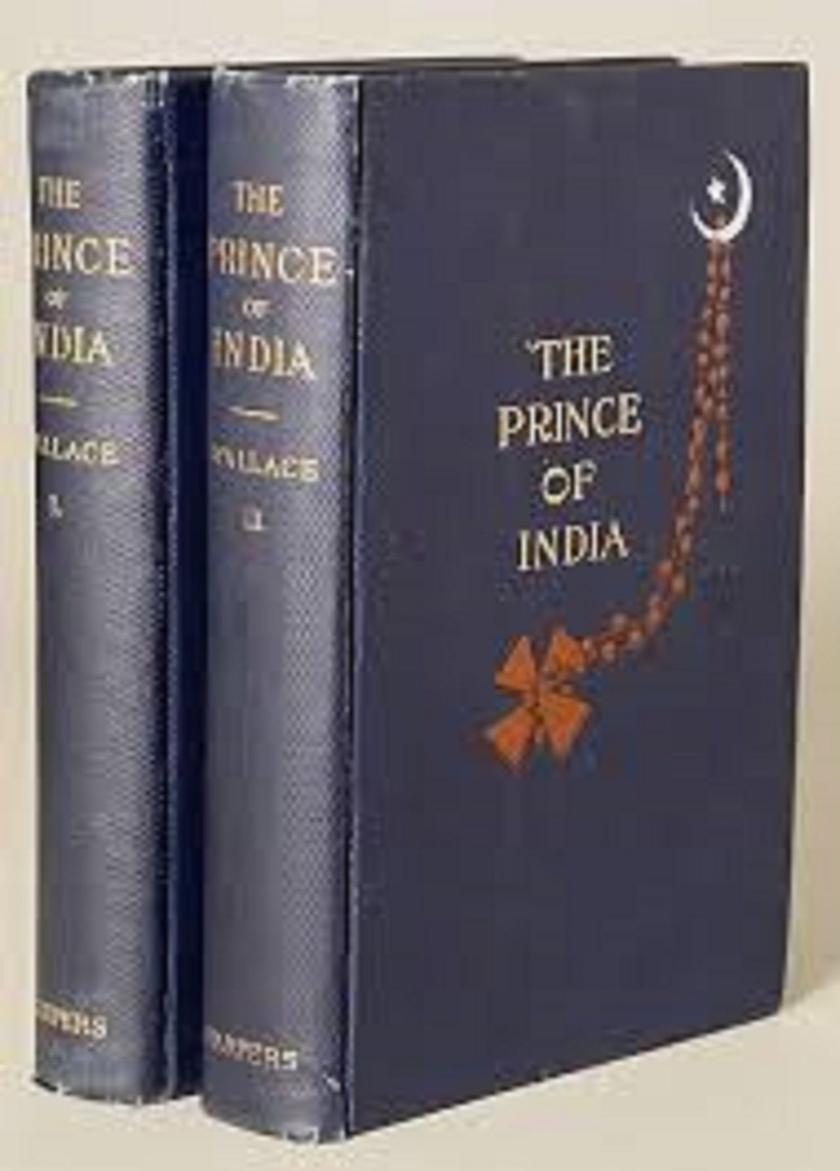
The Prince of India
¥8.09
According to Wikipedia: "Lewis "Lew" Wallace (April 10, 1827 – February 15, 1905) was a lawyer, governor, Union general in the American Civil War, American statesman, and author, best remembered for his historical novel Ben-Hur: A Tale of the Christ… Wallace's most notable service came in July 1864, at the Battle of Monocacy, part of the Valley Campaigns of 1864. Although the force under his command (amalgamated from the Middle Department) and the division of James B. Ricketts from VI Corps was defeated by Confederate General Jubal A. Early, he was able to delay Early's advance toward Washington, D.C., to the point that the city defenses had time to organize and repel Early... Wallace participated in the military commission trial of the Lincoln assassination conspirators as well as the court-martial of Henry Wirz, commandant of the Andersonville prison camp.[4] He resigned from the army on November 30, 1865.[5] Late in the war, he directed secret efforts by the government to help the Mexicans remove the French occupation forces who had seized control of Mexico in 1864. He continued in those efforts more publicly after the war and was offered a major general's commission in the Mexican army after his resignation from the U.S. Army. Multiple promises by the Mexican revolutionaries were never delivered, which forced Wallace into deep financial debt. Wallace held a number of important political posts during the 1870s and 1880s. He served as governor of New Mexico Territory from 1878 to 1881, and as U.S. Minister to the Ottoman Empire from 1881 to 1885. As governor, he offered amnesty to many men involved in the Lincoln County War; in the process he met with Billy the Kid. On March 17, 1879, the pair arranged that the Kid would act as an informant and testify against others involved in the Lincoln County War, and, in return, the Kid would be "scot free with a pardon in [his] pocket for all [his] misdeeds". But the Kid returned to his outlaw ways and Governor Wallace withdrew his offer. While serving as governor, Wallace completed the novel that made him famous: Ben-Hur: A Tale of the Christ (1880). It grew to be the best-selling American novel of the 19th century.[6] The book has never been out of print and has been filmed four times."
True Evangelism or Winning Souls by Prayer
¥8.09
According to Wikipedia: "Lewis Sperry Chafer (February 27, 1871 – August 22, 1952) was the founder and first president of Dallas Theological Seminary, and an influential founding member of modern Christian Dispensationalism.


