


 购物车
购物车 个人中心
个人中心

The Will to Believe and Other Essays in Popular Philosophy
¥8.09
According to Wikipedia: ""The Will to Believe" is a lecture by William James, first published in 1896, which defends, in certain cases, the adoption of a belief without prior evidence of its truth. In particular, James is concerned in this lecture about defending the rationality of religious faith even lacking sufficient evidence of religious truth. James' central argument in "The Will to Believe" hinges on the idea that access to the evidence for whether or not certain beliefs are true depends crucially upon first adopting those beliefs without evidence. As an example, James argues that it can be rational to have unsupported faith in one's own ability to accomplish tasks that require confidence. Importantly, James points out that this is the case even for pursuing scientific inquiry. James then argues that like belief in one's own ability to accomplish a difficult task, religious faith can also be rational even if one at the time lacks evidence for the truth of one's religious belief.
From Sail to Steam
¥8.09
Classic work of history. According to Wikipedia: "Alfred Thayer Mahan (September 27, 1840 - December 1, 1914) was a United States Navy officer, geostrategist, and educator. His ideas on the importance of sea power influenced navies around the world, and helped prompt naval buildups before World War I. Several ships were named USS Mahan, including the lead vessel of a class of destroyers. His research into naval History led to his most important work, The Influence of Seapower Upon History, 1660-1783, published in 1890."
American Notes
¥8.09
Dodo Collections brings you another classic from Charles Dickens, ‘American Notes.’ ? American Notes is a fascinating account of nineteenth-century America sketched with Charles Dickens's characteristic wit and charm. When Charles Dickens set out for America in 1842 he was the most famous man of his day to travel there - curious about the revolutionary new civilization that had captured the English imagination. His frank and often humorous descriptions cover everything from his comically wretched sea voyage to his sheer astonishment at the magnificence of the Niagara Falls, while he also visited hospitals, prisons and law courts and found them exemplary. But Dickens's opinion of America as a land ruled by money, built on slavery, with a corrupt press and unsavoury manners, provoked a hostile reaction on both sides of the Atlantic. American Notes is an illuminating account of a great writer's revelatory encounter with the New World ? Charles Dickens was an English writer and social critic. He created some of the world's best-known fictional characters and is regarded as the greatest novelist of the Victorian era. His works enjoyed unprecedented popularity during his lifetime, and by the twentieth century critics and scholars had recognised him as a literary genius. His novels and short stories enjoy lasting popularity. Born in Portsmouth, Dickens left school to work in a factory when his father was incarcerated in a debtors' prison. Despite his lack of formal education, he edited a weekly journal for 20 years, wrote 15 novels, five novellas, hundreds of short stories and non-fiction articles, lectured and performed extensively, was an indefatigable letter writer, and campaigned vigorously for children's rights, education, and other social reforms. ? A prolific 19th Century author of short stories, plays, novellas, novels, fiction and non-fiction; during his lifetime Dickens became known the world over for his remarkable characters, his mastery of prose in the telling of their lives, and his depictions of the social classes, morals and values of his times. Some considered him the spokesman for the poor, for he definitely brought much awareness to their plight, the downtrodden and the have-nots. He had his share of critics, like Virginia Woolf and Henry James, but also many admirers, even into the 21st Century.
Jacob’s Room by Virginia Woolf - Delphi Classics (Illustrated)
¥8.09
This eBook features the unabridged text of ‘Jacob’s Room by Virginia Woolf - Delphi Classics (Illustrated)’ from the bestselling edition of ‘The Complete Works of Virginia Woolf’. Having established their name as the leading publisher of classic literature and art, Delphi Classics produce publications that are individually crafted with superior formatting, while introducing many rare texts for the first time in digital print. The Delphi Classics edition of Woolf includes original annotations and illustrations relating to the life and works of the author, as well as individual tables of contents, allowing you to navigate eBooks quickly and easily. eBook features: * The complete unabridged text of ‘Jacob’s Room by Virginia Woolf - Delphi Classics (Illustrated)’ * Beautifully illustrated with images related to Woolf’s works * Individual contents table, allowing easy navigation around the eBook * Excellent formatting of the text Please visit www.delphiclassics.com to learn more about our wide range of titles

Is Life Worth Living Without Immortality?
¥8.09
Dodo Collections brings you another classic from M. M. Mangasarian, ‘Is Life Worth Living Without Immortality?’ ? This book is based upon the famous lecture delivered before the Independent Religious Society, Chicago?by Mangasarian. ? Born in Mashger (now within Turkey) in the Ottoman Empire, M. M. Mangasarian attended Robert College in Constantinople, and was ordained as minister in Marsovan in 1878. In about 1880 he enrolled at Princeton University. He was pastor at a Presbyterian church in Philadelphia from 1882 to 1885, when he resigned, becoming an independent preacher and a lecturer on "independent religion" in New York. In 1892 he became leader of the Ethical Culture Society of Chicago, a group established by Felix Adler. In 1900 he organized the Independent Religious Society of Chicago, a rationalist group, of which he remained pastor until 1925. He retired to Piedmont, California, where he lived for the rest of his life. ? During his life Mangasarian wrote a number of books. His most popular, including The Truth About Jesus — Is He a Myth? (1909) and The Bible Unveiled (1911), deal with the evidence against the existence of an historical Jesus. He also wrote hundreds of essays and lectures on questions of the times. His books and essays were translated into French, German, Spanish, and other foreign languages. The general subject of his writing was religious criticism and the philosophy of religion. ? Mangasarian considered himself a Rationalist or a Secularist not an Atheist, since he considered atheism a non-verifiable belief system.
Experiences of a Dug-out: 1914-1918
¥8.09
A different commentary on the First World War, this memoir is a compelling and insightful not from a soldier who has served in the front line but rather from a man who served in the war office. Thoroughly compulsive reading, putting so much into context and giving great insight into the major strategic decisions of the First World War.
France at War: On the Frontier of Civilisation
¥8.09
Dodo Collections brings you another classic from Rudyard Kipling, ‘France at War: On the Frontier of Civilisation.’ ? In 1915, in the second year of the Great War, Kipling made a tour as a journalist on the front of some of the French armed forces. His report of what he had seen of the military activity was published in six articles in the Daily Telegraph, in England, and in the New York Sun. He published some (censored) articles of war journalism in 1915, collected as The New Army in Training and France at War. ? Kipling's works of fiction include The Jungle Book (1894), Kim (1901), and many short stories, including "The Man Who Would Be King" (1888). His poems include "Mandalay" (1890), "Gunga Din" (1890), "The Gods of the Copybook Headings" (1919), "The White Man's Burden" (1899), and "If—" (1910). He is regarded as a major innovator in the art of the short story; his children's books are classics of children's literature; and one critic described his work as exhibiting "a versatile and luminous narrative gift". ? Kipling was one of the most popular writers in England, in both prose and verse, in the late 19th and early 20th centuries. Henry James said: "Kipling strikes me personally as the most complete man of genius (as distinct from fine intelligence) that I have ever known." In 1907, he was awarded the Nobel Prize in Literature, making him the first English-language writer to receive the prize, and its youngest recipient to date Among other honours, he was sounded out for the British Poet Laureateship and on several occasions for a knighthood, all of which he declined

The Social Contract
¥8.09
According to Wikipedia: "Of The Social Contract, Or Principles of Political Right (Du contrat social ou Principes du droit politique; 1762) by Jean-Jacques Rousseau is a book in which Rousseau theorized about the best way to establish a political community in the face of the problems of commercial society, which he had already identified in his Discourse on Inequality (1754). The Social Contract helped inspire political reforms or revolutions in Europe, especially in France. The Social Contract argued against the idea that monarchs were divinely empowered to legislate; as Rousseau asserts, only the people, who are sovereign, have that all-powerful right... Jean-Jacques Rousseau (28 June 1712 – 2 July 1778) was a Genevan philosopher, writer, and composer of the 18th century. His political philosophy influenced the French Revolution as well as the overall development of modern political, sociological, and educational thought. Rousseau's novel Emile, or On Education is a treatise on the education of the whole person for citizenship. His sentimental novel Julie, or the New Heloise was of importance to the development of pre-romanticism and romanticism in fiction. Rousseau's autobiographical writings — his Confessions, which initiated the modern autobiography, and his Reveries of a Solitary Walker — exemplified the late 18th-century movement known as the Age of Sensibility, and featured an increased focus on subjectivity and introspection that later characterized modern writing. His Discourse on Inequality and The Social Contract are cornerstones in modern political and social thought."
The Meditations of Marcus Aurelius
¥18.56
Marcus Aurelius was a Roman Emperor from 161 to 180. He ruled with Lucius Verus as co-emperor from 161 until Verus' death in 169. He was the last of the Five Good Emperors, and is also considered one of the most important Stoic philosophers. During his reign, the Empire defeated a revitalized Parthian Empire in the East; Aurelius' general Avidius Cassius sacked the capital Ctesiphon in 164. In central Europe, Aurelius fought the Marcomanni, Quadi, and Sarmatians with success during the Marcomannic Wars, with the threat of the Germanic tribes beginning to represent a troubling reality for the Empire. A revolt in the East led by Avidius Cassius failed to gain momentum and was suppressed immediately. Marcus Aurelius' Stoic tome Meditations, written in Greek while on campaign between 170 and 180, is still revered as a literary monument to a philosophy of service and duty, describing how to find and preserve equanimity in the midst of conflict by following nature as a source of guidance and inspiration.
The Legend of Sleepy Hollow: English and Russian language edition
¥40.79
Sleepy Hollow is known for its ghosts and the haunting atmosphere that pervades the imaginations of its inhabitants and visitors. The most infamous spectre in the Hollow is the Headless Horseman, said to be the ghost of a Hessian trooper who had his head shot off by a stray cannonball during some nameless battle of the American Revolutionary War, and who rides forth to the scene of battle in nightly quest of his head. This edition features original English language text followed by Russian language edition for those learning Russian language or curious about this story in other languages.
Billy Budd and Other Prose Pieces by Herman Melville - Delphi Classics (Illustra
¥8.09
This eBook features the unabridged text of ‘Billy Budd and Other Prose Pieces by Herman Melville - Delphi Classics (Illustrated)’ from the bestselling edition of ‘The Complete Works of Herman Melville’. Having established their name as the leading publisher of classic literature and art, Delphi Classics produce publications that are individually crafted with superior formatting, while introducing many rare texts for the first time in digital print. The Delphi Classics edition of Melville includes original annotations and illustrations relating to the life and works of the author, as well as individual tables of contents, allowing you to navigate eBooks quickly and easily. eBook features: * The complete unabridged text of ‘Billy Budd and Other Prose Pieces by Herman Melville - Delphi Classics (Illustrated)’ * Beautifully illustrated with images related to Melville’s works * Individual contents table, allowing easy navigation around the eBook * Excellent formatting of the text Please visit www.delphiclassics.com to learn more about our wide range of titles
A Woman of Thirty by Honoré de Balzac - Delphi Classics (Illustrated)
¥8.09
This eBook features the unabridged text of ‘A Woman of Thirty by Honoré de Balzac - Delphi Classics (Illustrated)’ from the bestselling edition of ‘The Collected Works of Honoré de Balzac’. Having established their name as the leading publisher of classic literature and art, Delphi Classics produce publications that are individually crafted with superior formatting, while introducing many rare texts for the first time in digital print. The Delphi Classics edition of Balzac includes original annotations and illustrations relating to the life and works of the author, as well as individual tables of contents, allowing you to navigate eBooks quickly and easily. eBook features: * The complete unabridged text of ‘A Woman of Thirty by Honoré de Balzac - Delphi Classics (Illustrated)’ * Beautifully illustrated with images related to Balzac’s works * Individual contents table, allowing easy navigation around the eBook * Excellent formatting of the text Please visit www.delphiclassics.com to learn more about our wide range of titles
Within a Budding Grove by Marcel Proust - Delphi Classics (Illustrated)
¥8.09
This eBook features the unabridged text of ‘Within a Budding Grove by Marcel Proust - Delphi Classics (Illustrated)’ from the bestselling edition of ‘The Complete Works of Marcel Proust’. Having established their name as the leading publisher of classic literature and art, Delphi Classics produce publications that are individually crafted with superior formatting, while introducing many rare texts for the first time in digital print. The Delphi Classics edition of Proust includes original annotations and illustrations relating to the life and works of the author, as well as individual tables of contents, allowing you to navigate eBooks quickly and easily. eBook features: * The complete unabridged text of ‘Within a Budding Grove by Marcel Proust - Delphi Classics (Illustrated)’ * Beautifully illustrated with images related to Proust’s works * Individual contents table, allowing easy navigation around the eBook * Excellent formatting of the text Please visit www.delphiclassics.com to learn more about our wide range of titles
Introduction to ‘The Zoology of the Voyage of H.M.S. Beagle’ by Charles Darwin
¥8.09
This eBook features the unabridged text of ‘Introduction to ‘The Zoology of the Voyage of H.M.S. Beagle’ by Charles Darwin - Delphi Classics (Illustrated)’ from the bestselling edition of ‘The Complete Works of Charles Darwin’. Having established their name as the leading publisher of classic literature and art, Delphi Classics produce publications that are individually crafted with superior formatting, while introducing many rare texts for the first time in digital print. The Delphi Classics edition of Darwin includes original annotations and illustrations relating to the life and works of the author, as well as individual tables of contents, allowing you to navigate eBooks quickly and easily. eBook features: * The complete unabridged text of ‘Introduction to ‘The Zoology of the Voyage of H.M.S. Beagle’ by Charles Darwin - Delphi Classics (Illustrated)’ * Beautifully illustrated with images related to Darwin’s works * Individual contents table, allowing easy navigation around the eBook * Excellent formatting of the text Please visit www.delphiclassics.com to learn more about our wide range of titles
The Old Sixth Regiment:Its War Record, 1861-65
¥8.09
The object of this work is to give a true and impartial record of the old Sixth Regiment during the war. The author collected the facts from a private diary kept by himself while in the service. Less has been known of the Sixth by our citizens than most of the other regiments; perhaps this is due partly to the fact that when we arrived.in Washington Colonel Chatfield instructed officers and men that it was unmilitary to write letters for the press; he desired that the War Record should know the record of the Sixth, and not the newspapers only. Its history is less full on this account; yet none can say that the record of the Sixth is sullied. In many trying places the regiment proved itself honor ably and gained confidence from its corps and department commanders. There may be errors in this work, and if any are inclined to censure, I trust they will remember that very few histories are without them; yet they are errors of the head and not of the heart. If what is here written meets the approval of the old members and the intelligent readers in general, I shall feel that my labors have been amply rewarded.

Islamic Folklore Ababil The Flock of Birds
¥12.18
“And He sent against them birds, in flocks. Striking them with stones of Sijjil (baked clay). And made them like an empty field of stalks (of which the corn has been eaten up by cattle).”(Al-Fil: 3-5)?????????????????????????????????????????????????????????????????????? ??????????????????????????????? While meekness is a characteristic of most visual creatures in the universe, then the frightful horror constitutes a characteristic of their unknown counterparts. I will not say anything else ...I am not allowed to talk about myself. My reality encloses a secret which if it is revealed to any creature, his blood will freeze and he will cease to exist out of fright. I am one of the Ababil the Flocks of Birds, that was mentioned in the Qur'an. I am the Commander of Communications among the six wings of the Eighth Army of these birds. The number of armies is a secret as well as the number of birds in the Eighth Army. We launch wars only at the order of Almighty Allah. I will not say how many missions we have carried out, for this matter belongs only to Almighty Allah. "Every day He has a matter to bring forth (such as giving honor to some, disgrace to some, life to some, death to some, etc.)!" All what I can say is that those missions were known to the Cherisher and Sustainer of the worlds. As for us creatures, there are cascading curtains and thick barriers that separate between them and us and this is because of Allah's mercy to His servants.

Camping Blues Book 3:The Extraordinarily Ordinary Life of Cassandra Jones
¥23.14
Excited for her first camping trip with her Girls Club, Cassandra buddies up with her friend Riley and hopes their friendship will become even stronger. It only takes a few hours for her to realize Riley doesn't have Cassie's best interests at heart. Frustrated, wet, and cold, Cassie decides it's time she figured out who her true friends are once and for all.

Pretreatment Guide for Homeless Outreach & Housing First
¥48.74
This book provides social workers, outreach clinicians, case managers, and concerned community members with a pretreatment guide for assisting homeless couples, youth, and single adults. The inter-relationship between Homeless Outreach and Housing First is examined in detail to inform program development and hands on practice. Pretreatment Guide for Homeless Outreach & Housing First shares five detailed case studies from the field to elucidate effective ways of helping and to demonstrate how the most vulnerable among us can overcome trauma and homelessness. Readers will: ·Expand their assessment skills and discover new interventions for helping people who have experienced long-term or chronic homelessness. ·Understand and be able to integrate the stages of common language construction with their own practice. ·Learn about the positive measurable impact of a Housing First approach and its moral, fiscal, and quality of life implications. ·Understand how to better integrate program policy and supervision with Homeless Outreach & Housing First initiatives. ·Learn how to utilize a Pretreatment Approach with couples, youth, and unaccompanied adults experiencing untreated major mental illness and addiction. "Jay S. Levy's book is essential reading to both people new to the movement to end homelessness and folks who have been in the trenches for many years. Learn how to do effective outreach with the chronic homeless population, and the ins and outs of the Housing First model. The personal stories and the success cases will give inspiration to work even harder to help both individuals and for ending homelessness in your community." Michael Stoops, Director of Community Organizing National Coalition for the Homeless, Washington, DC Learn more at www.JaySLevy.com Another empowering book from Loving Healing Press www.LovingHealing.com
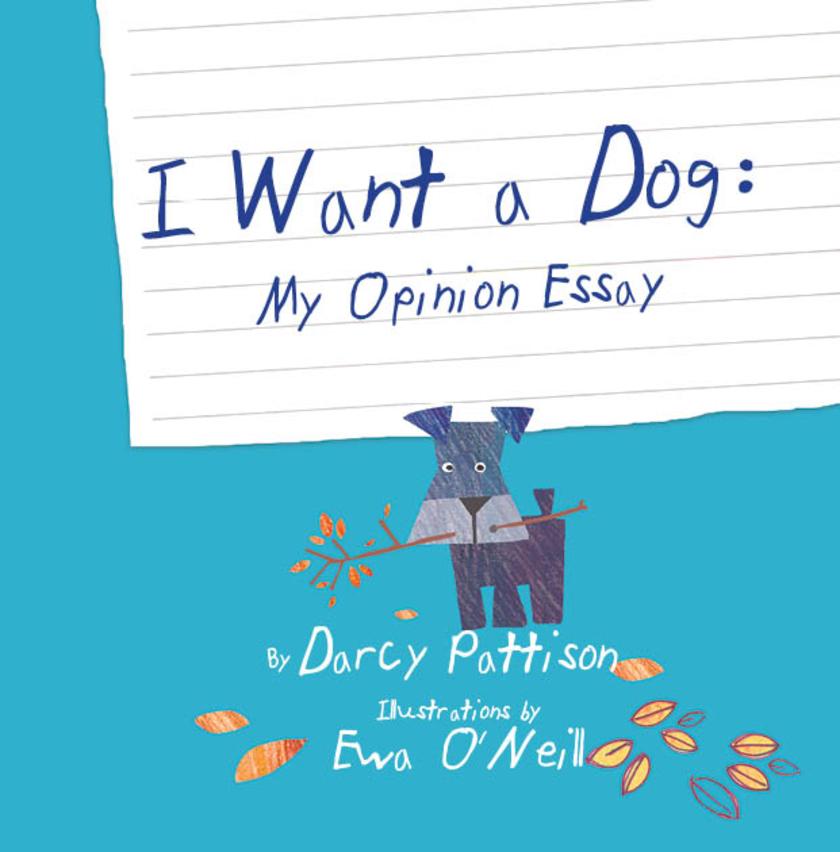
I Want a Dog:My Opinion Essay
¥24.44
Hurrah for Essays! All writing lessons should be this much fun. When cousins Dennis and Mellie decide to get a dog, they consider carefully what breed would be best for each family. For example, Dennis wants a big dog, but Mellie wants tiny. He has no other pets, but she has other pets that a dog must get along with. They consider different dog personalities, family situations, and personal preferences. Dennis writes an opinion essay for his teacher, Mrs. Shirky. But will his essay convince his parents to get the dog of his dreams? This story takes a popular subject—kids getting a pet—and adds dogs of all sizes and shapes: all writing lessons should be this much fun. In the end, it’s cousins and the dogs that keep a reader turning the page. What kind of dog will Dennis choose? Will Mellie want the same kind of dog? PRAISE FROM DOG EXPERTS “Darcy Pattison does a remarkable job on several fronts with her wonderful new book I Want A Dog: My Opinion Essay. She introduces the value of the written text at an early age to children. This cannot be emphasized enough in our early classrooms. With this comes an important lesson regarding the responsibility of owning and caring for a dog. As President of the Labrador Retriever Club representing the breed with the largest number of dogs I know how imperative responsible dog ownership is and Darcy does a wonderful job instilling this at an early age. This is a remarkable children’s book that has a lesson.” –Fred Kampo, President of the Labrador Retriever Club This story hits many notes: A family story about cousins, Dennis and Mellie Information on dog breeds Responsible dog ownership Mentor-text for teaching writing Model opinion essay for elementary students Models the writing process, especially the importance of pre-writing or planning before you write Completes the writing process by showing the results of Dennis’s essay I WANT A DOG almost makes opinion essays look too easy. For STEM classes, a good study of dog species. See other books in THE READ AND WRITE series I Want a Cat: My Opinion Essay My Crazy Dog: My Narrative Essay ABOUT THE AUTHOR Growing up, author Darcy Pattison (www.darcypattison.com) wanted to be an astronaut. Instead, she writes about aliens in her early chapter book series, ALIEN, INC. SERIES (Mims House), which includes Kell, the Alien; Kell and the Horse Apple Parade; Kell and the Giants; and Kell and the Detectives. Published in eight languages, her middle grade novels include: Saucy and Bubba: A Hansel and Gretel Tale (Mims House); The Girl, the Gypsy and the Gargoyle (Mims House); and Vagabonds (Mims House). Recent nature books for children include: Abayomi, the Brazilian Puma: The True Story of an Orphaned Cub (Mims House); Wisdom, the Midway Albatross (Mims House), a Starred Review in Publisher’s Weekly; Desert Baths (Arbordale), an NSTA Outstanding Science Trade Book 2013; and, Prairie Storms (Arbordale). Darcy Pattison is the 2007 recipient of Arkansas Governor’s Arts Awards for her work in Children’s Literature. For more see darcypattison.com/about ABOUT THE ILLUSTRATOR In her debut picture book, Ewa O’Neill (ewaoneill.com) creates art that is luscious, inventive, and colorful, bringing the story energy and humor. A dog-lover herself, Ewa (pronounced Eh-vuh) gives each breed a personality that helps kids begin to tell dog breeds apart.
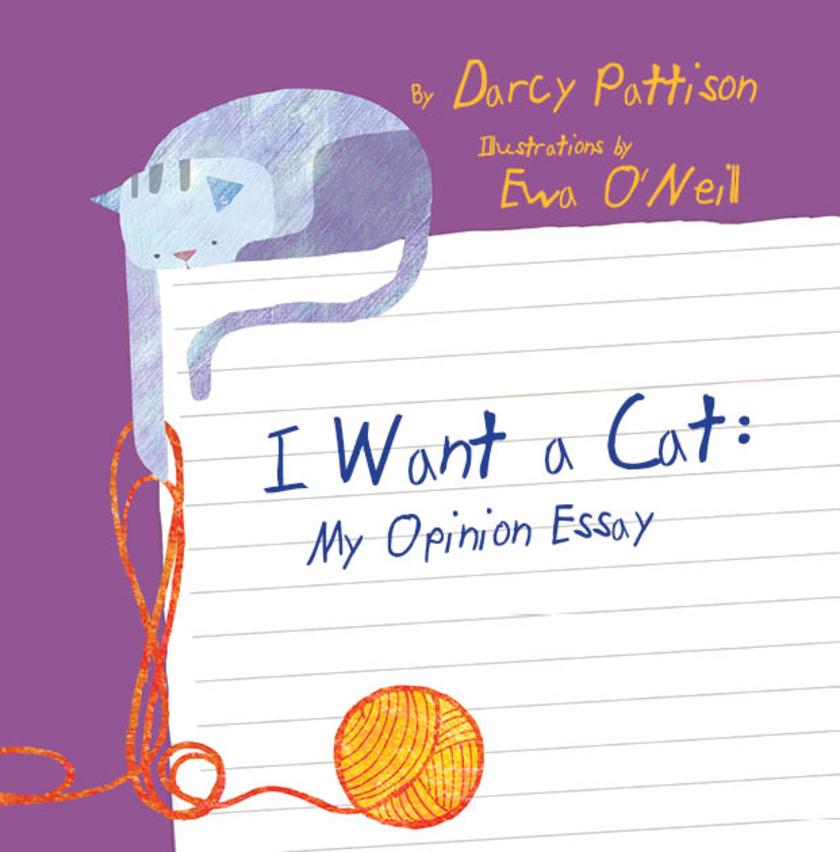
I Want a Cat:My Opinion Essay
¥24.44
Hurrah for Essays! All writing lessons should be this much fun. When cousins Mellie and Dennis decide to get a cat, they consider carefully what breed would be best for each family. For example, Mellie wants a cat that pounces, but Dennis wants a lazy cat, like his lazy dog, Clark Kent. Mellie wants a lap cat, but Dennis just wants a warm body BESIDE him. They consider different cat personalities, family situations, and personal preferences. Mellie writes an opinion essay for her teacher, Mr. Eagle. But will her essay convince her parents to get the cat of her dreams? This story takes a popular subject—kids getting a pet—and adds cats of all sizes and shapes: all writing lessons should be this much fun. In the end, it’s the cousins and the cats that keep a reader turning the page. What kind of cat will Mellie choose? Will Dennis want the same kind of cat? PRAISE FROM CAT EXPERTS “This is an absolutely delightful book intended for children, but actually one that is informative for adults as well, it reinforces the importance of considering various factors when selecting a cat as a pet. The two cousins are exchanging thoughts about their lifestyles and priorities. They each have a vision of their ‘ideal cat.’ Though every cat is an individual, the book expresses the value of predictable personality traits and other characteristics of various pedigreed cat breeds. It is a charming story of the two children each going through the process of finding a cat who best fits their own preferences. The playful illustrations compliment the humorous and educational quality of the book.” --Joan Miller, Cahir, CFA Outreach and Education, Cat Fancier’s Association This is quite simply as informative a cat book as any text out there. Each selected breed pinpoints the single most important trait to know about it before choosing a cat ‘purrfect’ for you. Although written from a child’s perspective, it makes clear sense to readers of all ages. As a cat lover and Maine Coon Cat breeder and enthusiast, I was thrilled with the spot on description and story of this beloved breed. — Alexis Mitchell, Syracoon/Furensics, Maine Coon Cat Breed Council Secretary, Maine Coon Cat breeders of CFA This story hits many notes: A family story about cousins, Dennis and Mellie Scientific information on cat breeds Responsible cat ownership Mentor-text for teaching writing Model opinion essay for elementary students Models the writing process, especially the importance of pre-writing or planning before you write Completes the writing process by showing the results of Dennis’s essay I WANT A DOG almost makes opinion essays look too easy. For STEM classes, a good study of cat species. See other books in THE READ AND WRITE series I Want a Dog: My Opinion Essay My Crazy Dog: My Narrative Essay (forthcoming) ABOUT THE AUTHOR Growing up, author Darcy Pattison (www.darcypattison.com) wanted to be an astronaut. Instead, she writes about aliens in her early chapter book series, ALIEN, INC. SERIES (Mims House), which includes Kell, the Alien; Kell and the Horse Apple Parade; Kell and the Giants; and Kell and the Detectives. Published in eight languages, her middle grade novels include: Saucy and Bubba: A Hansel and Gretel Tale (Mims House); The Girl, the Gypsy and the Gargoyle (Mims House); and Vagabonds (Mims House). Recent nature books for children include: Abayomi, the Brazilian Puma: The True Story of an Orphaned Cub (Mims House); Wisdom, the Midway Albatross (Mims House), a Starred Review in Publisher’s Weekly; Desert Baths (Arbordale), an NSTA Outstanding Science Trade Book 2013; and, Prairie Storms (Arbordale). Darcy Pattison is the 2007 recipient of Arkansas Governor’s Arts Awards for her work in Children’s Literature. For more see darcypattison.com/about ABOUT THE ILLUSTRATOR In her debut picture book, Ewa O’Neill (ewaoneill.com) creates art that is luscious, inventive, and colorful, bringing the story energy and humor. A cat-lover herself, Ewa (pronounced Eh-vuh) gives each breed a personality that helps kids begin to tell cat breeds apart.
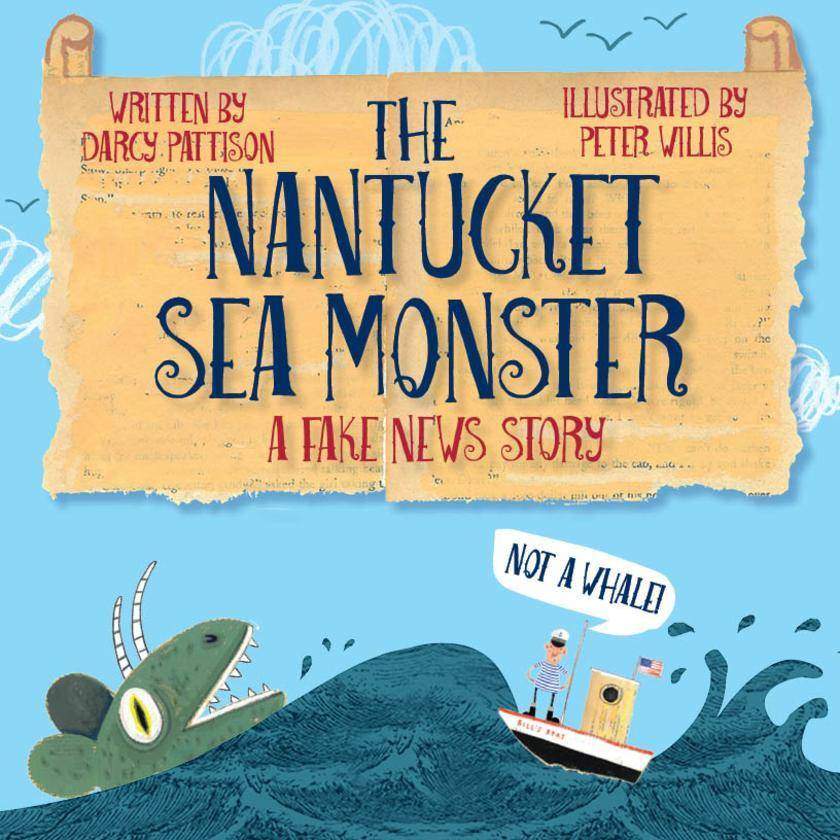
The Nantucket Sea Monster:A Fake News Story
¥40.79
A JUNIOR LIBRARY GUILD SELECTION Do you believe everything you read in the newspaper? Early in August 1937, a news flash came: a sea monster had been spotted lurking off the shore of Nantucket Island. Historically, the Massachusetts island had served as port for whaling ships. Eyewitnesses swore this wasn’t a whale, but some new, fearsome creature. As eyewitness account piled up, newspaper stories of the sea monster spread quickly. Across the nation, people shivered in fear. Then, footprints were found on a Nantucket beach. Photographs were sent to prominent biologists for their opinion. Discussion swirled about raising a hunting party. On August 18, news spread across the island: the sea monster had been captured. Islanders ran to the beach and couldn’t believe their eyes. This nonfiction picture book is a perfect tool to discuss non-political fake news stories. Back matter discusses the freedom of the press guaranteed by the First Amendment to the U.S. Constitution. Quotes from Thomas Jefferson make it clear that fake news has always been one of the costs of a free press. A Timeline lists actual events in the order they occurred. A vocabulary list defines relevant words.


