


 购物车
购物车 个人中心
个人中心

The Nihilists
¥8.09
Dodo Collections brings you another classic from Oscar Wilde, The Nihilists. The Nihilists is a play by Oscar Wilde. It is a melodramatic tragedy set in Russia and is loosely based on the life of Vera Zasulich. It was Wilde's first play, and the first to be performed. In 1880, with only a few copies privately printed, arrangements were made with noted actresses for a production the United Kingdom, but this never materialized. The first ever public performance was in New York in 1883 at the Union Square Theatre based on revisions made by Wilde while lecturing in America in 1882. The play was not a success and folded after only one week. It is rarely revived. Oscar Fingal O'Flahertie Wills Wilde (16 October 1854 – 30 November 1900) was an Irish author, playwright and poet. After writing in different forms throughout the 1880s, he became one of London's most popular playwrights in the early 1890s. He is remembered for his epigrams, his novel The Picture of Dorian Gray, his plays, as well as the circumstances of his imprisonment and early death. At the height of his fame and success, while his masterpiece, The Importance of Being Earnest (1895), was still on stage in London, Wilde had the Marquess of Queensberry prosecuted for libel. The Marquess was the father of Wilde's lover, Lord Alfred Douglas. The charge carried a penalty of up to two years in prison. The trial unearthed evidence that caused Wilde to drop his charges and led to his own arrest and trial for gross indecency with other men. After two more trials he was convicted and imprisoned for two years' hard labour. In 1897, in prison, he wrote De Profundis, which was published in 1905, a long letter which discusses his spiritual journey through his trials, forming a dark counterpoint to his earlier philosophy of pleasure. Upon his release he left immediately for France, never to return to Ireland or Britain. There he wrote his last work, The Ballad of Reading Gaol (1898), a long poem commemorating the harsh rhythms of prison life. He died destitute in Paris at the age of 46.
14 Plays
¥8.09
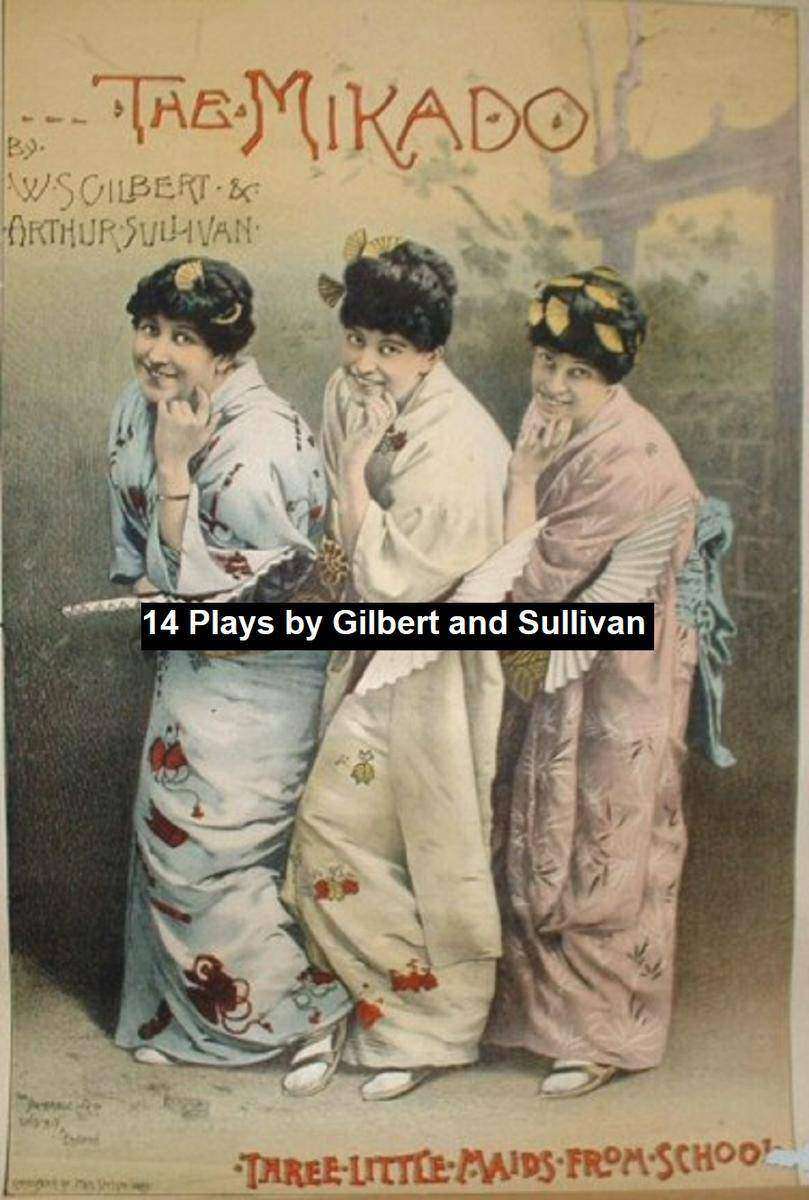
This book includes: Gondoliers, Grand Duke, H.M.S Pinafore, Iolanthe, The Mikado, Pirates of Penzance, Ruddigore, The Sorcerer, Thespis, Trial by Jury, Utopia Limited, Yeomen of the Guard, and Patience. All of these plays/operettas were written 1871 to 1896. According to Wikipedia: "Gilbert and Sullivan refers to the Victorian era partnership of librettist W. S. Gilbert (1836–1911) and composer Arthur Sullivan (1842–1900). Together, they wrote fourteen comic operas between 1871 and 1896, of which H.M.S. Pinafore, The Pirates of Penzance, and The Mikado are among the best known. Gilbert, who wrote the words, created fanciful "topsy-turvy" worlds for these operas, where each absurdity is taken to its logical conclusion—fairies rub elbows with British lords, flirting is a capital offence, gondoliers ascend to the monarchy, and pirates turn out to be noblemen who have gone wrong. Sullivan, six years Gilbert's junior, composed the music, contributing memorable melodies that could convey both humour and pathos. Producer Richard D'Oyly Carte brought Gilbert and Sullivan together and nurtured their collaboration. He built the Savoy Theatre in 1881 to present their joint works—which came to be known as the Savoy Operas—and he founded the D'Oyly Carte Opera Company, which performed and promoted their works for over a century. The Gilbert and Sullivan operas have enjoyed broad and enduring international success and are still performed frequently throughout the English-speaking world. The collaboration introduced innovations in content and form that directly influenced the development of musical theatre through the 20th century. The operas have also influenced political discourse, literature, film and television and have been widely parodied and pastiched by humorists."
The Wolves and the Lamb
¥8.09
Classic play. According to Wikipedia: "Thackeray is most often compared to one other great novelist of Victorian literature, Charles Dickens. During the Victorian era, he was ranked second only to Dickens, but he is now much less read and is known almost exclusively for Vanity Fair. In that novel he was able to satirize whole swaths of humanity while retaining a light touch. It also features his most memorable character, the engagingly roguish Becky Sharp. As a result, unlike Thackeray's other novels, it remains popular with the general reading public; it is a standard fixture in university courses and has been repeatedly adapted for movies and television. In Thackeray's own day, some commentators, such as Anthony Trollope, ranked his History of Henry Esmond as his greatest work, perhaps because it expressed Victorian values of duty and earnestness, as did some of his other later novels. It is perhaps for this reason that they have not survived as well as Vanity Fair, which satirizes those values."
The Inspector General
¥8.09
Classic satiric play. According to Wikipedia: "Nikolai Vasilievich Gogol ( 1809 - 1852) was a Russian writer of Ukrainian ethnicity. Although his early works were heavily influenced by his Ukrainian upbringing and identity, he wrote in Russian and his works belong to the tradition of Russian literature; often called the "father of modern Russian realism," he was one of the first Russian authors to criticize his country's way of life. The novels Taras Bul'ba (1835; 1842 [revised edition]), Dead Souls (1842), the play The Inspector-General (1836, 1842), and the short story The Overcoat (1842) are among his masterpieces."
Apple Cake and Baklava
¥65.32
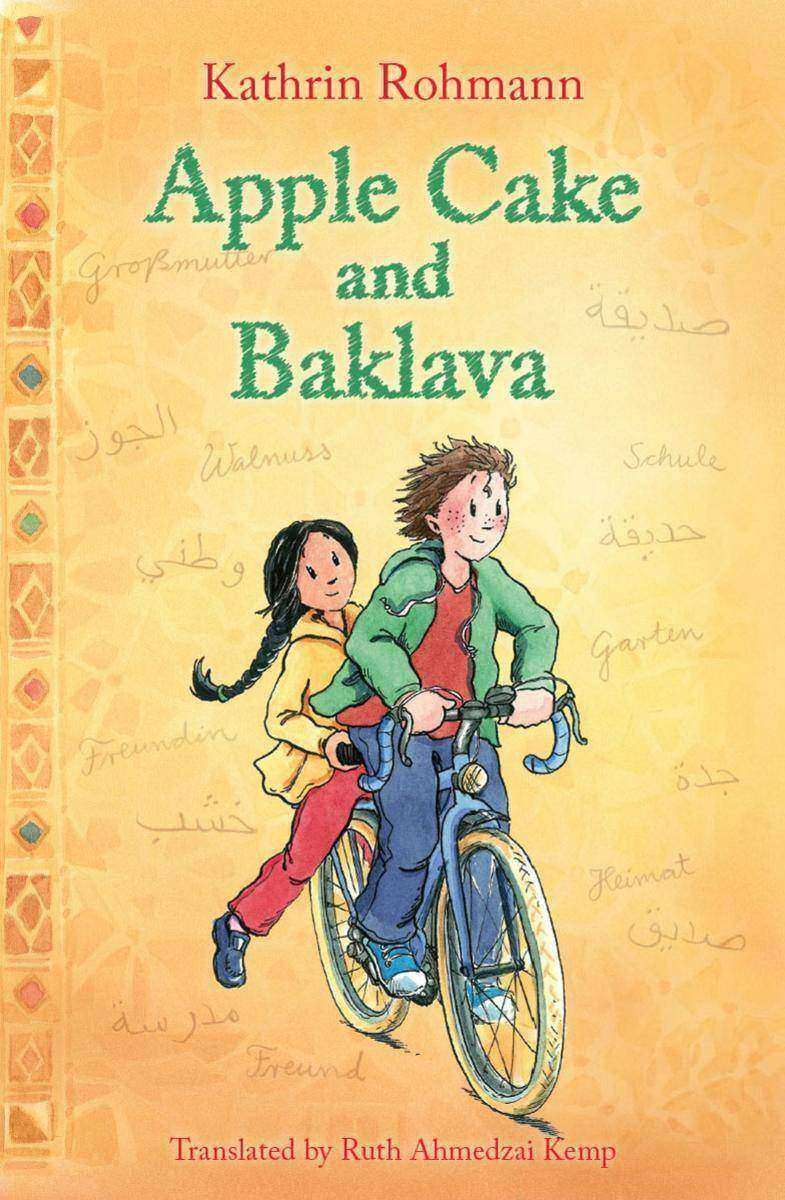
Leila is the new girl in Max’s class in rural Germany, and they soon become close friends. She has fled Syria with her family, having left her beloved grandmother and father behind. Her most cherished object is a walnut from her grandmother’s garden. Max is close to his own grandmother, who is very understanding of Leila’s situation, having fled her home in Pommern as a little girl. Leila is desperately sad when she loses her beloved walnut and, in a failed attempt, sets out to return to Syria. Apple Cake and Baklava is a story about otherness, openness and the willingness to come to know one another. Many children will be aware of the latest surge of refugees and their plight. Leila’s is a sadly universal and timeless story of leaving behind a home country forever. While set in rural Northern Germany, it could equally take place in most European countries. This is an absorbing book for older primary and younger middle-school children, and Franziska Harvey’s lovely black-and-white illustrations – some small, some full page – enrich the story.
Bebe Bulles Et Les Arcs-En-Ciel
¥31.07
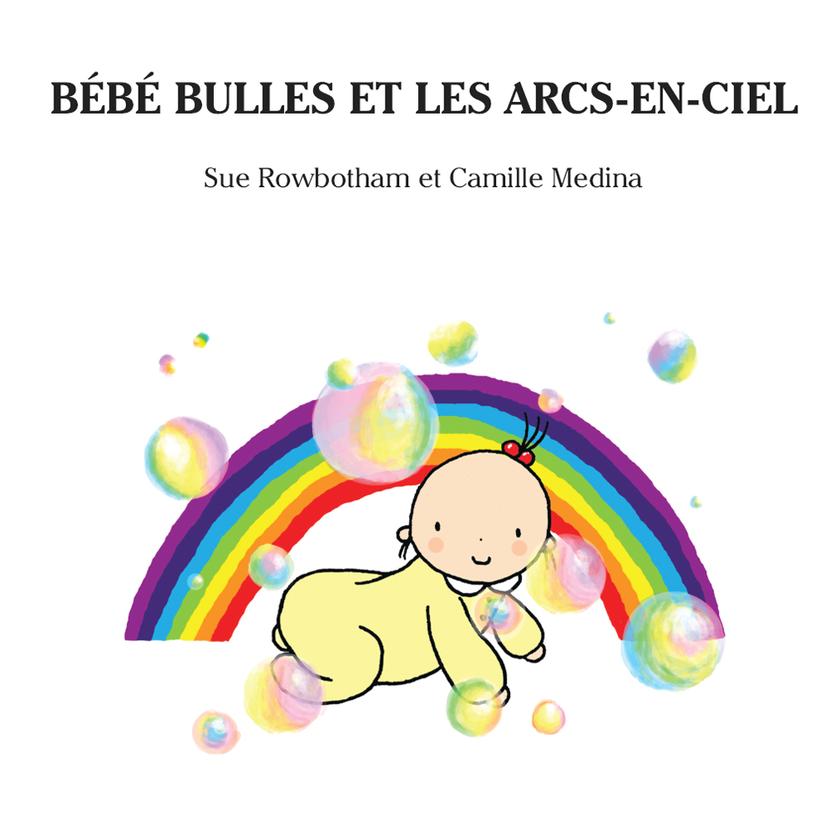
Bébé Bulles aime les arcs-en-ciel. Elle en voit de partout. Et toi, est-ce que toi aussi tu les vois ? Il était une fois une petite fille prénommée Sue, qui aimait jouer avec les mots et raconter des histoires, et qui rêvait de devenir écrivain. Elle grandit et sa vie prit un tout autre chemin, mais elle continua à inventer des histoires pour ses enfants. L’une de ces histoires fut abandonnée dans un tiroir pendant 25 ans. Pendant ce temps, dans une autre partie du monde et plusieurs années plus tard, une autre petite fille du nom de Camille se passionna pour le matériel d’art et de papèterie, le dessin, et les travaux manuels. Quand cette petite fille devint adulte elle décida qu’elle voulait continuer à imaginer et créer, et faire sourire les gens ; elle devint donc illustratrice. Un jour, un peu par hasard les chemins de la conteuse d’histoires et de l’illustratrice se croisèrent, et Bébé Bulles vit le jour. Explorez son univers gai et coloré avec vos tout-petits, et aidez-les à apprendre les couleurs et à trouver des arcs-en-ciel dans toutes sortes de lieux inattendus.

Hard Times: - play adaptation
¥38.62
Brilliant adaptation of Charles Dickens biting novel H ard Times . Dominated by Gradgrind and Bounderby, Coketown’s prosperity is built on the cotton mills where thousands of men and women slave away for long hours and little pay. Gradgrind’s obsession with material progress damages his children Louisa and Tom, leading to scandal and disaster. ‘Hard Times’ celebrates the importance of the human heart in an age obsessed with materialism. Circus, music, and dark comedy all go into the rich mix of this truly Dickensian theatrical tale. Charles Way has written over 50 plays, specializing in writing for children, young people and family audiences. His plays are performed worldwide. He has won several major awards - A Spell of Cold Weather won the Writers Guild best children's play award in 2001 and in 2004 his play Red Red Shoes won the English Arts Council best children's play award. In Germany, his play Missing won the Children's Theatre prize and in the USA? he was nominated for a Helen Hayes Award. He was commissioned by the National Theatre to write Alice In The News , which children all over Britain have performed. He has also written many plays for radio, and a TV poem for BBC 2, No Borders , set in the Welsh borders, where he lives and has spent most of his creative life. ? " A stellar adaptation by Charles Way, moving, thoughtful and wonderfully drawn’.??????????????????????? What’s on Stage ***** ‘Way gives real depth to characters, replaces Dickens’ sentimentality with warmth and his censoriousness with moral indignation’. ?????????????????????????? The Independent ***** ‘daringly restructures Dickens’ plot, yet sticks to the motto of his lisping ringmaster Mr Sleary: “People mutht be amuthed.”’ ????????????????????????????????????????????The Observer ?
Battle-Pieces and Aspects of the War
¥8.09
Poems by the author of Moby Dick. He explains, "With few exceptions, the Pieces in this volume originated in an impulse imparted by the fall of Richmond. They were composed without reference to collective arrangement, but being brought together in review, naturally fall into the order assumed. The events and incidents of the conflict--making up a whole, in varied amplitude, corresponding with the geographical area covered by the war--from these but a few themes have been taken, such as for any cause chanced to imprint themselves upon the mind. The aspects which the strife as a memory assumes are as manifold as are the moods of involuntary meditation--moods variable, and at times widely at variance. Yielding instinctively, one after another, to feelings not inspired from any one source exclusively, and unmindful, without purposing to be, of consistency..."
Underwoods
¥8.09
Poetry. According to Wikipedia: "Robert Louis (Balfour) Stevenson ( 1850 - 1894), was a Scottish novelist, poet, and travel writer, and a leading representative of Neo-romanticism in English literature. He was the man who "seemed to pick the right word up on the point of his pen, like a man playing spillikins", as G. K. Chesterton put it. He was also greatly admired by many authors, including Jorge Luis Borges, Ernest Hemingway, Rudyard Kipling, Vladimir Nabokov, and J. M. Barrie. Most modernist writers dismissed him, however, because he was popular and did not write within their definition of modernism. It is only recently that critics have begun to look beyond Stevenson's popularity and allow him a place in the canon."
The Taming of the Shrew, with line numbers
¥8.09
Classic Shakespearean comedy, with line numbers. According to Wikipedia: "The Taming of the Shrew is an early comedy by William Shakespeare believed to have been written between 1590 and 1594. The play begins with a framing device, often referred to as the Induction, in which a drunken tinker named Sly is tricked into thinking he is a nobleman by a mischievous Lord. The Lord has a play performed for Sly's amusement with a primary and sub-plot. The main plot depicts the courting of Petruchio, a gentleman of Verona, and Katherina, the headstrong, obdurate, and eponymous shrew. Katherina is at first an unwilling participant in the relationship but Petruchio tempers her with various psychological torments - the "taming" - until she is an obedient bride. The sub-plot features a competition between the suitors of Katherina's less intractable sister, Bianca."
Pericles, Prince of Tyre, with line numbers
¥8.09
The classic Shakespeare play, with line numbers. According to Wikipedia: "Pericles, Prince of Tyre is a Jacobean play written at least in part by William Shakespeare and included in modern editions of his collected works despite questions over its authorship, as it was not included in the First Folio. Modern editors generally agree that Shakespeare is responsible for almost exactly half the play—827 lines—the main portion after scene 9 that follows the story of Pericles and Marina.[1][2][3][4] Modern textual studies indicate that the first two acts of 835 lines detailing the many voyages of Pericles were written by a mediocre collaborator, which strong evidence suggests to have been the victualler, pander, dramatist and pamphleteer George Wilkins.
Leben und Tod des Koenigs Johann
¥8.09
Die Shakespeare-Geschichte spielt K?nig John, in deutscher ?bersetzung. Laut Wikipedia: "Das Leben und der Tod von K?nig John, ein Geschichtsstück von William Shakespeare, dramatisiert die Herrschaft von John, K?nig von England (regierte 1199-1216), Sohn von Heinrich II. Von England und Eleonore von Aquitanien und Vater von Henry Es wird angenommen, dass es in der Mitte der 1590er Jahre geschrieben wurde, aber nicht ver?ffentlicht wurde, bis es im Ersten Folio 1623 erschien.
The King in Yellow
¥40.79
The King in Yellow is a book of mysteries and supernatural stories by American writer Robert W. Chambers. The stories inspired production of the new hit HBO series True Detective. There are ten stories, the first four of which, The Repairer of Reputations, The Mask, In the Court of the Dragon, and The Yellow Sign, mention The King in Yellow, a forbidden play which induces despair or madness in those who read it.
In Search of the Unknown
¥40.79
Our narrator is hired by the New York Zoological Society to assist a professor who is in charge of their gardens and exhibits. He embarks on his search for a Great Auk, a species that was extinct for fifty or so years.

The Burglar's Christmas
¥40.79
A beautiful Christmas story of love, forgiveness and uneasy life. Set in Chicago on a bitterly cold Christmas night, William, considers stealing both to satisfy his hunger and to find excitement in his dull life, but when a woman drops a parcel he gives it to her instead of running off with it. He feels as if he is a failed thief, in the same manner as he has failed at everything - college, journalism, real estate, performing. He then walks into a house in an attempt to steal the jewellery, and his own mother finds him there.
Romeo et Juliette (Romeo and Juliet in French)
¥8.09
Traduit par Fran?ois Pierre Guillaume Guizot (1787 - 1874), historien fran?ais et homme d'?tat. Publié en 1864. Selon Wikipedia: Roméo et Juliette est une tragédie écrite au début de la carrière du dramaturge William Shakespeare à propos de deux jeunes amants maudits dont les morts unissent finalement leurs familles en conflit. Il est parmi les histoires archétypales les plus populaires de Shakespeare de jeunes amants adolescents. Roméo et Juliette appartient à une tradition de romans tragiques qui remonte à l'antiquité. Son intrigue est basée sur un conte italien, traduit en vers comme l'histoire tragique de Romeus et Juliette par Arthur Brooke en 1562 et repris en prose dans le palais du plaisir par William Painter en 1582. Shakespeare emprunté lourdement des deux mais, pour élargir le complot , développé des personnages de soutien, notamment Mercutio et Paris. Crue écrite entre 1591 et 1595, la pièce fut d'abord publiée en version quarto en 1597. "
Judith, a Play in Three Acts: Founded on the Apocryphal Book of Judith
¥8.09
Dodo Collections brings you another classic from Arnold Bennett, ‘"Judith, a Play in Three Acts; Founded on the Apocryphal Book of Judith."’ ? Enoch Arnold Bennett (always known as Arnold Bennett) was one of the most remarkable literary figures of his time, a product of the English Potteries that he made famous as the Five Towns. Yet he could hardly wait to escape his home town, and he did so by the sheer force of his ambition to succeed as an author. In his time he turned his hand to every kind of writing, but he will be remembered for such novels as The Old Wives' Tale, the Clayhanger trilogy (Clayhanger, Hilda Lessways, and These Twain), and The Card. He also wrote such intriguing self-improvement books as Literary Taste, How To Live on 24 Hours a Day, The Human Machine, etc. ? After a local education Bennett finished his education at the University of London and for a time was editor of Woman magazine. After 1900 he devoted himself entirely to writing; dramatic criticism was one of his foremost interests. Bennett is best known, however, for his novels, several of which were written during his residence in France. ? Bennett's infancy was spent in genteel poverty, which gave way to prosperity as his father succeeded as a solicitor. From this provincial background he became a novelist. His enduring fame is as a Chronicler of the Potteries towns, the setting and inspiration of some of his most famous and enduring literary work and the place where he grew up.
Henri IV, Premiere Partie, (Henry IV Part I in French)
¥8.09
Pièce d'histoire de Shakespeare, Henry IV Part One, en traduction fran?aise. Selon Wikipédia: "Henry IV, Part 1 est une pièce d'histoire de William Shakespeare, qui aurait été écrite au plus tard en 1597. C'est la deuxième pièce de la tétralogie de Shakespeare traitant des règnes successifs de Richard II, Henri IV (deux pièces ), et Henry V. Henry IV, partie 1 dépeint une période de l'histoire qui commence avec la bataille de Hotspur à Homildon contre le Douglas à la fin de 1402 et se termine avec la défaite des rebelles à Shrewsbury au milieu de 1403. Dès le début il a été un jeu extrêmement populaire à la fois avec le public et les critiques. "
The Title: A Comedy in Three Acts
¥8.09
Dodo Collections brings you another classic from Arnold Bennett, ‘"The Title: A Comedy in Three Acts."’ ? Set against the backdrop of World War I, this play is a rollicking send-up of Britain's class system and its growing absurdity in the heady period of democratization that began to transpire in the early twentieth century. When mild-mannered protagonist Culver finds out that he is entitled to a formal honor (i.e., a title), he begins to reconsider the age-old hierarchy and all that it entails. ? Enoch Arnold Bennett (always known as Arnold Bennett) was one of the most remarkable literary figures of his time, a product of the English Potteries that he made famous as the Five Towns. Yet he could hardly wait to escape his home town, and he did so by the sheer force of his ambition to succeed as an author. In his time he turned his hand to every kind of writing, but he will be remembered for such novels as The Old Wives' Tale, the Clayhanger trilogy (Clayhanger, Hilda Lessways, and These Twain), and The Card. He also wrote such intriguing self-improvement books as Literary Taste, How To Live on 24 Hours a Day, The Human Machine, etc. ? After a local education Bennett finished his education at the University of London and for a time was editor of Woman magazine. After 1900 he devoted himself entirely to writing; dramatic criticism was one of his foremost interests. Bennett is best known, however, for his novels, several of which were written during his residence in France. ? Bennett's infancy was spent in genteel poverty, which gave way to prosperity as his father succeeded as a solicitor. From this provincial background he became a novelist. His enduring fame is as a Chronicler of the Potteries towns, the setting and inspiration of some of his most famous and enduring literary work and the place where he grew up.
Richard III in French
¥8.09
Lecture de l'histoire de Shakespeare, Richard III, en traduction fran?aise. Selon Wikipédia: "Richard III est une pièce d'histoire de William Shakespeare, qui aurait été écrite vers 1591. Elle décrit l'accession au pouvoir machiavélique et le court règne de Richard III d'Angleterre. Le premier folio est le plus souvent classé comme tel, mais de temps à autre, comme dans l'édition quarto, il s'agit d'une tragédie: Richard III conclut la première tétralogie de Shakespeare (qui contient aussi Henry VI, parties 1-3).
Shakespeare's Pericles in French
¥8.09
Le classique Shakespeare joue en traduction fran?aise. Selon Wikipédia: "Périclès, prince de Tyr est une pièce jacobéenne écrite au moins en partie par William Shakespeare et incluse dans les éditions modernes de ses ?uvres rassemblées malgré des questions sur sa paternité, car elle n'était pas incluse dans le premier folio. conviennent que Shakespeare est responsable de presque exactement la moitié du jeu - 827 lignes - la partie principale après la scène 9 qui suit l'histoire de Périclès et Marina.Les études textuelles modernes indiquent que les deux premiers actes de 835 lignes détaillant les nombreux voyages de Périclès ont été écrits par un collaborateur médiocre, qui suggère fortement d'avoir été l'aviateur, pander, dramaturge et pamphlétaire George Wilkins.


