


 购物车
购物车 个人中心
个人中心
R Machine Learning By Example
¥90.46
Understand the fundamentals of machine learning with R and build your own dynamic algorithms to tackle complicated real-world problems successfully About This Book Get to grips with the concepts of machine learning through exciting real-world examples Visualize and solve complex problems by using power-packed R constructs and its robust packages for machine learning Learn to build your own machine learning system with this example-based practical guide Who This Book Is For If you are interested in mining useful information from data using state-of-the-art techniques to make data-driven decisions, this is a go-to guide for you. No prior experience with data science is required, although basic knowledge of R is highly desirable. Prior knowledge in machine learning would be helpful but is not necessary. What You Will Learn Utilize the power of R to handle data extraction, manipulation, and exploration techniques Use R to visualize data spread across multiple dimensions and extract useful features Explore the underlying mathematical and logical concepts that drive machine learning algorithms Dive deep into the world of analytics to predict situations correctly Implement R machine learning algorithms from scratch and be amazed to see the algorithms in action Write reusable code and build complete machine learning systems from the ground up Solve interesting real-world problems using machine learning and R as the journey unfolds Harness the power of robust and optimized R packages to work on projects that solve real-world problems in machine learning and data science In Detail Data science and machine learning are some of the top buzzwords in the technical world today. From retail stores to Fortune 500 companies, everyone is working hard to making machine learning give them data-driven insights to grow their business. With powerful data manipulation features, machine learning packages, and an active developer community, R empowers users to build sophisticated machine learning systems to solve real-world data problems. This book takes you on a data-driven journey that starts with the very basics of R and machine learning and gradually builds upon the concepts to work on projects that tackle real-world problems. You’ll begin by getting an understanding of the core concepts and definitions required to appreciate machine learning algorithms and concepts. Building upon the basics, you will then work on three different projects to apply the concepts of machine learning, following current trends and cover major algorithms as well as popular R packages in detail. These projects have been neatly divided into six different chapters covering the worlds of e-commerce, finance, and social-media, which are at the very core of this data-driven revolution. Each of the projects will help you to understand, explore, visualize, and derive insights depending upon the domain and algorithms. Through this book, you will learn to apply the concepts of machine learning to deal with data-related problems and solve them using the powerful yet simple language, R. Style and approach The book is an enticing journey that starts from the very basics to gradually pick up pace as the story unfolds. Each concept is first defined in the larger context of things succinctly, followed by a detailed explanation of their application. Each topic is explained with the help of a project that solves a real real-world problem involving hands-on work thus giving you a deep insight into the world of machine learning.
Learning iOS Penetration Testing
¥71.93
Secure your iOS applications and uncover hidden vulnerabilities by conducting penetration testsAbout This BookAchieve your goal to secure iOS devices and applications with the help of this fast paced manualFind vulnerabilities in your iOS applications and fix them with the help of this example-driven guideAcquire the key skills that will easily help you to perform iOS exploitation and forensics with greater confidence and a stronger understandingWho This Book Is ForThis book is for IT security professionals who want to conduct security testing of applications. This book will give you exposure to diverse tools to perform penetration testing. This book will also appeal to iOS developers who would like to secure their applications, as well as security professionals. It is easy to follow for anyone without experience of iOS pentesting.What You Will LearnUnderstand the basics of iOS app development, deployment, security architecture, application signing, application sandboxing, and OWASP TOP 10 for mobileSet up your lab for iOS app pentesting and identify sensitive information stored locallyPerform traffic analysis of iOS devices and catch sensitive data being leaked by side channelsModify an application’s behavior using runtime analysisAnalyze an application’s binary for security protectionAcquire the knowledge required for exploiting iOS devicesLearn the basics of iOS forensicsIn DetailiOS has become one of the most popular mobile operating systems with more than 1.4 million apps available in the iOS App Store. Some security weaknesses in any of these applications or on the system could mean that an attacker can get access to the device and retrieve sensitive information. This book will show you how to conduct a wide range of penetration tests on iOS devices to uncover vulnerabilities and strengthen the system from attacks.Learning iOS Penetration Testing discusses the common vulnerabilities and security-related shortcomings in an iOS application and operating system, and will teach you to conduct static and dynamic analysis of iOS applications.This practical guide will help you uncover vulnerabilities in iOS phones and applications. We begin with basics of iOS security and dig deep to learn about traffic analysis, code analysis, and various other techniques. Later, we discuss the various utilities, and the process of reversing and auditing.Style and approachThis fast-paced and practical guide takes a step-by-step approach to penetration testing with the goal of helping you secure your iOS devices and apps quickly.
MongoDB Cookbook - Second Edition
¥80.65
Harness the latest features of MongoDB 3 with this collection of 80 recipes – from managing cloud platforms to app development, this book is a vital resourceAbout This BookGet to grips with the latest features of MongoDB 3Interact with the MongoDB server and perform a wide range of query operations from the shellFrom administration to automation, this cookbook keeps you up to date with the world’s leading NoSQL databaseWho This Book Is ForThis book is engineered for anyone who is interested in managing data in an easy and efficient way using MongoDB. You do not need any prior knowledge of MongoDB, but it would be helpful if you have some programming experience in either Java or Python.What You Will LearnInstall, configure, and administer MongoDB sharded clusters and replica setsBegin writing applications using MongoDB in Java and Python languagesInitialize the server in three different modes with various configurationsPerform cloud deployment and introduce PaaS for MongoDiscover frameworks and products built to improve developer productivity using MongoTake an in-depth look at the Mongo programming driver APIs in Java and PythonSet up enterprise class monitoring and backups of MongoDBIn DetailMongoDB is a high-performance and feature-rich NoSQL database that forms the backbone of the systems that power many different organizations – it’s easy to see why it’s the most popular NoSQL database on the market. Packed with many features that have become essential for many different types of software professionals and incredibly easy to use, this cookbook contains many solutions to the everyday challenges of MongoDB, as well as guidance on effective techniques to extend your skills and capabilities.This book starts with how to initialize the server in three different modes with various configurations. You will then be introduced to programming language drivers in both Java and Python. A new feature in MongoDB 3 is that you can connect to a single node using Python, set to make MongoDB even more popular with anyone working with Python. You will then learn a range of further topics including advanced query operations, monitoring and backup using MMS, as well as some very useful administration recipes including SCRAM-SHA-1 Authentication. Beyond that, you will also find recipes on cloud deployment, including guidance on how to work with Docker containers alongside MongoDB, integrating the database with Hadoop, and tips for improving developer productivity.Created as both an accessible tutorial and an easy to use resource, on hand whenever you need to solve a problem, MongoDB Cookbook will help you handle everything from administration to automation with MongoDB more effectively than ever before.Style and approachEvery recipe is explained in a very simple set-by-step manner yet is extremely comprehensive.
OpenCV By Example
¥90.46
Enhance your understanding of Computer Vision and image processing by developing real-world projects in OpenCV 3About This BookGet to grips with the basics of Computer Vision and image processingThis is a step-by-step guide to developing several real-world Computer Vision projects using OpenCV 3This book takes a special focus on working with Tesseract OCR, a free, open-source library to recognize text in imagesWho This Book Is ForIf you are a software developer with a basic understanding of Computer Vision and image processing and want to develop interesting Computer Vision applications with Open CV, this is the book for you. Knowledge of C++ is required.What You Will LearnInstall OpenCV 3 on your operating systemCreate the required CMake *s to compile the C++ application and manage its dependenciesGet to grips with the Computer Vision workflows and understand the basic image matrix format and filtersUnderstand the segmentation and feature extraction techniquesRemove backgrounds from a static scene to identify moving objects for video surveillanceTrack different objects in a live video using various techniquesUse the new OpenCV functions for text detection and recognition with TesseractIn DetailOpen CV is a cross-platform, free-for-use library that is primarily used for real-time Computer Vision and image processing. It is considered to be one of the best open source libraries that helps developers focus on constructing complete projects on image processing, motion detection, and image segmentation.Whether you are completely new to the concept of Computer Vision or have a basic understanding of it, this book will be your guide to understanding the basic OpenCV concepts and algorithms through amazing real-world examples and projects.Starting from the installation of OpenCV on your system and understanding the basics of image processing, we swiftly move on to creating optical flow video analysis or text recognition in complex scenes, and will take you through the commonly used Computer Vision techniques to build your own Open CV projects from scratch.By the end of this book, you will be familiar with the basics of Open CV such as matrix operations, filters, and histograms, as well as more advanced concepts such as segmentation, machine learning, complex video analysis, and text recognition.Style and approachThis book is a practical guide with lots of tips, and is closely focused on developing Computer vision applications with OpenCV. Beginning with the fundamentals, the complexity increases with each chapter. Sample applications are developed throughout the book that you can execute and use in your own projects.
JavaScript Projects for Kids
¥45.77
Gear up for a roller-coaster ride into the world of JavaScript and programming with this easy-to-follow, fun, and entertaining project-based guideAbout This BookGet to know the concepts of HTML and CSS to work with JavaScriptExplore the concepts of object-oriented programmingFollow this step-by-step guide on the fundamentals of JavaScript programmingWho This Book Is ForIf you've never written code before or you are completely new to the world of web programming, then this book is the right choice for you. This book is for kids of age 10 years and above and parents who are completely new to the world of programming and want to get introduced to programming.What You Will LearnLearn how to work with Google Developer tools to iterate, debug and profile your codeDevelop a Battleship game using the basic concepts of HTML and CSSGet to know the fundamentals of JavaScript programmingCreate our own version of Pac Man game.Discover the vital concepts of object-oriented programmingIn DetailJavaScript is the most widely-used programming language for web development and that's not all! It has evolved over the years and is now being implemented in an array of environments from websites to robotics. Learning JavaScript will help you see the broader picture of web development.This book will take your imagination to new heights by teaching you how to work with JavaScript from scratch. It will introduce you to HTML and CSS to enhance the appearance of your applications. You’ll then use your skills to build on a cool Battleship game! From there, the book will introduce you to jQuery and show you how you can manipulate the DOM. You’ll get to play with some cool stuff using Canvas and will learn how to make use of Canvas to build a game on the lines of Pacman, only a whole lot cooler! Finally, it will show you a few tricks with OOP to make your code clean and will end with a few road maps on areas you can explore further.Style and approachThis is an easy-to-follow, informative, and fun guide that takes a project-based approach to teaching programming in JavaScript. You will learn everything you need to get started with serious web application development.
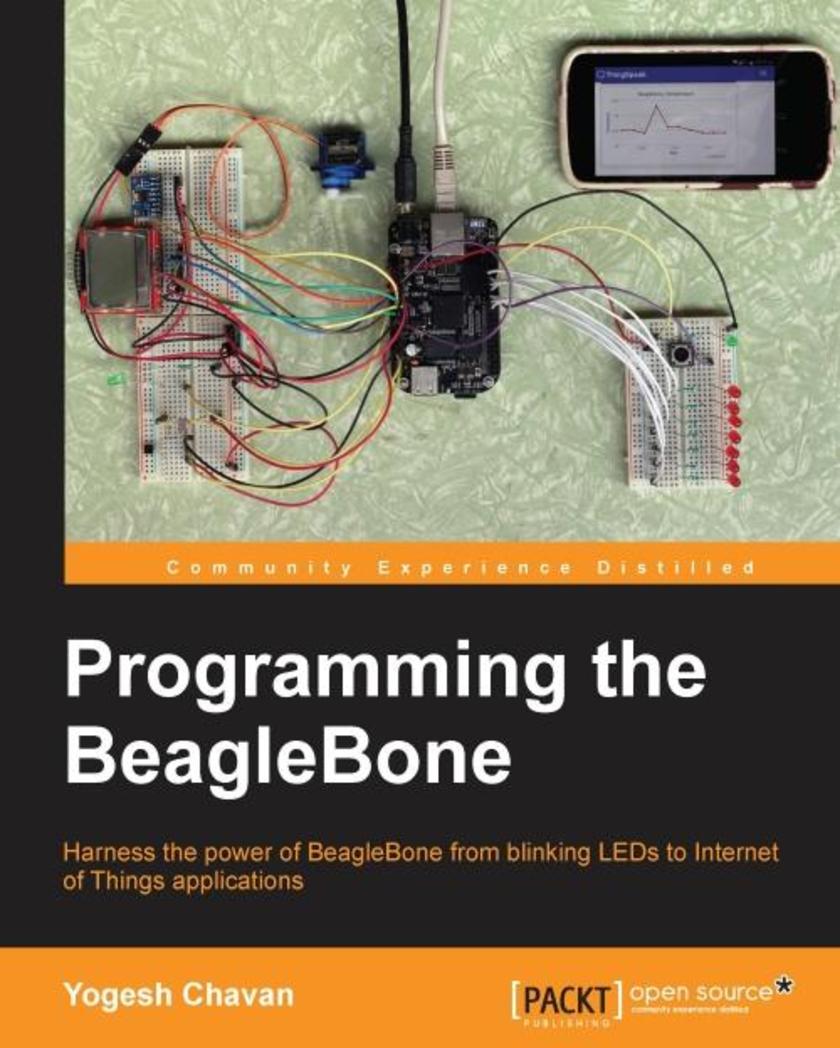
Programming the BeagleBone
¥54.49
Master BeagleBone programming by doing simple electronics and Internet of Things projectsAbout This BookQuickly develop electronics projects that interact with Internet applications using JavaScript and PythonLearn about electronics components such as sensors and motors, and how to communicate with them by writing programsA step-by-step guide to explore the exciting world of BeagleBone—from connecting BeagleBone to doing electronics projects and creating IoT applicationsWho This Book Is ForIf you want to learn programming on embedded systems with BeagleBone by doing simple electronics projects, this book is for you. This book is also helpful to BeagleBone owners who want to quickly implement small-scale home automation solutions. It is assumed that you have familiarity with C and Python programming. Some familiarity with electronics is helpful but not essential.What You Will LearnConnect your BeagleBone to a computer in different ways and get the Cloud9 IDE running to quick-start programming on the BeagleBoneGet to know about BeagleBone extension pins such as GPIO and how to connect various electronics components with BeagleBoneRead and write to various electronics components such as LED, Push-button, sensors, and motorsGrasp in-depth theory on Analog, PWM, and BUS programming and the electronics components used in programsHandle data to and from various BUS supporting modules such as UART, I2C, and SPI using the Adafruit BBIO Python libraryWrite real-life IoT applications in JavaScript and Python such as shooting an e-mail on overheat and controlling a servo motor remotelyMake use of online free cloud services to store and analyze sensor data collected on the BeagleBoneDiscover what else can be done using the BeagleBoneGet to grips with embedded system BUS communicationIn DetailThe whole world is moving from desktop computers to smartphones and embedded systems. We are moving towards utilizing Internet of Things (IoT). An exponential rise in the demand for embedded systems and programming in the last few years is driving programmers to use embedded development boards such as Beaglebone.BeagleBone is an ultra-small, cost-effective computer that comes with a powerful hardware. It runs a full-fledged Debian Linux OS and provides numerous electronics solutions. BeagleBone is open source and comes with an Ethernet port, which allows you to deploy IoT projects without any additions to the board. It provides plenty of GPIO, Anlaog pins, and UART, I2C, SPI pins which makes it the right choice to perform electronics projects. This gives you all the benefits of Linux kernel such as multitasking, multiusers, and extensive device driver support. This allows you to do programming in many languages including high-level languages such as JavaScript and Python.This book aims to exploit the hardware and software capabilities of BeagleBone to create real-life electronics and IoT applications quickly. It is divided into two parts. The first part covers JavaScript programs. The second part provides electronics projects and IoT applications in Python.First, you will learn to use BeagleBone as tool to write useful applications on embedded systems. Starting with the basics needed to set up BeagleBone and the Cloud9 IDE, this book covers interfacing with various electronics components via simple programs. The electronics theory related to these components is then explained in depth before you use them in a program. Finally, the book helps you create some real-life IoT applications.Style and approachAn easy-to-follow guide full of real-world electronics programs and quick troubleshooting tips using BeagleBone. All the required electronics concepts are explained in detail before using them in a program and all programs are explained in depth. Most of the theory is covered in the first part; while the second part gives you some quick programs.
Drupal 8 Theming with Twig
¥80.65
Master Drupal 8’s new Twig templating engine to create fun and fast websites with simple steps to help you move from concept to completion About This Book Create beautiful responsive Drupal 8 websites using Twig Quickly master theme administration, custom block layouts, views, and the Twig template structure A step-by-step guide to the most common approaches in web design Who This Book Is For This book is intended for front-end developers, designers, and anyone who is generally interested in learning all the new features of Drupal 8 theming. Discover what has changed from Drupal 7 to Drupal 8 and immerse yourself in the new Twig PHP templating engine. Familiarity with HTML5, CSS3, JavaScript, and the Drupal Admin interface would be helpful. Prior experience with setting up and configuring a standalone development environment is required as we will be working with PHP and MySQL. What You Will Learn Navigate the Drupal 8 Admin interface Build custom block layouts with reusable and fieldable blocks Create subthemes based on the Bartik and Classy base themes Construct a responsive theme with Twitter Bootstrap Work with the new Twig PHP templating engine Configure Drupal for Twig debugging Enable preprocessing of Twig variables Develop a theme from scratch following a step-by-step project outline In Detail Drupal 8 is an open source content management system and powerful framework that helps deliver great websites to individuals and organizations, including non-profits, commercial, and government around the globe. This new release has been built on top of object-oriented PHP and includes more than a handful of improvements such as a better user experience, cleaner HTML5 markup, a new templating engine called Twig, multilingual capabilities, new configuration management, and effortless content authoring. Drupal 8 will quickly become the new standard for deploying content to both the web and mobile applications. However, with so many new changes, it can quickly become overwhelming knowing where to start and how to quickly. Starting from the bottom up, we will install, set up, and configure Drupal 8. We’ll navigate the Admin interface so you can learn how to work with core themes and create new custom block layouts. Walk through a real-world project to create a Twig theme from concept to completion while adopting best practices to implement CSS frameworks and JavaScript libraries. We will see just how quick and easy it is to create beautiful, responsive Drupal 8 websites while avoiding the common mistakes that many front-end developers make. Style and approach Drupal 8 Theming with Twig is intended for front-end developers, designers, and anyone who is generally interested in learning all the new features of Drupal 8 theming. Discover what has changed from Drupal 7 to Drupal 8 and immerse yourself in the new Twig PHP templating engine. Familiarity with HTML5, CSS3, JavaScript, and the Drupal Admin interface would be helpful. Prior experience with setting up and configuring a standalone development environment is required as we will be working with PHP and MySQL.
Troubleshooting OpenStack
¥54.49
Get unstuck and start stacking! About This Book Easily fix the nagging problems that commonly plague OpenStack and become the go-to person in your organization Get better equipped to troubleshoot and solve common problems in performance, availability, and automation that confront production-ready OpenStack environments Save time and decrease frustration by solving significant issues that arise from OpenStack deployments pertaining to storage and networking Who This Book Is For You will need a basic understanding of OpenStack, Linux, and Cloud computing. If you have an understanding of Linux, this book will help you leverage that knowledge in the world of OpenStack, giving you confidence to tackle most issues that may arise. What You Will Learn Diagnose and remediate authentication and authorization problems in Keystone Fix common issues with images served through Glance Master the art of troubleshooting Neutron networking Navigate and overcome problems with Nova Troubleshoot and resolve Cinder block storage issues Identify and correct Swift object storage problems Isolate and fix issues caused by Heat orchestration Leverage Ceilometer and other metering and monitoring tools for effective troubleshooting In Detail OpenStack is a collection of software projects that work together to provide a cloud fabric. OpenStack is one of the fastest growing open source projects in history that unlocks cloud computing for everyone. With OpenStack, you are able to create public or private clouds on your own hardware. The flexibility and control afforded by OpenStack puts the cloud within reach of anyone willing to learn this technology. Starting with an introduction to OpenStack troubleshooting tools, we’ll walk through each OpenStack service and how you can quickly diagnose, troubleshoot, and correct problems in your OpenStack. Understanding the various projects and how they interact is essential for anyone attempting to troubleshoot an OpenStack cloud. We will start by explaining each of the major components and the dependencies between them, and move on to show you how to identify and utilize an effective set of OpenStack troubleshooting tools and fix common Keystone problems. Next, we will expose you to common errors and problems you may encounter when using the OpenStack Block Storage service (Cinder). We will then examine Heat, the OpenStack Orchestration Service, where you will learn how to trace errors, determine their root cause, and effectively correct the issue. Finally, you will get to know the best practices to architect your OpenStack cloud in order to achieve optimal performance, availability, and reliability. Style and approach This is straight-to-the point guide to fixing your OpenStack cluster. Common problems are identified and suggestions to resolve these problems are presented in a simple, easy-to-understand manner.
Learning C# by Developing Games with Unity 5.x - Second Edition
¥80.65
Develop your first interactive 2D platformer game by learning the fundamentals of C# About This Book Get to grips with the fundamentals of *ing in C# with Unity Create an awesome, 2D platformer game from scratch using the principles of object-oriented programming and coding in C# This is a step-by-step guide to learn the fundamentals of C# *ing to develop GameObjects and master the basics of the new UI system in Unity Who This Book Is For The book is targeted at beginner level Unity developers with no programming experience. If you are a Unity developer and you wish to learn how to write C# *s and code by creating games, then this book is for you. What You Will Learn Understand the fundamentals of variables, methods, and code syntax in C# Get to know about techniques to turn your game idea into working project Use loops and collections efficiently in Unity to reduce the amount of code Develop a game using the object-oriented programming principles Generate infinite levels for your game Create and code a good-looking functional UI system for your game Publish and share your game with users In Detail Unity is a cross-platform game engine that is used to develop 2D and 3D video games. Unity 5 is the latest version, released in March 2015, and adds a real-time global illumination to the games, and its powerful new features help to improve a game’s efficiency. This book will get you started with programming behaviors in C# so you can create 2D games in Unity. You will begin by installing Unity and learning about its features, followed by creating a C# *. We will then deal with topics such as unity *ing for you to understand how codes work so you can create and use C# variables and methods. Moving forward, you will find out how to create, store, and retrieve data from collection of objects. You will also develop an understanding of loops and their use, and you’ll perform object-oriented programming. This will help you to turn your idea into a ready-to-code project and set up a Unity project for production. Finally, you will discover how to create the GameManager class to manage the game play loop, generate game levels, and develop a simple UI for the game. By the end of this book, you will have mastered the art of applying C# in Unity. Style and approach This is a step-by-step guide to developing a game from scratch by applying the fundamentals of C# and Unity *ing.
Mastering JBoss Drools 6
¥90.46
Discover the power of Drools 6 and Business Rules for developing complex scenarios in your applications About This Book Implement and model different rules using the DRL full syntax Model complex business decisions and domain models in order to automate and improve your operational decisions with the Drools framework A practical, fast-paced, hands-on guide to help you use the different components provided by the Drools Rule Engine Who This Book Is For This book is for Java developers and architects who need to have a deep understanding of how to create or integrate your applications with the Drools Rules Framework. The book assumes that you know the Java language well and also have experience with some widely used frameworks, such as Spring. You should also know the basics of Maven-based applications. What You Will Learn Automate your application’s decisions, such as promotion applying, discount policies, fraud detection, and more. Quickly get started with writing your first rules using the DRL full syntax. Discover the power of the new syntax components of the rule language. Define inferences in your business rules to simplify complex decisions. Write decision tables, templates,domain-specific languages, and scorecards, and learn how to map them to the Drools framework. Harness the full operational power of Drools through all of its configuration points. Use Drools configurations and architectures for different environments and scenarios. In Detail Mastering JBoss Drools 6 will provide you with the knowledge to develop applications involving complex scenarios. You will learn how to use KIE modules to create and execute Business Rules, and how the PHREAK algorithm internally works to drive the Rule Engine decisions. This book will also cover the relationship between Drools and jBPM, which allows you to enrich your applications by using Business Processes. You will be briefly introduced to the concept of complex event processing (Drools CEP) where you will learn how to aggregate and correlate your data based on temporal conditions. You will also learn how to define rules using domain-specific languages, such as spreadsheets, database entries, PMML, and more. Towards the end, this book will take you through the integration of Drools with the Spring and Camel frameworks for more complex applications. Style and approach Approached from a developer’s perspective, the book teaches you all the advanced concepts of Business Rules applicable examples with helpful screenshots, diagrams, tutorials, and examples.
Mastering Wireshark
¥90.46
Analyze data network like a professional by mastering Wireshark - From 0 to 1337 About This Book Master Wireshark and train it as your network sniffer Impress your peers and get yourself pronounced as a network doctor Understand Wireshark and its numerous features with the aid of this fast-paced book packed with numerous screenshots, and become a pro at resolving network anomalies Who This Book Is For Are you curious to know what’s going on in a networkDo you get frustrated when you are unable to detect the cause of problems in your networksThis is where the book comes into play. Mastering Wireshark is for developers or network enthusiasts who are interested in understanding the internal workings of networks and have prior knowledge of using Wireshark, but are not aware about all of its functionalities. What You Will Learn Install Wireshark and understand its GUI and all the functionalities of it Create and use different filters Analyze different layers of network protocols and know the amount of packets that flow through the network Decrypt encrypted wireless traffic Use Wireshark as a diagnostic tool and also for network security analysis to keep track of malware Troubleshoot all the network anomalies with help of Wireshark Resolve latencies and bottleneck issues in the network In Detail Wireshark is a popular and powerful tool used to analyze the amount of bits and bytes that are flowing through a network. Wireshark deals with the second to seventh layer of network protocols, and the analysis made is presented in a human readable form. Mastering Wireshark will help you raise your knowledge to an expert level. At the start of the book, you will be taught how to install Wireshark, and will be introduced to its interface so you understand all its functionalities. Moving forward, you will discover different ways to create and use capture and display filters. Halfway through the book, you’ll be mastering the features of Wireshark, analyzing different layers of the network protocol, looking for any anomalies. As you reach to the end of the book, you will be taught how to use Wireshark for network security analysis and configure it for troubleshooting purposes. Style and approach Every chapter in this book is explained to you in an easy way accompanied by real-life examples and screenshots of the interface, making it easy for you to become an expert at using Wireshark.
Flask By Example
¥63.21
Unleash the full potential of the Flask web framework by creating simple yet powerful web applications About This Book The most up-to-date book on Flask on the market Create your own world-class applications and master the art of Flask by unravelling its enigma through this journey This step-by-step tutorial is packed with examples on blending different technologies with Flask to get you up and running Who This Book Is For Have you looked at PHP and hated the clunky bloated syntaxOr looked at .Net and wished it was more open and flexibleMaybe you’ve tried your hand at GUI libraries in Python and found them hard to useIf your answer to any one of these questions is a yes, then this is just the book for you. It is also intended for people who know the basics of Python and want to learn how to use it to build powerful solutions with a web front-end. What You Will Learn Build three web applications from the ground up using the powerful Python micro framework, Flask. Dynamically display data to your viewers, based on their requests Store user and static data in SQL and NoSQL databases and use this data to power your web applications Create a good user experience by combining HTML, CSS, and JavaScript Harness the convenience of freely available APIs, including OpenWeatherMap, Open Exchange Rates, and bitly Extend your applications to build advanced functionality, such as a user account control system using Flask-Login Learn about web application security and defend against common attacks, such as SQL injection and XSS In Detail This book will take you on a journey from learning about web development using Flask to building fully functional web applications. In the first major project, we develop a dynamic Headlines application that displays the latest news headlines along with up-to-date currency and weather information. In project two, we build a Crime Map application that is backed by a MySQL database, allowing users to submit information on and the location of crimes in order to plot danger zones and other crime trends within an area. In the final project, we combine Flask with more modern technologies, such as Twitter's Bootstrap and the NoSQL database MongoDB, to create a Waiter Caller application that allows restaurant patrons to easily call a waiter to their table. This pragmatic tutorial will keep you engaged as you learn the crux of Flask by working on challenging real-world applications. Style and approach This book will provide you with rich, practical experience of Flask. Every technology, that is employed along with Flask is comprehensively introduced, while the book focusses on developing web applications. Pointers to educational material are always given if you want to gain in-depth knowledge of the various technologies used.
Boost.Asio C++ Network Programming Cookbook
¥90.46
Over 25 hands-on recipes to create robust and highly-efficient cross-platform distributed applications with the Boost.Asio libraryAbout This BookBuild highly efficient distributed applications with easeEnhance your cross-platform network programming skills with one of the most reputable C++ librariesFind solutions to real-world problems related to network programming with ready-to-use recipes using this detailed and practical handbookWho This Book Is ForIf you want to enhance your C++ network programming skills using the Boost.Asio library and understand the theory behind development of distributed applications, this book is just what you need. The prerequisite for this book is experience with general C++11. To get the most from the book and comprehend advanced topics, you will need some background experience in multithreading.What You Will LearnBoost your working knowledge of one of the most reputable C++ networking libraries—Boost.AsioFamiliarize yourself with the basics of TCP and UDP protocolsCreate scalable and highly-efficient client and server applicationsUnderstand the theory behind development of distributed applicationsIncrease the security of your distributed applications by adding SSL supportImplement a HTTP client easilyUse iostreams, scatter-gather buffers, and timersIn DetailStarting with recipes demonstrating the execution of basic Boost.Asio operations, the book goes on to provide ready-to-use implementations of client and server applications from simple synchronous ones to powerful multithreaded scalable solutions. Finally, you are presented with advanced topics such as implementing a chat application, implementing an HTTP client, and adding SSL support. All the samples presented in the book are ready to be used in real projects just out of the box.As well as excellent practical examples, the book also includes extended supportive theoretical material on distributed application design and construction.Style and approachThis book is a set of recipes, each containing the statement and de*ion of a particular practical problem followed by code sample providing the solution to the problem and detailed step-by-step explanation. Recipes are grouped by topic into chapters and ordered by the level of complexity from basic to advanced.
Splunk Developer's Guide - Second Edition
¥80.65
Learn the A to Z of building excellent Splunk applications with the latest techniques using this comprehensive guideAbout This BookThis is the most up-to-date book on Splunk 6.3 for developersGet ahead of being just a Splunk user and start creating custom Splunk applications as per your needsYour one-stop-solution to Splunk application developmentWho This Book Is ForThis book is for those who have some familiarity with Splunk and now want to learn how to develop an efficient Splunk application. Previous experience with Splunk, writing searches, and designing basic dashboards is expected.What You Will LearnImplement a Modular Input and a custom D3 data visualizationCreate a directory structure and set view permissionsCreate a search view and a dashboard view using advanced XML modulesEnhance your application using eventtypes, tags, and macrosPackage a Splunk application using best practicesPublish a Splunk application to the Splunk communityIn DetailSplunk provides a platform that allows you to search data stored on a machine, analyze it, and visualize the analyzed data to make informed decisions. The adoption of Splunk in enterprises is huge, and it has a wide range of customers right from Adobe to Dominos. Using the Splunk platform as a user is one thing, but customizing this platform and creating applications specific to your needs takes more than basic knowledge of the platform.This book will dive into developing Splunk applications that cater to your needs of making sense of data and will let you visualize this data with the help of stunning dashboards.This book includes everything on developing a full-fledged Splunk application right from designing to implementing to publishing. We will design the fundamentals to build a Splunk application and then move on to creating one. During the course of the book, we will cover application data, objects, permissions, and more. After this, we will show you how to enhance the application, including branding, workflows, and enriched data. Views, dashboards, and web frameworks are also covered.This book will showcase everything new in the latest version of Splunk including the latest data models, alert actions, XML forms, various dashboard enhancements, and visualization options (with D3). Finally, we take a look at the latest Splunk cloud applications, advanced integrations, and development as per the latest release.Style and approachThis book is an easy-to-follow guide with lots of tips and tricks to help you master all the concepts necessary to develop and deploy your Splunk applications.
Swift Essentials - Second Edition
¥63.21
Discover how to build iOS and watchOS applications in Swift 2 using XcodeAbout This BookGets you up and running with Swift programming without any prior iOS development experience.A fast paced guide showing best practices and lets you get up to speed with Swift to quickly build your own iOS applicationsA unique practical approach to make your life with Swift easy.Who This Book Is ForAre you interested in learning SwiftDo you want to write iOS applications in SwiftIf yes, then this is the book for you. No prior iOS programming experience is assumed; however, having some experience with any programming language will be beneficial.What You Will LearnDive into Swift and explore its innovative and powerful syntaxWork with Swift in Xcode to get a unique and productive approach to developmentFind out how to create complete iOS applicationsDiscover rapid prototyping with a Swift playgroundGet to know how to use the Swift storyboard to develop multi-page applicationsGet to grips with parsing JSON and XML data from network sourcesBuild a network client for GitHub repositories, with full source code on GitHubIn DetailSwift was considered one of the biggest innovations last year, and certainly with Swift 2 announced at WWDC in 2015, this segment of the developer space will continue to be hot and dominating.This is a fast-paced guide to provide an overview of Swift programming and then walks you through in detail how to write iOS applications. Progress through chapters on custom views, networking, parsing and build a complete application as a Git repository, all by using Swift as the core languageStyle and approachThis fast-paced practical guide will quickly give you hands-on experience with all the features of Swift programming. Following the practical examples in the book will help you successfully create your own iOS applications.
Getting Started with ResearchKit
¥80.65
Enter the era of medical research using mobile devices with the help of this guide on ResearchKit!About This BookCreate a simple clinical research app using most aspects of ResearchKitBuild a simple survey with various data types with the results printed on the screen.A step-by-step guide introducing Apple's ResearchKit and techniques to incorporate it into various apps.Who This Book Is ForThis book is aimed at medical researchers with basic iOS coding knowledge and iOS developers looking to create clinical research apps.What You Will LearnLearn to create customized consent formGet introduced to two backend services: a simple backend server using Sinatra and Sage BridgeBuild a custom task (a conditional survey example) and a navigable taskGet an Overview of ResearchKit's open source repository and App CoreInteraction with the hardware of the device including the gyro and the motion sensorsLearn the basics of this revolutionary technologyGet introduced to the barebones app and learn to write your first codeIn DetailResearchKit is an open source software development framework from Apple that lets you easily create mobile applications for clinical research studies. ResearchKit provides you the ability to orchestrate the administration of tasks and recording of the results. ResearchKit provides tasks in order to perform informed consent, active tasks, and surveys.Starting with the basics of the ResearchKit framework, this books walks you through the steps of creating iOS applications that could serve as the basis of a clinical research mobile app.This book will introduce readers to ResearchKit and how to turn your iPhone into into a clinical research tool. The book will start off by installing and building the research framework in line with the researcher's needs; during this, the reader will learn to embed ResearchKit in the application and create a small task.After this, the book will go a little deeper into creating modules for surveys, consents, and so on. The book will also cover the various aspects of privacy and security with regard to participant data, and how to build dashboards for visualizing medical data and results in line with the researcher's requirements: data backends, JSON serialization and deserialization, and so on.Readers will be able to fully utilize ResearchKit for medical research, will be able to get more and more patients to participate in their surveys, and will gain insights from the surveys using the dashboards created.Style and approachA hands-on guide with ample screenshots for you to follow and learn about ResearchKit. Each topic is explained sequentially and placed in context so that you can get a better understanding of every step in the process of creating clinical research apps.
Cocos2d Cross-Platform Game Development Cookbook - Second Edition
¥90.46
Develop games for iOS and Android using Cocos2d with the aid of over 70 step-by-step recipesAbout This BookLearn to efficiently use Cocos2d to develop cross-platform games, and have them work on iOS as well as AndroidGet acquainted with industry-wide professional tools such as Glyph Designer, Texture Packer, and Physics Editor, as well as using the Swift/ Sprite builder implementation of Cocos2dUse the easy-to-follow recipes to develop as well as deploy games to the Playstore and the App StoreWho This Book Is ForThis book is for intermediate game developers and especially the ones who are generally curious to find out what’s new in Cocos2d v 3.3.What You Will LearnBuild custom sprites with custom animations for the gameBuild interactivity into your game by adding gestures and touch interactionsUnderstand AI enemy programming and path finding to make games more excitingAdd physics to your game to make it more lively and interactiveGet familiar with the Swift and Sprite builder implementations along with Objective-C programmingPerform hassle-free deployment of games built in iOS onto AndroidAdd effects and particle systems to make the game more colorfulIn DetailCocos2d is the world’s leading game development framework for developing iOS games. With the introduction of Swift and Spritebuilder, it has become easier than ever to develop the games of your dreams without much effort. With Cocos2d, you can also deploy the game on Android, thereby maximizing profit and reducing development and porting costs.The book starts off with a detailed look at how to implement sprites and animations into your game to make it livelier. You will then learn to add scenes to the game such as the gameplay scene and options scene and create menus and buttons in these scenes, as well as creating transitions between them. From there on, you will get an understanding of how to program user interactions such as tapping, holding, and swiping. You’ll then add accelerometer inputs and physics to the scene, and make objects respond back to the inputs. A game is practically incomplete without audio being added, so this will be covered next.The next section will include ways to add Artificial Intelligence to enemies in the game, allowing them to patrol, chase, and shoot in a projectile manner. You will then learn to use NSUserDefault to save and load game progress, and create and access files using JSON, Plist, and XML files for custom storage and retrieval of data. Then you will learn to add dynamic lighting to your game and will use industry-wide tools such as Texture Packer, Glyph Designer, Physics Editor, Particle Designer, and Sprite Illuminator to create more visually appealing and performance-optimized games.Towards the end of the book, we dive into Apple’s latest programming language—Swift, highlighting the major differences between Objective C and Swift. The book culminates with taking your existing game developed for iOS and porting it to Android, showing you how to install the Android Xcode plugin as well.Style and approachThe book is written in an extremely lucid and step-by-step manner; it can be understood easily by anyone. The topics included are broken down into individual chapters so you can refer to the specific chapter to get answers on the subject you are interested in.
Test-Driven iOS Development with Swift
¥71.93
Create fully-featured and highly functional iOS apps by writing tests firstAbout This BookLearn test-driven principles to help you build apps with fewer bugs and better designsBecome more efficient while working with Swift to move on to your next project faster!Learn how to incorporate all of the principles of test-driven development (TDD) in to your daily programming workflowWho This Book Is ForIf debugging iOS apps is a nerve-racking task for you and you are looking for a fix, this book is for you.What You Will LearnImplement TDD in swift application developmentGet to know the fundamentals, life cycle, and benefits of TDDExplore the tools and frameworks to effectively use TDDDevelop models and controllers driven by testsConstruct the network layer using stubsUse functional tests to ensure the app works as plannedAutomate and streamline the building, analysing, testing, and archiving of your iOS appsIn DetailTest-driven development (TDD) is a proven way to find software bugs early. Writing tests before your code improves the structure and maintainability of your app.Test-driven iOS Development with Swift will help you understand the process of TDD and how it impacts your applications written in Swift. Through practical, real-world examples, you’ll start seeing how to implement TDD in context. We will begin with an overview of your TDD workflow and then deep-dive into unit testing concepts and code cycles. We will showcase the workings of functional tests, which will help you improve the user interface. Finally, you will learn about automating deployments and continuous integration to run an environment.Style and approachThis is an easy-to-follow example-driven tutorial, packed with lots of tips and tricks that explore TDD bit-by-bit in the process of making an iOS application.
Learning Cython Programming - Second Edition
¥63.21
Learn the fundamentals of Cython to extend the legacy of your applicationsAbout This BookLearn how to extend C applications with pure Python codeGet more from Python – you’ll not only learn Cython, you’ll also unlock a greater understanding of how to harness PythonPacked with tips and tricks that make Cython look easy, dive into this accessible programming guide and find out what happens when you bring C and Python together!Who This Book Is ForThis book is for developers who are familiar with the basics of C and Python programming and wish to learn Cython programming to extend their applications.What You Will LearnReuse Python logging in CMake an IRC bot out of your C applicationExtend an application so you have a web server for rest callsPractice Cython against your C++ codeDiscover tricks to work with Python ConfigParser in CCreate Python bindings for native librariesFind out about threading and concurrency related to GILExpand Terminal Multiplexer Tmux with CythonIn DetailCython is a hybrid programming language used to write C extensions for Python language. Combining the practicality of Python and speed and ease of the C language it’s an exciting language worth learning if you want to build fast applications with ease.This new edition of Learning Cython Programming shows you how to get started, taking you through the fundamentals so you can begin to experience its unique powers.You’ll find out how to get set up, before exploring the relationship between Python and Cython. You’ll also look at debugging Cython, before moving on to C++ constructs, Caveat on C++ usage, Python threading and GIL in Cython. Finally, you’ll learn object initialization and compile time, and gain a deeper insight into Python 3, which will help you not only become a confident Cython developer, but a much more fluent Python developer too.Style and approachThis practical and a fast-paced guide gives you all the information you need to start programming using Cython.
Mastering Puppet - Second Edition
¥90.46
Master Puppet for configuration management of your systems in an enterprise deploymentAbout This BookThis book is an advanced guide to using and deploying Puppet 4 in your organization with a special focus on issues faced in larger enterprise deploymentsFrom an experienced author, learn to deal with scaling, performance, and multiple developers with the help of real-world examplesThis is the most up-to-date guide on Puppet, and covers the advanced concepts of Puppet 4Who This Book Is ForThis book is for those who have intermediate knowledge of Puppet and are looking to deploy it in their environment. Some idea how to write simple modules for configuration management with Puppet is a prerequisite for this book.What You Will LearnScale out your Puppet infrastructure using proxying techniquesAutomate your code promotion workflow using Git and r10kSolve real-world problems using public modules from the Puppet ForgeUse Hiera to separate the data of your configuration from the code of your configurationWrite your own custom facts in RubyExtend Puppet with your own custom facts, modules, and typesUse exported resources to orchestrate change between machinesDebug a puppetserver using Java techniquesIn DetailPuppet is a configuration management system and a language. It was written for and by system administrators to manage large numbers of systems efficiently and prevent configuration drifts.Mastering Puppet deals with the issues faced when scaling out Puppet to handle large numbers of nodes. It will show you how to fit Puppet into your enterprise and allow many developers to work on your Puppet code simultaneously. In addition, you will learn to write custom facts and roll your own modules to solve problems. Next, popular options for performing reporting and orchestration tasks will be introduced in this book. Moving over to troubleshooting techniques, which will be very useful. The concepts presented are useful to any size organization.By the end of the book, you will know how to deal with problems of scale and exceptions in your code, automate workflows, and support multiple developers working simultaneously.Style and approachThis book is a step-wise guide packed with examples to help you configure complex systems in Puppet.
Unreal Engine 4 Game Development Essentials
¥80.65
Master the basics of Unreal Engine 4 to build stunning video gamesAbout This BookGet to grips with the user interface of Unreal Engine 4 and find out more about its various robust featuresCreate dream video games with the help of the different tools Unreal Engine 4 offersCreate video-games and fully utilize the power of Unreal Engine 4 to bring games to life through this step-by-step guideWho This Book Is ForIf you have a basic understanding of working on a 3D environment and you are interested in video game development, then this book is for you. A solid knowledge of C++ will come in handy.What You Will LearnDownload both the binary and source version of Unreal Engine 4 and get familiar with the UIGet to know more about the Material Editor and how it worksAdd a post process to the scene and alter it to get a unique look for your sceneAcquaint yourself with the unique and exclusive feature of Unreal Engine 4—BlueprintsFind out more about Static and Dynamic lighting and the difference between various lightsUse Matinee to create cut scenesCreate a health bar for the player with the use of Unreal Motion Graphics (UMG)Get familiar with Cascade Particle EditorIn DetailUnreal Engine 4 is a complete suite of game development tools that gives you power to develop your game and seamlessly deploy it to iOS and Android devices. It can be used for the development of simple 2D games or even stunning high-end visuals. Unreal Engine features a high degree of portability and is a tool used by many game developers today.This book will introduce you to the very popular Unreal 4 engine with hands-on instructions to build stunning video games. You will begin by creating a new project or prototype by learning the essentials of Unreal engine, then you’ll get an understanding of how the World Browser can help to improve performance of our game. Next, we’ll create a level of detailed models and materials to further improve performance. After that, you’ll see how to import textures, create different materials, and see what materials can do in terms of post-processing. Finally, you will get acquainted with the Paper2D tool and the blueprints system to further increase our project's performance with Engine’s scalability tools.Style and approachThis step-by-step guide will help you gain practical knowledge about Unreal Engine through detailed de*ions of all the tools offered by Unreal Engine.


