万本电子书0元读

万本电子书0元读

Hands-On Concurrency with Rust
Brian L. Troutwine
¥81.74
Get to grips with modern software demands by learning the effective uses of Rust's powerful memory safety. About This Book ? Learn and improve the sequential performance characteristics of your software ? Understand the use of operating system processes in a high-scale concurrent system ? Learn of the various coordination methods available in the Standard library Who This Book Is For This book is aimed at software engineers with a basic understanding of Rust who want to exploit the parallel and concurrent nature of modern computing environments, safely. What You Will Learn ? Probe your programs for performance and accuracy issues ? Create your own threading and multi-processing environment in Rust ? Use coarse locks from Rust’s Standard library ? Solve common synchronization problems or avoid synchronization using atomic programming ? Build lock-free/wait-free structures in Rust and understand their implementations in the crates ecosystem ? Leverage Rust’s memory model and type system to build safety properties into your parallel programs ? Understand the new features of the Rust programming language to ease the writing of parallel programs In Detail Most programming languages can really complicate things, especially with regard to unsafe memory access. The burden on you, the programmer, lies across two domains: understanding the modern machine and your language's pain-points. This book will teach you to how to manage program performance on modern machines and build fast, memory-safe, and concurrent software in Rust. It starts with the fundamentals of Rust and discusses machine architecture concepts. You will be taken through ways to measure and improve the performance of Rust code systematically and how to write collections with confidence. You will learn about the Sync and Send traits applied to threads, and coordinate thread execution with locks, atomic primitives, data-parallelism, and more. The book will show you how to efficiently embed Rust in C++ code and explore the functionalities of various crates for multithreaded applications. It explores implementations in depth. You will know how a mutex works and build several yourself. You will master radically different approaches that exist in the ecosystem for structuring and managing high-scale systems. By the end of the book, you will feel comfortable with designing safe, consistent, parallel, and high-performance applications in Rust. Style and approach Readers will be taken through various ways to improve the performance of their Rust code.
Building RESTful Web Services with .NET Core
Gaurav Aroraa,Tadit Dash
¥73.02
Building Complete E-commerce/Shopping Cart Application About This Book ? Follow best practices and explore techniques such as clustering and caching to achieve a reactive, scalable web service ? Leverage the .NET Framework to quickly implement RESTful endpoints. ? Learn to implement a client library for a RESTful web service using ASP.NET Core. Who This Book Is For This book is intended for those who want to learn to build RESTful web services with the latest .NET Core Framework. To make best use of the code samples included in the book, you should have a basic knowledge of C# and .NET Core. What You Will Learn ? Add basic authentication to your RESTful API ? Create a Carts Controller and Orders Controller to manage and process Orders ? Intercept HTTP requests and responses by building your own middleware ? Test service calls using Postman and Advanced REST Client ? Secure your data/application using annotations In Detail REST is an architectural style that tackles the challenges of building scalable web services. In today's connected world, APIs have taken a central role on the web. APIs provide the fabric through which systems interact, and REST has become synonymous with APIs. The depth, breadth, and ease of use of ASP.NET Core makes it a breeze for developers to work with for building robust web APIs. This book takes you through the design of RESTful web services and leverages the ASP.NET Core framework to implement these services. This book begins by introducing you to the basics of the philosophy behind REST. You'll go through the steps of designing and implementing an enterprise-grade RESTful web service. This book takes a practical approach, that you can apply to your own circumstances. This book brings forth the power of the latest .NET Core release, working with MVC. Later, you will learn about the use of the framework to explore approaches to tackle resilience, security, and scalability concerns. You will explore the steps to improve the performance of your applications. You'll also learn techniques to deal with security in web APIs and discover how to implement unit and integration test strategies. By the end of the book, you will have a complete understanding of Building a client for RESTful web services, along with some scaling techniques. Style and approach This book is a step-by-step, hands-on guide to designing and building RESTful web services.
Beginning Swift
Beginning Swift
Rob Kerr,Kåre Morstøl
¥43.59
Master the fundamentals of programming in Swift 4 About This Book ? Covers theory and practice in equal parts ? Teaches you how to correctly structure and architect software using Swift ? Uses real-world examples to connect the theory to a professional setting ? Imparts expertise in the core Swift standard library Who This Book Is For If you are seeking fundamental Swift programming skills, in preparation for learning to develop native applications for iOS or macOS, this book is the best for you. You don’t need to have any prior Swift knowledge; however, object-oriented programming experience is desired. What You Will Learn ? Explore the fundamental Swift programming concepts, language structure, and the Swift programming syntax ? Learn how Swift compares to other computer languages and how to transform your thinking to leverage new concepts such as optionals and protocols ? Master how to use key language elements, such as strings and collections ? Grasp how Swift supports modern application development using advanced features, such as built-in Unicode support and higher-order functions. In Detail Take your first foray into programming for Apple devices with Swift. Swift is fundamentally different from Objective-C, as it is a protocol-oriented language. While you can still write normal object-oriented code in Swift, it requires a new way of thinking to take advantage of its powerful features and a solid understanding of the basics to become productive. This course helps you develop client-side and server-side applications, as well as web services using Swift. We'll begin with exploring the fundamental Swift programming concepts, language structure, and the Swift programming syntax. Then, we'll learn to create original custom operators with Swift operators, branching, and loops. Moving on, we'll learn how to run application codes and compile errors. Having made progress with it, we'll see how Swift compares to other computer languages and how to transform your thinking. Then, master the usage of key language elements, such as strings and collections. Finally, grasp how Swift supports modern application development using advanced features, such as built-in Unicode support and higher-order functions. This is an introductory course to the Swift programming language with Xcode.After completing this course, students will be well-prepared to begin developing native end-user applications for iOS or macOS, or to develop server-side (back-end) application and web services using Swift on Linux. Style and approach This is an introductory course to the Swift programming language with Xcode. The course does not expect you to have any previous Swift knowledge or experience. The course covers ample amount of exercises so that students learn the basics hands-on.
Mastering Spring Boot 2.0
Dinesh Rajput
¥90.46
Learn to develop, test, and deploy your Spring Boot distributed application and explore various best practices. About This Book ? Build and deploy your microservices architecture in the cloud ? Build event-driven resilient systems using Hystrix and Turbine ? Explore API management tools such as KONG and API documentation tools such as Swagger Who This Book Is For The book is targeted at experienced Spring and Java developers who have a basic knowledge of working with Spring Boot. The reader should be familiar with Spring Boot basics, and aware of its benefits over traditional Spring Framework-based applications. What You Will Learn ? Build logically structured and highly maintainable Spring Boot applications ? Configure RESTful microservices using Spring Boot ? Make the application production and operation-friendly with Spring Actuator ? Build modern, high-performance distributed applications using cloud patterns ? Manage and deploy your Spring Boot application to the cloud (AWS) ? Monitor distributed applications using log aggregation and ELK In Detail Spring is one of the best frameworks on the market for developing web, enterprise, and cloud ready software. Spring Boot simplifies the building of complex software dramatically by reducing the amount of boilerplate code, and by providing production-ready features and a simple deployment model. This book will address the challenges related to power that come with Spring Boot's great configurability and flexibility. You will understand how Spring Boot configuration works under the hood, how to overwrite default configurations, and how to use advanced techniques to prepare Spring Boot applications to work in production. This book will also introduce readers to a relatively new topic in the Spring ecosystem – cloud native patterns, reactive programming, and applications. Get up to speed with microservices with Spring Boot and Spring Cloud. Each chapter aims to solve a specific problem or teach you a useful skillset. By the end of this book, you will be proficient in building and deploying your Spring Boot application. Style and approach The book takes a practical, example-driven approach to teaching you all the advanced features of Spring Boot 2.0
Natural Language Processing with TensorFlow
Thushan Ganegedara
¥73.02
Write modern natural language processing applications using deep learning algorithms and TensorFlow About This Book ? Focuses on more efficient natural language processing using TensorFlow ? Covers NLP as a field in its own right to improve understanding for choosing TensorFlow tools and other deep learning approaches ? Provides choices for how to process and evaluate large unstructured text datasets ? Learn to apply the TensorFlow toolbox to specific tasks in the most interesting field in artificial intelligence Who This Book Is For This book is for Python developers with a strong interest in deep learning, who want to learn how to leverage TensorFlow to simplify NLP tasks. Fundamental Python skills are assumed, as well as some knowledge of machine learning and undergraduate-level calculus and linear algebra. No previous natural language processing experience required, although some background in NLP or computational linguistics will be helpful. What You Will Learn ? Core concepts of NLP and various approaches to natural language processing ? How to solve NLP tasks by applying TensorFlow functions to create neural networks ? Strategies to process large amounts of data into word representations that can be used by deep learning applications ? Techniques for performing sentence classification and language generation using CNNs and RNNs ? About employing state-of-the art advanced RNNs, like long short-term memory, to solve complex text generation tasks ? How to write automatic translation programs and implement an actual neural machine translator from scratch ? The trends and innovations that are paving the future in NLP In Detail Natural language processing (NLP) supplies the majority of data available to deep learning applications, while TensorFlow is the most important deep learning framework currently available. Natural Language Processing with TensorFlow brings TensorFlow and NLP together to give you invaluable tools to work with the immense volume of unstructured data in today’s data streams, and apply these tools to specific NLP tasks. Thushan Ganegedara starts by giving you a grounding in NLP and TensorFlow basics. You'll then learn how to use Word2vec, including advanced extensions, to create word embeddings that turn sequences of words into vectors accessible to deep learning algorithms. Chapters on classical deep learning algorithms, like convolutional neural networks (CNN) and recurrent neural networks (RNN), demonstrate important NLP tasks as sentence classification and language generation. You will learn how to apply high-performance RNN models, like long short-term memory (LSTM) cells, to NLP tasks. You will also explore neural machine translation and implement a neural machine translator. After reading this book, you will gain an understanding of NLP and you'll have the skills to apply TensorFlow in deep learning NLP applications, and how to perform specific NLP tasks. Style and approach The book provides an emphasis on both the theory and practice of natural language processing. It introduces the reader to existing TensorFlow functions and explains how to apply them while writing NLP algorithms. The popular Word2vec method is used to teach the essential process of learning word representations. The book focuses on how to apply classical deep learning to NLP, as well as exploring cutting edge and emerging approaches. Specific examples are used to make the concepts and techniques concrete.
Mastering vRealize Operations Manager - Second Edition
Spas Kaloferov,Scott Norris,Christopher Slater
¥81.74
Manage vRealize operations manager 6.6 effectively using this comprehensive guide. About This Book ? Get complete control of capacity management in your virtual environment ? Display the most appropriate performance metrics and assemble your own dashboard ? Analyze and process data from different sources into a single repository ? Optimize vRealize Automation workload placement Who This Book Is For If you are an administrator of a virtual environment and have used vRealize Operations before but want to gain a professional understanding by easily implementing complex tasks with it, then this book is for you. What You Will Learn ? Discover advanced vRealize Operations concepts and design your processes effectively for the underlying architecture ? Plan and install a new version or upgrade from a previous one ? Apply proven capacity management theories and techniques in practical, real-world environments ? Manipulate data and metrics to display them in the most effective way possible ? Create custom views and dashboards fit for any use case ? Explore how policies have evolved in vRealize Operations 6.6 and how to apply them in the most effective manner In Detail In the modern IT world, the criticality of managing the health, efficiency, and compliance of virtualized environments is more important than ever. With vRealize Operations Manager 6.6, you can make a difference to your business by being reactive rather than proactive. Mastering vRealize Operations Manager helps you streamline your processes and customize the environment to suit your needs. You will gain visibility across all devices in the network and retain full control. With easy-to-follow, step-by-step instructions and support images, you will quickly master the ability to manipulate your data and display it in a way that best suits you and your business or technical requirements. This book not only covers designing, installing, and upgrading vRealize Operations 6.6, but also gives you a deep understanding of its building blocks: badges, alerts, super metrics, views, dashboards, management packs, and plugins. With the new vRealize Operations 6.6 troubleshooting capabilities, capacity planning, intelligent workload placement, and additional monitoring capabilities, this book is aimed at ensuring you get the knowledge to manage your virtualized environment as effectively as possible. Style and approach A step-by-step practical approach guide that help you learn new features of vRealize operations manager 6.6.
The DevOps 2.2 Toolkit
Viktor Farcic
¥90.46
Learn from an expert on how use self-adapting and self-healing systems within Docker. About This Book ? Viktor Farcic shows you all aspects in the creation of self-adapting and self-healing systems in both a practical and hands-on approach. ? Learn how to choose a successful solution for metrics storage and query, including InfluxDB, Nagios and Sensu, Prometheus and Graphite. ? Discover how to integrate Docker Flow Monitor with Docker Flow Proxy. ? How to apply Docker self-healing and self-adaptive to both services and infrastructure. Who This Book Is For This book is for professionals experienced with Docker looking to create both self-adapting and self-healing systems using the software. What You Will Learn ? Let Viktor Farcic show you all aspects in the creation of self-adapting and self-healing systems in both a practical and hands-on approach. ? Learn how to choose a successful solution for metrics storage and query, including InfluxDB, Nagios and Sensu, Prometheus and Graphite. ? Understand how to integrate Docker Flow Monitor with Docker Flow Proxy. ? The creation of cluster-wide alerts by creating alerts based on metrics. ? How to apply self-healing and self-adaptive to both services and infrastructure. In Detail Building on The DevOps 2.0 Toolkit and The DevOps 2.1 Toolkit: Docker Swarm, Viktor Farcic brings his latest exploration of the Docker technology as he records his journey to explore two new programs, self-adaptive and self-healing systems within Docker. The DevOps 2.2 Toolkit: Self-Sufficient Docker Clusters is the latest book in Viktor Farcic’s series that helps you build a full DevOps Toolkit. This book in the series looks at Docker, the tool designed to make it easier in the creation and running of applications using containers. In this latest entry, Viktor combines theory with a hands-on approach to guide you through the process of creating self-adaptive and self-healing systems. Within this book, Viktor will cover a wide-range of emerging topics, including what exactly self-adaptive and self-healing systems are, how to choose a solution for metrics storage and query, the creation of cluster-wide alerts and what a successful self-sufficient system blueprint looks like. Work with Viktor and dive into the creation of self-adaptive and self-healing systems within Docker. Style and approach Readers join Viktor Farcic as he continues his exploration of Docker and begins to explore new opportunities with the platform.
React: Cross-Platform Application Development with React Native
Emilio Rodriguez Martinez
¥73.02
Harness the power of React Native to build 4 real-world apps About This Book ? Build quirky and fun projects from scratch and become efficient with React Native ? Learn to build professional Android and iOS applications using your existing JavaScript knowledge ? Use isomorphic principles to build mobile apps that offer a native user experience ? Embedded with assessments that will help you revise the concepts you have learned in this course Who This Book Is For This book is for developers who want to build amazing cross-platform apps with React Native. What You Will Learn ? Structure React Native projects to ease maintenance and extensibility ? Optimize a project to speed up development ? Use external modules to speed up the development and maintenance of your projects ? Explore the different UI and code patterns to be used for iOS and Android ? Get to know the best practices when building apps in React Native In Detail React Native helps web and mobile developers to build cross-platform apps that perform at the same level as any other natively developed app. The range of apps that can be built using this library is huge. From e-commerce to games, React Native is a good fit for any mobile project due to its flexibility and extendable nature. This project-based book consists of four standalone projects. Each project will help you gain a sound understanding of the framework and build mobile apps with native user experience. Starting with a simple standalone car booking app, you will progressively move on to building advanced apps by adding connectivity with external APIs, using native features, such as the camera or microphone, in the mobile device, integrating with state management libraries such as Redux or MobX, or leveraging React Native’s performance by building a full-featured game. This book is ideal for developers who want to build amazing cross-platform apps with React Native. This book is embedded with useful assessments that will help you revise the concepts you have learned in this book. Style and approach This project-based book consists of four projects. Each project is a standalone project that covers the core techniques and concepts of React Native. Note: This book is a blend of text and quizzes, all packaged up keeping your journey in mind. It includes content from the following Packt products: ? React Native Blueprints by Emilio Rodriguez Martinez
DevOps: Continuous Delivery, Integration, and Deployment with DevOps
Sricharan Vadapalli
¥73.02
Explore the high-in demand core DevOps strategies with powerful DevOps tools such as Ansible, Jenkins, and Chef About This Book ? Get acquainted with methodologies and tools of the DevOps framework ? Perform continuous integration, delivery, deployment, and monitoring using DevOps tools ? Explore popular tools such as Git, Jenkins, Maven, Gerrit, Nexus, Selenium, and so on ? Embedded with assessments that will help you revise the concepts you have learned in this book Who This Book Is For This book is for engineers, architects, and developers, who wish to learn the core strategies of DevOps. What You Will Learn ? Get familiar with life cycle models, maturity states, progression and best practices of DevOps frameworks ? Learn to set up Jenkins and integrate it with Git ? Know how to build jobs and perform testing with Jenkins ? Implement infrastructure automation (Infrastructure as Code) with tools such as Chef and Ansible ? Understand continuous monitoring process with tools such as Splunk and Nagios ? Learn how Splunk improves the code quality In Detail DevOps is the most widely used software engineering culture and practice that aim sat software development and operation. Continuous integration is a cornerstone technique of DevOps that merges software code updates from developers into a shared central mainline. This book takes a practical approach and covers the tools and strategies of DevOps. It starts with familiarizing you with DevOps framework and then shows how toper form continuous delivery, integration, and deployment with DevOps. You will explore DevOps process maturity frameworks and progression models with checklist templates for each phase of DevOps. You will also be familiar with agile terminology, methodology, and the benefits accrued by an organization by adopting it. You will also get acquainted with popular tools such as Git, Jenkins ,Maven, Gerrit, Nexus, Selenium, and so on.You will learn configuration, automation, and the implementation of infrastructure automation (Infrastructure as Code) with tools such as Chef and Ansible. This book is ideal for engineers, architects, and developers, who wish to learn the core strategies of DevOps. Style and approach This book takes a practical approach and covers the tools and strategies of DevOps. It starts with familiarizing you with DevOps framework and then shows how to perform continuous delivery, integration, and deployment with DevOps. Note: This book is a blend of text and quizzes, all packaged up keeping your journey in mind. It includes content from the following Packt product: ? Hands-on DevOps by Sricharan Vadapalli
OpenCV 3 Computer Vision with Python Cookbook
Alexey Spizhevoy,Aleksandr Rybnikov
¥81.74
Recipe-based approach to tackle the most common problems in Computer Vision by leveraging the functionality of OpenCV using Python APIs About This Book ? Build computer vision applications with OpenCV functionality via Python API ? Get to grips with image processing, multiple view geometry, and machine learning ? Learn to use deep learning models for image classification, object detection, and face recognition Who This Book Is For This book is for developers who have a basic knowledge of Python. If you are aware of the basics of OpenCV and are ready to build computer vision systems that are smarter, faster, more complex, and more practical than the competition, then this book is for you. What You Will Learn ? Get familiar with low-level image processing methods ? See the common linear algebra tools needed in computer vision ? Work with different camera models and epipolar geometry ? Find out how to detect interesting points in images and compare them ? Binarize images and mask out regions of interest ? Detect objects and track them in videos In Detail OpenCV 3 is a native cross-platform library for computer vision, machine learning, and image processing. OpenCV's convenient high-level APIs hide very powerful internals designed for computational efficiency that can take advantage of multicore and GPU processing. This book will help you tackle increasingly challenging computer vision problems by providing a number of recipes that you can use to improve your applications. In this book, you will learn how to process an image by manipulating pixels and analyze an image using histograms. Then, we'll show you how to apply image filters to enhance image content and exploit the image geometry in order to relay different views of a pictured scene. We’ll explore techniques to achieve camera calibration and perform a multiple-view analysis. Later, you’ll work on reconstructing a 3D scene from images, converting low-level pixel information to high-level concepts for applications such as object detection and recognition. You’ll also discover how to process video from files or cameras and how to detect and track moving objects. Finally, you'll get acquainted with recent approaches in deep learning and neural networks. By the end of the book, you’ll be able to apply your skills in OpenCV to create computer vision applications in various domains. Style and approach This book helps you learn the core concepts of OpenCV faster by taking a recipe-based approach where you can try out different code snippets to understand a concept.
PostGIS Cookbook - Second Edition
Mayra Zurbaran,Pedro M. Wightman,Paolo Corti
¥90.46
Create and manage spatial data with PostGIS About This Book ? Import and export geographic data from the PostGIS database using the available tools ? Maintain, optimize, and fine-tune spatial data for long-term viability ? Utilize the parallel support functionality that was introduced in PostgreSQL 9.6 Who This Book Is For This book is for developers who need some quick solutions for PostGIS. Prior knowledge of PostgreSQL and spatial concepts would be an added advantage. What You Will Learn ? Import and export geographic data from the PostGIS database using the available tools ? Structure spatial data using the functionality provided by a combination of PostgreSQL and PostGIS ? Work with a set of PostGIS functions to perform basic and advanced vector analyses ? Connect PostGIS with Python ? Learn to use programming frameworks around PostGIS ? Maintain, optimize, and fine-tune spatial data for long-term viability ? Explore the 3D capabilities of PostGIS, including LiDAR point clouds and point clouds derived from Structure from Motion (SfM) techniques ? Distribute 3D models through the Web using the X3D standard ? Use PostGIS to develop powerful GIS web applications using Open Geospatial Consortium web standards ? Master PostGIS Raster In Detail PostGIS is a spatial database that integrates the advanced storage and analysis of vector and raster data, and is remarkably flexible and powerful. PostGIS provides support for geographic objects to the PostgreSQL object-relational database and is currently the most popular open source spatial databases. If you want to explore the complete range of PostGIS techniques and expose related extensions, then this book is for you. This book is a comprehensive guide to PostGIS tools and concepts which are required to manage, manipulate, and analyze spatial data in PostGIS. It covers key spatial data manipulation tasks, explaining not only how each task is performed, but also why. It provides practical guidance allowing you to safely take advantage of the advanced technology in PostGIS in order to simplify your spatial database administration tasks. Furthermore, you will learn to take advantage of basic and advanced vector, raster, and routing approaches along with the concepts of data maintenance, optimization, and performance, and will help you to integrate these into a large ecosystem of desktop and web tools. By the end, you will be armed with all the tools and instructions you need to both manage the spatial database system and make better decisions as your project's requirements evolve. Style and approach This comprehensive guide uses a problem-solving approach to help you acquire a solid understanding of PostGIS.
Working with Odoo 11 - Third Edition
Greg Moss
¥90.46
Transform and modernize your businesses and upgrade your enterprise management skills with Odoo 11, the most comprehensive management software About This Book ? Use project management along with analytics for better reporting ? Build an Odoo module and integrate it with other platforms with this practical guide ? Explore new design and mobile updates from the Odoo enterprise Who This Book Is For This book is for beginners, and will help you learn advanced-level features with Odoo such as creating your own custom modules. You do not need any prior knowledge of Odoo. What You Will Learn ? Configure a functioning customer relationship management system ? Set up a purchasing and receiving system ? Implement manufacturing operations and processes using real-world examples ? Discover the capabilities of Odoo's financial accounting and reporting features ? Integrate powerful human resource applications ? Utilize Odoo's project management application to organize tasks ? Customize Odoo without writing a line of code In Detail Odoo is an all-in-one management software that offers an array of business applications, forming a complete suite of enterprise management applications. Odoo 11 comes with advances on usability, speed, and design. Working with Odoo 11 starts with how to set up Odoo, both online and on your own server. You’ll then configure the basic company settings required to quickly get your first Odoo system up and running. Later, you’ll explore customer relationship management in Odoo and its importance in a modern business environment. You'll then dive into purchasing applications with Odoo, learn some of the primary functionalities of ERP systems for manufacturing operations, and use analytic accounting to provide better reporting. After that, you'll learn how to work with Odoo for mobile, and finally, you will walk through the recent Odoo 11 features with respect to the community and enterprise edition, giving you a complete understanding of what Odoo can do for your business. Style and approach A guide to learning the advanced features of Odoo 11, to enable customization of Odoo modules to suite ones' business needs.
Snapchat Marketing Success
Hillary Scholl
¥23.14
Snapchat ?Marketing ?Success Virtually all social media sites out there have users communicating with text or chat…sure, some social media sites are starting to adopt video and there is some image sharing, but at the core, comments are left and messages are sent. That is NOT the case with Snapchat. Communication is all done through images and videos with the occasional small caption. This is how the younger generation likes to communicate… Short and sweet. Snapchat is one of the most unusual social networks to make it big online. You wouldn’t have thought that such a simple concept, handled arguably quite poorly to begin with, would become the huge behemoth it has today. And yet it has – and right now it’s flying higher than ever thanks to its 2.0 update. Snapchat’s story is surprising enough on face value but when you learn some of the more surprising twists and turns, the plot only thickens. Read on and let’s take a closer look at some of the things you probably didn’t know about Snapchat… ?Snapchat is Highly Personal If you’ve had your ear to the ground, then you may have heard the buzz about live streaming. Live streaming services are quickly becoming incredibly popular thanks to their ability to allow direct and live communication between a brand and its followers. But in fact, Snapchat has been providing something very similar for a long time. Snapchat allows you to update people about your trip to another country, it allows you to invite people to watch the public unveiling of your new product or service and it allows you to share a joke as you’re coming out the shower. This kind of personal communication has the power to create much more engagement, familiarity and trust. And if you look at the big names on Snapchat – like Arnold Schwarzenegger – then you’ll be able to easily see how it can be used to great effect. It Has Incredible Engagement Yes, Snapchat’s ‘instant’ nature gives it the potential to greatly increase engagement. And in reality, that’s exactly what it does. If ever you think you can’t make it big online, let Snapchat be an inspiring story to suggest otherwise. Snapchat is by no means some miracle feat of coding. Rather, this was actually a relatively poorly put together piece of code and would sap huge amounts of battery and CPU power when running in the background even! That’s not to say it’s a bad app – only that it’s all the more impressive it was able to do as well as it did. Facebook Tried to Buy Snapchat When it was enjoying its first major surge in popularity, Snapchat was offered a purchase bid from Facebook worth $3 billion. That’s a huge vote of confidence from the biggest social network on the planet… and Snapchat turned it down! ??Here’s Why You Need To Take A Close Look At Snapchat… ·Although often overlooked, Snapchat is one of the most powerful new social networks for driving traffic online…? ·Snapchatis all about socialization and a great way to interact with your brand? ·Snapchat was recently offered $3 Billion by Facebook… and they turned it down… this makes it clear that Snapchat is sure that it’s only getting bigger and better!? ·Engagement on Snapchat is MASSIVE, and growing… because all communication is focused on image and video sharing, your audience is very attentive and interested in anything you put in front of them…...Snapchat is adding 200 million new active users every single month!
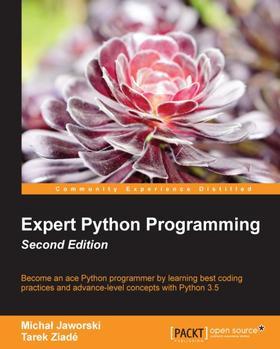
Expert Python Programming - Second Edition
Michal Jaworski, Tarek Ziade
¥334.25
Become an ace Python programmer by learning best coding practices and advance-level concepts with Python 3.5About This Book·Based on the latest stable version of Python (version 3.5)·Creating well manageable code that will run in various environments with different sets of dependencies·Packed with advanced concepts and best practices to write efficient Python codeWho This Book Is ForThe book would appeal to web developers and Python programmers who want to start using version 3.5 and write code efficiently. Basic knowledge of Python programming is expected.What You Will Learn·Conventions and best practices that are widely adopted in the python community·Package python code effectively for community and production use·Easy and lightweight ways to automate code deployment on remote systems·Improve your code's quality, reliability, and performance·Write concurrent code in python·Extend python with code written in different languagesIn DetailPython is a dynamic programming language, used in a wide range of domains by programmers who find it simple, yet powerful. Even if you find writing Python code easy, writing code that is efficient and easy to maintain and reuse is a challenge.The focus of the book is to familiarize you with common conventions, best practices, useful tools and standards used by python professionals on a daily basis when working with code.You will begin with knowing new features in Python 3.5 and quick tricks for improving productivity. Next, you will learn advanced and useful python syntax elements brought to this new version. Using advanced object-oriented concepts and mechanisms available in python, you will learn different approaches to implement metaprogramming. You will learn to choose good names, write packages, and create standalone executables easily.You will also be using some powerful tools such as buildout and vitualenv to release and deploy the code on remote servers for production use. Moving on, you will learn to effectively create Python extensions with C, C++, cython, and pyrex. The important factors while writing code such as code management tools, writing clear documentation, and test-driven development are also covered.You will now dive deeper to make your code efficient with general rules of optimization, strategies for finding bottlenecks, and selected tools for application optimization.By the end of the book, you will be an expert in writing efficient and maintainable code.Style and approach An easy-to-follow guide that covers industry followed best practices in Python programming
Mastering Akka
Mastering Akka
Christian Baxter
¥371.39
Master the art of creating scalable, concurrent, and reactive applications using AkkaAbout This Book·This book will help you cure anemic models with domain-driven design·We cover major Akka programming concepts such as concurrency, scalability, and reactivity·You will learn concepts like Event Sourcing and CQRS via Akka Persistence, Akka Streams, Akka Http as well as Akka ClusteringWho This Book Is ForIf you want to use the Lightbend platform to create highly performant reactive applications, then this book is for you. If you are a Scala developer looking for techniques to use all features of the new Akka release and want to incorporate these solutions in your current or new projects, then this book is for you. Expert Java developers who want to build scalable, concurrent, and reactive application will find this book helpful.What You Will Learn·Use Akka actors to enable parallel execution·Build out domain-driven design based components like entities and aggregates·Respond to command requests on that aggregate root that affect the internal state·Leverage Akka Persistence, protobuf and Cassandra to save the persistent state of you entities·Build out complex processing graphs with the Graph Builder DSL·Understand the dynamic push/pull nature of backpressure handling within Akka Streams·Route HTTP requests to an actor and return a response·Deploy actor instances across a set of nodes via ConductR for high availabilityIn DetailFor a programmer, writing multi-threaded applications is critical as it is important to break large tasks into smaller ones and run them simultaneously. Akka is a distributed computing toolkit that uses the abstraction of the Actor model, enabling developers to build correct, concurrent, and distributed applications using Java and Scala with ease. The book begins with a quick introduction that simplifies concurrent programming with actors. We then proceed to master all aspects of domain-driven design. We'll teach you how to scale out with Akka Remoting/Clustering. Finally, we introduce Conductr as a means to deploy to and manage microservices across a cluster.Style and approachThis comprehensive, fast-paced guide is packed with several real-world use cases that will help you understand concepts, issues, and resolutions while using Akka to create highly performant, scalable, and concurrency-proof reactive applications.
Secrets to Effective Author Marketing: It’s More Than “Buy My Book”
Maggie Lynch
¥46.36
Have you put your book out there and been disappointed in your sales? Perhaps you’ve tried a variety of marketing tactics to boost discoverability: blog posts, social media, book tours, paid ads in a variety of venues. But nothing is working. The publishing landscape changes every year. The number of books published has increased and the competition for readers is more than it has been before. The key is to?define your audience and then convince those potential readers of the?value?of your book. Your marketing time and money should primarily be spent on a message of value–not price, not story, and not genre. This book provides specific techniques to exploit that value without resorting to the typical overexposure in social media and newsletters with “Buy My Book” sales messaging. Instead, focus on the top three proven techniques that actually sell books. Follow step-by-step instructions and timelines to learn how to: 1) Create an Effective Plan for Communicating to Readers; 2) Use Social Media and Email lists to Engage with Your Readers; and 3) Plan for Effective Campaigns for both Book Launches and Backlist Rejuvenation throughout the year. In addition this book provides techniques to: Distinguish specific groups of readers most likely to buy your novel or nonfiction book. Understand your competition and the advantages that your book offers. Clarify hooks that capture attention of the media, reviewers, and readers. Identify where and how to reach readers, reviewers, and media. Create and implement a consistent brand throughout all marketing efforts. Effectively select, from 100+ options, the appropriate marketing tactics and timing that matches your book intentions and values. Maximize organic reach and stay to a budget of less than $100 per book campaign. Develop a long-term online marketing plan.
Secrets to Pricing and Distribution: Ebook, Print and Direct Sales
Maggie McVay Lynch
¥30.88
Once you have a finished book, you need to get it into readers’ hands. Loading your book to a vendor looks deceivingly easy. However, the career author knows that each vendor has its own methods for promoting books, performing searches, and identifying ready buyers. You need to take advantage of these differences in order to maximize your profits and discoverability. Capitalize on competitive retail pricing in different markets, and use effective metadata to draw more readers to your books. Learn to: Write compelling book blurbs for each title that focus on “reader cookies” and marketing. Unlock keywords and get access to hidden category options. Take advantage of search algorithm nuances at Amazon, Barnes and Noble, Kobo, and Apple. Use aggregators to increase distribution opportunities around the world. Evaluate opportunities for direct sales to bookstores and individual consumers.
Learning Go Programming
Vladimir Vivien
¥371.39
An insightful guide to learning the Go programming languageAbout This Book·Insightful coverage of Go programming syntax, constructs, and idioms to help you understand Go code effectively·Push your Go skills, with topics such as, data types, channels, concurrency, object-oriented Go, testing, and network programming·Each chapter provides working code samples that are designed to help reader quickly understand respective topicWho This Book Is ForIf you have prior exposure to programming and are interested in learning the Go programming language, this book is designed for you. It will quickly run you through the basics of programming to let you exploit a number of features offered by Go programming language.What You Will Learn·Install and configure the Go development environment to quickly get started with your first program.·Use the basic elements of the language including source code structure, variables, constants, and control flow primitives to quickly get started with Go·Gain practical insight into the use of Go's type system including basic and composite types such as maps, slices, and structs.·Use interface types and techniques such as embedding to create idiomatic object-oriented programs in Go.·Develop effective functions that are encapsulated in well-organized package structures with support for error handling and panic recovery.·Implement goroutine, channels, and other concurrency primitives to write highly-concurrent and safe Go code·Write tested and benchmarked code using Go's built test tools·Access OS resources by calling C libraries and interact with program environment at runtimeIn DetailThe Go programming language has firmly established itself as a favorite for building complex and scalable system applications. Go offers a direct and practical approach to programming that let programmers write correct and predictable code using concurrency idioms and a full-featured standard library.This is a step-by-step, practical guide full of real world examples to help you get started with Go in no time at all. We start off by understanding the fundamentals of Go, followed by a detailed description of the Go data types, program structures and Maps. After this, you learn how to use Go concurrency idioms to avoid pitfalls and create programs that are exact in expected behavior. Next, you will be familiarized with the tools and libraries that are available in Go for writing and exercising tests, benchmarking, and code coverage.Finally, you will be able to utilize some of the most important features of GO such as, Network Programming and OS integration to build efficient applications. All the concepts are explained in a crisp and concise manner and by the end of this book; you would be able to create highly efficient programs that you can deploy over cloud.Style and approachThe book is written to serve as a reader-friendly step-by-step guide to learning the Go programming language. Each topic is sequentially introduced to build on previous materials covered. Every concept is introduced with easy-to-follow code examples that focus on maximizing the understanding of the topic at hand.
Mastering Hibernate
Mastering Hibernate
Ramin Rad
¥222.81
Learn how to correctly utilize the most popular Object-Relational Mapping tool for your Enterprise applicationAbout This Book·Understand the internals of Hibernate and its architecture, and how it manages Entities, Events, Versioning, Filters, and Cache·Observe how Hibernate bridges the gap between object-oriented concepts and relational models·Discover how Hibernate can address architectural concerns such as Transaction, Database Multi-tenancy, Clustering, and Database ShardsWho This Book Is ForMastering Hibernate is intended for those who are already using or considering using Hibernate as the solution to address the problem of Object Relational Mapping. If you are already using Hibernate, this book will help you understand the internals and become a power user of Hibernate.What You Will Learn·Understand the internals of a Hibernate session and how Entities are managed·Declare better mapping between entity classes and database tables·Manage entity associations and collections·Fetch data not just by entity ID, but also using HQL, Criteria Objects, Filters, and Native SQL·Observe the first and second level caches and find out how to manage them·Collect statistics and metrics data for further observation·Make your application work with multi-tenant databasesIn DetailHibernate has been so successful since its inception that it even influenced the Java Enterprise Edition specification in that the Java Persistence API was dramatically changed to do it the Hibernate way. Hibernate is the tool that solves the complex problem of Object Relational Mapping. It can be used in both Java Enterprise applications as well as .Net applications. Additionally, it can be used for both SQL and NoSQL data stores.Some developers learn the basics of Hibernate and hit the ground quickly. But when demands go beyond the basics, they take a reactive approach instead of learning the fundamentals and core concepts. However, the secret to success for any good developer is knowing and understanding the tools at your disposal. It's time to learn about your tool to use it betterThis book first explores the internals of Hibernate by discussing what occurs inside a Hibernate session and how Entities are managed. Then, we cover core topics such as mapping, querying, caching, and we demonstrate how to use a wide range of very useful annotations.Additionally, you will learn how to create event listeners or interceptors utilizing the improved architecture in the latest version of Hibernate.Style and approachThis book takes a close look at the core topics, and helps you understand the complex topics by showing you examples and giving you in-depth discussions.
C++ Game Development Cookbook
Druhin Mukherjee
¥334.25
Over 90 recipes to get you creating modern, fast, and high-quality games with C++About This Book·Level up your game programming skills with insightful recipes on building games in C++·Analyze the less commonly discussed problems with C++ applications to develop the best games·Improve the performance of your games with the new multi-threading and networking features of C++11Who This Book Is ForThis book is ideal for aspiring game developers who are proficient in C++ programming and are interested in developing games with C++. Some basic knowledge of game programming will be useful but is not necessary.What You Will Learn·Explore the basics of game development to build great and effective features for your game·Develop your first text-based game using the various concepts of object-oriented programming·Use algorithms when developing games with various sorting and searching techniques·Exploit data structures in a game's development for data storage·Create your first 2D game using GDI library and sprite sheet.·Build your first advanced 2D game of space invaders using patterns such as observer, fly-weight, abstract factory, command, state, and moreIn DetailC++ is one of the preferred languages for game development as it supports a variety of coding styles that provides low-level access to the system. C++ is still used as a preferred game programming language by many as it gives game programmers control of the entire architecture, including memory patterns and usage. However, there is little information available on how to harness the advanced features of C++ to build robust games.This book will teach you techniques to develop logic and game code using C++. The primary goal of this book is to teach you to create high-quality games using C++ game programming scripts and techniques, regardless of the library or game engine you use. It will show you how to make use of the object-oriented capabilities of C++ so you can write well-structured and powerful games of any genre. The book also explores important areas such as physics programming and audio programming, and gives you other useful tips and tricks to improve your code.By the end of this book, you will be competent in game programming using C++, and will be able to develop your own games in C++.Style and approachEvery recipe of this guide covers a task that will help you build different aspects of a game, such as taking player input and displaying the output, using control flow to implement decision making, and so on. Each recipe begins with gentle introduction and key concepts, has illustrated examples of use, and ends with a detailed but informative description of the inner workings.
Scala High Performance Programming
Vincent Theron, Michael Diamant
¥334.25
Leverage Scala and the functional paradigm to build performant softwareAbout This Book·Get the first book to explore Scala performance techniques in depth!·Real-world inspired use cases illustrate and support the techniques studied and the language features·This book is written by Vincent Theron and Michael Diamant, software engineers with several years of experience in the high-frequency trading and programmatic advertising industriesWho This Book Is ForThis book assumes a basic exposure to the Scala programming language and the Java Virtual Machine. You should be able to read and understand moderately advanced Scala code. No other knowledge is required.What You Will Learn·Analyze the performance of JVM applications by developing JMH benchmarks and profiling with Flight Recorder·Discover use cases and performance tradeoffs of Scala language features, and eager and lazy collections·Explore event sourcing to improve performance while working with stream processing pipelines·Dive into asynchronous programming to extract performance on multicore systems using Scala Future and Scalaz Task·Design distributed systems with conflict-free replicated data types (CRDTs) to take advantage of eventual consistency without synchronization·Understand the impact of queues on system performance and apply the Free monad to build systems robust to high levels of throughputIn DetailScala is a statically and strongly typed language that blends functional and object-oriented paradigms. It has experienced growing popularity as an appealing and pragmatic choice to write production-ready software in the functional paradigm. Scala and the functional programming paradigm enable you to solve problems with less code and lower maintenance costs than the alternatives. However, these gains can come at the cost of performance if you are not careful.Scala High Performance Programming arms you with the knowledge you need to create performant Scala applications. Starting with the basics of understanding how to define performance, we explore Scala's language features and functional programming techniques while keeping a close eye on performance throughout all the topics.We introduce you as the newest software engineer at a fictitious financial trading company, named MV Trading. As you learn new techniques and approaches to reduce latency and improve throughput, you'll apply them to MV Trading's business problems. By the end of the book, you will be well prepared to write production-ready, performant Scala software using the functional paradigm to solve real-world problems.Style and approachThis step-by-step guide will help you create high performance applications using Scala. Packed with lots of code samples, tips and tricks, every topic is explained in a detailed, easy-to-understand manner.