


 购物车
购物车 个人中心
个人中心
Mastering Magento 2 - Second Edition
¥80.65
Maximize the power of Magento 2 to create productive online stores About This Book Updated for Magento 2, this book offers a comprehensive coverage of all the new features of Magento to build modern online stores Exploit little-known techniques to extend, tune, and manage your Magento installation Detailed coverage to make your store run faster, better, and more productively Who This Book Is For This book is for web designers, developers, or e-commerce store-owners who design or manage Magento stores for their clients and want to gain an in-depth understanding of the various features of Magento 2. What You Will Learn Discover what makes Magento 2 different — and even more powerful Develop strategies to create multi-store environments Find out how to create themes and extend the functionality of Magento 2 Create sound development practices to insure code integrity and security Know the why, as well as the how, behind using Magento 2 In Detail The long-awaited release of the world's most popular online solution, Magento 2, is now out with an all new interface and several enhancements. This book offers you advanced guidance on managing, optimizing, and extending your store while taking advantage of the new features of Magento 2. This is a comprehensive guide to using the all new features and interface of Magento 2 to build, extend, and design online stores. From planning your Magento installation through to advanced techniques designed to make your store as successful as possible, this book is your roadmap to managing your Magento store. Focusing on Magento's Community version, the book covers everything from creating and managing multiple stores to fine-tuning Magento for speed and performance. You’ll learn how to manage categories, products, design themes, extensions, and more. Style and Approach This book will be a straightforward guide that will dive deep into both aspects of developing and administering beautiful and secure stores. Get a firm idea of the different tools that the latest version has to offer to ensure the best customer experience.
Linux Networking Cookbook
¥63.21
Over 40 recipes to help you set up and configure Linux networks About This Book Move beyond the basics of how a Linux machine works and gain a better understanding of Linux networks and their configuration Impress your peers by setting up and configuring a Linux server and its various network elements like a pro This is a hands-on solution guide to building, maintaining, and securing a network using Linux Who This Book Is For This book is targeted at Linux systems administrators who have a good basic understanding and some prior experience of how a Linux machine operates, but want to better understand how various network services function, how to set them up, and how to secure them. You should be familiar with how to set up a Linux server and how to install additional software on them. What You Will Learn Route an IPv6 netblock to your local network Modify your named instance to support setting hostnames for your IPv6 addresses Use SSH for remote console access Configure NGINX with TLS Secure XMPP with TLS Leverage iptables6 to firewall your IPv6 traffic Configure Samba as an Active Directory compatible directory service In Detail Linux can be configured as a networked workstation, a DNS server, a mail server, a firewall, a gateway router, and many other things. These are all part of administration tasks, hence network administration is one of the main tasks of Linux system administration. By knowing how to configure system network interfaces in a reliable and optimal manner, Linux administrators can deploy and configure several network services including file, web, mail, and servers while working in large enterprise environments. Starting with a simple Linux router that passes traffic between two private networks, you will see how to enable NAT on the router in order to allow Internet access from the network, and will also enable DHCP on the network to ease configuration of client systems. You will then move on to configuring your own DNS server on your local network using bind9 and tying it into your DHCP server to allow automatic configuration of local hostnames. You will then future enable your network by setting up IPv6 via tunnel providers. Moving on, we’ll configure Samba to centralize authentication for your network services; we will also configure Linux client to leverage it for authentication, and set up a RADIUS server that uses the directory server for authentication. Toward the end, you will have a network with a number of services running on it, and will implement monitoring in order to detect problems as they occur. Style and approach This book is packed with practical recipes and a task-based approach that will walk you through building, maintaining, and securing a computer network using Linux.
Kali Linux 2: Windows Penetration Testing
¥90.46
Kali Linux: a complete pentesting toolkit facilitating smooth backtracking for working hackers About This Book Conduct network testing, surveillance, pen testing and forensics on MS Windows using Kali Linux Footprint, monitor, and audit your network and investigate any ongoing infestations Customize Kali Linux with this professional guide so it becomes your pen testing toolkit Who This Book Is For If you are a working ethical hacker who is looking to expand the offensive skillset with a thorough understanding of Kali Linux, then this is the book for you. Prior knowledge about Linux operating systems and the BASH terminal emulator along with Windows desktop and command line would be highly beneficial. What You Will Learn Set up Kali Linux for pen testing Map and enumerate your Windows network Exploit several common Windows network vulnerabilities Attack and defeat password schemes on Windows Debug and reverse-engineer Windows programs Recover lost files, investigate successful hacks and discover hidden data in innocent-looking files Catch and hold admin rights on the network, and maintain backdoors on the network after your initial testing is done In Detail Microsoft Windows is one of the two most common OS and managing its security has spawned the discipline of IT security. Kali Linux is the premier platform for testing and maintaining Windows security. Kali is built on the Debian distribution of Linux and shares the legendary stability of that OS. This lets you focus on using the network penetration, password cracking, forensics tools and not the OS. This book has the most advanced tools and techniques to reproduce the methods used by sophisticated hackers to make you an expert in Kali Linux penetration testing. First, you are introduced to Kali's top ten tools and other useful reporting tools. Then, you will find your way around your target network and determine known vulnerabilities to be able to exploit a system remotely. Next, you will prove that the vulnerabilities you have found are real and exploitable. You will learn to use tools in seven categories of exploitation tools. Further, you perform web access exploits using tools like websploit and more. Security is only as strong as the weakest link in the chain. Passwords are often that weak link. Thus, you learn about password attacks that can be used in concert with other approaches to break into and own a network. Moreover, you come to terms with network sniffing, which helps you understand which users are using services you can exploit, and IP spoofing, which can be used to poison a system's DNS cache. Once you gain access to a machine or network, maintaining access is important. Thus, you not only learn penetrating in the machine you also learn Windows privilege’s escalations. With easy to follow step-by-step instructions and support images, you will be able to quickly pen test your system and network. Style and approach This book is a hands-on guide for Kali Linux pen testing. This book will provide all the practical knowledge needed to test your network's security using a proven hacker's methodology. The book uses easy-to-understand yet professional language for explaining concepts.
Practical Windows Forensics
¥90.46
Leverage the power of digital forensics for Windows systems About This Book Build your own lab environment to analyze forensic data and practice techniques. This book offers meticulous coverage with an example-driven approach and helps you build the key skills of performing forensics on Windows-based systems using digital artifacts. It uses specific open source and Linux-based tools so you can become proficient at analyzing forensic data and upgrade your existing knowledge. Who This Book Is For This book targets forensic analysts and professionals who would like to develop skills in digital forensic analysis for the Windows platform. You will acquire proficiency, knowledge, and core skills to undertake forensic analysis of digital data. Prior experience of information security and forensic analysis would be helpful. You will gain knowledge and an understanding of performing forensic analysis with tools especially built for the Windows platform. What You Will Learn Perform live analysis on victim or suspect Windows systems locally or remotely Understand the different natures and acquisition techniques of volatile and non-volatile data. Create a timeline of all the system actions to restore the history of an incident. Recover and analyze data from FAT and NTFS file systems. Make use of various tools to perform registry analysis. Track a system user's browser and e-mail activities to prove or refute some hypotheses. Get to know how to dump and analyze computer memory. In Detail Over the last few years, the wave of the cybercrime has risen rapidly. We have witnessed many major attacks on the governmental, military, financial, and media sectors. Tracking all these attacks and crimes requires a deep understanding of operating system operations, how to extract evident data from digital evidence, and the best usage of the digital forensic tools and techniques. Regardless of your level of experience in the field of information security in general, this book will fully introduce you to digital forensics. It will provide you with the knowledge needed to assemble different types of evidence effectively, and walk you through the various stages of the analysis process. We start by discussing the principles of the digital forensics process and move on to show you the approaches that are used to conduct analysis. We will then study various tools to perform live analysis, and go through different techniques to analyze volatile and non-volatile data. Style and approach This is a step-by-step guide that delivers knowledge about different Windows artifacts. Each topic is explained sequentially, including artifact analysis using different tools and techniques. These techniques make use of the evidence extracted from infected machines, and are accompanied by real-life examples.

3D Game Design with Unreal Engine 4 and Blender
¥90.46
Combine the powerful UE4 with Blender to create visually appealing and comprehensive game environments About This Book The only resource that shows how you can incorporate Blender into your Unreal Engine 4 Game environment Create amazing 3D game environments by leveraging the power of Blender and Unreal Engine 4 Practical step-by-step approach with plenty of illustrative examples to get you started immediately Who This Book Is For This book would be ideal for 3D artists and game designers who want to create amazing 3D game environments and leverage the power of Blender with Unreal Engine 4. 3D design basics would be necessary to get the most out of this book. Some previous experience with Blender would be helpful but not essential What You Will Learn Create a fully functioning game level of your own design using Blender and Unreal Engine 4 Customize your level with detailed 3D assets created with Blender Import assets into Unreal Engine 4 to create an amazing finished product Build a detailed dynamic environment with goals and an ending Explore Blender’s incredible animation tools to animate elements of your game Create great environments using sound effects, particle effects, and class blueprints In Detail Unreal Engine 4 now has support for Blender, which was not available in earlier versions. This has opened up new possibilities and that is where this book comes in. This is the first book in the market combining these two powerful game and graphic engines. Readers will build an amazing high-level game environment with UE4 and will show them how to use the power of Blender 3D to create stunning animations and 3D effects for their game. This book will start with creating levels, 3D assets for the game, game progression, light and environment control, animation, and so on. Then it will teach readers to add amazing visual effects to their game by applying rendering, lighting, rigging, and compositing techniques in Blender. Finally, readers will learn how to smoothly transfer blender files to UE4 and animate the game assets. Each chapter will add complexities to the game environment. Style and approach This will have a clear, step-by-step approach to creating game assets in Blender and then importing them to UE4 to create stunning game environments. All asset creation techniques are explained in detail along with tips on how to use them to create your own game environments. The book offers end-to-end coverage of how to design a game level from scratch.
Getting Started with Microsoft System Center Operations Manager
¥107.90
A beginner's guide to help you design, deploy and administer your System Center Operations Manager 2016 and 2012 R2 environments About This Book Discover how to monitor complex IT environments with System Center Operations Manager using tips, tricks and best practice recommendations from industry experts. Learn how to create eye-catching dashboards and reports to help deliver a tangible return on investment back to your organization. Optimize, troubleshoot and perform disaster recovery in Operations Manager using step by step examples based on real-world scenarios. Who This Book Is For The target audience for this book is the IT Pro or System Administrator who wants to deploy and use System Center Operations Manager but has no previous knowledge of the product. As a ‘Getting Started’ book, our primary objective is to equip you with the knowledge you need to feel comfortable when working with common monitoring scenarios in OpsMgr. With this in mind, deep-diving into less-common OpsMgr features such as Audit Collection Services (ACS), Agentless Exception Monitoring (AEM) and Application Performance Monitoring (APM) has been intentionally omitted. What You Will Learn Install a new System Center 2016 Operations Manager Management Group Design and provision custom views to relevant support teams. Understand how to deploy agents Work with management packs Monitor network devices Model your IT services with distributed applications Create dashboards and custom visualizations Tune, optimize, maintain and troubleshoot System Center Operations Manager In Detail Most modern IT environments comprise a heterogeneous mixture of servers, network devices, virtual hypervisors, storage solutions, cross-platform operating systems and applications. All this complexity brings a requirement to deliver a centralized monitoring and reporting solution that can help IT administrators quickly identify where the problems are and how best to resolve them. Using System Center Operations Manager (OpsMgr), administrators get a full monitoring overview of the IT services they have responsibility for across the organization - along with some useful management capabilities to help them remediate any issues they've been alerted to. This book begins with an introduction to OpsMgr and its core concepts and then walks you through designing and deploying the various roles. After a chapter on exploring the consoles, you will learn how to deploy agents, work with management packs, configure network monitoring and model your IT services using distributed applications. There’s a chapter dedicated to alert tuning and another that demonstrates how to visualize your IT using dashboards. The final chapters in the book discuss how to create alert sub*ions, manage reports, backup and recover OpsMgr, perform maintenance and troubleshoot common problems. Style and approach A beginner’s guide that focuses on providing the practical skills required to effectively deploy and administer OpsMgr with walkthrough examples and tips on all the key concepts.
Learning ArcGIS Runtime SDK for .NET
¥80.65
Learn how to build native, cross-platform mapping apps with this comprehensive and practical guide, using the MVVM pattern About This Book Enhance the user experience with the power of ArcGIS runtime SDK for .NET. This clear, well segregated book has all the information you need on ArcGIS Runtime SDK. Just name it—this book has it! This highly practical book empowers you to build your own custom application! Get to know the inner details of ArcGIS Runtime SDK from our experts, in this book written by Ron Vincent, with 24 years' experience in the GIS industry and many in GIS training. Who This Book Is For This book caters to long-term users of Esri’s technologies that are new to mobile development or are transitioning from older Esri technologies such as ArcGIS Engine. It is also for users who are unfamiliar with Esri or GIS and are in need of a mapping solution for either their desktop or a mobile platform, or both. The book requires knowledge of .NET. What You Will Learn Understand and implement the MVVM pattern using MVVM Light Create and add layers from offline and online resources such as ArcGIS Online or ArcGIS for Server Create a 2D or 3D map and decide what kind of symbology to use Symbolize the layers based on the geometry Search and find objects in the layers Geocode an address and create a route using an address Edit layer objects from online content and offline content Test the application using test-driven development and then build and release the application for the intended audience In Detail ArcGIS is a geographic information system (GIS) that enables you to work with maps and geographic information. It can be used to create and utilize maps, compile geographic data, analyze mapped information, share and discover geographic information and manage geographic information in a database. This book starts by showing you where ArcGIS Runtime fits within Esri’s overall platform strategy. You'll create an initial map using the SDK, then use it to get an understanding of the MVVM model. You'll find out about the different kinds of layers and start adding layers, and you'll learn to transform maps into a 3D scene. The next chapters will help you comprehend and extract information contained in the maps using co-ordinates and layer objects. Towards the end, you will learn to set the symbology, decide whether to use 2D or 3D, see how to implement 2D or 3D, and learn to search and find objects. You'll also get to grips with many other standard features of the Application Programming Interface (API), including create applications and finally testing, licensing, and deploying them. Once completed, you will be able to meet most of the common requirements of any mapping application for desktop or mobile platforms. Style and approach This comprehensive book takes a completely practical approach, where every chapter explains the important concepts and demonstrates a practical application of them in a hands-on manner.
Mastering Unreal Engine 4.X
¥90.46
Take your game development skills to the next level with one of the best engines on the market About This Book Build an entire AAA game level throughout the book Take your C++ *ing skills to the next level and use them extensively to build the game An advanced practical guide with a tutorial style approach that will help you make the best of Unreal engine 4 Who This Book Is For This book is for game developers who have a basic knowledge of Unreal Engine and C++ *ing knowledge. If you want to take the leap from a casual game developer to a full-fledged professional game developer with Unreal Engine 4, this is the book for you. What You Will Learn Script your player controls in C++ Build a superb and engaging level with advanced design techniques Program AI with C++ Use Cascade to add life to your games Use custom shaders and advanced shading techniques to make things pretty Implement an awesome UI in the game Control gameplay using data tables In Detail Unreal Engine 4 has garnered a lot of attention in the gaming world because of its new and improved graphics and rendering engine, the physics simulator, particle generator, and more. This book is the ideal guide to help you leverage all these features to create state-of-the-art games that capture the eye of your audience. Inside we’ll explain advanced shaders and effects techniques and how you can implement them in your games. You’ll create custom lighting effects, use the physics simulator to add that extra edge to your games, and create customized game environments that look visually stunning using the rendering technique. You’ll find out how to use the new rendering engine efficiently, add amazing post-processing effects, and use data tables to create data-driven gameplay that is engaging and exciting. By the end of this book, you will be able to create professional games with stunning graphics using Unreal Engine 4! Style and approach An advanced guide that will take you to the next level of developing games with Unreal engine with illustrative examples that will make you confident of creating customized professional level games on your won.
CISSP in 21 Days - Second Edition
¥80.65
Boost your confidence and get the competitive edge you need to crack the exam in just 21 days! About This Book Day-by-day plan to study and assimilate core concepts from CISSP CBK Revise and take a mock test at the end of every four chapters A systematic study and revision of myriad concepts to help you crack the CISSP examination Who This Book Is For If you are a Networking professional aspiring to take the CISSP examination and obtain the coveted CISSP certification (considered to be the Gold Standard in Information Security personal certification), then this is the book you want. This book assumes that you already have sufficient knowledge in all 10 domains of the CISSP CBK by way of work experience and knowledge gained from other study books. What You Will Learn Review Exam Cram and Practice review questions to reinforce the required concepts Follow the day–by-day plan to revise important concepts a month before the CISSPexam Boost your time management for the exam by attempting the mock question paper Develop a structured study plan for all 10 CISSPdomains Build your understanding of myriad concepts in the Information Security domain Practice the full-blown mock test to evaluate your knowledge and exam preparation In Detail Certified Information Systems Security Professional (CISSP) is an internationally recognized and coveted qualification. Success in this respected exam opens the door to your dream job as a security expert with an eye-catching salary. But passing the final exam is challenging. Every year a lot of candidates do not prepare sufficiently for the examination, and fail at the final stage. This happens when they cover everything but do not revise properly and hence lack confidence. This simple yet informative book will take you through the final weeks before the exam with a day-by-day plan covering all of the exam topics. It will build your confidence and enable you to crack the Gold Standard exam, knowing that you have done all you can to prepare for the big day. This book provides concise explanations of important concepts in all 10 domains of the CISSP Common Body of Knowledge (CBK). Starting with Confidentiality, Integrity, and Availability, you will focus on classifying information and supporting assets. You will understand data handling requirements for sensitive information before gradually moving on to using secure design principles while implementing and managing engineering processes. You will understand the application of cryptography in communication security and prevent or mitigate strategies for network attacks. You will also learn security control requirements and how to assess their effectiveness. Finally, you will explore advanced topics such as automated and manual test result analysis and reporting methods. A complete mock test is included at the end to evaluate whether you're ready for the exam. This book is not a replacement for full study guides; instead, it builds on and reemphasizes concepts learned from them. Style and approach There are many overlapping concepts that are applicable to more than one security domain in the CISSP exam. Hence, the eight security domains are aligned in a logical order so as to cover the concepts in the most appropriate sequence in this guide. Each chapter provides an illustration in the form of a flow diagram at the start to supply an overall view of the concepts covered in that chapter. This will facilitate a bird's-eye view of the chapter contents and the core security concepts covered. You can refer to this book throughout while preparing for the test or most importantly systematically revise the eight domains on a day-by-day basis up to one month before the exam. Hence the chapters are divided into 21 convenient days.
Mastering JavaScript Design Patterns - Second Edition
¥71.93
Write reliable code to create powerful applications by mastering advanced JavaScript design patterns About This Book Learn how to use tried and true software design methodologies to enhance your JavaScript code Discover robust JavaScript implementations of classic and advanced design patterns Packed with easy-to-follow examples that can be used to create reusable code and extensible designs Who This Book Is For This book is ideal for JavaScript developers who want to gain expertise in object-oriented programming with JavaScript and the new capabilities of ES-2015 to improve their web development skills and build professional-quality web applications. What You Will Learn Harness the power of patterns for tasks ranging from application building to code testing Rethink and revitalize your code with the use of functional patterns Improve the way you organize your code Build large-scale apps seamlessly with the help of reactive patterns Identify the best use cases for microservices Get to grips with creational, behavioral, and structural design patterns Explore advanced design patterns including dependency injection In Detail With the recent release of ES-2015, there are several new object-oriented features and functions introduced in JavaScript. These new features enhance the capabilities of JavaScript to utilize design patterns and software design methodologies to write powerful code. Through this book, you will explore how design patterns can help you improve and organize your JavaScript code. You’ll get to grips with creational, structural and behavioral patterns as you discover how to put them to work in different scenarios. Then, you'll get a deeper look at patterns used in functional programming, as well as model view patterns and patterns to build web applications. This updated edition will also delve into reactive design patterns and microservices as they are a growing phenomenon in the world of web development. You will also find patterns to improve the testability of your code using mock objects, mocking frameworks, and monkey patching. We’ll also show you some advanced patterns including dependency injection and live post processing. By the end of the book, you'll be saved of a lot of trial and error and developmental headaches, and you will be on the road to becoming a JavaScript expert. Style and approach Packed with several real-world use cases, this book shows you through step-by-step instructions how to implement the advanced object-oriented programming features to build sophisticated web applications that promote scalability and reusability.
Learning SaltStack - Second Edition
¥63.21
Build, manage, and secure your infrastructure by utilizing the power of SaltStack About This Book First book in the market to incorporate all the latest features of SaltStack. Leverage the power of SaltStack for building, managing and securing your infrastructure. Effectively use commands and control the state of your infrastructure in a jiffy. Who This Book Is For This book is aimed at System Administrators who are looking forward to manage their infrastructure using SaltStack with no prior knowledge about it. What You Will Learn Install Salt on your servers Run commands on all or some of your minions instantly from a central managing server Write custom Salt modules to handle your infrastructure’s unique needs Define the state of your infrastructure and use Salt to enforce that state. Create platform-agnostic state definitions for greater flexibility and power Manage virtual servers on public or private clouds using Salt Cloud Use the event system in Salt to create a reactive and self-healing infrastructure In Detail SaltStack is one of the best infrastructure management platforms available. It provides powerful tools for defining and enforcing the state of your infrastructure in a clear, concise way. With this book learn how to use these tools for your own infrastructure by understanding the core pieces of Salt. In this book we will take you from the initial installation of Salt, through running their first commands, and then talk about extending Salt for individual use cases. From there you will explore the state system inside of Salt, learning to define the desired state of our infrastructure in such a way that Salt can enforce that state with a single command. Finally, you will learn about some of the additional tools that salt provides, including salt-cloud, the reactor, and the event system. We?ll finish by exploring how to get involved with salt and what?s new in the salt community. Finally, by the end of the book, you'll be able to build a reliable, scalable, secure, high-performance infrastructure and fully utilize the power of cloud computing. Style and approach This will be a comprehensive guide on SaltStack along with installation and setting up of Salt on couple of platforms. Then enlightening the readers about remote execution system and configuration management system and ending with concepts of security and best practices.
Magento Extensions Development
¥71.93
Design, build, and maintain a powerful, secure, and complete extension for Magento 2, the world’s favorite e-commerce platform About This Book Deploy a complete real-world extension step by step Construct your extension with the best and most up-to-date development methods Learn about team working and code sharing Who This Book Is For If you want to write a specific customization or a large new and full-featured extension on Magento 2, this book is intended for you. You must be an intermediate to professional-level developer in PHP to appreciate this book. What You Will Learn Build a fully-functional complex extension to add new functionality to Magento Register your code with GIT and work with your team Write new layouts and templates Set up a fully configurable grid and forms in the backend Create code unit tests and run them through TDD Propose localized contents Develop optimized extensions for a high-load environment Publish extensions on the Magento Connect Marketplace In Detail Magento has been revealed as the best and the most popular open source e-commerce platform in the world, with about 250k+ online stores. Magento 2 is the most recent version of this awesome toolset: every new and modern development techniques are used to offer a real modular approach and powerful architecture. The book will support you in the writing of innovative and complex extensions. Starting from the beginning, we will cover how to set up a development environment that allows you to be really efficient in your functionality writing, including GIT registering and many other development tools. We then move on to provide a large overview of the best practices to scale your module in a high-load environment. After these foundations, you will see how to use test driven-development (TDD) and unit tests to handle your code. We then build a complex extension together, step by step, and internationally-ready. Next, you will find out how to protect the users’ data. Finally, we will take a look a publishing the extension on the new Magento Connect marketplace and how to protect your intellectual property. After you read this book, you will know everything you need to know to become an invaluable extension editor, whether it is for your customers’ needs or for your own requirements. Style and approach This book takes a step-by-step approach to developing the extension and learning the new concepts of developments. Each topic is explained sequentially in the process of creating the extension, and punctuated by detailed explanations of the features of the code.
Learning Modular Java Programming
¥63.21
Explore the power of modular programming for building applications with Java and Spring! About This Book Understand the basic concepts of Modular Programming to build enterprise applications with Java Create short and precise code and eliminate recursion The book follows a step-by-step approach that makes implementing Modular Programming easy Who This Book Is For This book targets Java developers who have a basic knowledge of application development with Java and are interested in learning the Modular Programming approach for building reusable applications that are easy to test, and thus improve overall project management. What You Will Learn Learn about Modular Programming and what modules an enterprise application can be divided into. Set up a development environment and create a "Hello World" application. Start implementing a sample application from the presentation layer. Implement the persistence layer. Implement the business layer, wrapping up all of the modules with Contexts and Dependency Injection (CDI). Manage an application's life cycle. Learn how to secure Web applications. Test enterprise applications and their automation. Understand how to version source code using Source Code Management (SCM) systems such as GIT and SVN. In Detail Modular programming means dividing an application into small parts and then developing it. It is an approach taken by developers to build applications and helps them add efficiency in their development process, thus making it more effective. The book starts with the fundamentals of Modular Programming. Then we move on to the actual implementation, where we teach developers how to divide an application into different modules or layers (such as presentation, execution, security, lifecycle, services, and so on) for better management. Once readers are well-versed in these modules and their development, the book shows how to create bindings in order to join these different modules and form a complete application. Next, the readers will learn how to manage these modules through dependency injection. Later, we move on to testing; readers will learn how to test the different modules of an application. The book ends by teaching readers how to maintain different versions of their application and how to modify it. By the end of the book, readers will have a good understanding of modular programming and will be able to use it to build applications with Java. Style and approach This book is a practical guide to help readers learn Modular Programming with Java and build an enterprise-ready app along the way. The book is divided into three major sections. The first teaches the fundamentals of Modular Programming and how to implement them; the second teaches readers to combine and manage the modules developed; in the final section, the book explains the applications of Modular Programming.

Delphi Cookbook - Second Edition
¥90.46
Over 60 hands-on recipes to help you master the power of Delphi for cross-platform and mobile development on multiple platforms About This Book Get to grips with Delphi to build and deploy various cross-platform applications Design, develop, and deploy real-world applications by implementing a single source codebase This swift guide will increase your productivity to develop applications with Delphi Who This Book Is For If you are an intermediate developer with a basic knowledge of Delphi and you want to develop cross-platform applications, then this book is for you. Familiarity with the fundamentals of RAD (Rapid Application Development) Studio is expected. What You Will Learn Develop visually stunning applications using FireMonkey Deploy LiveBinding effectively with the right OOP approach Create server-side programs to serve RESTful web services and provide data to your mobile apps Use well-defined GUI design patterns to build mobile applications that provide a great user experience Build mobile apps that read data from a remote server efficiently Call the platform native API on Android and iOS even for an unpublished API Manage software customization for your customer by making better use of an extended RTTI Implement the most popular design pattern without wasting too much time on debugging and bug fixing In Detail Delphi is a cross-platform Integrated Development Environment (IDE) that supports rapid application development for Microsoft Windows, Apple Mac OS X, Google Android, and Apple iOS. It helps you to concentrate on the real business and save yourself the pain of wandering amid GUI widget details, or having to tackle inter-platform incompatibilities. It also has a wide range of drag-and-drop controls, helping you code your business logic into your business model, and it compiles natively for desktop and mobile platforms. This book will teach you how to design and develop applications, deploy them on the cloud platform, and distribute them within an organization via Google Play and other similar platforms. You will begin with the basics of Delphi and get acquainted with JSON format strings, XSLT transformations, unicode encodings and various types of streams. We then move on to more advanced topics such as developing higher-order functions and using enumerators and RTTI. You will get an understanding of how Delphi RTL functions and how to use FireMonkey in a VCL application. We will then cover topics such as multithreading, using the parallel programming library and putting Delphi on a server. We will also take a look at the new feature of WebBroker Apache modules and then ride the mobile revolution with FireMonkey. By the end of the book, you will be able to develop and deploy cross-platform applications using Delphi. Style and approach Delphi Cookbook is an easy-to-follow guide, rich with hands-on examples of real-world programming tasks in Delphi.
Node.js Design Patterns - Second Edition
¥90.46
Get the best out of Node.js by mastering its most powerful components and patterns to create modular and scalable applications with ease About This Book Create reusable patterns and modules by leveraging the new features of Node.js . Understand the asynchronous single thread design of node and grasp all its features and patterns to take advantage of various functions. This unique guide will help you get the most out of Node.js and its ecosystem. Who This Book Is For The book is meant for developers and software architects with a basic working knowledge of JavaScript who are interested in acquiring a deeper understanding of how to design and develop enterprise-level Node.js applications. Basic knowledge of Node.js is also helpful to get the most out of this book. What You Will Learn Design and implement a series of server-side JavaScript patterns so you understand why and when to apply them in different use case scenarios Become comfortable with writing asynchronous code by leveraging constructs such as callbacks, promises, generators and the async-await syntax Identify the most important concerns and apply unique tricks to achieve higher scalability and modularity in your Node.js application Untangle your modules by organizing and connecting them coherently Reuse well-known techniques to solve common design and coding issues Explore the latest trends in Universal JavaScript, learn how to write code that runs on both Node.js and the browser and leverage React and its ecosystem to implement universal applications In Detail Node.js is a massively popular software platform that lets you use JavaScript to easily create scalable server-side applications. It allows you to create efficient code, enabling a more sustainable way of writing software made of only one language across the full stack, along with extreme levels of reusability, pragmatism, simplicity, and collaboration. Node.js is revolutionizing the web and the way people and companies create their software. In this book, we will take you on a journey across various ideas and components, and the challenges you would commonly encounter while designing and developing software using the Node.js platform. You will also discover the "Node.js way" of dealing with design and coding decisions. The book kicks off by exploring the basics of Node.js describing it's asynchronous single-threaded architecture and the main design patterns. It then shows you how to master the asynchronous control flow patterns,and the stream component and it culminates into a detailed list of Node.js implementations of the most common design patterns as well as some specific design patterns that are exclusive to the Node.js world.Lastly, it dives into more advanced concepts such as Universal Java*, and scalability' and it's meant to conclude the journey by giving the reader all the necessary concepts to be able to build an enterprise grade application using Node.js. Style and approach This book takes its intended readers through a comprehensive explanation to create a scalable and efficient real-time server-side apps.
Modern JavaScript Applications
¥90.46
An example-driven guide that explores the world of modern web development with JavaScript About This Book Explore the new features of ECMAScript 6 and how they can be incorporated to build cutting edge web applications Learn about modern web architectures and build real-world apps on top of them Make use of modern JavaScript tools, techniques and frameworks to enhance your web development skills Who This Book Is For This book is for existing JavaScript developers who want to explore some of the modern JavaScript features, techniques, and architectures to develop cutting edge web applications. What You Will Learn Learn to create single page websites Gain expertise in responsive and dynamic website design Enable Real-time communications between client-client and client-server/server-client Create APIs for large-scale applications Write complete applications using functional reactive programming In Detail Over the years, JavaScript has taken significant strides in the world of modern web development to enhance the development of a wide range of applications with different architectures. This book explores the advanced and new features that have arrived in JavaScript and how they can be applied to develop high-quality applications with different architectures. The book begins by covering a single page application that builds on the innovative MVC approach using AngularJS. As we move forward, the book shows you how to develop an enterprise-level application with the microservices architecture, using Node to build web services. We then focus on network programming concepts and you’ll build a real-time web application with websockets. When you’ve gained a solid grip on the different architectures, we’ll move on to the area where JavaScript shines, that is, UI development. You’ll learn to build responsive, declarative UIs with React and Bootstrap. As we near the end of this book, you’ll see how the performance of web applications can be enhanced using Functional Reactive Programming (FRP). Along the way, the book also explores how the power of JavaScript can be increased multi-fold. After reading this book, you will have a solid knowledge of the latest JavaScript techniques, tools, and architecture to build modern web apps. Style and approach Covering all the new features in ECMAScript 6, this book takes a project-based approach to introduce you to all the latest techniques, tools, and architectures of JavaScript web development. Each project that the book builds will show you a different angle of the power of JavaScript in modern web development.
Monitoring Elasticsearch
¥63.21
Monitor your Elasticsearch cluster's health, and diagnose and solve its performance and reliability issues About This Book Understand common performance and reliability pitfalls in ElasticSearch Use popular monitoring tools such as ElasticSearch-head, BigDesk, Marvel, Kibana, and more This is a step-by-step guide with lots of case studies on solving real-world ElasticSearch cluster issues Who This Book Is For This book is for developers and system administrators who use ElasticSearch in a wide range of capacities. Prior knowledge of ElasticSearch and related technologies would be helpful, but is not necessary. What You Will Learn Explore your cluster with ElasticSearch-head and BigDesk Access the underlying data of the ElasticSearch monitoring plugins using the ElasticSearch API Analyze your cluster’s performance with Marvel Troubleshoot some of the common performance and reliability issues that come up when using ElasticSearch Analyze a cluster’s historical performance, and get to the bottom of and recover from system failures Use and install various other tools and plugins such as Kibana and Kopf, which is helpful to monitor ElasticSearch In Detail ElasticSearch is a distributed search server similar to Apache Solr with a focus on large datasets, a schema-less setup, and high availability. This schema-free architecture allows ElasticSearch to index and search unstructured content, making it perfectly suited for both small projects and large big data warehouses with petabytes of unstructured data. This book is your toolkit to teach you how to keep your cluster in good health, and show you how to diagnose and treat unexpected issues along the way. You will start by getting introduced to ElasticSearch, and look at some common performance issues that pop up when using the system. You will then see how to install and configure ElasticSearch and the ElasticSearch monitoring plugins. Then, you will proceed to install and use the Marvel dashboard to monitor ElasticSearch. You will find out how to troubleshoot some of the common performance and reliability issues that come up when using ElasticSearch. Finally, you will analyze your cluster’s historical performance, and get to know how to get to the bottom of and recover from system failures. This book will guide you through several monitoring tools, and utilizes real-world cases and dilemmas faced when using ElasticSearch, showing you how to solve them simply, quickly, and cleanly. Style and approach This is a step-by-step guide to monitoring your ElasticSearch cluster and correcting performance issues. It is filled with lots of in-depth, real-world use-cases on solving different ElasticSearch cluster issues.
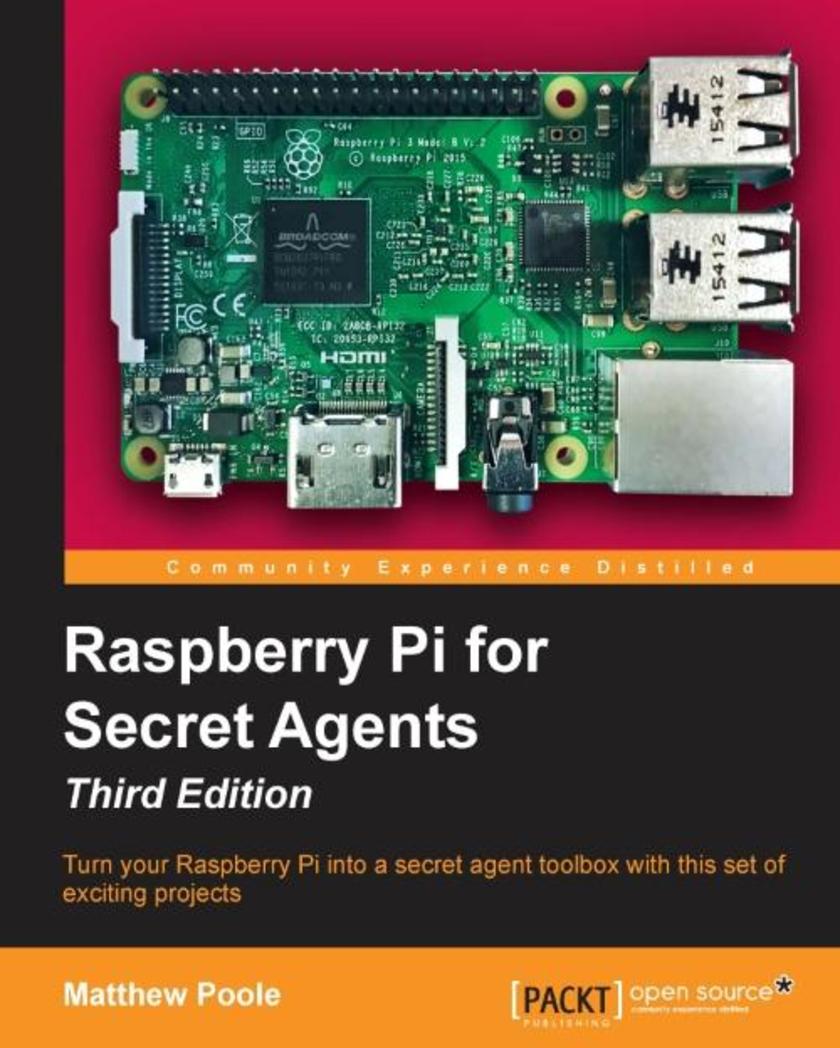
Raspberry Pi for Secret Agents - Third Edition
¥63.21
Turn your Raspberry Pi into a secret agent toolbox with this set of exciting projects About This Book Turn your Raspberry Pi into a multi-purpose secret agent gadget for audio and video surveillance, Wi-Fi exploration, or playing pranks on your friends Detect an intruder on camera or with sensors and set off an alarm or receive messages to your phone Find out what the other computers on your network are up to and make yourself anonymous on the Internet This book has been updated for new additions to your toolkit featuring the tiny, recently released Raspberry Pi Zero board Who This Book Is For This book is for those who are new to the Raspberry Pi Zero ,Raspberry Pi 2 or Raspberry Pi 3 and have some experience with the original Raspberry Pi models, and even for those budding secret agents who would like to use Pi Zero as a secret agent toolbox. No programming experience is assumed. Suitable for the novice and expert alike, each topic provides a fast and easy way to get started with exciting applications, with practical examples in every chapter. What You Will Learn Install and configure the Raspbian Jessie operating system for maximum mischief Detect an intruder with motion detection or a laser trip wire and set off an alarm Listen in to conversations from a distance over Bluetooth Distort your voice in weird and wonderful ways Track the Pi's whereabouts using GPS Connect your Pi to the mobile Internet using a 3G dongle and make yourself anonymous on the net Display secret messages and codes to fellow agents on a LED display In Detail This book is for all mischievous Raspberry Pi owners who’d like to see their computer transform into a neat spy gadget to be used in a series of practical pranks and projects. No previous skills are required to follow along, and if you’re completely new to Linux, you’ll pick up much of the basics for free. We’ll help you set up your Raspberry Pi Zero , Raspberry Pi 2 and Raspberry Pi 3 and guide you through a number of pranks and secret agent techniques that are so inconspicuous yet high on mischief. You’ll learn how to configure your operating system for maximum mischief and start exploring audio, video, or Wi-Fi techniques. We’ll show you how to record, listen, or talk to people from a distance and how to set up your own phone network. Then, you’ll plug in your webcam and set up a motion detector with an alarm and find out what the other computers on your Wi-Fi network are up to. Once you've mastered the techniques, we’ll combine them with a battery pack and GPS for the ultimate off-road spy kit. Style and Approach This easy-to-follow guide is for budding secret agents who want to create tools for mischief, stealth, and reconnaissance. It’s full of fun, practical examples and easy-to-follow recipes, guaranteeing maximum mischief for all skill levels.
Spring MVC: Beginner's Guide - Second Edition
¥80.65
Unleash the power of the latest Spring MVC 4.x to develop a complete application About This Book Work through carefully crafted exercises with detailed explanations for each step will help you understand the concepts with ease You will gain a clear understanding of the end-to-end request/response life cycle, and each logical component’s responsibility This book is packed with tips and tricks that demonstrate industry best practices on developing a Spring-MVC-based application Who This Book Is For The book is for Java developers who want to exploit Spring MVC and its features to build web applications. Some familiarity with basic servlet programming concepts would be a plus, but is not a prerequisite. What You Will Learn Familiarize yourself with the anatomy of the Spring 4.X development environment Understand web application architecture and the Spring MVC request flow Integrate bean validation and custom validation Use error handling and exception resolving Get to grips with REST-based web service development and Ajax Test your web application In Detail Spring MVC helps you build flexible and loosely coupled web applications. The Spring MVC Framework is architected and designed in such a way that every piece of logic and functionality is highly configurable. Also, Spring can integrate effortlessly with other popular web frameworks such as Struts, WebWork, Java Server Faces, and Tapestry. The book progressively teaches you to configure the Spring development environment, architecture, controllers, libraries, and more before moving on to developing a full web application. It begins with an introduction to the Spring development environment and architecture so you're familiar with the know-hows. From here, we move on to controllers, views, validations, Spring Tag libraries, and more. Finally, we integrate it all together to develop a web application. You'll also get to grips with testing applications for reliability. Style and approach This book takes a pragmatic step-by-step approach to web application development using Spring MVC, with informative screenshots and concise explanation.
Big Data Analytics with R
¥99.18
Utilize R to uncover hidden patterns in your Big Data About This Book Perform computational analyses on Big Data to generate meaningful results Get a practical knowledge of R programming language while working on Big Data platforms like Hadoop, Spark, H2O and SQL/NoSQL databases, Explore fast, streaming, and scalable data analysis with the most cutting-edge technologies in the market Who This Book Is For This book is intended for Data Analysts, Scientists, Data Engineers, Statisticians, Researchers, who want to integrate R with their current or future Big Data workflows. It is assumed that readers have some experience in data analysis and understanding of data management and algorithmic processing of large quantities of data, however they may lack specific skills related to R. What You Will Learn Learn about current state of Big Data processing using R programming language and its powerful statistical capabilities Deploy Big Data analytics platforms with selected Big Data tools supported by R in a cost-effective and time-saving manner Apply the R language to real-world Big Data problems on a multi-node Hadoop cluster, e.g. electricity consumption across various socio-demographic indicators and bike share scheme usage Explore the compatibility of R with Hadoop, Spark, SQL and NoSQL databases, and H2O platform In Detail Big Data analytics is the process of examining large and complex data sets that often exceed the computational capabilities. R is a leading programming language of data science, consisting of powerful functions to tackle all problems related to Big Data processing. The book will begin with a brief introduction to the Big Data world and its current industry standards. With introduction to the R language and presenting its development, structure, applications in real world, and its shortcomings. Book will progress towards revision of major R functions for data management and transformations. Readers will be introduce to Cloud based Big Data solutions (e.g. Amazon EC2 instances and Amazon RDS, Microsoft Azure and its HDInsight clusters) and also provide guidance on R connectivity with relational and non-relational databases such as MongoDB and HBase etc. It will further expand to include Big Data tools such as Apache Hadoop ecosystem, HDFS and MapReduce frameworks. Also other R compatible tools such as Apache Spark, its machine learning library Spark MLlib, as well as H2O. Style and approach This book will serve as a practical guide to tackling Big Data problems using R programming language and its statistical environment. Each section of the book will present you with concise and easy-to-follow steps on how to process, transform and analyse large data sets.
Learning Embedded Android N Programming
¥80.65
Create the perfectly customized system by unleashing the power of Android OS on your embedded device About This Book Understand the system architecture and how the source code is organized Explore the power of Android and customize the build system Build a fully customized Android version as per your requirements Who This Book Is For If you are a Java programmer who wants to customize, build, and deploy your own Android version using embedded programming, then this book is for you. What You Will Learn Master Android architecture and system design Obtain source code and understand the modular organization Customize and build your first system image for the Android emulator Level up and build your own Android system for a real-world device Use Android as a home automation and entertainment system Tailor your system with optimizations and add-ons Reach for the stars: look at the Internet of Things, entertainment, and domotics In Detail Take a deep dive into the Android build system and its customization with Learning Embedded Android Programming, written to help you master the steep learning curve of working with embedded Android. Start by exploring the basics of Android OS, discover Google’s “repo” system, and discover how to retrieve AOSP source code. You'll then find out to set up the build environment and the first AOSP system. Next, learn how to customize the boot sequence with a new animation, and use an Android “kitchen” to “cook” your custom ROM. By the end of the book, you'll be able to build customized Android open source projects by developing your own set of features. Style and approach This step-by-step guide is packed with various real-world examples to help you create a fully customized Android system with the most useful features available.


