


 购物车
购物车 个人中心
个人中心
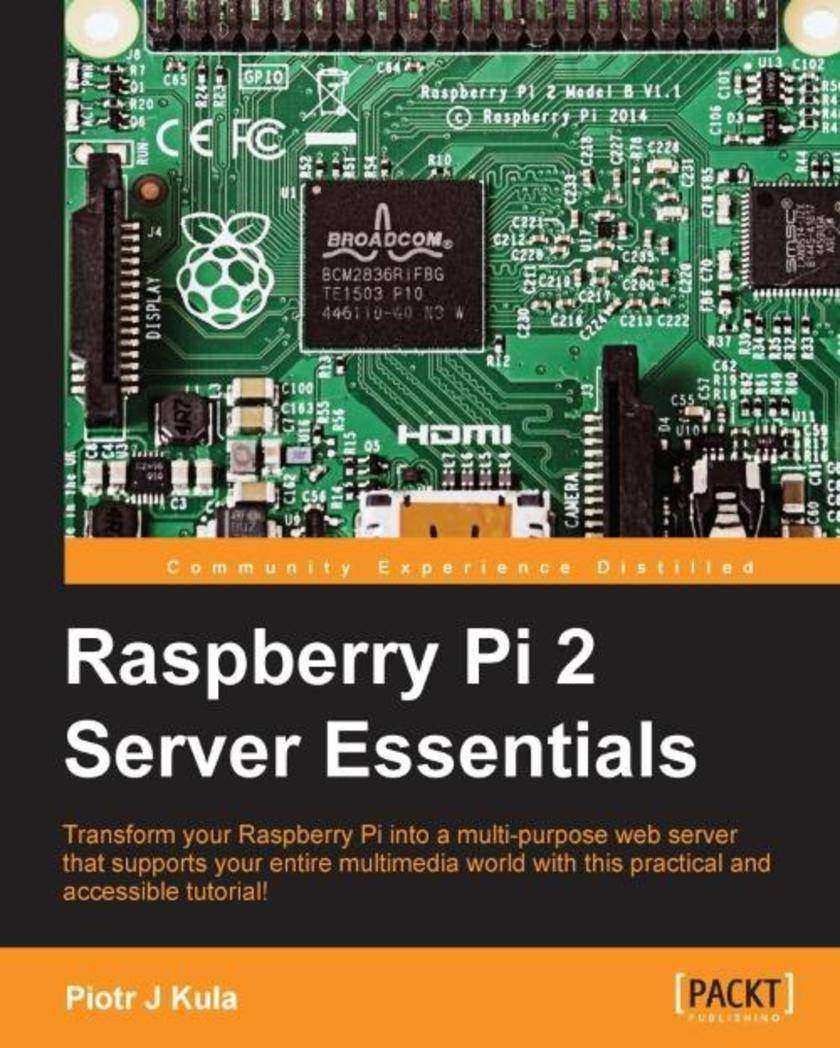
Raspberry Pi 2 Server Essentials
¥54.49
Transform your Raspberry Pi into a multi-purpose web server that supports your entire multimedia world with this practical and accessible tutorial! About This Book Host websites, games, and even stream HD videos with the impressive power of Raspberry Pi 2 Get to grips with embedded programming by turning your Pi into the cloud server that can be used to power Internet of Things projects Make the Raspberry Pi 2 the center of your latest tech experiments and discover how it can manage and host resources Who This Book Is For Seeking inspiration for some new tech projectsWant to get more from your Raspberry PiThis book has been created especially for you! What You Will Learn Host your Raspberry Pi as a web server using the minimum power resources Connect your Pi to the Internet and perform network benchmarking Explore the cross-platform features of the Pi as you run Python, Node.JS, ASP.NET, and PHP all in one place Share files over the Internet using your Pi as a file server Turn your Pi into a game server, host and engage into playing Enjoy live HD video streaming and exclusive real-time text overlays In Detail There’s no end to what you can do with a Raspberry Pi – it makes a huge range of tech projects possible. This book shows you how to transform it into a multipurpose web server, able to store and manage resources that lets you build some truly innovative and impressive computing creations. You’ll learn how to use your Raspberry Pi 2 to host a website using a range of different languages, host a game server, store files, and run everything from a media center to a cloud network. If you want to take control of your technological world, start building your own server and find out what’s possible with the Raspberry Pi microcomputer. Begin by getting your Pi set up – follow each step as the book shows you how to prepare a network and configure the additional features that you’ll need to build your projects. Once you’ve done this you’ll dig a little deeper and set up your pi as a file server, making sure it’s built for speed using a range of different tools, including Python, Node.js and ASP.NET. Following this the book shows you how to extend your server to allow you to host games, and stream live HD video before customizing it even further to create a fully-fledged media center. It doesn’t stop there however – the book then dives into the exciting world of the Internet of Things (IoT). You’ll learn how to install Windows IoT onto your Raspberry Pi, the operating system that’s driving embedded software projects all around the world. Once you’ve done this you’ll be ready to explore IoT further, as the book shows you how to use your device to host a cloud network that can form the basis of a wider IoT project. Style and approach Packed with plenty of practical examples that walk you through a number of Raspberry Pi projects, this book is an accessible journey into embedded computing and Internet of Things.
Sass and Compass Designer's Cookbook
¥90.46
Over 120 practical and easy-to-understand recipes that explain how to use Sass and Compass to write efficient, maintainable, and reusable CSS code for your web development projects About This Book Leverage Sass to make your CSS code maintainable, reusable and prevent code duplications Shorten debug time with Sass when creating complex CSS code for different browsers and devices Write easy and bullet-proof CSS with Compass using this step-by-step and detailed guide Who This Book Is For This book is mainly intended for web developers and designers who are comfortable with CSS and HTML. If you are someone with some experience with CSS, you will find the learning curve of learning Sass syntax to be less steep. Basic knowledge of web development is helpful but you don't have to be a programmer to understand Sass. What You Will Learn Spend less time debugging code Compile Sass code into readable and maintainable CSS Integrate Sass in your own projects Reuse your code to prevent code duplications Write reusable and portable CSS code Make use of pre-built and established code written by other developers Reduce development and maintenance time of your projects Set up a development environment with Gulp In Detail Sass and Compass Designer's Cookbook helps you to get most out of CSS3 and harness its benefits to create engaging and receptive applications. This book will help you develop faster and reduce the maintenance time for your web development projects by using Sass and Compass. You will learn how to use with CSS frameworks such as Bootstrap and Foundation and understand how to use other libraries of pre-built mixins. You will also learn setting up a development environment with Gulp. This book guides you through all the concepts and gives you practical examples for full understanding. Style and approach This book is the perfect mix of essential theory combined with real-life examples and problems, with clear explanations of the more sophisticated Sass concepts. Learn Sass and Compass with practical and well-explained example code. This book follows a problem and solution approach that is convenient to understand and follow.
Mastering Python
¥71.93
Master the art of writing beautiful and powerful Python by using all of the features that Python 3.5 offers About This Book Become familiar with the most important and advanced parts of the Python code style Learn the trickier aspects of Python and put it in a structured context for deeper understanding of the language Offers an expert's-eye overview of how these advanced tasks fit together in Python as a whole along with practical examples Who This Book Is For Almost anyone can learn to write working * and create high quality code but they might lack a structured understanding of what it means to be 'Pythonic'. If you are a Python programmer who wants to code efficiently by getting the syntax and usage of a few intricate Python techniques exactly right, this book is for you. What You Will Learn Create a virtualenv and start a new project Understand how and when to use the functional programming paradigm Get familiar with the different ways the decorators can be written in Understand the power of generators and coroutines without digressing into lambda calculus Create metaclasses and how it makes working with Python far easier Generate HTML documentation out of documents and code using Sphinx Learn how to track and optimize application performance, both memory and cpu Use the multiprocessing library, not just locally but also across multiple machines Get a basic understanding of packaging and creating your own libraries/applications In Detail Python is a dynamic programming language. It is known for its high readability and hence it is often the first language learned by new programmers. Python being multi-paradigm, it can be used to achieve the same thing in different ways and it is compatible across different platforms. Even if you find writing Python code easy, writing code that is efficient, easy to maintain, and reuse is not so straightforward. This book is an authoritative guide that will help you learn new advanced methods in a clear and contextualised way. It starts off by creating a project-specific environment using venv, introducing you to different Pythonic syntax and common pitfalls before moving on to cover the functional features in Python. It covers how to create different decorators, generators, and metaclasses. It also introduces you to functools.wraps and coroutines and how they work. Later on you will learn to use asyncio module for asynchronous clients and servers. You will also get familiar with different testing systems such as py.test, doctest, and unittest, and debugging tools such as Python debugger and faulthandler. You will learn to optimize application performance so that it works efficiently across multiple machines and Python versions. Finally, it will teach you how to access C functions with a simple Python call. By the end of the book, you will be able to write more advanced *s and take on bigger challenges. Style and Approach This book is a comprehensive guide that covers advanced features of the Python language, and communicate them with an authoritative understanding of the underlying rationale for how, when, and why to use them.
Game Audio Development with Unity 5.X
¥80.65
Create ‘AAA’ quality game audio with new features and tools built for Unity About This Book ? Explore the basics of audio development in Unity to create spatial sound, mixing, effects, composition, adaptive audio and more. ? Leverage the Audio Mixer of Unity 5.x to create blockbuster sound and music for your game. ? Learn about developing professional audio for games with FMOD Studio and composing original music with Reaper. ? Build amazing audio synchronized graphic visualizations with Unity. ? Understand how real-time character lip syncing can be implemented. Who This Book Is For The ideal target audience for this book will be game developers, both Indie as well as semi pro. No prior knowledge of Unity and audio development is assumed, What You Will Learn ? Develop game audio and other audio effects with Unity ? Getting familiar with the new Audio Mixer introduced in Unity 5 ? Implement dynamic and adaptive audio using various tools and strategies ? Explore interesting ways to incorporate audio into a game with sound visualization ? Use 3rd party professional audio development tools like FMOD ? Compose original music and record vocals ? Understand and troubleshoot audio performance issues In Detail Game Audio is one of the key components in making a game successful and it is quite popular in the gaming industry. So if you are a game developer with an eye on capturing the gamer market then this book is the right solution for you. In this book, we will take you through a step by step journey which will teach you to implement original and engaging soundtracks and SFX with Unity 5.x. You will be firstly introduced to the basics of game audio and sound development in Unity. After going through the core topics of audio development: audio sources, spatial sound, mixing, effects, and more; you will then have the option of delving deeper into more advanced topics like dynamic and adaptive audio. You will also learn to develop dynamic and adaptive audio using the Unity Audio Mixer. Further, you will learn how professional third party tools like FMOD are used for audio development in Unity. You will then go through the creation of sound visualization techniques and creating your own original music using the simple yet powerful audio workstation Reaper. Lastly, you will go through tips, techniques and strategies to help you optimize game audio performance or troubleshoot issues. At the end of the book, you’ll have gained the skills to implement professional sound and music. Along with a good base knowledge audio and music principles you can apply across a range of other game development tools. Style and approach This book will have a step by step practical approach where downloadable free games will be given with the book and readers will be free to work with them.
Practical Game AI Programming
¥90.46
Jump into the world of Game AI development About This Book ? Move beyond using libraries to create smart game AI, and create your own AI projects from scratch ? Implement the latest algorithms for AI development and in-game interaction ? Customize your existing game AI and make it better and more efficient to improve your overall game performance Who This Book Is For This book is for game developers with a basic knowledge of game development techniques and some basic programming techniques in C# or C++. What You Will Learn ? Get to know the basics of how to create different AI for different type of games ? Know what to do when something interferes with the AI choices and how the AI should behave if that happens ? Plan the interaction between the AI character and the environment using Smart Zones or Triggering Events ? Use animations correctly, blending one animation into another and rather than stopping one animation and starting another ? Calculate the best options for the AI to move using Pruning Strategies, Wall Distances, Map Preprocess Implementation, and Forced Neighbours ? Create Theta algorithms to the AI to find short and realistic looking paths ? Add many characters into the same scene and make them behave like a realistic crowd In Detail The book starts with the basics examples of AI for different game genres and directly jumps into defining the probabilities and possibilities of the AI character to determine character movement. Next, you’ll learn how AI characters should behave within the environment created. Moving on, you’ll explore how to work with animations. You’ll also plan and create pruning strategies, and create Theta algorithms to find short and realistic looking game paths. Next, you’ll learn how the AI should behave when there is a lot of characters in the same scene. You'll explore which methods and algorithms, such as possibility maps, Forward Chaining Plan, Rete Algorithm, Pruning Strategies, Wall Distances, and Map Preprocess Implementation should be used on different occasions. You’ll discover how to overcome some limitations, and how to deliver a better experience to the player. By the end of the book, you think differently about AI. Style and approach The book has a step-by-step tutorial style approach. The algorithms are explained by implementing them in #.
vSphere High Performance Cookbook - Second Edition
¥90.46
Over 80 recipes to help you improve vSphere 6.5's performance and solve problems before they arise About This Book ? The practical recipes provide cost-effective and high performance for any application running in a virtual machine ? Contains best practices and troubleshooting techniques to resolve vSphere 6.5 performance issues ? Get a comprehensive coverage of performance issues and solutions including vCenter Server design and virtual machine and application tuning Who This Book Is For If you are a system administrator and are planning to deploy vSphere 6.5 in your organization and want to maximize its performance, then this book is for you. Prior knowledge of the vSphere 6.5 concepts is essential. What You Will Learn ? Understand the VMM Scheduler, cache aware CPU Scheduler, NUMA aware CPU Scheduler, and more during the CPU Performance Design phase ? Get to know the virtual memory reclamation technique, host ballooning monitoring, and swapping activity ? Choose the right platform while designing your vCenter Server, redundant vCenter design, and vCenter SSO and its deployment ? Learn how to use various performance simulation tools ? Design VCSA Server Certificates to minimize security threats ? Use health check tools for storage and boost vSphere 6.5's performance with VAAI and VASA In Detail vSphere is a mission-critical piece of software for many businesses. It is a complex tool, and incorrect design and deployment can create performance related issues that can negatively affect the business. This book is focused on solving these problems as well as providing best practices and performance-enhancing techniques. This edition is fully updated to include all the new features in version 6.5 as well as the latest tools and techniques to keep vSphere performing at its best. This book starts with interesting recipes, such as the interaction of vSphere 6.5 components with physical layers such as CPU, memory, and networking. Then we focus on DRS, resource control design, and vSphere cluster design. Next, you'll learn about storage performance design and how it works with VMware vSphere 6.5. Moving on, you will learn about the two types of vCenter installation and the benefits of each. Lastly, the book covers performance tools that help you get the most out of your vSphere installation. By the end of this book, you will be able to identify, diagnose, and troubleshoot operational faults and critical performance issues in vSphere 6.5. Style and approach This cookbook is written in a practical, helpful style with numerous recipes focusing on answering and providing solutions to common and not-so-common performance issues and problems.
Practical Predictive Analytics
¥90.46
Make sense of your data and predict the unpredictable About This Book ? A unique book that centers around develop six key practical skills needed to develop and implement predictive analytics ? Apply the principles and techniques of predictive analytics to effectively interpret big data ? Solve real-world analytical problems with the help of practical case studies and real-world scenarios taken from the world of healthcare, marketing, and other business domains Who This Book Is For This book is for those with a mathematical/statistics background who wish to understand the concepts, techniques, and implementation of predictive analytics to resolve complex analytical issues. Basic familiarity with a programming language of R is expected. What You Will Learn ? Master the core predictive analytics algorithm which are used today in business ? Learn to implement the six steps for a successful analytics project ? Classify the right algorithm for your requirements ? Use and apply predictive analytics to research problems in healthcare ? Implement predictive analytics to retain and acquire your customers ? Use text mining to understand unstructured data ? Develop models on your own PC or in Spark/Hadoop environments ? Implement predictive analytics products for customers In Detail This is the go-to book for anyone interested in the steps needed to develop predictive analytics solutions with examples from the world of marketing, healthcare, and retail. We'll get started with a brief history of predictive analytics and learn about different roles and functions people play within a predictive analytics project. Then, we will learn about various ways of installing R along with their pros and cons, combined with a step-by-step installation of RStudio, and a de*ion of the best practices for organizing your projects. On completing the installation, we will begin to acquire the skills necessary to input, clean, and prepare your data for modeling. We will learn the six specific steps needed to implement and successfully deploy a predictive model starting from asking the right questions through model development and ending with deploying your predictive model into production. We will learn why collaboration is important and how agile iterative modeling cycles can increase your chances of developing and deploying the best successful model. We will continue your journey in the cloud by extending your skill set by learning about Databricks and SparkR, which allow you to develop predictive models on vast gigabytes of data. Style and Approach This book takes a practical hands-on approach wherein the algorithms will be explained with the help of real-world use cases. It is written in a well-researched academic style which is a great mix of theoretical and practical information. Code examples are supplied for both theoretical concepts as well as for the case studies. Key references and summaries will be provided at the end of each chapter so that you can explore those topics on their own.
Daniel Arbuckle’s Mastering Python
¥71.93
Gain a thorough understanding of operating in a Python development environment, and some of the most important advanced topics with Daniel Arbuckle. This dynamic, concise book is full of real-world solutions for Python 3.6 problems, and advanced-level concepts such as reactive programming, microservices, ctypes and Cython. About This Book ? Covers the latest and advanced concepts of Python such as parallel processing with Python 3.6 ? Explore the Python language from its basic installation and setup to concepts such as reactive programming and microservices ? Get introduced to the mechanism for rewriting code in a compiled language along with ctypes and Cython tools Who This Book Is For If you are a programmer and are familiar with the basics of Python, and you want to broaden your knowledge base to develop projects better and faster, this book is for you. Even if you are not familiar with Python, Daniel Arbuckle's Mastering Python starts with the basics and takes you on a journey to become an expert in the technology. What You Will Learn ? Get to grips with the basics of operating in a Python development environment ? Build Python packages to efficiently create reusable code ? Become proficient at creating tools and utility programs in Python ? Use the Git version control system to protect your development environment from unwanted changes ? Harness the power of Python to automate other software ? Distribute computational tasks across multiple processors ? Handle high I/O loads with asynchronous I/O to get a smoother performance ? Take advantage of Python's metaprogramming and programmable syntax features ? Get acquainted with the concepts behind reactive programming and RxPy In Detail Daniel Arbuckle's Mastering Python covers the basics of operating in a Python development environment, before moving on to more advanced topics. Daniel presents you with real-world solutions to Python 3.6 and advanced-level concepts, such as reactive programming, microservices, ctypes, and Cython tools. You don't need to be familiar with the Python language to use this book, as Daniel starts with a Python primer. Throughout, Daniel highlights the major aspects of managing your Python development environment, shows you how to handle parallel computation, and helps you to master asynchronous I/O with Python 3.6 to improve performance. Finally, Daniel will teach you the secrets of metaprogramming and unit testing in Python, helping you acquire the perfect skillset to be a Python expert. Daniel will get you up to speed on everything from basic programming practices to high-end tools and techniques, things that will help set you apart as a successful Python programmer. Style and Approach Daniel Arbuckle's Mastering Python covers basic to advanced-level concepts in computer science. If you are a beginner, then Daniel will help you get started. If you are experienced, he will expand your knowledge base.
Learning Elasticsearch
¥90.46
Store, search, and analyze your data with ease using Elasticsearch 5.x About This Book ? Get to grips with the basics of Elasticsearch concepts and its APIs, and use them to create efficient applications ? Create large-scale Elasticsearch clusters and perform analytics using aggregation ? This comprehensive guide will get you up and running with Elasticsearch 5.x in no time Who This Book Is For If you want to build efficient search and analytics applications using Elasticsearch, this book is for you. It will also benefit developers who have worked with Lucene or Solr before and now want to work with Elasticsearch. No previous knowledge of Elasticsearch is expected. What You Will Learn ? See how to set up and configure Elasticsearch and Kibana ? Know how to ingest structured and unstructured data using Elasticsearch ? Understand how a search engine works and the concepts of relevance and scoring ? Find out how to query Elasticsearch with a high degree of performance and scalability ? Improve the user experience by using autocomplete, geolocation queries, and much more ? See how to slice and dice your data using Elasticsearch aggregations. ? Grasp how to use Kibana to explore and visualize your data ? Know how to host on Elastic Cloud and how to use the latest X-Pack features such as Graph and Alerting In Detail Elasticsearch is a modern, fast, distributed, scalable, fault tolerant, and open source search and analytics engine. You can use Elasticsearch for small or large applications with billions of documents. It is built to scale horizontally and can handle both structured and unstructured data. Packed with easy-to- follow examples, this book will ensure you will have a firm understanding of the basics of Elasticsearch and know how to utilize its capabilities efficiently. You will install and set up Elasticsearch and Kibana, and handle documents using the Distributed Document Store. You will see how to query, search, and index your data, and perform aggregation-based analytics with ease. You will see how to use Kibana to explore and visualize your data. Further on, you will learn to handle document relationships, work with geospatial data, and much more, with this easy-to-follow guide. Finally, you will see how you can set up and scale your Elasticsearch clusters in production environments. Style and approach This comprehensive guide will get you started with Elasticsearch 5.x, so you build a solid understanding of the basics. Every topic is explained in depth and is supplemented with practical examples to enhance your understanding.

韩语听力从入门到达人:TOPIK考试初级、中高级听力素材精选精练
¥7.92
学习外语,“把好门关”十分重要。“听说读写”中将“听”放在首位,可见听力在外语学习中的重要性。《韩语听力从门到达人:TOPIK考试初级、中高级听力素材精选精练》选取多场景多层次的内容,采用由浅深的讲解方式,分为发音门、辨别发音相似的音节词汇短语、日常会话、心灵美文、名家名作选、可爱童谣、热门韩剧、人气歌谣、名人演讲等章节,涵盖与韩语听力相关的几乎全部内容。本书对话分为简单会话和复杂会话,且录音速度有常速和慢速两本版本。而且考虑到初学者的学习要求,本书还设置了大量的讲解和练习环节。本书完美附赠双速音频、新TOPIK听力词汇迷你小册。

江户川乱步(中日双语) (日本推理小说鼻祖短篇精选)
¥1.99
本书是日本推理小说鼻祖江户川乱步脍炙人口的短篇小说选集。本书精选江户川乱步脍炙人口的4篇经典短篇小说,谜一般的推理、跌宕起伏的情节,带你领略光怪陆离的推理世界。推理小说研究者钱晓波献译导读。书中日文部分全文标注假名,中日对照排版,方便读者学习与朗读。超值精装有声典藏版,附赠日文全文朗读及中文广播剧。日文版由日籍专家倾情朗读,中文版由《琅琊榜》“誉王”配音献声朗读。并赠送精美书签。


日语入门教程
¥20.61
旨在借助简明实用的内容构建起因人制宜的教程,以利于有志赴日研修的同学通过短期强化具备简单的听说能力。主要特色如下: ①重“听说”,轻“笔头”。突出言语的交流功能,严防“哑巴”日语。 ②语法讲解简明扼要,通过开门见山、浅显易懂的解释使学生殊途同归地掌握基本句式框架和基本助词用法。 ③将歌谣式课文导入日语入门期,辅以相应听力材料;通过歌曲等多媒体手段激发学生学习热情,有助于学生牢记平、片假名。 ④句型训练时,须有大量例句作支撑。同一句型框架下选用的代替词汇要具有高频性,即突出实用效果。 ⑤循序渐进地推进“简单场景对话练习”,加大口试在复习题中的比重。兼顾日常会话的适用性、词汇句型的简约性和解释分析的明了性。
Microservices with Clojure
¥81.74
The common patterns and practices of the microservice architecture and their application using the Clojure programming language. About This Book ? Relevance of the microservice architecture and benefits of Clojure's functional and simple features to implement it. ? Learn best practices and common principles to avoid common pitfalls while developing microservices. ? Learn how to use Pedestal to build your next microservices, secure them using JWT, and monitor them using the ELK stack Who This Book Is For You should have a working knowledge of programming in Clojure. However, no knowledge of RESTful architecture, microservices, or web services is expected. If you are looking to apply techniques to your own projects, taking your first steps into microservice architecture, this book is for you. What You Will Learn ? Explore the pros and cons of monolithic and microservice architectures ? Use Clojure to effectively build a reallife application using Microservices ? Gain practical knowledge of the Clojure Pedestal framework and how to use it to build Microservices ? Explore various persistence patterns and learn how to use Apache Kafka to build event-driven microservice architectures ? Secure your Microservices using JWT ? Monitor Microservices at scale using the ELK stack ? Deploy Microservices at scale using container orchestration platforms such as Kubernetes In Detail The microservice architecture is sweeping the world as the de facto pattern with which to design and build scalable, easy-tomaintain web applications. This book will teach you common patterns and practices, and will show you how to apply these using the Clojure programming language. This book will teach you the fundamental concepts of architectural design and RESTful communication, and show you patterns that provide manageable code that is supportable in development and at scale in production. We will provide you with examples of how to put these concepts and patterns into practice with Clojure. This book will explain and illustrate, with practical examples, how teams of all sizes can start solving problems with microservices. You will learn the importance of writing code that is asynchronous and non-blocking and how Pedestal helps us do this. Later, the book explains how to build Reactive microservices in Clojure that adhere to the principles underlying the Reactive Manifesto. We finish off by showing you various ways to monitor, test, and secure your microservices. By the end, you will be fully capable of setting up, modifying, and deploying a microservice with Clojure and Pedestal. Style and approach This book highlights the merits of the microservice architecture and its implementation with Clojure. Learn to implement microservices by migrating a monolithic application to a microservice-based architecture.
Learning AWS IoT
¥73.02
Learn to use AWS IoT services to build your connected applications with the help of this comprehensive guide. About This Book ? Gets you started with AWS IoT and its functionalities ? Learn different modules of AWS IoT with practical use cases. ? Learn to secure your IoT communication Who This Book Is For This book is for anyone who wants to get started with the AWS IoT Suite and implement it with practical use cases. This book acts as an extensive guide, on completion of which you will be in a position to start building IoT projects using AWS IoT platform and using cloud services for your projects. What You Will Learn ? Implement AWS IoT on IoT projects ? Learn the technical capabilities of AWS IoT and IoT devices ? Create IoT-based AWS IoT projects ? Choose IoT devices and AWS IoT platforms to use based on the kind of project you need to build ? Deploy AWS Greengrass and AWS Lambda ? Develop program for AWS IoT Button ? Visualize IoT AWS data ? Build predictive analytics using AWS IoT and AWS Machine Learning In Detail The Internet of Things market increased a lot in the past few years and IoT development and its adoption have showed an upward trend. Analysis and predictions say that Enterprise IoT platforms are the future of IoT. AWS IoT is currently leading the market with its wide range of device support SDKs and versatile management console. This book initially introduces you to the IoT platforms, and how it makes our IoT development easy. It then covers the complete AWS IoT Suite and how it can be used to develop secure communication between internet-connected things such as sensors, actuators, embedded devices, smart applications, and so on. The book also covers the various modules of AWS: AWS Greengrass, AWS device SDKs, AWS IoT Platform, AWS Button, AWS Management consoles, AWS-related CLI, and API references, all with practical use cases. Near the end, the book supplies security-related best practices to make bi-directional communication more secure. When you've finished this book, you'll be up-and-running with the AWS IoT Suite, and building IoT projects. Style and approach This book is a step-by-step practical guide that helps you learn AWS IoT quickly.
Dynamics 365 Application Development
¥90.46
Learn, develop, and design applications using the new features in Microsoft Dynamics CRM About This Book ? Implement business logic using processes, plugins, and client-side *s with MS Dynamics 365 ? Develop custom CRM solutions to improve your business applications ? A comprehensive guide that covers the new features of Microsoft Dynamics 365 and increasingly advanced topics. Who This Book Is For This book targets skilled developers who are looking to build business-solution software and are new to application development in Microsoft Dynamics 365, especially for CRM. What You Will Learn ? Discover new designers tools included in Dynamics 365 CRM ? Develop apps using the platform-agnostic Web API ? Leverage Azure Extensions to design cloud-aware applications ? Learn how to implement CRUD operation ? Create integrated real-world apps using Microsoft PowerApps and Flow by combining services such as Twitter, Facebook, and SharePoint ? Configure and use Artificial Intelligence Azure Cognitive Services for Recommendation and Text Analytic services In Detail Microsoft Dynamics 365 CRM is the most trusted name in enterprise-level customer relationship management. Thelatest version of Dynamics CRM comes with the important addition of exciting features guaranteed to make your life easier. It comes straight off the shelf with a whole new frontier of updated business rules, process enhancements, SDK methods, and other enhancements. This book will introduce you to the components of the new designer tools, such as SiteMap, App Module, and Visual Designer for Business Processes. Going deeper, this book teaches you how to develop custom SaaS applications leveraging the features of PowerApps available in Dynamics 365.Further, you will learn how to automate business processes using Microsoft Flow, and then we explore Web API, the most important platform update in Dynamics 365 CRM. Here, you'll also learn how to implement Web API in custom applications. You will learn how to write an Azure-aware plugin to design and integrate cloud-aware solutions. The book concludes with configuring services using newly released features such as Editable grids, Data Export Service, LinkedIn Integration, Relationship Insights, and Live Assist. Style and approach The book takes a pragmatic approach, exploring Dynamics 365 and its CRM features with the help of real-world scenarios.

Elon Musk
¥95.11
South African born Elon Musk is the renowned entrepreneur and innovator behind PayPal, SpaceX, Tesla, and SolarCity. Musk wants to save our planet; he wants to send citizens into space, to form a colony on Mars; he wants to make money while doing these things; and he wants us all to know about it. He is the real-life inspiration for the Iron Man series of films starring Robert Downey Junior. The personal tale of Musk’s life comes with all the trappings one associates with a great, drama-filled story. He was a freakishly bright kid who was bullied brutally at school, and abused by his father. In the midst of these rough conditions, and the violence of apartheid South Africa, Musk still thrived academically and attended the University of Pennsylvania, where he paid his own way through school by turning his house into a club and throwing massive parties. He started a pair of huge dot-com successes, including PayPal, which eBay acquired for $1.5 billion in 2002. Musk was forced out as CEO and so began his lost years in which he decided to go it alone and baffled friends by investing his fortune in rockets and electric cars. Meanwhile Musk’s marriage disintegrated as his technological obsessions took over his life ... Elon Musk is the Steve Jobs of the present and the future, and for the past twelve months, he has been shadowed by tech reporter, Ashlee Vance. Elon Musk: How the Billionaire CEO of Spacex and Tesla is Shaping our Future is an important, exciting and intelligent account of the real-life Iron Man.
Learning Scala Programming
¥81.74
Learn how to write scalable and concurrent programs in Scala, a language that grows with you. About This Book ? Get a grip on the functional features of the Scala programming language ? Understand and develop optimal applications using object-oriented and functional Scala constructs ? Learn reactive principles with Scala and work with the Akka framework Who This Book Is For This book is for programmers who choose to get a grip over Scala to write concurrent, scalable, and reactive programs. No prior experience with any programming language is required to learn the concepts explained in this book. Knowledge of any programming language would help the reader understanding concepts faster though. What You Will Learn ? Get to know the reasons for choosing Scala: its use and the advantages it provides over other languages ? Bring together functional and object-oriented programming constructs to make a manageable application ? Master basic to advanced Scala constructs ? Test your applications using advanced testing methodologies such as TDD ? Select preferred language constructs from the wide variety of constructs provided by Scala ? Make the transition from the object-oriented paradigm to the functional programming paradigm ? Write clean, concise, and powerful code with a functional mindset ? Create concurrent, scalable, and reactive applications utilizing the advantages of Scala In Detail Scala is a general-purpose programming language that supports both functional and object-oriented programming paradigms. Due to its concise design and versatility, Scala's applications have been extended to a wide variety of fields such as data science and cluster computing. You will learn to write highly scalable, concurrent, and testable programs to meet everyday software requirements. We will begin by understanding the language basics, syntax, core data types, literals, variables, and more. From here you will be introduced to data structures with Scala and you will learn to work with higher-order functions. Scala's powerful collections framework will help you get the best out of immutable data structures and utilize them effectively. You will then be introduced to concepts such as pattern matching, case classes, and functional programming features. From here, you will learn to work with Scala's object-oriented features. Going forward, you will learn about asynchronous and reactive programming with Scala, where you will be introduced to the Akka framework. Finally, you will learn the interoperability of Scala and Java. After reading this book, you'll be well versed with this language and its features, and you will be able to write scalable, concurrent, and reactive programs in Scala. Style and approach This book is for programmers who want to master Scala to write concurrent, scalable, and reactive programs. Though no experience with any programming language is needed, some basic knowledge would help understand concepts faster.

Deep Learning Essentials
¥63.21
Get to grips with the essentials of deep learning by leveraging the power of Python About This Book ? Your one-stop solution to get started with the essentials of deep learning and neural network modeling ? Train different kinds of neural networks to tackle various problems in Natural Language Processing, computer vision, speech recognition, and more ? Covers popular Python libraries such as Tensorflow, Keras, and more, along with tips on training, deploying and optimizing your deep learning models in the best possible manner Who This Book Is For Aspiring data scientists and machine learning experts who have limited or no exposure to deep learning will find this book to be very useful. If you are looking for a resource that gets you up and running with the fundamentals of deep learning and neural networks, this book is for you. As the models in the book are trained using the popular Python-based libraries such as Tensorflow and Keras, it would be useful to have sound programming knowledge of Python. What You Will Learn ? Get to grips with the core concepts of deep learning and neural networks ? Set up deep learning library such as TensorFlow ? Fine-tune your deep learning models for NLP and Computer Vision applications ? Unify different information sources, such as images, text, and speech through deep learning ? Optimize and fine-tune your deep learning models for better performance ? Train a deep reinforcement learning model that plays a game better than humans ? Learn how to make your models get the best out of your GPU or CPU In Detail Deep Learning a trending topic in the field of Artificial Intelligence today and can be considered to be an advanced form of machine learning, which is quite tricky to master. This book will help you take your first steps in training efficient deep learning models and applying them in various practical scenarios. You will model, train, and deploy different kinds of neural networks such as Convolutional Neural Network, Recurrent Neural Network, and will see some of their applications in real-world domains including computer vision, natural language processing, speech recognition, and so on. You will build practical projects such as chatbots, implement reinforcement learning to build smart games, and develop expert systems for image captioning and processing. Popular Python library such as TensorFlow is used in this book to build the models. This book also covers solutions for different problems you might come across while training models, such as noisy datasets, small datasets, and more. This book does not assume any prior knowledge of deep learning. By the end of this book, you will have a firm understanding of the basics of deep learning and neural network modeling, along with their practical applications. Style and approach This step-by-step guide is filled with real-world practical examples and use cases to solve various deep learning problems.
Manage Your SAP Projects With SAP Activate
¥71.93
Explore and use the agile techniques of SAP Activate Framework in your SAP Projects. About This Book ? Explore the three pillars of SAP Activate and see how it works in different scenario. ? Understand and Implement Agile and Scrum concepts in SAP Activate. ? Get to Grisp with SAP Activate framework and manage your SAP projects effectively. Who This Book Is For This book is for readers who want to understand the working of SAP Activate and use it to manage SAP projects. Prior knowledge of SAP Hana is must. What You Will Learn ? Understand the fundamentals of SAP S4/HANA. ? Get familiar with the structure and characteristics of SAP Activate. ? Explore the application scenarios of SAP Activate. ? Use Agile and Scrum in SAP Projects effectively and efficiently ? Implement your learning into a sample project to explore and understand the benefits of SAP Activate methodology. In Detail It has been a general observation that most SAP consultants and professionals are used to the conventional waterfall methodology. Traditionally, this method has been there for ages and we all grew up learning about it and started practicing it in real world. The evolution of agile methodology has revolutionized the way we manage our projects and businesses. SAP Activate is an innovative, next generation business suite that allows producing working deliverables straight away. Manage your SAP Project with SAP Activate, will take your learning to the next level. The book promises to make you understand and practice the SAP Activate Framework. The focus is to take you on a journey of all the phases of SAP Activate methodology and make you understand all the phases with real time project examples. The author explains how SAP Activate methodology can be used through real-world use cases, with a comprehensive discussion on Agile and Scrum, in the context of SAP Project. You will get familiar with SAP S4HANA which is an incredibly innovative platform for businesses which can store business data, interpret it, analyze it, process it in real time, and use it when it's needed depending upon the business requirement. Style and approach An easy to follow approach with concepts explained via scenarios and project examples
Learning Neo4j 3.x - Second Edition
¥90.46
Run blazingly fast queries on complex graph datasets with the power of the Neo4j graph database About This Book ? Get acquainted with graph database systems and apply them in real-world use cases ? Use Cypher query language, APOC and other Neo4j extensions to derive meaningful analysis from complex data sets. ? A practical guide filled with ready to use examples on querying, graph processing and visualizing information to build smarter spatial applications. Who This Book Is For This book is for developers who want an alternative way to store and process data within their applications. No previous graph database experience is required; however, some basic database knowledge will help you understand the concepts more easily. What You Will Learn ? Understand the science of graph theory, databases and its advantages over traditional databases. ? Install Neo4j, model data and learn the most common practices of traversing data ? Learn the Cypher query language and tailor-made procedures to analyze and derive meaningful representations of data ? Improve graph techniques with the help of precise procedures in the APOC library ? Use Neo4j advanced extensions and plugins for performance optimization. ? Understand how Neo4j's new security features and clustering architecture are used for large scale deployments. In Detail Neo4j is a graph database that allows traversing huge amounts of data with ease. This book aims at quickly getting you started with the popular graph database Neo4j. Starting with a brief introduction to graph theory, this book will show you the advantages of using graph databases along with data modeling techniques for graph databases. You'll gain practical hands-on experience with commonly used and lesser known features for updating graph store with Neo4j's Cypher query language. Furthermore, you'll also learn to create awesome procedures using APOC and extend Neo4j's functionality, enabling integration, algorithmic analysis, and other advanced spatial operation capabilities on data. Through the course of the book you will come across implementation examples on the latest updates in Neo4j, such as in-graph indexes, scaling, performance improvements, visualization, data refactoring techniques, security enhancements, and much more. By the end of the book, you'll have gained the skills to design and implement modern spatial applications, from graphing data to unraveling business capabilities with the help of real-world use cases. Style and approach A step-by-step approach of adopting Neo4j, the world's leading graph database. This book includes a lot of background information, helps you grasp the fundamental concepts behind this radical new way of dealing with connected data, and will give you lots of examples of use cases and environments where a graph database would be a great fit
Progressive Web Apps with React
¥80.65
Enhance the performance of your applications by using React and adding the Progressive web app capability to it About This Book ? Bring the best of mobile sites and native apps to your users with progressive web applications ? Create fast, reliable, and engaging PWAs with React and Firebase ? Create high-performance applications even with low connection speeds by leveraging modern web technologies Who This Book Is For This book is for Java* Developers who want to develop high performance Web User Interfaces. This book requires basic knowledge of HTML, CSS and JavaScript. What You Will Learn ? Set up Webpack configuration, as well as get the development server running ? Learn basic Firebase configuration and deployment ? Create routes, manage multiple components, and learn how to use React Router v4 to manage the flow of data ? Use React life cycle methods to load data ? Add a service worker to the app and learn how it works ? Use a service worker to send Push Notifications ? Configure Webpack to split up the JavaScript bundle and lazy load component files ? Learn how to use the web Cache API to use your app offline ? Audit PWAs with Google's Lighthouse tool In Detail For years, the speed and power of web apps has lagged behind native applications. Progressive Web Apps (PWAs) aim to solve this by bridging the gap between the web apps and native apps, delivering a host of exciting features. Simultaneously, React is fast becoming the go-to solution for building modern web UIs, combining ease of development with performance and capability. Using React alongside PWA technology will make it easy for you to build a fast, beautiful, and functional web app. After an introduction and brief overview of the goals of PWAs, the book moves on to setting up the application structure. From there, it covers the Webpack build process and the process of creating React components. You'll learn how to set up the backend database and authentication solution to communicate with Firebase and how to work with React Router. Next, you will create and configure your web app manifest, making your PWA installable on mobile devices. Then you'll get introduced to service workers and see how they work as we configure the app to send push notifications using Firebase Cloud Messaging. We'll also explore the App Shell pattern, a key concept in PWAs and look at its advantages regarding efficient performance. Finally, you'll learn how to add offline capabilities to the app with caching and confirm your progress by auditing your PWA with Lighthouse. Also, you'll discover helper libraries and shortcuts that will help you save time and understand the future of PWA development. Style and approach This is a step-by-step book, wherein, you will use the React framework to create a complete progressive web app.


