


 购物车
购物车 个人中心
个人中心
Machine Learning with R Cookbook - Second Edition
¥90.46
Explore over 110 recipes to analyze data and build predictive models with simple and easy-to-use R code About This Book ? Apply R to simplify predictive modeling with short and simple code ? Use machine learning to solve problems ranging from small to big data ? Build a training and testing dataset, applying different classification methods. Who This Book Is For This book is for data science professionals, data analysts, or people who have used R for data analysis and machine learning who now wish to become the go-to person for machine learning with R. Those who wish to improve the efficiency of their machine learning models and need to work with different kinds of data set will find this book very insightful. What You Will Learn ? Create and inspect transaction datasets and perform association analysis with the Apriori algorithm ? Visualize patterns and associations using a range of graphs and find frequent item-sets using the Eclat algorithm ? Compare differences between each regression method to discover how they solve problems ? Detect and impute missing values in air quality data ? Predict possible churn users with the classification approach ? Plot the autocorrelation function with time series analysis ? Use the Cox proportional hazards model for survival analysis ? Implement the clustering method to segment customer data ? Compress images with the dimension reduction method ? Incorporate R and Hadoop to solve machine learning problems on big data In Detail Big data has become a popular buzzword across many industries. An increasing number of people have been exposed to the term and are looking at how to leverage big data in their own businesses, to improve sales and profitability. However, collecting, aggregating, and visualizing data is just one part of the equation. Being able to extract useful information from data is another task, and a much more challenging one. Machine Learning with R Cookbook, Second Edition uses a practical approach to teach you how to perform machine learning with R. Each chapter is divided into several simple recipes. Through the step-by-step instructions provided in each recipe, you will be able to construct a predictive model by using a variety of machine learning packages. In this book, you will first learn to set up the R environment and use simple R commands to explore data. The next topic covers how to perform statistical analysis with machine learning analysis and assess created models, covered in detail later on in the book. You'll also learn how to integrate R and Hadoop to create a big data analysis platform. The detailed illustrations provide all the information required to start applying machine learning to individual projects. With Machine Learning with R Cookbook, machine learning has never been easier. Style and approach This is an easy-to-follow guide packed with hands-on examples of machine learning tasks. Each topic includes step-by-step instructions on tackling difficulties faced when applying R to machine learning.
MongoDB Administrator’s Guide
¥71.93
Manage, fine-tune, secure and deploy your MongoDB solution with ease with the help of practical recipes About This Book ? Configure and deploy your MongoDB instance securely, without any hassle ? Optimize your database's query performance, perform scale-out operations, and make your database highly available ? Practical guide with a recipe-based approach to help you tackle any problem in the application and database administration aspects of MongoDB Who This Book Is For Database administrators with a basic understanding of the features of MongoDB and who want to professionally configure, deploy, and administer a MongoDB database, will find this book essential. If you are a MongoDB developer and want to get into MongoDB administration, this book will also help you. What You Will Learn ? Install and deploy MongoDB in production ? Manage and implement optimal indexes ? Optimize monitoring in MongoDB ? Fine-tune the performance of your queries ? Debug and diagnose your database's performance ? Optimize database backups and recovery and ensure high availability ? Make your MongoDB instance scalable ? Implement security and user authentication features in MongoDB ? Master optimal cloud deployment strategies In Detail MongoDB is a high-performance and feature-rich NoSQL database that forms the backbone of the systems that power many different organizations. Packed with many features that have become essential for many different types of software professional and incredibly easy to use, this cookbook contains more than 100 recipes to address the everyday challenges of working with MongoDB. Starting with database configuration, you will understand the indexing aspects of MongoDB. The book also includes practical recipes on how you can optimize your database query performance, perform diagnostics, and query debugging. You will also learn how to implement the core administration tasks required for high-availability and scalability, achieved through replica sets and sharding, respectively. You will also implement server security concepts such as authentication, user management, role-based access models, and TLS configuration. You will also learn how to back up and recover your database efficiently and monitor server performance. By the end of this book, you will have all the information you need—along with tips, tricks, and best practices—to implement a high-performance MongoDB solution. Style and approach This practical book follows a problem-solution approach to help you tackle any issues encountered while performing MongoDB administrative tasks. Each recipe is detailed, and explained in a very easy to understand manner
Mastering Windows PowerShell Scripting - Second Edition
¥80.65
Master the art of automating and managing your environment using PowerShell About This Book ? Find quick solutions to automate your environment with ease ? Work with large amounts of data effortlessly with PowerShell data types and secure them ? Packed with real-world examples to automate and simplify the management of your Windows environment Who This Book Is For If you are a system administrator who wants to become an expert in controlling and automating your Windows environment, then this book is for you. It is also for those new to the PowerShell language. What You Will Learn ? Optimize code through the use of functions, switches, and looping structures ? Install PowerShell on your Linux system ? Utilize variables, hashes, and arrays to store data ? Work with Objects and Operators to test and manipulate data ? Parse and manipulate different data types ? Write .NET classes with ease within the PowerShell ? Create and implement regular expressions in PowerShell *s ? Deploy applications and code with PowerShell’s Package management modules ? Leverage session-based remote management ? Manage files, folders, and registries through the use of PowerShell In Detail PowerShell *s offer a handy way to automate various chores. Working with these *s effectively can be a difficult task. This comprehensive guide starts from scratch and covers advanced-level topics to make you a PowerShell expert. The first module, PowerShell Fundamentals, begins with new features, installing PowerShell on Linux, working with parameters and objects, and also how you can work with .NET classes from within PowerShell. In the next module, you’ll see how to efficiently manage large amounts of data and interact with other services using PowerShell. You’ll be able to make the most of PowerShell’s powerful automation feature, where you will have different methods to parse and manipulate data, regular expressions, and WMI. After automation, you will enter the Extending PowerShell module, which covers topics such as asynchronous processing and, creating modules. The final step is to secure your PowerShell, so you will land in the last module, Securing and Debugging PowerShell, which covers PowerShell execution policies, error handling techniques, and testing. By the end of the book, you will be an expert in using the PowerShell language. Style and approach This practical guide covers all the advanced PowerShell functionalities that an administrator needs to learn to automate their environments.
Mastering Unity 2017 Game Development with C# - Second Edition
¥90.46
Master realistic animations and graphics, particle systems, game AI and physics, sprites and VR development with Unity 2017 About This Book ? Create professional grade games with realistic animation and graphics, particle systems and game physics with Unity 2017 ? Unleash the power of C# *ing to create intelligent game AI and professional grade game workflows. ? Create immersive VR games using the latest Unity 2017 VR SDK. Who This Book Is For If you are a Unity developer who now wants to develop and deploy interesting games by leveraging the new features of Unity 2017, then this is the book for you. Basic knowledge of C# programming is assumed. What You Will Learn ? Explore hands-on tasks and real-world scenarios to make a Unity horror adventure game ? Create enemy characters that act intelligently and make reasoned decisions ? Use data files to save and restore game data in a way that is platform-agnostic ? Get started with VR development ? Use navigation meshes, occlusion culling, and Profiler tools ? Work confidently with GameObjects, rotations, and transformations ? Understand specific gameplay features such as AI enemies, inventory systems, and level design In Detail Do you want to make the leap from being an everyday Unity developer to being a pro game developer? Then look no further! This book is your one-stop solution to creating mesmerizing games with lifelike features and amazing gameplay. This book focuses in some detail on a practical project with Unity, building a first-person game with many features. You'll delve into the architecture of a Unity game, creating expansive worlds, interesting render effects, and other features to make your games special. You will create individual game components, use efficient animation techniques, and implement collision and physics effectively. Specifically, we'll explore optimal techniques for importing game assets, such as meshes and textures; tips and tricks for effective level design; how to animate and * NPCs; how to configure and deploy to mobile devices; how to prepare for VR development; how to work with version control; and more. By the end of this book, you'll have developed sufficient competency in Unity development to produce fun games with confidence. Style and approach This book takes an easy-to-follow, step-by-step tutorial approach. You will create an advanced level Unity game with an emphasis on leveraging advanced Unity 2017 features while developing the game in its entirety.
Continuous Integration, Delivery, and Deployment
¥80.65
Getting started with the processes and the tools to continuously deliver high-quality software About This Book ? Incorporate popular development practices to prevent messy code ? Automate your build, integration, release, and deployment processes with Jenkins, Git, and Gulp―and learn how continuous integration (CI) can save you time and money ? Gain an end-to-end overview of Continuous Integration using different languages (JavaScript and C#) and tools (Gulp and Jenkins) Who This Book Is For This book is for developers who want to understand and implement Continuous Integration and Delivery in their daily work. A basic knowledge of at least JavaScript and HTML/CSS is required. Knowing C# and SQL will come in handy. Most programmers who have programmed in a (compiled) C-like language will be able to follow along. What You Will Learn ? Get to know all the aspects of Continuous Integration, Deployment, and Delivery ? Find out how Git can be used in a CI environment ? Set up browser tests using Karma and Selenium and unit tests using Jasmine ? Use Node.js, npm, and Gulp to automate tasks such as linting, testing, and minification ? Explore different Jenkins jobs to integrate with Node.js and C# projects ? Perform Continuous Delivery and Deployment using Jenkins ? Test and deliver a web API In Detail The challenge faced by many teams while implementing Continuous Deployment is that it requires the use of many tools and processes that all work together. Learning and implementing all these tools (correctly) takes a lot of time and effort, leading people to wonder whether it's really worth it. This book sets up a project to show you the different steps, processes, and tools in Continuous Deployment and the actual problems they solve. We start by introducing Continuous Integration (CI), deployment, and delivery as well as providing an overview of the tools used in CI. You'll then create a web app and see how Git can be used in a CI environment. Moving on, you'll explore unit testing using Jasmine and browser testing using Karma and Selenium for your app. You'll also find out how to automate tasks using Gulp and Jenkins. Next, you'll get acquainted with database integration for different platforms, such as MongoDB and PostgreSQL. Finally, you'll set up different Jenkins jobs to integrate with Node.js and C# projects, and Jenkins pipelines to make branching easier. By the end of the book, you'll have implemented Continuous Delivery and deployment from scratch. Style and approach This practical book takes a step-by-step approach to explaining all the concepts of Continuous Integration and delivery, and how it can help you deliver a high-quality product.
Implementing Modern DevOps
¥71.93
Help your organization join the DevOps revolution About This Book ? Helps you skill up your DevOps knowledge without a strong set of prerequisites ? Deliver continuously improved software by showcasing the most advanced tools and techniques ? Acquire a deeper insight into implementing DevOps in your organization and deliver results from day 1 Who This Book Is For This book is written for engineers and companies that want to learn the minimum set of required technologies and processes to be successful in the DevOps world. This book also targets system administrators, developers, and IT professionals who would like to employ DevOps techniques and best practices to manage IT infrastructures or would like to acquire the necessary skills needed to work in DevOps teams. What You Will Learn ? Master development best practices. ? Understand how the Agile Delivery Methodology helps you ensure accuracy and quality. ? Analyze branching strategies such as branch creation, merging, and synchronization. ? Learn to automate builds to deploy and deliver code faster and more often ? Explore testing frameworks and how to automate testing ? Learn to put specific metrics in place to measure ROI of DevOps and monitor logs and events in a system In Detail This book follows a unique approach to modern DevOps using cutting-edge tools and technologies such as Ansible, Kubernetes, and Google Cloud Platform. This book starts by explaining the organizational alignment that has to happen in every company that wants to implement DevOps in order to be effective, and the use of cloud datacenters in combination with the most advanced DevOps tools to get the best out of a small team of skilled engineers. It also delves into how to use Kubernetes to run your applications in Google Cloud Platform, minimizing the friction and hassle of maintaining a cluster but ensuring its high availability. By the end of this book, you will be able to realign teams in your company and create a Continuous Delivery pipeline with Kubernetes and Docker. With strong monitoring in place, you will also be able to react to adverse events in your system, minimizing downtime and improving the overall up-time and stability of your system. Style and approach This book takes a step-by-step practical approach to the implementation of DevOps. This book will teach you how to enable IT organizations to deliver faster and smarter through a unique approach using Code-Build-Test-Release-Configure-Monitor (CBTRCM).
Spring 5 Design Patterns
¥80.65
Learn various design patterns and best practices in Spring 5 and use them to solve common design problems. About This Book ? Explore best practices for designing an application ? Manage your code easily with Spring's Dependency Injection pattern ? Understand the benefits that the right design patterns can offer your toolkit Who This Book Is For This book is for developers who would like to use design patterns to address common problems while designing an app using the Spring Framework and Reactive Programming approach. A basic knowledge of the Spring Framework and Java is assumed. What You Will Learn ? Develop applications using dependency injection patterns ? Learn best practices to design enterprise applications ? Explore Aspect-Oriented Programming relating to transactions, security, and caching. ? Build web applications using traditional Spring MVC patterns ? Learn to configure Spring using XML, annotations, and Java. ? Implement caching to improve application performance. ? Understand concurrency and handle multiple connections inside a web server. ? Utilizing Reactive Programming Pattern to build Reactive web applications. In Detail Design patterns help speed up the development process by offering well tested and proven solutions to common problems. These patterns coupled with the Spring framework offer tremendous improvements in the development process. The book begins with an overview of Spring Framework 5.0 and design patterns. You will understand the Dependency Injection pattern, which is the main principle behind the decoupling process that Spring performs, thus making it easier to manage your code. You will learn how GoF patterns can be used in Application Design. You will then learn to use Proxy patterns in Aspect Oriented Programming and remoting. Moving on, you will understand the JDBC template patterns and their use in abstracting database access. Then, you will be introduced to MVC patterns to build Reactive web applications. Finally, you will move on to more advanced topics such as Reactive streams and Concurrency. At the end of this book, you will be well equipped to develop efficient enterprise applications using Spring 5 with common design patterns Style and approach The book takes a pragmatic approach, showing various design patterns and best-practice considerations, including the Reactive programming approach with the Spring 5 Framework and ways to solve common development and design problems for enterprise applications.
Architecting Modern Java EE Applications
¥90.46
Find out how to craft effective, business-oriented Java EE 8 applications that target customer’s demands in the age of Cloud platforms and container technology. About This Book ? Understand the principles of modern Java EE and how to realize effective architectures ? Gain knowledge of how to design enterprise software in the age of automation, Continuous Delivery and Cloud platforms ? Learn about the reasoning and motivations behind state-of-the-art enterprise Java technology, that focuses on business Who This Book Is For This book is for experienced Java EE developers who are aspiring to become the architects of enterprise-grade applications, or software architects who would like to leverage Java EE to create effective blueprints of applications. What You Will Learn ? What enterprise software engineers should focus on ? Implement applications, packages, and components in a modern way ? Design and structure application architectures ? Discover how to realize technical and cross-cutting aspects ? Get to grips with containers and container orchestration technology ? Realize zero-dependency, 12-factor, and Cloud-native applications ? Implement automated, fast, reliable, and maintainable software tests ? Discover distributed system architectures and their requirements In Detail Java EE 8 brings with it a load of features, mainly targeting newer architectures such as microservices, modernized security APIs, and cloud deployments. This book will teach you to design and develop modern, business-oriented applications using Java EE 8. It shows how to structure systems and applications, and how design patterns and Domain Driven Design aspects are realized in the age of Java EE 8. You will learn about the concepts and principles behind Java EE applications, and how to effect communication, persistence, technical and cross-cutting concerns, and asynchronous behavior. This book covers Continuous Delivery, DevOps, infrastructure-as-code, containers, container orchestration technologies, such as Docker and Kubernetes, and why and especially how Java EE fits into this world. It also covers the requirements behind containerized, zero-dependency applications and how modern Java EE application servers support these approaches. You will also learn about automated, fast, and reliable software tests, in different test levels, scopes, and test technologies. This book covers the prerequisites and challenges of distributed systems that lead to microservice, shared-nothing architectures. The challenges and solutions of consistency versus scalability will further lead us to event sourcing, event-driven architectures, and the CQRS principle. This book also includes the nuts and bolts of application performance as well as how to realize resilience, logging, monitoring and tracing in a modern enterprise world. Last but not least the demands of securing enterprise systems are covered. By the end, you will understand the ins and outs of Java EE so that you can make critical design decisions that not only live up to, but also surpass your clients' expectations. Style and approach This book focuses on solving business problems and meeting customer demands in the enterprise world. It covers how to create enterprise applications with reasonable technology choices, free of cargo-cult and over-engineering. The aspects shown in this book not only demonstrate how to realize a certain solution, but also explain its motivations and reasoning.
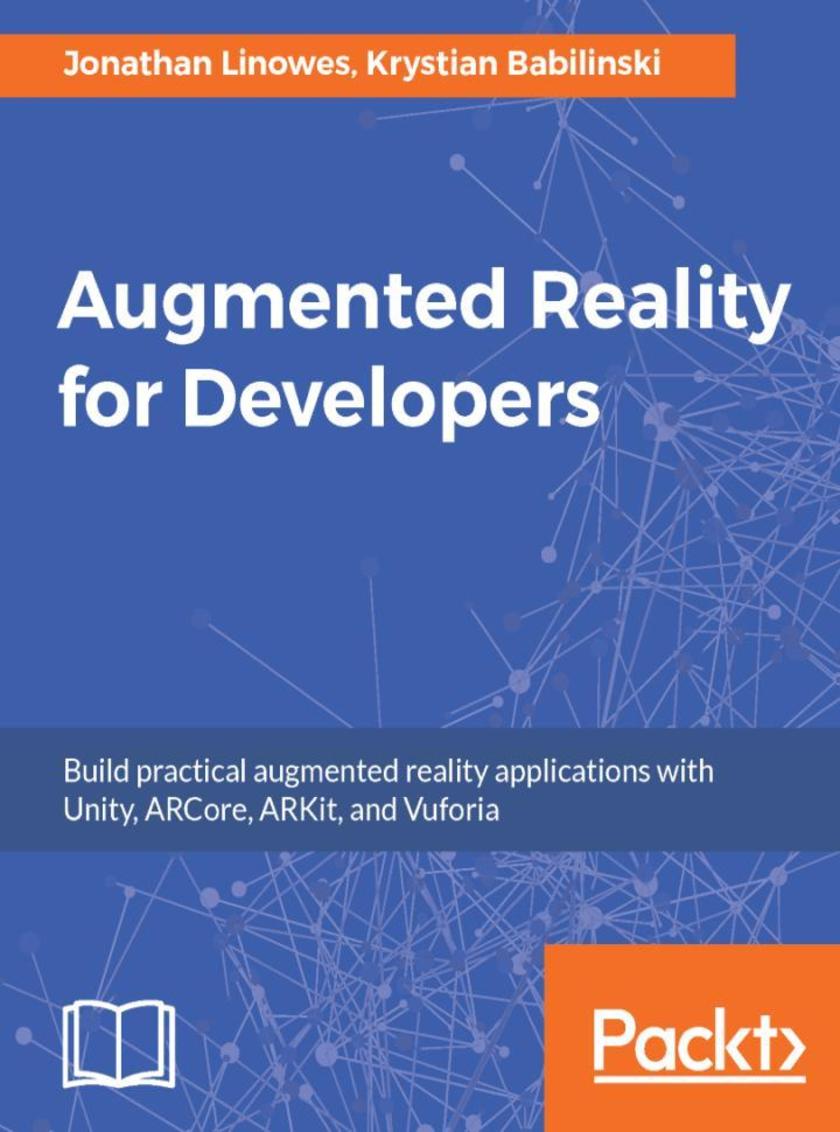
Augmented Reality for Developers
¥90.46
Build exciting AR applications on mobile and wearable devices with Unity 3D, Vuforia, ARToolKit, Microsoft Mixed Reality HoloLens, Apple ARKit, and Google ARCore About This Book ? Create unique AR applications from scratch, from beginning to end, with step-by-step tutorials ? Use Unity 3D to efficiently create AR apps for Android, iOS, and Windows platforms ? Use Vuforia, ARTookKit, Windows Mixed Reality, and Apple ARKit to build AR projects for a variety of markets ? Learn best practices in AR user experience, software design patterns, and 3D graphics Who This Book Is For The ideal target audience for this book is developers who have some experience in mobile development, either Android or iOS. Some broad web development experience would also be beneficial. What You Will Learn ? Build Augmented Reality applications through a step-by-step, tutorial-style project approach ? Use the Unity 3D game engine with the Vuforia AR platform, open source ARToolKit, Microsoft's Mixed Reality Toolkit, Apple ARKit, and Google ARCore, via the C# programming language ? Implement practical demo applications of AR including education, games, business marketing, and industrial training ? Employ a variety of AR recognition modes, including target images, markers, objects, and spatial mapping ? Target a variety of AR devices including phones, tablets, and wearable smartglasses, for Android, iOS, and Windows HoloLens ? Develop expertise with Unity 3D graphics, UIs, physics, and event systems ? Explore and utilize AR best practices and software design patterns In Detail Augmented Reality brings with it a set of challenges that are unseen and unheard of for traditional web and mobile developers. This book is your gateway to Augmented Reality development—not a theoretical showpiece for your bookshelf, but a handbook you will keep by your desk while coding and architecting your first AR app and for years to come. The book opens with an introduction to Augmented Reality, including markets, technologies, and development tools. You will begin by setting up your development machine for Android, iOS, and Windows development, learning the basics of using Unity and the Vuforia AR platform as well as the open source ARToolKit and Microsoft Mixed Reality Toolkit. You will also receive an introduction to Apple's ARKit and Google's ARCore! You will then focus on building AR applications, exploring a variety of recognition targeting methods. You will go through multiple complete projects illustrating key market sectors including business marketing, education, industrial training, and gaming. By the end of the book, you will have gained the necessary knowledge to make quality content appropriate for a range of AR devices, platforms, and intended uses. Style and approach This book adopts a practical, step-by-step, tutorial-style approach. The design principles and methodology will be explained by creating different modules of the AR app.
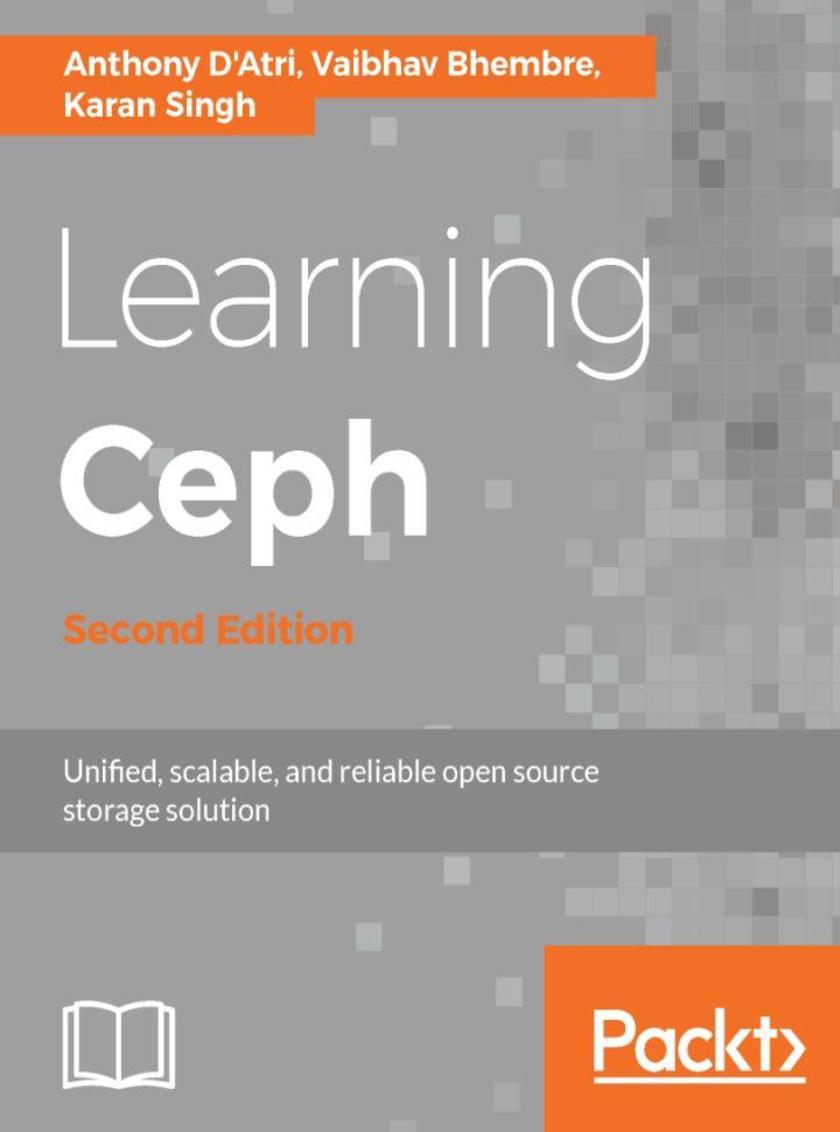
Learning Ceph - Second Edition
¥90.46
Implement and manage your software-defined, massively scalable storage system About This Book ? Explore Ceph's architecture in order to achieve scalability and high availability ? Learn to utilize Ceph efficiently with the help of practical examples ? Successfully implement Ceph clusters to scale-out storage solutions along with outstanding data protection Who This Book Is For A basic knowledge of GNU/Linux, and storage systems, and server components is assumed. If you have no experience of software-defined storage solutions and Ceph, but are eager to learn about them, this is the book for you. What You Will Learn ? The limitations of existing systems and why you should use Ceph as a storage solution ? Familiarity with Ceph's architecture, components, and services ? Instant deployment and testing of Ceph within a Vagrant and VirtualBox environment ? Ceph operations including maintenance, monitoring, and troubleshooting ? Storage provisioning of Ceph's block, object, and filesystem services ? Integrate Ceph with OpenStack ? Advanced topics including erasure coding, CRUSH maps, and performance tuning ? Best practices for your Ceph clusters In Detail Learning Ceph, Second Edition will give you all the skills you need to plan, deploy, and effectively manage your Ceph cluster. You will begin with the first module, where you will be introduced to Ceph use cases, its architecture, and core projects. In the next module, you will learn to set up a test cluster, using Ceph clusters and hardware selection. After you have learned to use Ceph clusters, the next module will teach you how to monitor cluster health, improve performance, and troubleshoot any issues that arise. In the last module, you will learn to integrate Ceph with other tools such as OpenStack, Glance, Manila, Swift, and Cinder. By the end of the book you will have learned to use Ceph effectively for your data storage requirements. Style and approach This step-by-step guide, including use cases and examples, not only helps you to easily use Ceph but also demonstrates how you can use it to solve any of your server or drive storage issues.
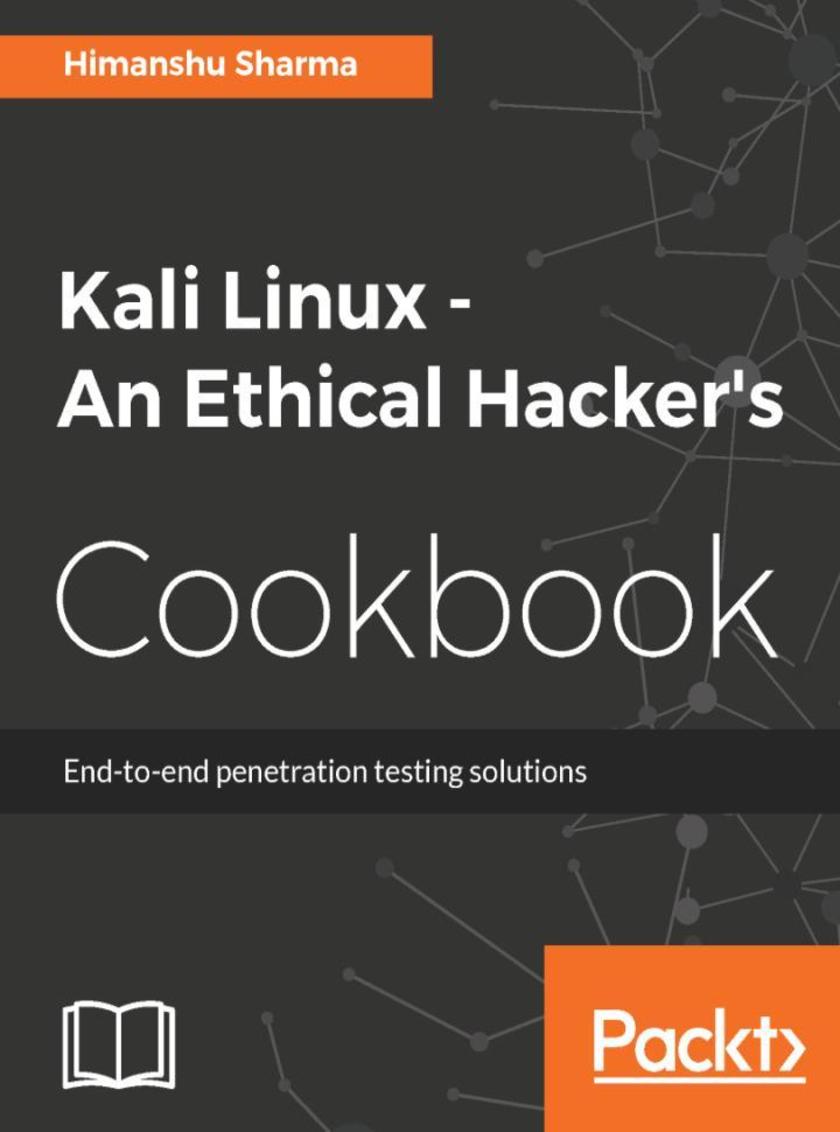
Kali Linux - An Ethical Hacker's Cookbook
¥80.65
Over 120 recipes to perform advanced penetration testing with Kali Linux About This Book ? Practical recipes to conduct effective penetration testing using the powerful Kali Linux ? Leverage tools like Metasploit, Wireshark, Nmap, and many more to detect vulnerabilities with ease ? Confidently perform networking and application attacks using task-oriented recipes Who This Book Is For This book is aimed at IT security professionals, pentesters, and security analysts who have basic knowledge of Kali Linux and want to conduct advanced penetration testing techniques. What You Will Learn ? Installing, setting up and customizing Kali for pentesting on multiple platforms ? Pentesting routers and embedded devices ? Bug hunting 2017 ? Pwning and escalating through corporate network ? Buffer over?ows 101 ? Auditing wireless networks ? Fiddling around with software-defned radio ? Hacking on the run with NetHunter ? Writing good quality reports In Detail With the current rate of hacking, it is very important to pentest your environment in order to ensure advanced-level security. This book is packed with practical recipes that will quickly get you started with Kali Linux (version 2016.2) according to your needs, and move on to core functionalities. This book will start with the installation and configuration of Kali Linux so that you can perform your tests. You will learn how to plan attack strategies and perform web application exploitation using tools such as Burp, and Jexboss. You will also learn how to perform network exploitation using Metasploit, Sparta, and Wireshark. Next, you will perform wireless and password attacks using tools such as Patator, John the Ripper, and airo*-ng. Lastly, you will learn how to create an optimum quality pentest report! By the end of this book, you will know how to conduct advanced penetration testing thanks to the book’s crisp and task-oriented recipes. Style and approach This is a recipe-based book that allows you to venture into some of the most cutting-edge practices and techniques to perform penetration testing with Kali Linux.
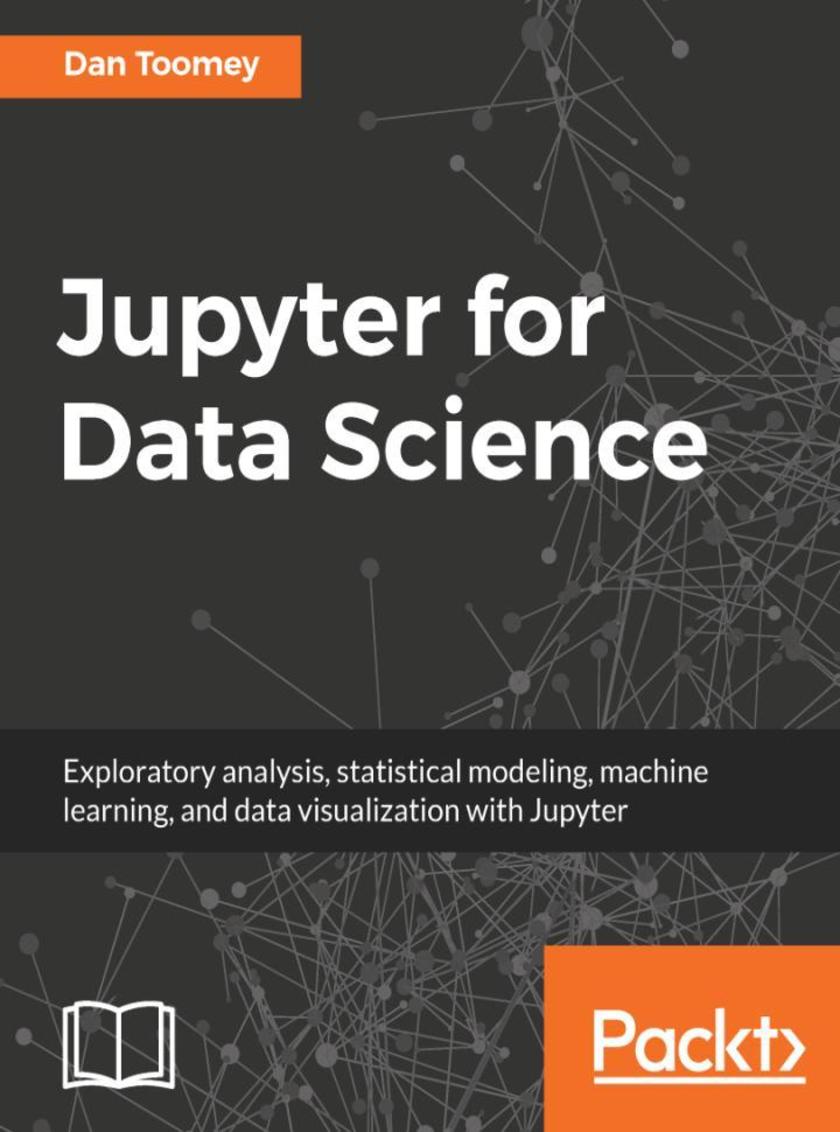
Jupyter for Data Science
¥71.93
Your one-stop guide to building an efficient data science pipeline using Jupyter About This Book ? Get the most out of your Jupyter notebook to complete the trickiest of tasks in Data Science ? Learn all the tasks in the data science pipeline—from data acquisition to visualization—and implement them using Jupyter ? Get ahead of the curve by mastering all the applications of Jupyter for data science with this unique and intuitive guide Who This Book Is For This book targets students and professionals who wish to master the use of Jupyter to perform a variety of data science tasks. Some programming experience with R or Python, and some basic understanding of Jupyter, is all you need to get started with this book. What You Will Learn ? Understand why Jupyter notebooks are a perfect fit for your data science tasks ? Perform scientific computing and data analysis tasks with Jupyter ? Interpret and explore different kinds of data visually with charts, histograms, and more ? Extend SQL's capabilities with Jupyter notebooks ? Combine the power of R and Python 3 with Jupyter to create dynamic notebooks ? Create interactive dashboards and dynamic presentations ? Master the best coding practices and deploy your Jupyter notebooks efficiently In Detail Jupyter Notebook is a web-based environment that enables interactive computing in notebook documents. It allows you to create documents that contain live code, equations, and visualizations. This book is a comprehensive guide to getting started with data science using the popular Jupyter notebook. If you are familiar with Jupyter notebook and want to learn how to use its capabilities to perform various data science tasks, this is the book for you! From data exploration to visualization, this book will take you through every step of the way in implementing an effective data science pipeline using Jupyter. You will also see how you can utilize Jupyter's features to share your documents and codes with your colleagues. The book also explains how Python 3, R, and Julia can be integrated with Jupyter for various data science tasks. By the end of this book, you will comfortably leverage the power of Jupyter to perform various tasks in data science successfully. Style and approach This book is a perfect blend of concepts and practical examples, written in a way that is very easy to understand and implement. It follows a logical flow where you will be able to build on your understanding of the different Jupyter features with every chapter.
MySQL 8 for Big Data
¥80.65
Uncover the power of MySQL 8 for Big Data About This Book ? Combine the powers of MySQL and Hadoop to build a solid Big Data solution for your organization ? Integrate MySQL with different NoSQL APIs and Big Data tools such as Apache Sqoop ? A comprehensive guide with practical examples on building a high performance Big Data pipeline with MySQL Who This Book Is For This book is intended for MySQL database administrators and Big Data professionals looking to integrate MySQL 8 and Hadoop to implement a high performance Big Data solution. Some previous experience with MySQL will be helpful, although the book will highlight the newer features introduced in MySQL 8. What You Will Learn ? Explore the features of MySQL 8 and how they can be leveraged to handle Big Data ? Unlock the new features of MySQL 8 for managing structured and unstructured Big Data ? Integrate MySQL 8 and Hadoop for efficient data processing ? Perform aggregation using MySQL 8 for optimum data utilization ? Explore different kinds of join and union in MySQL 8 to process Big Data efficiently ? Accelerate Big Data processing with Memcached ? Integrate MySQL with the NoSQL API ? Implement replication to build highly available solutions for Big Data In Detail With organizations handling large amounts of data on a regular basis, MySQL has become a popular solution to handle this structured Big Data. In this book, you will see how DBAs can use MySQL 8 to handle billions of records, and load and retrieve data with performance comparable or superior to commercial DB solutions with higher costs. Many organizations today depend on MySQL for their websites and a Big Data solution for their data archiving, storage, and analysis needs. However, integrating them can be challenging. This book will show you how to implement a successful Big Data strategy with Apache Hadoop and MySQL 8. It will cover real-time use case scenario to explain integration and achieve Big Data solutions using technologies such as Apache Hadoop, Apache Sqoop, and MySQL Applier. Also, the book includes case studies on Apache Sqoop and real-time event processing. By the end of this book, you will know how to efficiently use MySQL 8 to manage data for your Big Data applications. Style and approach Step by Step guide filled with real-world practical examples.
Building Business Websites with Squarespace 7 - Second Edition
¥80.65
Discover the best way to build, design and launch professional websites with Squarespace quickly, without needing to learn any code About This Book ? Discover time-saving tricks and best practices, and avoid common pitfalls while creating a website ? Create visually stunning Responsive Design templates for your website with Squarespace 7 ? Understand how to monitor, measure, and manage your website after launching it Who This Book Is For This book is ideal for anyone who wants to learn how to use the latest version of Squarespace to create a website from scratch and take it through to go-live. You don't need any prior experience with Squarespace, HTML, or CSS, or building websites in general as everything is done using Squarespace's simple, browser-based interface. What You Will Learn ? Develop an essential Website Toolkit that will act as reference and materials for your entire project, ensuring you stay on-target to meet your objectives ? Set up your Squarespace account, learn how the interface works, and select the correct template for your website's purpose and goals ? Create your website framework, fill it with content, and arrange your pages using Squarespace's easy drag-and-drop tools ? Customize your site's look and feel to match your brand, and create a stunning visual impact for your website on all types of devices, including mobiles and tablets ? Configure the core functions your business needs, whether connecting to social media, promoting events, showcasing your work, or selling goods and services online ? Learn time-saving tricks and how to avoid common pitfalls from an experienced professional with years of Squarespace experience ? Gain valuable insights about search engine optimization, communicating effectively online, and other e-marketing advice ? How to monitor, measure, and manage your website post-launch In Detail Squarespace is a web-based tool that allows non-technical people to create and manage professional-looking websites quickly, without needing to write any code. It empowers business owners to take total control of their own websites, without needing to pay someone to design or maintain it. This book covers much more than just how to use Squarespace. It covers all aspects of creating a successful business website, from developing your brand identity, to writing and structuring content to match your target audience's needs, and dozens of other other valuable tips that will help your website shine. Most importantly, you'll learn the correct steps to follow in order to ensure your project is smooth and stress-free. The book starts by helping you plan your website project and gather all the raw materials you'll need. Next, you'll set up your account and become familiar with the terminology and tools that you'll be using. Once you've learned the basics of how the Squarespace interface, templates, and different page types operate, you will create the framework of your website, ready for you to insert content and functionality. Then, once all the core elements are in place, you'll apply the aesthetic fine-tuning needed to bring your website in line with your brand. After the aesthetics have been honed and all functions tested, you will launch your website and drive traffic to it, monitor it, and improve it. Style and approach This easy-to-follow guide will teach you to build websites the easiest way in the latest version of Squarespace.
Building Android UIs with Custom Views
¥80.65
Create engaging user experiences and awesome user interfaces using this guide About This Book ? Move beyond default UI templates, create and customize amazing UIs with Android Custom View ? Enable smooth data flow and create futuristic UIs by creating flexible custom views ? Scale your apps with responsive and data intensive views Who This Book Is For This book is for Android developers who want to create great user interfaces and move beyond the basics of the standard UI elements. They must have basic Android development knowledge along with basic Java programming. What You Will Learn ? Extend the standard UI widget framework by creating Custom views ? Add complex rendering, animations, and interactions to your views ? Optimize performance and decrease battery usage ? Implement custom views to share between multiple projects, or share it publicly ? Create 3D custom views using OpenGL ES In Detail To build great user interfaces for your Android apps that go beyond the standard UI elements, you need to use custom Android views. With these, you can give your app a distinctive look and ensure that it functions properly across multiple devices. This book will help you construct a great UI for your apps by teaching you how to create custom Android views. You will start by creating your first Android custom view and go through the design considerations. You will then see how the right choices will enable your custom view to perform seamlessly across multiple platforms and Android versions. You will create custom styleable attributes that work with Android XML layouts, learn to process touch events, define custom attributes, and add properties and events to them. By the end of this book, you will be able to create apps with custom views that are responsive and adaptable to make your app distinctive and an instant hit with its users. Style and approach The approach will be that of a step by step practical tutorial. The book will take you through a complete journey, right from creating your first Android view to customizing it to enable it to support any complex app.
Python Deep Learning Cookbook
¥80.65
Solve different problems in modelling deep neural networks using Python, Tensorflow, and Keras with this practical guide About This Book ? Practical recipes on training different neural network models and tuning them for optimal performance ? Use Python frameworks like TensorFlow, Caffe, Keras, Theano for Natural Language Processing, Computer Vision, and more ? A hands-on guide covering the common as well as the not so common problems in deep learning using Python Who This Book Is For This book is intended for machine learning professionals who are looking to use deep learning algorithms to create real-world applications using Python. Thorough understanding of the machine learning concepts and Python libraries such as NumPy, SciPy and scikit-learn is expected. Additionally, basic knowledge in linear algebra and calculus is desired. What You Will Learn ? Implement different neural network models in Python ? Select the best Python framework for deep learning such as PyTorch, Tensorflow, MXNet and Keras ? Apply tips and tricks related to neural networks internals, to boost learning performances ? Consolidate machine learning principles and apply them in the deep learning field ? Reuse and adapt Python code snippets to everyday problems ? Evaluate the cost/benefits and performance implication of each discussed solution In Detail Deep Learning is revolutionizing a wide range of industries. For many applications, deep learning has proven to outperform humans by making faster and more accurate predictions. This book provides a top-down and bottom-up approach to demonstrate deep learning solutions to real-world problems in different areas. These applications include Computer Vision, Natural Language Processing, Time Series, and Robotics. The Python Deep Learning Cookbook presents technical solutions to the issues presented, along with a detailed explanation of the solutions. Furthermore, a discussion on corresponding pros and cons of implementing the proposed solution using one of the popular frameworks like TensorFlow, PyTorch, Keras and CNTK is provided. The book includes recipes that are related to the basic concepts of neural networks. All techniques s, as well as classical networks topologies. The main purpose of this book is to provide Python programmers a detailed list of recipes to apply deep learning to common and not-so-common scenarios. Style and approach Unique blend of independent recipes arranged in the most logical manner
Phalcon Cookbook
¥71.93
Master Phalcon by implementing hands-on recipes using industry best practices with the Web and CLI interfaces About This Book Create quick prototypes with the Phalcon Developer Tools Learn to use the powerful and uniquely efficient Phalcon ORM Reuse codes in real projects Who This Book Is For If you are a beginner-to-intermediate Phalcon developer who wants to level up or an advanced user who is seeking some new techniques and insight, then this book is perfect for you. This book will be relevant to you over a long period of time due to the mixed nature of this book in providing both abstract comprehension as well as specific examples meant to be usable in your projects. You will be able to experiment with each new aspect of integration in prebuilt recipes meant to best illustrate each specific feature. This will save you lots of time getting up to speed before attempting to integrate into a real application. What You Will Learn Install the Phalcon extension from both premade packages and source code Create a normal and micro application structure Understand the dispatcher event cycle and create custom plugins Get hands-on using the Phalcon Query Language and ORM Create flexible views with the Volt template system Leverage Phalcon to prevent common security vulnerabilities Optimize an application with focused solutions Profile and debug an application to get increased reliability In Detail Phalcon is a high-performance PHP framework delivered as a PHP extension. This provides new opportunities for speed and application design, which until recently have been unrealized in the PHP ecosystem. Packed with simple learning exercises, technology prototypes, and real-world usable code, this book will guide you from the beginner and setup stage all the way to advanced usage. You will learn how to avoid niche pitfalls, how to use the command-line developer tools, how to integrate with new web standards, as well as how to set up and customize the MVC application structure. You will see how Phalcon can be used to quickly set up a single file web application as well as a complex multi-module application suitable for long-term projects. Some of the recipes focus on abstract concepts that are vital to get a deep comprehension of Phalcon and others are designed as a vehicle to deliver real-world usable classes and code snippets to solve advanced problems. You’ll start out with basic setup and application structure and then move onto the Phalcon MVC and routing implementation, the power of the ORM and Phalcon Query Language, and Phalcon’s own Volt templating system. Finally, you will move on to caching, security, and optimization. Style and approach An easy-to-start guide that provides
Containerization with LXC
¥90.46
Get acquainted with the world of LXC About This Book Get the most practical and up-to-date resource on LXC and take full advantage of what Linux containers can offer in the day-to-day operations of large-scale applications Learn how to deploy and administer various workloads such as web applications inside LXC Save your organization time and money by building robust and secure containers and by speeding the deployment process of your software Who This Book Is For This book is for Linux engineers and software developers who are looking to deploy applications in a fast, secure, and scalable way for use in testing and production. What You Will Learn Deep dive into the foundations of Linux containers with kernel namespaces and cgroups Install, configure, and administer Linux containers with LXC and libvirt Begin writing applications using Python libvirt bindings Take an in-depth look at container networking Set up monitoring and security with LXC Build and deploy a highly available application with LXC in the cloud In Detail In recent years, containers have gained wide adoption by businesses running a variety of application loads. This became possible largely due to the advent of kernel namespaces and better resource management with control groups (cgroups). Linux containers (LXC) are a direct implementation of those kernel features that provide operating system level virtualization without the overhead of a hypervisor layer. This book starts by introducing the foundational concepts behind the implementation of LXC, then moves into the practical aspects of installing and configuring LXC containers. Moving on, you will explore container networking, security, and backups. You will also learn how to deploy LXC with technologies like Open Stack and Vagrant. By the end of the book, you will have a solid grasp of how LXC is implemented and how to run production applications in a highly available and scalable way. Style and approach A practical guide that introduces the core technologies behind Linux containers and provides a deep dive into installation, configuration, and operations of LXC.
Julia: High Performance Programming
¥179.84
Leverage the power of Julia to design and develop high performing programs About This Book Get to know the best techniques to create blazingly fast programs with Julia Stand out from the crowd by developing code that runs faster than your peers' code Complete an extensive data science project through the entire cycle from ETL to analytics and data visualization Who This Book Is For This learning path is for data scientists and for all those who work in technical and scientific computation projects. It will be great for Julia developers who are interested in high-performance technical computing. This learning path assumes that you already have some basic working knowledge of Julia's syntax and high-level dynamic languages such as MATLAB, R, Python, or Ruby. What You Will Learn Set up your Julia environment to achieve the highest productivity Solve your tasks in a high-level dynamic language and use types for your data only when needed Apply Julia to tackle problems concurrently and in a distributed environment Get a sense of the possibilities and limitations of Julia's performance Use Julia arrays to write high performance code Build a data science project through the entire cycle of ETL, analytics, and data visualization Display graphics and visualizations to carry out modeling and simulation in Julia Develop your own packages and contribute to the Julia Community In Detail In this learning path, you will learn to use an interesting and dynamic programming language—Julia! You will get a chance to tackle your numerical and data problems with Julia. You’ll begin the journey by setting up a running Julia platform before exploring its various built-in types. We’ll then move on to the various functions and constructs in Julia. We’ll walk through the two important collection types—arrays and matrices in Julia. You will dive into how Julia uses type information to achieve its performance goals, and how to use multiple dispatch to help the compiler emit high performance machine code. You will see how Julia’s design makes code fast, and you’ll see its distributed computing capabilities. By the end of this learning path, you will see how data works using simple statistics and analytics, and you’ll discover its high and dynamic performance—its real strength, which makes it particularly useful in highly intensive computing tasks. This learning path combines some of the best that Packt has to offer in one complete, curated package. It includes content from the following Packt products: Getting Started with Julia by Ivo Balvaert Julia High Performance by Avik Sengupta Mastering Julia by Malcolm Sherrington Style and approach This hands-on manual will give you great explanations of the important concepts related to Julia programming.
Learning RxJava
¥80.65
Reactive Programming with Java and ReactiveX About This Book ? Explore the essential tools and operators RxJava provides, and know which situations to use them in ? Delve into Observables and Subscribers, the core components of RxJava used for building scalable and performant reactive applications ? Delve into the practical implementation of tools to effectively take on complex tasks such as concurrency and backpressure Who This Book Is For The primary audience for this book is developers with at least a fundamental mastery of Java. Some readers will likely be interested in RxJava to make programs more resilient, concurrent, and scalable. Others may be checking out reactive programming just to see what it is all about, and to judge whether it can solve any problems they may have. What You Will Learn ? Learn the features of RxJava 2 that bring about many significant changes, including new reactive types such as Flowable, Single, Maybe, and Completable ? Understand how reactive programming works and the mindset to "think reactively" ? Demystify the Observable and how it quickly expresses data and events as sequences ? Learn the various Rx operators that transform, filter, and combine data and event sequences ? Leverage multicasting to push data to multiple destinations, and cache and replay them ? Discover how concurrency and parallelization work in RxJava, and how it makes these traditionally complex tasks trivial to implement ? Apply RxJava and Retrolambda to the Android domain to create responsive Android apps with better user experiences ? Use RxJava with the Kotlin language to express RxJava more idiomatically with extension functions, data classes, and other Kotlin features In Detail RxJava is a library for composing asynchronous and event-based programs using Observable sequences for the JVM, allowing developers to build robust applications in less time. Learning RxJava addresses all the fundamentals of reactive programming to help readers write reactive code, as well as teach them an effective approach to designing and implementing reactive libraries and applications. Starting with a brief introduction to reactive programming concepts, there is an overview of Observables and Observers, the core components of RxJava, and how to combine different streams of data and events together. You will also learn simpler ways to achieve concurrency and remain highly performant, with no need for synchronization. Later on, we will leverage backpressure and other strategies to cope with rapidly-producing sources to prevent bottlenecks in your application. After covering custom operators, testing, and debugging, the book dives into hands-on examples using RxJava on Android as well as Kotlin. Style and approach This book will be different from other Rx books, taking an approach that comprehensively covers Rx concepts and practical applications.
Mastering Kali Linux for Web Penetration Testing
¥90.46
Master the art of exploiting advanced web penetration techniques with Kali Linux 2016.2 About This Book ? Make the most out of advanced web pen-testing techniques using Kali Linux 2016.2 ? Explore how Stored (a.k.a. Persistent) XSS attacks work and how to take advantage of them ? Learn to secure your application by performing advanced web based attacks. ? Bypass internet security to traverse from the web to a private network. Who This Book Is For This book targets IT pen testers, security consultants, and ethical hackers who want to expand their knowledge and gain expertise on advanced web penetration techniques. Prior knowledge of penetration testing would be beneficial. What You Will Learn ? Establish a fully-featured sandbox for test rehearsal and risk-free investigation of applications ? Enlist open-source information to get a head-start on enumerating account credentials, mapping potential dependencies, and discovering unintended backdoors and exposed information ? Map, scan, and spider web applications using nmap/zenmap, nikto, arachni, webscarab, w3af, and NetCat for more accurate characterization ? Proxy web transactions through tools such as Burp Suite, OWASP's ZAP tool, and Vega to uncover application weaknesses and manipulate responses ? Deploy SQL injection, cross-site *ing, Java vulnerabilities, and overflow attacks using Burp Suite, websploit, and SQLMap to test application robustness ? Evaluate and test identity, authentication, and authorization schemes and sniff out weak cryptography before the black hats do In Detail You will start by delving into some common web application architectures in use, both in private and public cloud instances. You will also learn about the most common frameworks for testing, such as OWASP OGT version 4, and how to use them to guide your efforts. In the next section, you will be introduced to web pentesting with core tools and you will also see how to make web applications more secure through rigorous penetration tests using advanced features in open source tools. The book will then show you how to better hone your web pentesting skills in safe environments that can ensure low-risk experimentation with the powerful tools and features in Kali Linux that go beyond a typical *-kiddie approach. After establishing how to test these powerful tools safely, you will understand how to better identify vulnerabilities, position and deploy exploits, compromise authentication and authorization, and test the resilience and exposure applications possess. By the end of this book, you will be well-versed with the web service architecture to identify and evade various protection mechanisms that are used on the Web today. You will leave this book with a greater mastery of essential test techniques needed to verify the secure design, development, and operation of your customers' web applications. Style and approach An advanced-level guide filled with real-world examples that will help you take your web application’s security to the next level by using Kali Linux 2016.2.


