


 购物车
购物车 个人中心
个人中心
Implementing Cisco Networking Solutions
¥80.65
Learn the art of designing, implementing, and managing Cisco's networking solutions on datacenters, wirelessly, security and mobility to set up an Enterprise network. About This Book ? Implement Cisco's networking solutions on datacenters and wirelessly, Cloud, Security, and Mobility ? Leverage Cisco IOS to manage network infrastructures. ? A practical guide that will show how to troubleshoot common issues on the network. Who This Book Is For This book is targeted at network designers and IT engineers who are involved in designing, configuring, and operating enterprise networks, and are in taking decisions to make the necessary network changes to meet newer business needs such as evaluating new technology choices, enterprise growth, and adding new services on the network. The reader is expected to have a general understanding of the fundamentals of networking, including the OSI stack and IP addressing. What You Will Learn ? Understand the network lifecycle approach ? Get to know what makes a good network design ? Design components and technology choices at various places in the network (PINS) ? Work on sample configurations for network devices in the LAN/ WAN/ DC, and the wireless domain ? Get familiar with the configurations and best practices for securing the network ? Explore best practices for network operations In Detail Most enterprises use Cisco networking equipment to design and implement their networks. However, some networks outperform networks in other enterprises in terms of performance and meeting new business demands, because they were designed with a visionary approach. The book starts by describing the various stages in the network lifecycle and covers the plan, build, and operate phases. It covers topics that will help network engineers capture requirements, choose the right technology, design and implement the network, and finally manage and operate the network. It divides the overall network into its constituents depending upon functionality, and describe the technologies used and the design considerations for each functional area. The areas covered include the campus wired network, wireless access network, WAN choices, datacenter technologies, and security technologies. It also discusses the need to identify business-critical applications on the network, and how to prioritize these applications by deploying QoS on the network. Each topic provides the technology choices, and the scenario, involved in choosing each technology, and provides configuration guidelines for configuring and implementing solutions in enterprise networks. Style and approach A step-by-step practical guide that ensures you implement Cisco solutions such as enterprise networks, cloud, and data centers, on small-to-large organizations.
Learn C# in 7 days
¥71.93
Learn C# in 7 days with practical examples, build a foundation for C# programming, and boost your skills to an advanced level About This Book ? Learn the basics of C# in 7 days ? Works as a reference guide describing the major features of C# ? Build easy and simple code through real-world example scenarios Who This Book Is For The book is for aspiring developers and absolute novices who want to get started with the world of programming. You do not need any knowledge of C# for this book. What You Will Learn ? Understand and set up the .NET environment ? Code in C# using the Visual Studio 2017 RC (preferable community edition) IDE ? Define variables, syntax, control flows, statements, and arrays etc through examples ? Understand the concepts of Object-Oriented Programming using C# ? Get acquainted with attributes, collection, generics, and LINQ ? Get your hands on class members such as Modifiers, Methods, Properties, Indexers, File I/O, Exception Handling, and Regex ? Build a real-world application using C# 7 In Detail This book takes a unique approach to teach C# to absolute beginners. You’ll learn the basics of the language in seven days. It takes a practical approach to explain the important concepts that build the foundation of the C# programming language. The book begins by teaching you the basic fundamentals using real-world practical examples and gets you acquainted with C# programming. We cover some important features and nuances of the language in a hands-on way, helping you grasp the concepts in a fluid manner. Later, you’ll explore the concepts of Object-Oriented Programming (OOP) through a real-world example. Then we dive into advanced-level concepts such as generics and collections, and you’ll get acquainted with objects and LINQ. Towards the end, you’ll build an application that covers all the concepts explained in the book. By the end of this book, you will have next-level skills and a good knowledge of the fundamentals of C#. Style and approach Fast paced guide to get you up-to-speed with the language. Every chapter is followed by an exercise that focuses on building something with the language. The codes of the exercises can be found on the Packt website
Swift 4 Protocol-Oriented Programming - Third Edition
¥71.93
Build fast and powerful applications by harnessing the power of protocol-oriented programming in Swift 4 About This Book ? Leverage the power of protocol-oriented programming in your applications and learn from real-world use cases ? Create a flexible code base with protocols and protocol extensions ? Leverage the power of generics in Swift 4 to create very flexible frameworks Who This Book Is For This book is for Swift developers who want to learn and implement protocol-oriented programming in their real-world applications.. What You Will Learn ? Understand the differences between object-oriented programming and protocol-oriented programming ? Explore the different types that Swift offers and what pitfalls to avoid ? Delve into generics and generic programming ? Learn how to implement Copy-On-Write within your custom types ? Implement several design patterns in a protocol-oriented way ? Design applications by prioritizing the protocol first and the implementation types second In Detail Swift has become the number one language used in iOS and macOS development. The Swift standard library is developed using protocol-oriented programming techniques, generics, and first-class value semantics; therefore, every Swift developer should understand these powerful concepts and how to take advantage of them in their application design. This book will help you understand the differences between object-oriented programming and protocol-oriented programming. It will demonstrate how to work with protocol-oriented programming using real-world use cases. You will gain a solid knowledge of the various types that can be used in Swift and the differences between value and reference types. You will be taught how protocol-oriented programming techniques can be used to develop very flexible and easy-to-maintain code. By the end of the book, you will have a thorough understanding of protocol-oriented programming and how to utilize it to build powerful and practical applications. Style and approach This book is written for developers who learn best by working with code, so every concept discussed in this book is reinforced with real code examples.
Modern R Programming Cookbook
¥80.65
Recipes for emerging developers in R programming and data scientists to simplify their R programming capabilities About This Book ? Develop strategies to speed up your R code ? Tackle programming problems and explore both functional and object-oriented programming techniques ? Learn how to address the core problems of programming in R with the most popular R packages for common tasks Who This Book Is For This book is for developers who would like to enhance the R programming skills. Basic knowledge of R programming is assumed. What You Will Learn ? Install R and its various IDE for a given platform along with installing libraries from different repositories and version control ? Learn about basic data structures in R and how to work with them ? Write customized R functions and handle recursions, exceptions in R environments ? Create the data processing task as a step by step computer program and execute using dplyr ? Extract and process unstructured text data ? Interact with database management system to develop statistical applications ? Formulate and implement parallel processing in R In Detail R is a powerful tool for statistics, graphics, and statistical programming. It is used by tens of thousands of people daily to perform serious statistical analyses. It is a free, open source system whose implementation is the collective accomplishment of many intelligent, hard-working people. There are more than 2,000 available add-ons, and R is a serious rival to all commercial statistical packages. The objective of this book is to show how to work with different programming aspects of R. The emerging R developers and data science could have very good programming knowledge but might have limited understanding about R syntax and semantics. Our book will be a platform develop practical solution out of real world problem in scalable fashion and with very good understanding. You will work with various versions of R libraries that are essential for scalable data science solutions. You will learn to work with Input / Output issues when working with relatively larger dataset. At the end of this book readers will also learn how to work with databases from within R and also what and how meta programming helps in developing applications. Style and approach This book will be a companion for R programmer and emerging developers in R programming areas. This book will contain recipes related to advanced R programming which will enable users to solve complex problems efficiently.
Learning Neo4j 3.x - Second Edition
¥90.46
Run blazingly fast queries on complex graph datasets with the power of the Neo4j graph database About This Book ? Get acquainted with graph database systems and apply them in real-world use cases ? Use Cypher query language, APOC and other Neo4j extensions to derive meaningful analysis from complex data sets. ? A practical guide filled with ready to use examples on querying, graph processing and visualizing information to build smarter spatial applications. Who This Book Is For This book is for developers who want an alternative way to store and process data within their applications. No previous graph database experience is required; however, some basic database knowledge will help you understand the concepts more easily. What You Will Learn ? Understand the science of graph theory, databases and its advantages over traditional databases. ? Install Neo4j, model data and learn the most common practices of traversing data ? Learn the Cypher query language and tailor-made procedures to analyze and derive meaningful representations of data ? Improve graph techniques with the help of precise procedures in the APOC library ? Use Neo4j advanced extensions and plugins for performance optimization. ? Understand how Neo4j's new security features and clustering architecture are used for large scale deployments. In Detail Neo4j is a graph database that allows traversing huge amounts of data with ease. This book aims at quickly getting you started with the popular graph database Neo4j. Starting with a brief introduction to graph theory, this book will show you the advantages of using graph databases along with data modeling techniques for graph databases. You'll gain practical hands-on experience with commonly used and lesser known features for updating graph store with Neo4j's Cypher query language. Furthermore, you'll also learn to create awesome procedures using APOC and extend Neo4j's functionality, enabling integration, algorithmic analysis, and other advanced spatial operation capabilities on data. Through the course of the book you will come across implementation examples on the latest updates in Neo4j, such as in-graph indexes, scaling, performance improvements, visualization, data refactoring techniques, security enhancements, and much more. By the end of the book, you'll have gained the skills to design and implement modern spatial applications, from graphing data to unraveling business capabilities with the help of real-world use cases. Style and approach A step-by-step approach of adopting Neo4j, the world's leading graph database. This book includes a lot of background information, helps you grasp the fundamental concepts behind this radical new way of dealing with connected data, and will give you lots of examples of use cases and environments where a graph database would be a great fit
Mastering CSS
¥71.93
Rich Finelli's modern CSS training course, based on his bestselling Mastering CSS video, now available in a book. Master CSS from best practices to practical CSS coding. About This Book ? Learn CSS directly from Rich Finelli, author of the bestselling Mastering CSS training course ? From best practices to deep coding, Rich Finelli shares his CSS knowledge with you ? Rich Finelli covers the latest CSS updates with flexbox and works with retina devices Who This Book Is For This book is for web designers who wish to master the best practices of CSS in their web projects. You already know how to work with a web page, and want to use CSS to master website presentation. What You Will Learn ? Master fundamental CSS concepts like the anatomy of a rule set, the box model, and the differences between block and inline elements ? Employ flexbox to layout and align elements simply and cleanly ? Become proficient with CSS3 properties such as transitions, transforms, gradients, and animations ? Delve into modular, reusable, and scalable CSS for more organized and maintainable style sheets ? Understand media queries and other pillars of responsive web design ? Get creative with the @font-face property, Google Web Fonts, font services such as Typekit, as well as, icon fonts ? Understand the workflow for HiDPI (retina) devices using 2x images, SVG, and the srcset attribute In Detail Rich Finelli trains you in CSS deep learning and shows you the techniques you need to work in the world of responsive, feature-rich web applications. Based on his bestselling Mastering CSS training video, you can now learn with Rich in this book! Rich shares with you his skills in creating advanced layouts, and the critical CSS insights you need for responsive web designs, fonts, transitions, animations, and using flexbox. Rich begins your CSS training with a review of CSS best practices, such as using a good text editor to automate your authoring and setting up a CSS baseline. You then move on to create a responsive layout making use of floats and stylable drop-down menus, with Rich guiding you toward a modular-organized approach to CSS. Your training with Rich Finelli then dives into detail about working with CSS and the best solutions to make your websites work. You'll go with him into CSS3 properties, transforms, transitions, and animations. You’ll gain his understanding of responsive web designs, web fonts, icon fonts, and the techniques used to support retina devices. Rich expands your knowledge of CSS so you can master one of the most valuable tools in modern web design. Style and approach Let Rich Finelli train you in CSS! This book has a direct training style because it is based on Rich's bestselling Mastering CSS training course.
Progressive Web Apps with React
¥80.65
Enhance the performance of your applications by using React and adding the Progressive web app capability to it About This Book ? Bring the best of mobile sites and native apps to your users with progressive web applications ? Create fast, reliable, and engaging PWAs with React and Firebase ? Create high-performance applications even with low connection speeds by leveraging modern web technologies Who This Book Is For This book is for Java* Developers who want to develop high performance Web User Interfaces. This book requires basic knowledge of HTML, CSS and JavaScript. What You Will Learn ? Set up Webpack configuration, as well as get the development server running ? Learn basic Firebase configuration and deployment ? Create routes, manage multiple components, and learn how to use React Router v4 to manage the flow of data ? Use React life cycle methods to load data ? Add a service worker to the app and learn how it works ? Use a service worker to send Push Notifications ? Configure Webpack to split up the JavaScript bundle and lazy load component files ? Learn how to use the web Cache API to use your app offline ? Audit PWAs with Google's Lighthouse tool In Detail For years, the speed and power of web apps has lagged behind native applications. Progressive Web Apps (PWAs) aim to solve this by bridging the gap between the web apps and native apps, delivering a host of exciting features. Simultaneously, React is fast becoming the go-to solution for building modern web UIs, combining ease of development with performance and capability. Using React alongside PWA technology will make it easy for you to build a fast, beautiful, and functional web app. After an introduction and brief overview of the goals of PWAs, the book moves on to setting up the application structure. From there, it covers the Webpack build process and the process of creating React components. You'll learn how to set up the backend database and authentication solution to communicate with Firebase and how to work with React Router. Next, you will create and configure your web app manifest, making your PWA installable on mobile devices. Then you'll get introduced to service workers and see how they work as we configure the app to send push notifications using Firebase Cloud Messaging. We'll also explore the App Shell pattern, a key concept in PWAs and look at its advantages regarding efficient performance. Finally, you'll learn how to add offline capabilities to the app with caching and confirm your progress by auditing your PWA with Lighthouse. Also, you'll discover helper libraries and shortcuts that will help you save time and understand the future of PWA development. Style and approach This is a step-by-step book, wherein, you will use the React framework to create a complete progressive web app.
Building Web and Mobile ArcGIS Server Applications with JavaScript - Second Edit
¥90.46
Master the ArcGIS API for JavaScript to build web and mobile applications using this practical guide. About This Book ? Develop ArcGIS Server applications with JavaScript, both for traditional web browsers as well as the mobile platform ? Make your maps informative with intuitive geographic layers, user interface widgets, and more ? Integrate ArcGIS content into your custom applications and perform analytics with the ArcGIS Online Who This Book Is For If you are a web or mobile application developer, who wants to create GIS applications in your respective platform, this book is ideal for you. You will need Java Script programming experience to get the most out of this book. Although designed as an introductory to intermediate level book, it will also be useful for more advanced developers who are new to the topic of developing applications with ArcGIS Server. What You Will Learn ? To create an application with the ArcGIS API for JavaScript ? Build and display a broad range of different geometry types to represent features on the map ? The best way to leverage a feature layer and display related attribute data ? The functionality of the wide range of widgets and how to use them effectively ? Query data to gain new insights into the information it contains ? Work with tasks to discover and locate features on the map ? Using the geocoder and associated widgets ? The ability of the API to provide turn by turn directions and routing capabilities ? How to use the Geometry Engine and Geometry Service tasks for common geoprocessing operations ? Integrate content on ArcGIS online and add it to your custom web mapping application In Detail The ArcGIS API for JavaScript enables you to quickly build web and mobile mapping applications that include sophisticated GIS capabilities, yet are easy and intuitive for the user. Aimed at both new and experienced web developers, this practical guide gives you everything you need to get started with the API. After a brief introduction to HTML/CSS/JavaScript, you'll embed maps in a web page, add the tiled, dynamic, and streaming data layers that your users will interact with, and mark up the map with graphics. You will learn how to quickly incorporate a broad range of useful user interface elements and GIS functionality to your application with minimal effort using prebuilt widgets. As the book progresses, you will discover and use the task framework to query layers with spatial and attribute criteria, search for and identify features on the map, geocode addresses, perform network analysis and routing, and add custom geoprocessing operations. Along the way, we cover exciting new features such as the client-side geometry engine, learn how to integrate content from ArcGIS.com, and use your new skills to build mobile web mapping applications. We conclude with a look at version 4 of the ArcGIS API for JavaScript (which is being developed in parallel with version 3.x) and what it means for you as a developer. Style and approach Readers will be taken through a series of exercises that will demonstrate how to efficiently build ArcGIS Server applications for the mobile and web.
Test-Driven iOS Development with Swift 4 - Third Edition
¥71.93
Use test-driven approach to develop highly-functional iOS apps with Swift 4 and Xcode 9 About This Book ? A practical guide to writing effective, organized, and clean code that works well ? Learn test-driven principles to help you build better-designed apps with fewer bugs ? A comprehensive overview of the techniques available for TDD in Swift Who This Book Is For To get the most out of this book, you will need some prior experience with Swift application development. You may have already heard about Test-Driven Development (TDD) but you don't need any prior experience of applying it to Swift applications. What You Will Learn ? Implement TDD in Swift application development ? Find bugs before you enter code using the TDD approach ? Use TDD to build models, view controllers, and views ? Test network code with asynchronous tests and stubs ? Write code that is a joy to read and maintain ? Develop functional tests to ensure the app works as planned In Detail Test-driven development (TDD) is a proven way to find software bugs early. Writing tests before you code improves the structure and maintainability of your apps. Using TDD, in combination with Swift 4's improved syntax, means there is no longer any excuse for writing bad code. This book will help you understand the process of TDD and how to apply it to your apps written in Swift. Through practical, real-world examples, you’ll learn how to implement TDD in context. You will begin with an overview of the TDD workflow and then delve into unit-testing concepts and code cycles. You will also plan and structure your test-driven iOS app, and write tests to drive the development of view controllers and helper classes. Next, you’ll learn how to write tests for network code and explore how the test-driven approach—in combination with stubs—helps you write network code even before the backend component is finished. Finally, the book will guide you through the next steps to becoming a testing expert by discussing integration tests, Behavior Driven Development (BDD), open source testing frameworks, and UI Tests (introduced in Xcode 9). Style and approach Using a step-by-step approach, you will develop an entire iOS app using TDD. During the course of the book, you will explore different strategies for writing tests for models, View Controllers, and networking code.
Jenkins 2.x Continuous Integration Cookbook - Third Edition
¥90.46
Get a problem-solution approach enriched with code examples for practical and easy comprehension About This Book ? Explore the use of more than 40 best-of-breed plug-ins for improving efficiency ? Secure and maintain Jenkins 2.x by integrating it with LDAP and CAS, which is a Single Sign-on solution ? Efficiently build advanced pipelines with pipeline as code, thus increasing your team's productivity Who This Book Is For If you are a Java developer, a software architect, a technical project manager, a build manager, or a development or QA engineer, then this book is ideal for you. A basic understanding of the software development life cycle and Java development is needed, as well as a rudimentary understanding of Jenkins. What You Will Learn ? Install and Configure Jenkins 2.x on AWS and Azure ? Explore effective ways to manage and monitor Jenkins 2.x ? Secure Jenkins 2.x using Matrix-based Security ? Deploying a WAR file from Jenkins 2.x to Azure App Services and AWS Beanstalk ? Automate deployment of application on AWS and Azure PaaS ? Continuous Testing – Unit Test Execution, Functional Testing and Load Testing In Detail Jenkins 2.x is one of the most popular Continuous Integration servers in the market today. It was designed to maintain, secure, communicate, test, build, and improve the software development process. This book will begin by guiding you through steps for installing and configuring Jenkins 2.x on AWS and Azure. This is followed by steps that enable you to manage and monitor Jenkins 2.x. You will also explore the ways to enhance the overall security of Jenkins 2.x. You will then explore the steps involved in improving the code quality using SonarQube. Then, you will learn the ways to improve quality, followed by how to run performance and functional tests against a web application and web services. Finally, you will see what the available plugins are, concluding with best practices to improve quality. Style and approach This book provides a problem-solution approach to some common tasks and some uncommon tasks using Jenkins 2.x and is well-illustrated with practical code examples.
Switching to Angular - Third Edition
¥54.49
Switching to Angular, Third Edition is the go-to book to align and get started with the Angular JavaScript framework. Angular contributor and international speaker Minko Gechev will help you square up and start building Angular apps and provide you an insight to the Google’s vision for the framework. About This Book ? Get up to date with Google’s vision for Angular ? Align with Angular version 5 and beyond from any direction with confidence ? Start using TypeScript to supercharge your Angular applications ? Understand the new framework from AngularJS perspective using your prior experience ? Use Angular to quickly build fast and scalable enterprise applications Who This Book Is For This book is for software developers who want to align with a modern version of Angular that’s aligned with Google’s vision of Angular version 5 and beyond, using stable APIs that they can depend on today and in the future. Also for anyone assessing changes to Angular and squaring up for a strategic migration to Angular v5, and for AngularJS developers who want to transfer their mindset to modern Angular version 5 and beyond. What You Will Learn ? Align with Google’s vision for Angular version 5 and beyond ? Confidently move forwards with a long-term understanding of Angular ? Use stable APIs in Angular to build future-proof, blazingly fast, enterprise applications ? Work with TypeScript to supercharge your Angular applications ? Understand the core concepts of Angular, aligned with the vision from Google ? Be ready with Angular from any direction - whether you’re building new new apps with the Angular and ASP.NET stack or upgrading from AngularJS with ngUpgrade In Detail Align your work to stable APIs of Angular, version 5 and beyond, with Angular expert Minko Gechev. Angular is the modern Google framework for you to build high-performing, SEO-friendly, and robust web applications. Switching to Angular, Third Edition shows you how you can align your current and future development with Google’s long term vision for Angular. Gechev shares his expert knowledge and community involvement to give you the clarity you need to confidently switch into Angular and stable APIs. Minko Gechev helps you square up to Angular with an overview of the framework, and understand the long term building blocks of Google’s web framework. Gechev then gives you the lowdown on TypeScript, with a crash-course so you can take advantage of Angular in its native, statically-typed environment. You’ll next move on to see how you can line up with Angular dependency injection, plus how Angular router and forms, and Angular pipes, are designed to work for your projects today and in the future. You'll be squared up and aligned with the vision and techniques of the one Angular, and be ready to start building quick and efficient Angular applications. You’ll know how to take advantage of the latest Angular features, and the core, stable APIs that you can depend on. You’ll be ready to confidently plan your future with the Angular framework. Style and approach In this book, Minko Gechev continues his direct style of sharing knowledge about Angular that he's developed across more than 40 international presentations to Angular developers. First, Minko explains Google's vision of Angular to you, and then you dive into a clear tutorial to work with Angular that's aligned with Google's vision of Angular.
Building Microservices with .NET Core
¥80.65
Architect your .NET applications by breaking them into really small pieces—microservices—using this practical, example-based guide About This Book ? Start your microservices journey and understand a broader perspective of microservices development ? Build, deploy, and test microservices using ASP.Net MVC, Web API, and Microsoft Azure Cloud ? Get started with reactive microservices and understand the fundamentals behind it Who This Book Is For This book is for .NET Core developers who want to learn and understand microservices architecture and implement it in their .NET Core applications. It’s ideal for developers who are completely new to microservices or have just a theoretical understanding of this architectural approach and want to gain a practical perspective in order to better manage application complexity. What You Will Learn ? Compare microservices with monolithic applications and SOA ? Identify the appropriate service boundaries by mapping them to the relevant bounded contexts ? Define the service interface and implement the APIs using ASP.NET Web API ? Integrate the services via synchronous and asynchronous mechanisms ? Implement microservices security using Azure Active Directory, OpenID Connect, and OAuth 2.0 ? Understand the operations and scaling of microservices in .NET Core ? Understand the testing pyramid and implement consumer-driven contract using pact net core ? Understand what the key features of reactive microservices are and implement them using reactive extension In Detail Microservices is an architectural style that promotes the development of complex applications as a suite of small services based on business capabilities. This book will help you identify the appropriate service boundaries within the business. We'll start by looking at what microservices are, and what the main characteristics are. Moving forward, you will be introduced to real-life application scenarios, and after assessing the current issues, we will begin the journey of transforming this application by splitting it into a suite of microservices. You will identify the service boundaries, split the application into multiple microservices, and define the service contracts. You will find out how to configure, deploy, and monitor microservices, and configure scaling to allow the application to quickly adapt to increased demand in the future. With an introduction to the reactive microservices, you strategically gain further value to keep your code base simple, focusing on what is more important rather than the messy asynchronous calls. Style and approach This guide serves as a stepping stone that helps .NET Core developers in their microservices architecture. This book provides just enough theory to understand the concepts and apply the examples.
HoloLens Blueprints
¥80.65
Unveil the world of mixed reality with HoloLens About This Book ? Bring holographic insights to existing line-of-business applications, tools, and workflows ? Focus on developing end-to-end realistic holographic application. ? Build interactive model *s and test them in Unity3D and holographic emulators Who This Book Is For This book is targeted at developers and designers working on mixed-reality developments for complex integrated scenarios using HoloLens. What You Will Learn ? Interact with holograms using different interaction models ? Develop your first holographic app ? Integrate holographic applications with cloud systems ? Visualize data feeds coming from the cloud through holograms ? Manage the application distribution of enterprise-enabled HoloLens ? Integrate HoloLens applications with services deployed on Azure ? Identify and create 3D Assets and Scenes ? Use HoloLens to explore the Internet of Things In Detail Do you want to create stunning applications with HoloLens? Are you a developer who is fascinated with Microsoft HoloLens and its capabilities? If so, this is the book for you. This book introduces and demystifies the HoloLens platform and shows you different ways of interaction with computers (mixed-reality). You will start your mixed-reality journey by understanding different types of digital reality. You will learn to build your first holographic app. Also, you will understand holographic application integration possibilities within Line of Business Applications using Azure. Moving ahead, you will create Integrated Solutions using IoT with HoloLens. Gradually you'll learn how to create and deploy apps on a device. You will learn to publish application to the store; if you are an enterprise developer, you will also manage and distribute applications for enterprise-enabled or domain-joined HoloLens. Finally, you will develop an end-to-end realistic holographic app, ranging from scenario identification to sketching, development, deployment, and, finally, production. Style and approach The book is a project-based guide to help you to create some really astonishing mixed-reality applications. It will provide end-to-end solutions and enable you to build stunning applications for HoloLens.
Introduction to JVM Languages
¥80.65
Explore the Java Virtual Machine with modern programming languages About This Book ? This guide provides in-depth coverage of the Java Virtual Machine and its features ? Filled with practical examples, this book will help you understand the core concepts of Java, Scala, Clojure, Kotlin, and Groovy ? Work with various programming paradigms and gain knowledge about imperative, object-oriented and functional programming Who This Book Is For This book is meant for programmers who are interested in the Java Virtual Machine (JVM) and want to learn more about the most popular programming languages that can be used for JVM development. Basic practical knowledge of a modern programming language that supports object-oriented programming (JavaScript, Python, C#, VB.NET, and C++) is assumed. What You Will Learn ? Gain practical information about the Java Virtual Machine ? Understand the popular JVM languages and the Java Class Library ? Get to know about various programming paradigms such as imperative, object-oriented, and functional ? Work with common JVM tools such as Eclipse IDE, Gradle, and Maven ? Explore frameworks such as SparkJava, Vert.x, Akka and JavaFX ? Boost your knowledge about dialects of other well-known programming languages that run on the JVM, including JavaScript, Python, and Ruby In Detail Anyone who knows software development knows about the Java Virtual Machine. The Java Virtual Machine is responsible for interpreting Java byte code and translating it into actions. In the beginning, Java was the only programming language used for the JVM. But increasing complexity of the language and the remarkable performance of the JVM created an opening for a new generation of programming languages. If you want to build a strong foundation with the Java Virtual Machine and get started with popular modern programming languages, then this book is for you. The book will begin with a general introduction of the JVM and its features, which are common to the JVM languages, helping you get abreast with its concepts. It will then dive into explaining languages such as Java, Scala, Clojure, Kotlin, and Groovy and will show how to work with each language, their features, use cases, and pros and cons. By writing example projects in those languages and focusing on each language’s strong points, it will help you find the programming language that is most appropriate for your particular needs. By the end of the book, you will have written multiple programs that run on the Java Virtual Machine and know about the differences between the various languages. Style and approach This practical, example-filled guide will help you get started with the JVM and some of its most popular languages.
ArcPy and ArcGIS - Second Edition
¥90.46
Use Python modules such as ArcPy, ArcREST and the ArcGIS API for Python to automate the analysis and mapping of geospatial data. About This Book ? Perform GIS analysis faster by automating tasks. ? Access the spatial data contained within shapefiles and geodatabases and transform between spatial reference systems. ? Automate the mapping of geospatial analyses and production of map books. Who This Book Is For If you are a GIS student or professional who needs an understanding of how to use ArcPy to reduce repetitive tasks and perform analysis faster, this book is for you. It is also a valuable book for Python programmers who want to understand how to automate geospatial analyses and implement ArcGIS Online data management. What You Will Learn ? Understand how to integrate Python into ArcGIS and make GIS analysis faster and easier. ? Create Python * using ArcGIS ModelBuilder. ? Learn to use ArcGIS online feature services and the basics of the ArcGIS REST API ? Understand the unique Python environment that is new with ArcGIS Pro ? Learn about the new ArcGIS Python API and how to use Anaconda and Jupyter with it ? Learn to control ArcGIS Enterprise using ArcPy In Detail ArcGIS allows for complex analyses of geographic information. The ArcPy module is used to * these ArcGIS analyses, providing a productive way to perform geo-analyses and automate map production. The second edition of the book focuses on new Python tools, such as the ArcGIS API for Python. Using Python, this book will guide you from basic Python *ing to advanced ArcPy * tools. This book starts off with setting up your Python environment for ArcGIS automation. Then you will learn how to output maps using ArcPy in MXD and update feature class in a geodatabase using arcpy and ArcGIS Online. Next, you will be introduced to ArcREST library followed by examples on querying, updating and manipulating ArcGIS Online feature services. Further, you will be enabling your *s in the browser and directly interacting with ArcGIS Online using Jupyter notebook. Finally, you can learn ways to use of ArcPy to control ArcGIS Enterprise and explore topics on deployments, data quality assurances, data updates, version control, and editing safeguards. By the end of the book, you will be equipped with the knowledge required to create automated analysis with administration reducing the time-consuming nature of GIS. Style and approach The book takes a pragmatic approach, showing ways to automate repetitive tasks and utilizing features of ArcPy with ArcGIS Pro and ArcGIS online.
Game Audio Development with Unity 5.X
¥80.65
Create ‘AAA’ quality game audio with new features and tools built for Unity About This Book ? Explore the basics of audio development in Unity to create spatial sound, mixing, effects, composition, adaptive audio and more. ? Leverage the Audio Mixer of Unity 5.x to create blockbuster sound and music for your game. ? Learn about developing professional audio for games with FMOD Studio and composing original music with Reaper. ? Build amazing audio synchronized graphic visualizations with Unity. ? Understand how real-time character lip syncing can be implemented. Who This Book Is For The ideal target audience for this book will be game developers, both Indie as well as semi pro. No prior knowledge of Unity and audio development is assumed, What You Will Learn ? Develop game audio and other audio effects with Unity ? Getting familiar with the new Audio Mixer introduced in Unity 5 ? Implement dynamic and adaptive audio using various tools and strategies ? Explore interesting ways to incorporate audio into a game with sound visualization ? Use 3rd party professional audio development tools like FMOD ? Compose original music and record vocals ? Understand and troubleshoot audio performance issues In Detail Game Audio is one of the key components in making a game successful and it is quite popular in the gaming industry. So if you are a game developer with an eye on capturing the gamer market then this book is the right solution for you. In this book, we will take you through a step by step journey which will teach you to implement original and engaging soundtracks and SFX with Unity 5.x. You will be firstly introduced to the basics of game audio and sound development in Unity. After going through the core topics of audio development: audio sources, spatial sound, mixing, effects, and more; you will then have the option of delving deeper into more advanced topics like dynamic and adaptive audio. You will also learn to develop dynamic and adaptive audio using the Unity Audio Mixer. Further, you will learn how professional third party tools like FMOD are used for audio development in Unity. You will then go through the creation of sound visualization techniques and creating your own original music using the simple yet powerful audio workstation Reaper. Lastly, you will go through tips, techniques and strategies to help you optimize game audio performance or troubleshoot issues. At the end of the book, you’ll have gained the skills to implement professional sound and music. Along with a good base knowledge audio and music principles you can apply across a range of other game development tools. Style and approach This book will have a step by step practical approach where downloadable free games will be given with the book and readers will be free to work with them.
Practical Game AI Programming
¥90.46
Jump into the world of Game AI development About This Book ? Move beyond using libraries to create smart game AI, and create your own AI projects from scratch ? Implement the latest algorithms for AI development and in-game interaction ? Customize your existing game AI and make it better and more efficient to improve your overall game performance Who This Book Is For This book is for game developers with a basic knowledge of game development techniques and some basic programming techniques in C# or C++. What You Will Learn ? Get to know the basics of how to create different AI for different type of games ? Know what to do when something interferes with the AI choices and how the AI should behave if that happens ? Plan the interaction between the AI character and the environment using Smart Zones or Triggering Events ? Use animations correctly, blending one animation into another and rather than stopping one animation and starting another ? Calculate the best options for the AI to move using Pruning Strategies, Wall Distances, Map Preprocess Implementation, and Forced Neighbours ? Create Theta algorithms to the AI to find short and realistic looking paths ? Add many characters into the same scene and make them behave like a realistic crowd In Detail The book starts with the basics examples of AI for different game genres and directly jumps into defining the probabilities and possibilities of the AI character to determine character movement. Next, you’ll learn how AI characters should behave within the environment created. Moving on, you’ll explore how to work with animations. You’ll also plan and create pruning strategies, and create Theta algorithms to find short and realistic looking game paths. Next, you’ll learn how the AI should behave when there is a lot of characters in the same scene. You'll explore which methods and algorithms, such as possibility maps, Forward Chaining Plan, Rete Algorithm, Pruning Strategies, Wall Distances, and Map Preprocess Implementation should be used on different occasions. You’ll discover how to overcome some limitations, and how to deliver a better experience to the player. By the end of the book, you think differently about AI. Style and approach The book has a step-by-step tutorial style approach. The algorithms are explained by implementing them in #.
vSphere High Performance Cookbook - Second Edition
¥90.46
Over 80 recipes to help you improve vSphere 6.5's performance and solve problems before they arise About This Book ? The practical recipes provide cost-effective and high performance for any application running in a virtual machine ? Contains best practices and troubleshooting techniques to resolve vSphere 6.5 performance issues ? Get a comprehensive coverage of performance issues and solutions including vCenter Server design and virtual machine and application tuning Who This Book Is For If you are a system administrator and are planning to deploy vSphere 6.5 in your organization and want to maximize its performance, then this book is for you. Prior knowledge of the vSphere 6.5 concepts is essential. What You Will Learn ? Understand the VMM Scheduler, cache aware CPU Scheduler, NUMA aware CPU Scheduler, and more during the CPU Performance Design phase ? Get to know the virtual memory reclamation technique, host ballooning monitoring, and swapping activity ? Choose the right platform while designing your vCenter Server, redundant vCenter design, and vCenter SSO and its deployment ? Learn how to use various performance simulation tools ? Design VCSA Server Certificates to minimize security threats ? Use health check tools for storage and boost vSphere 6.5's performance with VAAI and VASA In Detail vSphere is a mission-critical piece of software for many businesses. It is a complex tool, and incorrect design and deployment can create performance related issues that can negatively affect the business. This book is focused on solving these problems as well as providing best practices and performance-enhancing techniques. This edition is fully updated to include all the new features in version 6.5 as well as the latest tools and techniques to keep vSphere performing at its best. This book starts with interesting recipes, such as the interaction of vSphere 6.5 components with physical layers such as CPU, memory, and networking. Then we focus on DRS, resource control design, and vSphere cluster design. Next, you'll learn about storage performance design and how it works with VMware vSphere 6.5. Moving on, you will learn about the two types of vCenter installation and the benefits of each. Lastly, the book covers performance tools that help you get the most out of your vSphere installation. By the end of this book, you will be able to identify, diagnose, and troubleshoot operational faults and critical performance issues in vSphere 6.5. Style and approach This cookbook is written in a practical, helpful style with numerous recipes focusing on answering and providing solutions to common and not-so-common performance issues and problems.
Practical Predictive Analytics
¥90.46
Make sense of your data and predict the unpredictable About This Book ? A unique book that centers around develop six key practical skills needed to develop and implement predictive analytics ? Apply the principles and techniques of predictive analytics to effectively interpret big data ? Solve real-world analytical problems with the help of practical case studies and real-world scenarios taken from the world of healthcare, marketing, and other business domains Who This Book Is For This book is for those with a mathematical/statistics background who wish to understand the concepts, techniques, and implementation of predictive analytics to resolve complex analytical issues. Basic familiarity with a programming language of R is expected. What You Will Learn ? Master the core predictive analytics algorithm which are used today in business ? Learn to implement the six steps for a successful analytics project ? Classify the right algorithm for your requirements ? Use and apply predictive analytics to research problems in healthcare ? Implement predictive analytics to retain and acquire your customers ? Use text mining to understand unstructured data ? Develop models on your own PC or in Spark/Hadoop environments ? Implement predictive analytics products for customers In Detail This is the go-to book for anyone interested in the steps needed to develop predictive analytics solutions with examples from the world of marketing, healthcare, and retail. We'll get started with a brief history of predictive analytics and learn about different roles and functions people play within a predictive analytics project. Then, we will learn about various ways of installing R along with their pros and cons, combined with a step-by-step installation of RStudio, and a de*ion of the best practices for organizing your projects. On completing the installation, we will begin to acquire the skills necessary to input, clean, and prepare your data for modeling. We will learn the six specific steps needed to implement and successfully deploy a predictive model starting from asking the right questions through model development and ending with deploying your predictive model into production. We will learn why collaboration is important and how agile iterative modeling cycles can increase your chances of developing and deploying the best successful model. We will continue your journey in the cloud by extending your skill set by learning about Databricks and SparkR, which allow you to develop predictive models on vast gigabytes of data. Style and Approach This book takes a practical hands-on approach wherein the algorithms will be explained with the help of real-world use cases. It is written in a well-researched academic style which is a great mix of theoretical and practical information. Code examples are supplied for both theoretical concepts as well as for the case studies. Key references and summaries will be provided at the end of each chapter so that you can explore those topics on their own.
Daniel Arbuckle’s Mastering Python
¥71.93
Gain a thorough understanding of operating in a Python development environment, and some of the most important advanced topics with Daniel Arbuckle. This dynamic, concise book is full of real-world solutions for Python 3.6 problems, and advanced-level concepts such as reactive programming, microservices, ctypes and Cython. About This Book ? Covers the latest and advanced concepts of Python such as parallel processing with Python 3.6 ? Explore the Python language from its basic installation and setup to concepts such as reactive programming and microservices ? Get introduced to the mechanism for rewriting code in a compiled language along with ctypes and Cython tools Who This Book Is For If you are a programmer and are familiar with the basics of Python, and you want to broaden your knowledge base to develop projects better and faster, this book is for you. Even if you are not familiar with Python, Daniel Arbuckle's Mastering Python starts with the basics and takes you on a journey to become an expert in the technology. What You Will Learn ? Get to grips with the basics of operating in a Python development environment ? Build Python packages to efficiently create reusable code ? Become proficient at creating tools and utility programs in Python ? Use the Git version control system to protect your development environment from unwanted changes ? Harness the power of Python to automate other software ? Distribute computational tasks across multiple processors ? Handle high I/O loads with asynchronous I/O to get a smoother performance ? Take advantage of Python's metaprogramming and programmable syntax features ? Get acquainted with the concepts behind reactive programming and RxPy In Detail Daniel Arbuckle's Mastering Python covers the basics of operating in a Python development environment, before moving on to more advanced topics. Daniel presents you with real-world solutions to Python 3.6 and advanced-level concepts, such as reactive programming, microservices, ctypes, and Cython tools. You don't need to be familiar with the Python language to use this book, as Daniel starts with a Python primer. Throughout, Daniel highlights the major aspects of managing your Python development environment, shows you how to handle parallel computation, and helps you to master asynchronous I/O with Python 3.6 to improve performance. Finally, Daniel will teach you the secrets of metaprogramming and unit testing in Python, helping you acquire the perfect skillset to be a Python expert. Daniel will get you up to speed on everything from basic programming practices to high-end tools and techniques, things that will help set you apart as a successful Python programmer. Style and Approach Daniel Arbuckle's Mastering Python covers basic to advanced-level concepts in computer science. If you are a beginner, then Daniel will help you get started. If you are experienced, he will expand your knowledge base.
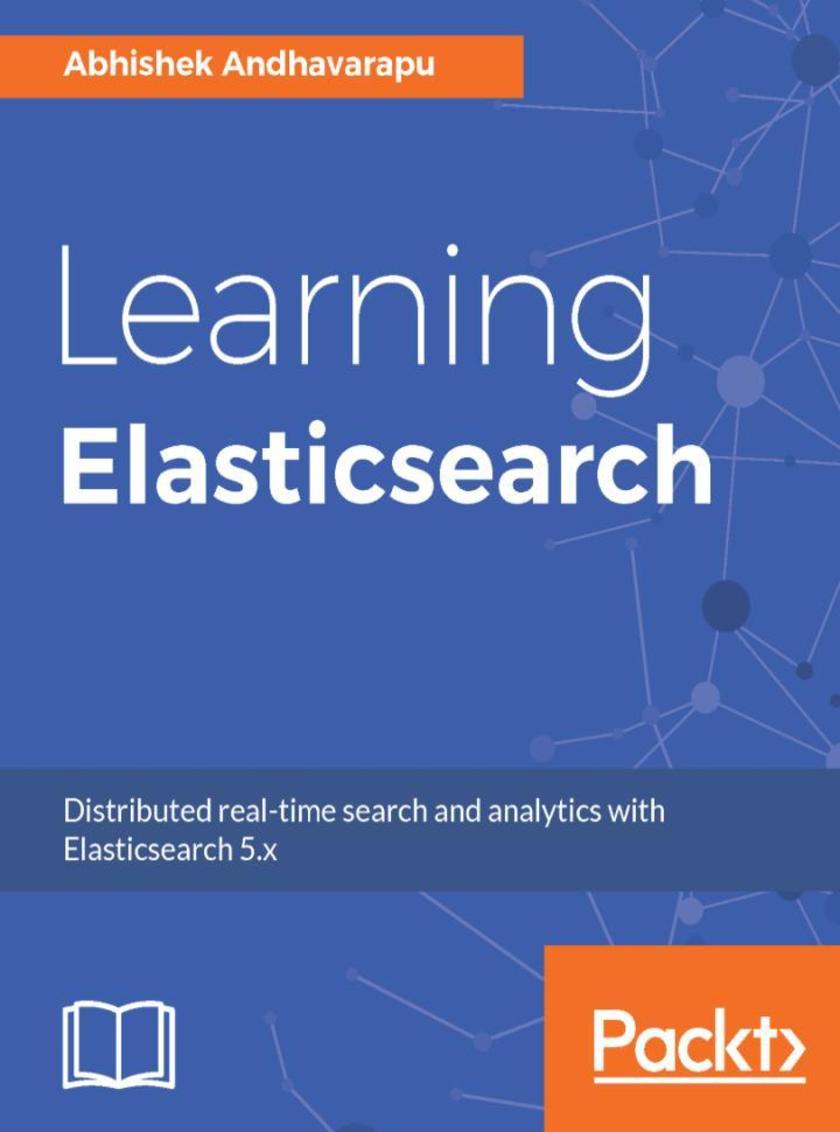
Learning Elasticsearch
¥90.46
Store, search, and analyze your data with ease using Elasticsearch 5.x About This Book ? Get to grips with the basics of Elasticsearch concepts and its APIs, and use them to create efficient applications ? Create large-scale Elasticsearch clusters and perform analytics using aggregation ? This comprehensive guide will get you up and running with Elasticsearch 5.x in no time Who This Book Is For If you want to build efficient search and analytics applications using Elasticsearch, this book is for you. It will also benefit developers who have worked with Lucene or Solr before and now want to work with Elasticsearch. No previous knowledge of Elasticsearch is expected. What You Will Learn ? See how to set up and configure Elasticsearch and Kibana ? Know how to ingest structured and unstructured data using Elasticsearch ? Understand how a search engine works and the concepts of relevance and scoring ? Find out how to query Elasticsearch with a high degree of performance and scalability ? Improve the user experience by using autocomplete, geolocation queries, and much more ? See how to slice and dice your data using Elasticsearch aggregations. ? Grasp how to use Kibana to explore and visualize your data ? Know how to host on Elastic Cloud and how to use the latest X-Pack features such as Graph and Alerting In Detail Elasticsearch is a modern, fast, distributed, scalable, fault tolerant, and open source search and analytics engine. You can use Elasticsearch for small or large applications with billions of documents. It is built to scale horizontally and can handle both structured and unstructured data. Packed with easy-to- follow examples, this book will ensure you will have a firm understanding of the basics of Elasticsearch and know how to utilize its capabilities efficiently. You will install and set up Elasticsearch and Kibana, and handle documents using the Distributed Document Store. You will see how to query, search, and index your data, and perform aggregation-based analytics with ease. You will see how to use Kibana to explore and visualize your data. Further on, you will learn to handle document relationships, work with geospatial data, and much more, with this easy-to-follow guide. Finally, you will see how you can set up and scale your Elasticsearch clusters in production environments. Style and approach This comprehensive guide will get you started with Elasticsearch 5.x, so you build a solid understanding of the basics. Every topic is explained in depth and is supplemented with practical examples to enhance your understanding.


