


 购物车
 个人中心


46 Miles
¥88.19
When Jarra Brown hears church bells he cannot fail to be reminded of the hundreds - 345 to be precise - of service personnel who passed through the beautiful rural Wiltshire countryside into Oxfordshire. These men and women were not hiking across its green pastures or sitting on top of the number 55 bus, instead they were lifeless, resting inside a coffin draped with the Union flag. By the end of August 2011 the bells of St Bartholomew's Church in Wootton Bassett had tolled more times than the residents of this once peaceful town cared to think about, for each chime represented the moment the police convoy accompanying the hearse from RAF Lyneham entered the High Street. A moment frozen in time, a moment when the residents of this town came to show their respects, a moment that couldn't have been more fitting even if it had been choreographed. There was no call to arms by the Town Crier, just a spontaneous, modest and unprompted response to those who had paid the ultimate price in the name of duty. 46 Miles is not a book about the politics of war, the whys and wherefores of the Iraq and Afghanistan conflicts, or indeed the hidden agendas and government strategies. It is about a town which captured the hearts of our nation and whose emotions rippled the entire 46 mile journey of honour, dignity and respect into Oxford. It is dedicated to those 345 people who, having signed up to serve their Queen and country, paid with their lives. Wootton Bassett, who nurtured the grieving on every occasion, wanted to let the nation know that these heroes will never be forgotten.
The Warlord of Mars
¥8.09
Science fiction adventure first published in 1918. According to Wikipedia: "Edgar Rice Burroughs (1875 – 1950) was an American author, best known for his creation of the jungle hero Tarzan and the heroic John Carter, although he produced works in many genres.
The Gods of Mars
¥8.09
Science fiction adventure, first published in 1914. According to Wikipedia: "Edgar Rice Burroughs (1875 – 1950) was an American author, best known for his creation of the jungle hero Tarzan and the heroic John Carter, although he produced works in many genres."
The Game
¥8.09
Classic Jack London novel. According to Wikipedia: "Jack London (1876 – 1916) was an American author who wrote The Call of the Wild, White Fang, and The Sea Wolf along with many other popular books. A pioneer in the then-burgeoning world of commercial magazine fiction, he was one of the first Americans to make a lucrative career exclusively from writing."
The Master of the World
¥8.09
Science fiction novel first published in 1904. Sequel to Robur the Conqueror. According to Wikipedia: "Jules Gabriel Verne (February 8, 1828 – March 24, 1905) was a French author who pioneered the science-fiction genre. He is best known for his novels Journey to the Center of the Earth (written in 1864), From the Earth to the Moon (1865), Twenty Thousand Leagues Under the Sea (1869–1870), and Around the World in Eighty Days (1873). Verne wrote about space, air, and underwater travel before navigable aircraft and practical submarines were invented, and before any means of space travel had been devised. Consequently he is often referred to as the "Father of science fiction", along with H. G. Wells. Verne is the second most translated author of all time, only behind Agatha Christie with 4162 translations, according to Index Translationum. Some of his work has been made into films."

New Chronicles of Rebecca
¥8.09
Sequel to Rebecca of Sunnybrook Farm. According to Wikipedia: "Kate Douglas Wiggin ( 1856 - 1923) was an American children's author and educator. Kate Douglas Smith Wiggin was born in Philadelphia, and was of Welsh descent. She started the first free kindergarten in San Francisco in 1878 (the Silver Street Free Kindergarten). With her sister in the 1880s she also established a training school for kindergarten teachers. She was also a writer of children's books, the best known being The Birds' Christmas Carol (1887) and Rebecca of Sunnybrook Farm (1903)."

Shorter Prose Pieces
¥8.09
Short collection of short pieces, including Phrases And Philosophies for the Use of The Young, Mrs. Langtry as Hester Grazebrook, Slaves of Fashion, Woman's Dress, More Radical Ideas upon Dress Reform, Costume, The American Invasion, Sermons in Stones at Bloomsbury, and L'Envoi. According to Wikipedia: "Oscar Fingal O'Flahertie Wills Wilde (1854 - 1900) was an Irish playwright, novelist, poet, and author of short stories. Known for his barbed wit, he was one of the most successful playwrights of late Victorian London, and one of the greatest celebrities of his day. As the result of a famous trial, he suffered a dramatic downfall and was imprisoned for two years of hard labour after being convicted of the offence of 'gross indecency.'"

The Heritage of Dedlow Marsh and Other Tales, collection of stories
¥8.09
Collection of stories, including: The Heritage of Dedlow Marsh, A Knight-Errant of the Foot-Hills, A Secret of Telegraph Hill, and Captain Jim's Friend. According to Wikipedia: "Bret Harte (August 25, 1836[2] – May 6, 1902) was an American author and poet, best remembered for his accounts of pioneering life in California. He was born in Albany, New York. ... He moved to California in 1853, later working there in a number of capacities, including miner, teacher, messenger, and journalist. He spent part of his life in the northern California coast town now known as Arcata, then just a mining camp on Humboldt Bay. His first literary efforts, including poetry and prose, appeared in The Californian, an early literary journal edited by Charles Henry Webb. In 1868 he became editor of The Overland Monthly, another new literary magazine, but this one more in tune with the pioneering spirit of excitement in California. His story, "The Luck of Roaring Camp," appeared in the magazine's second edition, propelling Harte to nationwide fame... Determined to pursue his literary career, in 1871 he and his family traveled back East, to New York and eventually to Boston, where he contracted with the publisher of The Atlantic Monthly for an annual salary of $10,000, "an unprecedented sum at the time." His popularity waned, however, and by the end of 1872 he was without a publishing contract and increasingly desperate. He spent the next few years struggling to publish new work (or republish old), delivering lectures about the gold rush, and even selling an advertising jingle to a soap company. In 1878 Harte was appointed to the position of United States Consul in the town of Krefeld, Germany and then to Glasgow in 1880. In 1885 he settled in London. During the thirty years he spent in Europe, he never abandoned writing, and maintained a prodigious output of stories that retained the freshness of his earlier work. He died in England in 1902 of throat cancer and is buried at Frimley."

The Bell-Ringer of Angel's, a collection of stories
¥8.09
Collection of stories. According to Wikipedia: "Bret Harte (August 25, 1836[2] – May 6, 1902) was an American author and poet, best remembered for his accounts of pioneering life in California. He was born in Albany, New York. ... He moved to California in 1853, later working there in a number of capacities, including miner, teacher, messenger, and journalist. He spent part of his life in the northern California coast town now known as Arcata, then just a mining camp on Humboldt Bay. His first literary efforts, including poetry and prose, appeared in The Californian, an early literary journal edited by Charles Henry Webb. In 1868 he became editor of The Overland Monthly, another new literary magazine, but this one more in tune with the pioneering spirit of excitement in California. His story, "The Luck of Roaring Camp," appeared in the magazine's second edition, propelling Harte to nationwide fame... Determined to pursue his literary career, in 1871 he and his family traveled back East, to New York and eventually to Boston, where he contracted with the publisher of The Atlantic Monthly for an annual salary of $10,000, "an unprecedented sum at the time." His popularity waned, however, and by the end of 1872 he was without a publishing contract and increasingly desperate. He spent the next few years struggling to publish new work (or republish old), delivering lectures about the gold rush, and even selling an advertising jingle to a soap company. In 1878 Harte was appointed to the position of United States Consul in the town of Krefeld, Germany and then to Glasgow in 1880. In 1885 he settled in London. During the thirty years he spent in Europe, he never abandoned writing, and maintained a prodigious output of stories that retained the freshness of his earlier work. He died in England in 1902 of throat cancer and is buried at Frimley."
On the Frontier
¥8.09
Collection of western stories, including: At the Mission of San Carmel, A Blue Grass Penelope, and Left Out on Lone Star Mountain. According to Wikipedia: "Bret Harte (August 25, 1836[2] – May 6, 1902) was an American author and poet, best remembered for his accounts of pioneering life in California. He was born in Albany, New York. ... He moved to California in 1853, later working there in a number of capacities, including miner, teacher, messenger, and journalist. He spent part of his life in the northern California coast town now known as Arcata, then just a mining camp on Humboldt Bay. His first literary efforts, including poetry and prose, appeared in The Californian, an early literary journal edited by Charles Henry Webb. In 1868 he became editor of The Overland Monthly, another new literary magazine, but this one more in tune with the pioneering spirit of excitement in California. His story, "The Luck of Roaring Camp," appeared in the magazine's second edition, propelling Harte to nationwide fame... Determined to pursue his literary career, in 1871 he and his family traveled back East, to New York and eventually to Boston, where he contracted with the publisher of The Atlantic Monthly for an annual salary of $10,000, "an unprecedented sum at the time." His popularity waned, however, and by the end of 1872 he was without a publishing contract and increasingly desperate. He spent the next few years struggling to publish new work (or republish old), delivering lectures about the gold rush, and even selling an advertising jingle to a soap company. In 1878 Harte was appointed to the position of United States Consul in the town of Krefeld, Germany and then to Glasgow in 1880. In 1885 he settled in London. During the thirty years he spent in Europe, he never abandoned writing, and maintained a prodigious output of stories that retained the freshness of his earlier work. He died in England in 1902 of throat cancer and is buried at Frimley."
Night-Born
¥8.09
Classic Jack London short stories, including THE NIGHT-BORN, THE MADNESS OF JOHN HARNED, WHEN THE WORLD WAS YOUNG, THE BENEFIT OF THE DOUBT, WINGED BLACKMAIL, BUNCHES OF KNUCKLES, WAR, UNDER THE DECK AWNINGS, TO KILL A MAN, and THE MEXICAN. Classic Jack London short stories, including MOON-FACE, THE LEOPARD MAN'S STORY, LOCAL COLOR, AMATEUR NIGHT, THE MINIONS OF MIDAS, THE SHADOW AND THE FLASH, ALL GOLD CANYON, and PLANCHETTE. According to Wikipedia: "Jack London (1876 – 1916) was an American author who wrote The Call of the Wild, White Fang, and The Sea Wolf along with many other popular books. A pioneer in the then-burgeoning world of commercial magazine fiction, he was one of the first Americans to make a lucrative career exclusively from writing."
Tales of the Fish Patrol
¥8.09
Classic Jack London short stories. According to Wikipedia: "Jack London (1876 – 1916) was an American author who wrote The Call of the Wild, White Fang, and The Sea Wolf along with many other popular books. A pioneer in the then-burgeoning world of commercial magazine fiction, he was one of the first Americans to make a lucrative career exclusively from writing."
The Exploration of the World
¥8.09
First part of Jules Verne's three-part history of the exploration of the world. This volume covers from Hanno and Herodotus to Champlain and LaSale. According to Wikipedia: "Jules Gabriel Verne (February 8, 1828 – March 24, 1905) was a French author who pioneered the science-fiction genre. He is best known for his novels Journey to the Center of the Earth (written in 1864), From the Earth to the Moon (1865), Twenty Thousand Leagues Under the Sea (1869–1870), and Around the World in Eighty Days (1873). Verne wrote about space, air, and underwater travel before navigable aircraft and practical submarines were invented, and before any means of space travel had been devised. Consequently he is often referred to as the "Father of science fiction", along with H. G. Wells. Verne is the second most translated author of all time, only behind Agatha Christie with 4162 translations..."
Tales of the Klondyke
¥8.09
Classic Jack London stories, including The God of His Fathers, The Great Interrogation, Which Make Men Remember, Siwash, The Man with the Gash, Jan the Unrepentant, Grit of Women, Where the Trail Forks, A Daughter of the Aurora, At the Rainbow's End, and The Scorn of Women. According to Wikipedia: "Jack London (1876 – 1916) was an American author who wrote The Call of the Wild, White Fang, and The Sea Wolf along with many other popular books. A pioneer in the then-burgeoning world of commercial magazine fiction, he was one of the first Americans to make a lucrative career exclusively from writing."

The Moon Endureth: Tales and Fancies
¥8.09
The Moon Endureth by John Buchan is a collection of tales and fancies, in prose and verse, which were originally published in Blackwood's Magazine. It includes From the Pentlands looking North and South, The Company of the Marjolaine, Avignon 1759, Lucid Interval, The Shorter Catechism (revised version), The Lemnian, Atta's song, Space, Stocks and Stones, Streams of Water in the South, The Gipsy's song to the lady Cassilis, The Grove of Ashtaroth, Wood magic, The riding of Ninemileburn, Plain Folk, The Kings of Orion, Babylon, The Green Glen, The Wise Years, Updater's note: Chapter 9 missing from etext], and The Rime of True Thomas. According to Wikipedia, "John Buchan, 1st Baron Tweedsmuir (26 August 1875 – 11 February 1940) was a Scottish novelist and Unionist politician who served as Governor General of Canada. Buchan's 100 works include nearly thirty novels, seven collections of short stories and biographies of Sir Walter Scott, Caesar Augustus, and Oliver Cromwell. Buchan's most famous of his books were the spy thrillers (including) The 39 Steps (which was converted to a play as well as an Alfred Hitchcock movie starring Robert Donat as Richard Hannay, though with Buchan's story much altered.) The "last Buchan" (as Graham Greene entitled his appreciative review) was the 1941 novel Sick Heart River (American title: Mountain Meadow), in which a dying protagonist confronts in the Canadian wilderness the questions of the meaning of life. The insightful quotation "It's a great life, if you don't weaken" is famously attributed to Buchan, as is "No great cause is ever lost or won, The battle must always be renewed, And the creed must always be restated."
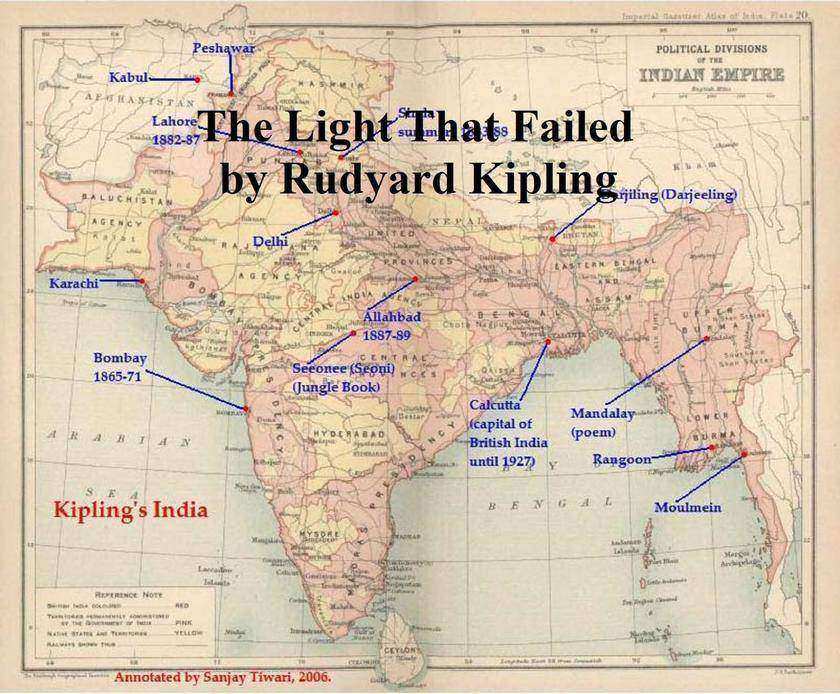
The Light that Failed
¥8.09
Classic Kipling novel. According to Wikipedia: "Joseph Rudyard Kipling (1865 – 1936) was an English author and poet. Born in Bombay, British India (now Mumbai), he is best known for his works The Jungle Book (1894) and Rikki-Tikki-Tavi (1902), his novel, Kim (1901); his poems, including Mandalay (1890), Gunga Din (1890), If— (1910); and his many short stories, including The Man Who Would Be King (1888). He is regarded as a major "innovator in the art of the short story"; his children's books are enduring classics of children's literature; and his best works speak to a versatile and luminous narrative gift. Kipling was one of the most popular writers in English, in both prose and verse, in the late 19th and early 20th centuries.[2] The author Henry James said of him: "Kipling strikes me personally as the most complete man of genius (as distinct from fine intelligence) that I have ever known." In 1907, he was awarded the Nobel Prize in Literature, making him the first English language writer to receive the prize, and to date he remains its youngest recipient. Among other honours, he was sounded out for the British Poet Laureateship and on several occasions for a knighthood, all of which he declined."

The Prince of India
¥8.09
According to Wikipedia: "Lewis "Lew" Wallace (April 10, 1827 – February 15, 1905) was a lawyer, governor, Union general in the American Civil War, American statesman, and author, best remembered for his historical novel Ben-Hur: A Tale of the Christ… Wallace's most notable service came in July 1864, at the Battle of Monocacy, part of the Valley Campaigns of 1864. Although the force under his command (amalgamated from the Middle Department) and the division of James B. Ricketts from VI Corps was defeated by Confederate General Jubal A. Early, he was able to delay Early's advance toward Washington, D.C., to the point that the city defenses had time to organize and repel Early... Wallace participated in the military commission trial of the Lincoln assassination conspirators as well as the court-martial of Henry Wirz, commandant of the Andersonville prison camp.[4] He resigned from the army on November 30, 1865.[5] Late in the war, he directed secret efforts by the government to help the Mexicans remove the French occupation forces who had seized control of Mexico in 1864. He continued in those efforts more publicly after the war and was offered a major general's commission in the Mexican army after his resignation from the U.S. Army. Multiple promises by the Mexican revolutionaries were never delivered, which forced Wallace into deep financial debt. Wallace held a number of important political posts during the 1870s and 1880s. He served as governor of New Mexico Territory from 1878 to 1881, and as U.S. Minister to the Ottoman Empire from 1881 to 1885. As governor, he offered amnesty to many men involved in the Lincoln County War; in the process he met with Billy the Kid. On March 17, 1879, the pair arranged that the Kid would act as an informant and testify against others involved in the Lincoln County War, and, in return, the Kid would be "scot free with a pardon in [his] pocket for all [his] misdeeds". But the Kid returned to his outlaw ways and Governor Wallace withdrew his offer. While serving as governor, Wallace completed the novel that made him famous: Ben-Hur: A Tale of the Christ (1880). It grew to be the best-selling American novel of the 19th century.[6] The book has never been out of print and has been filmed four times."
The Bat
¥8.09
According to Wikipedia: "Mary Roberts Rinehart (August 12, 1876-September 22, 1958) was a prolific author often called the American Agatha Christie.[1] She is considered the source of the phrase "The butler did it", although she did not actually use the phrase herself, and also considered to have invented the "Had-I-But-Known" school of mystery writing.... Rinehart wrote hundreds of short stories, poems, travelogues and special articles. Many of her books and plays, such as The Bat (1920) were adapted for movies, such as The Bat (1926), The Bat Whispers (1930), and The Bat (1959). While many of her books were best-sellers, critics were most appreciative of her murder mysteries. Rinehart, in The Circular Staircase (1908), is credited with inventing the "Had-I-But-Known" school of mystery writing. The Circular Staircase is a novel in which "a middle-aged spinster is persuaded by her niece and nephew to rent a country house for the summer. The house they choose belonged to a bank defaulter who had hidden stolen securities in the walls. The gentle, peace-loving trio is plunged into a series of crimes solved with the help of the aunt. This novel is credited with being the first in the "Had-I-But-Known" school."[3] The Had-I-But-Known mystery novel is one where the principal character (frequently female) does less than sensible things in connection with a crime which have the effect of prolonging the action of the novel. Ogden Nash parodied the school in his poem Don't Guess Let Me Tell You: "Sometimes the Had I But Known then what I know now I could have saved at least three lives by revealing to the Inspector the conversation I heard through that fortuitous hole in the floor." The phrase "The butler did it", which has become a cliché, came from Rinehart's novel The Door, in which the butler actually did do it, although that exact phrase does not actually appear in the work."

Egy milliomos b?rében
¥2.94
Видано 45 мовами! Донна Тартт — лауреат Пул?тцер?всько? прем?? № 1 у списку 100 видатних книжок за верс??ю The New York Times Отямившись п?сля вибуху в музе?, тринадцятир?чний Тео ще не розум??, що там, п?д уламками, залишилися його мат?р ? його дитинство. Пробираючись до виходу, повз кам?ння та т?ла, в?н п?дбира? безц?нну картину фламандського майстра, яку так любила його мати. Дивний старий, вмираючи, в?дда? йому свого персня та просить винести картину зв?дси... Тео буде кидати ?з родини в родину, ?з Нью-Йорка до Амстердама, ?з глибин в?дчаю до ейфор??. Викрадений ?Щиголь? стане його прокляттям та над??ю на порятунок... Vidano 45 movami! Donna Tartt — laureat Pul?tcer?vs'ko? prem?? № 1 u spisku 100 vidatnih knizhok za vers??ju The New York Times Otjamivshis' p?slja vibuhu v muze?, trinadcjatir?chnij Teo shhe ne rozum??, shho tam, p?d ulamkami, zalishilisja jogo mat?r ? jogo ditinstvo. Probirajuchis' do vihodu, povz kam?nnja ta t?la, v?n p?dbira? bezc?nnu kartinu flamands'kogo majstra, jaku tak ljubila jogo mati. Divnij starij, vmirajuchi, v?dda? jomu svogo persnja ta prosit' vinesti kartinu zv?dsi... Teo bude kidati ?z rodini v rodinu, ?z N'ju-Jorka do Amsterdama, ?z glibin v?dchaju do ejfor??. Vikradenij ?Shhigol'? stane jogo prokljattjam ta nad??ju na porjatunok...
Emile
¥28.04
Underground* *The author of the diary and the diary itself are, of course, imaginary. Nevertheless it is clear that such persons as the writer of these notes not only may, but positively must, exist in our society, when we consider the circumstances in the midst of which our society is formed. I have tried to expose to the view of the public more distinctly than is commonly done, one of the characters of the recent past. He is one of the representatives of a generation still living. In this fragment, entitled "Underground," this person introduces himself and his views, and, as it were, tries to explain the causes owing to which he has made his appearance and was bound to make his appearance in our midst. In the second fragment there are added the actual notes of this person concerning certain events in his life.--AUTHOR'S NOTE. II am a sick man.... I am a spiteful man. I am an unattractive man. I believe my liver is diseased. However, I know nothing at all about my disease, and do not know for certain what ails me. I don't consult a doctor for it, and never have, though I have a respect for medicine and doctors. Besides, I am extremely superstitious, sufficiently so to respect medicine, anyway (I am well-educated enough not to be superstitious, but I am superstitious). No, I refuse to consult a doctor from spite. That you probably will not understand. Well, I understand it, though. Of course, I can't explain who it is precisely that I am mortifying in this case by my spite: I am perfectly well aware that I cannot "pay out" the doctors by not consulting them; I know better than anyone that by all this I am only injuring myself and no one else. But still, if I don't consult a doctor it is from spite. My liver is bad, well--let it get worse! I have been going on like that for a long time--twenty years. Now I am forty. I used to be in the government service, but am no longer. I was a spiteful official. I was rude and took pleasure in being so. I did not take bribes, you see, so I was bound to find a recompense in that, at least. (A poor jest, but I will not scratch it out. I wrote it thinking it would sound very witty; but now that I have seen myself that I only wanted to show off in a despicable way, I will not scratch it out on purpose!) When petitioners used to come for information to the table at which I sat, I used to grind my teeth at them, and felt intense enjoyment when I succeeded in making anybody unhappy. I almost did succeed. For the most part they were all timid people--of course, they were petitioners. But of the uppish ones there was one officer in particular I could not endure. He simply would not be humble, and clanked his sword in a disgusting way. I carried on a feud with him for eighteen months over that sword. At last I got the better of him. He left off clanking it. That happened in my youth, though. But do you know, gentlemen, what was the chief point about my spite? Why, the whole point, the real sting of it lay in the fact that continually, even in the moment of the acutest spleen, I was inwardly conscious with shame that I was not only not a spiteful but not even an embittered man, that I was simply scaring sparrows at random and amusing myself by it. I might foam at the mouth, but bring me a doll to play with, give me a cup of tea with sugar in it, and maybe I should be appeased. I might even be genuinely touched, though probably I should grind my teeth at myself afterwards and lie awake at night with shame for months after. That was my way.

Evolution of Love
¥18.74
In these times of ours, though concerning the exact year there is no need to be precise, a boat of dirty and disreputable appearance, with two figures in it, floated on the Thames, between Southwark bridge which is of iron, and London Bridge which is of stone, as an autumn evening was closing in. The figures in this boat were those of a strong man with ragged grizzled hair and a sun-browned face, and a dark girl of nineteen or twenty, sufficiently like him to be recognizable as his daughter. The girl rowed, pulling a pair of sculls very easily; the man, with the rudder-lines slack in his hands, and his hands loose in his waistband, kept an eager look out. He had no net, hook, or line, and he could not be a fisherman; his boat had no cushion for a sitter, no paint, no inscription, no appliance beyond a rusty boathook and a coil of rope, and he could not be a waterman; his boat was too crazy and too small to take in cargo for delivery, and he could not be a lighterman or river-carrier; there was no clue to what he looked for, but he looked for something, with a most intent and searching gaze. The tide, which had turned an hour before, was running down, and his eyes watched every little race and eddy in its broad sweep, as the boat made slight head-way against it, or drove stern foremost before it, according as he directed his daughter by a movement of his head. She watched his face as earnestly as he watched the river. But, in the intensity of her look there was a touch of dread or horror. Allied to the bottom of the river rather than the surface, by reason of the slime and ooze with which it was covered, and its sodden state, this boat and the two figures in it obviously were doing something that they often did, and were seeking what they often sought. Half savage as the man showed, with no covering on his matted head, with his brown arms bare to between the elbow and the shoulder, with the loose knot of a looser kerchief lying low on his bare breast in a wilderness of beard and whisker, with such dress as he wore seeming to be made out of the mud that begrimed his boat, still there was a business-like usage in his steady gaze. So with every lithe action of the girl, with every turn of her wrist, perhaps most of all with her look of dread or horror; they were things of usage. 'Keep her out, Lizzie. Tide runs strong here. Keep her well afore the sweep of it.' Trusting to the girl's skill and making no use of the rudder, he eyed the coming tide with an absorbed attention. So the girl eyed him. But, it happened now, that a slant of light from the setting sun glanced into the bottom of the boat, and, touching a rotten stain there which bore some resemblance to the outline of a muffled human form, coloured it as though with diluted blood. This caught the girl's eye, and she shivered. 'What ails you?' said the man, immediately aware of it, though so intent on the advancing waters; 'I see nothing afloat.' The red light was gone, the shudder was gone, and his gaze, which had come back to the boat for a moment, travelled away again. Wheresoever the strong tide met with an impediment, his gaze paused for an instant. At every mooring-chain and rope, at every stationery boat or barge that split the current into a broad-arrowhead, at the offsets from the piers of Southwark Bridge, at the paddles of the river steamboats as they beat the filthy water, at the floating logs of timber lashed together lying off certain wharves, his shining eyes darted a hungry look. After a darkening hour or so, suddenly the rudder-lines tightened in his hold, and he steered hard towards the Surrey shore. Always watching his face, the girl instantly answered to the action in her sculling; presently the boat swung round, quivered as from a sudden jerk, and the upper half of the man was stretched out over the stern.


