


 购物车
购物车 个人中心
个人中心
Presentation Skills in 7 simple steps
¥61.51
7 simple steps to transform your presentations Speaking in front of an audience can be tough. Believe it or not, working out what you want to say is often the easiest part. You may need help overcoming nerves, or practical advice on body language, using technology, or dealing with tricky questions. This book gives you practical advice on how to give well-structured and clear presentations that engage your listeners and make an impact. No more sweaty palms, just cool, calm and effective presentations.
The Corner Office: How Top CEOs Made It and How You Can Too
¥95.75
Aspirational business book based on interviews with over 75 leading American CEOs. What does it take to succeed in business and to inspire others? Adam Bryant of The New York Times sat down with more than seventy-five CEOs and asked them how they do their jobs and the most important lessons they learned as they rose through the ranks. The Corner Office draws together lessons, memorable stories, and eye-opening insights from chief executives like Steven Ballmer (Microsoft), Carol Bartz (Yahoo), Jeffrey Katzenberg (DreamWorks), and Alan Mulally (Ford), as Bryant reveals the keys to success in the business world, including the five qualities CEOs value most in their employees, and shows how executives at the top of their game get the most out of others. For aspiring executives, of any age, The Corner Office offers perspectives that will help anyone who seeks to be a more effective leader and employee, and a path to future success.

HarperCollins e-books
¥140.08
Generation Ageless an authoritative and eye-opening look at the past, present, and future of Baby Boomers Think Baby Boomers are all alikeThink again. This dynamic generation is nearing the traditional age of retirement, but is in no mood to slow down. Learn how to market, sell to, do business with, or just understand this remarkable generation, from Yankelovich, Inc., the organization that knows them better than anyone else. Yankelovich actually coined the term "Baby Boomer" back in the late 1960s, when they first started collecting data on this influential generation. Now, more than thirty years later, they have the most complete information on Boomers ever assembled. And they have put it all together in this groundbreaking look at America's largest and most powerful generation. In Generation Ageless, Yankelovich president J. Walker Smith, Ph.D., and senior partner Ann Clurman, Boomers themselves, dig deep into what makes this generation tick. With fresh, original data and a wide-ranging look at everything about Boomers, they dissect Boomers into six major segments Straight Arrows, Due Diligents, Maximizers, Sideliners, Diss/Contenteds, and Re-Activists to provide new insights into the world's most talked-about generation. The results show key imperatives invaluable to anyone selling a product, service, or idea to this 78-million strong group.Boomers are the dominant generation in America. Their values and aspirations set the tone for everyone. Advances in medicine and health mean that this youth-obsessed generation is now focused on an everlasting prime of life. They are literally middle age less: holding onto their position at the top of the pyramid for as long as possible, and not fading away to their golden years. Today's fifty- and sixty-year-old Boomers are not eagerly anticipating lives of disengaged retirement. Instead, middle age less Boomers expect another twenty or thirty years of impact and influence albeit in a variety of ways reflective of a surfeit of agendas and ambitions they have yet to fulfill.

Live Rich
¥83.03
Money can Buy You HappinessIn Die Broke Stephen Pollan introduced a new radical new strategy for spending, saving, and investing money in today's financial market.In Live Rich, he now concentrates on the earning side--with the compelling observation that living rich has less to do with net worth and everything to do with freedom. You can live the life you want by adhering to the four tenets of the Live Rich philosophy: Make Money Too many of us have been fed the line that "work isn't necessarily about making money." Tell that to Visa next time they send you a bill. Don't Grow, Change Be ready to change your work paradigm on a moment's notice, to morph from career to career several times as conditions--and you--change. Take Charge In the twenty-first century, you must become proactive and start taking measured risks. Become a Mercenary Think for yourself as a free agent, responsible for your own security and always on the lookout for the next great job. Live Rich With Stephen Pollan's revolutionary workplace ideals, as well as a detailed action plan, you can apply this philosophy to every facet of your life and truly Live Rich.
HarperCollins e-books
¥90.73
There is no doubt that we are in the middle of a transition to a knowledge-based economy. Breakthrough technologies in microelectronics, biotechnology, new materials, telecommunications, robotics, and computers are fundamentally changing the game of creating wealth. While these new industries are growing explosively, existing industries such as banking and retail are being transformed beyond recognition. As a result, a new global economy is emerging to replace existing national economies.What will it take for individuals, companies, and entire countries to succeed in the new economics of the twenty-first centuryRather than focusing on spending, Lester C. Thurow argues that we must emphasize investment in basic knowledge, education, and infrastructure. Only by committing ourselves to building communal wealth can we maximize opportunities for building personal wealth as well. Building Wealth is an indispensable guide to surviving -- and thriving -- in the economies of the twenty-first century.

HarperCollins e-books
¥145.97
The commercial and cultural explosion of the digital age may have been born in California's Silicon Valley, but it reached its high point of riotous, chaotic exuberance in New York City from 1995 to 2000 in the golden age of Silicon Alley. In that short stretch of time a generation of talented, untested twentysomethings deluged the city, launching thousands of new Internet ventures and attracting billions of dollars in investment capital. Many of these young entrepreneurs were entranced by the infinite promise of the new media; others seemed more captivated by the promise of infinite profits. The innovations they launched from online advertising to 24-hour Webcasting propelled both the Internet and the tech-stock boom of the late '90s. And in doing so they sent the city around them into a maelstrom of brainstorming, code-writing, fundraising, drugs, sex, and frenzied hype . . .until April 2000, when the NASDAQ zeppelin finally burst and fell at their feet. In the pages of Digital Hustlers, Alley insiders Casey Kait and Stephen Weiss have captured the excitement and excesses of this remarkable moment in time. Weaving together the voices of more than fifty of the industry's leading characters, this extraordinary oral history offers a ground-zero look at the birth of a new medium. Here are entrepreneurs like Kevin O'Connor of DoubleClick, Fernando Espuelas of StarMedia, and Craig Kanarick of Razorfish; commentators like Omar Wasow of MSNBC and Jason McCabe Calacanis of the Silicon Alley Reporter; and inimitable Alley characters like party diva Courtney Pulitzer and Josh Harris, the clown prince of Pseudo.com. Together they describe a world of sweatshop programmers and paper millionaires, of cocktail-napkin business plans and billion-dollar IPOs, of spectacular successes and flame-outs alike. Candid and open-eyed, bristling with energy and argument, Digital Hustlers is an unforgettable group portrait of a wildly creative culture caught in the headlights of achievement.

HarperCollins e-books
¥128.85
Middle-class couples are working harder than ever. So why are they finding it more difficult to finance their homes, send their kids to college, and save toward retirement?Couples who are strapped for time and weighed down by costly fixed expenses need more than a personal finance pep talk: They need a plan. In The Big Payoff, CNBC correspondent Sharon Epperson lays out a nuts-and-bolts program that couples of all ages can use to realize their financial dreams. From stretching your budget and investing wisely in your home to protecting your family's money and building wealth over the years, The Big Payoff offers a concise bounty of precious information and practical steps toward financial wellness.Epperson begins by showing couples how to communicate better about money. She helps them realize that the same qualities needed to create a lasting relationship understanding, compromise, and patience are vital when it comes to building a secure financial future. Every important decision couples make, whether it's buying a home, having kids, changing jobs, or preparing for retirement, will inevitably involve a discussion about money, and Epperson teaches them how to handle finances with a cool hand while keeping the marriage vibrant and healthy. In addition, she empowers couples to take money matters into their own hands and shows them that by taking control of their finances, they can stop fretting about cash and start focusing on the important things in life.Each of the following chapters is designed to get partners talking and thinking about their financial life together. In eight easy-to-understand steps, Epperson unpacks the various options for saving money; creating emergency, retirement, and college savings plans; investing in a home; choosing the right life and health insurance; and drafting an estate plan. A wife and mother of two herself, Epperson knows a thing or two about the pitfalls of financial planning and doses her advice with plenty of humorous anecdotes, hard-earned experience, and down-to-earth language. Additionally, through helpful worksheets and exercises, The Big Payoff helps readers customize a plan that will work best for them and reap the most payback.It's never too late or too early to start, and now is the best time to start planning. Whether you are newlyweds or fast-approaching retirement, just starting a family or soon to be empty-nesters, this book is for you. After working hard to provide for your family, the reward of discovering your financial strength will be the peace of mind to enjoy your marriage, your family, and the rest of your lives together.

HarperCollins e-books
¥140.29
Whether it was a Ginsu knife, George Foreman Grill, Tony Robbins' motivational book, kitchen device by Ron Popeil, or any of the countless other famous products that have been marketed on infomercials over the years, admit it: you or someone you know has bought one and you're not alone. Last year, one out of every three Americans picked up the phone and ordered a product from a television infomercial or home shopping network, and in But Wait . . . There's More! journalist (and infomercial addict) Remy Stern offers a lively, behind-the-scenes exploration of this enormous business one that markets the world's most outrageous products using the most outrageous tactics. Don't let the kitschy exterior fool you: behind the laughable demonstrations, goofy grins, and cheesy dialogue lies an industry larger than the film and music industries combined. The first book of its kind, But Wait . . . There's More! exposes the never-before-told story of the infomercial and home shopping phenomenon in all its excessive glory and its meteoric rise to become one of the most profitable businesses in America. Along the way, Stern details the history behind the classic products and introduces readers to some of the most famous (and infamous) pitchmen and personalities in the business, including Tony Robbins, Billy Mays, Ron Popeil, Tony Little, Suzanne Somers, Kevin Trudeau, and Joe Francis. He also presents an in-depth look at the business behind the camera the canny sales strategies, clever psychological tools, and occasionally questionable tactics marketers have used to get us to open up our wallets and spend, spend, spend.Stern's eye-opening account also offers a penetrating look at how late-night television conquered the American consumer and provides insight into modern American culture: our rampant consumerism, our desire for instant riches, and our collective dream of perfect abs, unblemished skin, and gleaming white teeth. Both a compelling business story and a thoroughly entertaining piece of investigative journalism (with a touch of muckraking and social satire), But Wait . . . There's More! will ensure that you never look at those too-good-to-be-true deals the same way again.

Love Is Not Enough: A Smart Woman’s Guide to Money
¥72.40
Merryn Somerset Webb, star of Channel 4's hit series ‘Superscrimpers’, shows you how to face the future with both money and confidence in this financial bible for sassy women. Money may not buy you love but it certainly helps with life's other little luxuries. From shopping sprees to pension plans, ISAs to investments, money plays a crucial role in our present and future comfort. We may not like to admit it, but diamonds – or cold, hard cash – really can be a girl's best friend. So why, when women have much to celebrate, are we reluctant to talk about it? Why, when we have more wealth in our own names than ever before, do women take less interest in money than men? And why do we still feel that demonstrating an interest in finance is somehow…unfeminine? Because let's face it – for most of us, Prince Charming and his bank balance just aren't coming. If we want to secure our futures we're going to have to do it ourselves. The good news is that it's not hard to do. Dealing with our personal finances is much, much easier than the financial industry would have us believe. Women tend to make better investors than men too – our instincts, so to speak, are on the money. All we need is a bit of know-how and the confidence to put it into practice. Combining years of financial expertise with a healthy dose of scepticism and an easy sense of humour, Merryn Somerset Webb's sharp, witty and appealing guide to personal wealth for sassy women provides the answers. Whether you're drowning in debt, negotiating a higher salary or tackling the thorny issue of a pre-nup, just one read through and you'll be in a position to sort your finances out for good, transforming them from a constant worry into a source of peace of mind.

Why the Best Man for the Job Is a Woman
¥84.16
Playing With The Big Boys -- And Beating Them At Their Own Game! From Meg Whitman of eBay to Marcy Carsey of Carsey-Warner and Oxygen Media, today's leading businesswomen show how to make it in the notorious boys' club of corporate America.Gone are the days when men called the shots. More and more women have replaced men or excelled over rivals in male-dominated industries because they possess the qualities of leadership that top firms are seeking today. Esther Wachs Book introduces the new Female Leader and reveals the seven key, and uniquely female, qualities of leadership that are turning the world around -- and allowing more women to achieve success.Filled with compelling insights gleaned from the country's highest-ranking businesswomen, Why the Best Man for the Job Is a Woman reveals how these exceptional women have soared to the top and captures their strategies for success.

Best Practices: Evaluating Performance
¥72.70
Successful management relies on identifying and promoting high-performing employees and targeting underperformers for serious improvement. Evaluating Performance, a comprehensive and essential resource for any manager on the run, shows you how.Learn to: Monitor day-to-day performance Conduct productive formal reviews Reward consistent, excellent performance through promotions Terminate underperforming employees Create a company-wide performance management system The Collins Best Practices guides offer new and seasoned managers the essential information they need to achieve more, both personally and professionally. Designed to provide tried-and-true advice from the world's most influential business minds, they feature practical strategies and tips to help you get ahead.

Best Practices: Managing People
¥72.70
In today's hypercompetitive business climate, managers who help employees achieve their individual potential stand to get and stay ahead. Managing People, a comprehensive and essential resource for any manager on the run, shows you how.Learn to: Delegate the right work to the right employee Motivate people to outperform the competition Establish and empower effective teams Manage multiple projects and stay on track Inspire trust and lead in times of change The Collins Best Practices guides offer new and seasoned managers the essential information they need to achieve more, both personally and professionally. Designed to provide tried-and-true advice from the world's most influential business minds, they feature practical strategies and tips to help you get ahead.
FairTax: The Truth
¥82.80
In 2005, firebrand radio talk show host Neal Boortz and Georgia congressman John Linder created The FairTax Book, presenting the American public with a bold new plan designed to eliminate federal taxes and the IRS, jump-start the U.S. economy, bring back lost industries and jobs, and recapture billions of untaxed dollars hoarded by criminal and offshore businesses. Their book became an immediate #1 New York Times bestseller, propelling a powerful grassroots tax reform movement that's spreading like wildfire across our nation.Now, three years later, the authors are back to answer the outspoken and misinformed critics of their innovative proposal. Offering eye-opening new insights not covered in the original book, FairTax: The Truth debunks the negative myths and gross misrepresentations of this groundbreaking idea. The FairTax plan is simple, brilliant, and it will work enabling you to keep all the money in your paycheck; eliminating the fraud, hassle, and waste of our current system; and revolutionizing the way America pays for itself.
Executive Intelligence
¥84.16
The final word on what traits make for highly successful managers and a detailed explanation of how to identify potential standout performers. Executive Intelligence is about the substance behind great leadership. Inspired by the work of Peter Drucker and Jim Collins, Justin Menkes set out to isolate the qualities that make for the 'right' people. Drawing on his background in psychology and bolstered by interviews with accomplished CEOs, Menkes paints the portrait of the ideal executive.In a sense, Menkes's work reveals an executive IQ the cognitive skills necessary in order to excel in senior management positions. Star leaders readily differentiate primary priorities from secondary concerns; they identify flawed assumptions; they anticipate the different needs of various stakeholders and how they might conflict with one another; and they recognise the underlying agendas of individuals in complex exchanges.Weaving together research, interviews and the results of his own proprietary testing, Menkes exposes one of the great fallacies of corporate life, that hiring and promotion are conducted on a systematic or scientific basis that allows the most accomplished to rise to their levels of optimal responsibility. Finally, Menkes is a passionate advocate for finding and employing the most talented people, especially those who may have been held back by external assumptions.
Go It Alone!
¥83.03
There is an epidemic of unhappiness in the American workplace. A full 70 percent of workers in the United States report that they are disengaged from their jobs. When asked, "Do you have the opportunity to do what you do best every day?" only 20 percent of nearly 2 million employees said yes. It is no wonder that 56 percent of all Americans dream of starting their own business. So why don't they do soBecause starting one's own business is seen as difficult, expensive, and risky.In this extraordinary book, successful Go It Alone! entrepreneur Bruce Judson explains that the conventional wisdom about starting your own business is stunningly wrong. Using the leverage of technology -- e-mail, the World Wide Web, and the remarkable array of off-the-shelf business services now available -- it is dramatically easier to start your own business. Magnified by these new services, it is also possible to create, for the first time, a highly focused business.Bruce Judson shows you the practical steps that will allow nearly any individual to create a business, often using job skills that seem to require an entire corporation for support. It is no longer necessary to spend time on the tasks that don't add value. It is now possible to stay small but reap big profits. Go-it-alone businesses allow the individual the freedom to concentrate on their greatest skills. After reading this book, your motto will be "Do What You Do Best, Let Others Do the Rest."
24 Days
¥83.03
This is the story of Rebecca Smith and John R. Emshwiller, the two reporters who led the Wall Street Journal's reporting on Enron and uncovered the unorthodox partnerships at the heart of the scandal through skill, luck, and relentless determination. It all started in August 2001when Emshwiller was assigned to write a supposedly simple article on the unexpected resignation of Enron CEO Jeff Skilling. During his research, Emshwiller uncovered a buried reference to an off-balance-sheet partnership called LJM. Little did he know, this was the start of a fast and furious ride through the remarkable downfall of a once highly-prized company. Written in an intense, fast paced narrative style, 24 Days tells the gripping story of the colossal collapse of what would become the world's most notorious corporation. The reader follows along as Smith and Emshwiller continue to uncover new partnerships and self-dealing among the highest levels of Enron's management. As they publish articles detailing their findings in the Journal, Wall Street and individual investors have a crisis of confidence and start selling Enron stock at unprecedented levels of volume. In the end - 24 short days later - Enron had completely collapsed, erasing 16 years of growth and losing $19 billion in market value while watching the stock drop from $33.84 to $8.41. Not only was the company destroyed, but investors and retired employees were completely wiped out-all the while Enron executives were collecting millions of dollars. Climaxing with this 24-day period, this book shows the reporter's-eye view of a David-and-Goliath battle between journalists and a giant corporation. Each day a new story uncovered another fact; each day the company issued denials. And when the investigative stories reached critical mass and momentum, the stock market cast its final vote of no confidence. In the tradition of Indecent Exposure and Barbarians at the Gate, two other gripping narratives that began as a series of Wall Street Journal stories and ended up as books that defined an era, 24 Days brings the importance of great investigative journalism to life.

Secrets of Six-Figure Women
¥95.39
According to the Department of Labor, the average woman in 1998 was bringing home less than $25,000 a year. For every dollar that a man makes, a woman makes between 50 and 75 cents, and that is hardly news. But what you may not know is that, quietly and steadily, the number of women making six figures or more is rapidly increasing. Currently, over fifteen million women make $100,000 or more, and the number continues to rise at a rate faster then for men. And these women come from every industry - psychologists, dot com founders, consultants, freelance writers, and even part-timers. What makes these particular women able to do so well in the workplaceFueled by curiosity, Barbara Stanny, author of Price Charming Isn't Coming: How Women Get Smart About Money (Viking Penguin), set out to research this phenomenon. What she discovered was that, though the high-earning women she interviewed came from different backgrounds and had had greatly different work experiences, they all had certain characteristics in common. Secrets of Six Figure Woman: Surprising Strategies of the Successful High Earners will be a ground breaking book for high earners who want to ensure their wealth, enhance their success, and learn from others who are in the same boat. It will also offer inspiration, guidance, and motivation to those who aspire to make more.
New Totally Awesome Money Book For Kids
¥67.12
Jam-packed with up-to-date, easy-to-understand information on every area of money, this smart, useful book—just right for kids age 8–14—makes learning about money fun. A savvy brother and sister team, Arthur and Rose explain a lot about money matters, including:?Budgets and savings (great ways to get the stuff you really want!) ?The basics of stocks, bonds, and other ways of investing ?Credit cards (“The Plastic Flash”) and borrowing ?Updated information on the Internet with useful Web links ?Online investing, Web safety precautions ?Saving and paying for college ?And much more

The One-Life Solution
¥83.03
Do you feel that if you could get rid of some of the chaos in your work life, you could take your performance to a greater levelDo you stay late at the office many nights, trying to empty an inbox that never seems to diminishDo you have difficulty dealing with cantankerous bosses or passive-aggressive coworkersDo you find yourself checking your BlackBerry almost against your will during dates, family dinners, or your children's soccer gamesIf you've answered yes to any of the above, chances are you feel fragmented, pulled in too many directions at once, frustrated. Your work life has taken over your personal life.In The One-Life Solution, Dr. Henry Cloud, consultant, bestselling author of the Boundaries series and Integrity, and clinical psychologist, examines the workplace. He demonstrates how our failure to maintain a unified life with good boundaries at the office not only blurs the line between the professional and the personal, but leaves us less equipped to deal with the problems of today's workplace: stress, heavy workload, and a blistering pace. As a result, we are overworked, overstressed, and unhappier than ever. Through real-world examples from years of working with leaders at companies large and small, Dr. Cloud shows us how to construct and enforce better boundaries against the technological devices, bullying bosses, and distracting coworkers who invade our time and space.From conducting an audit of your time, to developing a policy of who you are and what you stand for, to learning how to overcome a paralyzing inability to say no, Dr. Cloud provides invaluable strategies and *s for moving toward a more unified, coherent sense of self and a life that fully encompasses work, family, and spirituality. In a clear, conversational voice, he will help you develop the ability to: contain self-destructive behavior and keep it from spreading. define yourself and know who you are. set limits when needed. communicate effectively. learn how to improve your performance at the office and outside it. By starting to do what's best for you, you'll find the key to living the one happy, fulfilling life that only you can live.
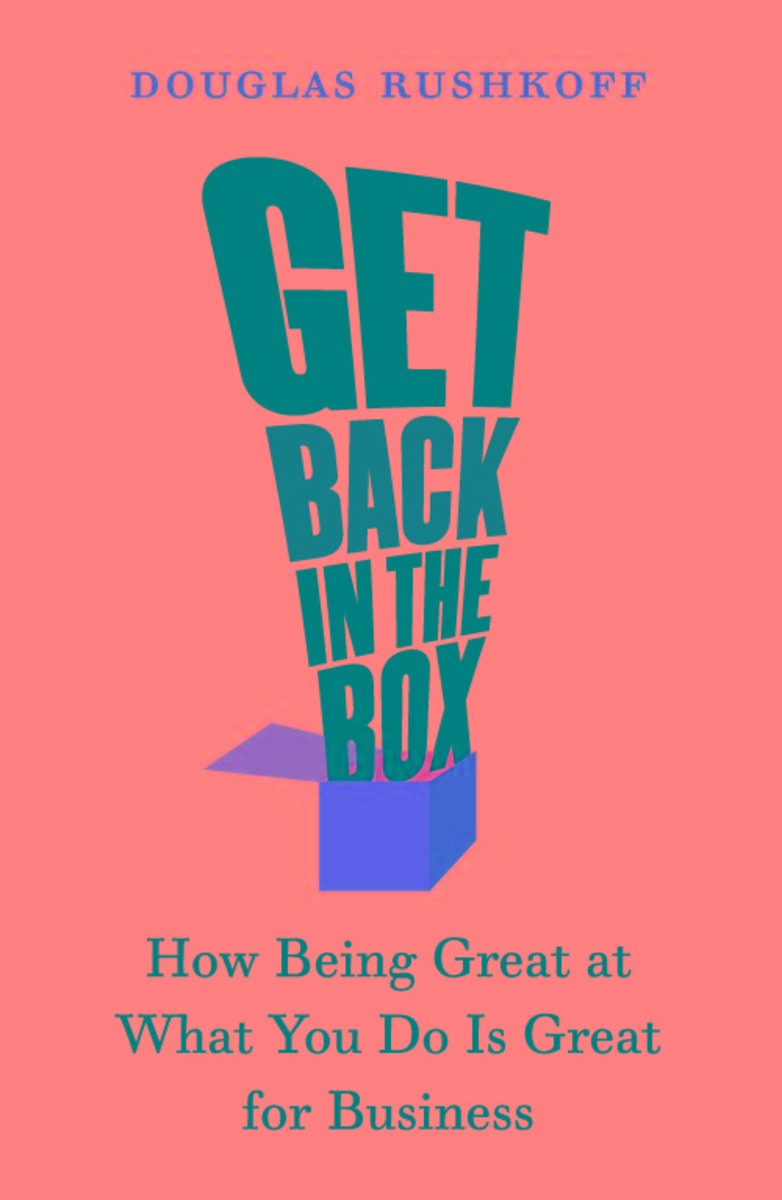
Get Back in the Box
¥84.28
Douglas Rushkoff was one of the first social commentators to identify the new culture around the internet. He has spent nearly a decade advising companies on the ways they can re-orient their businesses to the transformations the internet has caused. Through his speaking and consulting, Rushkoff has discovered an important and unrecognized shift in American business. Too many companies are panicked and operating in survival mode when the worst of the crisis has already passed. Likening the internet transformation to the intellectual and technological ferment of the Enlightment, Rushkoff suggests we have a remarkable opportunity to re-integrate our new perspective with the work we actually do. Instead of running around trying to "think out of the box," Rushkoff demonstrates, now is the time to "get back in the box" and improve the way we do our jobs, run our operations and drive innovation from the ground up. Combining stories gleaned from his consulting with a thrilling tour of history's dramatic moments and clever readings of cultural shift we've just experienced, Rushkoff offers a compelling vision of the simple and effective ways businesses can re-invigorate themselves.

What Really Works
¥95.39
Based on a groundbreaking study, analysing data on 200 management practices gathered over a 10 year period. Reveals the effectiveness of the 4+2 practices (4 primary and 2 of 4 possible secondary) practices that really matter the ones that, if followed rigorously, ensure sustained business success. With a new introduction by the authors. With hundreds of well known management practices and pre*ions promoted by consultants and available to business, which are really effective and contribute to the growth and continued success of a companyWhich do little or nothingBased on the "Evergreen Project," a massive, 5 year study involving the business school faculties of ten universities, the authors set out to find the management practices that truly promote long term growth and success. Their findings will revolutionize the art and practice of business management.The book shows that there are essentially six management practices that all successful companies must master simultaneously. They range from focusing on a strategy of growth to maintaining the depth and quality of human talent in the organization.


