


 购物车
购物车 个人中心
个人中心
Maya Programming with Python Cookbook
¥80.65
Master complex workflows and conquer the world with Python and Maya About This Book Improve your modelling skills and reduce your *ing problems using Python in Maya Learn to communicate with web applications using Python for easier team development A quick and practical answer to every problem you can have whilst *ing in Maya with Python Who This Book Is For This book is for Python developers who have just started *ing with Maya. What You Will Learn Find out how to use Python *ing to automate tedious tasks Create functional user interfaces to make *s easy to share with others Add new functionality to Maya via the power of *ing Import and export arbitrary data into and out of Maya Improve your workflow, and that of your team Create custom create custom controls to make rigs that are easy to work with Implement a system to render 3D assets for isometric games Use * jobs to trigger actions automatically in response to user interaction Open a command port to allow other applications to communicate with Maya In Detail Maya is a 3D graphics and animation software, used to develop interactive 3D applications and games with stupendous visual effects. The Maya Programming with Python Cookbook is all about creating fast, powerful automation systems with minimum coding using Maya Python. With the help of insightful and essential recipes, this book will help you improve your modelling skills. Expand your development options and overcome *ing problems encountered whilst developing code in Maya. Right from the beginning, get solutions to complex development concerns faced when implementing as parts of build. Style and approach This book is comprised of a set of practical recipes, grouped under specific topics, which can be referred to independently or in sequence. These recipes provide quick solutions to common problems, and cover most of the real-world scenarios that developers are likely to face when working with Maya.
Eclipse Plug-in Development: Beginner's Guide - Second Edition
¥90.46
Develop skills to build powerful plug-ins with Eclipse IDE through examples About This Book Create useful plug-ins to make Eclipse work for you Learn how to migrate Eclipse 3.x plug-ins to Eclipse 4.x From automation to testing, find out how to get your IDE performing at an impressive standard Who This Book Is For This book is for Java developers familiar with Eclipse who need more from the IDE. This book will sharpen your confidence and make you a more productive developer with a tool that supports rather than limits you. What You Will Learn Create plug-ins for Eclipse 4.x Test plug-ins automatically with JUnit Display tree and table information in views Upgrade Eclipse 3.x plug-ins to Eclipse 4.x Find out how to build user interfaces from SWT and JFace Run tasks in the background and update the user interface asynchronously Automate builds of plug-ins and features Automate user interface tests with SWTBot In Detail Eclipse is used by everyone from indie devs to NASA engineers. Its popularity is underpinned by its impressive plug-in ecosystem, which allows it to be extended to meet the needs of whoever is using it. This book shows you how to take full advantage of the Eclipse IDE by building your own useful plug-ins from start to finish. Taking you through the complete process of plug-in development, from packaging to automated testing and deployment, this book is a direct route to quicker, cleaner Java development. It may be for beginners, but we're confident that you'll develop new skills quickly. Pretty soon you'll feel like an expert, in complete control of your IDE. Don't let Eclipse define you - extend it with the plug-ins you need today for smarter, happier, and more effective development. Style and approach Packed with plenty of examples so you're never stuck, or never left simply reading instructions, this book encourages you to get started immediately. This book is for developers who want to develop, not just learn.
Visual Studio 2015 Cookbook - Second Edition
¥90.46
Over 50 new and improved recipes to put Visual Studio 2015 to work in your crucial development projects About This Book Get to grips with all the new Visual Studio 2015 features regardless of your preferred programming language Apply Visual Studio to all areas of development: writing, debugging, and application lifecycle maintenance Straightforward and hands-on advice for building both Windows and Android apps Who This Book Is For If you are a developer excited about the new features introduced in Visual Studio 2015, then no matter what your programming language of choice is, Visual Studio 2015 Cookbook is for you. You should have a good knowledge of working with previous versions of Visual Studio to benefit from the recipes in this book. What You Will Learn Customize the editor's new abilities to fit your development style Create apps for Windows Use Visual Studio to debug parallel and concurrent programs Integrate .NET Framework 4.6 effectively Put TypeScript to work in your web applications Develop modern C++11 with Visual Studio 2015 Protect and manage your source code with Team Foundation Server In Detail Visual Studio 2015 is the premier tool for developers targeting the Microsoft platform. Learning how to effectively use this technology can enhance your productivity while simplifying your most common tasks, allowing you more time to focus on your project. Visual Studio 2015 is packed with improvements that increase productivity, and this book walks you through each one in succession to help you smooth your workflow and get more accomplished. From customization and the interface to code snippets and debugging, the Visual Studio upgrade expands your options — and this book is your fast-track guide to getting on board quickly. Visual Studio 2015 Cookbook will introduce you to all the new areas of Visual Studio and how they can quickly be put to use to improve your everyday development tasks. With this book, you will learn not only what VS2015 offers, but what it takes to put it to work for your projects. Style and approach This book is a practical guide to using Visual Studio 2015 and will help you become familiar with the improvements made in previous versions. Each recipe provides a hands-on approach to the new features with step-by-step instructions on how to increase your productivity.
Learning Android Application Development
¥71.93
Build Android N applications using modern techniques and libraries to get your own high-quality apps published on Google Play in no time About This Book Get started with Android development, from the installation of required tools to publishing to the market Make your applications Android N ready—Android has evolved quite a lot since the very beginning and so has their Software Development Kit—so get up to speed Save time and improve the quality of your applications with widely used open source libraries and dependency management Who This Book Is For Want to get started with Android developmentStart here. What You Will Learn Get to know how to use popular open source libraries to reduce time to market and avoid re-inventing the wheel Automate your application’s testing phase to avoid last minute crashes Use dependency management to properly keep dependencies and updates under control Efficiently show huge amounts of items in a list Forget about memory and speed concerns Publish and monetize your Android applications on Google Play Persist your application data so it can continue working in offline mode Don’t let the UX break because of network issues In Detail The mobile app market is huge. But where do you startAnd how you can deliver something that takes Google Play by stormThis guide is the perfect route into Android app development – while it’s easy for new apps to sink without a trace, we’ll give you the best chance of success with practical and actionable guidance that will unlock your creativity and help you put the principles of Android development into practice. From the fundamentals and getting your project started to publishing your app to a huge market of potential customers, follow this guide to become a confident, creative and reliable mobile developer. Get to grips with new components in Android 7 such as RecyclerView, and find out how to take advantage of automated testing, and, of course, much, much more. What are you waiting forThere’s never been a better time – or a better way – to get into Android app development. Style and approach More than just a manual, this is an accessible route into Android development. Packed with examples that demonstrate how to put key concepts and ideas into practice, this guide isn’t just about learning, it’s about immediate development.
Introduction to R for Business Intelligence
¥63.21
Learn how to leverage the power of R for Business Intelligence About This Book Use this easy-to-follow guide to leverage the power of R analytics and make your business data more insightful. This highly practical guide teaches you how to develop dashboards that help you make informed decisions using R. Learn the A to Z of working with data for Business Intelligence with the help of this comprehensive guide. Who This Book Is For This book is for data analysts, business analysts, data science professionals or anyone who wants to learn analytic approaches to business problems. Basic familiarity with R is expected. What You Will Learn Extract, clean, and transform data Validate the quality of the data and variables in datasets Learn exploratory data analysis Build regression models Implement popular data-mining algorithms Visualize results using popular graphs Publish the results as a dashboard through Interactive Web Application frameworks In Detail Explore the world of Business Intelligence through the eyes of an analyst working in a successful and growing company. Learn R through use cases supporting different functions within that company. This book provides data-driven and analytically focused approaches to help you answer questions in operations, marketing, and finance. In Part 1, you will learn about extracting data from different sources, cleaning that data, and exploring its structure. In Part 2, you will explore predictive models and cluster analysis for Business Intelligence and analyze financial times series. Finally, in Part 3, you will learn to communicate results with sharp visualizations and interactive, web-based dashboards. After completing the use cases, you will be able to work with business data in the R programming environment and realize how data science helps make informed decisions and develops business strategy. Along the way, you will find helpful tips about R and Business Intelligence. Style and approach This book will take a step-by-step approach and instruct you in how you can achieve Business Intelligence from scratch using R. We will start with extracting data and then move towards exploring, analyzing, and visualizing it. Eventually, you will learn how to create insightful dashboards that help you make informed decisions—and all of this with the help of real-life examples.
Mastering Sass
¥80.65
Create interactive and responsive cross-browser apps with SASS and Compass About This Book Create data-intensive, highly scalable apps using Sass and COMPASS Master the concepts of Sass and COMPASS and unleash your potential to develop enterprise-grade apps This book is an experts’ guide on leveraging Sass and COMPASS features Who This Book Is For This book is aimed at those who know CSS3 and HTML5 quite well and who've built a few small-to-medium-sized websites from scratch using Sass and Compass. What You Will Learn Master Sass and Compass features Familiarize yourself with CSS and HTML concepts that are vital for a good Sass workflow. Build real-world websites focusing on layouts and content aspects Work on a grid system using Compass and Susy Automate your workflow with Gulp Write functions and mixins to leverage the control flow In Detail CSS and Sass add elegance and excellence to the basic language, and consist of a CSS-compatible syntax that allows you to use variables, nested rules, mixins, inline imports, and much more. This book will start with an overview of the features in Sass and Compass, most of which you'll already be familiar; however, this will ensure you know what’s expected as the book goes deeper into Sass and Compass. Next you will learn CSS and HTML concepts that are vital to a good Sass workflow. After all, Sass exists to simplify writing CSS, but it won’t teach you how to make clean, scalable, reusable CSS. For that, you need to understand some basic concepts of OOCSS, SMACCS, and Atomic Design. Once you’ve brushed up on the important concepts, it’s time to write some Sass. Mainly you’ll write a few functions and mixins that really leverage control flow using @if / @else loops and you’ll learn how to figure out when and why things are going wrong before they bring you to a stop. Moving further, you’ll learn how to use @debug, @warn and @error to properly handle errors. You’ll also learn about Gulp and how to use it to automate your workflow and reduce your repetitive tasks. And finally you’ll learn about sourcemaps. With sourcemaps, you’ll be able to write, debug, and view your Sass and Compass all from within the browser. It’ll even LiveReload too! As a bonus, you’ll take a look at that funky Flexbox, currently all the rage! You’ll learn how powerful and flexible it really is, and how you can use it with Compass. Best of all, it falls back very gracefully indeed! In fact, you’ll be able to apply it to any existing project without having to change a line of the original CSS. Style and approach This book will provide readers with practical, actionable expertise to enhance their knowledge
OpenStack: Building a Cloud Environment
¥161.31
Learn how you can put the features of OpenStack to work in the real world in this comprehensive path About This Book Harness the abilities of experienced OpenStack administrators and architects, and run your own private cloud successfully Learn how to install, configure, and manage all of the OpenStack core projects including topics on Object Storage, Block Storage, and Neutron Networking services such as LBaaS and FWaaS Get better equipped to troubleshoot and solve common problems in performance, availability, and automation that confront production-ready OpenStack environments Who This Book Is For This course is for those who are new to OpenStack who want to learn the cloud networking fundamentals and get started with OpenStack networking. Basic understanding of Linux Operating System, Virtualization, and Networking, and Storage principles will come in handy. What You Will Learn Get an introduction to OpenStack and its components Store and retrieve data and images using storage components, such as Cinder, Swift, and Glance Install and configure Swift, the OpenStack Object Storage service, including configuring Container Replication between datacenters Gain hands on experience and familiarity with Horizon, the OpenStack Dashboard user interface Learn how to automate OpenStack installations using Ansible and Foreman Follow practical advice and examples for running OpenStack in production Fix common issues with images served through Glance and master the art of troubleshooting Neutron networking In Detail OpenStack is a collection of software projects that work together to provide a cloud fabric. Learning OpenStack Cloud Computing course is an exquisite guide that you will need to build cloud environments proficiently. This course will help you gain a clearer understanding of OpenStack’s components and their interaction with each other to build a cloud environment. The first module, Learning OpenStack, starts with a brief look into the need for authentication and authorization, the different aspects of dashboards, cloud computing fabric controllers, along with 'Networking as a Service' and 'Software defined Networking'. Then, you will focus on installing, configuring, and troubleshooting different architectures such as Keystone, Horizon, Nova, Neutron, Cinder, Swift, and Glance. After getting familiar with the fundamentals and application of OpenStack, let's move deeper into the realm of OpenStack. In the second module, OpenStack Cloud Computing Cookbook, preview how to build and operate OpenStack cloud computing, storage, networking, and automation. Dive into Neutron, the OpenStack Networking service, and get your hands dirty with configuring ML2, networks, routers, and distributed virtual routers. Further, you'll learn practical examples of Block Storage, LBaaS, and FBaaS. The final module, Troubleshooting OpenStack, will help you quickly diagnose, troubleshoot, and correct problems in your OpenStack. We will diagnose and remediate issues in Keystone, Glance, Neutron networking, Nova, Cinder block storage, Swift object storage, and issues caused by Heat orchestration. This Learning Path combines some of the best that Packt has to offer in one complete, curated package. It includes content from the following Packt products: Learning OpenStack by Alok Shrivastwa, Sunil Sarat OpenStack Cloud Computing Cookbook - Third Edition by Kevin Jackson , Cody Bunch, Egle Sigler Troubleshooting OpenStack by Tony Campbell Style and approach This course aims to create a smooth learning path that will teach you how to get started with setting up private and public clouds using a free and open source cloud computing platform—OpenStack. Through this comprehensive course, you'll learn OpenStack Cloud computing from scratch to finish and more!"
Javascript: Object Oriented Programming
¥143.87
Build sophisticated web applications by mastering the art of Object-Oriented Java* About This Book Learn popular Object-Oriented programming (OOP) principles and design patterns to build robust apps Implement Object-Oriented concepts in a wide range of frontend architectures Capture objects from real-world elements and create object-oriented code that represents them Learn the latest ES6 features and how to test and debug issues with JavaScript code using various modern mechanisms Who This Book Is For JavaScript developers looking to enhance their web developments skills by learning object-oriented programming. What You Will Learn Get acquainted with the basics of JavaScript language constructs along with object-oriented programming and its application. Learn to build scalable server application in JavaScript using Node.js Generate instances in three programming languages: Python, JavaScript, and C# Work with a combination of access modifiers, prefixes, properties, fields, attributes, and local variables to encapsulate and hide data Master DOM manipulation, cross-browser strategies, and ES6 Identify and apply the most common design patterns such as Singleton, Factory, Observer, Model-View-Controller, and Mediator Patterns Design applications using a modular architecture based on SOLID principles In Detail JavaScript is the behavior, the third pillar in today's paradigm that looks at web pages as something that consists of : content (HTML), presentation (CSS), and behavior (JavaScript). Using JavaScript, you can create interactive web pages along with desktop widgets, browser, and application extensions, and other pieces of software. Object-oriented programming, which is popularly known as OOP, is basically based on the concept of objects rather than actions. The first module will help you master JavaScript and build futuristic web applications. You will start by getting acquainted with the language constructs and how to organize code easily. You develop concrete understanding of variable scoping, loops, and best practices on using types and data structures, as well as the coding style and recommended code organization patterns in JavaScript. The book will also teach you how to use arrays and objects as data structures. By the end of the book, you will understand how reactive JavaScript is going to be the new paradigm. The second module is an easy-to-follow course, which includes hands-on examples of solutions to common problems with object-oriented code. It will help to identify objects from real-life scenarios, to protect and hide data with the data encapsulation features of Python, JavaScript, and C#. You will discover the advantage of duck typing in both Python and JavaScript, while you work with interfaces and generics in C#. With a fair understanding of interfaces, multiple inheritance, and composition, you will move on to refactor existing code and to organize your source for easy maintenance and extension. The third module takes you through all the in-depth and exciting futures hidden behind the facade. You should read through this course if you want to be able to take your JavaScript skills to a new level of sophistication. Style and approach This course is a comprehensive guide where each chapter consists of best practices, constructive advice, and few easy-to-follow examples that will build up your skills as you advance through the book. Get object oriented with this course, which takes you on a journey to get acquainted with few useful hands-on tools, features, and ways to enhance your productivity using OOP techniques. It will also act as a reference guide with useful examples on resolving problems with object-oriented code in Python, JavaScript, and C#.
Go: Building Web Applications
¥152.59
Build real-world, production-ready solutions by harnessing the powerful features of Go About This Book An easy-to-follow guide that provides everything a developer needs to know to build end-to-end web applications in Go Write interesting and clever, but simple code, and learn skills and techniques that are directly transferable to your own projects A practical approach to utilize application scaffolding to design highly scalable programs that are deeply rooted in go routines and channels Who This Book Is For This book is intended for developers who are new to Go, but have previous experience of building web applications and APIs. What You Will Learn Build a fully featured REST API to enable client-side single page apps Utilize TLS to build reliable and secure sites Learn to apply the nuances of the Go language to implement a wide range of start-up quality projects Create websites and data services capable of massive scale using Go's net/http package, exploring RESTful patterns as well as low-latency WebSocket APIs Interact with a variety of remote web services to consume capabilities ranging from authentication and authorization to a fully functioning thesaurus Explore the core syntaxes and language features that enable concurrency in Go Understand when and where to use concurrency to keep data consistent and applications non-blocking, responsive, and reliable Utilize advanced concurrency patterns and best practices to stay low-level without compromising the simplicity of Go itself In Detail Go is an open source programming language that makes it easy to build simple, reliable, and efficient software. It is a statically typed language with syntax loosely derived from that of C, adding garbage collection, type safety, some dynamic-typing capabilities, additional built-in types such as variable-length arrays and key-value maps, and a large standard library. This course starts with a walkthrough of the topics most critical to anyone building a new web application. Whether it’s keeping your application secure, connecting to your database, enabling token-based authentication, or utilizing logic-less templates, this course has you covered. Scale, performance, and high availability lie at the heart of the projects, and the lessons learned throughout this course will arm you with everything you need to build world-class solutions. It will also take you through the history of concurrency, how Go utilizes it, how Go differs from other languages, and the features and structures of Go's concurrency core. It will make you feel comfortable designing a safe, data-consistent, and high-performance concurrent application in Go. This course is an invaluable resource to help you understand Go's powerful features to build simple, reliable, secure, and efficient web applications. Style and approach This course is a step-by-step guide, which starts off with the basics of go programming to build web applications and will gradually move on to cover intermediate and advanced topics. You will be going through this smooth transition by building interesting projects along with the authors, discussing significant options, and decisions at each stage, while keeping the programs lean, uncluttered, and as simple as possible.
Learning DevOps: Continuously Deliver Better Software
¥152.59
Learn to use some of the most exciting and powerful tools to deliver world-class quality software with continuous delivery and DevOps About This Book Get to know the background of DevOps so you understand the collaboration between different aspects of an IT organization and a software developer Deploy top-quality software and ensure software maintenance and release management with this practical guide This course covers some of the most exciting technology available to DevOps engineers, and demonstrates multiple techniques for using them Real-world and realistic examples are provided to help you as you go about the implementation and adoption of continuous delivery and DevOps Who This Book Is For This course is for developers who want to understand how the infrastructure that builds today's enterprises works, and how to painlessly and regularly ship quality software. What You Will Learn Set up and familiarize yourself with all the tools you need to be efficient with DevOps Design an application that is suitable for continuous deployment systems with DevOps in mind Test the code using automated regression testing with Jenkins Selenium Managing the lifecycle of hosts, from creation to ongoing management using Puppet Razor Find out how to manage, use, and work with Code in the Git version management system See what traps, pitfalls, and hurdles to look out for as you implement continuous delivery and DevOps In Detail Harness the power of DevOps to boost your skill set and make your IT organization perform better. If you’re keen to employ DevOps techniques to better your software development, this course contains all you need to overcome the day-to-day complications of managing complex infrastructures the DevOps way. Start with your first module – Practical DevOps - that encompasses the entire flow from code from testing to production. Get a solid ground-level knowledge of how to monitor code for any anomalies, perform code testing, and make sure the code is running smoothly through a series of real-world exercise, and develop practical skills by creating a sample enterprise Java application. In the second module, run through a series of tailored mini-tutorials designed to give you a complete understanding of every DevOps automation technique. Create real change in the way you deliver your projects by utilizing some of the most commendable software available today. Go from your first steps of managing code in Git to configuration management in Puppet, monitoring using Sensu, and more. In the final module, get to grips with the continuous delivery techniques that will help you reduce the time and effort that goes into the delivery and support of software. This Learning Path combines some of the best that Packt has to offer in one complete, curated package. It includes content from the following Packt products: Practical DevOps by Joakim Verona DevOps Automation Cookbook by Michael Duffy Continuous Delivery and DevOps : A Quickstart Guide - Second Edition by Paul Swartout Style and approach This course is an easy to follow project based guide for all those with a keen interest in deploying world-class software using some of the most effective and remarkable technologies available.
Haskell High Performance Programming
¥90.46
Boost the performance of your Haskell applications using optimization, concurrency, and parallel programming About This Book Explore the benefits of lazy evaluation, compiler features, and tools and libraries designed for high performance Write fast programs at extremely high levels of abstraction Work through practical examples that will help you address the challenges of writing efficient code Who This Book Is For To get the most out of this book, you need to have a working knowledge of reading and writing basic Haskell. No knowledge of performance, optimization, or concurrency is required. What You Will Learn Program idiomatic Haskell that's also surprisingly efficient Improve performance of your code with data parallelism, inlining, and strictness annotations Profile your programs to identify space leaks and missed opportunities for optimization Find out how to choose the most efficient data and control structures Optimize the Glasgow Haskell Compiler and runtime system for specific programs See how to smoothly drop to lower abstractions wherever necessary Execute programming for the GPU with Accelerate Implement programming to easily scale to the cloud with Cloud Haskell In Detail Haskell, with its power to optimize the code and its high performance, is a natural candidate for high performance programming. It is especially well suited to stacking abstractions high with a relatively low performance cost. This book addresses the challenges of writing efficient code with lazy evaluation and techniques often used to optimize the performance of Haskell programs. We open with an in-depth look at the evaluation of Haskell expressions and discuss optimization and benchmarking. You will learn to use parallelism and we'll explore the concept of streaming. We’ll demonstrate the benefits of running multithreaded and concurrent applications. Next we’ll guide you through various profiling tools that will help you identify performance issues in your program. We’ll end our journey by looking at GPGPU, Cloud and Functional Reactive Programming in Haskell. At the very end there is a catalogue of robust library recommendations with code samples. By the end of the book, you will be able to boost the performance of any app and prepare it to stand up to real-world punishment. Style and approach This easy-to-follow guide teaches new practices and techniques to optimize your code, and then moves towards more advanced ways to effectively write efficient Haskell code. Small and simple practical examples will help you test the concepts yourself, and you will be able to easily adapt them for any application.
Julia for Data Science
¥90.46
Explore the world of data science from scratch with Julia by your side About This Book An in-depth exploration of Julia's growing ecosystem of packages Work with the most powerful open-source libraries for deep learning, data wrangling, and data visualization Learn about deep learning using Mocha.jl and give speed and high performance to data analysis on large data sets Who This Book Is For This book is aimed at data analysts and aspiring data scientists who have a basic knowledge of Julia or are completely new to it. The book also appeals to those competent in R and Python and wish to adopt Julia to improve their skills set in Data Science. It would be beneficial if the readers have a good background in statistics and computational mathematics. What You Will Learn Apply statistical models in Julia for data-driven decisions Understanding the process of data munging and data preparation using Julia Explore techniques to visualize data using Julia and D3 based packages Using Julia to create self-learning systems using cutting edge machine learning algorithms Create supervised and unsupervised machine learning systems using Julia. Also, explore ensemble models Build a recommendation engine in Julia Dive into Julia’s deep learning framework and build a system using Mocha.jl In Detail Julia is a fast and high performing language that's perfectly suited to data science with a mature package ecosystem and is now feature complete. It is a good tool for a data science practitioner. There was a famous post at Harvard Business Review that Data Scientist is the sexiest job of the 21st century. (https://hbr.org/2012/10/data-scientist-the-sexiest-job-of-the-21st-century). This book will help you get familiarised with Julia's rich ecosystem, which is continuously evolving, allowing you to stay on top of your game. This book contains the essentials of data science and gives a high-level overview of advanced statistics and techniques. You will dive in and will work on generating insights by performing inferential statistics, and will reveal hidden patterns and trends using data mining. This has the practical coverage of statistics and machine learning. You will develop knowledge to build statistical models and machine learning systems in Julia with attractive visualizations. You will then delve into the world of Deep learning in Julia and will understand the framework, Mocha.jl with which you can create artificial neural networks and implement deep learning. This book addresses the challenges of real-world data science problems, including data cleaning, data preparation, inferential statistics, statistical modeling, building high-performance machine learning systems and creating effective visualizations using Julia. Style and approach This practical and easy-to-follow yet comprehensive guide will get you learning about Julia with respect to data science. Each topic is explained thoroughly and placed in context. For the more inquisitive, we dive deeper into the language and its use case. This is the one true guide to working with Julia in data science.
Mastering Identity and Access Management with Microsoft Azure
¥107.90
Start empowering users and protecting corporate data, while managing Identities and Access with Microsoft Azure in different environments About This Book Deep dive into the Microsoft Identity and Access Management as a Service (IDaaS) solution Design, implement and manage simple and complex hybrid identity and access management environments Learn to apply solution architectures directly to your business needs and understand how to identify and manage business drivers during transitions Who This Book Is For This book is for business decision makers, IT consultants, and system and security engineers who wish to plan, design, and implement Identity and Access Management solutions with Microsoft Azure. What You Will Learn Apply technical de*ions and solution architectures directly to your business needs and deployments Identify and manage business drivers and architecture changes to transition between different scenarios Understand and configure all relevant Identity and Access Management key features and concepts Implement simple and complex directory integration, authentication, and authorization scenarios Get to know about modern identity management, authentication, and authorization protocols and standards Implement and configure a modern information protection solution Integrate and configure future improvements in authentication and authorization functionality of Windows 10 and Windows Server 2016 In Detail Microsoft Azure and its Identity and Access Management is at the heart of Microsoft’s Software as a Service, including Office 365, Dynamics CRM, and Enterprise Mobility Management. It is an essential tool to master in order to effectively work with the Microsoft Cloud. Through practical, project based learning this book will impart that mastery. Beginning with the basics of features and licenses, this book quickly moves on to the user and group lifecycle required to design roles and administrative units for role-based access control (RBAC). Learn to design Azure AD to be an identity provider and provide flexible and secure access to SaaS applications. Get to grips with how to configure and manage users, groups, roles, and administrative units to provide a user- and group-based application and self-service access including the audit functionality. Next find out how to take advantage of managing common identities with the Microsoft Identity Manager 2016 and build cloud identities with the Azure AD Connect utility. Construct blueprints with different authentication scenarios including multi-factor authentication. Discover how to configure and manage the identity synchronization and federation environment along with multi -factor authentication, conditional access, and information protection scenarios to apply the required security functionality. Finally, get recommendations for planning and implementing a future-oriented and sustainable identity and access management strategy. Style and approach A practical, project-based learning experience explained through hands-on examples.
Xamarin Blueprints
¥99.18
Leverage the power of Xamarin to create stunning cross-platform and native apps About This Book Helps you get a clear practical understanding of creating professional-grade apps with Xamarin Covers Xamarin.Forms, Xamarin Android, and Xamarin iOS If you want to transform yourself from an amateur mobile developer into a professional app developer across multiple platforms, then this is the ideal book for you Who This Book Is For If you are a mobile developer looking to create interesting and fully featured apps for different platforms, then this book is the ideal solution for you. A basic knowledge of Xamarin and C# programming is assumed What You Will Learn Discover eight different ways to create your own Xamarin applications Improve app performance by using SQLite for data-intensive applications Set up a simple web service to feed JSON data into mobile applications Store files locally with Xamarin.Forms using dependency services Use Xamarin extension libraries to create effective applications with less coding In Detail Do you want to create powerful, efficient, and independent apps from scratch that will leverage the Xamarin framework and code with C#Well, look no further; you’ve come to the right place! This is a learn-as-you-build practical guide to building eight full-fledged applications using Xamarin.Forms, Xamarin Android, and Xamarin iOS. Each chapter includes a project, takes you through the process of building applications (such as a gallery Application, a text-to-speech service app, a GPS locator app, and a stock market app), and will show you how to deploy the application’s source code to a Google Cloud Source Repository. Other practical projects include a chat and a media-editing app, as well as other examples fit to adorn any developer’s utility belt. In the course of building applications, this book will teach you how to design and prototype professional-grade applications implementing performance and security considerations. Style and approach A project-based approach that will solve all your needs when it comes to creating native Android, iOS, and cross-platform apps efficiently and effectively.
Splunk Essentials - Second Edition
¥71.93
A fast-paced and practical guide to demystifying big data and transforming it into operational intelligence About This Book Want to get started with Splunk to analyze and visualize machine dataOpen this book and step into the world of Splunk. Leverage the exceptional analysis and visualization capabilities to make informed decisions for your business This easy-to-follow, practical book can be used by anyone, even if you have never managed any data before Who This Book Is For This book will be perfect for you if you are a Software engineer or developer or System administrators or Business analyst who seek to correlate machine data with business metrics and provide intuitive real-time and statistical visualizations. Some knowledge or experience of previous versions of Splunk will be helpful but not essential. What You Will Learn Install and configure Splunk Gather data from different sources, isolate them by indexes, classify them into source types, and tag them with the essential fields Be comfortable with the Search Processing Language and get to know the best practices in writing search queries Create stunning and powerful dashboards Be proactive by implementing alerts and scheduled reports Use the Splunk SDK and integrate Splunk data into other applications Implement the best practices in using Splunk. In Detail Splunk is a search, analysis, and reporting platform for machine data, which has a high adoption on the market. More and more organizations want to adopt Splunk to use their data to make informed decisions. This book is for anyone who wants to manage data with Splunk. You’ll start with very basics of Splunk— installing Splunk—and then move on to searching machine data with Splunk. You will gather data from different sources, isolate them by indexes, classify them into source types, and tag them with the essential fields. After this, you will learn to create various reports, XML forms, and alerts. You will then continue using the Pivot Model to transform the data models into visualization. You will also explore visualization with D3 in Splunk. Finally you’ll be provided with some real-world best practices in using Splunk. Style and approach This fast-paced, example-rich guide will help you analyze and visualize machine data with Splunk through simple, practical instructions.
Practical Data Analysis - Second Edition
¥90.46
A practical guide to obtaining, transforming, exploring, and analyzing data using Python, MongoDB, and Apache Spark About This Book Learn to use various data analysis tools and algorithms to classify, cluster, visualize, simulate, and forecast your data Apply Machine Learning algorithms to different kinds of data such as social networks, time series, and images A hands-on guide to understanding the nature of data and how to turn it into insight Who This Book Is For This book is for developers who want to implement data analysis and data-driven algorithms in a practical way. It is also suitable for those without a background in data analysis or data processing. Basic knowledge of Python programming, statistics, and linear algebra is assumed. What You Will Learn Acquire, format, and visualize your data Build an image-similarity search engine Generate meaningful visualizations anyone can understand Get started with analyzing social network graphs Find out how to implement sentiment text analysis Install data analysis tools such as Pandas, MongoDB, and Apache Spark Get to grips with Apache Spark Implement machine learning algorithms such as classification or forecasting In Detail Beyond buzzwords like Big Data or Data Science, there are a great opportunities to innovate in many businesses using data analysis to get data-driven products. Data analysis involves asking many questions about data in order to discover insights and generate value for a product or a service. This book explains the basic data algorithms without the theoretical jargon, and you’ll get hands-on turning data into insights using machine learning techniques. We will perform data-driven innovation processing for several types of data such as text, Images, social network graphs, documents, and time series, showing you how to implement large data processing with MongoDB and Apache Spark. Style and approach This is a hands-on guide to data analysis and data processing. The concrete examples are explained with simple code and accessible data.
Buildbox 2.x Game Development
¥80.65
Build rich, high production value mobile games and distribute them across different platforms with Buildbox About This Book Create captivating 2D & 2.5D (isometric) video games for all platforms Leverage Buildbox to monetize and prepare your games for distribution This step-by-step tutorial will get you generating complex and media rich games with no coding experience Who This Book Is For This book caters to those who have an interest or desire to create their own mobile games either as a hobbyist or who are looking to enhance their skills as a professional games developer. No coding experience is required. What You Will Learn Create the illusion of a 3D background in your game using parallax Add advanced controls and obstacles to our first world Develop assets (graphic and audio) for the Buildbox engine Design games based on the capabilities and limitations of Buildbox and their target platforms Compile and distribute video games on various channels such as Steam, iOS store, Android stores, and the Mac App Store Optimize your games to get the absolute best quality within platform restrictions Conquer common issues experienced with Buildbox development In Detail Buildbox is an “any skill level” development platform to develop video games with no coding experience. It also exports these games to be compiled for any platform (from Windows to Mac to iOS to Android and Blackberry) all using the same graphic user interface. Using an example as a tutorial, we will relate the driving principles and you’ll see how you can implement these principles to develop any games on the platform. We begin by setting expectations and providing a brief overview of the software. But it’s not long before you “dive in” to creating your first video game. You will actually have a playable level (“world”) by the end of the second chapter. Later on, you’ll learn everything from basic graphics creation to advanced world design while you refine your first game, called “Ramblin’ Rover.” All along the way, you will see how certain functions could be used in tandem to create other types of games; hoping to spark imagination. We will follow the principles and process of monetization through ads and in-game rewards. Lastly, we will go through the process of exporting, compiling, and preparing your storefront to sell the games you will eventually create. Style and approach This book follows a tutorial-based approach that teaches through examples, while also providing the necessary principles to enable you to abstract these principles into any game you want to make.
Spark for Data Science
¥90.46
Analyze your data and delve deep into the world of machine learning with the latest Spark version, 2.0 About This Book Perform data analysis and build predictive models on huge datasets that leverage Apache Spark Learn to integrate data science algorithms and techniques with the fast and scalable computing features of Spark to address big data challenges Work through practical examples on real-world problems with sample code snippets Who This Book Is For This book is for anyone who wants to leverage Apache Spark for data science and machine learning. If you are a technologist who wants to expand your knowledge to perform data science operations in Spark, or a data scientist who wants to understand how algorithms are implemented in Spark, or a newbie with minimal development experience who wants to learn about Big Data Analytics, this book is for you! What You Will Learn Consolidate, clean, and transform your data acquired from various data sources Perform statistical analysis of data to find hidden insights Explore graphical techniques to see what your data looks like Use machine learning techniques to build predictive models Build scalable data products and solutions Start programming using the RDD, DataFrame and Dataset APIs Become an expert by improving your data analytical skills In Detail This is the era of Big Data. The words ‘Big Data’ implies big innovation and enables a competitive advantage for businesses. Apache Spark was designed to perform Big Data analytics at scale, and so Spark is equipped with the necessary algorithms and supports multiple programming languages. Whether you are a technologist, a data scientist, or a beginner to Big Data analytics, this book will provide you with all the skills necessary to perform statistical data analysis, data visualization, predictive modeling, and build scalable data products or solutions using Python, Scala, and R. With ample case studies and real-world examples, Spark for Data Science will help you ensure the successful execution of your data science projects. Style and approach This book takes a step-by-step approach to statistical analysis and machine learning, and is explained in a conversational and easy-to-follow style. Each topic is explained sequentially with a focus on the fundamentals as well as the advanced concepts of algorithms and techniques. Real-world examples with sample code snippets are also included.
Mastering Articulate Storyline
¥80.65
Build up your e-learning development skills with Articulate Storyline About This Book Develop interactive e-learning projects using advanced techniques Impress your clients and/or audience with out-of-the-box interactions Step-by-step walkthroughs provide practical solutions Who This Book Is For This book is for anyone experienced in using the basic functions of Articulate Storyline who are yearning to learn more. It’s designed to provide a brief overview of key concepts, to help you refresh your knowledge of common functions, and teach you how to push Storyline to the limit! What You Will Learn Familiarize yourself with best practices for e-learning development Review key Storyline concepts before diving in deep with development Discover new ways of working within Storyline to extend slide content and enhance interactivity Personalize your story with advanced variable-based interactions See how JavaScript can be used in your stories to do some really neat things Assess your learners using customized assessment options and find out how to troubleshoot common issues Customize the learning experience by modifying the player properties and publishing settings Customize your story and prepare it for publishing In Detail Storyline is a powerful e-learning authoring tool that allows you to take your creativity to the next level. However, more often than not, projects don't require such complex interactions, leaving Storyline's full capabilities untapped. This book will provide you with the information you need to take your Storyline development up a notch by leveraging the full suite of possibilities Storyline has to offer. You will be provided with a refresher of the key concepts before we take you deep into the exciting world of enhanced interactivity, variables, and even some JavaScript—oh my! With downloadable activities, you can either follow along and compare your output, use the activities as they are, modify the activities to suit your own needs, or reverse-engineer the activities to better understand how they were developed. Style and approach You’ll get hands-on working with project files that were created with you in mind. As you move through each chapters, the practical, step-by-step approach will get you using some of the more advanced features of Storyline to create polished and snazzy interactions.
Node.js Web Development - Third Edition
¥80.65
Create real-time server-side applications with this practical, step-by-step guide About This Book Learn about server-side JavaScript with Node.js and Node modules through the most up-to-date book on Node.js web development Understand website development both with and without the Connect/Express web application framework Develop both HTTP server and client applications Who This Book Is For This book is for anybody looking for an alternative to the "P" languages (Perl, PHP, and Python), or anyone looking for a new paradigm of server-side application development. You should have at least a rudimentary understanding of JavaScript and web application development. What You Will Learn Install and use Node.js for both development and deployment Use the Express application framework Configure Bootstrap for mobile-first theming Use data storage engines such as MySQL, SQLITE3, and MongoDB Understand user authentication methods, including OAuth, with third-party services Deploy Node.js to live servers, including microservice development with Docker Perform unit testing with Mocha Perform functional testing of the web application with CasperJS In Detail Node.js is a server-side JavaScript platform using an event driven, non-blocking I/O model allowing users to build fast and scalable data-intensive applications running in real time. Node.js Web Development shows JavaScript is not just for browser-side applications. It can be used for server-side web application development, real-time applications, microservices, and much more. This book gives you an excellent starting point, bringing you straight to the heart of developing web applications with Node.js. You will progress from a rudimentary knowledge of JavaScript and server-side development to being able to create and maintain your own Node.js application. With this book you'll learn how to use the HTTP Server and Client objects, data storage with both SQL and MongoDB databases, real-time applications with Socket.IO, mobile-first theming with Bootstrap, microservice deployment with Docker, authenticating against third-party services using OAuth, and much more. Style and Approach This book is a practical guide for anyone looking to develop striking and robust web applications using Node.js.
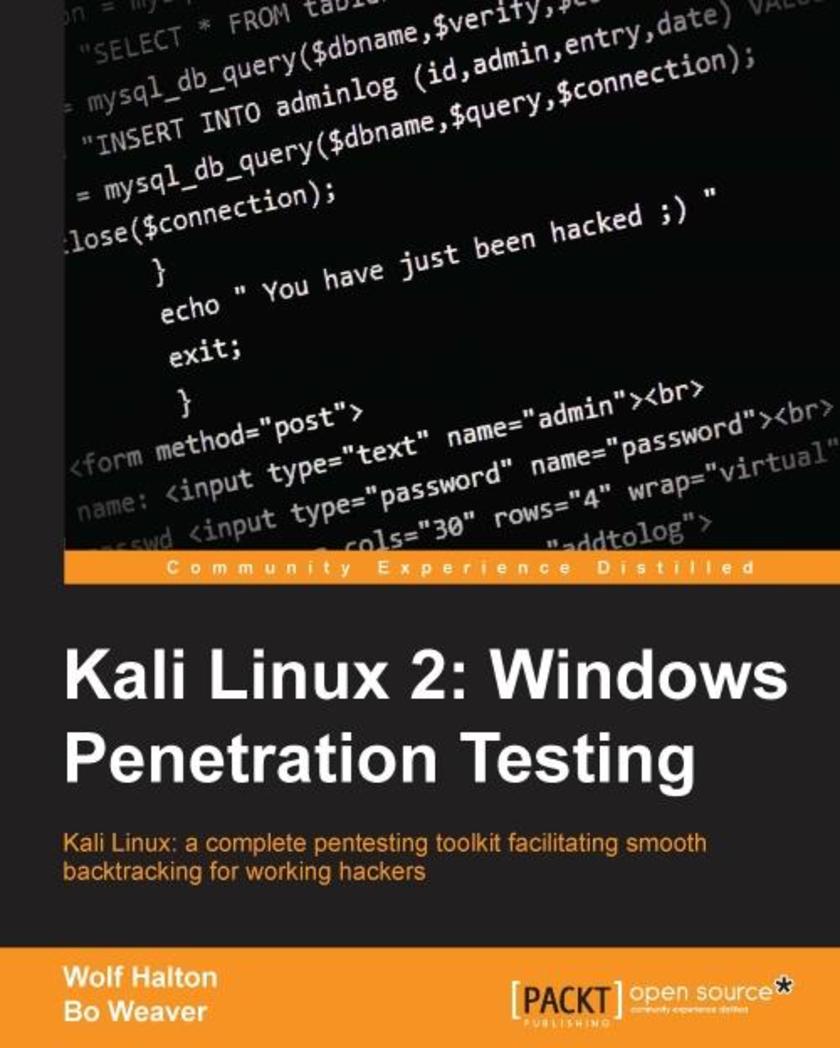
Kali Linux 2: Windows Penetration Testing
¥90.46
Kali Linux: a complete pentesting toolkit facilitating smooth backtracking for working hackers About This Book Conduct network testing, surveillance, pen testing and forensics on MS Windows using Kali Linux Footprint, monitor, and audit your network and investigate any ongoing infestations Customize Kali Linux with this professional guide so it becomes your pen testing toolkit Who This Book Is For If you are a working ethical hacker who is looking to expand the offensive skillset with a thorough understanding of Kali Linux, then this is the book for you. Prior knowledge about Linux operating systems and the BASH terminal emulator along with Windows desktop and command line would be highly beneficial. What You Will Learn Set up Kali Linux for pen testing Map and enumerate your Windows network Exploit several common Windows network vulnerabilities Attack and defeat password schemes on Windows Debug and reverse-engineer Windows programs Recover lost files, investigate successful hacks and discover hidden data in innocent-looking files Catch and hold admin rights on the network, and maintain backdoors on the network after your initial testing is done In Detail Microsoft Windows is one of the two most common OS and managing its security has spawned the discipline of IT security. Kali Linux is the premier platform for testing and maintaining Windows security. Kali is built on the Debian distribution of Linux and shares the legendary stability of that OS. This lets you focus on using the network penetration, password cracking, forensics tools and not the OS. This book has the most advanced tools and techniques to reproduce the methods used by sophisticated hackers to make you an expert in Kali Linux penetration testing. First, you are introduced to Kali's top ten tools and other useful reporting tools. Then, you will find your way around your target network and determine known vulnerabilities to be able to exploit a system remotely. Next, you will prove that the vulnerabilities you have found are real and exploitable. You will learn to use tools in seven categories of exploitation tools. Further, you perform web access exploits using tools like websploit and more. Security is only as strong as the weakest link in the chain. Passwords are often that weak link. Thus, you learn about password attacks that can be used in concert with other approaches to break into and own a network. Moreover, you come to terms with network sniffing, which helps you understand which users are using services you can exploit, and IP spoofing, which can be used to poison a system's DNS cache. Once you gain access to a machine or network, maintaining access is important. Thus, you not only learn penetrating in the machine you also learn Windows privilege’s escalations. With easy to follow step-by-step instructions and support images, you will be able to quickly pen test your system and network. Style and approach This book is a hands-on guide for Kali Linux pen testing. This book will provide all the practical knowledge needed to test your network's security using a proven hacker's methodology. The book uses easy-to-understand yet professional language for explaining concepts.


