


 购物车
购物车 个人中心
个人中心

Deadly Storms
¥97.69
This series of nonfiction readers will grab a student's interest from the very first page! Designed with struggling readers in mind, these riveting 92-page books offer short chapters on significant disasters. Each chapter is its own mini-book, which includes a timeline, key terms, and interesting facts. Fascinating black and white photographs keep the pages turning. A bibliography encourages further topical reading. Disasters are inherently frightening, riveting, and involving. Grabbed straight from the headlines, these disasters leave tragedy, destruction, and years of anguish: Cyclones, Hurricanes, Tornadoes, The Perfect Storm, Hurricane Katrina, and more.

Terrorism
¥97.69
This series of nonfiction readers will grab a student's interest from the very first page! Designed with struggling readers in mind, these riveting 92-page books offer short chapters on significant disasters. Each chapter is its own mini-book, which includes a timeline, key terms, and interesting facts. Fascinating black and white photographs keep the pages turning. A bibliography encourages further topical reading. Disasters are inherently frightening, riveting, and involving. Grabbed straight from the headlines, these disasters leave tragedy, destruction, and years of anguish: The Munich Massacre, Sara Jane Olson, The Achille Lauro, The Unabomber, Oklahoma City, 9/11, The London Underground, and more.
The Dolorous Passion of Our Lord Jesus Christ
¥8.09
According to Wikipedia: "The Roman Catholic Church, officially known as the Catholic Church is the world's largest Christian church, representing over half of all Christians and one-sixth of the world's population. The Catholic Church is a communion of 23 sui juris particular churches. Among these are the Western Rite (Latin Rite) and Eastern Catholic Churches comprising 2,782 dioceses. The Church's highest earthly authority in matters of faith, morality and Church governance is the pope, currently Benedict XVI who holds supreme authority over the Church in concert with the College of Bishops, of which he is the head. The community is made up of an ordained ministry and the laity; members of either group may belong to organized religious communities."

Apologia Pro Vita Sua
¥8.09
According to Wikipedia: "Apologia Pro Vita Sua (Latin: A defense of his life) is the classic defense by John Henry Newman of his religious opinions, published in 1864 in response to what he saw as an unwarranted attack on him, the Catholic priesthood, and Roman Catholic doctrine by Charles Kingsley. The work quickly became a bestseller and has remained in print to this day. The work was tremendously influential in turning public opinion for Newman, and in establishing him as one of the foremost exponents of Catholicism in England....Venerable John Henry Newman, CO (21 February 1801 – 11 August 1890) was a Roman Catholic priest and Cardinal who converted to Roman Catholicism from Anglicanism in October 1845. In early life, he was a major figure in the Oxford Movement to bring the Church of England back to its Catholic roots. Eventually his studies in history persuaded him to become a Roman Catholic. Both before and after becoming a Roman Catholic, he wrote a number of influential books, including Via Media, Essay on the Development of Christian Doctrine (1845), Apologia Pro Vita Sua (1865-66) and the Grammar of Assent (1870)."
The Tao Teh King or The Tao
¥8.09
According to Wikipedia: "The Tao Te Ching, Dao De Jing, or Daodejing, also simply referred to as the Laozi, is a Chinese classic text. According to tradition, it was written around the 6th century BC by the sage Laozi (or Lao Tzu, "Old Master"), a record-keeper at the Zhou Dynasty court, by whose name the text is known in China. The text's true authorship and date of composition or compilation are still debated, although the oldest excavated text dates back to the late 4th century BC. The text is fundamental to both philosophical and religious Taoism and strongly influenced other schools, such as Legalism, Confucianism and Chinese Buddhism, which when first introduced into China was largely interpreted through the use of Daoist words and concepts. Many Chinese artists, including poets, painters, calligraphers, and even gardeners have used the Daodejing as a source of inspiration. Its influence has also spread widely outside East Asia, and is amongst the most translated works in world literature."
True Evangelism or Winning Souls by Prayer
¥8.09
According to Wikipedia: "Lewis Sperry Chafer (February 27, 1871 – August 22, 1952) was the founder and first president of Dallas Theological Seminary, and an influential founding member of modern Christian Dispensationalism.
He That Is Spiritual
¥8.09
According to Wikipedia: "Lewis Sperry Chafer (February 27, 1871 – August 22, 1952) was the founder and first president of Dallas Theological Seminary, and an influential founding member of modern Christian Dispensationalism.
Nero
¥8.09
According to Wikipedia: "Jacob Abbott (November 14, 1803 – October 31, 1879) was an American writer of children's books. Abbott was born at Hallowell, Maine to Jacob and Betsey Abbott. He graduated from Bowdoin College in 1820; studied at Andover Theological Seminary in 1821, 1822, and 1824; was tutor in 1824-1825, and from 1825 to 1829 was professor of mathematics and natural philosophy at Amherst College; was licensed to preach by the Hampshire Association in 1826; founded the Mount Vernon School for Young Ladies in Boston in 1829, and was principal of it in 1829-1833; was pastor of Eliot Congregational Church (which he founded), at Roxbury, Massachusetts in 1834-1835; and was, with his brothers, a founder, and in 1843-1851 a principal of Abbott's Institute, and in 1845-1848 of the Mount Vernon School for Boys, in New York City. He was a prolific author, writing juvenile fiction, brief histories, biographies, religious books for the general reader, and a few works in popular science. He died in Farmington, Maine, where he had spent part of his time after 1839, and where his brother, Samuel Phillips Abbott, founded the Abbott School."
Laughter: an Essay on the Meaning of the Comic
¥8.09
According to Wikipedia: "In the idiosyncratic Laughter: An Essay on the Meaning of the Comic, Bergson develops a theory not of laughter itself, but of how laughter can be provoked (see his objection to Delage, published in the 23rd edition of the essay). He describes the process of laughter (refusing to give a conceptual definition which would not approach its reality), used in particular by comics and clowns, as the caricature of the mechanism nature of humans (habits, automatic acts, etc.), one of the two tendencies of life (degradation towards inert matter and mechanism, and continual creation of new forms). However, Bergson warns us that laughter’s criterion of what should be laughed at is not a moral criterion and that it can in fact cause serious damage to a person’s self-esteem.This essay made his opposition to the Cartesian theory of the animal-machine obvious."
The Interest of America in Sea Power
¥8.09
Classic work of military history and theory. According to Wikipedia: "Alfred Thayer Mahan (September 27, 1840 - December 1, 1914) was a United States Navy officer, geostrategist, and educator. His ideas on the importance of sea power influenced navies around the world, and helped prompt naval buildups before World War I. Several ships were named USS Mahan, including the lead vessel of a class of destroyers. His research into naval History led to his most important work, The Influence of Seapower Upon History,1660-1783, published in 1890."
Sayings of the Jewish Fathers: Pirke Abot
¥8.09
Volume 3 of the Library of Jewish Classics. From the Preface: "Notwithstanding the fact that there are many editions of the Sayings of the Jewish Fathers, and that it has been translated innumerable times in all modern tongues, no apology need be given for the appearance of this little volume in the series of Jewish Classics. The Pirke Abot is indeed a classical bit of that ancient Jewish classic, the Mishnah. The translation in this edition is based largely upon that of Taylor, in his Sayings of the Jewish Fathers, and upon the excellent version of Singer, in his Authorized Daily Prayer Book."
The History of Rome
¥8.09
Literally translated, first published in 1853. According to Wikipedia: "Livy's work met with instant acclaim. His books were published in sets of ten, although when entirely completed, his whole work was available for sale in its entirety. His highly literary approach to his historical writing renders his works very entertaining, and they remained constantly popular from his own day, through the Middle Ages, and into the modern world. Dante speaks highly of him in his poetry, and Francis I of France commissioned extensive artwork treating Livian themes. That he was chosen by Rome's first emperor to be the private tutor to his successor indicates Livy's renown as a great writer and sage. As topics from his history appear to have been used for writing topics in Roman schools, it is more than likely that his works, or sections, were used as textbooks... He can be looked upon as the prose counterpart of Vergil in Golden Age Latin literature."
A Footnote to History
¥8.09
According to Wikipedia: "Robert Louis (Balfour) Stevenson ( 1850 - 1894), was a Scottish novelist, poet, and travel writer, and a leading representative of Neo-romanticism in English literature. He was the man who "seemed to pick the right word up on the point of his pen, like a man playing spillikins", as G. K. Chesterton put it. He was also greatly admired by many authors, including Jorge Luis Borges, Ernest Hemingway, Rudyard Kipling, Vladimir Nabokov, and J. M. Barrie. Most modernist writers dismissed him, however, because he was popular and did not write within their definition of modernism. It is only recently that critics have begun to look beyond Stevenson's popularity and allow him a place in the canon."
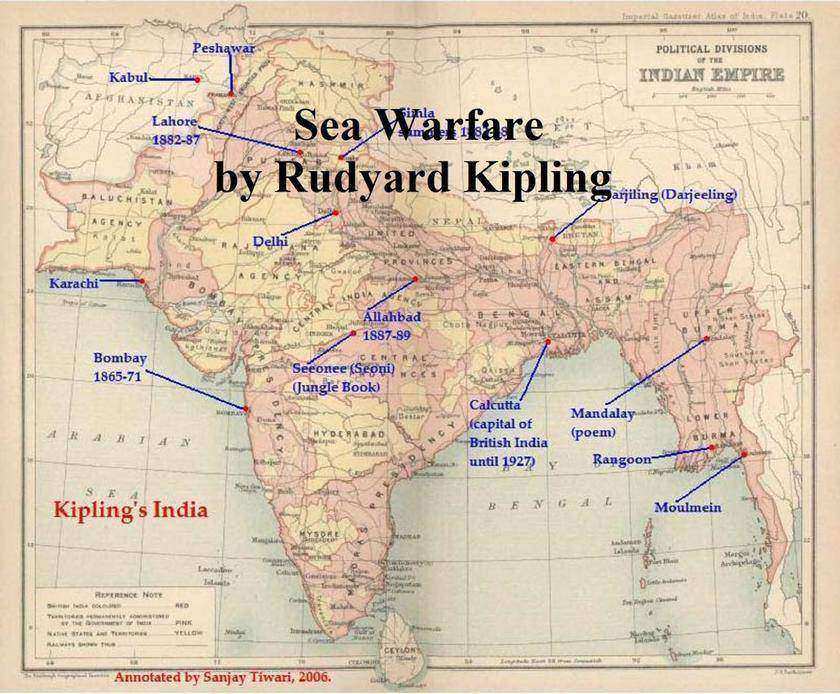
Sea Warfare
¥8.09
Overview of the British Navy, up through World War I. According to Wikipedia: "Joseph Rudyard Kipling (1865 – 1936) was an English author and poet. Born in Bombay, British India (now Mumbai), he is best known for his works The Jungle Book (1894) and Rikki-Tikki-Tavi (1902), his novel, Kim (1901); his poems, including Mandalay (1890), Gunga Din (1890), If— (1910); and his many short stories, including The Man Who Would Be King (1888). He is regarded as a major "innovator in the art of the short story"; his children's books are enduring classics of children's literature; and his best works speak to a versatile and luminous narrative gift. Kipling was one of the most popular writers in English, in both prose and verse, in the late 19th and early 20th centuries.[2] The author Henry James said of him: "Kipling strikes me personally as the most complete man of genius (as distinct from fine intelligence) that I have ever known." In 1907, he was awarded the Nobel Prize in Literature, making him the first English language writer to receive the prize, and to date he remains its youngest recipient. Among other honours, he was sounded out for the British Poet Laureateship and on several occasions for a knighthood, all of which he declined.
The Gulf and Inland Waters
¥8.09
Classic work of American history. According to Wikipedia: "Alfred Thayer Mahan (September 27, 1840 - December 1, 1914) was a United States Navy officer, geostrategist, and educator. His ideas on the importance of sea power influenced navies around the world, and helped prompt naval buildups before World War I. Several ships were named USS Mahan, including the lead vessel of a class of destroyers. His research into naval History led to his most important work, The Influence of Seapower Upon History,1660-1783, published in 1890."
The Major Operations of the Navies in the War of American Independence
¥8.09
Classic work of American history. According to Wikipedia: "Alfred Thayer Mahan (September 27, 1840 - December 1, 1914) was a United States Navy officer, geostrategist, and educator. His ideas on the importance of sea power influenced navies around the world, and helped prompt naval buildups before World War I. Several ships were named USS Mahan, including the lead vessel of a class of destroyers. His research into naval History led to his most important work, The Influence of Seapower Upon History,1660-1783, published in 1890."
The Rise of the New West 1819-1829
¥8.09
Classic work of American history. According to Wikipedia: "Frederick Jackson Turner (November 14, 1861 - March 14, 1932) is widely regarded, along with Charles A. Beard, as one of the two most influential American historians of the early 20th century. He is best known for The Significance of the Frontier in American History."
Leviathan, Or the Matter, Forme, and Power of a Common-Wealth Ecclesiastical and
¥8.09
First published in 1651, a classic of political science. According to Wikipedia: "Thomas Hobbes (1588 – 1679) was an English philosopher, remembered today for his work on political philosophy. His 1651 book Leviathan established the foundation for most of Western political philosophy from the perspective of social contract theory. Hobbes also contributed to a diverse array of fields, including history, geometry, physics of gases, theology, ethics, general philosophy, and political science. His account of human nature as self-interested cooperation has proved to be an enduring theory in the field of philosophical anthropology."
Aristotle: Poetics, Ethics, Politics, and Categories
¥8.09
This file includes four books: Poetics, Ethics, Politics, and Categories. According to Wikipedia: "Aristotle (384 BC – 322 BC)[1] was a Greek philosopher and polymath, a student of Plato and teacher of Alexander the Great. His writings cover many subjects, including physics, metaphysics, poetry, theater, music, logic, rhetoric, linguistics, politics, government, ethics, biology, and zoology. Together with Plato and Socrates (Plato's teacher), Aristotle is one of the most important founding figures in Western philosophy. Aristotle's writings were the first to create a comprehensive system of Western philosophy, encompassing morality, aesthetics, logic, science, politics, and metaphysics."
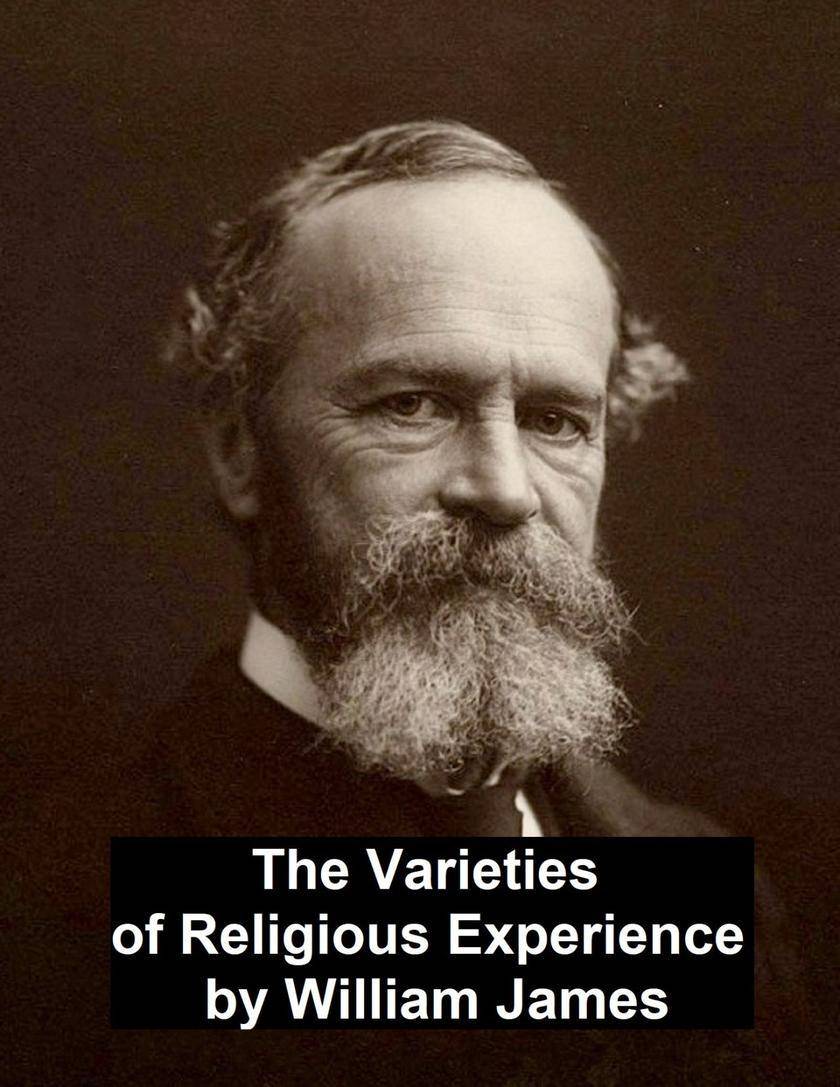
The Varieties of Religious Experience
¥8.09
The psychology of religious belief. "If the inquiry be psychological, not religious institutions, but rather religious feelings and religious impulses must be its subject, and I must confine myself to those more developed subjective phenomena recorded in literature produced by articulate and fully self-conscious men, in works of piety and autobiography." According to Wikipedia: "William James (1842 – 1910) was a pioneering American psychologist and philosopher trained as a medical doctor. He wrote influential books on the young science of psychology, educational psychology, psychology of religious experience and mysticism, and the philosophy of pragmatism. He was the brother of novelist Henry James and of diarist Alice James. William James was born at the Astor House in New York City. He was the son of Henry James Sr., an independently wealthy and notoriously eccentric Swedenborgian theologian well acquainted with the literary and intellectual elites of his day. The intellectual brilliance of the James family milieu and the remarkable epistolary talents of several of its members have made them a subject of continuing interest to historians, biographers, and critics."
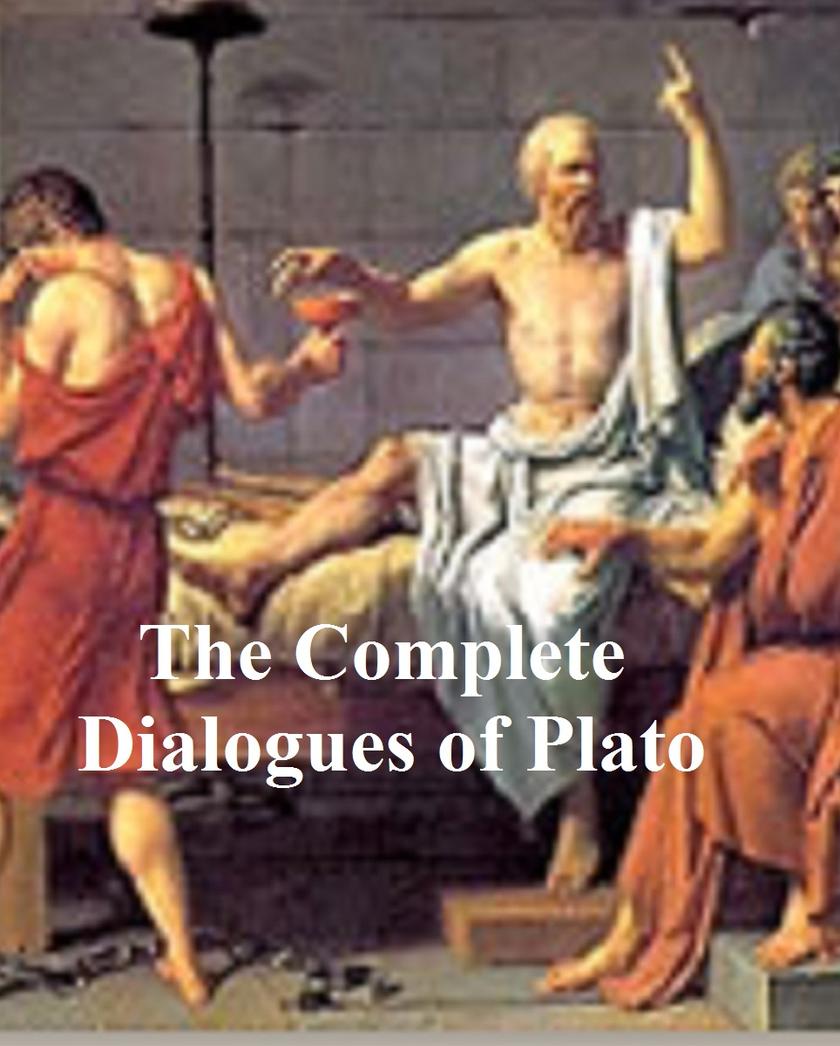
The Complete Dialogues of Plato
¥8.09
This book-collection file includes all 26 dialogues: Apology, Charmides (and preface to the collection), Cratylus, Critias, Crito, Euthyphro, Euthydemus, Gorgias, Ion, Laches, Laws, Lesser Hippias, Lysis, Menexus, Meno, Parmenides, Phaedo, Phaedrus, Philebus, Protagoras, Republic, Sophist, Statesman, Symposium, Theaetetus, and Timaeus. The Jowett translation. According to Wikipedia: "Plato (428/427 BC[a] – 348/347 BC), was a Classical Greek philosopher, who, together with his mentor, Socrates, and his student, Aristotle, helped to lay the foundations of Western philosophy.[2] Plato was also a mathematician, writer of philosophical dialogues, and founder of the Academy in Athens, the first institution of higher learning in the western world. Plato was originally a student of Socrates, and was as much influenced by his thinking as by what he saw as his teacher's unjust death."


