


 购物车
购物车 个人中心
个人中心
Laughter: an Essay on the Meaning of the Comic
¥8.09
According to Wikipedia: "In the idiosyncratic Laughter: An Essay on the Meaning of the Comic, Bergson develops a theory not of laughter itself, but of how laughter can be provoked (see his objection to Delage, published in the 23rd edition of the essay). He describes the process of laughter (refusing to give a conceptual definition which would not approach its reality), used in particular by comics and clowns, as the caricature of the mechanism nature of humans (habits, automatic acts, etc.), one of the two tendencies of life (degradation towards inert matter and mechanism, and continual creation of new forms). However, Bergson warns us that laughter’s criterion of what should be laughed at is not a moral criterion and that it can in fact cause serious damage to a person’s self-esteem.This essay made his opposition to the Cartesian theory of the animal-machine obvious."
Commentaries
¥8.09
This is a collection of Calvin's Commentaries -- a large collection, about four times the size of a typical novel. According to Wikipedia: "John Calvin (né Jean Cauvin; 10 July 1509 – 27 May 1564) was an influential French theologian and pastor during the Protestant Reformation. He was a principal figure in the development of the system of Christian theology later called Calvinism. Originally trained as a humanist lawyer, he suddenly converted and broke from the Roman Catholic Church in the 1520s. After a violent uprising against Protestants in France, he was forced to flee to Basel, Switzerland, where in 1536 he published the first edition of his seminal work, Institutes of the Christian Religion. Calvin was invited by William Farel to help reform the church in Geneva. However, the city council resisted the implementation of Calvin and Farel's ideas and both were expelled. At the invitation of Martin Bucer, Calvin proceeded to Strasbourg where he became the minister of a church of French refugees. He continued to support the reform movement in Geneva, and was eventually invited back to lead its church. Following his return he introduced new forms of church government and liturgy, despite the opposition of several powerful families in the city who tried to curb his authority. During this period, Michael Servetus, a Spaniard known for his heretical views, arrived in Geneva. He was denounced by Calvin and executed by the city council. Following an influx of supportive refugees and new elections to the council, Calvin's opponents were forced out. He spent his final years promoting the Reformation both within Geneva and throughout Europe."
History of a Plague in London
¥8.09
The Introduction begins: "The father of Daniel Defoe was a butcher in the paris h of St. Giles's, Cripplegate, London. In this parish, probably, Daniel Defoe was born in 1661, the year after the restoration of Charles II. The boy's parents wished him to become a dissenting minister, and so intrusted his education to a Mr. Morton who kept an academy for the training of nonconformist divines. How long Defoe staid at this school is not known. He seems to think himself that he staid there long enough to become a good scholar; for he declares that the pupils were "made masters of the English tongue, and more of them excelled in that particular than of any school at that time." If this statement be true, we can only say that the other schools must have been very bad indeed. Defoe never acquired a really good style, and can in no true sense be called a "master of the English tongue."
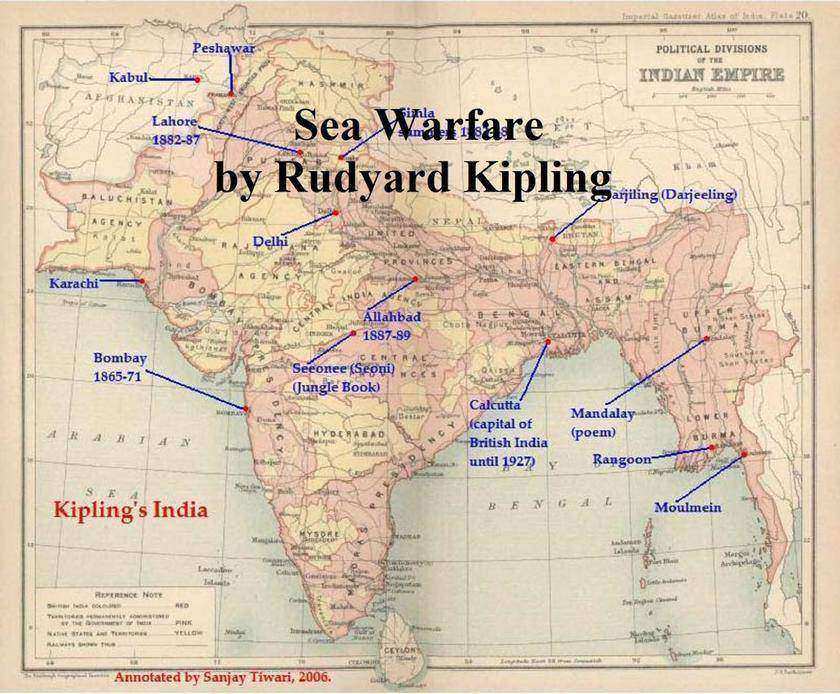
Sea Warfare
¥8.09
Overview of the British Navy, up through World War I. According to Wikipedia: "Joseph Rudyard Kipling (1865 – 1936) was an English author and poet. Born in Bombay, British India (now Mumbai), he is best known for his works The Jungle Book (1894) and Rikki-Tikki-Tavi (1902), his novel, Kim (1901); his poems, including Mandalay (1890), Gunga Din (1890), If— (1910); and his many short stories, including The Man Who Would Be King (1888). He is regarded as a major "innovator in the art of the short story"; his children's books are enduring classics of children's literature; and his best works speak to a versatile and luminous narrative gift. Kipling was one of the most popular writers in English, in both prose and verse, in the late 19th and early 20th centuries.[2] The author Henry James said of him: "Kipling strikes me personally as the most complete man of genius (as distinct from fine intelligence) that I have ever known." In 1907, he was awarded the Nobel Prize in Literature, making him the first English language writer to receive the prize, and to date he remains its youngest recipient. Among other honours, he was sounded out for the British Poet Laureateship and on several occasions for a knighthood, all of which he declined.
History of the Revolt in the Netherlands
¥8.09
The prequel to the American Revolution. This struggle for political and religious freedom inspired America's Founding Fathers. Schiller tells the tale with a novelist's insight into character. According to Wikipedia: "Johann Christoph Friedrich von Schiller (1759 – 1805) was a German poet, philosopher, historian, and dramatist. During the last few years of his life (1788–1805), Schiller struck up a productive, if complicated, friendship with already famous and influential Johann Wolfgang Goethe, with whom he greatly discussed issues concerning aesthetics, encouraging Goethe to finish works he left merely as sketches; this thereby gave way to a period now referred to as Weimar Classicism."
Pragmatism:A New Name for Some Old Ways of Thinking
¥8.09
A profoundly influential figure in American psychology, William James (1842–1910) was also a philosopher of note, who used Charles S. Peirce's theories of pragmatism as a basis for his own conception of that influential philosophy. For James, this meant an emphasis on "radical empiricism" and the concept that the meaning of any idea — philosophical, political, social, or otherwise — has validity only in terms of its experiential and practical consequences. James propounded his theories of pragmatism in this book, one of the most important in American philosophy. In a sense, he wished to test competing systems of thought in the "marketplace of actual experience" to determine their validity, i.e. whether adopting a particular philosophical theory or way of looking at the world makes an actual difference in individual conduct or in how we perceive and react to the varieties of experience. In these pages, James not only makes a strong case for his own ideas, but mounts a powerful attack against the transcendental and rationalist tradition. For anyone interested in William James or the history of American philosophical thought, Pragmatism is an essential and thought provoking reference. In this handy, inexpensive edition, it will challenge and stimulate any thinking person.
The Great Pestilence
¥8.09
According to Wikipedia: "The Black Death was one of the most devastating pandemics in human history, resulting in the deaths of an estimated 75 to 200 million people and peaking in Europe in the years 1346–53. Although there were several competing theories as to the etiology of the Black Death, analysis of DNA from victims in northern and southern Europe published in 2010 and 2011 indicates that the pathogen responsible was the Yersinia pestis bacterium, probably causing several forms of plague. The Black Death is thought to have originated in the arid plains of central Asia, where it then travelled along the Silk Road, reaching the Crimea by 1346.[citation needed][6] From there, it was most likely carried by Oriental rat fleas living on the black rats that were regular passengers on merchant ships. Spreading throughout the Mediterranean and Europe, the Black Death is estimated to have killed 30–60% of Europe's total population. All in all, the plague reduced the world population from an estimated 450 million down to 350–375 million in the 14th century. The aftermath of the plague created a series of religious, social, and economic upheavals, which had profound effects on the course of European history. It took 150 years for Europe's population to recover. The plague recurred occasionally in Europe until the 19th century."
The Path of the King
¥8.09
The Path of the King is a travel through historic events that traces a band of gold as it is passed from a young Viking to Abraham Lincoln. The following is a quotation from its original publication (AL BURT COMPANY PUBLISHERS, 1921): "We wonder that so great a man as Abraham Lincoln should spring from humble people but who knows what his more distant ancestry might have been In a series of dramatic chapters Mr Buchan tells what he imagines to have been the ancestry of Lincoln The worthy son of a northern chieftain who had come down with his people into Normandy, a Norman knight who fought under Duke William and settled in England, a French knight emissary of Saint Louis to Kubla Khan, a proud demoiselle friend to Jeanne d Arc, a French gentleman who went with Columbus on his second voyage, an avenger of Saint Bartholomew's Day, a friend to Sir Walter Raleigh, a supporter of Cromwell, a soldier of fortune under Marlborough, a mighty hunter in Virginia, all these says Mr Buchan were Lincoln's forebears Their blood ran in his veins and made him in James Russell Lowell's phrase the last of the kings." According to Wikipedia, "John Buchan, 1st Baron Tweedsmuir (26 August 1875 – 11 February 1940) was a Scottish novelist and Unionist politician who served as Governor General of Canada. Buchan's 100 works include nearly thirty novels, seven collections of short stories and biographies of Sir Walter Scott, Caesar Augustus, and Oliver Cromwell. Buchan's most famous of his books were the spy thrillers (including) The 39 Steps (which was converted to a play as well as an Alfred Hitchcock movie starring Robert Donat as Richard Hannay, though with Buchan's story much altered.) The "last Buchan" (as Graham Greene entitled his appreciative review) was the 1941 novel Sick Heart River (American title: Mountain Meadow), in which a dying protagonist confronts in the Canadian wilderness the questions of the meaning of life. The insightful quotation "It's a great life, if you don't weaken" is famously attributed to Buchan, as is "No great cause is ever lost or won, The battle must always be renewed, And the creed must always be restated."
The Germany and the Agricola of Tacitus
¥8.09
According to Wikipedia: "Publius (or Gaius) Cornelius Tacitus (AD 56 – AD 117) was a senator and a historian of the Roman Empire. The surviving portions of his two major works—the Annals and the Histories—examine the reigns of the Roman Emperors Tiberius, Claudius, Nero and those who reigned in the Year of the Four Emperors. These two works span the history of the Roman Empire from the death of Augustus in AD 14 to (presumably) the death of emperor Domitian in AD 96. There are enormous lacunae in the surviving texts, including one four books long in the Annals. Other works by Tacitus discuss oratory (in dialogue format, see Dialogus de oratoribus), Germania (in De origine et situ Germanorum), and biographical notes about his father-in-law Agricola, primarily during his campaign in Britannia (see De vita et moribus Iulii Agricolae)."
The Consolation of Philosophy
¥8.09
According to Wikipedia: "Anicius Manlius Severinus Bo?thius,commonly called Boethius (ca. 480–524 or 525 AD) was a philosopher of the early 6th century. He was born in Rome to an ancient and prominent family which included emperors Petronius Maximus and Olybrius and many consuls... Boethius was imprisoned and eventually executed by King Theodoric the Great, who suspected him of conspiring with the Eastern Roman Empire. While jailed, Boethius composed his Consolation of Philosophy, a philosophical treatise on fortune, death, and other issues. The Consolation became one of the most popular and influential works of the Middle Ages."
Bhagavad-Gita
¥8.09
"Being a discourse between Arjuna, Prince of India, and the Supreme Being under the form of Krishna". This translation first published in 1900. According to Wikipedia: "The Bhagavad Gītā, also more simply known as Gita, is a 700-verse Hindu scripture that is part of the ancient Hindu epic, the Mahabharata, but is frequently treated as a freestanding text, and in particular, as an Upanishad in its own right, one of the several books that comprise the more general Vedic tradition. It is revealed scripture in the views of Hindus, the scripture for Hindus represents the words and message of god, the book is considered among the most important texts in the history of literature and philosophy... Sir Edwin Arnold CSI CIE (10 June 1832 – 24 March 1904) was an English poet and journalist, who is most known for his work, The Light of Asia."
Dhammapada
¥8.09
According to Wikipedia: "The Dhammapada is a versified Buddhist scripture traditionally ascribed to the Buddha himself. It is one of the best-known texts from the Theravada canon. The title, Dhammapada, is a compound term composed of dhamma and pada, each word having a number of denotations and connotations. Generally, dhamma can refer to the Buddha's "doctrine" or an "eternal truth" or "righteousness" or all "phenomena"; and, at its root, pada means "foot" and thus by extension, especially in this context, means either "path" or "verse" (cf. "prosodic foot") or both."
Dharma Sutras
¥8.09
According to Wikipedia: "The Dharmasutras are Sanskrit texts dealing with custom, rituals and law. They include the four surviving written works of the ancient Indian tradition on the subject of dharma, or the rules of behavior recognized by a community. Unlike the later Dharmashastra, the dharmasutras are composed in prose. The oldest Dharmasutra is generally believed to have been that of Apastamba, followed by the dharmasutras of Gautama, Baudhayana, and an early version of Vasishtha. It is difficult to determine exact dates for these texts, but the dates between 500–300 BCE have been suggested for the oldest Dharmasutras."
Aristotle: Poetics, Ethics, Politics, and Categories
¥8.09
This file includes four books: Poetics, Ethics, Politics, and Categories. According to Wikipedia: "Aristotle (384 BC – 322 BC)[1] was a Greek philosopher and polymath, a student of Plato and teacher of Alexander the Great. His writings cover many subjects, including physics, metaphysics, poetry, theater, music, logic, rhetoric, linguistics, politics, government, ethics, biology, and zoology. Together with Plato and Socrates (Plato's teacher), Aristotle is one of the most important founding figures in Western philosophy. Aristotle's writings were the first to create a comprehensive system of Western philosophy, encompassing morality, aesthetics, logic, science, politics, and metaphysics."
Afghanistan
¥8.09
First published in the 19th century. Written by a brigadier general from the U.S. The book begins: "In universal history there is no more interesting subject for the consideration of the political student than the record of Russian progress through Central Asia. In one sense this advance is a practical reestablishment or extension of the influence of the Aryan race in countries long dominated by peoples of Turki or Mongolian origin; in another sense it has resulted in a transition from the barbarism or rude forms of Asiatic life to the enlightenment and higher moral development of a European age. In a religious sense it embodies a crusade against Oriental fanaticism; and it is a curious feature of the Anglo-Russian dispute, that upon a question of temporal gain, the greatest Christian nation finds itself allied with the followers of Buddha and Mahomet against Russia under the Banner of the Cross."
British Political Leaders
¥8.09
First published in 1903. Biographies of Balfour, Lord Salisbury, Lord Rosebery, Chamberlain, Labourchere, Morley, Burns, Hicks-Beach, Redmond,Harcourt, Bryce, Campbell-Bannerman, and the Earl of Aberdeen.
Afghanistan - A Country Study
¥8.09
Based on research completed in 1997. Originally published by the Federal Research Division of the Library of Congress as part of the Country Studies/Area Handbook Series sponsored by the U.S. Department of the Army between 1986 and 1998. Each study offers a comprehensive description and analysis of the country or region's historical setting, geography, society, economy, political system, and foreign policy.

Deadly Storms
¥97.69
This series of nonfiction readers will grab a student's interest from the very first page! Designed with struggling readers in mind, these riveting 92-page books offer short chapters on significant disasters. Each chapter is its own mini-book, which includes a timeline, key terms, and interesting facts. Fascinating black and white photographs keep the pages turning. A bibliography encourages further topical reading. Disasters are inherently frightening, riveting, and involving. Grabbed straight from the headlines, these disasters leave tragedy, destruction, and years of anguish: Cyclones, Hurricanes, Tornadoes, The Perfect Storm, Hurricane Katrina, and more.

Terrorism
¥97.69
This series of nonfiction readers will grab a student's interest from the very first page! Designed with struggling readers in mind, these riveting 92-page books offer short chapters on significant disasters. Each chapter is its own mini-book, which includes a timeline, key terms, and interesting facts. Fascinating black and white photographs keep the pages turning. A bibliography encourages further topical reading. Disasters are inherently frightening, riveting, and involving. Grabbed straight from the headlines, these disasters leave tragedy, destruction, and years of anguish: The Munich Massacre, Sara Jane Olson, The Achille Lauro, The Unabomber, Oklahoma City, 9/11, The London Underground, and more.
Cold Cases
¥97.69
Bursting with facts, these books will truly enthrall struggling readers. Nonfiction titles cover high-interest topics both creepy and utterly terrifying. Each title is thoroughly researched and includes an introduction, five chapters, an epilogue, glossary, and index. On-the-scene photography captures students' imagination and spurs further reading. These are books that struggling readers will not put down! This title explores highly publicized cold cases when will justice be served? The five chapters describe the lives of Chandra Levy, JonBenet Ramsey, Natalee Holloway, Jam Master Jay, and engaged couple Lindsay Cutshall and Jason Allen.
The Glory of the Trenches
¥8.09
In 1914, Coningsby Dawson went to Ottawa, saw Sir Sam Hughes, and was offered a commission in the Canadian Field Artillery on the completion of his training at the Royal Military College of Canada, at Kingston, Ontario. "His long training at Kingston had been very severe. It included besides the various classes which he attended a great deal of hard exercise, long rides or foot marches over frozen roads before breakfast, and so forth."


