


 购物车
购物车 个人中心
个人中心
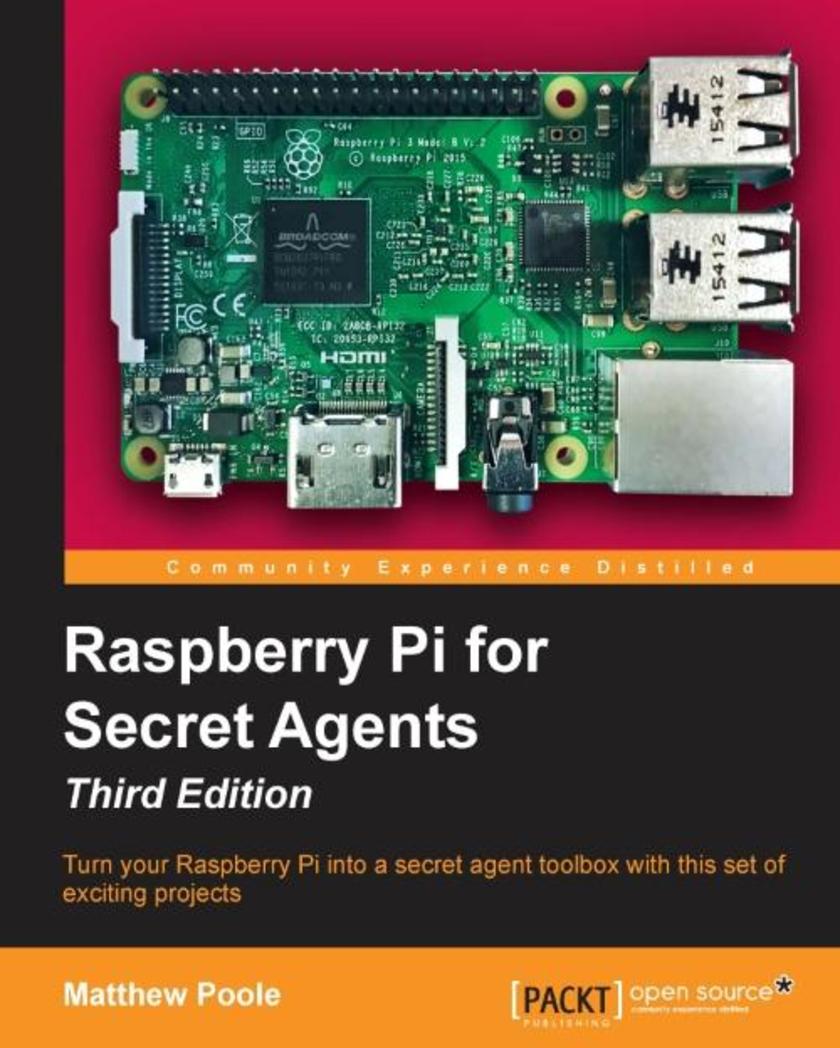
Raspberry Pi for Secret Agents - Third Edition
¥63.21
Turn your Raspberry Pi into a secret agent toolbox with this set of exciting projects About This Book Turn your Raspberry Pi into a multi-purpose secret agent gadget for audio and video surveillance, Wi-Fi exploration, or playing pranks on your friends Detect an intruder on camera or with sensors and set off an alarm or receive messages to your phone Find out what the other computers on your network are up to and make yourself anonymous on the Internet This book has been updated for new additions to your toolkit featuring the tiny, recently released Raspberry Pi Zero board Who This Book Is For This book is for those who are new to the Raspberry Pi Zero ,Raspberry Pi 2 or Raspberry Pi 3 and have some experience with the original Raspberry Pi models, and even for those budding secret agents who would like to use Pi Zero as a secret agent toolbox. No programming experience is assumed. Suitable for the novice and expert alike, each topic provides a fast and easy way to get started with exciting applications, with practical examples in every chapter. What You Will Learn Install and configure the Raspbian Jessie operating system for maximum mischief Detect an intruder with motion detection or a laser trip wire and set off an alarm Listen in to conversations from a distance over Bluetooth Distort your voice in weird and wonderful ways Track the Pi's whereabouts using GPS Connect your Pi to the mobile Internet using a 3G dongle and make yourself anonymous on the net Display secret messages and codes to fellow agents on a LED display In Detail This book is for all mischievous Raspberry Pi owners who’d like to see their computer transform into a neat spy gadget to be used in a series of practical pranks and projects. No previous skills are required to follow along, and if you’re completely new to Linux, you’ll pick up much of the basics for free. We’ll help you set up your Raspberry Pi Zero , Raspberry Pi 2 and Raspberry Pi 3 and guide you through a number of pranks and secret agent techniques that are so inconspicuous yet high on mischief. You’ll learn how to configure your operating system for maximum mischief and start exploring audio, video, or Wi-Fi techniques. We’ll show you how to record, listen, or talk to people from a distance and how to set up your own phone network. Then, you’ll plug in your webcam and set up a motion detector with an alarm and find out what the other computers on your Wi-Fi network are up to. Once you've mastered the techniques, we’ll combine them with a battery pack and GPS for the ultimate off-road spy kit. Style and Approach This easy-to-follow guide is for budding secret agents who want to create tools for mischief, stealth, and reconnaissance. It’s full of fun, practical examples and easy-to-follow recipes, guaranteeing maximum mischief for all skill levels.
Mastering FreeSWITCH
¥80.65
Master the art of advanced VoIP and WebRTC communication with the most dynamic application server, FreeSWITCH About This Book Forget the hassle - make FreeSWITCH work for you Discover how FreeSWITCH integrates with a range of tools and APIs From high availability to IVR development use this book to become more confident with this useful communication software Who This Book Is For SysAdmins, VoIP engineers – whoever you are, whatever you’re trying to do, this book will help you get more from FreeSWITCH. What You Will Learn Get to grips with the core concepts of FreeSWITCH Learn FreeSWITCH high availability Work with SIP profiles, gateways, ITSPs, and Codecs optimization Implement effective security on your projects Master audio manipulation and recording Discover how FreeSWITCH works alongside WebRTC Build your own complex IVR and PBX applications Connect directly to PSTN/TDM Create your own FreeSWITCH module Trace SIP packets with the help of best open source tools Implement Homer Sipcapture to troubleshoot and debug all your platform traffic In Detail FreeSWITCH is one of the best tools around if you’re looking for a modern method of managing communication protocols through a range of different media. From real-time browser communication with the WebRTC API to implementing VoIP (voice over internet protocol), with FreeSWITCH you’re in full control of your projects. This book shows you how to unlock its full potential – more than just a tutorial, it’s packed with plenty of tips and tricks to make it work for you. Written by members of the team who actually helped build FreeSWITCH, it will guide you through some of the newest features of version 1.6 including video transcoding and conferencing. Find out how FreeSWITCH interacts with other tools and APIs, learn how to tackle common (and not so common) challenges ranging from high availability to IVR development and programming advanced PBXs. Great communication functionality begins with FreeSWITCH – find out how and get your project up and running today. Style and approach Find out how it works, then put your knowledge into practice - that's how this advanced FreeSWITCH guide has been designed to help you learn. You'll soon master FreeSWITCH and be confident using it in your projects.
Mastering Social Media Mining with Python
¥80.65
Acquire and analyze data from all corners of the social web with Python About This Book Make sense of highly unstructured social media data with the help of the insightful use cases provided in this guide Use this easy-to-follow, step-by-step guide to apply analytics to complicated and messy social data This is your one-stop solution to fetching, storing, analyzing, and visualizing social media data Who This Book Is For This book is for intermediate Python developers who want to engage with the use of public APIs to collect data from social media platforms and perform statistical analysis in order to produce useful insights from data. The book assumes a basic understanding of the Python Standard Library and provides practical examples to guide you toward the creation of your data analysis project based on social data. What You Will Learn Interact with a social media platform via their public API with Python Store social data in a convenient format for data analysis Slice and dice social data using Python tools for data science Apply text analytics techniques to understand what people are talking about on social media Apply advanced statistical and analytical techniques to produce useful insights from data Build beautiful visualizations with web technologies to explore data and present data products In Detail Your social media is filled with a wealth of hidden data – unlock it with the power of Python. Transform your understanding of your clients and customers when you use Python to solve the problems of understanding consumer behavior and turning raw data into actionable customer insights. This book will help you acquire and analyze data from leading social media sites. It will show you how to employ scientific Python tools to mine popular social websites such as Facebook, Twitter, Quora, and more. Explore the Python libraries used for social media mining, and get the tips, tricks, and insider insight you need to make the most of them. Discover how to develop data mining tools that use a social media API, and how to create your own data analysis projects using Python for clear insight from your social data. Style and approach This practical, hands-on guide will help you learn everything you need to perform data mining for social media. Throughout the book, we take an example-oriented approach to use Python for data analysis and provide useful tips and tricks that you can use in day-to-day tasks.
Windows Server 2016 Hyper-V Cookbook - Second Edition
¥107.90
Save time and resources by getting to know the best practices and intelligence from industry experts About This Book This book helps you gain a fresh perspective through a recipe-based approach on the new Microsoft Server 2016 Hyper-V Over 80 recipes to help you master the administrative tasks of Hyper-V and get to grips with advanced solutions and techniques for virtualization These hands-on advanced recipes will help you deploy, maintain, and upgrade Hyper-V virtual machines Who This Book Is For This book is for Hyper-V administrators who are looking to take advantage of all exciting new features that Microsoft Server 2016 Hyper-V has to offer. What You Will Learn Install and manage Hyper-V in Full, Server Core, and Nano Server Get to know how to migrate and upgrade physical and virtual machines Configure disks, network, memory, security, and auditing settings for virtual machines Take a deep dive into high availability and disaster recovery Save time and money by getting to grips with PowerShell automation Understand the new features around network and nested virtualization, distributed storage QoS, Hyper-V Replica, and much more Gain a full view of your virtual machines and host servers through monitoring, reporting, and troubleshooting tips In Detail Hyper-V is a Windows-based, very cost-effective virtualization solution with easy-to-use and well-known administrative consoles. With this book on your side you will master the worlds of Hyper-V deployment, migration, and management by learning tips, tricks, and best practices, especially when it comes to advanced-level tasks. You will learn how to quickly deploy and automate multiple VMs, and support Hyper-V clusters through different installation methods. You will learn the concepts efficiently with the help of up-to-date real-world examples and improve the scalability and efficiency of large-scale VM deployments with Nano Server. By the end of this book, you will be an ace Windows Server 2016 Hyper-V with the skills needed to administer and manage it effectively and survive in the brave new world of mobile-first, cloud-first. Further, take advantage of bonus appendix explaining Hyper-V and backup architecture and the difference between versions. Style and approach This advanced-level book provides step-by-step recipes on real-world examples so you can get practical, hands-on experience of the subjects.

NHibernate 4.x Cookbook - Second Edition
¥90.46
Over 90 incredible and powerful recipes to help you efficiently use NHibernate in your application About This Book · Master the full range of NHibernate features through detailed example recipes that you can quickly apply to your own applications· Reduce hours of application development time and get a better application architecture and improved performance· Create, maintain, and update your database structure automatically with the help of NHibernate Who This Book Is For This book is written for .NET developers who want to use NHibernate and those who want to deepen their knowledge of the platform. Examples are written in C# and XML. Some basic knowledge of SQL is assumed. If you build .NET applications that use relational databases, this book is for you. What You Will Learn · Create a persistent object model to move data in and out of your database· Build the database from your model automatically· Configure NHibernate for use with WebForms, MVC, WPF, and WinForms applications· Create database queries using a variety of methods· Improve the performance of your applications using a variety of techniques· Build an infrastructure for fast, easy, test-driven development of your data access layer· Implement entity validation, auditing, full-text search, horizontal partitioning (sharding), and spatial queries using NHibernate Contrib projects In Detail NHibernate is a mature, flexible, scalable, and feature-complete open source project for data access. Although it sounds like an easy task to build and maintain database applications, it can be challenging to get beyond the basics and develop applications that meet your needs perfectly. NHibernate allows you to use plain SQL and stored procedures less and keep focus on your application logic instead. Learning the best practices for a NHibernate-based application will help you avoid problems and ensure that your project is a success. The book will take you from the absolute basics of NHibernate through to its most advanced features, showing you how to take full advantage of each concept to quickly create amazing database applications. You will learn several techniques for each of the four core NHibernate tasks—configuration, mapping, session and transaction management, and querying—and which techniques fit best with various types of applications. In short, you will be able to build an application using NHibernate by the end of the book. You will also learn how to best implement enterprise application architecture patterns using NHibernate, leading to clean, easy-to-understand code and increased productivity. In addition to new features, you will learn creative ways to extend the NHibernate core, as well as gaining techniques to work with the NHibernate search, shards, spatial, envers, and validation projects. Style and approach This book contains recipes with examples organized in functional areas, each containing step-by-step instructions on everything necessary to execute a particular task. The book is designed so you can read it from start to end or just open up any chapter and start following the recipes.
Learning Vue.js 2
¥80.65
Learn how to build amazing and complex reactive web applications easily with Vue.js About This Book Learn how to propagate DOM changes across the website without writing extensive jQuery callbacks code. Learn how to achieve reactivity and easily compose views with Vue.js and understand what it does behind the scenes. Explore the core features of Vue.js with small examples, learn how to build dynamic content into preexisting web applications, and build Vue.js applications from scratch. Who This Book Is For This book is perfect for novice web developer seeking to learn new technologies or frameworks and also for webdev gurus eager to enrich their experience. Whatever your level of expertise, this book is a great introduction to the wonderful world of reactive web apps. What You Will Learn Build a fully functioning reactive web application in Vue.js from scratch. The importance of the MVVM architecture and how Vue.js compares with other frameworks such as Angular.js and React.js. How to bring reactivity to an existing static application using Vue.js. How to use plugins to enrich your applications. How to develop customized plugins to meet your needs. How to use Vuex to manage global application’s state. In Detail Vue.js is one of the latest new frameworks to have piqued the interest of web developers due to its reactivity, reusable components, and ease of use. This book shows developers how to leverage its features to build high-performing, reactive web interfaces with Vue.js. From the initial structuring to full deployment, this book provides step-by-step guidance to developing an interactive web interface from scratch with Vue.js. You will start by building a simple application in Vue.js which will let you observe its features in action. Delving into more complex concepts, you will learn about reactive data binding, reusable components, plugins, filters, and state management with Vuex. This book will also teach you how to bring reactivity to an existing static application using Vue.js. By the time you finish this book you will have built, tested, and deployed a complete reactive application in Vue.js from scratch. Style and approach This book is a thorough, step-by-step guide showing readers how to build complete web apps with Vue.js. While teaching its intricacies, this book shows how to implement the MVVM architecture in the real world and build high-performing web interfaces.
Mastering C# and .NET Framework
¥80.65
Deep dive into C# and .NET architecture to build efficient, powerful applications About This Book Uniquely structured content to help you understand what goes on under the hood of .NET’s managed code platform to master .NET programming Deep dive into C# programming and how the code executes via the CLR Packed with hands-on practical examples, you’ll understand how to write applications to make full use of the new features of .NET 4.6, .NET Core and C# 6/7 Who This Book Is For This book was written exclusively for .NET developers. If you’ve been creating C# applications for your clients, at work or at home, this book will help you develop the skills you need to create modern, powerful, and efficient applications in C#. No knowledge of C# 6/7 or .NET 4.6 is needed to follow along—all the latest features are included to help you start writing cross-platform applications immediately. You will need to be familiar with Visual Studio, though all the new features in Visual Studio 2015 will also be covered. What You Will Learn Understand C# core concepts in depth, from sorting algorithms to the Big O notation Get up to speed with the latest changes in C# 6/7 Interface SQL Server and NoSQL databases with .NET Apprehend SOLID principles and the most relevant GoF Patterns with practical examples in C# 6.0 Defend C# applications against attacks Use Roslyn, a self-hosted framework to compile and advanced edition in both C# and Visual basic .NET languages Discern LINQ and associated Lambda expressions, generics, and delegates Design a .NET application from the ground up Understand the internals of a .NET assembly Grasp some useful advanced features in optimization and parallelism In Detail Mastering C# and .NET Framework will take you in to the depths of C# 6.0/7.0 and .NET 4.6, so you can understand how the platform works when it runs your code, and how you can use this knowledge to write efficient applications. Take full advantage of the new revolution in .NET development, including open source status and cross-platform capability, and get to grips with the architectural changes of CoreCLR. Start with how the CLR executes code, and discover the niche and advanced aspects of C# programming – from delegates and generics, through to asynchronous programming. Run through new forms of type declarations and assignments, source code callers, static using syntax, auto-property initializers, dictionary initializers, null conditional operators, and many others. Then unlock the true potential of the .NET platform. Learn how to write OWASP-compliant applications, how to properly implement design patterns in C#, and how to follow the general SOLID principles and its implementations in C# code. We finish by focusing on tips and tricks that you'll need to get the most from C# and .NET. This book also covers .NET Core 1.1 concepts as per the latest RTM release in the last chapter. Style and approach This book uses hands-on practical code examples that will take you into the depths of C# and .NET. Packed with hands-on practical examples, it is great as a tutorial, or as a reference guide.
Learning Vulkan
¥99.18
Discover how to build impressive 3D graphics with the next-generation graphics API—Vulkan About This Book Get started with the Vulkan API and its programming techniques using the easy-to-follow examples to create stunning 3D graphics Understand memory management in Vulkan and implement image and buffer resources Get hands-on with the drawing process and synchronization, and render a 3D graphics scene with the Vulkan graphics pipeline Who This Book Is For This book is ideal for graphic programmers who want to get up and running with Vulkan. It’s also great for programmers who have experience with OpenGL and other graphic APIs who want to take advantage of next generation APIs. A good knowledge of C/C++ is expected. What You Will Learn Learn fundamentals of Vulkan programing model to harness the power of modern GPU devices. Implement device, command buffer and queues to get connected with the physical hardware. Explore various validation layers and learn how to use it for debugging Vulkan application. Get a grip on memory management to control host and device memory operations. Understand and implement buffer and image resource types in Vulkan. Define drawing operations in the Render pass and implement graphics pipeline. Manage GLSL shader using SPIR-V and update the shader resources with de*or sets and push constants. Learn the drawing process, manage resources with synchronization objects and render 3D scene output on screen with Swapchain. Bring realism to your rendered 3D scene with textures, and implement linear and optimal textures In Detail Vulkan, the next generation graphics and compute API, is the latest offering by Khronos. This API is the successor of OpenGL and unlike OpenGL, it offers great flexibility and high performance capabilities to control modern GPU devices. With this book, you'll get great insights into the workings of Vulkan and how you can make stunning graphics run with minimum hardware requirements. We begin with a brief introduction to the Vulkan system and show you its distinct features with the successor to the OpenGL API. First, you will see how to establish a connection with hardware devices to query the available queues, memory types, and capabilities offered. Vulkan is verbose, so before diving deep into programing, you’ll get to grips with debugging techniques so even first-timers can overcome error traps using Vulkan’s layer and extension features. You’ll get a grip on command buffers and acquire the knowledge to record various operation commands into command buffer and submit it to a proper queue for GPU processing. We’ll take a detailed look at memory management and demonstrate the use of buffer and image resources to create drawing textures and image views for the presentation engine and vertex buffers to store geometry information. You'll get a brief overview of SPIR-V, the new way to manage shaders, and you'll define the drawing operations as a single unit of work in the Render pass with the help of attachments and subpasses. You'll also create frame buffers and build a solid graphics pipeline, as well as making use of the synchronizing mechanism to manage GPU and CPU hand-shaking. By the end, you’ll know everything you need to know to get your hands dirty with the coolest Graphics API on the block. Style and approach This book takes a practical approach to guide you through the Vulkan API, and you will get to build an application throughout the course of the book. Since you are expected to be familiar with C/C++, there is not much hand-holding throughout the course of the book.
Scaling Big Data with Hadoop and Solr - Second Edition
¥80.65
This book is aimed at developers, designers, and architects who would like to build big data enterprise search solutions for their customers or organizations. No prior knowledge of Apache Hadoop and Apache Solr/Lucene technologies is required.
Python Geospatial Analysis Essentials
¥63.21
If you are an experienced Python developer and wish to get up-to-speed with geospatial programming, then this book is for you. While familiarity with installing third-party Python libraries would be an advantage, no prior knowledge of geospatial programming is required.
Microsoft Azure IaaS Essentials
¥45.77
This book is intended for system administrators and other IT professionals who need to both design and implement an Azure-based cloud solution. With the help of this book, you will soon master the basic tasks needed to build a cloud-based solution.
Getting Started with Electronic Projects
¥54.49
This book is aimed at hobbyists with basic knowledge of electronics circuits. Whether you are a novice electronics project builder, a ham radio enthusiast, or a BeagleBone tinkerer, you will love this book.
vCenter Troubleshooting
¥54.49
The book is designed for the competent vCenter administrator or anyone who is responsible for the vSphere environment. It can be used as a guide by vSphere architects and VMware consultants for a successful vSphere solution. You should have good knowledge and an understanding of core elements and applications of the vSphere environment.
Spring Cookbook
¥80.65
This book is for you if you have some experience with Java and web development (not necessarily in Java) and want to become proficient quickly with Spring.
Zabbix Performance Tuning
¥54.49
This book is aimed at Zabbix administrators who want to learn how to improve the performance of the Zabbix system. Basic knowledge of Zabbix's components and features is assumed.
OpenCart Theme and Module Development
¥54.49
This book is aimed at developers and designers who want to start developing their own themes and extensions and for those who want to know about the code workflow of the OpenCart theme and modules.
R Data Visualization Cookbook
¥80.65
If you are a data journalist, academician, student or freelance designer who wants to learn about data visualization, this book is for you. Basic knowledge of R programming is expected.
Mastering vRealize Operations Manager
¥100.27
If you are an administrator of a virtual environment and have used vROps before but want to gain a professional understanding by implementing complex tasks easily with it, then this book is for you.
SAP BusinessObjects Dashboards 4.1 Cookbook
¥90.46
If you are a developer with a good command and knowledge of creating dashboards, but are not yet an advanced user of SAP BusinessObjects Dashboards, then this is the perfect book for you. Prerequisites include a good working knowledge of Microsoft Excel as well as knowledge of basic dashboard practices.
Microsoft Azure Storage Essentials
¥63.21
If you are an IT professional with a basic knowledge of Microsoft Azure and want to learn Azure Storage services, then this book is for you.
Qt 5 Blueprints
¥90.46
If you are a programmer looking for a truly cross-platform GUI framework to help you save your time by side-stepping the incompatibility between different platforms and building applications using Qt 5 for multiple targets, then this book is most certainly intended for you. It is assumed that you have a basic programming experience of C++ and fundamental knowledge about Qt.


