


 购物车
购物车 个人中心
个人中心
Moodle 3 Administration - Third Edition
¥90.46
An administrator’s guide to configuring, securing, customizing, and extending MoodleAbout This BookLearn how to plan, install, optimize, customize, and configure MoodleGuarantee a cutting-edge learning experience in a secure and customizable environment while optimizing your day-to-day workloadA one-stop guide with a problem-solution approach and a wide range of real-world examplesWho This Book Is ForIf you are a technician, systems administrator, or part of academic staff, this is the book for you. This book is ideal for anyone who has to administer a Moodle system. Whether you are dealing with a small-scale local Moodle system or a large-scale multi-site Virtual Learning Environment, this book will assist you with any administrative task. Some basic Moodle knowledge is helpful, but not essential.What You Will LearnInstall and update Moodle on multiple platforms manually and via CLI and GITManage courses and categories, users and cohorts, as well as rolesGet Moodle hooked up to repositories, portfolios, and open badgesConfigure Moodle for mobile usage, accessibility, localization, communication, and collaborationGuarantee backups, security and privacy, and achieve maximum performance via the Moodle Universal Cache and the new cron systemConfigure the Moodle events system to generate comprehensive reports, statistics, and learning analyticsNetwork Moodle with Mahara and extend it with third-party add-ons and via LTICustomize Moodle web services to enable mobile learning and integration with other IT systemsIn DetailMoodle is the de facto standard for open source learning platforms. However, setting up and managing a learning environment can be a complex task since it covers a wide range of technical, organizational, and pedagogical topics. This ranges from basic user and course management, to configuring plugins and design elements, all the way to system settings, performance optimization, events frameworks, and so on.This book concentrates on basic tasks such as how to set up and configure Moodle and how to perform day-to-day administration activities, and progresses on to more advanced topics that show you how to customize and extend Moodle, manage courses, cohorts, and users, and how to work with roles and capabilities. You’ll learn to configure Moodle plugins and ensure your VLE conforms to pedagogical and technical requirements in your organization. You’ll then learn how to integrate the VLE via web services and network it with other sites, including Mahara, and extend your system via plugins and LTI. By the end of this book, you will be able to set up an efficient, fully fledged, and secure Moodle system.Style and approachThe book takes a problem-solution approach to fall in line with your day-to-day operations. This is a one-stop reference for any task you will ever come across when administering a Moodle site of any shape and size.
Scala Design Patterns
¥99.18
Write efficient, clean, and reusable code with ScalaAbout This BookUnleash the power of Scala and apply it in the real worldIncrease your efficiency by leveraging the power of Creational, Structural, Behavioural, and Functional design patternsBuild object oriented and functional applications quickly and effectivelyWho This Book Is ForIf you want to increase your understanding of Scala and apply it to real-life application development, then this book is for you. We’ve also designed the book to be used as a quick reference guide while creating applications. Previous Scala programming knowledge is expected.What You Will LearnImmerse yourself in industry-standard design patterns—structural, creational, and behavioral—to create extraordinary applicationsFeel the power of traits and their application in ScalaImplement abstract and self types and build clean design patternsBuild complex entity relationships using structural design patternsCreate applications faster by applying functional design patternsIn DetailScala has become increasingly popular in many different IT sectors. The language is exceptionally feature-rich which helps developers write less code and get faster results. Design patterns make developer’s lives easier by helping them write great software that is easy to maintain, runs efficiently and is valuable to the company or people concerned.You will learn about the various features of Scala and be able to apply well-known, industry-proven design patterns in your work. The book starts off by focusing on some of the most interesting features of Scala while using practical real-world examples. We will also cover the popular "Gang of Four" design patterns and show you how to incorporate functional patterns effectively. By the end of this book, you will have enough knowledge and understanding to quickly assess problems and come up with elegant solutions.Style and approachThe design patterns in the book will be explained using real-world, step-by-step examples. For each design pattern, there will be hints about when to use it and when to look for something more suitable. This book can also be used as a practical guide, showing you how to leverage design patterns effectively.
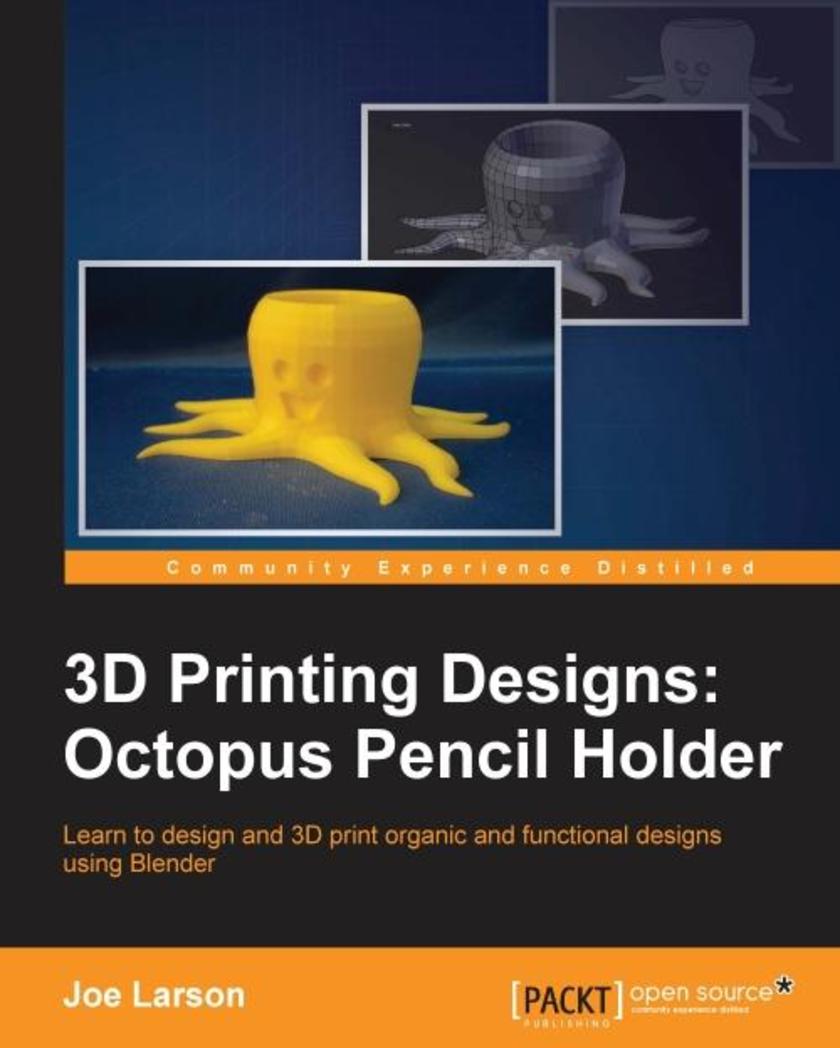
3D Printing Designs: Octopus Pencil Holder
¥35.96
Learn to design and 3D print organic and functional designs using BlenderAbout This BookLearn how to make complex shapes by editing basic onesMake printable objects from multiple shapes and partsLearn how to design from scratch, without a reference to physical objectsWho This Book Is ForYou should have basic knowledge of Blender and 3D printing and be interested in printing your first object.What You Will LearnGet to know the guiding principles required to create 3D printer-friendly modelsUnderstand material characteristics, printing specifications, tolerances, and design tipsMaster the art of modifying basic shapes with Blender's powerful editing tools: extrude, loop cuts, and other transformationsLearn techniques of editing complex meshes, smoothing, combining shapes, and exporting them into STL files for printingIn DetailThis book will cover the very basic but essential techniques you need to model an organic and functional object for 3D printing using Blender.Starting with pen and paper and then moving on to the computer, you will create your first project in Blender, add basic geometric shapes, and use techniques such as extruding and subdividing to transform these shapes into complex meshes. You will learn how modifiers can automatically refine the shape further and combine multiple shapes into a single 3D printable model.By the end of the book, you will have gained enough practical hands-on experience to be able to create a 3D printable object of your choice, which in this case is a 3D print-ready octopus pencil holder.Style and approachThis is a starter project designed to introduce you to your first real-world 3D printing designs, where you'll learn how to handle the fundamental principles of 3D printing design and have your hands on your reward in no time.
Kali Linux Web Penetration Testing Cookbook
¥90.46
Over 80 recipes on how to identify, exploit, and test web application security with Kali Linux 2About This BookFamiliarize yourself with the most common web vulnerabilities a web application faces, and understand how attackers take advantage of themSet up a penetration testing lab to conduct a preliminary assessment of attack surfaces and run exploitsLearn how to prevent vulnerabilities in web applications before an attacker can make the most of itWho This Book Is ForThis book is for IT professionals, web developers, security enthusiasts, and security professionals who want an accessible reference on how to find, exploit, and prevent security vulnerabilities in web applications. You should know the basics of operating a Linux environment and have some exposure to security technologies and tools.What You Will LearnSet up a penetration testing laboratory in a secure wayFind out what information is useful to gather when performing penetration tests and where to look for itUse crawlers and spiders to investigate an entire website in minutesDiscover security vulnerabilities in web applications in the web browser and using command-line toolsImprove your testing efficiency with the use of automated vulnerability scannersExploit vulnerabilities that require a complex setup, run custom-made exploits, and prepare for extraordinary scenariosSet up Man in the Middle attacks and use them to identify and exploit security flaws within the communication between users and the web serverCreate a malicious site that will find and exploit vulnerabilities in the user's web browserRepair the most common web vulnerabilities and understand how to prevent them becoming a threat to a site's securityIn DetailWeb applications are a huge point of attack for malicious hackers and a critical area for security professionals and penetration testers to lock down and secure. Kali Linux is a Linux-based penetration testing platform and operating system that provides a huge array of testing tools, many of which can be used specifically to execute web penetration testing.This book will teach you, in the form step-by-step recipes, how to detect a wide array of vulnerabilities, exploit them to analyze their consequences, and ultimately buffer attackable surfaces so applications are more secure, for you and your users.Starting from the setup of a testing laboratory, this book will give you the skills you need to cover every stage of a penetration test: from gathering information about the system and the application to identifying vulnerabilities through manual testing and the use of vulnerability scanners to both basic and advanced exploitation techniques that may lead to a full system compromise. Finally, we will put this into the context of OWASP and the top 10 web application vulnerabilities you are most likely to encounter, equipping you with the ability to combat them effectively. By the end of the book, you will have the required skills to identify, exploit, and prevent web application vulnerabilities.Style and approachTaking a recipe-based approach to web security, this book has been designed to cover each stage of a penetration test, with de*ions on how tools work and why certain programming or configuration practices can become security vulnerabilities that may put a whole system, or network, at risk. Each topic is presented as a sequence of tasks and contains a proper explanation of why each task is performed and what it accomplishes.
OpenGL Game Development By Example
¥107.90
Design and code your own 2D and 3D games efficiently using OpenGL and C++ About This Book Create 2D and 3D games completely, through a series of end-to-end game projects Learn to render high performance 2D and 3D graphics using OpenGL Implement a rudimentary game engine using step-by-step code Who This Book Is For If you are a prospective game developer with some experience using C++, then this book is for you. Both prospective and experienced game programmers will find nuggets of wisdom and practical advice as they learn to code two full games using OpenGL, C++, and a host of related tools. What You Will Learn Set up your development environment in Visual Studio using OpenGL Use 2D and 3D coordinate systems Implement an input system to handle the mouse and the keyboard Create a state machine to handle complex changes in the game Load, display, and manipulate both 2D and 3D graphics Implement collision detection and basic physics Discover the key components needed to complete a polished game Handle audio files and implement sound effects and music In Detail OpenGL is one of the most popular rendering SDKs used to develop games. OpenGL has been used to create everything from 3D masterpieces running on desktop computers to 2D puzzles running on mobile devices. You will learn to apply both 2D and 3D technologies to bring your game idea to life. There is a lot more to making a game than just drawing pictures and that is where this book is unique! It provides a complete tutorial on designing and coding games from the setup of the development environment to final credits screen, through the creation of a 2D and 3D game. The book starts off by showing you how to set up a development environment using Visual Studio, and create a code framework for your game. It then walks you through creation of two games–a 2D platform game called Roboracer 2D and a 3D first-person space shooter game–using OpenGL to render both 2D and 3D graphics using a 2D coordinate system. You'll create sprite classes, render sprites and animation, and navigate and control the characters. You will also learn how to implement input, use audio, and code basic collision and physics systems. From setting up the development environment to creating the final credits screen, the book will take you through the complete journey of creating a game engine that you can extend to create your own games. Style and approach An easy-to-follow guide full of code examples to illustrate every concept and help you build a 2D and 3D game from scratch, while learning the key tools that surround a typical OpenGL project.

Mobile Application Penetration Testing
¥90.46
Explore real-world threat scenarios, attacks on mobile applications, and ways to counter them About This Book Gain insights into the current threat landscape of mobile applications in particular Explore the different options that are available on mobile platforms and prevent circumventions made by attackers This is a step-by-step guide to setting up your own mobile penetration testing environment Who This Book Is For If you are a mobile application evangelist, mobile application developer, information security practitioner, penetration tester on infrastructure web applications, an application security professional, or someone who wants to learn mobile application security as a career, then this book is for you. This book will provide you with all the skills you need to get started with Android and iOS pen-testing. What You Will Learn Gain an in-depth understanding of Android and iOS architecture and the latest changes Discover how to work with different tool suites to assess any application Develop different strategies and techniques to connect to a mobile device Create a foundation for mobile application security principles Grasp techniques to attack different components of an Android device and the different functionalities of an iOS device Get to know secure development strategies for both iOS and Android applications Gain an understanding of threat modeling mobile applications Get an in-depth understanding of both Android and iOS implementation vulnerabilities and how to provide counter-measures while developing a mobile app In Detail Mobile security has come a long way over the last few years. It has transitioned from "should it be done?" to "it must be done!"Alongside the growing number of devises and applications, there is also a growth in the volume of Personally identifiable information (PII), Financial Data, and much more. This data needs to be secured. This is why Pen-testing is so important to modern application developers. You need to know how to secure user data, and find vulnerabilities and loopholes in your application that might lead to security breaches. This book gives you the necessary skills to security test your mobile applications as a beginner, developer, or security practitioner. You'll start by discovering the internal components of an Android and an iOS application. Moving ahead, you'll understand the inter-process working of these applications. Then you'll set up a test environment for this application using various tools to identify the loopholes and vulnerabilities in the structure of the applications. Finally, after collecting all information about these security loop holes, we'll start securing our applications from these threats. Style and approach This is an easy-to-follow guide full of hands-on examples of real-world attack simulations. Each topic is explained in context with respect to testing, and for the more inquisitive, there are more details on the concepts and techniques used for different platforms.
Mapbox Cookbook
¥71.93
Over 35 recipes to design and implement uniquely styled maps using the Mapbox platform About This Book Design and develop beautifully styled maps using TileMill, MapBox Studio, and CartoCSS Get to grips with the mapbox.js and Leaflet to create visually stunning web and mobile applications An easy-to-follow, quick reference guide to integrate powerful APIs and services like Foursquare, Fusion Tables, Geoserver, and CartoDB to populate your maps Who This Book Is For If you are a web developer seeking for GIS expertise on how to create, style, and publish interactive and unique styled maps, then this book is for you. Basic knowledge of programming and java*s is assumed. What You Will Learn Get accustomed to the MapBox Editor to visually style your maps Learn everything about CartoCSS, and how it will help you fine tune your styled maps Use MapBox Studio and Tilemill to generate your own tiles and vector maps Publish your maps using a variety of technologies like node.js, PHP, and Geoserver Integrate with third party APIs and services to populate your maps with public or private data Create many different map visualization styles like choropleth and heat maps, add interactivity, and even learn how to animate data over time Work with many different data formats and external services to create robust maps Learn to use MapBox GL to create a mobile application In Detail Maps are an essential element in today’s location aware applications. Right from displaying earth surface information to creating thematic maps displaying plethora of information, most of the developers lack the necessary knowledge to create customizable maps with combination of various tools and libraries. The MapBox platform is one such platform which offers all the tools and API required to create and publish a totally customizable map. Starting with building your first map with the online MapBox Editor, we will take you all the way to building advanced web and mobile applications with totally customizable map styles. Through the course of chapters we’ll learn CartoCSS styling language and understand the various components of MapBox platform and their corresponding JavaScript API. In the initial few chapters we will dive deeper into the TileMill and MapBox Studio components of MapBox and use them to generate custom styled map tiles and vector maps. Furthermore, we will publish these custom maps using PHP, node.js and third party tools like Geoserver. We’ll also learn to create different visualizations and map styles like a choropleth map, a heat map and add user interactivity using a UFTGrid. Moving on, we dive into advanced concepts and focus on integration with third party services like Foursquare, Google FusionTables, CartoDB, and Torque to help you populate and even animate your maps. In the final chapter we’ll learn to use the Mapbox SDK to create and publish interactive maps for the iOS platform. By the end of this book, you will learn about MapBox GL and how to create a fully functional, location-aware mobile app, using the maps styles created in the recipes. Style and approach An easy-to-use recipe driven book that will not just serve code samples, but also explains all the theory and concepts required to fully understand each recipe.
Moodle 2.0 First Look
¥71.93
The book looks at the main functional areas of Moodle that have significant new features, explains the new features and how to use them. It draws attention to significant differences from how things used to behave, and gives the reader an idea of the kind of consequences these changes will bring to them. If you are an existing Moodle user, tutor, or administrator, then this book is for you. You are expected to be familiar with the operation of Moodle.
OpenStreetMap
¥71.93
This book introduces the OSM project, its aims and objectives, and its history, then guides you through the process of gathering, editing, and using OpenStreetMap data using a series of real-world examples. This book is the perfect aid for geographic-information professionals interested in using OpenStreetMap in their work and web designers and developers who want to include mapping in their sites, and want a distinctive style. It is for you if you have a need to use maps and geographic data for work or leisure, and want accurate, up-to-date maps showing the information you're interested in, without details you don't need. If you want to use maps for navigation and want more or less detail than traditional printed maps give this book is perfect for you.
IBM Lotus Sametime 8 Essentials: A User's Guide
¥80.65
As a user, you will learn, using real-world scenarios and tasks, exactly how to use all the features of Sametime. Beginning with how to install Sametime, we've included step-by-step de*ions and screen prints for each topic area in a clear easy-to-follow format. Each chapter builds on what you learn in earlier chapters and guides you into using the more advanced features of Sametime, but if you only want to develop your skills in one particular area, each chapter acts as a stand-alone module. If you want to learn how to use IBM Lotus Sametime, then this book is for you. No matter if you're new to Sametime or want to become a Sametime power user, this book contains something for you. The focus is on using Sametime as a user and does not include information about development or administration of a Sametime environment; but any user of Sametime in an organization will be able to take this book, sit down at their computer, and learn how to use each feature of Sametime from start to finish.
Building job sites with Joomla!
¥71.93
This will be a step-by-step tutorial - a workbook with practical approach. The book starts by looking at the important features that make a professional job site: adding and managing jobs, jobseekers and employers, providing online recruitment services, selling credits and managing credit system, SEO to drive huge traffic to your job site, and so on. This book includes a lot of screenshots which not only illustrate tasks but also create a visual impact. This book contains overall necessary information that is important for the understanding of job site development. If you are looking for building and managing a job site using Joomla! extensions then this book is for you. Prior knowledge of using extensions is not expected but Joomla! basics will be required.
EJB 3.0 Database Persistence with Oracle Fusion Middleware 11g
¥99.18
This is a practical, tutorial-style book that includes many examples that demonstrate how to develop EJB 3.0 database persistence applications with Oracle Fusion Middleware 11g. Every chapter starts with setting the environment for the chapter and includes an example application illustrated with figures at milestone stages. This book is aimed at EJB 3.0 application developers who want to learn about the practical use of EJB 3.0 database persistence with Oracle Fusion Middleware. Those who are already using EJB 3.0 database persistence will learn about using EJB 3.0 database persistence with Oracle Fusion Middleware 11g. The target audience is expected to have some prior knowledge about Java EE, EJBs, EJB 3.0, JSF, AJAX, web services, and XML. This book is ideal for those developers who have working knowledge of JDeveloper and WebLogic server, and wish to learn about the practical use of EJB 3.0 with Oracle Fusion Middleware.
Silverlight 4 User Interface Cookbook
¥90.46
Written in a Cookbook style, this book offers learning and techniques through recipes. It contains step-by-step instructions for designers and developers who want to learn about how to design and implement numerous user interface patterns with Silverlight. It will take you a step further by providing you with professional and proven user interface and user experience guidelines wherever possible. The book is designed in such a way that you can explore it chapter-by-chapter, or read it in any order. Written in a Cookbook style, this book offers learning and techniques through recipes. It contains step-by-step instructions for designers and developers who want to learn about how to design and implement numerous user interface patterns with Silverlight. It will take you a step further by providing you with professional and proven user interface and user experience guidelines wherever possible. The book is designed in such a way that you can explore it chapter-by-chapter, or read it in any order.
ChronoForms 1.3 for Joomla! site Cookbook
¥80.65
This book is the missing manual for creating forms on your Joomla! site. Using simple examples that you can easily follow we will show you how you can create forms of almost any kind. Most of the chapters focus on one topic starting with simple recipes for new users and then adding new features that add more to the form but may also require more knowledge and experience to implement.Other chapters look in more detail at adding special features, or creating forms to perform particular tasks. Again the recipes range from those that a new user can easily implement to those that will help more advanced developers.Each recipe is kept as simple as possible and set out so that it can be easily implemented with the code supplied; and the recipes are also a set of building blocks that you can use to create much more complex forms using several recipes to build your form.As far as space allows we have explained how the code works, what features of Joomla or of ChronoForms we are using and we’ve offered suggestions in the ‘There’s more . . .’ sections for ways in which the basic recipe can be extended or adapted.The code examples are complete and can be adapted by new users with the minimum of customization or they can be as a starting point for developers with more coding experience to build on and adapt to create fully customized form applications. This is a practical hands-on book for people who want to add forms to their Joomla! site. Whether you just want to add a simple newsletter sign-up form or a complex multi-page interactive form you’ll find helpful suggestions and recipes that will get your forms working. Many recipes will work ‘out-of-the-box’ using ChronoForms built-in capabilities; other more advanced recipes require some knowledge of Joomla!, HTML, CSS ,PHP, MySQL or JavaScript. There is working code with each recipe that you can adapt to meet your specific needs.
SAP BusinessObjects Dashboards 4.0 Cookbook
¥99.18
This guide to SAP BusinessObjects Dashboards 4.0 (formerly Xcelsius )is a cookbook packed full of practical recipes written in a clear, concise manner with annotated examples to empower readers to quickly accomplish specific dashboard tasks. If you are a developer with a good command and knowledge of creating dashboards, but are not yet an advanced Dashboard Design user, then this is the perfect book for you. You should have a good working knowledge of Microsoft Excel as well as knowledge of basic dashboard practices, though experience of Dashboard Design as a specific dashboard tool is not essential.
Oracle 11g R1/R2 Real Application Clusters Essentials
¥125.34
This book documents how to administer a complex Oracle 11g RAC environment. It covers new RAC components such as ASM’s new features, performance tuning, and troubleshooting. It contains real world examples, expert tips, and troubleshooting advice. This book focuses on Oracle RAC 11g R1 with additional 11g R2 information included. If you are an Oracle DBA who wants to administer Real Application Clusters, then this book is for you. Basic understanding of Oracle DBA is required. No experience of Oracle RAC is required.
MySQL Admin Cookbook LITE: Configuration, Server Monitoring, Managing Users
¥35.96
"This book is for ambitious MySQL users as well as professional data center database administrators. Beginners as well as experienced administrators will benefit from this cookbook and get fresh ideas to improve their MySQL environments. Detailed background information will enable them to widen their MySQL horizon. It does not cover SQL basics, how to install MySQL servers, or how to design a relational database schema. Readers are expected to have a basic understanding of the SQL language and database concepts in general."
Inkscape 0.48 Essentials for Web Designers: LITE
¥35.96
This book is written for web designers who want to add attractive visual elements to their website. It assumes no previous knowledge of Inkscape. General familiarity with vector graphics programming is recommended but not required. It will also be a useful guide for experienced Inkscape users who want to learn how to apply their skills to website design.
Amazon SimpleDB: LITE
¥35.96
If you are a developer wanting to get to grips with a primer into SimpleDB, then this book is for you. You do not need to know anything about SimpleDB to read and learn from this book, and no basic knowledge is strictly necessary.
Sage Beginners Guide
¥90.46
This is a beginner's guide with clear step-by-step instructions, explanations, and advice. Each concept is illustrated with a complete example that you can use as a starting point for your own work. If you are an engineer, scientist, mathematician, or student, this book is for you. To get the most from Sage by using the Python programming language, we'll give you the basics of the language to get you started. For this, it will be helpful if you have some experience with basic programming concepts.
CMS Made Simple Development Cookbook
¥80.65
This is a cookbook, with practical recipes providing tips and tricks to the most common problems and scenarios faced with CMS Made Simple Development. If you are a CMS Made Simple user wanting to expand your skill set, or a programmer who wants to develop for CMS Made Simple, this book is for you. You will need working knowledge of PHP, HTML, and SQL. Some experience with CMS Made Simple is recommended.


