


 购物车
购物车 个人中心
个人中心
Mastering Angular Components
¥66.58
Develop modern user interfaces using Angular 6 and its component-based architecture. Key Features * Build better web applications with highly scalable concepts using Angular * Learn new ways to design your web applications * Build a fully functional web application that lets you tackle real-world user interface problems using Angular components Book Description Angular framework embraces a mature user interface (UI) component architecture, a powerful tool when developing scalable application interfaces. The simple and deterministic design of Angular components supports you in building large and scalable component-based applications. Mastering Angular Components covers a new holistic way of thinking about UI development, and helps you discover the power of Angular 6 components through various examples. The book starts with an introduction to component-based user interfaces and how Angular 6 manages this concept. Following a step-by-step approach, you will build a fully functional task-management application using Angular. You’ll start with basic layout components, adding some core task-management components before completing the first draft of your application. You will then move on to working through a refactoring exercise in order to learn how to enhance the way you deal with states and data. Once you have got to grips with all this, you will study how to make use of the Angular router within your application. By the end of this book, you will be able to constantly refine the functionality of your application and create components that render SVG graphics, add a time-tracking feature, visualize data using third-party library Chartist, and even create a plugin architecture using Angular components. What you will learn * Use TypeScript to create Angular 6 components * Leverage component composition to solve complex UI requirements * Build an architecture using pure components and container components * Explore the basics of RxJS observable streams and use them to build your application reactively * Communicate between components using child queries * Implement the Angular router to make your application navigable * Build reusable and dynamic graphical content using Angular components and SVG * Integrate third-party libraries such as Moment.js and Chartist into your existing Angular application Who this book is for Mastering Angular Components is for you if you are an Angular developer who already has a good understanding of basic frontend web technologies such as JavaScript, HTML, and CSS.
Hands-On Serverless Computing
¥78.47
Deploy functions efficiently using different cloud-based serverless offerings Key Features *Understand the concept of Function-as-a-Service *Implement Serverless solutions using AWS Lambda, Azure Functions and Google Cloud Functions *Practical approach towards choosing the best tool for your serverless environment Book Description Serverless applications and architectures are gaining momentum and are increasingly being used by companies of all sizes. Serverless software takes care of many problems that developers face when running systems and servers, such as fault tolerance, centralized logging, horizontal scalability, and deployments. You will learn how to harness serverless technology to rapidly reduce production time and minimize your costs, while still having the freedom to customize your code, without hindering functionality. Upon finishing the book, you will have the knowledge and resources to build your own serverless application hosted in AWS, Microsoft Azure, or Google Cloud Platform, and will have experienced the benefits of event-driven technology for yourself. This hands-on guide dives into the basis of serverless architectures and how to build them using Node.js as a programming language, Visual Studio Code for code editing, and Postman for quickly and securely developing applications without the hassle of configuring and maintaining infrastructure on three public cloud platforms. What you will learn *Understand the benefts of serverless computing and know when to use it *Develop serverless applications on AWS, Azure, and Google Cloud *Get to grips with Function as a Service (FaaS) *Apply triggers to serverless functions *Build event-driven apps using serverless frameworks *Use the Node.js programming language to build serverless apps *Use code editors, such as Visual Studio Code, as development environments *Master the best development practices for creating scalable and practical solutions Who this book is for This book is targeted towards developers, system administrators or any stakeholder working in the Serverless environment and want to understand how functions work. Basic idea of serverless architecture can be an added advantage
Pocket CIO – The Guide to Successful IT Asset Management
¥73.02
Create and manage a clear working IT asset management strategy with this unique guide About This Book ? A detailed IT Asset Management (ITAM) guidebook with real-world templates that can be converted into working ITAM documents. ? Includes in-depth discussion on how risk management has changed and the possible solutions needed to address the new normal ? A step-by-step ITAM manual for newbies as well as seasoned ITAM veterans Who This Book Is For This book is intended for CIOs, VPs and CTOs of mid to large-sized enterprises and organizations. If you are dealing with changes such as mergers, acquisitions, divestitures, new products or services, cyber security, mandated regulations, expansion, and much more, this book will help you too. What You Will Learn ? Close the hidden risk gaps created by IT assets (hardware and software) ? Create and manage a clear working proactive ITAM and SAM program and policy ? A clear, concise explanation of what IT Asset Management is, the benefits, and results ? A clear, concise explanation of what Software Asset Management is, the benefits, and results ? The best ways to manage a software audit and how to be prepared for one ? Considerations for selecting the best technology for a specific company including what questions should be asked at the onset. ? Increasing ITAM program and project success with change management In Detail IT Asset Management (ITAM) supports life cycle management and strategic decision making for an IT environment. This book is a detailed IT Asset Management (ITAM) guidebook with real-world templates that can be converted into working ITAM documents. It is a step-by-step IT asset management manual for the newbies as well as the seasoned ITAM veterans, providing a unique insight into asset management. It discusses how risk management has changed over time and the possible solutions needed to address the new normal. The book also includes considerations for selecting the best technology for a specific company including what questions should be asked at the onset, as well as the best ways to manage a software audit and how to be prepared for one. This book is your perfect guide to create holistic IT asset management and Software asset management programs that close the risk gaps, increases productivity and results in cost efficiencies. It allows the IT Asset Managers, Software Asset Managers, and/or the full IT Asset Management (ITAM) ITAM/SAM program team to take a deep dive by using the templates offered in the guidebook. You will be aware of the specific roles and responsibilities for every aspect of IT asset management, software asset management, and software license compliance audit response. By the end of this book, you will be well aware of what IT and Software Asset Management is all about and the different steps, processes, and roles required to truly master it. By the end of this book, you will be well aware of what IT Asset Management is all about and the different skills required to truly master it. Style and approach Packed with important discussion points, examples, case studies, templates, and checklists.
Beginning React
¥26.15
Take your web applications to a whole new level with efficient, component-based UIs that deliver cutting-edge interactivity and performance. Key Features *Elaborately explains basics before introducing advanced topics *Explains creating and managing the state of components across applications *Implement over 15 practical activities and exercises across 11 topics to reinforce your learning Book Description Projects like Angular and React are rapidly changing how development teams build and deploy web applications to production. In this book, you’ll learn the basics you need to get up and running with React and tackle real-world projects and challenges. It includes helpful guidance on how to consider key user requirements within the development process, and also shows you how to work with advanced concepts such as state management, data-binding, routing, and the popular component markup that is JSX. As you complete the included examples, you’ll find yourself well-equipped to move onto a real-world personal or professional frontend project. What you will learn *Understand how React works within a wider application stack *Analyze how you can break down a standard interface into specific components *Successfully create your own increasingly complex React components with HTML or JSX *Correctly handle multiple user events and their impact on overall application state *Understand the component lifecycle to optimize the UX of your application *Configure routing to allow effortless, intuitive navigation through your components Who this book is for If you are a frontend developer who wants to create truly reactive user interfaces in JavaScript, then this is the book for you. For React, you’ll need a solid foundation in the essentials of the JavaScript language, including new OOP features that were introduced in ES2015. An understanding of HTML and CSS is assumed, and a basic knowledge of Node.js will be useful in the context of managing a development workflow, but is not essential.
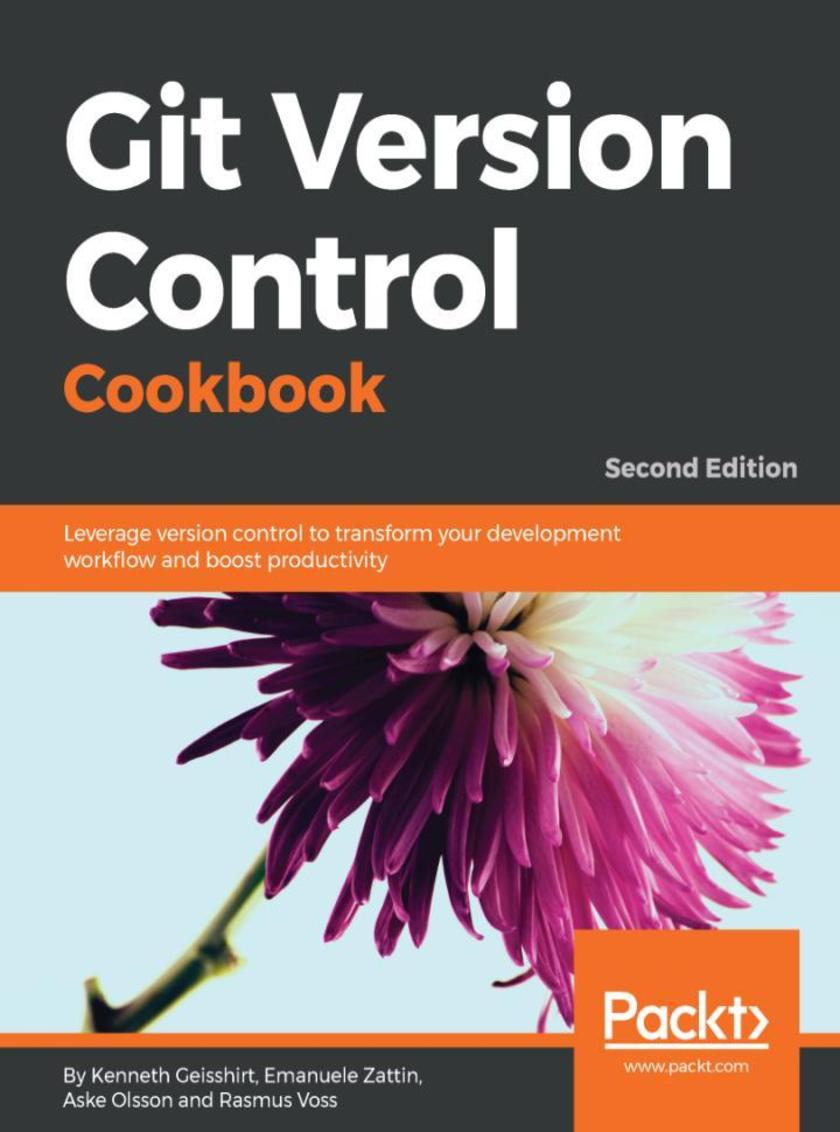
Git Version Control Cookbook
¥78.47
A series of practical recipes to simplify the Git learning experience and increase your productivity when using Git version control Key Features *Explore practical recipes to use Git’s most advanced features *Learn how Git references its objects and how history is recorded *Use reflog and git fsck to recover lost information Book Description Git is one of the most popular tools for versioning. Git Version Control Cookbook builds on the success of the previous edition and provides you with an up-to-date guide to solving problems related to versioning. You’ll start by learning about the Git data model and how it stores files and looks at commits. By using simple commands, you’ll learn how to navigate through the database. Once you have accustomed yourself to the basics, you’ll explore techniques to configure Git with comprehensive examples and configuration targets. You’ll gain insights into improving your understanding of branches and recovery from mistakes — right from committing to a wrong branch to recovering lost commits or files. You’ll then move on to discovering the features that Git rebase has to offer and use regular Git merge on other branches. You’ll explore Git notes and learn how to utilize the update, list, and search commands. In addition to this, you’ll learn how to extract metadata from repositories and automate your daily tasks using Git hooks. You’ll then study in detail repository maintenance, patching, and offline sharing. By the end of the book, you’ll have grasped various tips and tricks for everyday usage, while increasing your knowledge of Git providers, integrations, and clients. What you will learn *Understand the Git data model and use commands to navigate the database *Find out how you can recover lost commits or files *Force a rebase on some branches and use regular Git to merge on the rest *Master the techniques required to extract metadata from repositories *Explore Git notes and learn about the various features that it offers *See how to decode different subcommands Who this book is for The Git Version Control Cookbook is for you if you are a developer or Build Release manager looking for a full-fledged practical guide that will take your Git knowledge to the next level. Basic knowledge of GNU tools and shell or bash scripting is needed.
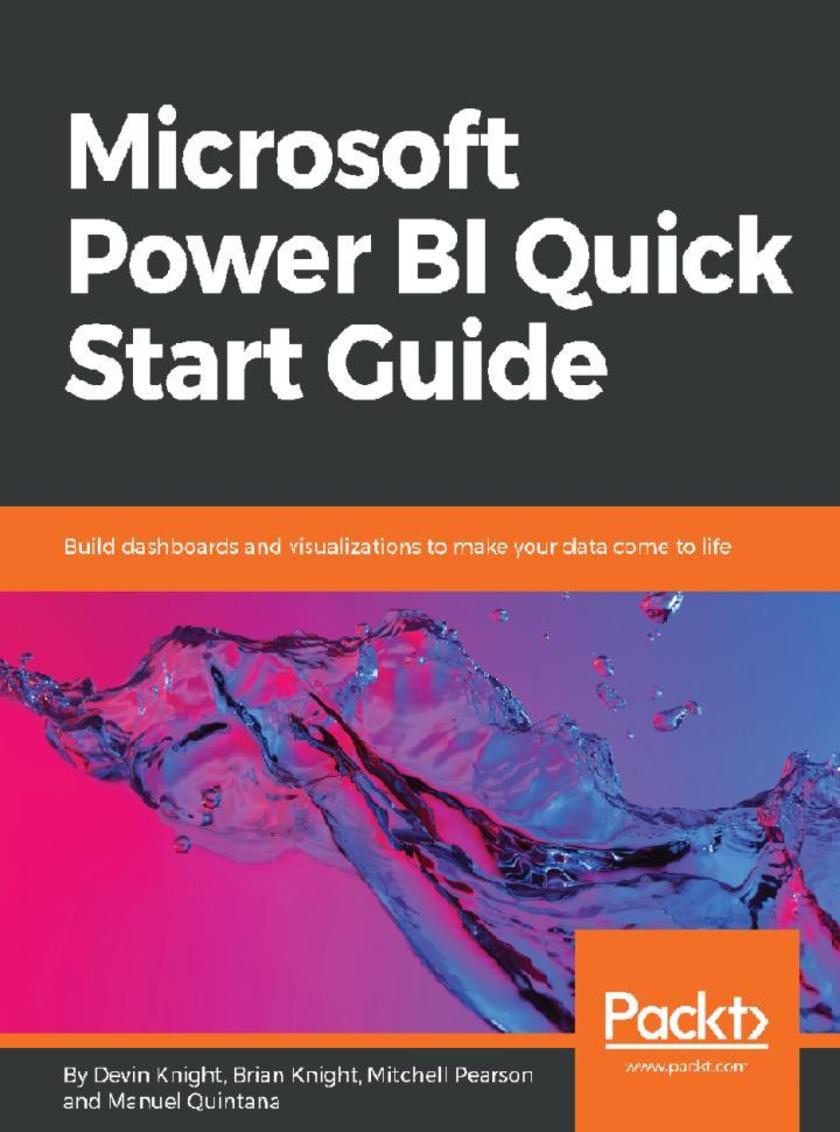
Microsoft Power BI Quick Start Guide
¥52.31
Develop robust, Scala-powered projects with the help of machine learning libraries such as SparkML to harvest meaningful insight Key Features *Gain hands-on experience in building data science projects with Scala *Exploit powerful functionalities of machine learning libraries *Use machine learning algorithms and decision tree models for enterprise apps Book Description Scala, together with the Spark Framework, forms a rich and powerful data processing ecosystem. Modern Scala Projects is a journey into the depths of this ecosystem. The machine learning (ML) projects presented in this book enable you to create practical, robust data analytics solutions, with an emphasis on automating data workflows with the Spark ML pipeline API. This book showcases or carefully cherry-picks from Scala’s functional libraries and other constructs to help readers roll out their own scalable data processing frameworks. The projects in this book enable data practitioners across all industries gain insights into data that will help organizations have strategic and competitive advantage. Modern Scala Projects focuses on the application of supervisory learning ML techniques that classify data and make predictions. You'll begin with working on a project to predict a class of flower by implementing a simple machine learning model. Next, you'll create a cancer diagnosis classification pipeline, followed by projects delving into stock price prediction, spam filtering, fraud detection, and a recommendation engine. By the end of this book, you will be able to build efficient data science projects that fulfil your software requirements. What you will learn *Create pipelines to extract data or analytics and visualizations *Automate your process pipeline with jobs that are reproducible *Extract intelligent data efficiently from large, disparate datasets *Automate the extraction, transformation, and loading of data *Develop tools that collate, model, and analyze data *Maintain the integrity of data as data flows become more complex *Develop tools that predict outcomes based on “pattern discovery” *Build really fast and accurate machine-learning models in Scala Who this book is for Modern Scala Projects is for Scala developers who would like to gain some hands-on experience with some interesting real-world projects. Prior programming experience with Scala is necessary.
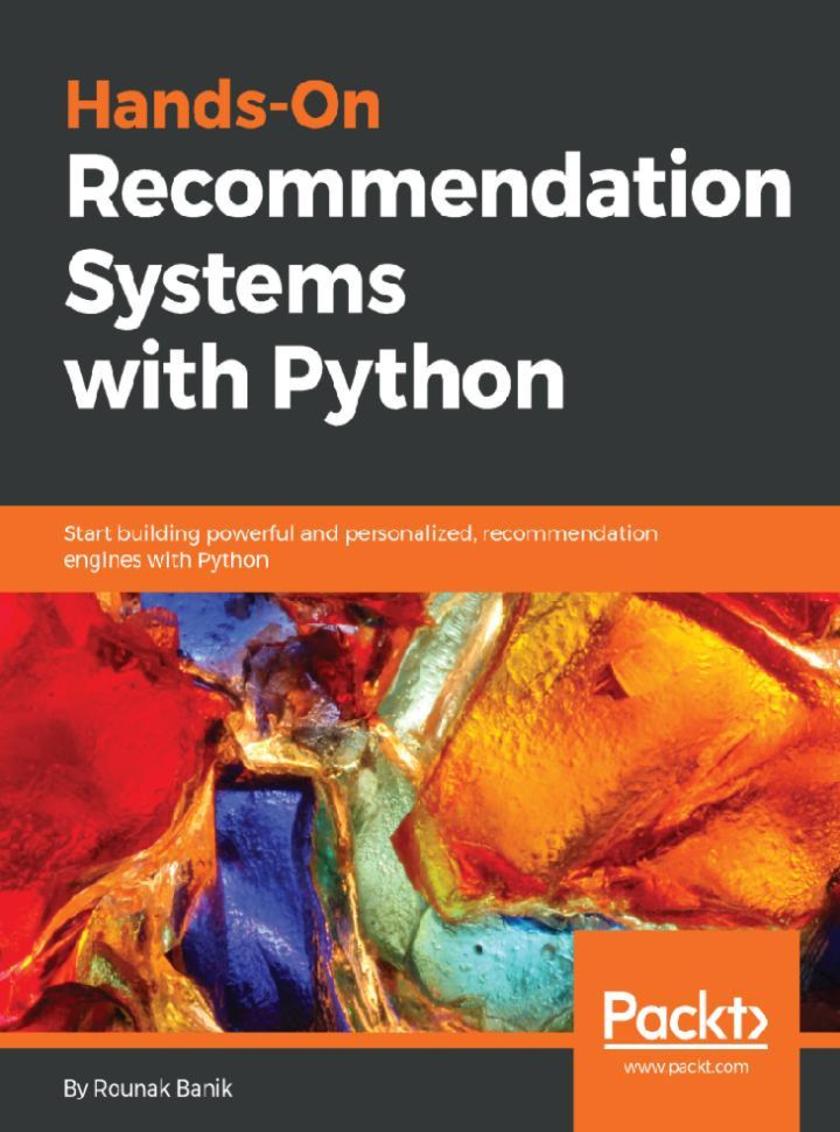
Hands-On Recommendation Systems with Python
¥52.31
Secure your Java applications by integrating the Spring Security framework in your code Key Features *Provide authentication, authorization and other security features for Java applications. *Learn how to secure microservices, cloud, and serverless applications easily *Understand the code behind the implementation of various security features Book Description Security is one of the most vital concerns for any organization. The complexity of an application is compounded when you need to integrate security with existing code, new technology, and other frameworks. This book will show you how to effectively write Java code that is robust and easy to maintain. Hands-On Spring Security 5 for Reactive Applications starts with the essential concepts of reactive programming, Spring Framework, and Spring Security. You will then learn about a variety of authentication mechanisms and how to integrate them easily with the Spring MVC application. You will also understand how to achieve authorization in a Spring WebFlux application using Spring Security.You will be able to explore the security confgurations required to achieve OAuth2 for securing REST APIs and integrate security in microservices and serverless applications. This book will guide you in integrating add-ons that will add value to any Spring Security module. By the end of the book, you will be proficient at integrating Spring Security in your Java applications What you will learn *Understand how Spring Framework and Reactive application programming are connected *Implement easy security confgurations with Spring Security expressions *Discover the relationship between OAuth2 and OpenID Connect *Secure microservices and serverless applications with Spring *Integrate add-ons, such as HDIV, Crypto Module, and CORS support *Apply Spring Security 5 features to enhance your Java reactive applications Who this book is for If you are a Java developer who wants to improve application security, then this book is for you. A basic understanding of Spring, Spring Security framework, and reactive applications is required to make the most of the book.
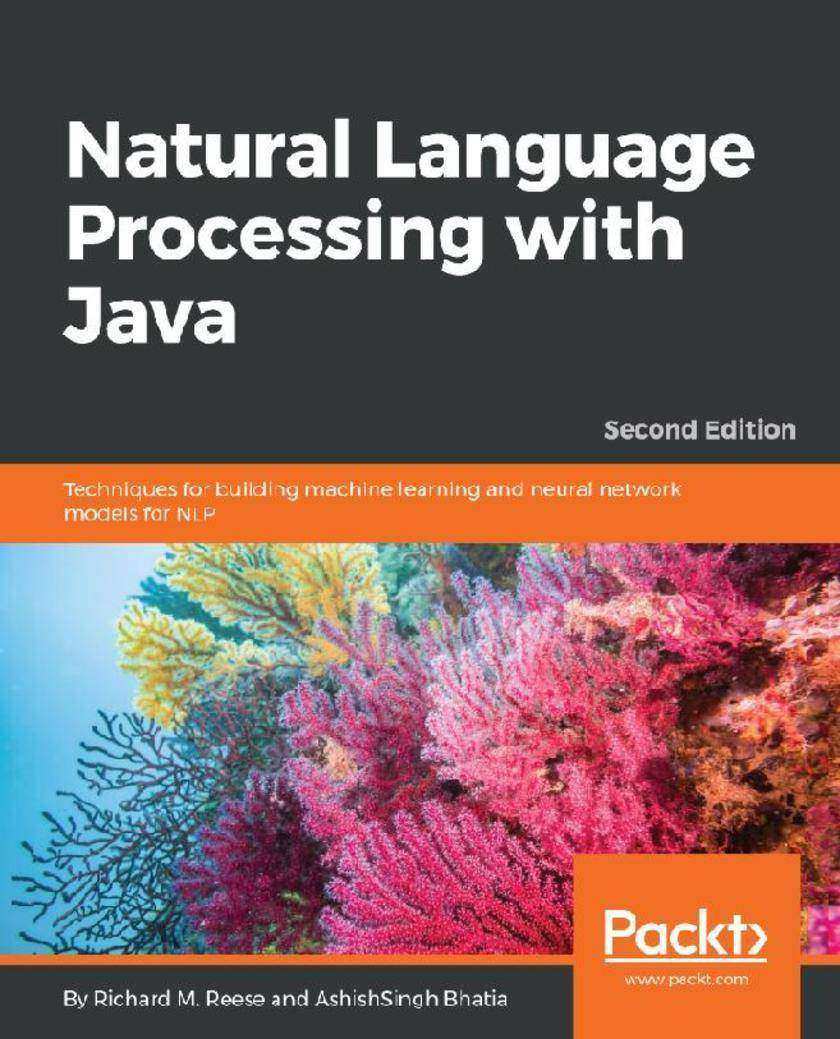
Natural Language Processing with Java
¥69.75
Discover how you can migrate a traditional on-premise SQL server database to a cloud-based solution with Microsoft Azure. Built with database administrators in mind, this book emulates different scenarios you might come across while working with large, complex SQL database migrations and provides solutions for effectively managing the migrated databases. Key Features *Implement backup, restore, and recovery of Azure SQL databases *Create shards and elastic pools to scale Azure SQL databases *Automate common management tasks with PowerShell *Implement over 40 practical activities and exercises across 24 topics to reinforce your learning Book Description As the cloud version of SQL Server, Azure SQL Database differs in key ways when it comes to management, maintenance, and administration. It’s important to know how to administer SQL Database to fully benefit from all of the features and functionality that it provides. This book addresses important aspects of an Azure SQL Database instance such as migration, backup restorations, pricing policies, security, scalability, monitoring, performance optimization, high availability, and disaster recovery. It is a complete guide for database administrators, and ideal for those who are planning to migrate from on premise SQL Server database to an Azure SQL Server database. What you will learn *Learn how to provision a new database or migrate an existing on-premise solution *Understand how to backup, restore, secure, and scale your own Azure SQL Database *Optimize the performance by monitoring and tuning your cloud-based SQL instance *Implement high availability and disaster recovery procedures with SQL Database *Develop a roadmap for your own scalable cloud solution with Azure SQL Database Who this book is for This book is ideal for database administrators, database developers, or application developers who are interested in developing or migrating existing applications with Azure SQL Database. Prior experience of working with an on-premise SQL Server deployment and brief knowledge of PowerShell and C# are recommended prerequisites.
Selenium WebDriver 3 Practical Guide
¥69.75
Bridge the gap between developer and data scientist by creating a modern open-source, Python-based toolset that works with Jupyter Notebook, and PixieDust. Key Features *Think deeply as a developer about your strategy and toolset in data science *Discover the best tools that will suit you as a developer in your data analysis *Accelerate the road to data insight as a programmer using Jupyter Notebook *Deep dive into multiple industry data science use cases Book Description Thoughtful Data Science brings new strategies and a carefully crafted programmer's toolset to work with modern, cutting-edge data analysis. This new approach is designed specifically to give developers more efficiency and power to create cutting-edge data analysis and artificial intelligence insights. Industry expert David Taieb bridges the gap between developers and data scientists by creating a modern open-source, Python-based toolset that works with Jupyter Notebook, and PixieDust. You'll find the right balance of strategic thinking and practical projects throughout this book, with extensive code files and Jupyter projects that you can integrate with your own data analysis. David Taieb introduces four projects designed to connect developers to important industry use cases in data science. The first is an image recognition application with TensorFlow, to meet the growing importance of AI in data analysis. The second analyses social media trends to explore big data issues and natural language processing. The third is a financial portfolio analysis application using time series analysis, pivotal in many data science applications today. The fourth involves applying graph algorithms to solve data problems. Taieb wraps up with a deep look into the future of data science for developers and his views on AI for data science. What you will learn *Bridge the gap between developer and data scientist with a Python-based toolset *Get the most out of Jupyter Notebooks with new productivity-enhancing tools *Explore and visualize data using Jupyter Notebooks and PixieDust *Work with and assess the impact of artificial intelligence in data science *Work with TensorFlow, graphs, natural language processing, and time series *Deep dive into multiple industry data science use cases *Look into the future of data analysis and where to develop your skills Who this book is for This book is for established developers who want to bridge the gap between programmers and data scientists. With the introduction of PixieDust from its creator, the book will also be a great desk companion for the already accomplished Data Scientist. Some fluency in data interpretation and visualization is also assumed since this book addresses data professionals such as business and general data analysts. It will be helpful to have some knowledge of Python, using Python libraries, and some proficiency in web development.
Hands-On High Performance with Spring 5
¥90.46
A hands-on guide to creating, monitoring, and tuning a high performance Spring web application About This Book ? Understand common performance pitfalls and improve your application's performance ? Build and deploy strategies for complex applications using the microservice architecture ? Understand internals of JVM - the core of all Java Runtime Environments Who This Book Is For If you’re a Spring developer who’d like to build high performance applications and have more control over your application's performance in production and development, this book is for you. Some familiarity with Java, Maven, and Eclipse is necessary. What You Will Learn ? Master programming best practices and performance improvement with bean wiring ? Analyze the performance of various AOP implementations ? Explore database interactions with Spring to optimize design and configuration ? Solve Hibernate performance issues and traps ? Leverage multithreading and concurrent programming to improve application performance ? Gain a solid foundation in JVM performance tuning using various tools ? Learn the key concepts of the microservice architecture and how to monitor them ? Perform Spring Boot performance tuning, monitoring, and health checks In Detail While writing an application, performance is paramount. Performance tuning for real-world applications often involves activities geared toward detecting bottlenecks. The recent release of Spring 5.0 brings major advancements in the rich API provided by the Spring framework, which means developers need to master its tools and techniques to achieve high performance applications. Hands-On High Performance with Spring 5 begins with the Spring framework's core features, exploring the integration of different Spring projects. It proceeds to evaluate various Spring specifications to identify those adversely affecting performance. You will learn about bean wiring configurations, aspect-oriented programming, database interaction, and Hibernate to focus on the metrics that help identify performance bottlenecks. You will also look at application monitoring, performance optimization, JVM internals, and garbage collection optimization. Lastly, the book will show you how to leverage the microservice architecture to build a high performance and resilient application. By the end of the book, you will have gained an insight into various techniques and solutions to build and troubleshoot high performance Spring-based applications. Style and approach This book takes a step-by-step approach with focused examples to teach you how to increase application performance.
Mastering High Performance with Kotlin
¥81.74
Find out how to write Kotlin code without overhead and how to use different profiling tools and bytecode viewer to inspect expressions of Kotlin language. About This Book ? Apply modern Kotlin features to speed up processing and implement highly efficient and reliable codes. ? Learn memory optimization, concurrency, multi-threading, scaling, and caching techniques to achieve high performance. ? Learn how to prevent unnecessary overhead and use profiling tools to detect performance issues. Who This Book Is For This book is for Kotlin developers who would like to build reliable and high-performance applications. Prior Kotlin programming knowledge is assumed. What You Will Learn ? Understand the importance of high performance ? Learn performance metrics ? Learn popular design patterns currently being used in Kotlin ? Understand how to apply modern Kotlin features to data processing ? Learn how to use profling tools ? Discover how to read bytecode ? Learn to perform memory optimizations ? Uncover approaches to the multithreading environment In Detail The ease with which we write applications has been increasing, but with it comes the need to address their performance. A balancing act between easily implementing complex applications and keeping their performance optimal is a present-day requirement In this book, we explore how to achieve this crucial balance, while developing and deploying applications with Kotlin. The book starts by analyzing various Kotlin specifcations to identify those that have a potentially adverse effect on performance. Then, we move on to monitor techniques that enable us to identify performance bottlenecks and optimize performance metrics. Next, we look at techniques that help to us achieve high performance: memory optimization, concurrency, multi threading, scaling, and caching. We also look at fault tolerance solutions and the importance of logging. We'll also cover best practices of Kotlin programming that will help you to improve the quality of your code base. By the end of the book, you will have gained some insight into various techniques and solutions that will help to create high-performance applications in the Kotlin environment Style and approach This book guides you through how to use profiling tools to detect performance issues and build high-performance applications in the Kotlin environment.
Deep Reinforcement Learning Hands-On
¥66.58
This practical guide will teach you how deep learning (DL) can be used to solve complex real-world problems. About This Book ? Explore deep reinforcement learning (RL), from the first principles to the latest algorithms ? Evaluate high-profile RL methods, including value iteration, deep Q-networks, policy gradients, TRPO, PPO, DDPG, D4PG, evolution strategies and genetic algorithms ? Keep up with the very latest industry developments, including AI-driven chatbots Who This Book Is For Some fluency in Python is assumed. Basic deep learning (DL) approaches should be familiar to readers and some practical experience in DL will be helpful. This book is an introduction to deep reinforcement learning (RL) and requires no background in RL. What You Will Learn ? Understand the DL context of RL and implement complex DL models ? Learn the foundation of RL: Markov decision processes ? Evaluate RL methods including Cross-entropy, DQN, Actor-Critic, TRPO, PPO, DDPG, D4PG and others ? Discover how to deal with discrete and continuous action spaces in various environments ? Defeat Atari arcade games using the value iteration method ? Create your own OpenAI Gym environment to train a stock trading agent ? Teach your agent to play Connect4 using AlphaGo Zero ? Explore the very latest deep RL research on topics including AI-driven chatbots In Detail Recent developments in reinforcement learning (RL), combined with deep learning (DL), have seen unprecedented progress made towards training agents to solve complex problems in a human-like way. Google's use of algorithms to play and defeat the well-known Atari arcade games has propelled the field to prominence, and researchers are generating new ideas at a rapid pace. Deep Reinforcement Learning Hands-On is a comprehensive guide to the very latest DL tools and their limitations. You will evaluate methods including Cross-entropy and policy gradients, before applying them to real-world environments. Take on both the Atari set of virtual games and family favorites such as Connect4. The book provides an introduction to the basics of RL, giving you the know-how to code intelligent learning agents to take on a formidable array of practical tasks. Discover how to implement Q-learning on 'grid world' environments, teach your agent to buy and trade stocks, and find out how natural language models are driving the boom in chatbots. Style and approach Deep Reinforcement Learning Hands-On explains the art of building self-learning agents using algorithms and practical examples. Experiment with famous examples, such as Google's defeat of well-known Atari arcade games.
Hands-On Full Stack Development with Spring Boot 2.0 and React
¥74.11
Develop efficient and modern full-stack applications using Spring Boot and React 16 About This Book ? Develop resourceful backends using Spring Boot and faultless frontends using React. ? Explore the techniques involved in creating a full-stack app by going through a methodical approach. ? Learn to add CRUD functionalities and use Material UI in the user interface to make it more user-friendly. Who This Book Is For Java developers who are familiar with Spring, but have not yet built full-stack applications What You Will Learn ? Create a RESTful web service with Spring Boot ? Understand how to use React for frontend programming ? Gain knowledge of how to create unit tests using JUnit ? Discover the techniques that go into securing the backend using Spring Security ? Learn how to use Material UI in the user interface to make it more user-friendly ? Create a React app by using the Create React App starter kit made by Facebook In Detail Apart from knowing how to write frontend and backend code, a full-stack engineer has to tackle all the problems that are encountered in the application development life cycle, starting from a simple idea to UI design, the technical design, and all the way to implementing, testing, production, deployment, and monitoring. This book covers the full set of technologies that you need to know to become a full-stack web developer with Spring Boot for the backend and React for the frontend. This comprehensive guide demonstrates how to build a modern full-stack application in practice. This book will teach you how to build RESTful API endpoints and work with the data access Layer of Spring, using Hibernate as the ORM. As we move ahead, you will be introduced to the other components of Spring, such as Spring Security, which will teach you how to secure the backend. Then, we will move on to the frontend, where you will be introduced to React, a modern JavaScript library for building fast and reliable user interfaces, and its app development environment and components. You will also create a Docker container for your application. Finally, the book will lay out the best practices that underpin professional full-stack web development. Style and approach A step-by-step guide to building full-stack applications along with best practices to make your Full-stack development journey easier
Google Cloud Platform for Architects
¥81.74
Get acquainted with GCP and manage robust, highly available, and dynamic solutions to drive business objective About This Book ? Identify the strengths, weaknesses and ideal use-cases for individual services offered on the Google Cloud Platform ? Make intelligent choices about which cloud technology works best for your use-case ? Leverage Google Cloud Platform to analyze and optimize technical and business processes Who This Book Is For If you are a Cloud architect who is responsible to design and manage robust cloud solutions with Google Cloud Platform, then this book is for you. System engineers and Enterprise architects will also find this book useful. A basic understanding of distributed applications would be helpful, although not strictly necessary. Some working experience on other public cloud platforms would help too. What You Will Learn ? Set up GCP account and utilize GCP services using the cloud shell, web console, and client APIs ? Harness the power of App Engine, Compute Engine, Containers on the Kubernetes Engine, and Cloud Functions ? Pick the right managed service for your data needs, choosing intelligently between Datastore, BigTable, and BigQuery ? Migrate existing Hadoop, Spark, and Pig workloads with minimal disruption to your existing data infrastructure, by using Dataproc intelligently ? Derive insights about the health, performance, and availability of cloud-powered applications with the help of monitoring, logging, and diagnostic tools in Stackdriver In Detail Using a public cloud platform was considered risky a decade ago, and unconventional even just a few years ago. Today, however, use of the public cloud is completely mainstream - the norm, rather than the exception. Several leading technology firms, including Google, have built sophisticated cloud platforms, and are locked in a fierce competition for market share. The main goal of this book is to enable you to get the best out of the GCP, and to use it with confidence and competence. You will learn why cloud architectures take the forms that they do, and this will help you become a skilled high-level cloud architect. You will also learn how individual cloud services are configured and used, so that you are never intimidated at having to build it yourself. You will also learn the right way and the right situation in which to use the important GCP services. By the end of this book, you will be able to make the most out of Google Cloud Platform design. Style and approach A clear, concise, and straightforward book which will enable to develop and manage optimum solutions for your infrastructure
Design Patterns and Best Practices in Java
¥74.11
Create various design patterns to master the art of solving problems using Java About This Book ? This book demonstrates the shift from OOP to functional programming and covers reactive and functional patterns in a clear and step-by-step manner ? All the design patterns come with a practical use case as part of the explanation, which will improve your productivity ? Tackle all kinds of performance-related issues and streamline your development Who This Book Is For This book is for those who are familiar with Java development and want to be in the driver’s seat when it comes to modern development techniques. Basic OOP Java programming experience and elementary familiarity with Java is expected. What You Will Learn ? Understand the OOP and FP paradigms ? Explore the traditional Java design patterns ? Get to know the new functional features of Java ? See how design patterns are changed and affected by the new features ? Discover what reactive programming is and why is it the natural augmentation of FP ? Work with reactive design patterns and find the best ways to solve common problems using them ? See the latest trends in architecture and the shift from MVC to serverless applications ? Use best practices when working with the new features In Detail Having a knowledge of design patterns enables you, as a developer, to improve your code base, promote code reuse, and make the architecture more robust. As languages evolve, new features take time to fully understand before they are adopted en masse. The mission of this book is to ease the adoption of the latest trends and provide good practices for programmers. We focus on showing you the practical aspects of smarter coding in Java. We'll start off by going over object-oriented (OOP) and functional programming (FP) paradigms, moving on to describe the most frequently used design patterns in their classical format and explain how Java’s functional programming features are changing them. You will learn to enhance implementations by mixing OOP and FP, and finally get to know about the reactive programming model, where FP and OOP are used in conjunction with a view to writing better code. Gradually, the book will show you the latest trends in architecture, moving from MVC to microservices and serverless architecture. We will finish off by highlighting the new Java features and best practices. By the end of the book, you will be able to efficiently address common problems faced while developing applications and be comfortable working on scalable and maintainable projects of any size. Style and approach This book explains design patterns in a step-by-step manner with clear and concise code explanations.
Machine Learning with Core ML
¥90.46
Leverage the power of Apple's Core ML to create smart iOS apps About This Book ? Explore the concepts of machine learning and Apple’s Core ML APIs ? Use Core ML to understand and transform images and videos ? Exploit the power of using CNN and RNN in iOS applications Who This Book Is For Machine Learning with Core ML is for you if you are an intermediate iOS developer interested in applying machine learning to your mobile apps. This book is also for those who are machine learning developers or deep learning practitioners who want to bring the power of neural networks in their iOS apps. Some exposure to machine learning concepts would be beneficial but not essential, as this book acts as a launchpad into the world of machine learning for developers. What You Will Learn ? Understand components of an ML project using algorithms, problems, and data ? Master Core ML by obtaining and importing machine learning model, and generate classes ? Prepare data for machine learning model and interpret results for optimized solutions ? Create and optimize custom layers for unsupported layers ? Apply CoreML to image and video data using CNN ? Learn the qualities of RNN to recognize sketches, and augment drawing ? Use Core ML transfer learning to execute style transfer on images In Detail Core ML is a popular framework by Apple, with APIs designed to support various machine learning tasks. It allows you to train your machine learning models and then integrate them into your iOS apps. Machine Learning with Core ML is a fun and practical guide that not only demystifies Core ML but also sheds light on machine learning. In this book, you’ll walk through realistic and interesting examples of machine learning in the context of mobile platforms (specifically iOS). You’ll learn to implement Core ML for visual-based applications using the principles of transfer learning and neural networks. Having got to grips with the basics, you’ll discover a series of seven examples, each providing a new use-case that uncovers how machine learning can be applied along with the related concepts. By the end of the book, you will have the skills required to put machine learning to work in their own applications, using the Core ML APIs Style and approach An easy-to-follow step by step guide which will help you get to grips with real world application of CoreML
Godot Engine Game Development Projects
¥73.02
Create interactive cross-platform games with the Godot Engine 3.0 About This Book ? Learn the art of developing cross-platform games ? Leverage Godot’s node and scene system to design robust, reusable game objects ? Integrate Blender easily and efficiently with Godot to create powerful 3D games Who This Book Is For Godot Engine Game Development Projects is for both new users and experienced developers, who want to learn to make games using a modern game engine. Some prior programming experience is recommended. What You Will Learn ? Get started with the Godot game engine and editor ? Organize a game project ? Import graphical and audio assets ? Use Godot’s node and scene system to design robust, reusable game objects ? Write code in GDScript to capture input and build complex behaviors ? Implement user interfaces to display information ? Create visual effects to spice up your game ? Learn techniques that you can apply to your own game projects In Detail Godot Engine Game Development Projects is an introduction to the Godot game engine and its new 3.0 version. Godot 3.0 brings a large number of new features and capabilities that make it a strong alternative to expensive commercial game engines. For beginners, Godot offers a friendly way to learn game development techniques, while for experienced developers it is a powerful, customizable tool that can bring your visions to life. This book consists of five projects that will help developers achieve a sound understanding of the engine when it comes to building games. Game development is complex and involves a wide spectrum of knowledge and skills. This book can help you build on your foundation level skills by showing you how to create a number of small-scale game projects. Along the way, you will learn how Godot works and discover important game development techniques that you can apply to your projects. Using a straightforward, step-by-step approach and practical examples, the book will take you from the absolute basics through to sophisticated game physics, animations, and other techniques. Upon completing the final project, you will have a strong foundation for future success with Godot 3.0. Style and approach The book is divided into five parts; each covering a different small-game project using a straightforward, step-by-step approach and practical examples. The book will take readers from the absolute basics through sophisticated game physics, animation, and other techniques.
Mastering Selenium WebDriver 3.0
¥81.74
Complement Selenium with useful additions that fit seamlessly into the rich and well-crafted API that Selenium offers About This Book ? Understand the power, simplicity, and limitations of the core Selenium framework ? Write clear, readable, and reliable tests that perform complex test automation tasks ? Work with ChromeDriver and GeckoDriver in headless mode Who This Book Is For If you are a software tester or a developer with working experience in Selenium and competency with Java, who is interested in automation and are looking forward to taking the next step in their learning journey, then this is the book for you. What You Will Learn ? Provide fast, useful feedback with screenshots ? Create extensible, well-composed page objects ? Utilize ChromeDriver and GeckoDriver in headless mode ? Leverage the full power of Advanced User Interactions APIs ? Use JavascriptExecutor to execute JavaScript snippets in the browser through Selenium ? Build user interaction into your test script using JavascriptExecutor ? Learn the basics of working with Appium In Detail The second edition of Mastering Selenium 3.0 WebDriver starts by showing you how to build your own Selenium framework with Maven. You'll then look at how you can solve the difficult problems that you will undoubtedly come across as you start using Selenium in an enterprise environment and learn how to produce the right feedback when failing. Next, you’ll explore common exceptions that you will come across as you use Selenium, the root causes of these exceptions, and how to fix them. Along the way, you’ll use Advanced User Interactions APIs, running any JavaScript you need through Selenium; and learn how to quickly spin up a Selenium Grid using Docker containers. In the concluding chapters, you‘ll work through a series of scenarios that demonstrate how to extend Selenium to work with external libraries and applications so that you can be sure you are using the right tool for the job. Style and approach This book is a pragmatic guide that takes you through the process of creating a test framework with Selenium 3. It then shows you how you can extend this framework to overcome common obstacles that you will come across whilst using Selenium.
Learning Malware Analysis
¥90.46
Understand malware analysis and its practical implementation About This Book ? Explore the key concepts of malware analysis and memory forensics using real-world examples ? Learn the art of detecting, analyzing, and investigating malware threats ? Understand adversary tactics and techniques Who This Book Is For This book is for incident responders, cyber-security investigators, system administrators, malware analyst, forensic practitioners, student, or curious security professionals interested in learning malware analysis and memory forensics. Knowledge of programming languages such as C and Python is helpful but is not mandatory. If you have written few lines of code and have a basic understanding of programming concepts, you’ll be able to get most out of this book. What You Will Learn ? Create a safe and isolated lab environment for malware analysis ? Extract the metadata associated with malware ? Determine malware's interaction with the system ? Perform code analysis using IDA Pro and x64dbg ? Reverse-engineer various malware functionalities ? Reverse engineer and decode common encoding/encryption algorithms ? Perform different code injection and hooking techniques ? Investigate and hunt malware using memory forensics In Detail Malware analysis and memory forensics are powerful analysis and investigation techniques used in reverse engineering, digital forensics, and incident response. With adversaries becoming sophisticated and carrying out advanced malware attacks on critical infrastructures, data centers, and private and public organizations, detecting, responding to, and investigating such intrusions is critical to information security professionals. Malware analysis and memory forensics have become must-have skills to fight advanced malware, targeted attacks, and security breaches. This book teaches you the concepts, techniques, and tools to understand the behavior and characteristics of malware through malware analysis. It also teaches you techniques to investigate and hunt malware using memory forensics. This book introduces you to the basics of malware analysis, and then gradually progresses into the more advanced concepts of code analysis and memory forensics. It uses real-world malware samples, infected memory images, and visual diagrams to help you gain a better understanding of the subject and to equip you with the skills required to analyze, investigate, and respond to malware-related incidents. Style and approach The book takes the reader through all the concepts, techniques and tools to understand the behavior and characteristics of malware by using malware analysis and it also teaches the techniques to investigate and hunt malware using memory forensics.
Mastering Linux Shell Scripting
¥63.21
Master the complexities of Bash shell scripting and unlock the power of shell for your enterprise About This Book ? Identify high-level steps such as verifying user input ? Using the command line and conditional statements in creating/executing simple shell scripts ? Create and edit dynamic shell scripts to manage complex and repetitive tasks ? Leverage the command-line to bypass GUI and automate common tasks Who This Book Is For If you are a Linux administrator or a system administrator and are interested in automating tasks in your daily lives, saving time and effort, this book is for you. Basic shell scripting and command-line experience will be required. Familiarity with the tasks you need to automate will be helpful. What You Will Learn ? Make, execute, and debug your first Bash script ? Create interactive scripts that prompt for user input ? Foster menu structures for operators with little command-line experience ? Develop scripts that dynamically edit web configuration files to produce a new virtual host ? Write scripts that use AWK to search and reports on log files ? Draft effective scripts using functions as building blocks, reducing maintenance and build time ? Make informed choices by comparing different script languages such as Python with BASH In Detail In this book, you’ll discover everything you need to know to master shell scripting and make informed choices about the elements you employ. Grab your favorite editor and start writing your best Bash scripts step by step. Get to grips with the fundamentals of creating and running a script in normal mode, and in debug mode. Learn about various conditional statements' code snippets, and realize the power of repetition and loops in your shell script. You will also learn to write complex shell scripts. This book will also deep dive into file system administration, directories, and system administration like networking, process management, user authentications, and package installation and regular expressions. Towards the end of the book, you will learn how to use Python as a BASH Scripting alternative. By the end of this book, you will know shell scripts at the snap of your fingers and will be able to automate and communicate with your system with keyboard expressions. Style and approach The book will capture your attention and keep you engaged with the simplicity and clarity of each explanation. Every step is accompanied by screenshots so you can cross-check the results before moving on.
Microsoft Operations Management Suite Cookbook
¥73.02
Manage on-premises and cloud IT assets from one console About This Book ? Empower yourself with practical recipes to collect and analyze operational insights on Windows and Linux servers in your on premises datacenters and in any public cloud environments such as Azure and AWS. ? Build capabilities through practical tasks and techniques to collect and analyze machine data ? Address business challenges and discover means to accommodate workloads and instances in a low cost manner Who This Book Is For This book is written for the IT professional and general reader who is interested in technology themes such as DevOps, Big Data Analytics, and digital transformation concepts. Azure and other cloud platform administrators, cloud professionals, and technology analysts who would like to solve everyday problems quickly and efficiently with hybrid management tools available in the Microsoft product ecosystem will derive much value from this book. Prior experience with OMS 2012 would be helpful. What You Will Learn ? Understand the important architectural considerations and strategies for OMS ? Use advanced search query commands and strategies to derive insights from indexed data ? Make use of alerting in OMS such as alert actions, and available options for the entire lifecycle of the alert ? Discover some practical tips for monitoring Azure container service containers and clusters using OMS ? Review and use the backup options available through the Azure backup service, as well as data recovery options available through Azure Site Recovery (ASR) ? Understand how to advance important DevOps concepts within your IT organization ? Learn how to manage configurations and automate process In Detail Microsoft Operations Management Suite Cookbook begins with an overview of how to hit the ground running with OMS insights and analytics. Next, you will learn to search and analyze data to retrieve actionable insights, review alert generation from the analyzed data, and use basic and advanced Log search queries in Azure Log Analytics. Following this, you will explore some other management solutions that provide functionality related to workload assessment, application dependency mapping, automation and configuration management, and security and compliance. You will also become well versed with the data protection and recovery functionalities of OMS Protection and Recovery, and learn how to use Azure Automation components and features in OMS. Finally you will learn how to evaluate key considerations for using the Security and Audit solution, and working with Security and Compliance in OMS. By the end of the book, you will be able to configure and utilize solution offerings in OMS, understand OMS workflows, how to unlock insights, integrate capabilities into new or existing workflows, manage configurations, and automate tasks and processes. Style and approach This is a recipe based guide where early chapters introduce the main concepts and key capabilities, and the later chapters delve into more advance concepts.


