


 购物车
购物车 个人中心
个人中心

Art of Cars 3
¥305.97
Pixar Animation Studios presents The Art of Cars 3, a behind-the-scenes look at the concept art from the latest film in the popular Cars series. Fascinating storyboards, full-color pastels, digital paintings, and more offer a unique perspective into the beloved world of Lightning McQueen and his friends, new and old. With a preface by John Lasseter, foreword by director Brian Fee, and an introduction by production designers Bill Cone and Jay Shuster, The Art of Cars 3 is a scenic road trip through a masterfully animated film.Copyright 2017 Disney Enterprises, Inc. and Pixar. All rights reserved.
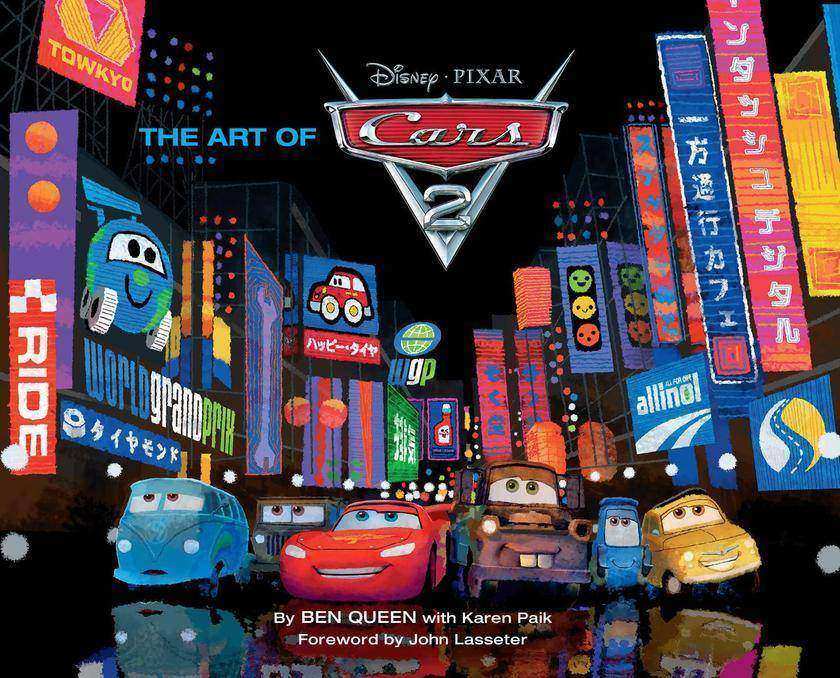
Art of Cars 2
¥305.97
Cars 2 is a globetrotting, high-octane ride through the world of Lightning McQueen, his best friend Mater, and an international collection of completely new characters. The Art of Cars 2 follows the development of the second installment in the Cars series, from the first story concepts and the filmmakers' worldwide research to the intricate "e;carified"e; details that make up the unique Cars 2 universe. Featuring the behind-the-scenes concept art that went into the film's creation--including color scripts, storyboards, character studies, environmental art, sculpts, and more--as well as a forward by director and racecar-enthusiast John Lasseter, The Art of Cars 2 celebrates the art and intrigue of this amazing new Pixar film.
Aristonenes - or, The Royal Shepherd
¥16.38
Anne Kingsmill was born in April 1661 (an exact date is not known) in Sydmonton, Hampshire.Throughout her life Anne was involved in several Court cases that dragged on for years. These involved both a share of her parents estate for her education and later her and her husband's share of an inheritance.In 1682, Anne became a maid of honour to Mary of Modena (wife of James, Duke of York, later King James II) at St James's Palace.Anne's interest in poetry began at the palace, and she started writing her own verse. The Court however was no place for a woman to display any poetic efforts. Woman were not considered suitable for such literary pursuits.At court, Anne met Colonel Heneage Finch. A courtier as well as a soldier. The couple married on 15th May 1684.

Medea - 'Let Medea fare in silence and darkness''
¥14.03
Lucius Annaeus Seneca, more readily known as Seneca the Younger, was born at Cordoba in the Roman province of Baetica in Hispania in approx 4 BC.Seneca attests that he was taken to Rome at a young age and educated in literature, grammar, and rhetoric; the standard education of high-born Romans. He also received philosophical training.Much of his life is not well documented but accounts do lean towards a pattern of ill-health at times. His breathing difficulties are thought to be the result of asthma and during his mid-twenties he contracted tuberculosis.He was sent to Egypt to live with his aunt, whose husband, Gaius Galerius, was Prefect of Egypt. In 31 AD he returned to Rome with her and, with her influence, was elected quaestor and with it the right to sit in the Roman Senate.Seneca's early career as a senator was successful and he was fulsomely praised for his oratory. A story related that emperor Caligula was so offended by Seneca's oratorical success that he ordered him to commit suicide. Seneca's ill-health prevented that.In 41 AD, Claudius became emperor, and Seneca was promptly cited by the new empress Messalina of adultery with Julia Livilla, the sister of Caligula and Agrippina.After trial the Senate pronounced a death sentence, which Claudius then commuted to exile. Seneca was to now spend the next eight years in Corsica. From this period of exile survive two of his earliest works-both consolations.In 49 AD Agrippina married her uncle Claudius, and through her Seneca was recalled to Rome. Agrippina appointed him, as tutor to her son, the future emperor Nero.Nero's early rule, during which he followed the advice of Seneca and Burrus, was competent. However, within a few years both Seneca and Burrus had lost their influence.In 58 AD the senator Publius Suillius Rufus made a series of public attacks on him saying that, Seneca had acquired a personal fortune of three hundred million sestertii. In response, Seneca brought a series of prosecutions for corruption against him. Suillius was dispatched into exile.After Burrus's death in 62 AD, Seneca's influence further declined. He adopted a quiet lifestyle at his country estates, concentrating on his studies and seldom visiting Rome. It was during these final few years that he composed two of his greatest works: 'Naturales Quaestiones'-an encyclopedia of the natural world; and his 'Letters to Lucilius'-which document his philosophical thoughts.In AD 65, Seneca was caught up in the aftermath of the Pisonian plot to kill Nero. Nero ordered him to kill himself. Seneca followed tradition by opening several veins in order to bleed to death. It was a sad conclusion for a man who has been called the first great Western thinker on the complex nature and role of gratitude in human relationships.
Malcontent - 'People don't forget. Nothing gets forgiven''
¥15.21
John Marston was born to John and Maria Marston nee Guarsi, and baptised on October 7th, 1576 at Wardington, Oxfordshire.Marston entered Brasenose College, Oxford in 1592 and earned his BA in 1594. By 1595, he was in London, living in the Middle Temple. His interests were in poetry and play writing, although his father's will of 1599 hopes that he would not further pursue such vanities.His brief career in literature began with the fashionable genres of erotic epyllion and satire; erotic plays for boy actors to be performed before educated young men and members of the inns of court.In 1598, he published 'The Metamorphosis of Pigmalion's Image and Certaine Satyres', a book of poetry. He also published 'The Scourge of Villanie', in 1598. 'Histriomastix' regarded as his first play was produced 1599. It's performance kicked off an episode in literary history known as the War of the Theatres; a literary feud between Marston, Jonson and Dekker that lasted until 1602.However, the playwrights were later reconciled; Marston wrote a prefatory poem for Jonson's 'Sejanus' in 1605 and dedicated 'The Malcontent' to him. Beyond this episode Marston's career continued to gather both strength, assets and followers. In 1603, he became a shareholder in the Children of Blackfriars company. He wrote and produced two plays with the company. The first was 'The Malcontent' in 1603, his most famous play. His second was 'The Dutch Courtesan', a satire on lust and hypocrisy, in 1604-5.In 1605, he worked with George Chapman and Ben Jonson on 'Eastward Ho', a satire of popular taste and the vain imaginings of wealth to be found in the colony of Virginia.Marston took the theatre world by surprise when he gave up writing plays in 1609 at the age of thirty-three. He sold his shares in the company of Blackfriars. His departure from the literary scene may have been because of further offence he gave to the king. The king suspended performances at Blackfriars and had Marston imprisoned.On 24th September 1609 he was made a deacon and them a priest on 24th December 1609. In October 1616, Marston was assigned the living of Christchurch, Hampshire.He died (accounts vary) on either the 24th or 25th June 1634 in London and was buried in the Middle Temple Church.

Merry Wives of Windsor - This is the short and the long of it
¥11.67
The life of William Shakespeare, arguably the most significant figure in the Western literary canon, is relatively unknown. Shakespeare was born in Stratford-upon-Avon in 1565, possibly on the 23rd April, St. George's Day, and baptised there on 26th April. Little is known of his education and the first firm facts to his life relate to his marriage, aged 18, to Anne Hathaway, who was 26 and from the nearby village of Shottery. Anne gave birth to their first son six months later. Shakespeare's first play, The Comedy of Errors began a procession of real heavyweights that were to emanate from his pen in a career of just over twenty years in which 37 plays were written and his reputation forever established. This early skill was recognised by many and by 1594 the Lord Chamberlain's Men were performing his works. With the advantage of Shakespeare's progressive writing they rapidly became London's leading company of players, affording him more exposure and, following the death of Queen Elizabeth in 1603, a royal patent by the new king, James I, at which point they changed their name to the King's Men. By 1598, and despite efforts to pirate his work, Shakespeare's name was well known and had become a selling point in its own right on title pages. No plays are attributed to Shakespeare after 1613, and the last few plays he wrote before this time were in collaboration with other writers, one of whom is likely to be John Fletcher who succeeded him as the house playwright for the King's Men. William Shakespeare died two months later on April 23rd, 1616, survived by his wife, two daughters and a legacy of writing that none have since yet eclipsed.
Yorkshire Tragedy - Yielded with coy submission, modest pride, And sweet relucta
¥23.45
Thomas Middleton was born in London in April 1580 and baptised on 18th April. Middleton was aged only five when his father died. His mother remarried but this unfortunately fell apart into a fifteen year legal dispute regarding the inheritance due Thomas and his younger sister. By the time he left Oxford, at the turn of the Century, Middleton had and published Microcynicon: Six Snarling Satirese which was denounced by the Archbishop of Canterbury and publicly burned. In the early years of the 17th century, Middleton wrote topical pamphlets. One - Penniless Parliament of Threadbare Poets was reprinted several times and the subject of a parliamentary inquiry. These early years writing plays continued to attract controversy. His writing partnership with Thomas Dekker brought him into conflict with Ben Jonson and George Chapman in the so-called War of the Theatres. His finest work with Dekker was undoubtedly The Roaring Girl, a biography of the notorious Mary Frith. In the 1610s, Middleton began another playwriting partnership, this time with the actor William Rowley, producing another slew of plays including Wit at Several Weapons and A Fair Quarrel. The ever adaptable Middleton seemed at ease working with others or by himself. His solo writing credits include the comic masterpiece, A Chaste Maid in Cheapside, in 1613. In 1620 he was officially appointed as chronologer of the City of London, a post he held until his death. The 1620s saw the production of his and Rowley's tragedy, and continual favourite, The Changeling, and of several other tragicomedies. However in 1624, he reached a peak of notoriety when his dramatic allegory A Game at Chess was staged by the King's Men. Though Middleton's approach was strongly patriotic, the Privy Council silenced the play after only nine performances at the Globe theatre, having received a complaint from the Spanish ambassador. What happened next is a mystery. It is the last play recorded as having being written by Middleton. Thomas Middleton died at his home at Newington Butts in Southwark in the summer of 1627, and was buried on July 4th, in St Mary's churchyard which today survives as a public park in Elephant and Castle.
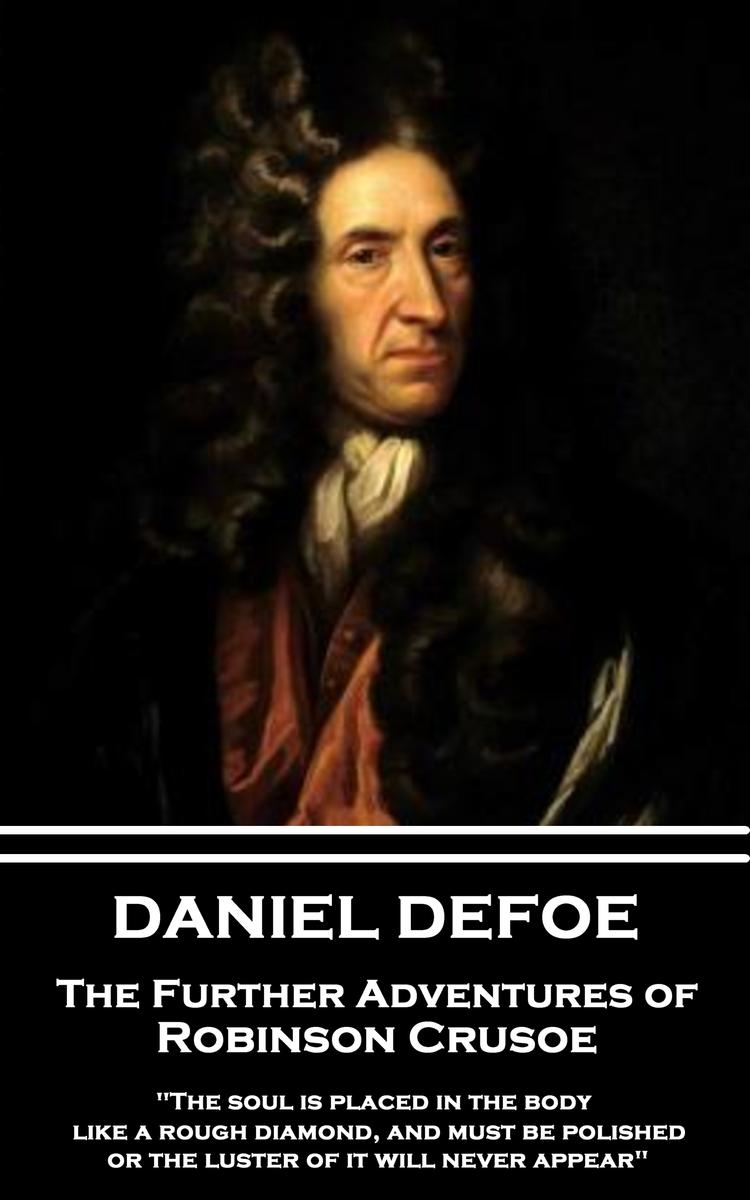
Further Adventures of Robinson Crusoe
¥29.33
Daniel Defoe is most well-known for his classic novels Robinson Crusoe and Moll Flanders. Born around 1660, he was also a journalist, a pamphleteer, a businessman, a spy. His life was long and colourful, and the breadth of his work, still highly regarded, is infused with similar vigour. It is said that only the bible has been printed in more languages than Robinson Crusoe. Defoe is also noted for being one of the earliest proponents of the novel. He was extremely prolific and a very versatile writer, producing several hundred books, pamphlets, and journals on various topics including politics, crime, religion, marriage, psychology and the supernatural. He was also a pioneer of economic journalism though was made bankrupt on more on one occasion and usually mired in debt. In later life Defoe was often most seen on Sundays when bailiffs and the like could legally make no move on him. Allegedly it was whilst hiding from creditors that he died on April 24th, 1731. He was interred in Bunhill Fields, London.
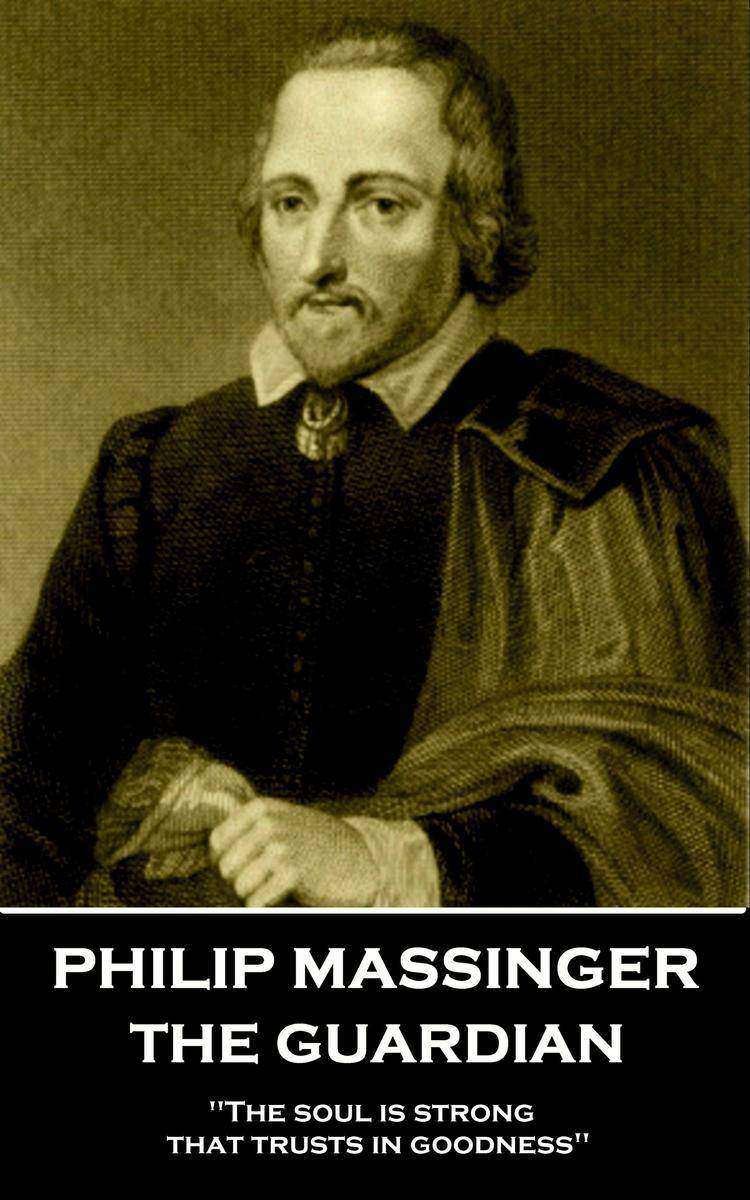
Guardian - The soul is strong that trusts in goodness
¥23.45
Philip Massinger was baptized at St. Thomas's in Salisbury on November 24th, 1583.Massinger is described in his matriculation entry at St. Alban Hall, Oxford (1602), as the son of a gentleman. His father, who had also been educated there, was a member of parliament, and attached to the household of Henry Herbert, 2nd Earl of Pembroke. The Earl was later seen as a potential patron for Massinger.He left Oxford in 1606 without a degree. His father had died in 1603, and accounts suggest that Massinger was left with no financial support this, together with rumours that he had converted to Catholicism, meant the next stage of his career needed to provide an income.Massinger went to London to make his living as a dramatist, but he is only recorded as author some fifteen years later, when The Virgin Martyr (1621) is given as the work of Massinger and Thomas Dekker.During those early years as a playwright he wrote for the Elizabethan stage entrepreneur, Philip Henslowe. It was a difficult existence. Poverty was always close and there was constant pleading for advance payments on forthcoming works merely to survive.After Henslowe died in 1616 Massinger and John Fletcher began to write primarily for the King's Men and Massinger would write regularly for them until his death.The tone of the dedications in later plays suggests evidence of his continued poverty. In the preface of The Maid of Honour (1632) he wrote, addressing Sir Francis Foljambe and Sir Thomas Bland: "e;I had not to this time subsisted, but that I was supported by your frequent courtesies and favours."e;The prologue to The Guardian (1633) refers to two unsuccessful plays and two years of silence, when the author feared he had lost popular favour although, from the little evidence that survives, it also seems he had involved some of his plays with political characters which would have cast shadows upon England's alliances.Philip Massinger died suddenly at his house near the Globe Theatre on March 17th, 1640. He was buried the next day in the churchyard of St. Saviour's, Southwark, on March 18th, 1640. In the entry in the parish register he is described as a "e;stranger,"e; which, however, implies nothing more than that he belonged to another parish.
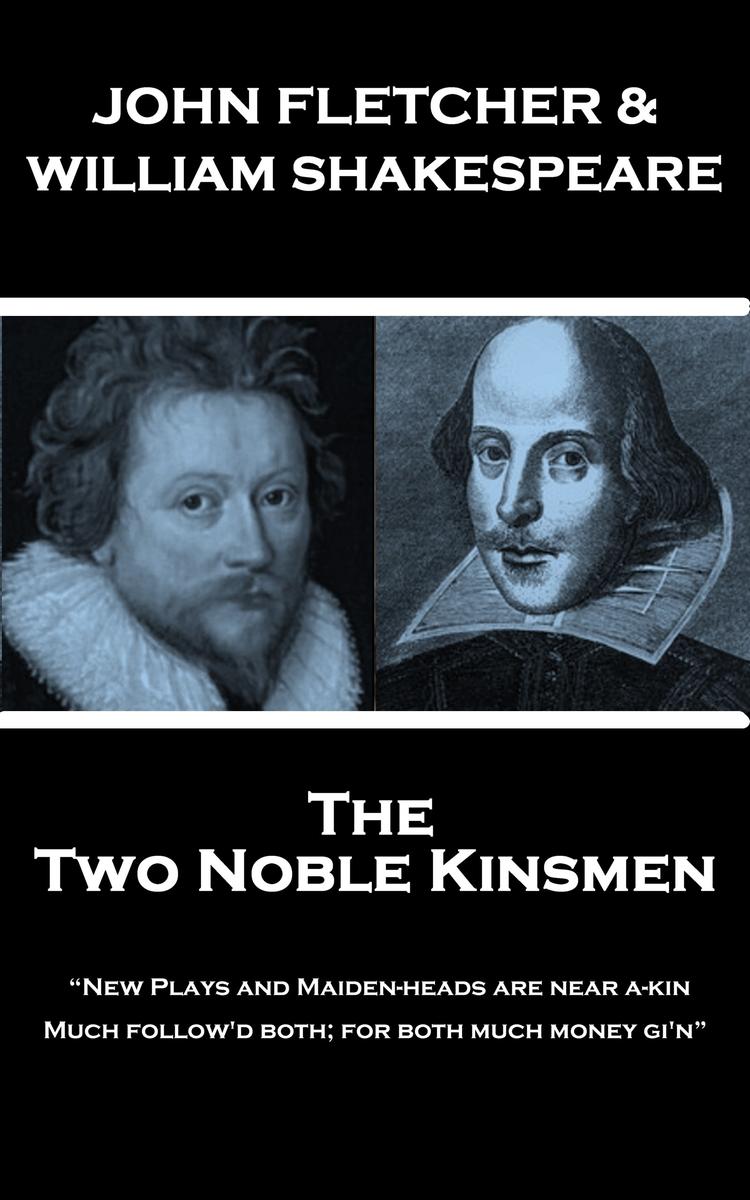
Two Noble Kinsmen - New Plays and Maiden-heads are near a-kin
¥23.45
John Fletcher was born in December, 1579 in Rye, Sussex. He was baptised on December 20th.As can be imagined details of much of his life and career have not survived and, accordingly, only a very brief indication of his life and works can be given.Young Fletcher appears at the very young age of eleven to have entered Corpus Christi College at Cambridge University in 1591. There are no records that he ever took a degree but there is some small evidence that he was being prepared for a career in the church.However what is clear is that this was soon abandoned as he joined the stream of people who would leave University and decamp to the more bohemian life of commercial theatre in London.The upbringing of the now teenage Fletcher and his seven siblings now passed to his paternal uncle, the poet and minor official Giles Fletcher. Giles, who had the patronage of the Earl of Essex may have been a liability rather than an advantage to the young Fletcher. With Essex involved in the failed rebellion against Elizabeth Giles was also tainted.By 1606 John Fletcher appears to have equipped himself with the talents to become a playwright. Initially this appears to have been for the Children of the Queen's Revels, then performing at the Blackfriars Theatre.Fletcher's early career was marked by one significant failure; The Faithful Shepherdess, his adaptation of Giovanni Battista Guarini's Il Pastor Fido, which was performed by the Blackfriars Children in 1608.By 1609, however, he had found his stride. With his collaborator John Beaumont, he wrote Philaster, which became a hit for the King's Men and began a profitable association between Fletcher and that company. Philaster appears also to have begun a trend for tragicomedy.By the middle of the 1610s, Fletcher's plays had achieved a popularity that rivalled Shakespeare's and cemented the pre-eminence of the King's Men in Jacobean London. After his frequent early collaborator John Beaumont's early death in 1616, Fletcher continued working, both singly and in collaboration, until his own death in 1625. By that time, he had produced, or had been credited with, close to fifty plays.William Shakespeare was born in Stratford-upon-Avon in late April 1565 and baptised there on 26th April. He was one of eight children.Little is known about his life but what is evident is the enormous contribution he has made to world literature.His writing was progressive, magnificent in scope and breathtaking in execution.Shakespeare's plays and sonnets helped enable the English language to speak with a voice unmatched by any other.William Shakespeare died on April 23rd 1616, survived by his wife and two daughters. He was buried two days after his death in the chancel of the Holy Trinity Church. The epitaph on the slab which covers his grave includes the following passage,Good friend, for Jesus's sake forbear, To dig the dust enclosed here. Blessed me the man that spares these stones, And cursed be he that moves my bones.
Henry VI, Part I - Defer no time, delays have dangerous ends.
¥11.67
The life of William Shakespeare, arguably the most significant figure in the Western literary canon, is relatively unknown. Shakespeare was born in Stratford-upon-Avon in 1565, possibly on the 23rd April, St. George's Day, and baptised there on 26th April. Little is known of his education and the first firm facts to his life relate to his marriage, aged 18, to Anne Hathaway, who was 26 and from the nearby village of Shottery. Anne gave birth to their first son six months later. Shakespeare's first play, The Comedy of Errors began a procession of real heavyweights that were to emanate from his pen in a career of just over twenty years in which 37 plays were written and his reputation forever established. This early skill was recognised by many and by 1594 the Lord Chamberlain's Men were performing his works. With the advantage of Shakespeare's progressive writing they rapidly became London's leading company of players, affording him more exposure and, following the death of Queen Elizabeth in 1603, a royal patent by the new king, James I, at which point they changed their name to the King's Men. By 1598, and despite efforts to pirate his work, Shakespeare's name was well known and had become a selling point in its own right on title pages. No plays are attributed to Shakespeare after 1613, and the last few plays he wrote before this time were in collaboration with other writers, one of whom is likely to be John Fletcher who succeeded him as the house playwright for the King's Men. William Shakespeare died two months later on April 23rd, 1616, survived by his wife, two daughters and a legacy of writing that none have since yet eclipsed.
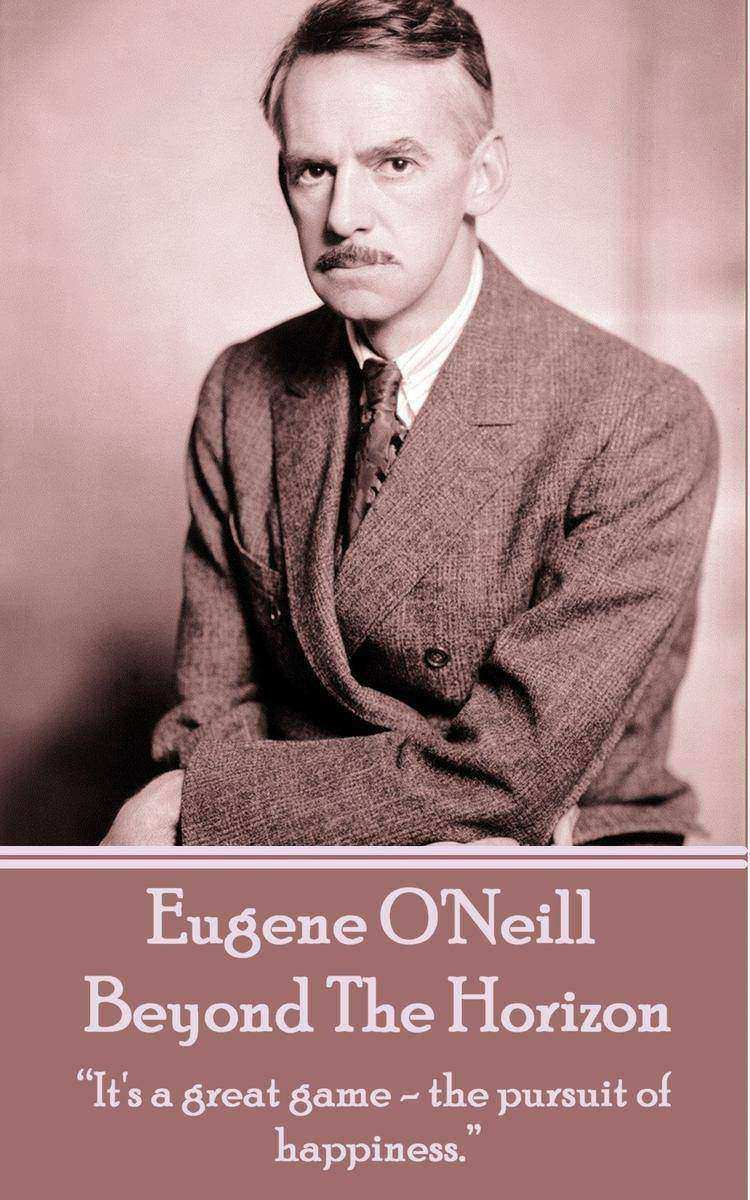
Beyond The Horizon - It's a great game - the pursuit of happiness.
¥23.45
Eugene Gladstone O'Neill was born on October 16, 1888 in a hotel bedroom in what is now Times Square, New York. Much of his childhood was spent in the comfort of books at boarding schools whilst his actor father was on the road and his Mother contended with her own demons. He spent only a year at University - Princeton - and various reasons have been given for his departure. However whatever his background and education denied or added to his development it is agreed amongst all that he was a playwright of the first rank and possibly America's greatest. His introduction of realism into American drama was instrumental in its development and paved a path for many talents thereafter. Of course his winning of both the Pulitzer Prize (4 times) and the Nobel Prize are indicative of his status. His more famous and later works do side with the disillusionment and personal tragedy of those on the fringes of society but continue to build upon ideas and structures he incorporated in his early one act plays. Eugene O'Neill suffered from various health problems, mainly depression and alcoholism. In the last decade he also faced a Parkinson's like tremor in his hands which made writing increasingly difficult. But out of such difficulties came plays of the calibre of The Iceman Cometh, Long Day's Journey Into Night, and A Moon for the Misbegotten. Eugene O'Neill died in Room 401 of the Sheraton Hotel on Bay State Road in Boston, on November 27, 1953, at the age of 65. As he was dying, he whispered his last words: "e;I knew it. I knew it. Born in a hotel room and died in a hotel room."e;
Orestes - Youth is the best time to be rich, and the best time to be poor
¥14.03
Euripides is rightly lauded as one of the great dramatists of all time. In his lifetime, he wrote over 90 plays and although only 18 have survived they reveal the scope and reach of his genius. Euripides is identified with many theatrical innovations that have influenced drama all the way down to modern times, especially in the representation of traditional, mythical heroes as ordinary people in extraordinary circumstances. As would be expected from a life lived 2,500 years ago, details of it are few and far between. Accounts of his life, written down the ages, do exist but whether much is reliable or surmised is open to debate. Most accounts agree that he was born on Salamis Island around 480 BC, to mother Cleito and father Mnesarchus, a retailer who lived in a village near Athens. Upon the receipt of an oracle saying that his son was fated to win "e;crowns of victory"e;, Mnesarchus insisted that the boy should train for a career in athletics. However, what is clear is that athletics was not to be the way to win crowns of victory. Euripides had been lucky enough to have been born in the era as the other two masters of Greek Tragedy; Sophocles and schylus. It was in their footsteps that he was destined to follow. His first play was performed some thirteen years after the first of Socrates plays and a mere three years after schylus had written his classic The Oristria. Theatre was becoming a very important part of the Greek culture. The Dionysia, held annually, was the most important festival of theatre and second only to the fore-runner of the Olympic games, the Panathenia, held every four years, in appeal. Euripides first competed in the City Dionysia, in 455 BC, one year after the death of schylus, and, incredibly, it was not until 441 BC that he won first prize. His final competition in Athens was in 408 BC. The Bacchae and Iphigenia in Aulis were performed after his death in 405 BC and first prize was awarded posthumously. Altogether his plays won first prize only five times. Euripides was also a great lyric poet. In Medea, for example, he composed for his city, Athens, "e;the noblest of her songs of praise"e;. His lyric skills however are not just confined to individual poems: "e;A play of Euripides is a musical whole....one song echoes motifs from the preceding song, while introducing new ones."e; Much of his life and his whole career coincided with the struggle between Athens and Sparta for hegemony in Greece but he didn't live to see the final defeat of his city. Euripides fell out of favour with his fellow Athenian citizens and retired to the court of Archelaus, king of Macedon, who treated him with consideration and affection. At his death, in around 406BC, he was mourned by the king, who, refusing the request of the Athenians that his remains be carried back to the Greek city, buried him with much splendor within his own dominions. His tomb was placed at the confluence of two streams, near Arethusa in Macedonia, and a cenotaph was built to his memory on the road from Athens towards the Piraeus.
Scottish History of James the Fourth
¥15.21
Robert Greene was, by the best accounts available, born in Norwich in 1558 and baptised on July 11th.Greene is believed to have been a pupil at Norwich Grammar School and then attended Cambridge receiving his B.A. in 1580, and an M.A. in 1583. He then moved to London and began an extraordinary chapter in his life as a widely published author. His literary career began with the publication of the long romance, 'Mamillia', (1580). Greene's romances were written in a highly wrought style which reached its peak in 'Pandosto' (1588) and 'Menaphon' (1589). Short poems and songs incorporated in some of the romances attest to his ability as a lyric poet. In 1588, he was granted an MA from Oxford University, almost certainly as a courtesy degree. Thereafter he sometimes placed the phrase Utruisq. Academiae in Artibus Magister', "e;Master of Arts in both Universities"e; on the title page of his works.The lack of records hinders any complete biography of Greene but he did write an autobiography of sorts, but where the balance lies between facts and artistic licence is not clearly drawn. According to that autobiography 'The Repentance of Robert Greene', Greene is alleged to have written 'A Groatsworth of Wit Bought with a Million of Repentance' during the month prior to his death, including in it a letter to his wife asking her to forgive him and stating that he was sending their son back to her. His output was prolific. Between 1583 and 1592, he published more than twenty-five works in prose, becoming one of the first authors in England to support himself with his pen in an era when professional authorship was virtually unknown.In his 'coney-catching' pamphlets, Greene fashioned himself into a well-known public figure, narrating colourful inside stories of rakes and rascals duping young gentlemen and solid citizens out of their hard-earned money. These stories, told from the perspective of a repentant former rascal, have been considered autobiographical, and to incorporate many facts of Greene's own life thinly veiled as fiction. However, the alternate account suggests that Greene invented almost everything, merely displaying his undoubted skills as a writer.In addition to his prose works, Greene also wrote several plays, none of them published in his lifetime, including 'The Scottish History of James IV', 'Alphonsus', and his greatest popular success, 'Friar Bacon and Friar Bungay', as well as 'Orlando Furioso', based on Ludovico Ariosto's Orlando Furioso.His plays earned himself the title as one of the 'University Wits', a group that included George Peele, Thomas Nashe, and Christopher Marlowe.Robert Greene died 3rd September 1592.
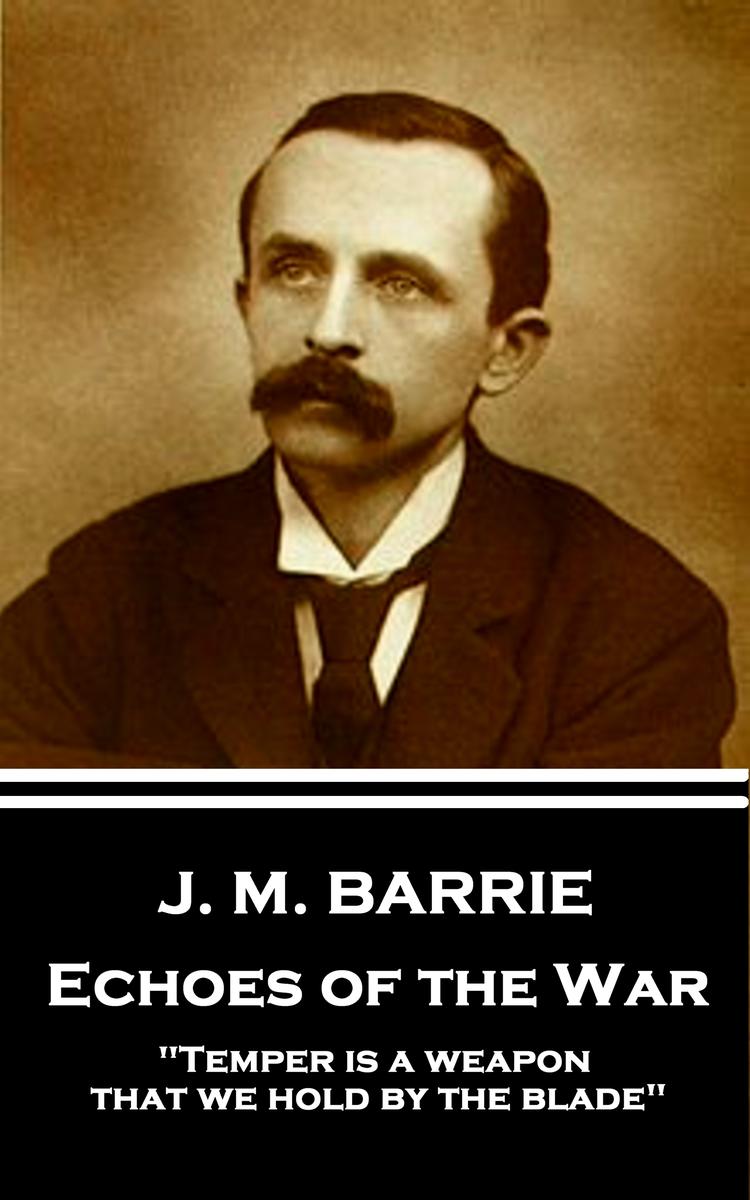
Echoes of the War - Temper is a weapon that we hold by the blade
¥16.38
Sir James Matthew Barrie, 1st Baronet, OM, was born in Kirriemuir, Angus the ninth of ten children on May 9th, 1860. From early formative experiences, Barrie knew that he wished to follow a career as an author. His family wished otherwise and sought to persuade him to choose a profession, such as the ministry. The compromise was that he would attend university to study literature at the University of Edinburgh. He graduated with an M.A. on April 21st, 1882. His first job was as a staff journalist for the Nottingham Journal. The London editor of the St. James's Gazette "e;liked that Scotch thing"e; in Barrie's short stories about his mother's early life. They also served as the basis for his first novels. Barrie though was increasingly drawn to working in the theatre. His first play, a biography of Richard Savage, was only performed once and critically panned. Undaunted he immediately followed this with Ibsen's Ghost in 1891, a parody of Ibsen's plays Hedda Gabler and Ghosts. Barrie's third play, Walker, London, in 1892 led to an introduction to his future wife, a young actress by the name of Mary Ansell. The two became friends, and she helped his family to care for him when he fell very ill in 1893 and 1894. Barrie proposed and they were married, in Kirriemuir, on July 9th, 1894. By some accounts the relationship was unconsummated and indeed the couple had no children. The story of Peter Pan had begun to formulate when Barrie became acquainted with the Llewelyn Davis family in 1897, meeting George, Jack and baby Peter with their nanny in London's Kensington Gardens. In 1901 and 1902, Barrie had back-to-back theatre successes with Quality Street and The Admirable Crichton. The character of "e;Peter Pan"e; first appeared in The Little White Bird in 1902. This most famous and enduring of his works; Peter Pan, or The Boy Who Wouldn't Grow Up had its first stage performance on December 27th, 1904. Peter Pan would overshadow everything written during his career. He continued to write for the rest of his life contributing many other fine and important works. Sir James Matthew Barrie, 1st Baronet, OM, died of pneumonia on June 19th,1937 and was buried at Kirriemuir next to his parents and two of his siblings.
Barretts of Wimpole Street
¥23.45
Rudolf Wilhelm Besier was born in Blitar, East Java, in the Dutch East Indies,on July 2nd, 1878. His father, the Dutch soldier Rudolf Wilhelm Besier, died whilst his mother, Margaret Ann Collinson, was pregnant with him. He was given his father's name in respect and remembrance. As a playwright his early career, which began with The Virgin Goddess in 1906, was somewhat limited. In 1912 he worked with HG Wells to turn Kipps into a stage play and after the war with Hugh Walpole on Robin's Father. Other plays were produced but received little attention. His great success came only in 1930. The Barretts of Wimpole Street was based on Elizabeth Barrett and Robert Browning's courtship. It was rejected by two London producers but did get to premiere at the Malvern Festival of 1930, produced by Sir Barry Jackson. (The first Malvern Drama Festival took place in 1929 dedicated to Bernard Shaw, six Shaw plays have debuted at Malvern including the 1929 English premiere of The Apple Cart, and the world premiere of Geneva in 1938). Alas, American producers were not at all interested. Twenty seven were approached and 27 rejected it. The actress Katharine Cornell however staged at the Hanna Theatre in Cleveland in 1931, and then New York where it opened on February 9th, 1931 at the Empire Theatre, starring Katharine Cornell and Brian Aherne. The Barretts of Wimpole Street became a major theatrical success and was turned, in 1934, into a glossy MGM film, starring Fredric March, Norma Shearer and Charles Laughton. The play was later used as the basis for a 1964 musical Robert and Elizabeth. Rudolf Besier died in Surrey on June 16th, 1942, at the age of 63.
Silver Box - Love has no age, no limit; and no death.
¥29.33
John Galsworthy first published in 1897 with a collection of short stories entitled "e;The Four Winds"e;. For the next 7 years he published these and all works under his pen name John Sinjohn. It was only upon the death of his father and the publication of "e;The Island Pharisees"e; in 1904 that he published as John Galsworthy. His first play, which we publish here, was The Silver Box, an immediate success when it debuted in 1906 and was followed by "e;The Man of Property"e; later that same year and was the first in the Forsyte trilogy. Whilst today he is far more well know as a Nobel Prize winning novelist then he was considered a playwright dealing with social issues and the class system. He was appointed to the Order of Merit in 1929, after earlier turning down a knighthood, and awarded the Nobel Prize in 1932 though he was too ill to attend. John Galsworthy died from a brain tumour at his London home, Grove Lodge, Hampstead on January 31st 1933. In accordance with his will he was cremated at Woking with his ashes then being scattered over the South Downs from an aeroplane.
Changeling - And with necessity, The tyrant's plea, excused his devilish deeds.
¥23.45
Thomas Middleton was born in London in April 1580 and baptised on 18th April. Middleton was aged only five when his father died. His mother remarried but this unfortunately fell apart into a fifteen year legal dispute regarding the inheritance due Thomas and his younger sister. By the time he left Oxford, at the turn of the Century, Middleton had and published Microcynicon: Six Snarling Satirese which was denounced by the Archbishop of Canterbury and publicly burned. In the early years of the 17th century, Middleton wrote topical pamphlets. One - Penniless Parliament of Threadbare Poets was reprinted several times and the subject of a parliamentary inquiry. These early years writing plays continued to attract controversy. His writing partnership with Thomas Dekker brought him into conflict with Ben Jonson and George Chapman in the so-called War of the Theatres. His finest work with Dekker was undoubtedly The Roaring Girl, a biography of the notorious Mary Frith. In the 1610s, Middleton began another playwriting partnership, this time with the actor William Rowley, producing another slew of plays including Wit at Several Weapons and A Fair Quarrel. The ever adaptable Middleton seemed at ease working with others or by himself. His solo writing credits include the comic masterpiece, A Chaste Maid in Cheapside, in 1613. In 1620 he was officially appointed as chronologer of the City of London, a post he held until his death. The 1620s saw the production of his and Rowley's tragedy, and continual favourite, The Changeling, and of several other tragicomedies. However in 1624, he reached a peak of notoriety when his dramatic allegory A Game at Chess was staged by the King's Men. Though Middleton's approach was strongly patriotic, the Privy Council silenced the play after only nine performances at the Globe theatre, having received a complaint from the Spanish ambassador. What happened next is a mystery. It is the last play recorded as having being written by Middleton. Thomas Middleton died at his home at Newington Butts in Southwark in the summer of 1627, and was buried on July 4th, in St Mary's churchyard which today survives as a public park in Elephant and Castle.
Broken Heart
¥19.91
John Ford is another of England's famed literary masters. A Playwright and Poet, he was the most important writer of Tragedies during the reign of King Charles I (1625-49). His works are beautifully poetic even whilst tackling subjects from incest to the choice between true love or forced marriage. Ford's work has endured down the centuries although little is known of his life, or, in some cases, even his contributions to his own plays when written with others. As a whole though it is a legacy of classics; powerful persuasions from driven characters and compelling narratives.
Macbeth - What's done cannot be undone.
¥11.67
The life of William Shakespeare, arguably the most significant figure in the Western literary canon, is relatively unknown. Shakespeare was born in Stratford-upon-Avon in 1565, possibly on the 23rd April, St. George's Day, and baptised there on 26th April. Little is known of his education and the first firm facts to his life relate to his marriage, aged 18, to Anne Hathaway, who was 26 and from the nearby village of Shottery. Anne gave birth to their first son six months later. Shakespeare's first play, The Comedy of Errors began a procession of real heavyweights that were to emanate from his pen in a career of just over twenty years in which 37 plays were written and his reputation forever established. This early skill was recognised by many and by 1594 the Lord Chamberlain's Men were performing his works. With the advantage of Shakespeare's progressive writing they rapidly became London's leading company of players, affording him more exposure and, following the death of Queen Elizabeth in 1603, a royal patent by the new king, James I, at which point they changed their name to the King's Men. By 1598, and despite efforts to pirate his work, Shakespeare's name was well known and had become a selling point in its own right on title pages. No plays are attributed to Shakespeare after 1613, and the last few plays he wrote before this time were in collaboration with other writers, one of whom is likely to be John Fletcher who succeeded him as the house playwright for the King's Men. William Shakespeare died two months later on April 23rd, 1616, survived by his wife, two daughters and a legacy of writing that none have since yet eclipsed.
Frogs - Under every stone lurks a politician
¥11.67
The reality is that little is known of Aristophanes actual life but eleven of his forty plays survive intact and upon those rest his deserved reputation as the Father of Comedy or, The Prince of Ancient Comedy. Accounts agree that he was born sometime between 456BC and 446 BC. Many cities claim the honor of his birthplace and the most probable story makes him the son of Philippus of gina, and therefore only an adopted citizen of Athens, a distinction which, at times could be cruel, though he was raised and educated in Athens. His plays are said to recreate the life of ancient Athens more realistically than any other author could. Intellectually his powers of ridicule were feared by his influential contemporaries; Plato himself singled out Aristophanes' play The Clouds as a slander that contributed to the trial and condemning to death of Socrates and although other satirical playwrights had also caricatured the philosopher his carried the most weight. His now lost play, The Babylonians, was denounced by the demagogue Cleon as a slander against the Athenian polis. Aristophanes seems to have taken this criticism to heart and thereafter caricatured Cleon mercilessly in his subsequent plays, especially The Knights. His life and playwriting years were undoubtedly long though again accounts as to the year of his death vary quite widely. What can be certain is that his legacy of surviving plays is in effect both a treasured legacy but also in itself the only surviving texts of Ancient Greek comedy.


