


 购物车
 个人中心

How Life Began
¥229.55
The origin of life is a hotly debated topic. The Christian Bible states that God created the heavens and the Earth, all in about seven days roughly six thousand years ago. This episode in Genesis departs markedly from scientific theories developed over the last two centuries which hold that life appeared on Earth about 3.5 billion years ago in the form of bacteria, followed by unicellular organisms half a millennia later. It is this version of genesis that Alexandre Meinesz explores in this engaging tale of life's origins and evolution.?How Life Began elucidates three origins, or geneses, of life-bacteria, nucleated cells, and multicellular organisms-and shows how evolution has sculpted life to its current biodiversity through four main events-mutation, recombination, natural selection, and geologic cataclysm.?As an ecologist who specializes in algae, the first organisms to colonize Earth, Meinesz brings a refreshingly novel voice to the history of biodiversity and emphasizes here the role of unions in organizing life. For example, the ingestion of some bacteria by other bacteria led to mitochondria that characterize animal and plant cells, and the chloroplasts of plant cells.?As Meinesz charmingly recounts, life's grandeur is a result of an evolutionary tendency toward sociality and solidarity. He suggests that it is our cohesion and collaboration that allows us to solve the environmental problems arising in the decades and centuries to come. Rooted in the science of evolution but enlivened with many illustrations from other disciplines and the arts, How Life Began?intertwines the rise of bacteria and multicellular life with Vermeer's portrait of Antoni van Leeuwenhoek, the story of Genesis and Noah, Meinesz's son's early experiences with Legos, and his own encounters with other scientists. All of this brings a very human and humanistic tone to Meinesz's charismatic narrative of the three origins of life.?

On the Nature of Limbs
¥229.55
The most prominent naturalist in Britain before Charles Darwin, Richard Owen made empirical discoveries and offered theoretical innovations that were crucial to the proof of evolution. Among his many lasting contributions to science was the first clear definition of the term homology-"e;the same organ in different animals under every variety of form and function."e; He also graphically demonstrated that all vertebrate species were built on the same skeletal plan and devised the vertebrate archetype as a representation of the simplest common form of all vertebrates.Just as Darwin's ideas continue to propel the modern study of adaptation, so too will Owen's contributions fuel the new interest in homology, organic form, and evolutionary developmental biology. His theory of the archetype and his views on species origins were first offered to the general public in On the Nature of Limbs, published in 1849. It reemerges here in a facsimile edition with introductory essays by prominent historians, philosophers, and practitioners from the modern evo-devo community.
Freudian Robot
¥247.21
The identity and role of writing has evolved in the age of digital media. But how did writing itself make digital media possible in the first placeLydia H. Liu offers here the first rigorous study of the political history of digital writing and its fateful entanglement with the Freudian unconscious.Liu's innovative analysis brings the work of theorists and writers back into conversation with one another to document significant meetings of minds and disciplines. She shows how the earlier avant-garde literary experiments with alphabetical writing and the word-association games of psychoanalysis contributed to the mathematical making of digital media. Such intellectual convergence, she argues, completed the transformation of alphabetical writing into the postphonetic, ideographic system of digital media, which not only altered the threshold of sense and nonsense in communication processes but also compelled a new understanding of human-machine interplay at the level of the unconscious.Ranging across information theory, cybernetics, modernism, literary theory, neurotic machines, and psychoanalysis, The Freudian Robot rewrites the history of digital media and the literary theory of the twentieth century.

Mapping the Nation
¥247.21
In the nineteenth century, Americans began to use maps in radically new ways. For the first time, medical men mapped diseases to understand and prevent epidemics, natural scientists mapped climate and rainfall to uncover weather patterns, educators mapped the past to foster national loyalty among students, and Northerners mapped slavery to assess the power of the South. After the Civil War, federal agencies embraced statistical and thematic mapping in order to profile the ethnic, racial, economic, moral, and physical attributes of a reunified nation. By the end of the century, Congress had authorized a national archive of maps, an explicit recognition that old maps were not relics to be discarded but unique records of the nation's past.All of these experiments involved the realization that maps were not just illustrations of data, but visual tools that were uniquely equipped to convey complex ideas and information. In Mapping the Nation, Susan Schulten charts how maps of epidemic disease, slavery, census statistics, the environment, and the past demonstrated the analytical potential of cartography, and in the process transformed the very meaning of a map.Today, statistical and thematic maps are so ubiquitous that we take for granted that data will be arranged cartographically. Whether for urban planning, public health, marketing, or political strategy, maps have become everyday tools of social organization, governance, and economics. The world we inhabit-saturated with maps and graphic information-grew out of this sea change in spatial thought and representation in the nineteenth century, when Americans learned to see themselves and their nation in new dimensions.
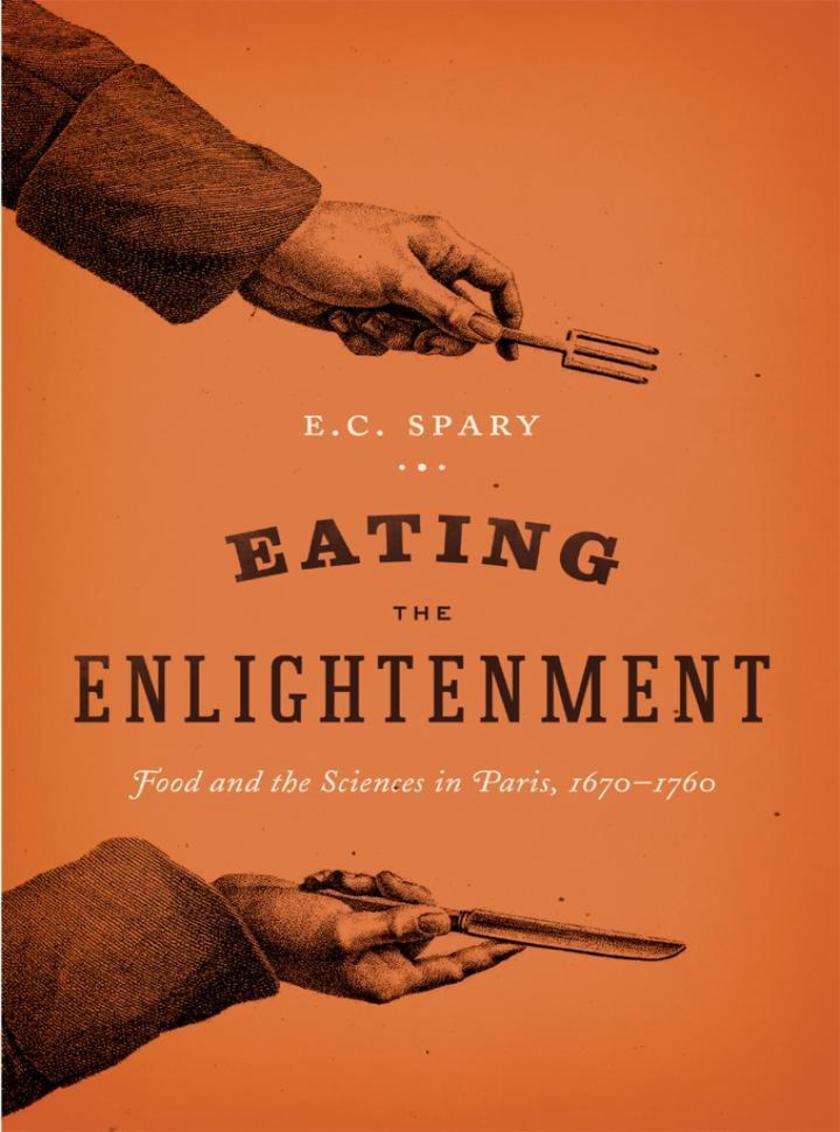
Eating the Enlightenment
¥247.21
Eating the Enlightenment offers a new perspective on the history of food, looking at writings about cuisine, diet, and food chemistry as a key to larger debates over the state of the nation in Old Regime France. Embracing a wide range of authors and scientific or medical practitioners-from physicians and poets to philosophes and playwrights-E. C. Spary demonstrates how public discussions of eating and drinking were used to articulate concerns about the state of civilization versus that of nature, about the effects of consumption upon the identities of individuals and nations, and about the proper form and practice of scholarship. En route, Spary devotes extensive attention to the manufacture, trade, and eating of foods, focusing upon coffee and liqueurs in particular, and also considers controversies over specific issues such as the chemistry of digestion and the nature of alcohol. Familiar figures such as Fontenelle, Diderot, and Rousseau appear alongside little-known individuals from the margins of the world of letters: the draughts-playing cafe owner Charles Manoury, the "e;Turkish envoy"e; Soliman Aga, and the natural philosopher Jacques Gautier d'Agoty. Equally entertaining and enlightening, Eating the Enlightenment will be an original contribution to discussions of the dissemination of knowledge and the nature of scientific authority.

Divas in the Convent
¥253.10
When eight-year-old Lucrezia Orsina Vizzana (1590-1662) entered one of the preeminent convents in Bologna in 1598, she had no idea what cloistered life had in store for her. Thanks to clandestine instruction from a local maestro di cappella-and despite the church hierarchy's vehement opposition to all convent music-Vizzana became the star of the convent, composing works so thoroughly modern and expressive that a recent critic described them as "e;historical treasures."e; But at the very moment when Vizzana's works appeared in 1623-she would be the only Bolognese nun ever to publish her music-extraordinary troubles beset her and her fellow nuns, as episcopal authorities arrived to investigate anonymous allegations of sisterly improprieties with male members of their order.?Craig A. Monson retells the story of Vizzana and the nuns of Santa Cristina to elucidate the role that music played in the lives of these cloistered women. Gifted singers, instrumentalists, and composers, these nuns used music not only to forge links with the community beyond convent walls, but also to challenge and circumvent ecclesiastical authority. Monson explains how the sisters of Santa Cristina-refusing to accept what the church hierarchy called God's will and what the nuns perceived as a besmirching of their honor-fought back with words and music, and when these proved futile, with bricks, roof tiles, and stones. These women defied one Bolognese archbishop after another, cardinals in Rome, and even the pope himself, until threats of excommunication and abandonment by their families brought them to their knees twenty-five years later. By then, Santa Cristina's imaginative but frail composer literally had been driven mad by the conflict.?Monson's fascinating narrative relies heavily on the words of its various protagonists, on both sides of the cloister wall, who emerge vividly as imaginative, independent-minded, and not always sympathetic figures. In restoring the musically gifted Lucrezia Orsina Vizzana to history, Monson introduces readers to the full range of captivating characters who played their parts in seventeenth-century convent life.?
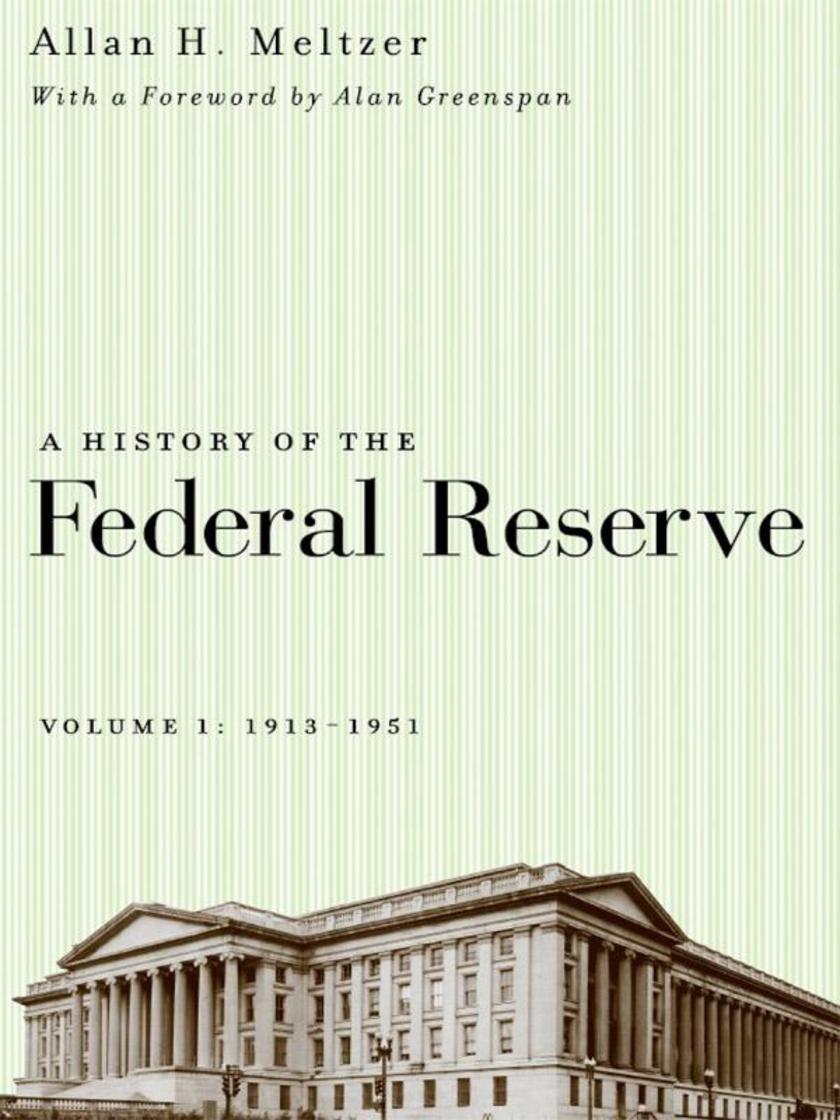
History of the Federal Reserve, Volume 1
¥265.87
Allan H. Meltzer's monumental history of the Federal Reserve System tells the story of one of America's most influential but least understood public institutions. This first volume covers the period from the Federal Reserve's founding in 1913 through the Treasury-Federal Reserve Accord of 1951, which marked the beginning of a larger and greatly changed institution.To understand why the Federal Reserve acted as it did at key points in its history, Meltzer draws on meeting minutes, correspondence, and other internal documents (many made public only during the 1970s) to trace the reasoning behind its policy decisions. He explains, for instance, why the Federal Reserve remained passive throughout most of the economic decline that led to the Great Depression, and how the Board's actions helped to produce the deep recession of 1937 and 1938. He also highlights the impact on the institution of individuals such as Benjamin Strong, governor of the Federal Reserve Bank of New York in the 1920s, who played a key role in the adoption of a more active monetary policy by the Federal Reserve. Meltzer also examines the influence the Federal Reserve has had on international affairs, from attempts to build a new international financial system in the 1920s to the Bretton Woods Agreement of 1944 that established the International Monetary Fund and the World Bank, and the failure of the London Economic Conference of 1933.Written by one of the world's leading economists, this magisterial biography of the Federal Reserve and the people who helped shape it will interest economists, central bankers, historians, political scientists, policymakers, and anyone seeking a deep understanding of the institution that controls America's purse strings."e;It was 'an unprecedented orgy of extravagance, a mania for speculation, overextended business in nearly all lines and in every section of the country.' An Alan Greenspan rumination about the irrational exuberance of the late 1990sTry the 1920 annual report of the board of governors of the Federal Reserve. . . . To understand why the Fed acted as it did-at these critical moments and many others-would require years of study, poring over letters, the minutes of meetings and internal Fed documents. Such a task would naturally deter most scholars of economic history but not, thank goodness, Allan Meltzer."e;-Wall Street Journal"e;A seminal work that anyone interested in the inner workings of the U. S. central bank should read. A work that scholars will mine for years to come."e;-John M. Berry, Washington Post"e;An exceptionally clear story about why, as the ideas that actually informed policy evolved, things sometimes went well and sometimes went badly. . . . One can only hope that we do not have to wait too long for the second installment."e;-David Laidler, Journal of Economic Literature"e;A thorough narrative history of a high order. Meltzer's analysis is persuasive and acute. His work will stand for a generation as the benchmark history of the world's most powerful economic institution. It is an impressive, even awe-inspiring achievement."e;-Sir Howard Davies, Times Higher Education Supplement

Shaky Game
¥265.87
In this new edition, Arthur Fine looks at Einstein's philosophy of science and develops his own views on realism. A new Afterword discusses the reaction to Fine's own theory."e;What really led Einstein . . . to renounce the new quantum orderFor those interested in this question, this book is compulsory reading."e;-Harvey R. Brown, American Journal of Physics"e;Fine has successfully combined a historical account of Einstein's philosophical views on quantum mechanics and a discussion of some of the philosophical problems associated with the interpretation of quantum theory with a discussion of some of the contemporary questions concerning realism and antirealism. . . . Clear, thoughtful, [and] well-written."e;-Allan Franklin, Annals of Science"e;Attempts, from Einstein's published works and unpublished correspondence, to piece together a coherent picture of 'Einstein realism.' Especially illuminating are the letters between Einstein and fellow realist Schrdinger, as the latter was composing his famous 'Schrdinger-Cat' paper."e;-Nick Herbert, New Scientist"e;Beautifully clear. . . . Fine's analysis is penetrating, his own results original and important. . . . The book is a splendid combination of new ways to think about quantum mechanics, about realism, and about Einstein's views of both."e;-Nancy Cartwright, Isis
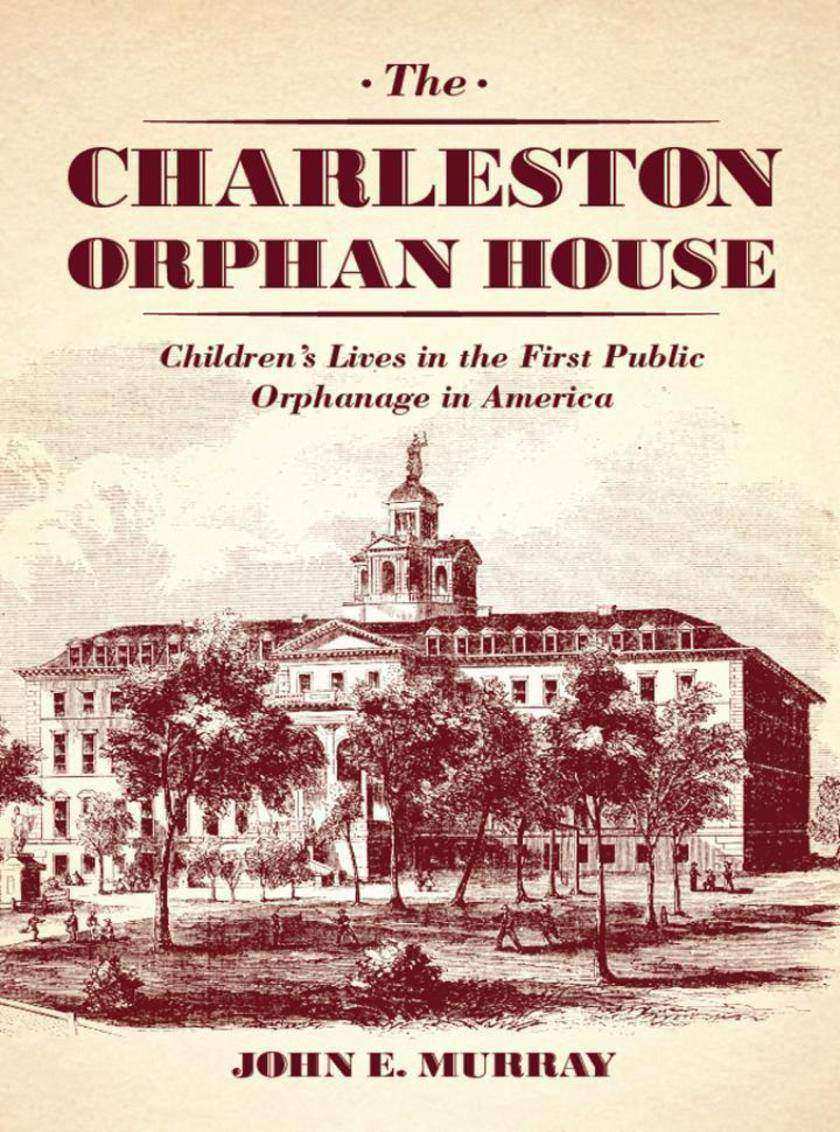
Charleston Orphan House
¥265.87
The first public orphanage in America, the Charleston Orphan House saw to the welfare and education of thousands of children from poor white families in the urban South. From wealthy benefactors to the families who sought its assistance to the artisans and merchants who relied on its charges as apprentices, the Orphan House was a critical component of the city's social fabric. By bringing together white citizens from all levels of society, it also played a powerful political role in maintaining the prevailing social order.?John E. Murray tells the story of the Charleston Orphan House for the first time through the words of those who lived there or had family members who did. Through their letters and petitions, the book follows the families from the events and decisions that led them to the Charleston Orphan House through the children's time spent there to, in a few cases, their later adult lives. What these accounts reveal are families struggling to maintain ties after catastrophic loss and to preserve bonds with children who no longer lived under their roofs.?An intimate glimpse into the lives of the white poor in early American history, The Charleston Orphan House is moreover an illuminating look at social welfare provision in the antebellum South.

Rereading the Fossil Record
¥288.41
Rereading the Fossil Record presents the first-ever historical account of the origin, rise, and importance of paleobiology, from the mid-nineteenth century to the late 1980s.?Drawing on a wealth of archival material, David Sepkoski shows how the movement was conceived and promoted by a small but influential group of paleontologists and examines the intellectual, disciplinary, and political dynamics involved in the ascendency of paleobiology. By tracing the role of computer technology, large databases, and quantitative analytical methods in the emergence of paleobiology, this book also offers insight into the growing prominence and centrality of data-driven approaches in recent science.

Nature of Diversity
¥376.70
All living things on earth-from individual species to entire ecosystems-have evolved through time, and evolution is the acknowledged framework of modern biology. Yet many areas of biology have moved from a focus on evolution to much narrower perspectives.Daniel R. Brooks and Deborah A. McLennan argue that it is impossible to comprehend the nature of life on earth unless evolution-the history of organisms-is restored to a central position in research. They demonstrate how the phylogenetic approach can be integrated with ecological and behavioral studies to produce a richer and more complete picture of evolution. Clearly setting out the conceptual, methodological, and empirical foundations of their research program, Brooks and McLennan show how scientists can use it to unravel the evolutionary history of virtually any characteristic of any living thing, from behaviors to ecosystems. They illustrate and test their approach with examples drawn from a wide variety of species and habitats.The Nature of Diversity provides a powerful new tool for understanding, documenting, and preserving the world's biodiversity. It is an essential book for biologists working in evolution, ecology, behavior, conservation, and systematics. The argument in The Nature of Diversity greatly expands upon and refines the arguments made in the authors' previous book Phylogeny, Ecology, and Behavior.
Lucretian Renaissance
¥447.34
With The Lucretian Renaissance, Gerard Passannante offers a radical rethinking of a familiar narrative: the rise of materialism in early modern Europe. Passannante begins by taking up the ancient philosophical notion that the world is composed of two fundamental opposites: atoms, as the philosopher Epicurus theorized, intrinsically unchangeable and moving about the void; and the void itself, or nothingness. Passannante considers the fact that this strain of ancient Greek philosophy survived and was transmitted to the Renaissance primarily by means of a poem that had seemingly been lost-a poem insisting that the letters of the alphabet are like the atoms that make up the universe.?By tracing this elemental analogy through the fortunes of Lucretius's On the Nature of Things, Passannante argues that, long before it took on its familiar shape during the Scientific Revolution, the philosophy of atoms and the void reemerged in the Renaissance as a story about reading and letters-a story that materialized in texts, in their physical recomposition, and in their scattering.?From the works of Virgil and Macrobius to those of Petrarch, Poliziano, Lambin, Montaigne, Bacon, Spenser, Gassendi, Henry More, and Newton, The Lucretian Renaissance recovers a forgotten history of materialism in humanist thought and scholarly practice and asks us to reconsider one of the most enduring questions of the period: what does it mean for a text, a poem, and philosophy to be "e;reborn"e;?
Heaven's Coast
¥83.03
The year is 1989 and Mark Doty's life has reached a state of enviable equilibrium. His reputation as a poet of formidable talent is growing, he enjoys his work as a college professor and, perhaps most importantly, he is deeply in love with his partner of many years, Wally Roberts. The harmonious existence these two men share is shattered, however, when they learn that Wally has tested positive for the HIV virus. From diagnosis to the initial signs of deterioration to the heartbreaking hour when Wally is released from his body's ruined vessel, Heaven's Coastis an intimate chronicle of love, its hardships, and its innumerable gifts. We witness Doty's passage through the deepest phase of grief -- letting his lover go while keeping him firmly alive in memory and heart -- and, eventually beyond, to the slow reawakening of the possibilities of pleasure. Part memoir, part journal, part elegy for a life of rare communication and beauty, Heaven's Coast evinces the same stunning honesty, resplendent de*ive power and rapt attention to the physical landscape that has won Doty's poetry such attention and acclaim.
The Official CIA Manual of Trickery and Deception
¥94.10
Magic or spycraftIn 1953, against the backdrop of the Cold War, the CIA initiated a top-secret program, code-named MKULTRA, to counter Soviet mind-control and interrogation techniques. Realizing that clandestine officers might need to covertly deploy newly developed pills, potions, and powders against the adversary, the CIA hired America's most famous magician, John Mulholland, to write two manuals on sleight of hand and undercover communication techniques. In 1973, virtually all documents related to MKULTRA were destroyed. Mulholland's manuals were thought to be among them until a single surviving copy of each, complete with illustrations, was recently discovered in the agency's archives.The manuals reprinted in this work represent the only known complete copy of Mulholland's instructions for CIA officers on the magician's art of deception and secret communications.

The Bucolic Plague
¥84.16
What happens when two New Yorkers (one an exdrag queen) do the unthinkable: start over, have a herd of kids, and get a little dirtyFind out in this riotous and moving true tale of goats, mud, and a centuries-old mansion in rustic upstate New York the new memoir by Josh Kilmer-Purcell, author of the New York Times bestseller I Am Not Myself These Days. A happy series of accidents and a doughnut-laden escape upstate take Josh and his partner, Brent, to the doorstep of the magnificent (and fabulously for sale) Beekman Mansion. One hour and one tour later, they have begun their transformation from uptight urbanites into the two-hundred-year-old-mansion-owning Beekman Boys.Suddenly, Josh a full-time New Yorker with a successful advertising career and Brent are weekend farmers, surrounded by nature's bounty and an eclectic cast: roosters who double as a wedding cover band; Bubby, the bionic cat; and a herd of eighty-eight goats, courtesy of their new caretaker, Farmer John. And soon, a fledgling business, born of a gift of handmade goat-milk soap, blossoms into a brand, Beekman 1802.The Bucolic Plague is tart and sweet, touching and laugh out loud funny, a story about approaching middle age, being in a long-term relationship, realizing the city no longer feeds you in the same way it used to, and finding new depths of love and commitment wherever you live.

Warning: Psychiatry Can Be Hazardous to Your Mental Health
¥84.16
How psychopharmacology has usurped the role of psychotherapy in our society, to the great detriment of the patients involved. William Glasser describes in Warning: Psychiatry Can Be Hazardous to Your Mental Health the sea change that has taken place in the treatment of mental health in the last few years. Millions of patients are now routinely being given pre*ions for a wide range of drugs including Ritalin, Prosac, Zoloft and related drugs which can be harmful to the brain. A previous generation of patients would have had a course of psychotherapy without brain damaging chemicals. Glasser explains the wide implications of this radical change in treatment and what can be done to counter it.

Weeds
¥95.11
The true story and true glories of the plants we love to hateFrom dandelions to crabgrass, stinging nettles to poison ivy, weeds are familiar, pervasive, widely despised, and seemingly invincible. How did they come to be the villains of the natural worldAnd why can the same plant be considered beautiful in some places but be deemed a menace in othersIn Weeds, renowned nature writer Richard Mabey embarks on an engaging journey with the verve and historical breadth of Michael Pollan. Weaving together the insights of botanists, gardeners, artists, and writers with his own travels and lifelong fascination, Mabey shows how these "botanical thugs" can destroy ecosystems but also can restore war zones and derelict cities; he reveals how weeds have been portrayed, from the "thorns and thistles" of Genesis to Shakespeare, Walden, and Invasion of the Body Snatchers; and he explains how kudzu overtook the American South, how poppies sprang up in First World War battlefields, and how "American weed" replaced the forests of Vietnam ravaged by Agent Orange. Hailed as "a profound and sympathetic meditation on weeds in relation to human beings" (Sunday Times), Weeds shows how useful these unloved plants can be, from serving as the first crops and medicines, to bur-dock inspiring the invention of Velcro, to cow parsley becoming the latest fashionable wedding adornment. Mabey argues that we have caused plants to become weeds through our reckless treatment of the earth, and he delivers a provocative defense of the plants we love to hate.
Letters from the Earth
¥94.10
I have told you nothing about man that is not true. You must pardon me if I repeat that remark now and then in these letters; I want you to take seriously the things I am telling you, and I feel that if I were in your place and you in mine, I should need that reminder from time to time, to keep my credulity from flagging.In Letters from the Earth, Twain presents himself as the Father of History -- reviewing and interpreting events from the Garden of Eden through the Fall and the Flood, translating the papers of Adam and his descendants through the generations. First published fifty years after his death, this eclectic collection is vintage Twain: sharp, witty, imaginative, complex, and wildly funny.

All Joy and No Fun
¥88.56
Thousands of books have examined the effects of parents on their children. But almost none have thought to ask: What are the effects of children on their parentsIn All Joy and No Fun, award-winning journalist Jennifer Senior tries to tackle this question, isolating and analyzing the many ways in which children reshape their parents' lives, whether it's their marriages, their jobs, their habits, their hobbies, their friendships, or their internal senses of self. She argues that changes in the last half century have radically altered the roles of today's mothers and fathers, making their mandates at once more complex and far less clear. Recruiting from a wide variety of sources in history, sociology, economics, psychology, philosophy, and anthropology she dissects both the timeless strains of parenting and the ones that are brand new, and then brings her research to life in the homes of ordinary parents around the country. The result is an unforgettable series of family portraits, starting with parents of young children and progressing to parents of teens. Through lively and accessible storytelling, Senior follows these mothers and fathers as they wrestle with some of parenthood's deepest vexations and luxuriate in some of its fi nest rewards.Meticulously researched yet imbued with emotional intelligence, All Joy and No Fun makes us reconsider some of our culture's most basic beliefs about parenthood, all while illuminating the profound ways children deepen and add purpose to our lives. By focusing on parenthood, rather than parenting, the book is original and essential reading for mothers and fathers of today and tomorrow.

Paris Without End
¥90.51
Hadley Richardson and Ernest Hemingway were the golden couple of Paris in the twenties, the center of an expatriate community boasting the likes of Scott and Zelda Fitzgerald, Gertrude Stein and Alice B. Toklas, and James and Nora Joyce. In this haunting account of the young Hemingways, Gioia Diliberto explores their passionate courtship, their family life in Paris with baby Bumby, and their thrilling, adventurous relationship a literary love story scarred by Hadley's loss of the only copy of Hemingway's first novel and ultimately destroyed by a devastating manage trois on the French Riviera.Compelling, illuminating, poignant, and deeply insightful, Paris Without End provides a rare, intimate glimpse of the writer who so fully captured the American imagination and the remarkable woman who inspired his passion and his art the only woman Hemingway never stopped loving.

Stairway To Heaven
¥101.00
No one knew Led Zeppelin like Richard Cole. The band's tour manager for more than a decade, Cole was there when they burst onto the music scene, achieved cult status, cut platinum records, and transformed popular music. Second only to the Beatles in sales for years, Led Zeppelin was rock's premier group. But unlike the boys from Liverpool, the excitement of this band"s music was matched by the fever pitch of their antics on and off the stage....In hotel rooms and stadiums, in a customized private Boeing 707 jet and country estates, Richard Cole saw it all -- and here he tells it all in this close-up, down-and-dirty, no-holds-barred account that records the highs, the lows, and the occasional in-betweens. This revised edition brings fans up to date on the band members' lives and careers, which may be a little quieter now, but their songs remain the same.


