


 购物车
购物车 个人中心
个人中心
Puppet 2.7 Cookbook
¥80.65
This book is written in a Cookbook style showing you how to set up and expand your Puppet infrastructure. It progresses through detailed information on the language and features, external tools, reporting, monitoring, and troubleshooting, and concludes with many specific recipes for managing popular applications. The book assumes that the reader already has a working Puppet installation and perhaps has written some basic manifests or adapted some published modules. It also requires some experience of Linux systems administration, including familiarity with the command line, file system, and text editing. No programming experience is required.
iClone 4.31 3D Animation Beginner's Guide
¥80.65
This book is a part of the Beginner's guide series, wherein you will quickly start doing tasks with precise instructions. Then the tasks will be followed by explanation and then a challenging task or a multiple choice question about the topic just covered. Do you have a story to tell or an idea to illustrateThis book is aimed at film makers, video producers/compositors, vxf artists or 3D artists/designers like you who have no previous experience with iClone. If you have that drive inside you to entertain people via the internet on sites like YouTube or Vimeo, create a superb presentation video, showcase a product or create a movie, or get a fast start on the iClone program, this Beginner’s guide was written with you in mind.
Microsoft SharePoint 2010 Power User Cookbook
¥80.65
This hands-on cookbook takes readers through many highly applicable intermediate and advanced SharePoint recipes, as well as offering three real-world business scenarios to complement the knowledge already gained. The book specifically sets out to cover important SharePoint 2010 topics that are often avoided by other authors. If you are an advanced End User or Power User of SharePoint 2010 who wants to accomplish specific business tasks beyond the basics, then this cookbook is not to be missed. You should already be comfortable with SharePoint in order to get the most out the recipes, which are applicable up to and including SharePoint Enterprise edition. You'll find this book useful not only as a learning tool, but also as a reference guide as your SharePoint skills and experience increase.
IBM WebSphere Application Server 8.0 Administration Guide
¥107.90
IBM WebSphere Application Server 8.0 Administration Guide is a highly practical, example-driven tutorial. You will be introduced to WebSphere Application Server 8.0, and guided through configuration, deployment, and tuning for optimum performance. If you are an administrator who wants to get up and running with IBM WebSphere Application Server 8.0, then this book is not to be missed. Experience with WebSphere and Java would be an advantage, but is not essential.
Learning jQuery, Third Edition
¥71.93
Step through each of the core concepts of the jQuery library, building an overall picture of its capabilities. Once you have thoroughly covered the basics, the book returns to each concept to cover more advanced examples and techniques. This book is for web designers who want to create interactive elements for their designs, and for developers who want to create the best user interface for their web applications. Basic JavaScript programming and knowledge of HTML and CSS is required. No knowledge of jQuery is assumed, nor is experience with any other JavaScript libraries.
Unity 3.x Game Development by Example Beginner's Guide
¥80.65
The book takes a clear, step-by-step approach to building small, simple game projects. It focuses on short, attainable goals so that the reader can finish something, instead of trying to create a complex RPG or open-world game that never sees the light of day. This book encourages readers hungry for knowledge. It does not go into gory detail about how every little knob and dial functions – that's what the software manual is for! Rather, this book is the fastest path from zero to finished game using the Unity game engine. If you've ever wanted to develop games, but have never felt "smart" enough to deal with complex programming, this book is for you. It's also a great kick-start for developers coming from other tools like Flash, Unreal Engine, and Game Maker Pro.
CentOS High Performance
¥63.21
Create high availability clusters to enhance system performance using CentOS 7About This BookMaster the concepts of high performance and high availability to eliminate performance bottlenecksMaximize the uptime of services running in a CentOS 7 clusterA step-by-step guide that will provide knowledge of methods and approaches to optimize the performance of CentOS clustersWho This Book Is ForThis book is targeted at system administrators: those who want a detailed, step-by-step guide to learn how to set up a high-availability CentOS 7 cluster, and those who are looking for a reference book to help them learn or refresh the necessary skills to ensure their systems and respective resources are utilized optimally. No previous knowledge of high-availability systems is needed, though the reader is expected to have at least some degree of familiarity with any spin-off of the Fedora family of Linux distributions, preferably CentOS.What You Will LearnInstall a CentOS 7 cluster and network infrastructureConfigure firewall, networking, and clustering services and settingsSet up and test a HAC (high-availability cluster) to host an Apache web server and a MariaDB database serverMonitor performance and availabilityIdentify bottlenecks and troubleshoot issuesImprove performance and ensure high availabilityIn DetailCentOS is the enterprise level Linux OS, which is 100% binary compatible to Red Hat Enterprise Linux (RHEL). It acts as a free alternative to RedHat's commercial Linux offering, with only a change in the branding. A high performance cluster consists in a group of computers that work together as one set parallel, hence minimizing or eliminating the downtime of critical services and enhancing the performance of the application.Starting with the basic principles of clustering, you will learn the necessary steps to install a cluster with two CentOS 7 servers. We will then set up and configure the basic required network infrastructure and clustering services. Further, you will learn how to take a proactive approach to the split-brain issue by configuring the failover and fencing of the cluster as a whole and the quorum of each node individually. Further, we will be setting up HAC and HPC clusters as a web server and a database server. You will also master the art of monitoring performance and availability, identifying bottlenecks, and exploring troubleshooting techniques.At the end of the book, you’ll review performance-tuning techniques for the recently installed cluster, test performance using a payload simulation, and learn the necessary skills to ensure that the systems, and the corresponding resources and services, are being utilized to their best capacity.Style and approachAn easy-to-follow and step-by-step guide with hands-on instructions to set up real-world simple cluster scenarios that will start you on the path to building more complex applications on your own.
Mastering Kali Linux Wireless Pentesting
¥90.46
Test your wireless network’s security and master advanced wireless penetration techniques using Kali LinuxAbout This BookDevelop your skills using attacks such as wireless cracking, Man-in-the-Middle, and Denial of Service (DOS), as well as extracting sensitive information from wireless networksPerform advanced wireless assessment and penetration testsUse Embedded Platforms, Raspberry PI, and Android in wireless penetration testing with Kali LinuxWho This Book Is ForIf you are an intermediate-level wireless security consultant in Kali Linux and want to be the go-to person for Kali Linux wireless security in your organisation, then this is the book for you. Basic understanding of the core Kali Linux concepts is expected.What You Will LearnFingerprint wireless networks with the various tools available in Kali LinuxLearn various techniques to exploit wireless access points using CSRFCrack WPA/WPA2/WPS and crack wireless encryption using Rainbow tables more quicklyPerform man-in-the-middle attack on wireless clientsUnderstand client-side attacks, browser exploits, Java vulnerabilities, and social engineeringDevelop advanced sniffing and PCAP analysis skills to extract sensitive information such as DOC, XLS, and PDF documents from wireless networksUse Raspberry PI and OpenWrt to perform advanced wireless attacksPerform a DOS test using various techniques and toolsIn DetailKali Linux is a Debian-based Linux distribution designed for digital forensics and penetration testing. It gives access to a large collection of security-related tools for professional security testing - some of the major ones being Nmap, Aircrack-ng, Wireshark, and Metasploit.This book will take you on a journey where you will learn to master advanced tools and techniques to conduct wireless penetration testing with Kali Linux.You will begin by gaining an understanding of setting up and optimizing your penetration testing environment for wireless assessments. Then, the book will take you through a typical assessment from reconnaissance, information gathering, and scanning the network through exploitation and data extraction from your target. You will get to know various ways to compromise the wireless network using browser exploits, vulnerabilities in firmware, web-based attacks, client-side exploits, and many other hacking methods. You will also discover how to crack wireless networks with speed, perform man-in-the-middle and DOS attacks, and use Raspberry Pi and Android to expand your assessment methodology.By the end of this book, you will have mastered using Kali Linux for wireless security assessments and become a more effective penetration tester and consultant.Style and approachThis book uses a step-by-step approach using real-world attack scenarios to help you master the wireless penetration testing techniques.
F# for Machine Learning Essentials
¥71.93
Get up and running with machine learning with F# in a fun and functional wayAbout This BookDesign algorithms in F# to tackle complex computing problemsBe a proficient F# data scientist using this simple-to-follow guideSolve real-world, data-related problems with robust statistical models, built for a range of datasetsWho This Book Is ForIf you are a C# or an F# developer who now wants to explore the area of machine learning, then this book is for you. Familiarity with theoretical concepts and notation of mathematics and statistics would be an added advantage.What You Will LearnUse F# to find patterns through raw dataBuild a set of classification systems using Accord.NET, Weka, and F#Run machine learning jobs on the Cloud with MBracePerform mathematical operations on matrices and vectors using Math.NETUse a recommender system for your own problem domainIdentify tourist spots across the globe using inputs from the user with decision tree algorithmsIn DetailThe F# functional programming language enables developers to write simple code to solve complex problems. With F#, developers create consistent and predictable programs that are easier to test and reuse, simpler to parallelize, and are less prone to bugs.If you want to learn how to use F# to build machine learning systems, then this is the book you want.Starting with an introduction to the several categories on machine learning, you will quickly learn to implement time-tested, supervised learning algorithms. You will gradually move on to solving problems on predicting housing pricing using Regression Analysis. You will then learn to use Accord.NET to implement SVM techniques and clustering. You will also learn to build a recommender system for your e-commerce site from scratch. Finally, you will dive into advanced topics such as implementing neural network algorithms while performing sentiment analysis on your data.Style and approachThis book is a fast-paced tutorial guide that uses hands-on examples to explain real-world applications of machine learning. Using practical examples, the book will explore several machine learning techniques and also describe how you can use F# to build machine learning systems.
ASP.NET jQuery Cookbook - Second Edition
¥99.18
Over 60 recipes for writing client * in ASP.NET 4.6 applications using jQueryAbout This BookThis is a step-by-step guide to solve common problems in ASP.NET applicationsEasy-to-follow recipes to write client *s effortlessly and quicklyA hands-on approach that will show you how to interface jQuery with ASP.NET websites and MVCWho This Book Is ForThis book is for ASP.NET developers who want to use jQuery to write client *s for cross-browser compatibility. The book assumes no prior knowledge of ASP.NET or jQuery, and every recipe is self-contained and explained in an easy-to-follow manner. Familiarity with Visual Studio and MS SQL Server is preferred, but not compulsory.What You Will LearnDownload and include jQuery in ASP.NET websites and MVCUse jQuery selectors with ASP.NET server controlsGet to know about event handling and DOM traversalDeploy jQuery for visual effects and animationsDevelop AJAX-enabled ASP.NET applicationsCreate your own pluginsSolve common problems using less code and cut down your development timeIn DetailjQuery is a lightweight JavaScript library that has changed the landscape of client *ing in web applications. Developed by John Resig in 2006, it has taken the web by storm because of its cross-browser compatibility and the ability to get more done with less code. It has gained popularity with ASP.NET developers and is now distributed with Visual Studio and the NuGet package manager.ASP.NET jQuery Cookbook explores the wide range of utilities that the jQuery library provides. It teaches you the nitty-gritty of plugging in these features in ASP.NET web applications. It covers every aspect of interfacing the library, right from downloading and including jQuery on web pages to selecting controls, handling events, and creating animations. This book also walks you through DOM traversal and manipulation in ASP.NET and then through visual effects and graphics in ASP.NET sites. It explores advanced features such as posting AJAX requests and writing plugins. It will provide you with all the information you need to use this library confidently with ASP.NET.Style and approachThis book takes a hands-on, pragmatic approach to solving common problems in ASP.NET applications using jQuery. Every recipe has detailed steps with screen captures and code snippets. The necessary theoretical concepts are introduced as and when needed.
ARM? Cortex? M4 Cookbook
¥99.18
Over 50 hands-on recipes that will help you develop amazing real-time applications using GPIO, RS232, ADC, DAC, timers, audio codecs, graphics LCD, and a touch screen About This Book This book focuses on programming embedded systems using a practical approach Examples show how to use bitmapped graphics and manipulate digital audio to produce amazing games and other multimedia applications The recipes in this book are written using ARM’s MDK Microcontroller Development Kit which is the most comprehensive and accessible development solution Who This Book Is For This book is aimed at those with an interest in designing and programming embedded systems. These could include electrical engineers or computer programmers who want to get started with microcontroller applications using the ARM Cortex-M4 architecture in a short time frame. The book’s recipes can also be used to support students learning embedded programming for the first time. Basic knowledge of programming using a high level language is essential but those familiar with other high level languages such as Python or Java should not have too much difficulty picking up the basics of embedded C programming. What You Will Learn Use ARM’s uVision MDK to configure the microcontroller run time environment (RTE), create projects and compile download and run simple programs on an evaluation board. Use and extend device family packs to configure I/O peripherals. Develop multimedia applications using the touchscreen and audio codec beep generator. Configure the codec to stream digital audio and design digital filters to create amazing audio effects. Write multi-threaded programs using ARM’s real time operating system (RTOS). Write critical sections of code in assembly language and integrate these with functions written in C. Fix problems using ARM’s debugging tool to set breakpoints and examine variables. Port uVision projects to other open source development environments. In Detail Embedded microcontrollers are at the core of many everyday electronic devices. Electronic automotive systems rely on these devices for engine management, anti-lock brakes, in car entertainment, automatic transmission, active suspension, satellite navigation, etc. The so-called internet of things drives the market for such technology, so much so that embedded cores now represent 90% of all processor’s sold. The ARM Cortex-M4 is one of the most powerful microcontrollers on the market and includes a floating point unit (FPU) which enables it to address applications. The ARM Cortex-M4 Microcontroller Cookbook provides a practical introduction to programming an embedded microcontroller architecture. This book attempts to address this through a series of recipes that develop embedded applications targeting the ARM-Cortex M4 device family. The recipes in this book have all been tested using the Keil MCBSTM32F400 board. This board includes a small graphic LCD touchscreen (320x240 pixels) that can be used to create a variety of 2D gaming applications. These motivate a younger audience and are used throughout the book to illustrate particular hardware peripherals and software concepts. C language is used predominantly throughout but one chapter is devoted to recipes involving assembly language. Programs are mostly written using ARM’s free microcontroller development kit (MDK) but for those looking for open source development environments the book also shows how to configure the ARM-GNU toolchain. Some of the recipes described in the book are the basis for laboratories and assignments undertaken by undergraduates. Style and approach The ARM Cortex-M4 Cookbook is a practical guide full of hands-on recipes. It follows a step-by-step approach that allows you to find, utilize and learn ARM concepts quickly.
Swift 2 By Example
¥80.65
Create robust and extensible iOS apps using the advanced features of Swift 2 About This Book Get up to speed with the new features of Swift 2 by following the exhaustive examples in this book Specialize in developing real iOS apps, and 2D and 3D videogames using Swift and Cocoapods Learn how to build server API apps to feed your iOS client apps Who This Book Is For This book is ideal for those who want to learn to develop app in Swift, starting the right way. Whether you are an expert Objective-C programmer or are new to this platform, you’ll quickly grasp the code of real world apps, and discover how to use Swift effectively. Prior experience in development for Apple devices would be helpful, but is not mandatory. What You Will Learn Create a server in Swift to deliver JSON data to an iOS app Take advantage of Cocoapods to use third-party libraries Use a clean and effective architecture to decrease complexity and speed up development Take advantage of the most useful parts of the iOS SDK Build games with SpriteKit and SceneKit Develop an app running on the cloud to act as an API server for your client’s apps In Detail Swift is no longer the unripe language it was when launched by Apple at WWDC14, now it’s a powerful and ready-for-production programming language that has empowered most new released apps. Swift is a user-friendly language with a smooth learning curve; it is safe, robust, and really flexible. Swift 2 is more powerful than ever; it introduces new ways to solve old problems, more robust error handling, and a new programming paradigm that favours composition over inheritance. Swift 2 by Example is a fast-paced, practical guide to help you learn how to develop iOS apps using Swift. Through the development of seven different iOS apps and one server app, you’ll find out how to use either the right feature of the language or the right tool to solve a given problem. We begin by introducing you to the latest features of Swift 2, further kick-starting your app development journey by building a guessing game app, followed by a memory game. It doesn’t end there, with a few more apps in store for you: a to-do list, a beautiful weather app, two games: Flappy Swift and Cube Runner, and finally an ecommerce app to top everything off. By the end of the book, you’ll be able to build well-designed apps, effectively use AutoLayout, develop videogames, and build server apps. Style and approach These easy-to-follow tutorials show you how to build real-world apps. The difficulty and complexity level increases chapter by chapter. Each chapter is dedicated to build a new app, beginning from a basic and unstyled app through to a full 3D game. The last two chapters show you how to build a complete client-server ecommerce app right from scratch.
Raspberry Pi Computer Architecture Essentials
¥71.93
Explore Raspberry Pi's architecture through innovative and fun projects About This Book Explore Raspberry Pi 2’s hardware through the Assembly, C/C++, and Python programming languages Experiment with connecting electronics up to your Raspberry Pi 2 and interacting with them through software Learn about the Raspberry Pi 2 architecture and Raspbian operating system through innovative projects Who This Book Is For Raspberry Pi Computer Architecture Essentials is for those who are new and those who are familiar with the Raspberry Pi. Each topic builds upon earlier ones to provide you with a guide to Raspberry Pi’s architecture. From the novice to the expert, there is something for everyone. A basic knowledge of programming and Linux would be helpful but is not required. What You Will Learn Set up your Raspberry Pi 2 and learn about its hardware Write basic programs in Assembly Language to learn about the ARM architecture Use C and C++ to interact with electronic components Find out about the Python language and how to use it to build web applications Interact with third-party microcontrollers Experiment with graphics and audio programming Expand Raspberry Pi 2’s storage mechanism by using external devices Discover Raspberry Pi 2’s GPIO pins and how to interact with them In Detail With the release of the Raspberry Pi 2, a new series of the popular compact computer is available for you to build cheap, exciting projects and learn about programming. In this book, we explore Raspberry Pi 2’s hardware through a number of projects in a variety of programming languages. We will start by exploring the various hardware components in detail, which will provide a base for the programming projects and guide you through setting up the tools for Assembler, C/C++, and Python. We will then learn how to write multi-threaded applications and Raspberry Pi 2’s multi-core processor. Moving on, you’ll get hands on by expanding the storage options of the Raspberry Pi beyond the SD card and interacting with the graphics hardware. Furthermore, you will be introduced to the basics of sound programming while expanding upon your knowledge of Python to build a web server. Finally, you will learn to interact with the third-party microcontrollers. From writing your first Assembly Language application to programming graphics, this title guides you through the essentials. Style and approach This book takes a step-by-step approach to exploring Raspberry Pi’s architecture through projects that build upon each other. Each project provides you with new information on how to interact with an aspect of the Raspberry Pi and Raspbian operating system, providing a well-rounded guide.
Learning Responsive Data Visualization
¥80.65
Master the art of building responsive visualizations on the Web About This Book Learn the techniques for building data visualizations that work well for all screen sizes Implement responsive techniques with popular libraries to get to grips with building responsive visualizations that work in the real world Incorporate responsive workflow in your data visualization process to build visualizations that take a mobile-first approach. Who This Book Is For Web developers and data science professionals who want to make their visualizations work for smaller screen sizes. Some basic knowledge of JavaScript and Data visualization is expected. What You Will Learn Get familiar with responsive design for data visualizations Understand the main concepts of D3.js to create interactive visualizations Unleash the power of Bootstrap to create stunning and responsive visualizations for all screen resolutions Implement Touch and Mouse interactions for mobile-first applications Design Transitions and Animations that impress in portrait and landscape Build a Responsive World Map using GeoJSON and D3.js In Detail Using D3.js and Responsive Design principles, you will not just be able to implement visualizations that look and feel awesome across all devices and screen resolutions, but you will also boost your productivity and reduce development time by making use of Bootstrap—the most popular framework for developing responsive web applications. This book teaches the basics of scalable vector graphics (SVG), D3.js, and Bootstrap while focusing on Responsive Design as well as mobile-first visualizations; the reader will start by discovering Bootstrap and how it can be used for creating responsive applications, and then implement a basic bar chart in D3.js. You will learn about loading, parsing, and filtering data in JavaScript and then dive into creating a responsive visualization by using Media Queries, responsive interactions for Mobile and Desktop devices, and transitions to bring the visualization to life. In the following chapters, we build a fully responsive interactive map to display geographic data using GeoJSON and set up integration testing with Protractor to test the application across real devices using a mobile API gateway such as AWS Device Farm. You will finish the journey by discovering the caveats of mobile-first applications and learn how to master cross-browser complications. Style and approach As the world shifts to mobile devices for consuming data on the Web, developers are faced with the unique challenge of making data visualizations work for their smaller screens. The growth of responsive web design enabled developers to adopt page layouts and media for smaller screens, but there is still little information available on how to adapt data visualizations for the smaller screens. This book fills this important gap and shows how responsive web design principles can be extended to create visualizations that work well regardless of the screen size, thereby allowing developers to build user-friendly visualizations that work well on all devices. In addition to covering some of the popular techniques and design patterns for building responsive visualizations, the book also shows readers how to implement these techniques with the help of some popular tools and libraries.
Learning SQLite for iOS
¥54.49
Extend SQLite with mobile development skills to build great apps for iOS devices About This Book Implement Swift code using SQLite statements Learn the background to SQL and SQLite for mobile development, its statements, and command features through practical examples Extend the standard SQLite functionality and increase your software creation portfolio Who This Book Is For This book is intended for those who want to learn about SQLite and how to develop apps in Swift or HTML5 using SQLite. Whether you are an expert Objective-C programmer or new to this platform, you'll learn quickly, grasping the code in real-world apps to use Swift. What You Will Learn Explore Swift's basic language statements Connect to SQLite and execute SQL statements Extend the SQLite language to create your own software extensions Use HTML5 with Phonegap on iOS Set up a Swift project using XCode with SQLite Administer SQLite databases in an easy and effective way In Detail The ability to use SQLite with iOS provides a great opportunity to build amazing apps. Apple's iOS SDK provides native support for SQLite databases. This combination offers the potential to create powerful, data-persistent applications. This book starts with the architecture of SQLite database and introduces you to concepts in SQL . You will find yourself equipped to design your own database system, administer it, and maintain it. Further, you will learn how to operate your SQLite databases smoothly using SQL commands. You will be able to extend the functionality of SQLite by using its vast arsenal of C API calls to build some interesting, exciting, new, and intelligent data-driven applications. Understand how Xcode, HTML5, and Phonegap can be used to build a cross-platform modern app which can benefit from all these technologies - all through creating a complete, customizable application skeleton that you can build on for your own apps. Style and approach This book is a practical and comprehensive guide to developing applications using SQLite and iOS.
jQuery Mobile Web Development Essentials - Third Edition
¥80.65
Build a powerful and practical jQuery-based framework in order to create mobile-optimized websites About This Book Build websites with jQuery Mobile that work beautifully across a wide range of mobile devices Become a competent jQuery Mobile developer and learn the building blocks of jQuery Mobile’s component-driven design This book covers key concepts but with a focus on providing the practical skills required Who This Book Is For This book is for any web developer who is looking to create mobile-optimized websites. Basic knowledge of HTML is required. Minor familiarity with JavaScript would help but is not required. What You Will Learn Create mobile-optimized sites using simple HTML Structure your sites so users can browse them on mobile devices Find out how to work with multiple pages in the JQM framework and embed multiple pages in HTML files Enhance simple pages using various toolbars Include mobile-optimized forms for interactive sites Convert desktop sites into mobile versions Use HTML5’s local storage feature in jQuery Mobile to include persistent client-side storage Explore the rich sets of widgets and themes available and discover how to modify them for use in your jQuery Mobile site In Detail jQuery Mobile is a HTML5-based touch-optimized web framework. jQuery Mobile can be used to build responsive cross-platform websites and apps for a wide range of smartphones, tablets, and desktop devices. The jQuery Mobile framework can be integrated with other mobile app frameworks such as PhoneGap, IBM Worklight, and more. Introduction to jQuery Mobile explains how to add the framework to your HTML pages to create rich, mobile-optimized web pages with minimal effort. You’ll learn how to use jQuery Mobile’s automatic enhancements and configure the framework for customized, powerful mobile-friendly websites. We then dig into forms, events, and styling. You'll see how jQuery Mobile automatically enhances content, and will find out how to use the JavaScript API to build complex sites. We’ll introduce you to how jQuery Mobile can be themed as well looking into how JavaScript can be used for deep sets of customizations. The examples are ready to run and can be used to help kick-start your own site. Along the way, you will leverage all the concepts you learn to build three sample mobile applications. Style and approach Through a set of easy to follow instructions, we’ll show you how to use jQuery Mobile’s features one easy-to-use widget at a time. You’ll see examples for each feature as well as screenshots to demonstrate what they should look like on a mobile device. You can then take these example files and modify them as you learn to experiment.
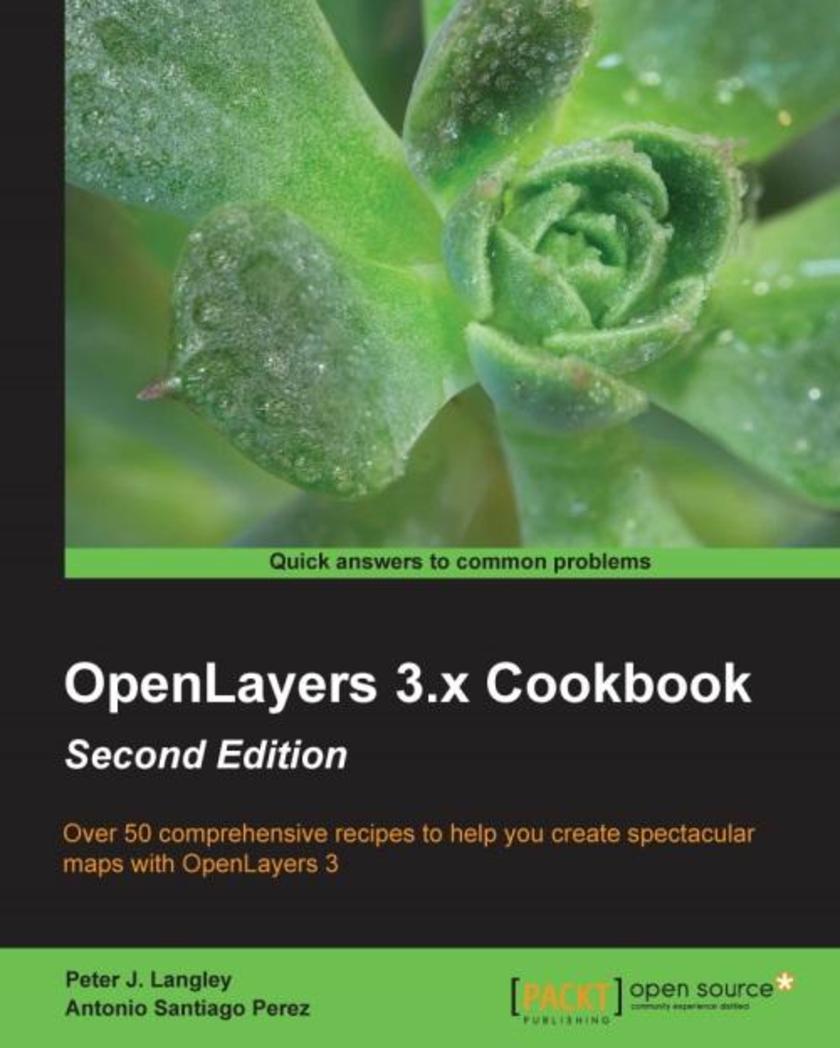
OpenLayers 3.x Cookbook - Second Edition
¥80.65
Over 50 comprehensive recipes to help you create spectacular maps with OpenLayers 3 About This Book Create highly customized mapping apps for the web with rich interactivity and diverse content using JavaScript See how successful mapping apps work and how they integrate with third-party services Packed full of code examples, screenshots, and explanations from professionals in the industry Who This Book Is For If you are a GIS-related professional with basic knowledge of web technologies and want to gain in-depth knowledge of creating web mapping applications, then this book is for you. The recipes will be appropriately mixed to suit JavaScript beginners or experts and cover basic to advanced topics on OpenLayers. What You Will Learn Create stunning maps, and understand projection. Add customized raster and vector layers Work with important tile providers Work with OGCs, WMS, and WFS compliant servers Read/write features from/to different data sources Style features to improve their visualization Understand events and work with the main controls Enhance maps with HTML5 technologies such as Geolocation In Detail Data visualization and analytics has become an important task across all technology-based industries. OpenLayers 3,is one of the most important and complete open source JavaScript mapping libraries today. Throughout this book, you will go through recipes that expose various features of OpenLayers 3, allowing you to gain an insight into building complex GIS web applications. You’ll get to grips with the basics of creating a map with common functionality and quickly advance to more complicated solutions that address modern challenges. You will explore into maps, raster and vector layers and styling in-depth. This book also includes problem solving and how-to recipes for the most common and important tasks. The range of recipes includes: creating basic maps, working with raster and vector layers, understanding events,working with the main controls, reading features from different data sources, styling features, and understanding the underlying architecture. It will also cover solutions and optimizations to challenges commonly faced in modern applications. Style and approach This book teaches you how to create stunning maps that are highly interactive and visually appealing with the help of 50 handpicked recipes. Each recipe will address your need to visualize data on a map. Just follow the steps in the recipes to create maps of your choice in no time.
Mastering Clojure
¥90.46
Understand the philosophy of the Clojure language and dive into its inner workings to unlock its advanced features, methodologies, and constructs About This Book Learn to handle data using sequences, reducers, and transducers in Clojure Explore the lesser known and more advanced features, constructs, and methodologies of the Clojure language and its ecosystem, such as asynchronous channels, actors, logic programming, and reactive programming Sharpen your Clojure skills through illustrative and comprehensive examples Who This Book Is For If you’re looking to learn more about the core libraries and dive deep into the Clojure language, then this book is ideal for you. Prior knowledge of the Clojure language is required. What You Will Learn Maximize the impact of parallelization, functional composition, and process transformation by composing reducers and transducers Process and manipulate data using sequences, reducers, and transducers in Clojure Modify and add features to the Clojure language using macros Explore the features of category theory and custom data sources for logic programming in Clojure Orchestrate parallelism and concurrency using built-in primitives as well as community libraries in Clojure Handle data with asynchronous and reactive programming methodologies and leverage it using the core.async library Test your code with unit tests, specs, and type checks to write testable code Troubleshoot and style your Clojure code to make it more maintainable In Detail Clojure is a general-purpose language from the Lisp family with an emphasis on functional programming. It has some interesting concepts and features such as immutability, gradual typing, thread-safe concurrency primitives, and macro-based metaprogramming, which makes it a great choice to create modern, performant, and scalable applications. Mastering Clojure gives you an insight into the nitty-gritty details and more advanced features of the Clojure programming language to create more scalable, maintainable, and elegant applications. You’ll start off by learning the details of sequences, concurrency primitives, and macros. Packed with a lot of examples, you’ll get a walkthrough on orchestrating concurrency and parallelism, which will help you understand Clojure reducers, and we’ll walk through composing transducers so you know about functional composition and process transformation inside out. We also explain how reducers and transducers can be used to handle data in a more performant manner. Later on, we describe how Clojure also supports other programming paradigms such as pure functional programming and logic programming. Furthermore, you’ll level up your skills by taking advantage of Clojure's powerful macro system. Parallel, asynchronous, and reactive programming techniques are also described in detail. Lastly, we’ll show you how to test and troubleshoot your code to speed up your development cycles and allow you to deploy the code faster. Style and approach This is an easy-to-follow project-based guide that throws you directly into the excitement of Clojure code. Mastering Clojure is for anyone who is interested in expanding their knowledge of language features and advanced functional programming.
Bootstrap By Example
¥80.65
Master Bootstrap 4's frontend framework and build your websites faster than ever before About This Book Become an expert in Bootstrap framework, and speed up front-end development and prototyping through real-life examples An applied guide exploring two web applications such as Twitter and Dashboard from scratch Hands on the Bootstrap version 4 even before the official release Who This Book Is For If you are a frontend developer with no knowledge of Bootstrap, then this book is for you. Basic knowledge of HTML, CSS, and JavaScript is expected, as well as a reasonable understanding of web frameworks, such as jQuery. What You Will Learn Discover how to use Bootstrap’s components and elements, and to customize them for your own projects Understand the framework’s usage in the best way with the recommended development patterns Create web pages for any kind of device like tablet, mobile, computer, etc. Construct a Twitter app by exploring the advanced bootstrap components like Breadcrumbs, Pagination, Media objects, and so on Combine the power of JavaScript with your Bootstrap app for more functionality Create a Dashboard web app using Bootstrap’s JavaScript plugins Learn the difference between Bootstrap’s version 3 and 4 of the framework Extend your knowledge on Bootstrap’s external plugins, their incorporation and usage In Detail Bootstrap is a free, open source collection of tools that helps developers create websites or web applications. It provides a faster, easier, and less repetitive solution to designing and building applications. Before Bootstrap’s release, it was necessary to import a variety of libraries into your project that offered different components and features for web interface development. Plus with the increased popularity of smartphones there were lack of libraries that could handle the responsiveness of a web page. Bootstrap‘s existence let it quickly become famous as a front-end framework that offered a wide set of tools from page grid up to components that render a web page in the best possible way for any device. This book will be a tutorial covering various examples as well as step-by-step methodology to create interesting web applications using Bootstrap and to understand the front-end framework to its core. We begin with an introduction to the Bootstrap framework and setting up an environment to build a simple web page. We then cover the grid system, basic Bootstrap components, HTML elements, and customization components for responsive and mobile first development. This is presented by creating a beautiful Landing page sample. You will also learn how to create a web application like Twitter by using the full set of components offered in the framework. Finally, you will learn to create a dashboard web app, using Bootstrap to its finest potential including component customizations, event handling, and external library integration. All these examples are explained step-by-step and in depth, while covering the versions 3 and the most recent version 4 of Bootstrap. So, you will be in the state of the art for front-end development. By the end of this book, you will be familiar with the development of a plugin for the framework and Bootstrap’s world which is popular for fast paced front-end web development, used in countless projects all over the world, and now yours. Style and approach This is a step-by-step guide that closely focuses on developing web applications in most objective way solving real-life problems with Bootstrap. It covers two sample web applications, which are explained in detail.
Magento Beginner's Guide Second Edition
¥90.46
This book is written in a friendly, beginner’s guide style with plenty of step-by-step instructions for installing, configuring, and using Magento to run your own e-commerce site. We will set up an example store in the book with enough information to adapt the instructions according to your needs.This book is for anyone who wants to create an online store using Magento. If you are a non-technical person and are discouraged by the complexity of this powerful e-commerce application, this book is ideal for you. This book would also suit someone with e-commerce knowledge but requires a guide to getting started with Magento.
Learning jQuery Fourth Edition
¥71.93
Step through each of the core concepts of the jQuery library, building an overall picture of its capabilities. Once you have thoroughly covered the basics, the book returns to each concept to cover more advanced examples and techniques.This book is for web designers who want to create interactive elements for their designs, and for developers who want to create the best user interface for their web applications. Basic JavaScript programming and knowledge of HTML and CSS is required. No knowledge of jQuery is assumed, nor is experience with any other JavaScript libraries.


