


 购物车
购物车 个人中心
个人中心

Her Mistletoe Husband (Mills & Boon Vintage Cherish)
¥31.10
His kisses were irresistible Alex D'Amour was an unexpected–and decidedly unwelcome!–guest in Elissa Crosby's home. Not wanting to spoil the Christmas mood for her two younger sisters and their families, she asked Alex to pretend they were friends. But he got carried away by his part and what her sisters actually saw was Alex–the affectionate lover! Had independent Elissa finally met her match? Only she knew that Alex was not wanting her so much as her beautiful home. But under the spell of the Christmas mistletoe–and Alex's magical kisses–miracles could happen…. ENCHANTED BRIDES– Wanted: three dream husbands for three loving sisters

Kissed By a Stranger (Mills & Boon Vintage Cherish)
¥31.10
Conflicting desires… Sarah Fox has never let a man come between her and her high-profile career as a TV reporter, until a handsome stranger saves her life…and shows her other, more rewarding ways of spending her time! Since a tragic brush with the pres, Luke Ansfield has had no desire to be back in the limelight. Sadly, his desire to be with Sarah keeps thrusting him into it. Luke could encourage her to change careers, but can he live with himself if he stands in the way of Sarah's future? Maybe he should convince her to leave him–but can he live without her?

Look-Alike Fiancee (Mills & Boon Vintage Cherish)
¥25.60
His choice of wife… Taryn had no doubts that when Mike O'Malley looked at her, he was seeing another woman: the mysterious, beautiful Crystal–his former fiancée, who'd broken his heart. Everyone said Taryn was the spitting image of her…. Was that the reason Mike was taking such a personal interest in Taryn? He claimed he wasn't interested in marrying anyone–but there was no denying the powerful attraction between them. Could it be that, despite his claims, Mike had marriage on his mind–and, if so, would he ever look into Taryn's eyes and see only her? "Ms. Duke captivates readers with…intense passion, a strong emotional conflict and endearing characters." –Romantic Times

Sweet Betrayal (Mills & Boon Vintage Cherish)
¥31.10
Once bitten, twice shy Nothing could fade the bitter memories Candy had of Cameron Strythe. How could he have been so callous, abandoning her pregnant sister all those years ago? He'd disrupted their lives, and he was stilldisturbing Candy's peace of mind with his dynamic presence and all too charming manner…. But this man had betrayed her sister and, Candy vowed, it was her absolute duty to exact a full and meaningful revenge–at any cost! "Helen Brooks pens a superb story with rich characters, sparkling interplay and a riveting emotional conflict." –Romantic Times

The Bartered Bride (Mills & Boon Vintage Cherish)
¥31.10
Contract–one wife! Reid Kennard is a ruthless financier used to buying and selling stocks, shares and priceless artifacts. But now Reid has his eye on a very different acquisition–Francesca Turner. Left destitute by her father's recent death, Francesca had walked into Reid's bank looking to extend her overdraft rather than for a marriage proposal! As Fran needs money and Reid needs a wife, he proposes the perfect barter: he'll rescue her and her family if she'll agree to marry him! But in this marriage of convenience can Fran ever be anything more than a bartered bride? Of A Marriage Has Been Arranged: "Talented writer Anne Weale's…masterful character development and charming scenes create a rich reading experience." –Romantic Times

The Billionaire Date (Mills & Boon Vintage Cherish)
¥31.10
Finding Mr Right Kit, Susannah, Alison–Single, successful and not searching for husbands–but love finds them anyway! When Jarrett Webster challenged Kit to organize a charity fund-raiser, a bachelor auction seemed ideal–with Jarrett as the prize! Bids were sure to flood in, and it'd be blissfull revenge for Kit to see Jarrett "sold" to the highest bidder. That would teach him to tease her about being Ms Career Woman! Annoyingly, Jarrett was completely happy to offer an intimate date on his private island. A whole weekend in paradise, with the sexiest man on earth! Try as she might to stop herself, Kit couldn't help thinking how exciting it would be if she could win the billionaire date….

Who Do You Think You Are?
¥39.24
What if the only thing standing in the way of your future was a dreadful mistake from your past? Tash is back in Doncaster from the Big Smoke, leaving a broken marriage behind her. Her parents killed in a tragic accident, she’s left rudderless and alone. So when sexy features writer Tim arrives back on the scene, she’s sorely tempted. But what if journalist Ed, rootless and troubled, is The One? Ed’s been enjoying the expat high life, but now he’s back in Doncaster. Haunted by the past he’s never quite been able to leave behind ? his brother disappeared at the height of the miner’s strike never to reappear ? it’s even harder now that he’s surrounded by painful reminders. If the only way to lay his brother to rest is to find out what really happened all those years ago, who better to help than sexy librarian Tash? Don't miss the gripping new novel from Claire Moss Then You Were Gone

Undercover Husband (Mills & Boon Vintage Cherish)
¥31.10
BACHELOR TERRITORY She's his client Roman Lufka is a rough, tough private investigator. He's been hired to protect Brittany Langford. The easiest way to be by her side, twenty-four hours a day, is to go undercover–as Brittany's husband. …and his wife! But if protecting his "wife" is easy, living with her isn't. They're perfect strangers–and for Roman, Brit is all too perfect. It seems this confirmed bachelor is facing his toughest assignment yet–falling in love! "Rebecca Winters writes from the heart…" –Debbi Macomber There are two sides to every story…and now it's his turn!

Weddings Do Come True (Mills & Boon Vintage Cherish)
¥31.10
THE RIGHT HUSBAND… In two weeks, Lacey McCade was supposed to walk down the aisle and say "I do" to the man of every woman's dreams…except her own. So when she heard about a short-term position at Black's Bluff Ranch, Lacey knew the live-in-job would give her time to think. But think was all she could do…about Ethan Black, her very sexy employer…. From the tender way he cared for his little charges to the tough way he tended to the land, Ethan made Lacey's heart stop, swell and swoon. But the proud, half Native-American rancher had closed his own heart to loving again. Still, something in Ethan's searing, soul-searching gaze dared Lacey to hope he'd make her wedding dreams come true….

Wife On His Doorstep (Mills & Boon Vintage Cherish)
¥31.10
JUNE BRIDES HIS MEANT-TO-BE BRIDE When doe-eyed, all gowned-up-and-no-groom-in-sight Megan Morison sought refuge in his arms, bachelor John Vermont offered her a roof over her head, a job to pay the bills and his rugged shoulder to lean on…. HER DESTINED GROOM Megan had had her fill of people trying to run her life, but with strong, silent, steely-eyed John Vermont, she felt truly safe, accepted…and dare she believed loved? But John claimed that marriage wasn't for him, though his longing looks and heated kisses suggested otherwise. And now Megan wished this gorgeous albeit gruff ship captain would take the gift destiny offered and make her his lawfully wedded wife…. Celebrate a month of joyful marriages with Silhouette Romance!

Wyatt's Most Wanted Wife (Mills & Boon Vintage Cherish)
¥31.10
Bachelor Gulch The Bachelor: Wyatt McCully, dedicated–and extremely eligible–town sheriff. Though husband-hungry women were flocking to Jasper Gulch, there was only one single gal Wyatt wanted. The Bride: Lisa Markman, a woman with a yearning for marriage, and with a secret. She couldn't dare consider lawman Wyatt as a potential groom. The sexy sheriff could tell when a woman was interested, and Lisa had all the signs of succumbing to his charming ways. So why did she refuse to take his heartfelt proposals seriously? Wyatt decided he had to uncover everything about the mysterious woman he intended to claim as his wife, and set out to make the pursuit his pleasure…and hers! Bachelor Gulch. This little town wanted women–but are these bachelors ready for marriage?

Selfish Beings (Selfish Beings, Book 1)
¥42.48
There's no place like home… Unless, like Kaarl, you are a demon and your home is Hell…literally! While the rest of Hell enjoys cruel games, Kaarl is looking for a new challenge. So he makes a deal with the devil himself: time in the Mortal Realm in return for human souls… The Mortal Realm offers a taste of freedom he could never experience in Hell and Kaarl jumps at the chance to fulfil his dream. But gathering human souls comes with a cost and as more and more souls lose their way, Kaarl realises that he is creating Hell on his beloved Earth. Now to save the Mortal Realm, Kaarl's going to have to switch sides… Praise for JL Morris 'This was a great read. Very entertaining.' - Koeur's Book Reviews 'A great story from a young author who has, I believe, a strong future in the literary world if he can produce more books like this.' - Fiona's Book Reviews
Python Social Media Analytics
¥90.46
Leverage the power of Python to collect, process, and mine deep insights from social media data About This Book ? Acquire data from various social media platforms such as Facebook, Twitter, YouTube, GitHub, and more ? Analyze and extract actionable insights from your social data using various Python tools ? A highly practical guide to conducting efficient social media analytics at scale Who This Book Is For If you are a programmer or a data analyst familiar with the Python programming language and want to perform analyses of your social data to acquire valuable business insights, this book is for you. The book does not assume any prior knowledge of any data analysis tool or process. What You Will Learn ? Understand the basics of social media mining ? Use PyMongo to clean, store, and access data in MongoDB ? Understand user reactions and emotion detection on Facebook ? Perform Twitter sentiment analysis and entity recognition using Python ? Analyze video and campaign performance on YouTube ? Mine popular trends on GitHub and predict the next big technology ? Extract conversational topics on public internet forums ? Analyze user interests on Pinterest ? Perform large-scale social media analytics on the cloud In Detail Social Media platforms such as Facebook, Twitter, Forums, Pinterest, and YouTube have become part of everyday life in a big way. However, these complex and noisy data streams pose a potent challenge to everyone when it comes to harnessing them properly and benefiting from them. This book will introduce you to the concept of social media analytics, and how you can leverage its capabilities to empower your business. Right from acquiring data from various social networking sources such as Twitter, Facebook, YouTube, Pinterest, and social forums, you will see how to clean data and make it ready for analytical operations using various Python APIs. This book explains how to structure the clean data obtained and store in MongoDB using PyMongo. You will also perform web scraping and visualize data using Scrappy and Beautifulsoup. Finally, you will be introduced to different techniques to perform analytics at scale for your social data on the cloud, using Python and Spark. By the end of this book, you will be able to utilize the power of Python to gain valuable insights from social media data and use them to enhance your business processes. Style and approach This book follows a step-by-step approach to teach readers the concepts of social media analytics using the Python programming language. To explain various data analysis processes, real-world datasets are used wherever required.
Getting Started with Terraform - Second Edition
¥54.49
Build, Manage and Improve your infrastructure effortlessly. About This Book ? An up-to-date and comprehensive resource on Terraform that lets you quickly and efficiently launch your infrastructure ? Learn how to implement your infrastructure as code and make secure, effective changes to your infrastructure ? Learn to build multi-cloud fault-tolerant systems and simplify the management and orchestration of even the largest scale and most complex cloud infrastructures Who This Book Is For This book is for developers and operators who already have some exposure to working with infrastructure but want to improve their workflow and introduce infrastructure as a code practice. Knowledge of essential Amazon Web Services components (EC2, VPC, IAM) would help contextualize the examples provided. Basic understanding of Jenkins and Shell *s will be helpful for the chapters on the production usage of Terraform. What You Will Learn ? Understand what Infrastructure as Code (IaC) means and why it matters ? Install, configure, and deploy Terraform ? Take full control of your infrastructure in the form of code ? Manage complete infrastructure, starting with a single server and scaling beyond any limits ? Discover a great set of production-ready practices to manage infrastructure ? Set up CI/CD pipelines to test and deliver Terraform stacks ? Construct templates to simplify more complex provisioning tasks In Detail Terraform is a tool used to efficiently build, configure, and improve the production infrastructure. It can manage the existing infrastructure as well as create custom in-house solutions. This book shows you when and how to implement infrastructure as a code practices with Terraform. It covers everything necessary to set up the complete management of infrastructure with Terraform, starting with the basics of using providers and resources. It is a comprehensive guide that begins with very small infrastructure templates and takes you all the way to managing complex systems, all using concrete examples that evolve over the course of the book. The book ends with the complete workflow of managing a production infrastructure as code—this is achieved with the help of version control and continuous integration. The readers will also learn how to combine multiple providers in a single template and manage different code bases with many complex modules. It focuses on how to set up continuous integration for the infrastructure code. The readers will be able to use Terraform to build, change, and combine infrastructure safely and efficiently. Style and approach This book will help and guide you to implement Terraform in your infrastructure. The readers will start by working on very small infrastructure templates and then slowly move on to manage complex systems, all by using concrete examples that will evolve during the course of the book.

A Ring For Cinderella (Mills & Boon Vintage Cherish)
¥25.60
LUCKY CHARM SISTERS KATE MAGGIE SUSAN DESPERATELY SEEKING CINDERELLA… Susan Greenwood had expected a tip, not an offer of marriage! But how could the down-on-her-luck beauty resist when rich-as-a-prince Zach Lowery proposed to her in the middle of the Lucky Charm Diner? Then she got her answer–it was just a role she had to play to soothe Zach's dying grandfather. But Zach never expected his pretend wife to tie him in knots with her selfless gestures and warm embraces. And soon this cynical rancher found himself trying to find a way to make a real future…a real family…with his Cinderella bride. The Lucky Charm Sisters: A boss, a brain and a beauty. Three sisters marry for convenience…but will they find love?

A Rugged Ranchin' Dad (Mills & Boon Vintage Cherish)
¥31.10
Fabulous Fathers FOREVER A FATHER When single dad Stone Tyler first met the beautiful and free-spirited Dahlia nine years ago, he was a rough-edged cowboy with no intention of getting married–ever. But it wasn't long before he was asking for Dahlia's hand, certain their love would last forever. But then an unthinkable tragedy struck their blissful home and tore his family apart. Although Stone and Dahlia couldn't deny the love that brought them together, they were suddenly separated by a world of pain and grief. Now Stone had to find a way to save his family and somehow convince his wife a lifetime of love awaited them…. This ranchin' dad would do anything to save his family.

Bachelor Boss (Mills & Boon Vintage Cherish)
¥31.10
MERGER IN THE MAKING…? Powerful CEO Philip Ambercroft prized efficiency, order–and no temptation in the office. So when he needed a temporary assistant, he decided to hire a no-nonsense, matronly type. But then he met the most qualified candidate…. All-too-appealing Madalyn Wier had impeccable references and years of experience–and she soon had her handsome executive boss falling for her womanly charms. But Philip was determined to deny the attraction between them, especially since Madalyn was a single mother who had a daughter to consider. And the confirmed bachelor wasn't prepared to propose a marriage merger…was he?

Undercover Fiancee (Mills & Boon Vintage Cherish)
¥31.10
Hired: one wife! Annabelle Forrester has only ever loved one man–Rand Dumbarton. The gorgeous tycoon had swept her off her feet and proposed marriage. But their whirlwind courtship had ended bitterly. Annabelle had been unable to forgive him for trying to make her choose between him and her job. The pint-size private eye is, however, shocked when her latest client turns out to be none other than Rand Dumbarton. It seems to Annabelle a cruel twist of fate that the man who couldn't accept her occupation now needs her help. But does Rand want her for business–or as his bride? Love Undercover Their mission was marriage!
Kali Linux Network Scanning Cookbook - Second Edition
¥90.46
Over 100 practical recipes that leverage custom *s and integrated tools in Kali Linux to help you effectively master network scanning About This Book ? Learn the fundamentals behind commonly used scanning techniques ? Deploy powerful scanning tools that are integrated into the Kali Linux testing platform ? The practical recipes will help you automate menial tasks and build your own * library Who This Book Is For This book is for information security professionals and casual security enthusiasts alike. It provides foundational principles if you’re a novice, but will also introduce *ing techniques and in-depth analysis if you’re more advanced. Whether you are brand new to Kali Linux or a seasoned veteran, this book will help you both understand and ultimately master many of the most powerful and useful scanning techniques in the industry. It is assumed that you have some basic security testing experience. What You Will Learn ? Develop a network-testing environment to test scanning tools and techniques ? Understand the principles of network-scanning tools by building *s and tools ? Identify distinct vulnerabilities in web apps and remote services and learn how they are exploited ? Perform comprehensive scans to identify listening on TCP and UDP sockets ? Get started with different Kali desktop environments--KDE, MATE, LXDE, and Xfce ? Use Sparta for information gathering, port scanning, fingerprinting, vulnerability scanning, and more ? Evaluate DoS threats and learn how common DoS attacks are performed ? Learn how to use Burp Suite to evaluate web applications In Detail With the ever-increasing amount of data flowing in today’s world, information security has become vital to any application. This is where Kali Linux comes in. Kali Linux focuses mainly on security auditing and penetration testing. This step-by-step cookbook on network scanning trains you in important scanning concepts based on version 2016.2. It will enable you to conquer any network environment through a range of network scanning techniques and will also equip you to * your very own tools. Starting with the fundamentals of installing and managing Kali Linux, this book will help you map your target with a wide range of network scanning tasks, including discovery, port scanning, fingerprinting, and more. You will learn how to utilize the arsenal of tools available in Kali Linux to conquer any network environment. The book offers expanded coverage of the popular Burp Suite and has new and updated *s for automating scanning and target exploitation. You will also be shown how to identify remote services, how to assess security risks, and how various attacks are performed. You will cover the latest features of Kali Linux 2016.2, which includes the enhanced Sparta tool and many other exciting updates. This immersive guide will also encourage the creation of personally *ed tools and the skills required to create them. Style and approach This step-by-step guide is full of recipes that will help you use integrated scanning tools in Kali Linux and develop custom *s to make new and unique tools of your own.
Nmap: Network Exploration and Security Auditing Cookbook - Second Edition
¥90.46
Over 100 practical recipes related to network and application security auditing using the powerful Nmap About This Book ? Learn through practical recipes how to use Nmap for a wide range of tasks for system administrators and penetration testers. ? Learn the latest and most useful features of Nmap and the Nmap Scripting Engine. ? Learn to audit the security of networks, web applications, databases, mail servers, Microsoft Windows servers/workstations and even ICS systems. ? Learn to develop your own modules for the Nmap Scripting Engine. ? Become familiar with Lua programming. ? 100% practical tasks, relevant and explained step-by-step with exact commands and optional arguments de*ion Who This Book Is For The book is for anyone who wants to master Nmap and its *ing engine to perform real life security auditing checks for system administrators and penetration testers. This book is also recommended to anyone looking to learn about network security auditing. Finally, novice Nmap users will also learn a lot from this book as it covers several advanced internal aspects of Nmap and related tools. What You Will Learn ? Learn about Nmap and related tools, such as Ncat, Ncrack, Ndiff, Zenmap and the Nmap Scripting Engine ? Master basic and advanced techniques to perform port scanning and host discovery ? Detect insecure configurations and vulnerabilities in web servers, databases, and mail servers ? Learn how to detect insecure Microsoft Windows workstations and scan networks using the Active Directory technology ? Learn how to safely identify and scan critical ICS/SCADA systems ? Learn how to optimize the performance and behavior of your scans ? Learn about advanced reporting ? Learn the fundamentals of Lua programming ? Become familiar with the development libraries shipped with the NSE ? Write your own Nmap Scripting Engine *s In Detail This is the second edition of 'Nmap 6: Network Exploration and Security Auditing Cookbook'. A book aimed for anyone who wants to master Nmap and its *ing engine through practical tasks for system administrators and penetration testers. Besides introducing the most powerful features of Nmap and related tools, common security auditing tasks for local and remote networks, web applications, databases, mail servers, Microsoft Windows machines and even ICS SCADA systems are explained step by step with exact commands and argument explanations. The book starts with the basic usage of Nmap and related tools like Ncat, Ncrack, Ndiff and Zenmap. The Nmap Scripting Engine is thoroughly covered through security checks used commonly in real-life scenarios applied for different types of systems. New chapters for Microsoft Windows and ICS SCADA systems were added and every recipe was revised. This edition reflects the latest updates and hottest additions to the Nmap project to date. The book will also introduce you to Lua programming and NSE * development allowing you to extend further the power of Nmap. Style and approach This book consists of practical recipes on network exploration and security auditing techniques, enabling you to get hands-on experience through real life scenarios.
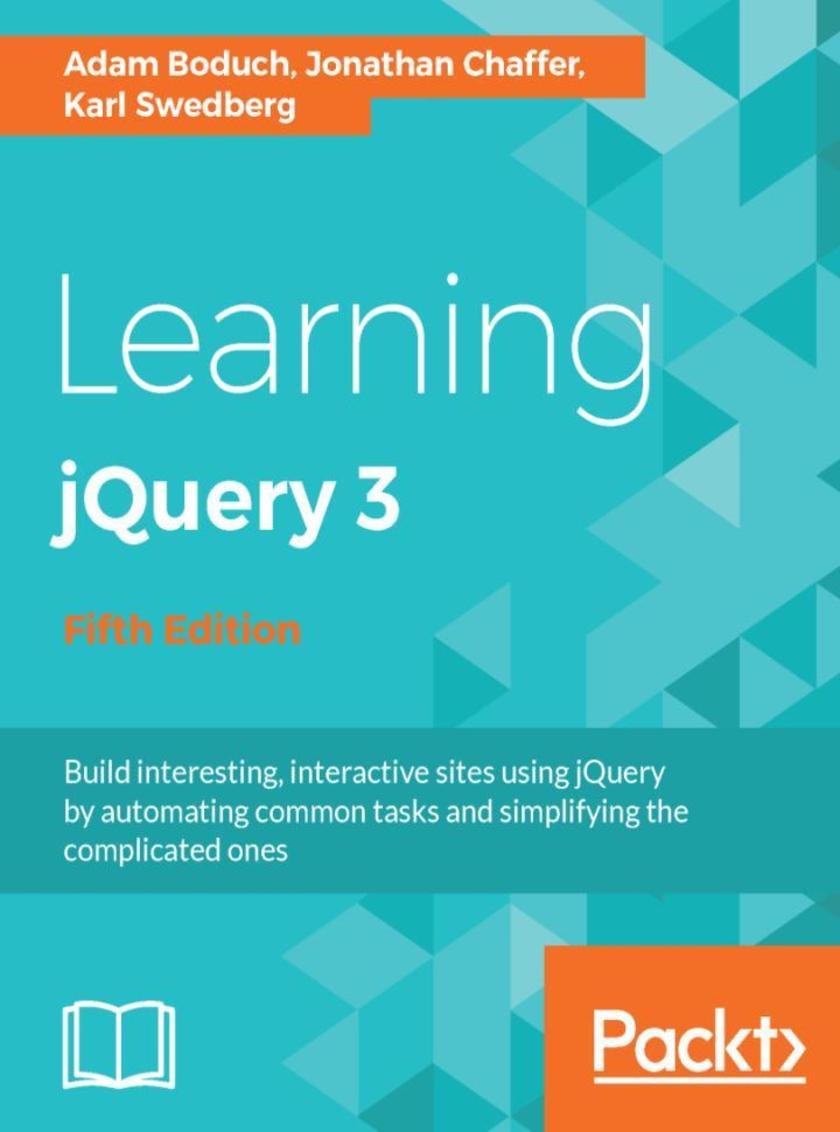
Learning jQuery 3 - Fifth Edition
¥71.93
Create efficient and smart web applications with jQuery 3.0 using this step-by-step practical tutorial About This Book ? Create a fully featured and responsive client-side application using jQuery ? Explore all the latest features of jQuery 3.0 and code examples updated to reflect modern JavaScript environments ? Develop high performance interactive pages Who This Book Is For This book is ideal for client-side JavaScript developers. You do need to have any previous experience with jQuery, although basic JavaScript programming knowledge is necessary. What You Will Learn ? Create custom interactive elements for your web designs ? Find out how to create the best user interface for your web applications ? Use selectors in a variety of ways to get anything you want from a page when you need it ? Master events to bring your web pages to life ? Add flair to your actions with a variety of different animation effects ? Discover the latest features available in jQuery with the latest update of this incredibly popular title ? Using jQuery npm Packages In Detail If you are a web developer and want to create web applications that look good, are efficient, have rich user interfaces, and integrate seamlessly with any backend using AJAX, then this book is the ideal match for you. We’ll show you how you can integrate jQuery 3.0 into your web pages, avoid complex JavaScript code, create brilliant animation effects for your web applications, and create a flawless app. We start by configuring and customising the jQuery environment, and getting hands-on with DOM manipulation. Next, we’ll explore event handling advanced animations, creating optimised user interfaces, and building useful third-party plugins. Also, we'll learn how to integrate jQuery with your favourite back-end framework. Moving on, we’ll learn how the ECMAScript 6 features affect your web development process with jQuery. we’ll discover how to use the newly introduced JavaScript promises and the new animation API in jQuery 3.0 in great detail, along with sample code and examples. By the end of the book, you will be able to successfully create a fully featured and efficient single page web application and leverage all the new features of jQuery 3.0 effectively. Style and approach Create efficient client-side apps that look great and run seamlessly across all devices with this step-by-step practical guide. There are illustrative examples for those who need extra help to get started with jQuery web development.


