


 购物车
购物车 个人中心
个人中心
?gy írtok ti
¥8.67
Mme. Vauquer (nee de Conflans) is an elderly person, who for the past forty years has kept a lodging-house in the Rue Nueve-Sainte-Genevieve, in the district that lies between the Latin Quarter and the Faubourg Saint-Marcel. Her house (known in the neighborhood as the Maison Vauquer) receives men and women, old and young, and no word has ever been breathed against her respectable establishment; but, at the same time, it must be said that as a matter of fact no young woman has been under her roof for thirty years, and that if a young man stays there for any length of time it is a sure sign that his allowance must be of the slenderest. In 1819, however, the time when this drama opens, there was an almost penniless young girl among Mme. Vauquer's boarders. That word drama has been somewhat discredited of late; it has been overworked and twisted to strange uses in these days of dolorous literature; but it must do service again here, not because this story is dramatic in the restricted sense of the word, but because some tears may perhaps be shed intra et extra muros before it is over. Will any one without the walls of Paris understand it? It is open to doubt. The only audience who could appreciate the results of close observation, the careful reproduction of minute detail and local color, are dwellers between the heights of Montrouge and Montmartre, in a vale of crumbling stucco watered by streams of black mud, a vale of sorrows which are real and joys too often hollow; but this audience is so accustomed to terrible sensations, that only some unimaginable and well-neigh impossible woe could produce any lasting impression there. Now and again there are tragedies so awful and so grand by reason of the complication of virtues and vices that bring them about, that egotism and selfishness are forced to pause and are moved to pity; but the impression that they receive is like a luscious fruit, soon consumed. Civilization, like the car of Juggernaut, is scarcely stayed perceptibly in its progress by a heart less easy to break than the others that lie in its course; this also is broken, and Civilization continues on her course triumphant. And you, too, will do the like; you who with this book in your white hand will sink back among the cushions of your armchair, and say to yourself, "Perhaps this may amuse me." You will read the story of Father Goriot's secret woes, and, dining thereafter with an unspoiled appetite, will lay the blame of your insensibility upon the writer, and accuse him of exaggeration, of writing romances. Ah! once for all, this drama is neither a fiction nor a romance! All is true,—so true, that every one can discern the elements of the tragedy in his own house, perhaps in his own heart. During the day a glimpse into the garden is easily obtained through a wicket to which a bell is attached. On the opposite wall, at the further end of the graveled walk, a green marble arch was painted once upon a time by a local artist, and in this semblance of a shrine a statue representing Cupid is installed; a Parisian Cupid, so blistered and disfigured that he looks like a candidate for one of the adjacent hospitals, and might suggest an allegory to lovers of symbolism. The half-obliterated inscription on the pedestal beneath determines the date of this work of art, for it bears witness to the widespread enthusiasm felt for Voltaire on his return to Paris in 1777: "Whoe'er thou art, thy master see; He is, or was, or ought to be."
Az ?gett-hegyi K?nyvtár
¥65.66
Alice was beginning to get very tired of sitting by her sister on the bank, and of having nothing to do: once or twice she had peeped into the book her sister was reading, but it had no pictures or conversations in it, 'and what is the use of a book,' thought Alice 'without pictures or conversation?'So she was considering in her own mind (as well as she could, for the hot day made her feel very sleepy and stupid), whether the pleasure of making a daisy-chain would be worth the trouble of getting up and picking the daisies, when suddenly a White Rabbit with pink eyes ran close by her. There was nothing so VERY remarkable in that; nor did Alice think it so VERY much out of the way to hear the Rabbit say to itself, 'Oh dear! Oh dear! I shall be late!' (when she thought it over afterwards, it occurred to her that she ought to have wondered at this, but at the time it all seemed quite natural); but when the Rabbit actually TOOK A WATCH OUT OF ITS WAISTCOAT-POCKET, and looked at it, and then hurried on, Alice started to her feet, for it flashed across her mind that she had never before seen a rabbit with either a waistcoat-pocket, or a watch to take out of it, and burning with curiosity, she ran across the field after it, and fortunately was just in time to see it pop down a large rabbit-hole under the hedge. In another moment down went Alice after it, never once considering how in the world she was to get out again. The rabbit-hole went straight on like a tunnel for some way, and then dipped suddenly down, so suddenly that Alice had not a moment to think about stopping herself before she found herself falling down a very deep well. Either the well was very deep, or she fell very slowly, for she had plenty of time as she went down to look about her and to wonder what was going to happen next. First, she tried to look down and make out what she was coming to, but it was too dark to see anything; then she looked at the sides of the well, and noticed that they were filled with cupboards and book-shelves; here and there she saw maps and pictures hung upon pegs. She took down a jar from one of the shelves as she passed; it was labelled 'ORANGE MARMALADE', but to her great disappointment it was empty: she did not like to drop the jar for fear of killing somebody, so managed to put it into one of the cupboards as she fell past it. 'Well!' thought Alice to herself, 'after such a fall as this, I shall think nothing of tumbling down stairs! How brave they'll all think me at home! Why, I wouldn't say anything about it, even if I fell off the top of the house!' (Which was very likely true.) Down, down, down. Would the fall NEVER come to an end! 'I wonder how many miles I've fallen by this time?' she said aloud. 'I must be getting somewhere near the centre of the earth. Let me see: that would be four thousand miles down, I think—' (for, you see, Alice had learnt several things of this sort in her lessons in the schoolroom, and though this was not a VERY good opportunity for showing off her knowledge, as there was no one to listen to her, still it was good practice to say it over) '—yes, that's about the right distance—but then I wonder what Latitude or Longitude I've got to?' (Alice had no idea what Latitude was, or Longitude either, but thought they were nice grand words to say.) ? ? ABOUT AUTHOR: ??Charles Lutwidge Dodgson (1832 – 1898), better known by his pen name, as “Lewis Carroll”, was an English writer, mathematician, logician, Anglican deacon and photographer. His most famous writings are Alice's Adventures in Wonderland and its sequel Through the Looking-Glass, as well as the poems "The Hunting of the Snark" and "Jabberwocky", all examples of the genre of literary nonsense.
Az ébred? t?z
¥87.31
After too many years, T. L. Sherred returns with a story that gets our SPACE SPECIAL rating. It's the story of a man with a headache—who found a cure for it! And the cure gave him more power than any man could dream of. ________________________________________ So I had a headache. The grandfather of all headaches. You try working on the roof line sometime, with the presses grinding and the overhead cranes wailing and the mechanical arms clacking and grabbing at your inner skull while you snap a shiny sheet of steel like an armored pillowcase and shove it into the maw of a hungry greasy ogre. Noise. Hammering, pounding, shrieking, gobbling, yammering, incessant noise. And I had a headache. PART I This headache had all the signs of permanency. It stayed with me when I slid my timecard into an empty slot that clanged back at me, when I skittered across a jammed street of blowing horns and impatient buses with brakedrums worn to the rivets, when I got off at my corner and stood in the precarious safety of a painted island in a whirring storm of hurtling hornets. It got even worse when I ate dinner and tried to read my paper through the shrill juvenile squeals of the housing project where I live surrounded by muddy moppets and, apparently, faithless wives and quarrelsome spouses. The walls of my Quonset are no thicker than usual. When Helen—that's my wife—dropped the casserole we got for a wedding present from her aunt and just stood there by the kitchen sink crying her eyes out in frustration I knew she finally had more of a mess to clean up than just the shattered remains of a brittle bowl. I didn't say a word. I couldn't. I shoved the chair across the room and watched it tilt the lamp her mother bought us. Before the lamp hit the floor my hat was on my head and I was out the door. Behind me I heard at least one pane of the storm door die in a fatal crash. I didn't look around to see if it were the one I'd put in last Sunday.
Tartuffe
¥8.67
Following the Equator (sometimes titled More Tramps Abroad) is a non-fiction travelogue published by American author Mark Twain in 1897. Twain was practically bankrupt in 1894 due to a failed investment into a "revolutionary" typesetting machine. In an attempt to extricate himself from debt of $100,000 (equivalent of about $2.5 million in 2010) he undertook a tour of the British Empire in 1895, a route chosen to provide numerous opportunities for lectures in the English. Themes:In Following the Equator, an account of that travel published in 1897, the author criticizes racism, imperialism and missionary zeal in observations woven into the narrative with classical Twain wit.In keeping with that wit, and Twain's love of a tall tale, Twain included a number of fictional stories in the body of what is otherwise a non-fiction work. In particular, the story of how Cecil Rhodes made his fortune by finding a newspaper in the belly of a shark, and the story of how a man named Ed Jackson made good in life out of a fake letter of introduction to Cornelius Vanderbilt, were anthologized in Charles Neider (ed) The Complete Short Stories of Mark Twain, (Doubleday, 1957) where they are presented as fiction. Chapter I A man may have no bad habits and have worse. —Pudd'nhead Wilson's New Calendar. The starting point of this lecturing-trip around the world was Paris, where we had been living a year or two. We sailed for America, and there made certain preparations. This took but little time. Two members of my family elected to go with me. Also a carbuncle. The dictionary says a carbuncle is a kind of jewel. Humor is out of place in a dictionary. We started westward from New York in midsummer, with Major Pond to manage the platform-business as far as the Pacific. It was warm work, all the way, and the last fortnight of it was suffocatingly smoky, for in Oregon and British Columbia the forest fires were raging. We had an added week of smoke at the seaboard, where we were obliged to wait awhile for our ship. She had been getting herself ashore in the smoke, and she had to be docked and repaired. We sailed at last; and so ended a snail-paced march across the continent, which had lasted forty days. We moved westward about mid-afternoon over a rippled and sparkling summer sea; an enticing sea, a clean and cool sea, and apparently a welcome sea to all on board; it certainly was to me, after the distressful dustings and smokings and swelterings of the past weeks. The voyage would furnish a three-weeks holiday, with hardly a break in it. We had the whole Pacific Ocean in front of us, with nothing to do but do nothing and be comfortable. The city of Victoria was twinkling dim in the deep heart of her smoke-cloud, and getting ready to vanish and now we closed the field-glasses and sat down on our steamer chairs contented and at peace. But they went to wreck and ruin under us and brought us to shame before all the passengers. They had been furnished by the largest furniture-dealing house in Victoria, and were worth a couple of farthings a dozen, though they had cost us the price of honest chairs. In the Pacific and Indian Oceans one must still bring his own deck-chair on board or go without, just as in the old forgotten Atlantic times—those Dark Ages of sea travel.

A General Introduction to Psychoanalysis: Illustrated
¥32.62
Négy gimis egy s?tét, dohos pincében ébred… Nyár, haverok, emberrablás. Doma, Zoli, Zsófi és Max egy s?tét, dohos pincében ébred. Hol lehetnek? ?s vajon hogy kerültek oda? A négy gimis csak arra emlékszik, hogy hazaindultak az év utolsó bulijáról, amit az egyik hipergazdag osztálytársuk rendezett. Szorult helyzetükben mind egymást okolják a t?rténtekért, hiszen valamennyiük életében van is valami gyanús. Doma édesanyja korábban rend?r volt, most magánnyomozóként dolgozik. Zoli a város legmen?bb brókerének a fia. A belevaló Zsófi, aki a tanév k?zepén érkezett, maga a két lábon járó rejtély. ?s ott van Max, aki a legidegesít?bb, legnagykép?bb srác az osztályban. Ráj?nnek, melyikük miatt kerültek bajba? ?s vajon meg tudnak sz?kni fogvatartóiktól? Minden leleményükre szükségük lesz, hogy az országhatárt és a saját korlátaikat is képesek legyenek átlépni. A Váltságdíj nélkül izgalmas, lebilincsel? krimi, melyben a tinisorsokból sz?v?d? kül?nleges hálótól az utolsó oldal után sincs kedvünk szabadulni. Varga Bálint (1970) újságíró, író. 2005-ben jelent meg els? k?nyve, a Magándetektívek. T?bb mint negyven krimit (k?ztük Lawrence Block és Jim Thompson munkáit) valamint ifjúsági regényeket (P. B. Kerr A lámpás gyermekei-sorozat) fordított. Számos k?nyv (k?ztük John le Carré regényeinek) szerkeszt?je. Tíz éven át maga is k?nyvkiadó volt. 2013-ig pedig egy magánnyomozó-irodának dolgozott analitikusként és legális hírszerz?ként.
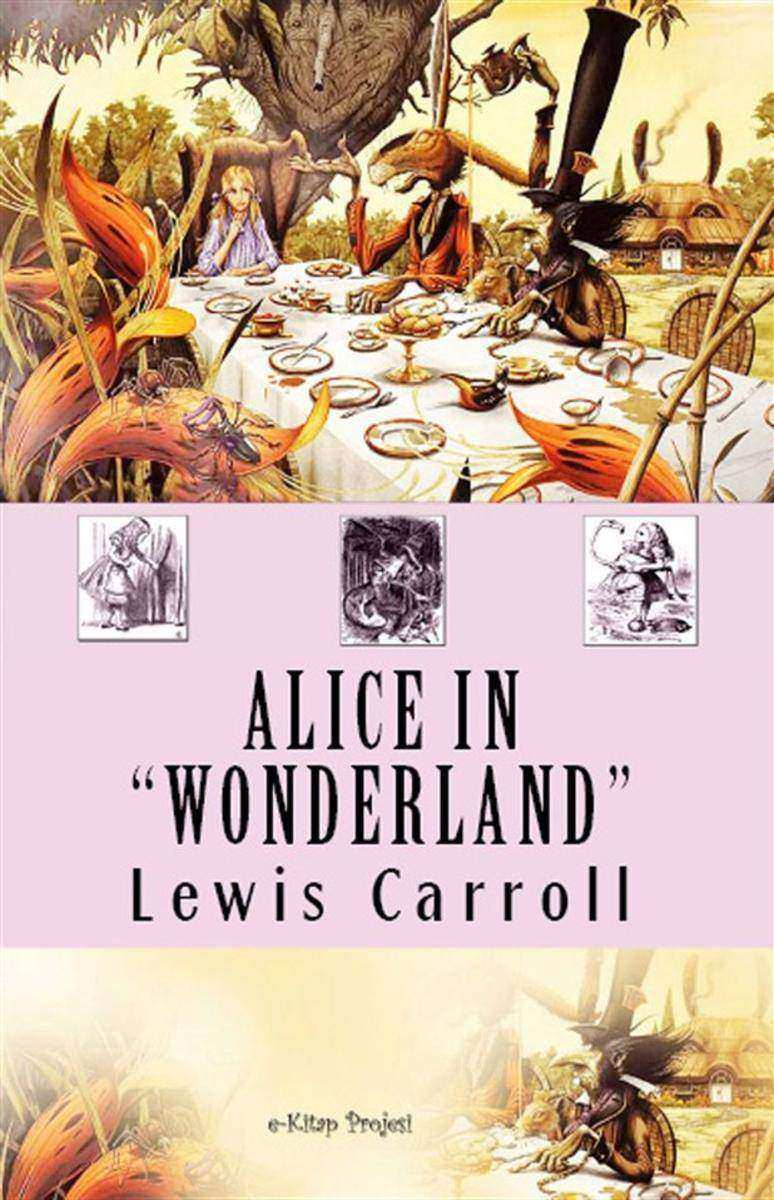
Alice in wonderland: {Illustrated}
¥8.09
This is illustrated and translated version od the "Jaufry the Knight and the Fair Brunissende" & “A Tale of the Times of King Arthur" Now of a tale of chivalry, of proper fashion, great allurement, full of-wise and courteous instances, and wherein abound acts of great prowess, strange adventures, assaults, encounters, and dread battles, you may list the telling. An it amuse you, I will relate thereof all that I do know, or that it please you to give ear unto. Let me know only that which ye desire, and if ye be inclined to listen in good sooth. When the minstrel doth indeed recite, neither should hearers buy nor sell, nor in low voice hold council; for thus the recital is lost to him who speaketh, and they methinks who listen cannot find therein great pleasure. I come, then, to recount to you tidings of the court of good King Arthur; he who was so worthy, so valiant, and so wise, that his name shall never die, but whereof shall eternally be spoken the mighty things he did; and the good knights, all for their prowess known, whom he did gather at his famed Round Table. In that court, the fairest and most loyal that ever shone beneath the stars, all men did find that counsel and that aid of which they stood in need. There triumphed right, and there were wrongs redressed. There dames and damsels, widows and orphans attacked unjustly, or disinherited by force, ne'er failed to meet with champions. The oppressed of all conditions there did find a refuge, and none e'er sought protection there in vain. Give, then, sweet welcome to a poem the fruit of such good place, and deign to listen unto it in peace. The troubadour who rhymed it never knew King Arthur; but he heard the entire story told at the court of the king of Aragon, the best of monarchs in this world. * Don Pedro III., killed in 1213 at the battle of Muret. A worthy father and a famous son, lord of goodly fortunes, humble in heart, and frank in nature as in mind, the king of Aragon loveth God and feareth Him; he maintaineth faith and loyalty, peace and justice: thus God protecteth him, giveth him the victory when he raiseth his banner against the infidel, and placeth him above all those who are alike worthy and bold. Where shall we seek youthful brows wearing a crown which emitteth rays of greater splendour He giveth good gifts to minstrels and to knights, and his court is the resort of all those who are esteemed brave and courteous. It was before him the troubadour heard related, by a stranger-knight of kin to Arthur and Sir Gawain, the song he here hath rhymed; and whereof the first adventure occurred while the king of the Round Table held his court at Carlisle on the day of Pentecost. The Adventure of the Forest Twas on the day of Pentecost, a feast which to Carlisle had drawn a host of knights, that Arthur, King of Briton's isle, his crown placed on his brows, and to the old monastic church proceeded to hear mass. And with him went a brilliant train, the Knights of the Round Table. There were Sir Gawain, Lancelot du Lac, Tristrem, and Ivan bold, Eric frank of heart, and Quex the seneschal, Percival and Calogrant, Cliges the worthy, Coedis the handsome knight, and Caravis short i' the arm; the whole of his bright court, indeed, was there, and many more whose names I have forgot. When mass was done, they to the palace home returned 'mid laughter and loud noise, the thoughts of each on pleasure only bent. Each on arrival gave his humour play. Some spoke of love, and some of chivalry; and some of ventures they were going to seek. Quex at this moment came into the hall, holding a branch of apple in his hand. All made room for him; for there were few who did not fear his tongue and the hard words which it was wont to utter. This baron bold held nothing in respect. E'en of the best he ever said the worst. But this apart, he was a brave stout knight, in council sage, a valiant man of war, and lord of lineage high..
Dracula
¥8.67
This book contains 66 original tales collected by the brothers Grimm. The exact print source is unknown. The etext appears to be based on the translation by Edgar Taylor and Marian Edwardes called Grimm's Household Tales, and it is identical to her edition. -The Frog King, or Iron Henry-The Good Bargain-The Twelve Brothers-Rapunzel-Hansel and Grethel-The White Snake-Cinderella ..and More The Brothers Grimm Fairy Tales: The Golden BirdHans In LuckJorinda And JorindelThe Travelling MusiciansOld SultanThe Straw, The Coal, And The BeanBriar RoseThe Dog And The SparrowThe Twelve Dancing PrincessesThe Fisherman And His WifeThe Willow-Wren And The BearThe Frog-PrinceCat And Mouse In PartnershipThe Goose-GirlThe Adventures Of Chanticleer And PartletRapunzelFundevogelThe Valiant Little TailorHansel And GretelThe Mouse, The Bird, And The SausageMother HolleLittle Red-Cap [Little Red Riding Hood]The Robber BridegroomTom ThumbRumpelstiltskinClever GretelThe Old Man And His GrandsonThe Little PeasantFrederick And CatherineSweetheart RolandSnowdropThe PinkClever ElsieThe Miser In The BushAshputtelThe White SnakeThe Wolf And The Seven Little KidsThe Queen BeeThe Elves And The ShoemakerThe Juniper-TreeThe TurnipClever HansThe Three LanguagesThe Fox And The CatThe Four Clever BrothersLily And The LionThe Fox And The HorseThe Blue LightThe RavenThe Golden GooseThe Water Of LifeThe Twelve HuntsmenThe King Of The Golden MountainDoctor KnowallThe Seven RavensThe Wedding Of Mrs FoxThe SaladThe Story Of The Youth Who Went Forth To Learn What Fear WasKing Grisly-BeardIron HansCat-SkinSnow-White And Rose-Red.. About Author: Wilhelm Grimm or The Brothers Grimm, Jacob (1785-1863) and Wilhelm (1786-1859), were born in Hanau, near Frankfurt, in the German state of Hesse. Throughout their lives they remained close friends, and both studied law at Marburg University. Jacob was a pioneer in the study of German philology, and although Wilhelm's work was hampered by poor health the brothers collaborated in the creation of a German dictionary, not completed until a century after their deaths. But they were best (and universally) known for the collection of over two hundred folk tales they made from oral sources and published in two volumes of 'Nursery and Household Tales' in 1812 and 1814. Although their intention was to preserve such material as part of German cultural and literary history, and their collection was first published with scholarly notes and no illustration, the tales soon came into the possession of young readers. This was in part due to Edgar Taylor, who made the first English translation in 1823, selecting about fifty stories 'with the amusement of some young friends principally in view.' They have been an essential ingredient of children's reading ever since.
Drawn at a Venture
¥9.24
MYTH: ITS BIRTH AND GROWTH.“Unchecked by external truth, the mind of man has a fatal facility for ensnaring, entrapping, and entangling itself. But, happily, happily for the human race, some fragment of physical speculation has been built into every false system. Here is the weak point. Its inevitable destruction leaves a breach in the whole fabric, and through that breach the armies of truth march in.”Sir H. S. Maine. MYTH: ITS BIRTH AND GROWTH.CHAPTER IITS PRIMITIVE MEANING.It is barely thirty years ago since the world was startled by the publication of Buckle’s History of Civilisation, with its theory that human actions are the effect of causes as fixed and regular as those which operate in the universe; climate, soil, food, and scenery being the chief conditions determining progress. That book was a tour de force, not a lasting contribution to the question of man’s mental development. The publication of Darwin’s epoch-making Origin of Species[1] showed wherein it fell short; how the importance of the above-named causes was exaggerated and the existence of equally potent causes overlooked. Buckle probably had not read Herbert Spencer’s Social Statics, and he knew nothing of the profound revolution in silent preparation in the quiet of Darwin’s home; otherwise, his book must have been rewritten. This would have averted the oblivion from which not even its charm of style can rescue it. Its brilliant but defective theories are obscured in the fuller light of that doctrine of descent with modifications by which we learn that external circumstances do not alone account for the widely divergent types of men, so that a superior race, in supplanting an inferior one, will change the face and destiny of a country, “making the solitary place to be glad, and the desert to rejoice and blossom as the rose.” Darwin has given us the clue to those subtle and still obscure causes which bring about, stage by stage, the unseen adaptations to requirements varying a type and securing its survival, and which have resulted in the evolution of the manifold species of living things. The notion of a constant relation between man and his surroundings is therefore untenable. The object of this book is to present in compendious form the evidence which myths and dreams supply as to primitive man’s interpretation of his own nature and of the external world, and more especially to indicate how such evidence carries within itself the history of the origin and growth of beliefs in the supernatural. The examples are selected chiefly from barbaric races, as furnishing the nearest correspondences to the working of the mind in what may be called its “eocene” stage, but examples are also cited from civilised races, as witnessing to that continuity of ideas which is obscured by familiarity or ignored by prejudice.Had more illustrations been drawn from sources alike prolific, the evidence would have been swollen to undue dimensions without increasing its significance; as it is, repetition has been found needful here and there, under the difficulty of entirely detaching the arguments advanced in the two parts of this work.
Madame Bovary
¥8.67
The book begins with a short preamble in which Lemuel Gulliver, in the style of books of the time, gives a brief outline of his life and history before his voyages. He enjoys travelling, although it is that love of travel that is his downfall. During his first voyage, Gulliver is washed ashore after a shipwreck and finds himself a prisoner of a race of tiny people, less than 6 inches tall, who are inhabitants of the island country of Lilliput. After giving assurances of his good behaviour, he is given a residence in Lilliput and becomes a favourite of the court. From there, the book follows Gulliver's observations on the Court of Lilliput. He is also given the permission to roam around the city on a condition that he must not harm their subjects. Gulliver assists the Lilliputians to subdue their neighbours, the Blefuscudians, by stealing their fleet. However, he refuses to reduce the island nation of Blefuscu to a province of Lilliput, displeasing the King and the court. Gulliver is charged with treason for, among other "crimes", "making water" in the capital (even though he was putting out a fire and saving countless lives). He is convicted and sentenced to be blinded, but with the assistance of a kind friend, he escapes to Blefuscu. Here he spots and retrieves an abandoned boat and sails out to be rescued by a passing ship, which safely takes him back home. This book of the Travels is a topical political satire. ABOUT AUTHOR: Jonathan Swift (1667 – 1745) was an Anglo-Irish satirist, essayist, political pamphleteer, poet and cleric who became Dean of St Patrick's Cathedral, Dublin. He is remembered for works such as Gulliver's Travels, A Modest Proposal, A Journal to Stella, Drapier's Letters, The Battle of the Books, An Argument Against Abolishing Christianity, and A Tale of a Tub. Swift originally published all of his works under pseudonyms – such as Lemuel Gulliver, Isaac Bickerstaff, MB Drapier – or anonymously. He is also known for being a master of two styles of satire: the Horatian and Juvenalian styles.YouthJonathan Swift was born in Dublin, Ireland. He was the second child and only son of Jonathan Swift (1640–1667) and his wife Abigail Erick (or Herrick), of Frisby on the Wreake. His father, a native of Goodrich, Herefordshire, accompanied his brothers to Ireland to seek their fortunes in law after their Royalist father's estate was brought to ruin during the English Civil War. Swift's father died in Dublin before he was born, and his mother returned to England. He was left in the care of his influential uncle, Godwin, a close friend and confidant of Sir John Temple, whose son later employed Swift as his secretary. Swift's family had several interesting literary connections: His grandmother, Elizabeth (Dryden) Swift, was the niece of Sir Erasmus Dryden, grandfather of the poet John Dryden. The same grandmother's aunt, Katherine (Throckmorton) Dryden, was a first cousin of Elizabeth, wife of Sir Walter Raleigh. His great-great grandmother, Margaret (Godwin) Swift, was the sister of Francis Godwin, author of The Man in the Moone which influenced parts of Swift's Gulliver's Travels. His uncle, Thomas Swift, married a daughter of the poet and playwright Sir William Davenant, a godson of William Shakespeare.WriterIn February 1702, Swift received his Doctor of Divinity degree from Trinity College, Dublin. That spring he travelled to England and returned to Ireland in October, accompanied by Esther Johnson—now 20—and his friend Rebecca Dingley, another member of William Temple's household. There is a great mystery and controversy over Swift's relationship with Esther Johnson nicknamed "Stella". Many, notably his close friend Thomas Sheridan believed that they were secretly married in 1716; others, like Swift's housekeeper Mrs Brent, and Rebecca Dingley (who lived with Stella all through her years in Ireland) dismissed the story as absurd.

A Treatise of Human Nature: Illustrated
¥32.62
THROWING HERSELF IN HER GRANDFATHER'S ARMS, SHE HELD HIM TIGHT She climbed so fast that she could soon discover, first the tree-tops, then the roof, finally the hut. Now she could see her grandfather sitting on his bench, smoking a pipe. Above the cottage the fir-trees gently swayed and rustled in the evening breeze. At last she had reached the hut, and throwing herself in her grandfather's arms, she hugged him and held him tight. She could say nothing but "Grandfather! grandfather! grandfather!" in her agitation. The old man said nothing either, but his eyes were moist, and loosening Heidi's arms at last, he sat her on his knee. When he had looked at her a while, he said: "So you have come home again, Heidi? Why? You certainly do not look very cityfied! Did they send you away?" "Oh no, you must not think that, grandfather. They all were so good to me; Clara, Mr. Sesemann and grandmama. But grandfather, sometimes I felt as if I could not bear it any longer to be away from you! I thought I should choke; I could not tell any one, for that would have been ungrateful. Suddenly, one morning Mr. Sesemann called me very early, I think it was the doctor's fault and—but I think it is probably written in this letter;" with that Heidi brought the letter and the bank-roll from her basket, putting them on her grandfather's lap. "This belongs to you," he said, laying the roll beside him. Having read the letter, he put it in his pocket. "Do you think you can still drink milk with me, Heidi?" he asked, while he stepped into the cottage. "Take your money with you, you can buy a bed for it and clothes for many years." ? ? ? ? ? ? ? ? ? ? ? ? ? ? ? ? ? ? ? ? ? ? ? ? ? ? ? ? ? *** Unassuming in plot and style, "Heidi" may none the less lay claim to rank as a world classic. In the first place, both background and characters ring true. The air of the Alps is wafted to us in every page; the house among the pines, the meadows, and the eagle poised above the naked rocks form a picture that no one could willingly forget. And the people, from the kindly towns-folk to the quaint and touching peasant types, are as real as any representation of human nature need be. Every goat even, has its personality. As for the little heroine, she is a blessing not only to everyone in the story, but to everyone who reads it. The narrative merits of the book are too apparent to call for comment.As to the author, Johanna Spyri, she has so entirely lost herself in her creation that we may pass over her career rather rapidly. She was born in Switzerland in 1829, came of a literary family, and devoted all her talent to the writing of books for and about children.Since "Heidi" has been so often translated into English it may well be asked why there is any need for a new version. The answer lies partly in the conventional character of the previous translations. Now, if there is any quality in "Heidi" that gives it a particular charm, that quality is freshness, absolute spontaneity. To be sure, the story is so attractive that it could never be wholly spoiled; but has not the reader the right to enjoy it in English at least very nearly as much as he could in German? The two languages are so different in nature that anything like a literal rendering of one into the other is sure to result in indirectness. Such a book must be not translated, but re-lived and re-created.To perform such a feat the writer must, to begin with, be familiar with the mountains, and able to appreciate with WordsworthThe silence that is in the starry sky, The sleep that is among the lonely hills. The translator of the present version was born and reared in a region closely similar to that of the story. Her home was originally in the picturesque town of Salzburg, and her father, Franz von Pausinger, was one of the greatest landscape painters of his country and generation. Another equally important requisite is knowledge of children. It happens that this translator has a daughter just the age of the heroine, who moreover loves to dress in Tyrolese costume. To translate "Heidi" was for her therefore a labor of love, which means that the love contended with and overcame the labor.

Bolondok hercege
¥73.49
“Goodbye, said the fox. And now here is my secret, a very simple secret. It is only with the heart that one can see rightly. What is essential is invisible to the eye.” Antoine de Saint-Exupéry, The Little Prince The Little Prince first published in 1943, is a novella and the most famous work of the French aristocrat, writer, poet and pioneering aviator Antoine de Saint-Exupéry. The novella is both the most read and most translated book in the French language, and was voted the best book of the 20th century in France. Translated into more than 250 languages and dialects selling over a million copies per year with sales totalling more than 140 million copies worldwide, it has become one of the best-selling books ever published. Saint-Exupéry, a laureate of several of France's highest literary awards and a reserve military pilot at the start of the Second World War, wrote and illustrated the manuscript while exiled in the United States after the Fall of France. He had travelled there on a personal mission to persuade its government to quickly enter the war against Nazi Germany. In the midst of personal upheavals and failing health he produced almost half of the writings he would be remembered for, including a tender tale of loneliness, friendship, love and loss, in the form of a young prince fallen to Earth.

Akik kétszer halnak meg
¥8.67
Emile, or On Education or ?mile, Or Treatise on Education (French: ?mile, ou De l’éducation) is a treatise on the nature of education and on the nature of man written by Jean-Jacques Rousseau, who considered it to be the “best and most important of all my writings”. Due to a section of the book entitled “Profession of Faith of the Savoyard Vicar,” Emile was banned in Paris and Geneva and was publicly burned in 1762, the year of its first publication. During the French Revolution, Emile served as the inspiration for what became a new national system of education. The work tackles fundamental political and philosophical questions about the relationship between the individual and society— how, in particular, the individual might retain what Rousseau saw as innate human goodness while remaining part of a corrupting collectivity. Its opening sentence: “Everything is good as it leaves the hands of the Author of things; everything degenerates in the hands of man.” Rousseau seeks to describe a system of education that would enable the natural man he identifies in The Social Contract (1762) to survive corrupt society. He employs the novelistic device of Emile and his tutor to illustrate how such an ideal citizen might be educated. Emile is scarcely a detailed parenting guide but it does contain some specific advice on raising children. It is regarded by some as the first philosophy of education in Western culture to have a serious claim to completeness, as well as being one of the first Bildungsroman novels, having preceded Goethe's Wilhelm Meister's Apprenticeship by more than thirty years. ? About Author: Jean-Jacques Rousseau (1712 – 1778) was a Genevan philosopher, writer, and composer of the 18th century. His political philosophy influenced the French Revolution as well as the overall development of modern political, sociological, and educational thought. Rousseau's novel ?mile, or On Education is a treatise on the education of the whole person for citizenship. His sentimental novel Julie, or the New Heloise was of importance to the development of pre-romanticism and romanticism in fiction. Rousseau's autobiographical writings — his Confessions, which initiated the modern autobiography, and his Reveries of a Solitary Walker — exemplified the late 18th-century movement known as the Age of Sensibility, and featured an increased focus on subjectivity and introspection that later characterized modern writing. His Discourse on the Origin of Inequality and his On the Social Contract are cornerstones in modern political and social thought. He argued that private property was conventional and the beginning of true civil society. Rousseau was a successful composer of music, who wrote seven operas as well as music in other forms, and made contributions to music as a theorist. As a composer, his music was a blend of the late Baroque style and the emergent Classical fashion, and he belongs to the same generation of transitional composers as Christoph Willibald Gluck and C.P.E. Bach. One of his more well-known works is the one-act opera Le devin du village, containing the duet "Non, Colette n'est point trompeuse" which was later rearranged as a standalone song by Beethoven. During the period of the French Revolution, Rousseau was the most popular of the philosophes among members of the Jacobin Club. Rousseau was interred as a national hero in the Panthéon in Paris, in 1794, 16 years after his death..
14
¥51.58
BOW-WOW AND MEW-MEW is one of the few books for beginners in reading that may be classed as literature. Written in words of mostly one syllable, it has a story to tell, which is related in so attractive a manner as to immediately win the favor of young children. It teaches English and English literature to the child in the natural way: through a love for the reading matter. It is the character of story that will, in the not distant future, replace the ordinary primer or reader with detached sentences, and which seldom possesses any relation to literature.The ultimate objects of any story can only be effected through the love for a story. The prominent point in this story is development of good character, which may well be regarded as the highest purpose of education. The transformation from bad to good traits in the dog and cat cannot but have a desirable effect on every child that reads the story. Bow-Wow and Mew-Mew become dissatisfied with their home and their surroundings, and ungrateful toward their benefactress. As the story tells, "They did not find good in any thing." But after running away and suffering hunger, neglect, and bad treatment, their characters begin to change. They naturally come to reflect their mistress's goodness. They learn the value of companionship and friendship, and the appreciation of a home. However, the ethical thoughts in the story are presented without a moral. The child really lives the scenes described. He has the emotions of the characters and feels their convictions. And this determines the worth of a story as an agent in character development.The narrative furnishes, further, the proper kind of exercise for the imagination. It affords abundant opportunity for the play of the dramatic instinct in the child, and effects a happy union of the "home world" and the "school world." The illustrations, drawn by Miss Hodge, have been planned and executed with considerable care.

A marsi
¥73.49
The book tells the adventures of five American prisoners of war on an uncharted island in the South Pacific. Begining in the American Civil War, as famine and death ravage the city of Richmond, Virginia, five northern POWs decide to escape in a rather unusual way – by hijacking a balloon! This is only the beginning of their adventures...

All In The Mind: Illustrated
¥4.58
The Jungle Book (1894) is a collection of stories by English Nobel laureate Rudyard Kipling. The stories were first published in magazines in 1893–94. The original publications contain illustrations, some by Rudyard's father, John Lockwood Kipling. Kipling was born in India and spent the first six years of his childhood there. After about ten years in England, he went back to India and worked there for about six-and-a-half years. These stories were written when Kipling lived in Vermont. There is evidence that it was written for his daughter Josephine, who died in 1899 aged six, after a rare first edition of the book with a poignant handwritten note by the author to his young daughter was discovered at the National Trust's Wimpole Hall in Cambridgeshire in 2010. The tales in the book (and also those in The Second Jungle Book which followed in 1895, and which includes five further stories about Mowgli) are fables, using animals in an anthropomorphic manner to give moral lessons. The verses of The Law of the Jungle, for example, lay down rules for the safety of individuals, families and communities. Kipling put in them nearly everything he knew or "heard or dreamed about the Indian jungle." Other readers have interpreted the work as allegories of the politics and society of the time. The best-known of them are the three stories revolving around the adventures of an abandoned "man cub" Mowgli who is raised by wolves in the Indian jungle. The most famous of the other stories are probably "Rikki-Tikki-Tavi", the story of a heroic mongoose, and "Toomai of the Elephants", the tale of a young elephant-handler. As with much of Kipling's work, each of the stories is preceded by a piece of verse, and succeeded by another. Characters:Akela – An Indian WolfBagheera – A melanistic (black) pantherBaloo— A Sloth BearBandar-log – A tribe of monkeysChil – A kite (renamed "Rann" in US editions)Chuchundra – A MuskratDarzee – A tailorbirdFather Wolf – The Father Wolf who raised Mowgli as his own cubGrey brother – One of Mother and Father Wolf's cubsHathi – An Indian ElephantIkki – An Asiatic Brush-tailed Porcupine (mentioned only)Kaa – Indian PythonKarait – Common KraitKotick – A White SealMang – A BatMor – An Indian PeafowlMowgli – Main character, the young jungle boyNag – A male Black cobraNagaina – A female King cobra, Nag's mateRaksha – The Mother wolf who raised Mowgli as own cubRikki-Tikki-Tavi – An Indian MongooseSea Catch – A Northern fur seal and Kotick's fatherSea Cow – A Steller's Sea CowSea Vitch – A WalrusShere Khan— A Royal Bengal TigerTabaqui – An Indian Jackal

Divine Comedy (Volume I): Paradise {Illustrated}
¥18.74
The Metamorphosis (German: Die Verwandlung, also sometimes translated as The Transformation) is a novella by Franz Kafka, first published in 1915. It has been cited as one of the seminal works of fiction of the 20th century and is studied in colleges and universities across the Western world. The story begins with a traveling salesman, Gregor Samsa, waking to find himself transformed (metamorphosed) into a large, monstrous insect-like creature. The cause of Samsa's transformation is never revealed, and Kafka never did give an explanation. The rest of Kafka's novella deals with Gregor's attempts to adjust to his new condition as he deals with being burdensome to his parents and sister, who are repulsed by the horrible, verminous creature Gregor has become. Part I: One day, Gregor Samsa, a traveling salesman, wakes up to find himself transformed into a "ungeheures Ungeziefer", literally "monstrous vermin", often interpreted as a giant bug or insect. He believes it is a dream, and reflects on how dreary life as a traveling salesman is. As he looks at the wall clock, he realizes he has overslept, and missed his train for work. He ponders on the consequences of this delay. Gregor becomes annoyed at how his boss never accepts excuses or explanations from any of his employees no matter how hard working they are, displaying an apparent lack of trusting abilities. Gregor's mother knocks on the door and he answers her. She is concerned for Gregor because he is late for work, which is unorthodox for Gregor. Gregor answers his mother and realizes that his voice has changed, but his answer is short so his mother does not notice the voice change. His sister, Grete, to whom he was very close, then whispers through the door and begs him to open the door. All his family members think that he is ill and ask him to open the door. He tries to get out of bed, but he is incapable of moving his body. While trying to move, he finds that his office manager, the chief clerk, has shown up to check on him. He finally rocks his body to the floor and calls out that he will open the door shortly.
Emma
¥23.30
A few years ago, while visiting or, rather, rummaging about Notre-Dame, the author of this book found, in an obscure nook of one of the towers, the following word, engraved by hand upon the wall:— ? ? ? ? ? ? ? ANArKH. These Greek capitals, black with age, and quite deeply graven in the stone, with I know not what signs peculiar to Gothic caligraphy imprinted upon their forms and upon their attitudes, as though with the purpose of revealing that it had been a hand of the Middle Ages which had inscribed them there, and especially the fatal and melancholy meaning contained in them, struck the author deeply. He questioned himself; he sought to divine who could have been that soul in torment which had not been willing to quit this world without leaving this stigma of crime or unhappiness upon the brow of the ancient church. Afterwards, the wall was whitewashed or scraped down, I know not which, and the inscription disappeared. For it is thus that people have been in the habit of proceeding with the marvellous churches of the Middle Ages for the last two hundred years. Mutilations come to them from every quarter, from within as well as from without. The priest whitewashes them, the archdeacon scrapes them down; then the populace arrives and demolishes them. Thus, with the exception of the fragile memory which the author of this book here consecrates to it, there remains to-day nothing whatever of the mysterious word engraved within the gloomy tower of Notre-Dame,—nothing of the destiny which it so sadly summed up. The man who wrote that word upon the wall disappeared from the midst of the generations of man many centuries ago; the word, in its turn, has been effaced from the wall of the church; the church will, perhaps, itself soon disappear from the face of the earth. It is upon this word that this book is founded.
Annuska
¥8.67
The history of our English translations of "Don Quixote" is instructive. Shelton's, the first in any language, was made, apparently, about 1608, but not published till 1612. This of course was only the First Part. It has been asserted that the Second, published in 1620, is not the work of Shelton, but there is nothing to support the assertion save the fact that it has less spirit, less of what we generally understand by "go," about it than the first, which would be only natural if the first were the work of a young man writing currente calamo, and the second that of a middle-aged man writing for a bookseller. On the other hand, it is closer and more literal, the style is the same, the very same translations, or mistranslations, occur in it, and it is extremely unlikely that a new translator would, by suppressing his name, have allowed Shelton to carry off the credit. In 1687 John Phillips, Milton's nephew, produced a "Don Quixote" "made English," he says, "according to the humour of our modern language." His "Quixote" is not so much a translation as a travesty, and a travesty that for coarseness, vulgarity, and buffoonery is almost unexampled even in the literature of that day. But it is, after all, the humour of "Don Quixote" that distinguishes it from all other books of the romance kind. It is this that makes it, as one of the most judicial-minded of modern critics calls it, "the best novel in the world beyond all comparison." It is its varied humour, ranging from broad farce to comedy as subtle as Shakespeare's or Moliere's that has naturalised it in every country where there are readers, and made it a classic in every language that has a literature.

Az ?rd?g egyetlen barátja
¥57.47
When does life begin?... A well-known book says "forty". A well-known radio program says "eighty". Some folks say it's mental, others say it's physical. But take the strange case of Mel Carlson who gave a lot of thought to the matter. Mel felt as if he were floating on clouds in the deepest, most intense dark he had ever experienced. He tried opening his eyes but nothing happened, only a sharp pain. Little bits of memory flashed back and he tried to figure out what could have happened, where he was. The last thing he could remember was the little lab hidden back in the mountains in an old mine tunnel. Remote, but only an hour's drive from the city. What had he been doing? Oh yes, arguing with Neil again. He even recalled the exact words."Damn it, Mel," his partner had said. "We've gone about as far as possible working with animal brains. We've got to get a human one." "We can't," Mel had disagreed. "There'd be enough of an uproar if the papers got hold of what we've been doing with animals. If we did get someone in a hospital to agree to let us use his brain on death, they would close us up tighter than a drum.""But our lab's too well hidden, they'd never know." "It wouldn't work anyway. The brain might be damaged for lack of oxygen and all of our work would go for nothing. Worse, it might indicate failure where a fresh, healthy brain would mean success.""We'll never know unless we try," said Neil almost violently, dark eyes glittering. "Our funds aren't going to last forever."
Drakula
¥18.74
Hark! hark! the dogs bark,The beggars are coming to town;Some in rags and some in tags,And some in a silken gown.Some gave them white bread,And some gave them brown,And some gave them a good horse-whip,And sent them out of the town. Little Jack Horner sat in the corner,Eating a Christmas pie;He put in his thumb, and pulled out a plum,And said, oh! what a good boy am I.

Assassin's Creed - Egység
¥71.29
This is the Illustrated version of the "A Journal of the Plague Year", A work that is often read as if it were non-fiction is his account of the Great Plague of London in 1665: A Journal of the Plague Year, a complex historical novel published in 1722. Bring out your dead! The ceaseless chant of doom echoed through a city of emptied streets and filled grave pits. For this was London in the year of 1665, the Year of the Great Plague....In 1721, when the Black Death again threatened the European Continent, Daniel Defoe wrote "A Journal of the Plague Year" to alert an indifferent populace to the horror that was almost upon them. Through the eyes of a saddler who had chosen to remain while multitudes fled, the master realist vividly depicted a plague-stricken city. He re-enacted the terror of a helpless people caught in a tragedy they could not comprehend: the weak preying on the dying, the strong administering to the sick, the sinful orgies of the cynical, the quiet faith of the pious. With dramatic insight he captured for all time the death throes of a great city. In this Illustrated book, Noted all of Defoe's pamphlet writing was political. One pamphlet (originally published anonymously) entitled "A True Relation of the Apparition of One Mrs. Veal the Next Day after her Death to One Mrs. Bargrave at Canterbury the 8th of September, 1705," deals with interaction between the spiritual realm and the physical realm. It was most likely written in support of Charles Drelincourt's The Christian Defense against the Fears of Death (1651). It describes Mrs. Bargrave's encounter with an old friend Mrs. Veal, after she had died. It is clear from this piece and other writings, that while the political portion of Defoe's life was fairly dominant, it was by no means the only aspect: "Wherever God erects a house of prayerthe Devil always builds a chapel there;And 't will be found, upon examination,the latter has the largest congregation."— Defoe's The True-Born Englishman, 1701 Copyright & Illustrated by e-Kitap Projesi ABOUT AUTHOR: Daniel Defoe ( 1660 – 1731), born Daniel Foe, was an English trader, writer, journalist, pamphleteer, and spy, now most famous for his novel Robinson Crusoe.


